EX-99.1
Published on

ANNUAL INFORMATION FORM
FOR THE YEAR ENDED DECEMBER 31, 2025
DATED: MARCH 11, 2026
 |  | ||||
TABLE OF CONTENTS
| |||||
1.GENERAL PROVISIONS
1.1Glossary of Terms
Except as otherwise defined herein, the following terms used but not otherwise defined in this Annual Information Form have the meanings set out below. Words importing the singular, where the context requires, include the plural and vice versa, and words importing any gender include all genders.
“2020 Aris Gold Indenture” means the trust indenture among Aris Holdings, TSX Trust and the Collateral Agent dated November 5, 2020, as supplemented on February 8, 2022, pursuant to which the 2027 Aris Holdings Notes were issued.
“2021 Offering” means the offering of 2026 Unsecured Notes pursuant to Rule 144A and Regulation S under the U.S. Securities Act of 1933 that closed on August 9, 2021 for aggregate gross proceeds of US$300 million.
“2024 Indenture” means the indenture dated October 31, 2024, as further amended, supplemented, amended and restated or otherwise modified and in effect from time to time, entered into among the Company, AM Segovia, ETK Inc. and Bank of New York Mellon in connection with the issuance of the 2029 Unsecured Notes.
“2024 Note Offering” means the offering of the 2029 Unsecured Notes pursuant to Rule 144A and Regulation S under the U.S. Securities Act of 1933 and prospectus exemptions available under Canadian securities laws that closed on October 31, 2024 for aggregate gross proceeds of US$450 million.
“2026 Unsecured Notes” means the US$300 million aggregate principal amount of senior unsecured notes due on August 9, 2026 issued in connection with the 2021 Offering and issued in denominations of US$200,000 and integral multiples of US$1,000 in excess thereof. The 2026 Unsecured Notes had a coupon of 6.875% and have been fully redeemed by the Company.
“2027 Aris Holdings Notes” means the senior secured gold-linked notes of Aris Holdings (formerly, Aris Gold) which bear interest at a rate of 7.5% per annum and mature on August 26, 2027 and which were issued in denominations of US$1.00 and integral multiples of US$1.00 in excess thereof. As of December 31, 2025, there was an aggregate principal amount of US$27.7 million 2027 Aris Holdings Notes outstanding.
“2029 Unsecured Notes” means the US$450 million aggregate principal amount of senior unsecured notes due on October 31, 2029 issued in connection with the 2024 Note Offering and issued in denominations of US$200,000 and integral multiples of US$1,000 in excess thereof. The 2029 Unsecured Notes have a coupon rate of 8.000% per annum.
“AISC” means all-in sustaining costs.
“AM Segovia” means Aris Mining (Panama) Segovia S.A. (formerly Gran Colombia Gold Segovia S.A. and, before that, Zandor Capital S.A.), the Panamanian joint venture company used by GCM and Medoro as a vehicle for completing the acquisition whereby AM Segovia, through its Colombian branch, acquired all of the assets of Frontino Gold Mines Ltd.
“ANLA” has the meaning given to such term in “Material Mineral Properties – Marmato Mine – Permitting, environment and social and community impact”.
“ANM” has the meaning given to such term in “Material Mineral Properties – Marmato Mine – Permitting, environment and social and community impact”.
“Annual Information Form” means this Annual Information Form dated March 11, 2026 in respect of the fiscal year ended December 31, 2025.
“Aris Gold” means Aris Gold Corporation, now Aris Mining Holdings Corp.
1
“Aris Holdings” means Aris Mining Holdings Corp., an amalgamated corporation formed by the amalgamation of Aris Gold and 1373945 B.C. Ltd.
“Aris Mining Marmato” means Aris Mining Marmato S.A.S., formerly Caldas Gold Marmato S.A.S., a wholly-owned subsidiary of the Company and existing under the laws of Colombia.
“Aris Mining Panama” means Aris Mining (Panama) Marmato Inc. (formerly Aris Gold Panama Inc.), a wholly-owned subsidiary of the Company existing under the laws of Panama.
“Aris Mining Transaction” has the meaning given to such term in “Corporate Structure – Name, Address and Incorporation”.
“Audit Committee” means the audit committee of the Company.
“AUX Canada” has the meaning given to such term in “Material Mineral Properties – Soto Norte Project – Property description, location and access - History”.
“AUX Colombia” has the meaning given to such term in “Material Mineral Properties – Soto Norte Project – Property description, location and access - History”.
“BCBCA” means the Business Corporations Act (British Columbia).
“BIA” has the meaning given to such term in “Directors and Officers – Corporate Bankruptcies”.
“Board” means the board of directors of the Company.
“Bulk Mining Zone” means the mineral resources and mineral reserves estimated from porphyry style gold mineralization below the 950 m elevation and the underground mine currently under construction located at the Zona Baja Mining Title at the Marmato Mine.
“Cboe Canada” means the Cboe Canada stock exchange, formerly the Neo Exchange Inc.
“CCAA” has the meaning given to such term in “Directors and Officers – Corporate Bankruptcies”.
“CDMB” has the meaning given to such term in “Material Mineral Properties – Sorte Norte Project – Infrastructure, permitting, and compliance activities - Environmental factors”.
“CIM” means the Canadian Institute of Mining, Metallurgy and Petroleum.
“Collateral Agent” means TSX Trust in its capacity as collateral agent on behalf of the holders of the 2027 Aris Holdings Notes and WPMI.
“Common Shares” means the common shares in the capital of the Company.
“Company”, “Aris Mining”, “our”, “we” or “us” means Aris Mining Corporation, formerly “GCM Mining Corp.” or “GCM”, a company existing under the laws of the Province of British Columbia.
“COP” means Colombian pesos.
“Corpocaldas” has the meaning given to such term in “General Development of the Business – Year Ended December 31, 2023 – Receipt of Bulk Mining Zone License”.
2
“Delegated Authority” has the meaning given to such term in “Audit Committee Information – Pre-Approval Policies and Procedures”.
“Deposited Ounces” has the meaning given to such term in “Description of Capital Structure – Notes – 2027 Aris Holdings Notes”.
“DSU” means deferred share units.
“EBITDA” means earnings before interest, taxes, depreciation, and amortization.
“EBX” has the meaning given to such term in “Material Mineral Properties – Soto Norte Project – Property description, location and access - History”.
“ESG” means environmental, social and governance.
“ESIA” has the meaning given to such term in “Material Mineral Properties – Sorte Norte Project – Infrastructure, permitting, and compliance activities - Environmental factors”.
“ESTMA” has the meaning given to such term in “Risk Factors – Corruption”.
“ETK” means ETK Inc., owner of the Toroparu Project.
“Fitch” has the meaning given to such term in “Description of Capital Structure – Ratings”.
“Floor Price” has the meaning given to such term in “Description of Capital Structure – Notes - 2027 Aris Holdings Notes”.
“forward-looking information” has the meaning given to such term in “General Provisions – Forward-Looking Information”
“FOFI” has the meaning given to such term in “General Provisions – Forward-Looking Information”
“GAAP” means generally accepted accounting principles.
“GCM Mining” or “GCM” mean GCM Mining Corp, presently Aris Mining Corporation, a company existing under the laws of the Province of British Columbia.
“Gold Trust Account” has the meaning given to such term in “Description of Capital Structure – Notes - 2027 Aris Holdings Notes”.
“Great Panther” has the meaning given to such term in “Directors and Officers – Corporate Bankruptcies”.
“ICSID” has the meaning given to such term in “General Development of the Business – Settlement of the ICSID Arbitration”.
“IFRS” means the International Financial Reporting Standards, accounting standards issued by the IFRS Foundation and the International Accounting Standards Board.
“Intercreditor Agreement” means the intercreditor agreement among TSX Trust, WPMI, Aris Holdings, Aris Mining Panama, Aris Mining Marmato and SARC dated November 5, 2020.
“Juby Project” means the exploration-stage gold project previously owned by the Company located approximately 15 km west-southwest of the town of Gowganda and 100 km south-southeast of the Timmins gold camp within the Shining Tree area in the southern part of the Abitibi greenstone belt in Ontario, Canada, which was sold to McFarlane Lake Mining Ltd. on September 29, 2025.
3
“Marmato Mine” means the gold-silver operation at Marmato, Caldas Department, Colombia, comprising three contiguous properties: Zona Alta mining titles, Zona Baja Mining Title and Echandia mining titles, as more particularly described in the Marmato Technical Report, including the currently operating Narrow Vein Zone, the existing 1,200 tpd processing plant and the area encompassing the Narrow Vein Zone and Bulk Mining Zone.
“Marmato PMPA” means the Precious Metals Purchase Agreement among WPMI, Aris Holdings, SARC, Aris Mining Marmato and Aris Mining Panama dated November 5, 2020, as amended on April 15, 2021 by the First Amending Agreement to the Precious Metals Purchase Agreement and as further amended on March 21, 2022 by the Second Amending Agreement to the Precious Metals Purchase Agreement.
“Marmato Technical Report” has the meaning given to such term in “General Provisions – Scientific and Technical Information”.
“McFarlane” has the meaning given to such term in “General Development of the Business – Year Ended December 31, 2025 – Sale of the Juby Project”.
“MD&A” means Management’s Discussion & Analysis.
“MDCIH” has the meaning given to such term in “Material Mineral Properties – Soto Norte Project – Property description, location and access - History”.
“Medoro” means Medoro Resources Ltd., the predecessor of Medoro Resources (B.C.) Inc. that existed under the Business Corporations Act of the Yukon Territory.
“Minsea” has the meaning given to such term in “Material Mineral Properties – Soto Norte Project – Property description, location and access - History”.
“Ministry” has the meaning given to such term in “Risk Factors - Foreign Operations”.
“Moody’s” has the meaning given to such term in “Description of Capital Structure – Ratings”.
“Mubadala” means MDC Industry Holding Company LLC.
“Narrow Vein Zone” means the Company’s current underground producing gold mine at the Marmato Mine operating from between the 1,300 m and 950 m elevations.
“NI 43-101” means National Instrument 43-101 – Standards of Disclosure for Mineral Projects issued by the Canadian Securities Administrators.
“NI 51-102” means National Instrument 51-102 – Continuous Disclosure Obligations issued by the Canadian Securities Administrators.
“NI 52-110” means National Instrument 52-110 – Audit Committees issued by the Canadian Securities Administrators.
“NYSE” means the New York Stock Exchange.
“NYSE American” means the NYSE American LLC.
“QAQC” has the meaning given to such term in “Material Mineral Properties – Segovia Operations – Sampling, Analysis and Data Verification”
“Odyssey” means Odyssey Trust Company.
4
“Option” means a stock option granted by the Company to purchase Common Shares pursuant to the Company’s amended and restated incentive stock option plan adopted by the Board on March 14, 2023 and approved by the Shareholders on May 11, 2023.
“Option Interest” has the meaning given to such term in “Material Mineral Properties – Toroparu Project – Agreements and Encumbrances
“OTCQX” means the OTCQX® Best Market in the United States.
“PFS” means Prefeasibility Study.
“PMA” has the meaning given to such term in “General Development of the Business – Year Ended December 31, 2023 – Receipt of Bulk Mining Zone License”.
“Preferred Shares” means preferred shares, issuable in series, in the capital of the Company.
“Properties” means the Segovia Operations, the Marmato Mine, the Soto Norte Project and the Toroparu Project.
“PSN” means Proyecto Soto Norte S.A.S. (formerly, Sociedad Minera de Santander S.A.S.)
“PSUs” means performance share units.
“PTO” has the meaning given to such term in “Material Mineral Properties – Marmato Mine – Permitting, environment and social and community impact”.
“RAP” has the meaning given to such term in “Material Mineral Properties – Sorte Norte Project – Infrastructure, permitting, and compliance activities – Social or community factors”.
“Qualified Person” has the meaning given to such term under NI 43-101, section 1.1, “Definitions”.
“S&P” has the meaning given to such term in Description of Capital Structure – Ratings”.
“SAG” has the meaning given to such term in “Material Mineral Properties – Soto Norte Project – Mineral processing and metallurgical testing – Comminution testwork”
“Sarbanes-Oxley Act” has the meaning given to such term in “Risk Factors – Public Company Obligations & Internal Control over Financial Reporting – Internal Control Over Financial Reporting”.
“SARC” means South American Resources Corp., formerly a wholly-owned subsidiary of the Company, which ceased to be a standalone entity effective as of January 1, 2021 pursuant to a vertical short form amalgamation with Aris Holdings whereby all of the issued and outstanding shares of SARC were cancelled.
“SEC” means the U.S. Securities and Exchange Commission.
“SEDAR+” means the System for Electronic Data Analysis and Retrieval + available at www.sedarplus.ca.
“Segovia Operations” means the Segovia operation consisting of four underground gold mines owned by Gran Colombia Gold Segovia Sucursal Colombia (now Aris Mining Segovia), a Colombian branch of AM Segovia, the processing plant, the polymetallic plant, and small-scale mining operations within the Company’s mining titles that are operated by miners under contract to deliver the material mined to the Company’s plant for processing.
5
“Segovia Technical Report” has the meaning given to such term in “General Provisions – Scientific and Technical Information”.
“Series 1 Preferred Shares” means the series 1 preferred shares in the capital of the Company, being the first series of the Preferred Shares.
“Series 1 Redemption Price” has the meaning given to such term in “Description of Capital Structure –Preferred Shares – Series 1 Preferred Shares”.
“SGS” has the meaning given to such term in “Material Mineral Properties – Segovia Operations – Sampling, Analysis and Data Verification”
“Shareholder” means a holder of Common Shares.
“Soto Norte Project” means the advanced exploration stage underground gold and copper project located in the department of Santander, Colombia operated by PSN.
“Soto Norte Project JV Agreement” has the meaning given to such term in “General Development of the Business”.
“Soto Norte Technical Report” has the meaning given to such term in “General Provisions – Scientific and Technical Information”.
“SRK (U.S.)” means SRK Consulting (U.S.), Inc.
“Sustainability Committee” means the sustainability committee of the Company.
“Technical Reports” has the meaning given to such term in “General Provisions – Scientific and Technical Information”.
“TRA” has the meaning given to such term in “Risk Factors – Foreign Operations”.
“Toroparu PMPA” means the Amended and Restated Precious Metals Purchase Agreement among WPMI, Goldheart Investment Holdings Ltd. (now, Aris Mining Toroparu Holding Ltd.) and Sandspring Resources Ltd. (now Aris Mining Guyana Holdings Corp.) dated April 22, 2015.
“Toroparu Project” means the exploration stage gold and copper project comprised of the Toroparu deposit and the Sona Hill deposit located in the Cuyuni-Mazaruni Region of Guyana.
“Toroparu Technical Report” has the meaning given to such term in “General Provisions – Scientific and Technical Information”.
“TSX” means the Toronto Stock Exchange.
“TSX Trust” means TSX Trust Company.
“Ventana” has the meaning given to such term in “Material Mineral Properties – Soto Norte Project – Property description, location and access - History”.
“WPMI” means Wheaton Precious Metals International Ltd.
“Zona Baja Mining Title” means the area of approximately 952.6 ha covered by an exploration and mining contract for gold and silver (contrato en virtud de aporte) dated April 4, 1989, entered into between the Empresa Colombiana de Minas (later denominated Empresa Nacional Minera Ltda.) and Dominguez Saieh Compañia Ltda. and later assigned to
6
Mineros Nacionales S.A. (now Aris Mining Marmato), under contract registration number 014-89M and mining title registration number GAFL-11 in the Municipality of Marmato, Caldas Department, Colombia.
1.2Forward-Looking Information
This Annual Information Form may contain or incorporate by reference information that constitutes “forward-looking information” or “forward-looking statements” (collectively, “forward-looking information”) within the meaning of the applicable securities legislation. All statements, other than statements of historical fact, contained or incorporated by reference in this Annual Information Form including, but not limited to, statements related to those items listed below, constitute forward-looking information. Forward-looking information involves known and unknown risks, uncertainties, and other factors that may cause the actual results, performance or achievements of the Company to be materially different from the forward-looking information contained herein. When used in this Annual Information Form, such information uses words such as “aims”, “anticipates”, “assumes”, “believes”, “budget”, “committed”, “continue”, “plans”, “project”, “endeavors”, “ensures”, “estimates”, “expects”, “focus”, “forecasts”, “forward”, “guidance”, “intends”, “likely”, “opportunity”, “outlook”, “pending”, “possible”, “potentially”, “predicts”, “proposed”, “scheduled”, “seeks”, “strives”, “targets” or variations of such words and phrases or statements that certain actions, events or results “can”, “could”, “generally”, “may”, “might”, “should”, “will” or “would” occur or be achieved and any other similar terminology.
The forward-looking information contained herein reflects current expectations regarding future events and operating performance and speaks only as of the date of this Annual Information Form. Generally, forward-looking information involves significant risks and uncertainties; therefore, it should not be read as a guarantee of future performance or results and will not necessarily be an accurate indication of whether or not such results will be achieved. Undue reliance should not be placed on such statements. A number of factors could cause the actual results to differ materially from the results discussed in the forward-looking information, including but not limited to, the factors discussed under “Risk Factors” herein. Although the forward-looking information is based on what management of the Company believes are reasonable assumptions, the Company cannot assure readers that actual results will be consistent with the forward-looking information.
This Annual Information Form includes forward-looking information pertaining to, among other factors, the following:
•the nature of the Company’s mineral reserves and resources;
•the realization of the Company’s mineral reserves and resources;
•the costs, plans and timing related to the development of the Properties;
•construction of the Bulk Mining Zone expansion and CIP plant at the Marmato Mine, including timing thereof;
•timing of environmental studies and updated ESIA relating to Soto Norte;
•the results of future production, including the 2026 annual production and cost guidance and the Company’s future financial and operating performance generally;
•the expected increase in gold production to 500,000 ounces in 2026;
•development pipeline and outlook of future annual production;
•results set out in technical reports on the Properties, including recommendations, economic analysis, cost estimates and assumptions set out therein;
•the expected contribution of production and sales margin from contract mining partners;
•supply and demand for gold, silver, copper and other commodities and commodity prices;
•the ability of the Company to raise capital and limitations on access to sources of financing on competitive terms that are in compliance with existing debt covenants;
•the timeline for completion of new technical reports on the Properties;
•expectations regarding the ability to continually add to mineral reserves through acquisitions, exploration and development;
•treatment and legal proceedings under governmental regulatory regimes, labour, environment and tax laws;
•human rights and diversity and other social, environmental and health and safety matters, policies, initiatives and objectives;
•the ability of the Company to obtain new permits, licenses and extensions of its existing licenses, including timing of applications for and filings thereof;
7
•stability of economic conditions and political conditions in Columbia and Guyana, generally;
•capital expenditure programs and the timing and method of financing thereof;
•risk factors affecting the Company’s business; and
•our strategy, plans and goals, including our proposed exploration, development, construction, permitting and operating plans and priorities, related timelines and schedules.
Forward-looking information is based upon a number of estimates and assumptions that, while considered reasonable by the Company as of the date of such statements, are inherently subject to significant business, economic and competitive uncertainties and contingencies. With respect to forward-looking information contained herein, the assumptions made by the Company include but are not limited to:
•that regulatory licenses, permits and authorizations will be maintained;
•future prices for gold, silver, copper and other commodities;
•future currency exchange and interest rates;
•future prices for natural gas, fuel, oil, electricity and other key supplies or inputs;
•the terms of royalties paid to the Colombian state on the payable gold, silver, and copper produced;
•the Company’s ability to generate sufficient cash flow from operations and capital markets to meet its future obligations and continue as a going concern;
•there not being any significant disruption affecting operations, whether due to labour disruptions, supply disruptions, power disruptions, damage to equipment or otherwise;
•the Company’s ability to obtain the necessary permits, including but not limited to, environmental and mining permits to properly develop, operate and expand current and future projects;
•the environmental liabilities to which the Properties are subject;
•political developments in any jurisdiction in which the Company operates being consistent with the Company’s current expectations;
•the validity of its existing title to property and mineral claims;
•the Company’s ability to maintain surface rights and legal access to property and mineral claims;
•experts retained by the Company, technical and otherwise, being appropriately reputable and qualified;
•the viability, economically and otherwise, of maintaining and developing the Segovia Operations;
•the viability, economically and otherwise, of maintaining current operations at the Narrow Vein Zone and constructing the Bulk Mining Zone;
•the viability, economically and otherwise, of developing the Soto Norte Project;
•the viability, economically and otherwise, of developing the Toroparu Project;
•the Company’s ability to obtain qualified staff and equipment in a timely and cost-efficient manner to meet the Company’s demand; and
•the impact of acquisitions, dispositions, suspensions or delays on the Company’s business.
Forward-looking information is based on current expectations, estimates and projections that involve a number of risks which could cause the actual results to vary and, in some instances, to differ materially from those described in the forward-looking information contained in this Annual Information Form. These material risks include, but are not limited to:
•local environmental and regulatory requirements and delays in obtaining required environmental and other licenses, including delays associated with local communities and indigenous peoples;
•changes in national and local government legislation, taxation, controls, regulations and political or economic developments in Colombia, Guyana, or other countries in which the Company does business or may carry on business in the future;
•uncertainties and hazards associated with gold exploration, development and mining, including but not limited to, environmental hazards, industrial accidents, unusual or unexpected formations, pressures, cave-ins, flooding, gold doré and polymetallic concentrate losses, and blockades and operational stoppages;
•risks associated with tailings and water management, including at the Segovia Operations and the Marmato Mine;
8
•risks associated with costs, supply chain disruptions, and financial risks due to changes in tariffs, trade policies, international trade disputes, or regulatory shifts;
•economic and political risks associated with operating in foreign jurisdictions, including emerging country risks, exchange controls, expropriation risks, political instability and corruption;
•risks associated with capital and operating cost estimates;
•dependence of operations on construction and maintenance of adequate infrastructure;
•fluctuations in foreign exchange or interest rates and stock market volatility;
•operational and technical problems;
•the Company’s ability to maintain good relations with employees and labour unions;
•reliance on key personnel;
•litigation risks;
•competition for, among other things, capital, and the acquisition of mining properties and undeveloped lands;
•uncertainties relating to title to property and mineral resource and mineral reserve estimates;
•risks associated with acquisitions and integration;
•risks associated with the Company’s ability to meet its financial obligations as they fall due;
•volatility in the price of gold, silver, copper or certain other commodities relevant to the Company’s operations, such as diesel fuel and electricity;
•risks that the Company’s actual production may be less than is currently estimated;
•risks associated with servicing the Company’s indebtedness and additional funding requirements for exploration, operational programs or expansion properties, as well as to complete any large scale development projects;
•risks associated with general economic factors, including ongoing economic conditions, investor sentiment, market accessibility and market perception;
•changes in the accessibility and availability of insurance for mining operations and property;
•environmental, sustainability and governance practices and performance;
•risks associated with climate change;
•risks associated with the reliance on experts outside of Canada;
•costs associated with the decommissioning of the Company’s mines and exploration properties;
•pandemics, epidemics and public health crises;
•potential conflicts of interest among the directors of the Company;
•uncertainties relating to the enforcement of civil labilities and service of process outside of Canada;
•risks associated with keeping adequate cyber-security measures;
•volatility of the Company’s stock price;
•the Company’s obligations as a public company;
•the Company’s ability to pay dividends in the future; and
•other factors further discussed under “Risk Factors”.
Readers are cautioned that the foregoing lists of factors are not exhaustive. There can be no assurance that forward-looking information will prove to be accurate. Forward-looking information is provided for the purpose of providing information about management’s expectations and plans relating to the future. The forward-looking information included in this Annual Information Form is qualified by these cautionary statements and those made in the Company’s other filings with the securities regulators of Canada including, but not limited to, the cautionary statements made in the “Risks and Uncertainties” section of the Company’s most recently filed MD&A.
The forward-looking information contained herein is made as of the date of this Annual Information Form and the Company assumes no obligations to update or revise it to reflect new events or circumstances, other than as required by applicable securities laws.
This Annual Information Form contains information that may constitute future-orientated financial information or financial outlook information (collectively, “FOFI”) about the Company’s prospective financial performance, financial position or cash flows, all of which are subject to the same assumptions, risk factors, limitations and qualifications as set forth above. Readers are cautioned that the assumptions used in the preparation of such information, although considered reasonable at the time of preparation, may prove to be imprecise or inaccurate and, as such, undue reliance should not be placed on
9
FOFI. The Company’s actual results, performance and achievements could differ materially from those expressed in, or implied by, FOFI. The Company has included FOFI in order to provide readers with a more complete perspective on the Company’s future operations and management’s current expectations relating to the Company’s future performance. Readers are cautioned that such information may not be appropriate for other purposes. FOFI contained herein was made as of the date of this Annual Information Form. Unless required by applicable laws, the Company does not undertake any obligation to publicly update or revise any FOFI statements, whether as a result of new information, future events or otherwise.
1.3General Matters
Unless otherwise indicated, all information in this Annual Information Form is as of December 31, 2025 and relates, in part, to a period of time prior to the change of the Company’s management and the Company’s Board on September 26, 2022.
In this Annual Information Form, unless otherwise indicated, all dollar amounts are expressed in U.S. dollars and references to “$” or “US$” are to U.S. dollars. References to “C$” are to Canadian dollars. All financial information in this Annual Information Form has been prepared in accordance with IFRS unless otherwise expressly indicated.
1.3.1Exchange Rate Information
1.3.1.1Canada Exchange Rate Information
The following table sets out the rate of exchange in effect at the end of each of the periods set out immediately below for one U.S. dollar in Canadian dollars; the high and low rate of exchange during those periods; and the average rate of exchange for those periods, each based on the daily rate of exchange as published on the Bank of Canada’s website. On March 10, 2026, the last business day preceding the date of this Annual Information Form, the exchange rate for one U.S. dollar in Canadian dollars, as published by the Bank of Canada, was US$1.00 = C$1.3567.
High | Low | Average | End of Period | |||||||||||
Year ended December 31, | ||||||||||||||
| 2025 | 1.4603 | 1.3558 | 1.3978 | 1.3706 | ||||||||||
| 2024 | 1.4415 | 1.3316 | 1.3695 | 1.4388 | ||||||||||
| 2023 | 1.3875 | 1.3129 | 1.3495 | 1.3226 | ||||||||||
1.3.1.2Colombia Exchange Rate Information
The following table sets out the rate of exchange in effect at the end of each of the periods set out immediately below for one U.S. dollar in COP; the high and low rate of exchange during those periods; and the average rate of exchange for those periods, each based on the rates as published on the Bank of the Republic of Colombia’s website. On March 10, 2026, the last business day preceding the date of this Annual Information Form, the exchange rate for one U.S. dollar in COP, as published by the Bank of the Republic of Colombia, was US$1.00 = 3,702.22 COP.
High | Low | Average | End of Period | |||||||||||
Year ended December 31, | ||||||||||||||
| 2025 | 4,421.25 | 3,697.00 | 4,050.63 | 3,769.96 | ||||||||||
| 2024 | 4,478.21 | 3,763.43 | 4,071.35 | 4,409.15 | ||||||||||
| 2023 | 5,061.21 | 3,706.95 | 4,257.12 | 4,810.20 | ||||||||||
10
1.3.2Special Note to Reader
References in this Annual Information Form to “GCM” refer to the Company prior to the completion of the Aris Mining Transaction and references to “Aris Mining” refer to the Company following the completion of the Aris Mining Transaction.
1.4Non-IFRS and Other Financial Measures
This Annual Information Form includes certain non-IFRS measures, namely: cash costs; cash costs per ounce (oz); AISC or all in sustaining costs; AISC per oz; EBITDA and sustaining and non-sustaining capital expenditures. Such measures are “non-GAAP financial measures”, “non-GAAP ratios”, “supplementary financial measures” or “capital management measures” (as such terms are defined in National Instrument 52-112 – Non-GAAP and Other Financial Measures Disclosure).
Aris Mining believes these measures, while not a substitute for measures of performance prepared in accordance with IFRS, provide investors an improved ability to evaluate the underlying performance of the Company. These measures do not have any standardized meaning prescribed under IFRS, and therefore may not be comparable to the information provided by other issuers.
Please see the information under the heading “Non-IFRS Measures” in the Company’s MD&A for the year ended December 31, 2025, which section is incorporated by reference in this Annual Information Form, for a description of the non-IFRS financial measures noted above and a reconciliation of these measures to the most directly comparable IFRS measure. The MD&A may be found on the Company’s SEDAR+ profile at www.sedarplus.ca and in its filings with the SEC at www.sec.gov.
1.5Scientific and Technical Information
Unless otherwise stated, the technical disclosure in this Annual Information Form is derived from and in some instances is an extract from, the technical reports prepared for those properties in accordance with NI 43-101 (collectively, the “Technical Reports”). The summaries of the Technical Reports contained in this Annual Information Form do not purport to be complete summaries of the Technical Reports, are subject to all the assumptions, qualifications and procedures set out in the Technical Reports and are qualified in their entirety with reference to the full text of the Technical Reports. Each of the authors of the Technical Reports is a “Qualified Person”, as such term is defined in NI 43-101 and each of the authors of the Technical Reports were independent of the Company within the meaning of NI 43-101 as of the effective date of the Technical Reports, other than Pamela De Mark, P.Geo., the SVP, Geology and Exploration for the Company, Corné Lourens, FAusIMM, the SVP Projects for the Company, and Inivaldo Diaz, CP, the former VP, Technical Services for the Company’s Colombian operations.
The Technical Reports are as follows:
1.The technical report relating to the Segovia Operations having an effective date of September 30, 2023 entitled “NI 43-101 Technical Report for the Segovia Operations, Antioquia, Colombia” prepared by Pamela De Mark, P.Geo., Inivaldo Diaz, CP and Cornelius Lourens, FAusIMM, and dated and filed December 6, 2023 (the “Segovia Technical Report”).
2.The technical report relating to the Marmato Mine having an effective date of June 30, 2022 entitled “Technical Report for the Marmato Gold Mine, Caldas Department, Colombia, Pre-Feasibility Study of the Lower Mine Expansion Project” prepared by Ben Parsons, MAusIMM (CP), Anton Chan, P.Eng., Brian Prosser, PE, SME-RM, Joanna Poeck, SME-RM, MMSAQP, Eric J. Olin, SME-RM, MAusIMM, Fredy Henriquez, SME-RM, ISRM, David Hoekstra, PE, NCEES, SME-RM, Mark Allan Willow, CEM, SME-RM, Vladimir Ugorets, MMSA, Colleen Crystal, PE, GE, Kevin Gunesch, B.Eng., PE, Tommaso Roberto Raponi, P.Eng., David Bird, PG, SME-RM and Pamela De Mark, P.Geo., and dated and filed on November 23, 2022 (the “Marmato Technical Report”).
3.The technical report relating to the Soto Norte Project having an effective date of August 18, 2025 entitled “NI 43-101 Technical Report Prefeasibility Study of the Soto Norte Project, Santander, Colombia” prepared by Kate
11
Kitchen, MAIG, Peter Lock, FAusIMM, Jan Eklund, P.Eng., Nicholas Sianta, P.E. and Rolf Schmitt, P.Geo., and dated and filed on September 3, 2025 (the “Soto Norte Technical Report”).
4.The technical report relating to the Toroparu Project having an effective date of October 21, 2025, entitled “NI 43-101 Technical Report, Preliminary Economic Assessment for the Toroparu Project, Cuyuni-Mazaruni, Guyana” prepared by Vaughn Duke, Pr.Eng., Jan Eklund, P.E. and Pamela De Mark, P.Geo and dated and filed on October 28, 2025 (the “Toroparu Technical Report”).
All of the Technical Reports are available for download on the Company’s website at www.aris-mining.com, on the Company’s profile on SEDAR+ at www.sedarplus.ca and in its filings with the SEC at www.sec.gov.
1.6Cautionary Note to U.S. Investors Concerning Estimates of Mineral Reserves and Mineral Resources
This Annual Information Form has been prepared in accordance with the requirements of the securities laws in effect in Canada, which differ in certain material respects from the disclosure requirements promulgated by the SEC. For example, the terms “mineral reserve”, “proven mineral reserve”, “probable mineral reserve”, “mineral resource”, “measured mineral resource”, “indicated mineral resource” and “inferred mineral resource” are Canadian mining terms as defined in accordance with Canadian National Instrument 43-101 Standards of Disclosure for Mineral Projects and the CIM Definition Standards on Mineral Resources and Mineral Reserves, adopted by the CIM Council, as amended. These definitions differ from the definitions in the disclosure requirements promulgated by the SEC. Accordingly, information contained in this Annual Information Form may not be comparable to similar information made public by U.S. companies reporting pursuant to SEC disclosure requirements.
2.CORPORATE STRUCTURE
2.1Name, Address and Incorporation
The full corporate name of the Company is Aris Mining Corporation (formerly, GCM Mining Corp.). The Company has dual corporate head offices in Vancouver, Canada and Bogotá, Colombia. The Company’s Vancouver head office is located at Suite 2400,1021 W. Hastings Street, Vancouver, British Columbia V6E 0C3 and its registered office is located at Suite 2900, 550 Burrard Street, Vancouver, British Columbia V6C 0A3.
The Company was incorporated under the Company Act (British Columbia) on May 27, 1982 under the name “Impala Resources Ltd.” On August 26, 1987, Impala Resources Ltd. changed its name to “International Impala Resources Ltd.” On November 13, 1992, International Impala Resources Ltd. changed its name to “Tapestry Ventures Ltd.” On December 22, 2004, Tapestry Ventures Ltd. changed its name to “Tapestry Resource Corp.” On August 13, 2010, in connection with an arm’s length reverse takeover, Tapestry Resource Corp. acquired all of the issued and outstanding securities of Gran Colombia Gold, S.A. and the Company changed its name from “Tapestry Resource Corp.” to “Gran Colombia Gold Corp.”
Effective June 10, 2011, Gran Colombia Gold Corp. completed a merger with Medoro, a TSX listed company. The combined company was continued under the BCBCA under the name “Gran Colombia Gold Corp.” As part of the Company’s efforts to streamline its corporate structure, effective January 1, 2017, the Company completed a vertical short form amalgamation with its wholly-owned subsidiary, Medoro Resources (B.C.) Ltd. On November 29, 2021, the Company changed its name from “Gran Colombia Gold Corp.” to “GCM Mining Corp.”
On September 26, 2022, GCM acquired all of the issued and outstanding common shares of Aris Gold not already owned by GCM, as a result of which Aris Gold became a wholly-owned subsidiary of the Company. In connection with the transaction, Aris Gold amended its articles to change its name to “Aris Mining Corporation” and to create a new series of Preferred Shares, being the Series 1 Preferred Shares (the “Aris Mining Transaction”).
12
2.2Intercorporate Relationships
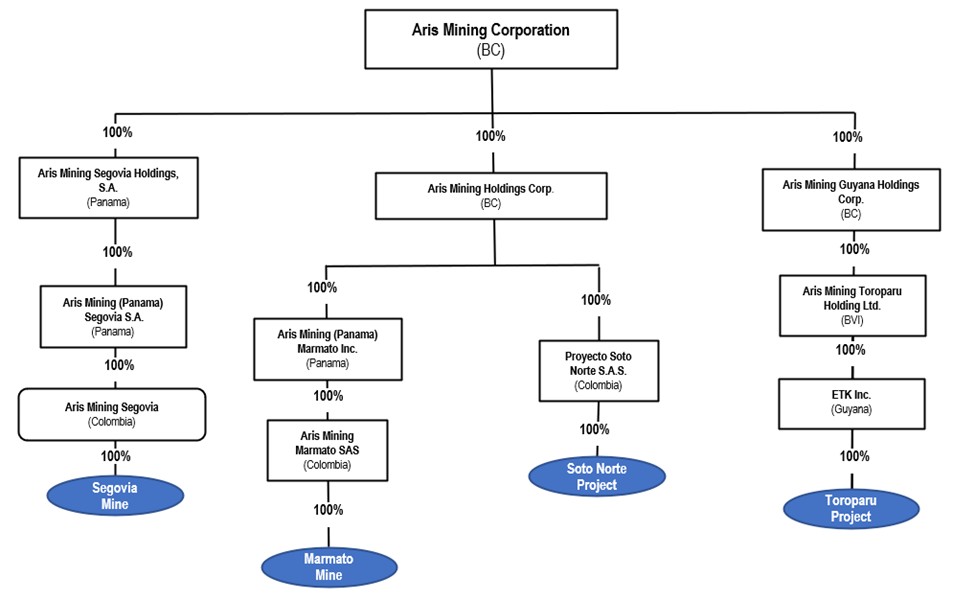
The following chart illustrates the Company’s material subsidiaries, together with the jurisdiction of existence of each company and the percentage of voting securities beneficially owned or over which control or direction is exercised, directly or indirectly, by the Company as at the date hereof. Certain aspects of the ownership structure have been simplified.
3.GENERAL DEVELOPMENT OF THE BUSINESS
3.1Year Ended December 31, 2023
Receipt of Bulk Mining Zone License
On July 12, 2023, the Company announced it received approval from the Corporación Autónoma Regional del Caldas (“Corpocaldas”), a regional environmental authority in Colombia, of the Environmental Management Plan (“PMA”) which permits the development of the Marmato Bulk Mining Zone. The new underground mine will provide access to the wider porphyry mineralization below the current Narrow Vein Zone, which allows for bulk mining methods in the Bulk Mining Zone. Bulk Mining Zone construction activities commenced in Q3 2023.
NYSE American Listing
Trading of the Common Shares on the NYSE American commenced on September 14, 2023 under the symbol “ARMN”, with trading on the OTCQX ceasing concurrent with the listing on the NYSE American.
13
Updates to Segovia Operation’s Mineral Resource and Mineral Reserve Estimates
On November 2, 2023, the Company announced an updated mineral resource estimate for its Segovia Operations effective September 30, 2023. On November 27, 2023, the Company announced an updated mineral reserve estimate for its Segovia Operations effective September 30, 2023, and that it was launching a project to increase the capacity of the processing plant at the Segovia Operations from 2,000 to 3,000 tonnes per day (“tpd”). See “Material Mineral Properties – Segovia Operations” for further information.
3.2Year Ended December 31, 2024
Increase of Ownership in the Soto Norte Project
On June 28, 2024, the Company completed the acquisition of an additional 31% interest in the Soto Norte Project, increasing its total ownership to 51% and the joint venture agreement related to the Soto Norte Project was amended and restated (the “Soto Norte Project JV Agreement”) to account for this change in ownership. Pursuant to this transaction:
(i)the Company issued 15,750,000 Common Shares to Mubadala, which are subject to a 12-month hold period. An additional 6,000,000 Common Shares are issuable to Mubadala upon receipt of an environmental license for the Soto Norte Project. This share issuance replaces a $300 million option under the original joint venture agreement for the Company to acquire an additional 30% interest in the project;
(ii)Mubadala retained a 49% interest in the Soto Norte Project. The Company is solely responsible for funding certain operating costs on behalf of the joint venture during the pre-licensing period. Non-operating and project construction costs are to be funded on a pro-rata ownership basis; and
(iii)the Company continues to be the operator of the Soto Norte Project. The Company and Mubadala have a mutual right-of-first-offer should a partner choose to exit the joint venture.
For further details of the terms of the Soto Norte Project JV Agreement, see a copy of the Soto Norte Project JV Agreement as filed under the Company’s profile on SEDAR+ at www.sedarplus.ca.
Updates to the Segovia Operation’s Mineral Resource and Mineral Reserve Estimates
On October 7, 2024, the Company announced updated mineral resource and mineral reserve estimates for its Segovia Operations, effective July 31, 2024, which resulted in the growth of the mineral resources and full replacement of the mineral reserves.
2024 Note Offering
On October 24, 2024, the Company announced the pricing of $450 million principal amount of 2029 Unsecured Notes to be issued under the 2024 Note Offering. The 2024 Note Offering closed on October 31, 2024, and on November 20, 2024, a portion of the net proceeds was used to fund the redemption of the then outstanding 2026 Unsecured Notes.
14
3.3Year Ended December 31, 2025
Expansion of Processing Capacity at Segovia
On June 30, 2025, the Company completed the installation and commissioning of a second processing mill at its Segovia Operations, increasing processing capacity by 50%, from 2,000 to 3,000 tpd.
Sale of the Juby Project
On September 29, 2025, the Company closed the sale of its wholly-owned Juby Project and related interests to McFarlane Lake Mining Limited (“McFarlane”) for total consideration of US$22 million, consisting of US$13.2 million in cash and 82,023,747 common shares of McFarlane (issued at C$0.15 per common share).
Settlement of the ICSID Arbitration
On November 19, 2025, the Company entered into a Settlement and Termination Agreement with the Republic of Colombia to end the International Centre for Settlement of Investment Disputes (“ICSID”) arbitration commenced in May 2018. The arbitration was brought by the Company against the Republic of Colombia before the ICSID seeking compensation for alleged breaches of the investment protection provisions of the Canada-Colombia Free Trade Agreement, stemming from the government’s failure to safeguard the Company’s investment in gold and silver mines in Colombia’s Marmato Mine and Segovia Operations. The proceedings concluded in February 2023, at which time the case was presented to the tribunal for the decision at that time.
In connection with the Settlement and Termination Agreement, the parties have terminated the ICSID arbitration and settled the claims without any cash payments, on the basis of the following material terms:
(i)the entry into three “Pillar Agreements” that include performance obligations on the part of each of the Company, the Republic of Colombia and relevant Colombian regulatory agencies in respect of formalization in the Marmato area, and collaborative initiatives with the National Police and Ministry of Defence;
(ii)engagement with the Attorney General’s Office to support ongoing legal and enforcement processes that protect the Company’s operations and workforce;
(iii)cooperation commitments from CORPOCALDAS, the Caldas regional environmental authority for Marmato, to oversee compliance of formalized mining operations in the Cerro El Burro area with applicable mining regulations and permits, and to exercise its enforcement powers, including imposing fines, sanctions, and precautionary measures where necessary; and
(iv)each party being responsible for its own costs associated with the arbitration and its settlement.
Acquisition of the Remaining 49% of the Soto Norte Project
On December 12, 2025, the Company completed the acquisition of the remaining 49% interest in the Soto Norte Project from Mubadala, resulting in the Company holding 100% of the project following the transaction. Pursuant to this transaction:
(i)the Company issued 1,739,130 Common Shares and paid US$60 million in cash to Mubadala, for total consideration of US$80 million;
(ii)Mubadala retains the right under the previous investment agreement to receive an additional payment of 6,000,000 Common Shares upon the Soto Norte Project receiving an environmental license; and
15
(iii)the parties terminated the Soto Norte Project JV Agreement and Mubadala’s precious metals stream covering the Soto Norte Project.
3.4Recent Developments
Updates to the Segovia Operation’s Mineral Resource and Mineral Reserve Estimates
On January 8, 2026, the Company announced updated mineral resource and mineral reserve estimates for its Segovia Operations, effective November 28, 2025, which resulted in the growth of the mineral resources and mineral reserves. See “Material Mineral Properties – Segovia Operations” for further information.
Board and Management Updates
On January 22, 2026, the Company announced Ian Telfer’s retirement from the Board and as Chair. In connection with Mr. Telfer’s retirement, Neil Woodyer, the founder of the Company, had been appointed as Chair and Chief Executive Officer, with David Garofalo appointed to the newly created role of Lead Independent Director.
In parallel with the Board changes, the Company announced that Douglas Bowlby had been promoted to President, and that the Chief Operating Officer role was eliminated.
NYSE Uplisting
On February 19, 2025, the Company announced that its Common Shares uplisted to the NYSE from the NYSE American under the unified ticker symbol “ARIS”.
4.DESCRIPTION OF THE BUSINESS
Aris Mining is a Canadian gold mining company focused on South America. The Company operates the Segovia and Marmato underground gold mines in Colombia, which together produced approximately 257,000 ounces of gold in 2025. Aris Mining is listed on the TSX and NYSE under the symbol ARIS.
Expansion projects underway at Segovia and Marmato are expected to increase production to approximately 500,000 ounces of gold per year, driven by the ramp-up at Segovia following the installation of the second mill, which was completed in June 2025, and construction of the new Marmato bulk mine and CIP plant, with first gold expected in Q4 2026.
Aris Mining’s existing portfolio supports a longer-term objective of approximately 1 million ounces of annual gold production1. Key projects include the high-grade Soto Norte gold project in Colombia, where environmental studies are being finalized for submission in Q2 2026 to initiate the licensing process, and the Toroparu gold project in Guyana, where a Prefeasibility Study is in progress and a construction decision is expected in early 2027.
1 Includes potential production estimates from the Toroparu Project, which is based on a preliminary economic assessment and is preliminary in nature. It includes inferred mineral resources that are considered too speculative geologically to have the economic considerations applied to them that would enable them to be categorized as mineral reserves, and there is no certainty that the preliminary economic assessment will be realized. Mineral resources that are not mineral reserves do not have demonstrated economic viability. There can be no assurance that the projected production will be achieved. Such production also remains subject to obtaining all necessary permits for both the Soto Norte Project and the Toroparu Project. See “Material Mineral Properties – Toroparu Project” for the qualifications and assumptions made with respect to such preliminary economic assessment.
16
The following are the Company’s mineral projects, all of which are material to the Company:
Name of Project | Ownership | Location | Status | ||||||||
Segovia Operations | 100% | Antioquia, Colombia | Producing; ramping up production following expansion of the processing plant | ||||||||
Marmato Mine | 100% | Caldas, Colombia | Producing; undergoing construction of the Bulk Mining Zone | ||||||||
Soto Norte Project | 100% | Santander, Colombia | Permitting stage; advancing environmental studies | ||||||||
Toroparu Project | 100% | Cuyuni-Mazaruni Region, Guyana | Exploration stage; advancing a Prefeasibility Study | ||||||||
4.1Principal Products
The Company’s principal product is gold doré. The Company’s revenue is primarily generated from the sale of gold doré to refiners with precious metals expertise.
The gold market is relatively deep and liquid and is traded on a worldwide basis. As a result, the Company is not dependent on a particular purchaser with regard to the sale of gold. The demand for gold is primarily for jewellery fabrication purposes and bullion investment, and the price of gold is generally quoted in U.S. dollars.
The use of gold as a store of value (principally due to the historical tendency of gold to retain its value in relative terms against basic goods and in times of inflation and monetary crisis) and the large quantities of gold held for this purpose in relation to annual mine production, has meant that historically, the potential total supply of gold has been far greater than demand. Thus, while current supply and demand plays some part in determining the price of gold, this does not occur to the same extent as with other commodities. Gold prices are significantly affected by macro-economic factors such as expectations of U.S. inflation, U.S. interest rates, exchange rates, changes in reserve policy by central banks and global or regional political and economic crises. Due to these factors, the gold price fluctuates continually, and such fluctuations are beyond the Company’s control.
4.2Employees
As of December 31, 2025, the Company and its subsidiaries had 15 employees at its corporate office, approximately 3,494 employees in Colombia and approximately 69 employees in Guyana.
4.3Local Communities and Small-Scale Miners
Gold rich Colombia has a highly active artisanal and small-scale mining sector. Traditional miners across the country engage in small-scale gold extraction, often in remote regions. This sector plays a significant role in local economies, providing livelihoods for many communities.
Aris Mining collaborates with small-scale miners, known as contract mining partners, to create mutually beneficial partnerships that support our host communities. This partnership model includes:
•Formation of Formal Companies: Contract mining partners establish formal mining companies, typically employing between 25 and 500 people.
•Mill Feed Agreements: At Segovia and Marmato, contract mining partners have long term contracts supplying mill feed to Aris Mining, with payment based on gold content, grade and the spot gold price.
17
•Support and Expertise: Contract mining partners gain access to the Company’s technical, operational, and safety expertise as well as working capital financing.
•Comprehensive Training: The Company provides training programs in Health and Safety, Environmental Stewardship, Accounting, Compliance and Business Management together with best practices in mining methods.
•Benefits of Formal Economy. The Colombian government benefits by receiving payment of royalties and taxes related to minerals that would otherwise be traded in black markets. Further, contract mining partners gain access to legal gold markets, government benefits, legal and judicial protections, financial services and broader commercial opportunities.
•Access to social security system: Employees of contract mining partners and their families gain access to social security, including health services, pensions plans and severance, among others.
•Gold Production Contribution: In 2026, contract mining partners are expected to contribute 45–50% of the Segovia Operations’ gold production, with owner mining providing 50–55%. At the Narrow Vein Zone, the Company is implementing strategies to grow the gold production contribution from contract mining partners.
Currently, the contract mining partner workforce includes approximately 2,341 workers at the Segovia Operations and 129 workers at the Marmato Mine.
The Company is also committed to the local procurement of labour, goods and services, and provides training programs in a variety of skilled areas to improve the quality of life of local community members.
4.4Specialized Skill and Knowledge
Operations in the gold exploration and development industry mean that the Company requires professionals with skills and knowledge in diverse fields of expertise. In the course of its exploration, development and operations, the Company requires the expertise of geologists, engineers and metallurgists and employs such persons directly and indirectly. To date, the Company has not experienced any difficulties in hiring and retaining the professionals and experts it requires for its operations and has found that it can locate and retain such employees and consultants and believes it will continue to be able to do so. See “Risk Factors – Shortage of Experienced Personnel.”
4.5Competitive Conditions
The precious metal mineral exploration and mining business is a competitive business. The Company competes with numerous other companies and individuals in the search for and the acquisition of attractive precious metal mineral assets. The Company’s ability to acquire precious metal mineral assets in the future will depend not only on its ability to develop its present properties, but also on its ability to select and acquire suitable producing properties or prospects for precious metal development or mineral exploration. See “Risk Factors – Competition”.
4.6Foreign Operations
The Company’s material mineral property interests are located in Colombia and Guyana. The Company’s activities in foreign jurisdictions may be affected by possible political or economic instability and government regulations relating to the mining industry and foreign investors. The risks created by this potential political and economic instability include, but are not limited to, extreme fluctuations in currency exchange rates and high rates of inflation. Changes in exploration or investment policies or shifts in political attitude in such jurisdictions may adversely affect the Company’s business. Mineral exploration and mining activities may be affected in varying degrees by government regulations with respect to restrictions on production, price controls, export controls, income taxes, expropriation of property, maintenance of property, environmental legislation, land use, land claims of local people, water use, property safety, tariffs and sanctions. The effect of these factors on the Company cannot be accurately predicted. Further information is provided under the heading entitled “Risk Factors”.
18
4.7Business Cycles
The mining business is subject to mineral price cycles. The marketability of minerals, doré and mineral concentrates is also affected by worldwide economic cycles. The Company’s operations are related and sensitive to the market price of gold and, to a lesser degree, to other metal prices such as silver. Metal prices fluctuate widely and are affected by numerous factors such as global supply, demand, inflation, exchange rates, interest rates, forward selling by producers, central bank sales and purchases, production, global or regional political, economic or financial climates and other factors beyond the control of the Company.
4.8Environmental Protection
The mining industry in Colombia and Guyana is subject to environmental laws and regulations under various governmental legislation relating to the protection of the environment, including requirements for closure and reclamation of mining properties. Compliance with such obligations and requirements can mean significant expenditures and may constrain the Company’s operations in the country. Breach of environmental obligations could lead to suspension or revocation of requisite environmental licenses and permits, civil liability for damages caused, and possible fines and penalties, all of which may significantly and negatively impact the Company’s position and competitiveness. See “Risk Factors – Environmental Laws”.
In prior years, the Company was subject to certain environmental charges assessed by the regional environmental authority in Segovia, known as Corantioquia, in connection with the discharges of effluents from the Segovia Operations processing plant into the nearby river basin. As a result of continuing efforts to minimize these discharges as of July 2017, the Company had virtually eliminated all discharges into the nearby river basin. Through continued strategic investments, including construction of the tailings storage facility and a STARI water treatment plant, the Company strives to continue to operate with zero discharges for the rest of the mine’s life.
The Company holds a formally accepted amended PMA for the El Silencio, Providencia, and Sandra K mines at the Segovia Operations which was approved on February 22, 2019, with a renewal period of five years, as well as an approval granted on November 25, 2019, both of which jointly approve the PMA for the Segovia Operations, with an expiry in December 2024. In October 2024, Aris Mining submitted a request for amendment, update and extension of the PMA, which was granted on December 23, 2025 and will be in force until December 23, 2030. The environmental license relating to the Carla mine is authorized and in force for the useful life of the Property. The environmental assessments included the measures and activities proposed by the Company for the control and mitigation of environmental risks and impacts based on technical studies, thus providing a reliable estimate of the environmental costs for the operation of the mining projects.
Other environmental permits related to water concessions, discharge permits, forest exploitation and water channel occupancy have also been updated and filed before Corantioquia, with such minor permits requested and granted on a rolling basis. The filing of such permits does not affect the PMA.
Mining at Marmato predates the regulatory requirements to prepare an environmental impact assessment as part of the permitting process. The Narrow Vein Zone operations are authorized through the approval of the PMA on October 29, 2001, covering environmental studies and management procedures for the Narrow Vein Zone. The construction of the Bulk Mining Zone expansion project is authorized through the amendment of the PMA, which includes the Bulk Mining Zone on July 12, 2023. The Company is conducting environmental impact studies in connection with a further amendment of the existing PMA, which was submitted in Q1 2026, which if granted, will allow for the construction of facilities required in the medium to long term, such as additional areas for management of tailings.
4.9Social and Environmental Policies
The Company is committed to achieving its ESG objectives and recognizes the role of effective sustainability and corporate responsibility programs in creating shared value for its stakeholders. To uphold these commitments, the Company has
19
implemented robust guidelines and management systems to ensure compliance with the laws and regulations of Colombia, Guyana, Canada, and other jurisdictions in which it may operate.
In line with international standards, the Company has developed policies and governance frameworks to guide its operations as a responsible mining company. This commitment is embedded throughout the organization and is reflected in the formation of the Board level Sustainability Committee.
Additionally, the Company’s approach to sustainability is reinforced by a suite of policies adopted by the Board, including the Environmental and Corporate Social Responsibility Policy, the Sustainability Policy, the Business Conduct and Ethics Policy, the Anti-Bribery and Anti-Corruption Policy, the Diversity Policy, the Anti-Discrimination Policy, the Supplier Code of Conduct and the Human Rights Declaration. These policies outline the Company’s principles and commitments, are available on the Company’s website at www.aris-mining.com.
4.9.1The Environment
The Company is committed to environmental protection through the active management of operational risks and targeted investments that enhance air and water quality, reduce emissions, and support biodiversity. The Company’s environmental management systems are designed to mitigate impacts while contributing to sustainable community development, and are informed by internationally recognized sustainability frameworks, including Towards Sustainable Mining, the OECD Due Diligence Guidance, and the advanced implementation of the Escazú Agreement.
To support social responsibility, the Company maintains dedicated sustainability teams in Colombia that engage directly with local communities and municipalities to assess needs and implement tailored programs aligned with the Company’s social investment framework. These efforts are reinforced through participation in the UN Global Compact, UN Women-aligned commitments, and the Voluntary Principles Initiative, strengthening governance across human rights, labour practices, gender equality, and community engagement.
Since August 2012, the Company has participated in the UNIDO Global Mercury Project, which is focused on reducing mercury contamination associated with artisanal and small-scale gold mining. This initiative is complemented by the collaborative implementation of the Minamata Convention on Mercury in Segovia, Antioquia, promoting cleaner technologies, miner training, and environmental restoration in support of Colombia’s international commitments.
The Company is also an engaged corporate member of the Voluntary Principles Initiative, reflecting its commitment to balancing security operations with the protection of human rights and reinforcing stakeholder confidence.
In addition, the Company actively participates in the Extractive Industries Transparency Initiative, reporting meaningful progress on implementation, and contributes to UN CEPAL regional forums that promote the formalization of sustainable mining practices in Latin America and the Caribbean.
The Company is also a member of the Colombian Mining Association, through which it advocates for responsible mining practices that support Colombia’s sustainable development. Through collaboration with industry peers and international organizations, the Company continues to strengthen transparency, operational standards, and its environmental and social performance.
Several flagship environmental initiatives that further demonstrate the Company’s commitment to sustainability include:
•Tailings Reprocessing at the Segovia Operations: A polymetallic plant processes tailings before storage in the dry stack tailings facility, extracting zinc, copper and lead for sale, reducing environmental impact, and generating additional revenue.
•Reforestation & Biodiversity Restoration: In partnership with local organizations, the Company launched a reforestation program to rehabilitate areas affected by unauthorized mining.
20
•Segovia Tailings Recovery & Ecopark: A program to rehabilitate closed tailings facilities led to the creation of Colibrí Ecopark, a 9,200 m² cultural and sports park. Opened in 2023 as part of the Segovia Tailings Deposit Master Plan, the Ecopark includes a soccer field, cycling and jogging tracks, a playground, an outdoor gym, a stage for 300 people, and parking. It serves as a model for sustainable tailings management in Colombia and Latin America. In November 2025, the Company commenced the rehabilitation of an additional closed tailings facility at its Segovia Operations, including the commissioning of its first self-consumption solar park. The solar park has an installed capacity of 2 MWp and an estimated annual generation of approximately 3.4 GWh. Once fully operational, the facility is expected to reduce the Segovia Operations’ carbon footprint by approximately 550 tonnes of CO₂ per year and to replace an estimated 7 percent of the energy consumption at the El Silencio mine, supporting a more efficient and sustainable mining model.
•Marmato “fast-track” initiatives: The Company has partnered with Corpocaldas to enhance and expand its environmental processes and facilities. This includes the construction of a state of the art industrial water treatment plant, which was commissioned in January 2025 and upgrades to domestic water treatment systems, which are expected to be completed in 2026.
4.9.2The Community
During 2025, the Company continued to promote human, social and economic growth initiatives in a way that benefits people, communities and businesses, making positive and lasting contributions to its stakeholders. To achieve this, the Company developed a social investment framework which includes infrastructure, education, social and economic development, environmental stewardship and diversity and inclusion programs. Additionally, through the Company’s artisanal and small-scale miners partnerships, the Company has executed numerous operations contracts with small-scale miners over the last ten years, resulting in the formalization of small-scale miners and the elimination of the use of mercury in these formalized units.
In 2025, the Company implemented over 90 projects across the five social investment pillars mentioned above. Notable initiatives and achievements include:
1.Education and Leadership. Approximately 4,500 students benefit from bilingual education and training programs, including fully sponsored education at La Salada School in Segovia and state exam preparation programs aimed at strengthening academic performance and improving access to higher education.
2.Infrastructure Development. Investments in more than 12kms of local roads (80% of total urban roads in Segovia); construction of mega schools; improvement of rural aqueducts; and the construction and improvement of local hospitals, benefiting over 40,000 residents in Segovia, Remedios and Marmato.
3.Support for Small-Scale Miners. The Company sponsored training programs for over 2,500 miners, offering courses on environmental management, health and safety, and accounting to enhance their competitiveness, complemented by occupational health initiatives.
4.Healthcare Initiatives. More than 1,300 community members received high-quality medical care through mobile health brigades, while over 300 medical devices were donated to municipal hospitals in Segovia and Marmato, strengthening local healthcare services.
During 2025, the Company paid social contributions of US$27.1 million to local communities and royalty and income tax payments of US$82.3 million.
4.9.3People
The Company is committed to promoting local employment, equality, diversity, inclusion and respect for human rights. Further, the health and safety of the Company’s employees, contractors and visitors take priority above all else. The Company strives to provide a safe work environment and to create a culture with safety at its core.
21
4.9.4Health and Safety
The Company is committed to achieving excellence in the management of health and safety at its operations. The Company understands its responsibility to provide a safe and healthy working environment for its workforce and is committed to preventing incidents and accidents and to mitigating health and safety risks and hazards. The Company believes that health and safety must be everyone’s responsibility and priority to achieve a culture of zero harm. Further, the Company promotes a culture of personal responsibility among its workforce together with health and safety leadership for supervisors and managers. The Company is committed to implementing health and safety management systems that meet international standards and applicable best practices including setting objectives and targets and measuring the Company’s performance against them.
4.9.5Human Rights and Diversity
The Company is committed to providing an environment that is free from unlawful discrimination and harassment. All employees, volunteers and members are entitled to an environment where they are treated with respect and dignity and have equal opportunity to fully contribute. All individuals within the organization are required to conduct themselves in a professional and appropriate manner, and to refrain from engaging in discrimination or harassment. Although the Company recognizes governments have the primary duty to ensure the respect, promotion and protection of human rights, the Company believes businesses play an important positive role in the respect of human rights in local communities, not only as catalysts, but also as safeguards in the Company’s areas of operation.
The Company strives to create an inclusive organizational culture that promotes equality of opportunity. The Company looks to attract, develop and retain the best talent and create a working environment that is inclusive and diverse, where everyone is treated without discrimination. The Company values talent regardless of age, race, gender, background, sexuality, religion or physical impairment and believes that diversity strengthens the team by promoting unique viewpoints and challenging us to think beyond our traditional frames of reference.
5.RISK FACTORS
The business and operations of the Company are subject to multiple risks. The Company considers the risks set out below to be the most significant to existing and potential investors in the Company, but they do not purport to be all of the risks associated with an investment in securities of the Company. If any of these risks materialize into actual events or circumstances, or other possible risks and uncertainties of which the Company is currently unaware or which it considers at this time to be immaterial or unlikely to actually occur, the Company’s assets, liabilities, financial condition, results of operations (including future results of operations), business and business prospects could be materially and adversely affected. In such circumstances, the price of the Company’s securities could decline and investors may lose all or part of their investment.
Regulatory Approvals
The operations of the Company and its exploration activities require approvals, licenses and permits from various regulatory authorities, governmental and otherwise (including project specific governmental decrees) that are by no means guaranteed. The Company believes that it holds or will obtain all necessary approvals, licenses and permits under applicable laws and regulations in respect of its projects and, to the extent that they have already been granted, believes it is presently complying in all material respects with the terms of such approvals, licenses and permits. However, such approvals, licenses and permits are subject to change in various circumstances and further project-specific governmental decrees and/or legislative enactments may be required. There can be no guarantee that the Company will be able to obtain or maintain all necessary approvals, licenses and permits that may be required and/or that all project-specific governmental decrees and/or required legislative enactments will be forthcoming to explore and develop the Properties on which it has exploration and mining rights, continue construction or operation of mining facilities or to maintain continued operations.
22
Changes in Legislation
The current Colombian mining code was enacted in 2001. In 2022, the government announced its intention to introduce before Congress a bill to amend the mining code. In 2024, a draft bill 340 aimed at amending the 2001 mining code was presented to Congress. However, there has not yet been a formal presentation of the draft bill for first discussion at Congress. The current 4-year term of both Chambers of Congress expires in July 2026, with legislative and presidential elections held in March and May. This will likely delay the process for approving any new legislation.
Mineral rights in Guyana are governed by the Mining Act of 1989 and applicable mining regulations. The applicable legislation has been updated by way of amendments and regulations and codes that have been introduced since 1989. However, the legislation has not substantially changed since it was created and there is no current indication that major changes are likely to be enacted.
Financial Risks
Commodity Price Risk
The profitability of the Company's operations depends, in large part, upon gold and other commodity prices. Gold and other commodity prices can fluctuate widely and are affected by many factors beyond the Company’s control, including but not limited to: industrial demand (global and regional), political and economic events (global and regional) including international trade disputes and the imposition of tariffs, gold and financial market volatility and other market factors, changing investor or consumer sentiment, expectations of inflation, expectations of economic activity, the popularity of cryptocurrencies as an alternative investment to gold, and central bank purchases and sales of gold and gold lending.
If metal prices decline significantly, or decline for an extended period, losses would be sustained, and, under certain circumstances, the Company may curtail or suspend some or all of its mining, exploration or development activities at its mines. Sustained lower metal prices may require changes to the Company’s mine plans, result in reduced production, and higher costs than anticipated, or both. In addition, a significant metal price decline could result in significant reductions in our mineral reserves and resources, losing the ability to operate some or all of the Company's properties economically, or being forced to sell them, and our business, financial condition, and/or stock price could be adversely affected.
The Company is required under the covenants of the 2027 Aris Holdings Notes to use commercially reasonable efforts to put in place commodity hedging contracts (put options) on a rolling four-quarters basis to establish a minimum selling price of $1,400 per ounce for the physical gold being accumulated in its gold escrow account. Gold accumulated in the gold escrow account will be sold to meet the Company’s financial obligations for the quarterly payments of the 2027 Aris Holdings Notes. Under the terms of the agreement, such hedging will not be required if one of the following conditions is met:
(i)the Company determines that any such hedging contracts are not obtainable on commercially reasonable terms; or
(ii)the failure to obtain any such hedging contracts would not reasonably be expected to materially adversely impact the ability of the Company to satisfy its obligations to make the quarterly amortizing payments.
As of December 31, 2025, the Company had no outstanding commodity hedging contracts in place.
Foreign Currency Risk
The Company is exposed to foreign currency fluctuations. Such exposure arises primarily from:
(iii)Translation of subsidiaries that have a functional currency, such as COP, differs from the USD functional currency of the Company.
23
(iv)Translation of monetary assets and liabilities denominated in foreign currencies, such as the Canadian dollar and Guyanese dollar.
The Company monitors its exposure to foreign currency risks arising from foreign currency balances and transactions. To reduce its foreign currency exposure associated with these balances and transactions, the Company may enter foreign currency derivatives to manage such risks. In 2025, the Company did not utilize derivative financial instruments to manage this risk.
Environmental Laws and Regulations
The Company’s operations are subject to the extensive environmental risks inherent in the gold and silver mining industry. The current or future operations of the Company, including development activities, commencement of production at its Properties, potential mining and processing operations and exploration activities require prior consultation and permits from various governmental authorities and such operations are and will be governed by laws and regulations governing prospecting, development, mining, production, exports, taxes, labour standards, occupational health, waste disposal, toxic substances, land use, environmental protection, mine safety and other matters.
Companies engaged in the development and operation of mines and related facilities generally experience increased costs and delays in production and other schedules as a result of the need to comply with applicable laws, regulations and permits. Existing and possible future environmental legislation, regulations and actions could cause significant additional expense, capital expenditures, restrictions and delays in the activities of the Company. There are certain risks inherent in the Company’s activities such as accidental spills, leakages or other unforeseen circumstances, which could subject the Company to extensive liability. In addition, the Company cannot assure that the unauthorized miners operating on its properties are in compliance with applicable environmental laws and regulations. Any violations by such miners could result in liability for the Company.
Failure to comply with applicable laws, regulations, and permitting requirements may result in enforcement actions thereunder, including orders issued by regulatory or judicial authorities causing operations to cease or be curtailed or the termination of mineral rights, and may include corrective measures requiring capital expenditures, installation of additional equipment, or remedial actions. Parties engaged in mining operations may be required to compensate those suffering loss or damage by reason of the mining activities and may have civil or criminal fines or penalties imposed for violations of applicable laws or regulations. Amendments to current laws, regulations and permits governing operations and activities of mining companies, or more stringent implementation thereof, could have an adverse impact on the Company and cause increases in capital expenditures or production costs or reductions in levels of production at producing properties or require abandonment or delays in development of mining properties.
Decommissioning Liabilities
Mining, processing, development and exploration activities are subject to various laws and regulations governing the protection of the environment. Accounting for reclamation and remediation obligations requires management to make estimates of the future costs the Company will incur to complete the reclamation and remediation work required to comply with existing laws and regulations at each mining operation. Actual costs incurred may differ from those amounts estimated. Also, future changes to environmental laws and regulations could increase the extent of reclamation and remediation work required to be performed by the Company. Increases in future costs could materially impact the amounts charged to operations for reclamation and remediation. The provision made in the Company’s financial statements represents management’s best estimate of the present value of the future reclamation and remediation obligation. The actual future expenditures may differ from the amounts currently provided.
24
Operations and Exploration
Exploration, Development and Operations
The exploration for and development of mineral deposits involves significant risks that even a combination of careful evaluation, experience and knowledge may not eliminate. Few properties that are explored are ultimately developed into producing mines and no assurance can be given that minerals will be discovered in sufficient quantities or having sufficient grade to justify commercial operations or that funds required for development can be obtained on a timely basis. Mineral exploration involves many risks and uncertainties, and success in exploration is dependent on a number of factors, including the quality of management, quality and availability of geological expertise and the availability of exploration capital. Substantial expenditures are required to complete drilling, establish mineral resources and mineral reserves and to develop processes to extract the minerals, develop mining and processing facilities and suitable infrastructure at any site chosen for mining, and establish commercial operations. Also, substantial expenses may be incurred on exploration projects which are subsequently abandoned due to poor exploration results or the inability to define mineral reserves which can be mined economically. Even if an exploration program is successful and economically recoverable minerals are found, it can take a number of years from the initial phases of drilling and identification of the mineralization until production is possible, during which time the economic feasibility of extraction may change and the minerals that were economically recoverable at the time of discovery may cease to be economically recoverable. There can be no assurance that the minerals recovered in small scale tests will be duplicated in large scale tests under on-site conditions or in production scale operations.
The long-term profitability of the Company’s operations will be in part directly related to the cost and success of its exploration programs, which may be affected by a number of factors. Substantial expenditures are required to establish mineral reserves through drilling, to develop processes to extract the reserves and, in the case of new properties, to develop the extraction and processing facilities and infrastructure at any site chosen for extraction. Although substantial benefits may be derived from the discovery of a major deposit, no assurance can be given that any such deposit will be commercially viable or that the funds required for development can be obtained on a timely basis.
The Segovia Operations have been in continuous production for over a century and the Company’s past production decisions have not been based on mineral reserves demonstrating economic feasibility and technical viability. In 2018 the first mineral reserve was estimated for the Segovia Operations. The Marmato Mine has been in continuous production since 1993 and the first mineral reserve was estimated in 2020.
The commercial viability of the Segovia Operations, the Marmato Mine, the Toroparu Project, the Soto Norte Project and other properties in which the Company may acquire an interest in the future depends upon on a number of factors, all of which are beyond the control of the Company, including, but not limited to: the particular attributes of the deposit, such as size, grade and proximity to infrastructure; silver and gold prices, which are highly cyclical; general and local labour market conditions; the proximity and capacity of processing facilities; local, provincial, central and international government regulations, including regulations relating to prices, taxes, royalties, land tenure, land use, importing and exporting of minerals and environmental protection; ongoing costs of production; and availability and cost of additional funding, and, in the case of the Toroparu Project and the Soto Norte Project, appropriate permitting. The exact effect of these factors, either alone or in combination, cannot be accurately predicted and their impact may result in the Company not being able to economically extract minerals from any identified mineral resource or mineral reserve which, in turn, could have an adverse impact on the Company’s cash flows, earnings, results of operations and financial condition and prospects. The Company cannot provide any certainty that the exploration or development programs planned by the Company will result in a profitable commercial mining operation in respect of the construction of the Bulk Mining Zone or the development of the Soto Norte Project and the Toroparu Project or other properties in which the Company has or may acquire an interest in the future.
25
Tailings Management
The tailings collection, treatment and disposal operations at the Segovia Operations and the Marmato Mine are subject to substantial regulation and involve significant environmental risks. The extraction process of separating gold and other metals from the host rock produces tailings. Tailings are derived from the waste rock generated once crushing, grinding, and extraction of gold or other metals from the ore is completed in the process plant, and are stored in engineered facilities.
Unanticipated failures or damage to tailings facilities may occur that could cause injuries, production loss, environmental pollution, a loss event in excess of insurance coverage, reputational damage, fines, sanctions, suspensions, loss of permits or other adverse effects on the Company’s operations and financial condition resulting in significant monetary losses, restrictions on operations and/or legal liability.
The Company currently operates a dry filtered tailings storage facility at the Segovia Operations and a dewatered tailings facility at the Narrow Vein Zone. A major failure of the tailings facilities (including through matters beyond the Company’s control such as extreme weather, seismic events, or other incidents) may cause damage to the environment and the surrounding communities. Poor design or poor maintenance of the tailings facilities or improper management of site water may contribute to facility failure or tailings release and could also result in damage or injury.
At the Marmato Mine, underground mining commenced at the Narrow Vein Zone in 1993 but the first tailings storage facility was not constructed until 2006. A second nearby facility was approved in 2012. These first facilities have an approved environmental permit, but were not designed or operated to international standards. Aris Mining is undertaking the closure and remediation of these facilities, which are expected to be completed by the end of 2026. Failure to comply with existing or new environmental, health and safety laws and regulations may result in injunctions, fines, suspension or revocation of permits and other penalties. The costs and delays associated with compliance with these laws, regulations and permits could prevent the Company from proceeding with the development of a project or the operation or further development of a mine or increase the costs of development or production and may adversely affect the Company’s business, results of operations or financial condition. The Company may also be held responsible for the costs of investigating and addressing contamination (including claims for natural resource damages) or for fines or penalties from governmental authorities relating to contamination issues at current or former sites, either owned directly or by third parties. The Company could also be held liable for claims relating to exposure to hazardous and toxic substances and major failure of the tailing facilities. The costs associated with such responsibilities and liabilities may be significant, be higher than estimated and involve a lengthy clean-up. Moreover, in the event that the Company is deemed liable for any damage caused by a major failure of the tailings facilities (including through matters beyond the Company’s control such as extreme weather, seismic events, or other incidents), the Company’s losses or consequences of regulatory action might not be covered by insurance policies. Should the Company be unable to fully fund the cost of remedying such environmental concerns, the Company may be required to suspend operations temporarily or permanently. Such incidents could also have a negative impact on the reputation and image of the Company.
Infrastructure
Mining, processing, development and exploration activities depend, to one degree or another, on adequate infrastructure. Reliable roads, bridges, power sources and water supply are important determinants, which affect capital and operating costs. Unusual or infrequent weather phenomena, sabotage, community, government, criminal activity or other interference in the maintenance or provision of such infrastructure could adversely affect the Company’s operations, financial condition and results of operations. Disruptions in the supply of products and services required for the Company’s activities in any of the jurisdictions in which it operates would also adversely affect the Company’s business, results of operations and financial condition.
Blockades and Operational Stoppages
The Company may be subject to blockades and operational stoppages related to social uprising against any stakeholder, including local, regional, and national governments, as well as adverse stakeholders that do not want to engage on
26
conciliatory terms with the Company. Although the Company has implemented a robust stakeholder engagement process to mitigate and address grievances in a prompt and adequate manner, there cannot be assurance that the Company will not be affected by any future blockade or operational stoppage.
Health and Safety Risk
Mining, like many other extractive natural resource industries, is subject to potential risks and liabilities due to accidents that could result in serious injury or death. The impact of such accidents could affect the profitability of operations, cause an interruption to operations, lead to a loss of licenses, affect the reputation of the Company and its ability to obtain further licenses, damage community relations and reduce the perceived appeal of the Company as an employer. Failure to comply with applicable health and safety laws may result in injunctions, damages, suspension or revocation of licences or permits and the imposition of penalties. There can be no assurance that the Company will be at all times in complete compliance with such laws, regulations and permits, or that the costs of complying with current and future health and safety laws and permits will not adversely affect the Company’s business, results of operations, financial condition or prospects. The Company has rigorous procedures in place to manage health and safety protocols in order to reduce the risk of occurrence and the severity of any accident and will continually invest time and resources to enhance health and safety at all operations. The Company has insurance policies in place to cover accidents and regularly monitors the adequacy of such policies.
Mining Risks and Insurance Risks
The mining industry is subject to significant risks and hazards, including environmental hazards, industrial accidents, unusual or unexpected geological conditions, labour force disruptions, civil strife, unavailability of materials and equipment, weather conditions, rock bursts, cave-ins, flooding, seismic activity, water conditions and gold bullion losses, most of which are beyond the Company’s control. These risks and hazards could result in: (i) damage to, or destruction of, mineral Properties or producing facilities; (ii) personal injury or death; (iii) environmental damage; (iv) delays in mining; and (v) monetary losses and possible legal liability. As a result, production may fall below historic or estimated levels and the Company may incur significant costs or experience significant delays that could have an adverse effect on the Company’s financial performance, liquidity and results of operations.
The Company maintains insurance to protect against some of these risks and hazards. The insurance is in amounts that are believed to be reasonable depending on the circumstances surrounding each identified risk. No assurance can be given that such insurance will continue to be available, or that it will be available at economically feasible premiums, or that the Company will maintain such insurance. The Company’s property, liability and other insurance may not provide sufficient coverage for losses related to these or other risks or hazards. In addition, the Company does not have coverage for certain environmental losses and other risks, as such coverage cannot be purchased at a commercially reasonable cost. The lack of, or insufficiency of, insurance coverage could adversely affect the Company’s cash flow and overall profitability.
Unauthorized Mining and Illegal Activities
The mining industry in Colombia is subject to incursions by unauthorized miners who gain illegal access to mines to steal mineralized rock primarily through manual mining methods. Mining by unauthorized miners occurs on and near some of the Company’s mining operations in Colombia. While the Company monitors unauthorized mining activity and is required to report it when discovered, it relies on the various levels of government to control and police illegal operations. In addition to the risk of losses and disruption of operations, these unauthorized miners pose a safety, security, social and environmental risk to the Company, its operations, Properties and the communities in which the Company operates. These incursions and unauthorized mining activities can potentially compromise underground structures, equipment and operations, which may lead to production stoppages, affect our ability to conduct business and require considerable investments in security and control measures. Unauthorized mining and theft could also result in lost gold production and mineral reserves, mine and development stoppages, and have an adverse effect on our financial condition or results of operations or project development. Besides the financial risk posed by unauthorized mining, the Company could face compliance and reputational risk associated with the unauthorized miners.
27
Foreign Operations
Colombia
The Company’s operations and projects are primarily located in Colombia, which exposes it to added risks and uncertainties due to different economic, cultural and political environments. Some of these risks include nationalization and expropriation; social unrest and political instability; uncertainties in perfecting mineral titles; delays or inability to obtain permits; trade barriers and exchange controls; limitations on repatriation of funds; and material changes in taxation. In addition, developing country status or unfavourable political climate in Colombia could make it difficult for the Company to obtain financing to fund existing operations and growth projects.
Temporary Reserve Areas
On January 30, 2024, the Colombian Ministry of Environment (the “Ministry”) issued Decree 044 which allows the Ministry to declare temporary reserve areas in certain parts of Colombia. To establish a temporary reserve area, a resolution must be issued by the Ministry detailing the area that is to be temporarily reserved. The Ministry issued Resolution 221 of 2025, amended by Resolution 239 of 2025, by means of which it declared a Temporary Reserve Area (“TRA”) in the Soto Norte region. The TRA will remain in effect for two years, until March 2027, with a possible two year extension. While the TRA is in force, no new concessions or environmental permits may be granted by the mining or environmental regulators. During this period, the Ministry must conduct environmental studies to determine whether to make the reserve area permanent. Notwithstanding the TRA, the Soto Norte Project may continue environmental studies, provided no environmental permit is required. Decree 044 and the TRA may delay licensing of the Soto Norte Project.
Decree 044 and the TRA resolutions are presently being challenged in administrative courts, with actions led by the Colombian Disciplinary Office, artisanal and small mining units, the Colombian Mining Trade Association, and the National trade association. The Courts have not yet ruled on this matter.
Additionally, the Administrative Tribunal of Santander issued a ruling in July 2025 in a class action proceeding recognizing the Santurbán páramo as a subject of personal rights and designating the Ministry as its legal guardian. While there is no direct impact on the Soto Norte Project, environmental licensing proceedings for the Soto Norte Project may be delayed or hindered because the Tribunal ordered that: (i) the Ministry must actively participate and protect the páramo in any licensing process, including through the use of administrative injunctions, (ii) all relevant environmental authorities must identify critical transition areas to the páramo in the Soto Norte region for water protection, and (iii) zoning regulations must exclude mining activities in “buffer zones” in alignment with the 2014 delimitation process. The ruling was appealed and a decision remains pending.
For clarity, this proposed resolution does not affect the Company’s Segovia Operations or Marmato Mine, all of which are licensed and located outside the designated study area. The Soto Norte Project remains several years away from development. With the completion of the Soto Norte Technical Report, PSN intends to present a fully redesigned project to the Colombian regulators following the conclusion of the environmental and technical studies currently underway.
Escazú Agreement
On December 25, 2024, Colombia signed and ratified the Regional Agreement on Access to Information, Public Participation, and Justice in Environmental Matters in Latin America and the Caribbean (commonly known as the Escazú Agreement), a United Nations treaty. The Escazú Agreement seeks to ensure the full and effective implementation of public participation in environmental decision-making. Article 7 of the Escazú Agreement establishes that the public’s right to participate in environmental decision-making includes the opportunity to submit observations through appropriate mechanisms. Furthermore, before adopting a decision, the relevant public authority must give due consideration to the outcome of the participation process.
Colombia has formally ratified the Escazú Agreement, by Law No. 2273 of 2022, which was also upheld by the country’s Constitutional Court.
28
Economic and Political Developments
The Segovia Operations, the Marmato Mine and the Soto Norte Project are located in Colombia; consequently, they are dependent upon the performance of the Colombian economy. As a result, the Company’s business, financial position and results of operations may be affected by the general conditions of the Colombian economy, price instabilities, currency fluctuations, inflation, interest rates, regulation, taxation, social instabilities, political unrest and other developments in or affecting Colombia over which the Company has no control. In addition, the Company’s exploration and production activities may be affected in varying degrees by political stability and government regulations relating to the industry.
In the past, Colombia has experienced periods of weak economic activity and deterioration in economic conditions. The Company cannot assure that such conditions will not return or that such conditions will not have an adverse effect on the Company’s business, financial condition or results of operations.
The Company’s financial condition and results of operations may also be affected by changes in the political climate in Colombia to the extent that such changes affect the nation’s economic policies, growth, stability or regulatory environment. Exploration may be affected in varying degrees by government regulations with respect to restrictions on future exploitation and production, price controls, export controls, foreign exchange controls, income taxes, wealth taxes, expropriation of property, environmental and social legislation and site safety. There can be no assurance that the Colombian government will continue to pursue business-friendly and open-market economic policies or policies that stimulate economic growth and social stability. Any changes in the Colombian economy or the Colombian government’s economic policies, in particular as they relate to the mining industry, may have a negative impact on the Company’s business, financial condition and results of operations.
Although Colombia has a long-standing tradition respecting the rule of law, which has been bolstered in recent years by the present and former government’s policies and programs, no assurances can be given that the Company’s plans and operations will not be adversely affected by future developments in Colombia. The Company’s property interests and proposed exploration activities in Colombia are subject to political, economic and other uncertainties, including the risk of expropriation, nationalization, renegotiation or nullification of existing contracts, mining licenses and permits or other agreements, changes in laws or taxation policies, currency exchange restrictions, changing political conditions, and international monetary fluctuations. Future government actions concerning the economy, taxation, or the operation and regulation of nationally important facilities such as mines, could have a significant effect on the Company.
Colombia’s government is centralized with a significant concentration of administrative and economic power in the President and Congress, with some degree of decentralization into local departments and municipalities. The Colombian government has historically exercised substantial influence over the economy, and its policies are likely to continue to have a significant effect on Colombian companies operating in Colombia, including the Company. The Colombian President has specific powers to determine governmental policies and actions relating to the economy and may adopt policies that may negatively affect the Company’s operations. Any changes in regulations or shifts in political attitudes are beyond the Company’s control and may adversely affect the Company’s business. Exploration may be affected in varying degrees by government regulations with respect to restrictions on future exploitation and production, price controls, export controls, foreign exchange controls, income and/or mining taxes, expropriation of property, environmental legislation and permitting and mine and/or site safety.
On August 7, 2022, a new central government was formed under elected president Gustavo Petro for a 4-year term, with no possibility of reelection. Elections for President and Congress will be held in March and May, 2026 and a new government will be inaugurated on August 7, 2026. Colombia has for decades held a tradition of peaceful transfer of power.
Seizure or Expropriation of Assets
Pursuant to Article 58 of the Colombian constitution, the Colombian government can exercise its eminent domain powers in respect of the Company’s assets in the event such action is required in order to protect public interests. According to Law
29
388 of 1997, eminent domain powers may be exercised through: (i) an ordinary expropriation proceeding (expropriacion ordinaria), (ii) an administrative expropriation (expropriacion administrativa) or (iii) an expropriation for war reasons (expropiacion en caso de guerra). In all cases, the Company would be entitled to a fair indemnification for the expropriated assets. However, indemnification may be paid in some cases years after the asset is effectively expropriated. Furthermore, the indemnification may be lower than the price for which the expropriated asset could be sold in a free-market sale or the value of the asset as part of an ongoing business.
Protection of Mining Rights
The Company’s mineral rights in Colombia are guaranteed by the Colombian Constitution and applicable laws. The Colombian Constitution and legislation include several legal recourses for the Company for the exercise of its rights to seek protection against third parties, which include, among others, unauthorized miners and squatters and includes the forcible removal of such third parties from the areas of the Company’s mineral rights. However, the effective protection of the Company’s mineral rights and the capability or willingness of Colombian authorities to enforce the Company’s rights cannot be assured.
Colombia is a Developing Country
The Company’s foreign operations involve substantial costs and are subject to certain risks because the mining industries in the countries in which the Company operates are still developing. The mining industry in Colombia is not as efficient or developed as the mining industries in Canada and the United States. As a result, the Company’s activities may take longer to complete and may be more expensive than similar operations in Canada or the United States. The availability of technical expertise, specific equipment and supplies may be more limited than in Canada or the United States. The Company expects that such factors will subject the Company’s operations in Colombia to economic and operating risks that may not be experienced in Canada or the United States.
Guerilla and other Criminal Activity
Colombia has experienced, and continues to experience, internal security issues, primarily due to the activities of guerrilla groups, drug cartels and criminal gangs. In rural regions of the country with minimal governmental presence these groups have exerted influence over the local population, assassinated local social leaders, and funded their activities by protecting and rendering services to drug traffickers and participating in drug trafficking activities. Certain areas in which the Company operates have been historically impacted by the activities of these groups.
Even though the Colombian Government’s programs and policies over the last two decades have reduced guerrilla and criminal activity, particularly in the form of terrorist attacks, homicides, kidnappings and extortion, such criminal activity persists in Colombia. Possible escalation of such activity and the effects associated with it may have a negative effect on the Colombian economy and on the Company, its employees, financial condition and results of operations.
Additionally, the perception that matters have not improved in Colombia may hinder the Company’s ability to access capital in a timely or cost-effective manner. There can be no assurance that continuing attempts to reduce or prevent guerilla, drug trafficking or criminal activity will be successful or that guerilla, drug trafficking and/or criminal activity will not disrupt the Company’s operations in the future.
Guyana
The Toroparu Project is located in Guyana and is therefore dependent upon the performance of the Guyanese economy. As a result, the Company’s business, financial position and results of operations may be affected by the general conditions of the Guyanese economy, price instabilities, currency fluctuations, inflation, interest rates, regulation, taxation, social instabilities, political unrest and other developments in or affecting Guyana over which the Company has no control. In addition, the Company’s exploration and production activities may be affected in varying degrees by political instability and government regulations relating to the industry.
30
In the past, Guyana has experienced periods of weak economic activity and deterioration in economic conditions. Despite the successive years of growth and the high projection of further growth for the economy in the immediate future due to the recent discoveries and activities in the oil and gas industry, the Company cannot assure that such conditions will not return or that such conditions will not have an adverse effect on the Company’s business, financial condition or results of any future operations.
The Company’s financial condition and results of any future operations may also be affected by changes in the political climate in Guyana, to the extent that such changes affect the nation’s economic policies, growth, stability or regulatory environment. Exploration may be affected in varying degrees by government regulations with respect to restrictions on future exploitation and production, price controls, export controls, foreign exchange controls, income taxes, wealth taxes, expropriation of property, environmental legislation and site safety. There can be no assurance that the Guyanese government will continue to pursue business-friendly and open-market economic policies or policies that stimulate economic growth and social stability.
Although Guyana has a long-standing tradition respecting the rule of law, which has been bolstered in recent years by the present and former government’s policies and programs, no assurances can be given that the Company’s plans and any future operations will not be adversely affected by future developments in Guyana. The Company’s property interests and exploration activities in Guyana are subject to political, economic and other uncertainties, including the risk of expropriation, nationalization, renegotiation or nullification of existing contracts, mining licenses and permits or other agreements, changes in laws or taxation policies, currency exchange restrictions, changing political conditions, and international monetary fluctuations. Future government actions concerning the economy, taxation, or the operation and regulation of nationally important facilities such as mines, could have a significant effect on the Company.
Political Instability
In Guyana, the government has historically exercised substantial influence on the local economy. However, in relation to the mining and the extractive industry, influence has been more related to legislation and regulations rather than direct participation in the industry.
Exploration may be affected in varying degrees by government regulations with respect to restrictions on future exploitation and production, price controls, export controls, foreign exchange controls, income or mining taxes, expropriation of property, environmental legislation and permitting and mine or site safety.
Increase in Economic Growth
Guyana’s economic growth has been steady over the past ten years with more significant increases in gross domestic product in the past few years. Guyana’s economic growth has been affected by the change in the price of crude oil on the global market. Emerging-market investment generally poses a greater degree of risk than investment in more mature market economies because of the increased risk of destabilization resulting from domestic and international developments.
There can be no assurance that any financial crises or geopolitical crises will not negatively affect investor confidence in emerging markets and economies such as Guyana.
Protection of Mining Rights
The Company’s mineral rights in Guyana are guaranteed by the Guyanese Constitution and applicable laws. Mineral rights in Guyana are governed by the Mining Act of 1989 and applicable mining regulations. The applicable legislation includes several legal recourses for the exercise of rights to seek protection against third parties, which include, among others, unauthorized miners and squatters and include the forcible removal of such third parties from the areas of our mineral rights, either through the regulatory authority or the Guyanese courts. However, the effective protection of our mineral rights and the capability or willingness of Guyanese authorities to enforce the Company’s rights cannot be assured. Lack of
31
governmental or judicial enforcement of the Company’s mineral rights may have an adverse impact on our business, financial condition and results of operations.
Border Controversy Between Guyana and Venezuela
The internationally recognized border between Guyana and Venezuela was established in 1899 by an arbitration panel. Importantly, the territory of Guyana has been continuously administered and controlled by Guyana since that time. The Venezuelan government claims that the Essequibo territory, a large area within Guyana that is west of the Essequibo River extending to the border of Venezuela, belongs to Venezuela. The resurgence of protests by the Venezuelan government in recent years has corresponded with the commencement of oil production and offshore oil discoveries within Guyana’s borders.
On December 3, 2023, the government of Venezuela held a consultative referendum over control of the Essequibo territory. The results of the referendum, including Venezuela’s unilateral claim over the Essequibo territory and disregard for the jurisdiction of the International Court of Justice in this matter have been disputed. The Guyanese and Venezuelan governments have since agreed not to threaten or use force against one another in any circumstances, including those consequential to any existing controversies between the two states, including disputes with respect to the Essequibo territory.
Corruption
The Company’s business is subject to the Corruption of Foreign Public Officials Act (Canada), the Foreign Corrupt Practices Act (United States) and similar anti-bribery laws in other jurisdictions, where a breach or violation could lead to civil and criminal fines and penalties, loss of licences or permits, and reputational harm. These laws generally prohibit bribery and other forms of corruption. The Company has policies in place to prevent any form of corruption or bribery, which includes enforcement of policies against giving or accepting money or gifts in certain circumstances. The Company provides regular training sessions to its employees which includes extensive and interactive training on the Company’s Business Conduct and Ethics Policy, Anti-Bribery and Anti-Corruption Policy, Supplier Code of Conduct Policy and Whistleblower Policy.
Despite the policies and training, it is possible that the Company, or some of its subsidiaries, employees or contractors, could be involved with bribery or corruption as a result of the unauthorized actions of its employees or contractors. If the Company is found guilty of such a violation, which could include a failure to take effective steps to prevent or address corruption by its employees or contractors, the Company could be subject to onerous penalties and reputational damage. A mere investigation itself could lead to significant corporate disruption, high legal costs and forced settlements (such as the imposition of an internal monitor). In addition, bribery allegations or bribery or corruption convictions could impair the Company’s ability to work with governments or non-governmental organizations. Such convictions or allegations could result in the formal exclusion of the Company from a country or area, national or international lawsuits, government sanctions or fines, project suspensions or delays, reduced market capitalization and increased investor concern.
In addition, the Canadian Extractive Sector Transparency Measures Act (“ESTMA”), which became effective June 1, 2015, requires public disclosure of payments to governments by mining and oil and gas companies engaged in the commercial development of oil, gas and minerals who are either publicly listed in Canada or with business or assets in Canada. Mandatory annual reporting is required for extractive companies with respect to payments made to foreign and domestic governments at all levels, including entities established by two or more governments, and including aboriginal groups. ESTMA requires reporting on the payments of any taxes, royalties, fees, production entitlements, bonuses, dividends, infrastructure improvement payments and any other prescribed payment over C$100,000. Failure to report, false reporting or structuring payments to avoid reporting may result in fines of up to C$250,000 (which may be concurrent). If the Company is subject to an enforcement action or in violation of ESTMA, this may result in significant penalties, fines and/or sanctions imposed, which could result in an adverse effect on our reputation. The Company complies with its obligations under ESTMA and, to date, has not received any fines or been subject to any enforcement action under ESTMA.
32
Local Legal Systems
Some of the jurisdictions in which the Company operates its exploration, development and production activities may have different or less developed legal systems than Canada or the United States, which may result in risks such as:
•ineffective legal redress in the courts of such jurisdictions, whether in respect of a breach of law or regulation;
•it being more difficult to obtain or retain title in an ownership dispute;
•a higher degree of discretion on the part of governmental authorities;
•the lack of judicial or administrative guidance on interpreting applicable rules and regulations;
•inconsistencies or conflicts between and within various laws, regulations, decrees, orders and resolutions; and
•relative inexperience of the administrative entities, judicial entities and courts in such matters.
In certain jurisdictions the commitment of local businesspeople, government officials and agencies and the judicial systems to abide by legal requirements and negotiated agreements may be more uncertain, creating particular concerns with respect to licenses and agreements for the Company’s business. These licenses and agreements may be susceptible to revision or cancellation and legal redress may be uncertain or delayed.
Further, most of the Company’s assets are located outside of Canada and certain of the directors and officers of the Company are resident outside of Canada. As a result, it may be difficult or impossible to enforce judgments granted by a court in Canada against the assets of the Company or the Company’s directors and officers residing outside of Canada. Moreover, it may not be possible for investors to effect service of process within Canada upon the aforementioned foreign directors and officers of the Company.
Community Relations
Various national and provincial laws, codes, resolutions, conventions, guidelines, and other materials relate to the rights of ethnic communities. The Company has interests in areas presently or previously inhabited or used by ethnic communities. Many of these laws, codes, resolutions, conventions, guidelines, and other materials impose obligations on governments to respect the rights of ethnic communities, including their fundamental right to be consulted with and participate in the decisions and projects affecting them. Some mandate that governments consult with ethnic communities regarding government actions which may affect them, including actions to approve or grant mining rights or permits. The obligations of governments and private parties under the various laws, codes, resolutions, conventions, guidelines, and other materials pertaining to ethnic communities continue to evolve and be defined. Opposition by such ethnic communities may be directed through legal, constitutional or administrative proceedings or expressed in manifestations such as protests, roadblocks or other forms of public expression against the Company’s activities. Opposition by ethnic communities to the Company’s operations may require modification of or preclude operation or development of the Properties or may require the Company to enter into additional or different agreements and compensations arrangements with ethnic communities with respect to the Segovia Operations, Marmato Mine, the Soto Norte Project and the Toroparu Project.
The Company’s relationships with the communities with which it operates, and other stakeholders are critical to ensure the future success of the Company’s existing operations and the construction and development of the Company’s Properties. While the Company believes its relationships with the communities in which it operates are strong, there is an increasing level of public concern relating to the perceived effect of mining activities on the environment and on communities impacted by such activities. Publicity adverse to the Company, its operations or extractive industries generally, could have an adverse effect on the Company and may impact relationships with the communities with which the Company operates and other stakeholders. While the Company is committed to operating in a socially responsible manner, there can be no assurance that the Company’s efforts in this respect will mitigate this potential risk. The Company’s Properties, including exploration projects, may also be impacted by relations with various community stakeholders, and the Company’s ability to develop related mining assets may still be affected by unforeseen outcomes from such community relations.
33
Forward-Looking Estimates
Investors are cautioned not to place undue reliance on forward-looking information. By its nature, forward-looking information involves numerous assumptions, known and unknown risks and uncertainties, of both a general and specific nature, that could cause actual results to differ materially from those suggested by forward-looking statements or contribute to the possibility that predictions, forecasts or projections will prove to be materially inaccurate. Additional information on the risks, assumptions and uncertainties is found under the heading “General Provisions – Forward-Looking Information.”
Cost Estimates
Capital and operating cost estimates made in respect of the Company’s current and future development projects and mines may not prove to be accurate. Capital and operating costs are estimated based on the interpretation of geological, engineering, and metallurgical data, feasibility studies, economic factors, productivity, anticipated climatic conditions and other factors. Any of the following events, among the other events and uncertainties described herein, could affect the ultimate accuracy of such estimates: (i) unanticipated changes in grade and tonnage of ore to be mined and processed; (ii) incorrect data on which mining and processing assumptions are made; (iii) delay in construction schedules and unanticipated transportation costs; (iv) the accuracy of major equipment and construction cost estimates; (v) labour and labour rate negotiations; (vi) changes in government regulation (including regulations regarding prices, cost of consumables, royalties, duties, taxes, permitting and restrictions on production quotas on exportation of minerals); (vii) macro-economic factors including (but not limited to) foreign exchange rates and inflation; and (viii) title claims.
Production Estimates
The Company prepares estimates of future gold and silver production for its operating mines. The figures for the Company’s future production are estimates based on interpretation and assumptions and actual production may be less than is currently estimated. The Company cannot give any assurance that it will achieve its production estimates. The failure of the Company to achieve its production estimates could have an adverse effect on any or all of its future cash flows, profitability, results of operations and financial condition. The Company’s ability to demonstrate sufficient economic returns will also affect the availability and cost of financing.
The Company’s actual production may vary from its estimates for a variety of reasons, including, but not limited to: actual ore mined varying from estimates of grade, tonnage, dilution, ore loss, and metallurgical and other characteristics; short-term operating factors such as the need for sequential development of mineral reserves and the processing of new or different grades from those planned; mine failures, equipment failures; industrial accidents; natural phenomena such as inclement weather conditions, floods, droughts, rock slides and earthquakes; encountering unusual or unexpected geological conditions; changes in power costs and potential power shortages; shortages of principal supplies needed for operation, including explosives, fuels, chemical reagents, water, equipment parts and lubricants; labour shortages or strikes; civil disobedience and protests; and restrictions or regulations imposed by government agencies or other changes in the regulatory environments. Such occurrences could result in damage to mineral Properties, interruptions in production, injury or death to persons, damage to property of the Company or others, monetary losses and legal liabilities. These factors may cause a mineral deposit that has been mined profitably in the past to become unprofitable forcing the Company to cease production. Finally, it is not unusual in new mining operations to experience unexpected problems during the start-up phase. Depending on the price of gold, silver or other minerals, the Company may determine that it is impractical to commence or, if commenced, to continue commercial production at a particular site.
Current Global Markets and Economic Conditions
Global financial conditions over the past decade have been characterized by volatility in both commodities prices and inflationary pressures. There remains considerable risk to the financial system due to potential economic shocks from geopolitical tensions, tariffs, trade disputes, military conflicts, natural disasters and outbreaks of endemics or pandemics. Such events may lead to market disruptions, including significant volatility in commodity prices, credit and capital markets and interest rates. This may impact the Company’s ability to obtain equity or debt financing in the future on terms
34
favourable to the Company. Additionally, global economic conditions may cause decreases in asset values that are deemed to be other than temporary, which may result in further impairment losses. If such volatility and market turmoil continue, the Company’s operations and financial condition could be adversely impacted.
To the extent the Company relies on the capital markets for necessary capital expenditures, the businesses, financial conditions and operations of the Company could be adversely affected by: (i) continued disruption and volatility in financial markets; (ii) continued capital and liquidity concerns regarding financial institutions generally and hindering the Company’s counterparties specifically; (iii) limitations resulting from governmental action in an effort to stabilize or provide additional regulation of the financial system; or (iv) recessionary or inflationary conditions that are deeper or last longer than currently anticipated.
Share Price Volatility
The market price for the Common Shares cannot be assured. In recent years, securities markets in Canada, the United States and elsewhere have experienced a high level of price and volume volatility, and the market prices of securities of many companies have experienced wide fluctuations in price that have not necessarily been related to the operating performance, underlying asset values or prospects of such companies. The trading price of the Common Shares may be subject to large fluctuations. For the same reason, the value of any of the Company’s securities convertible into, or exchangeable for, Common Shares may also fluctuate significantly, which may result in losses to investors. The price of the Common Shares will be subject to market trends and conditions generally. Factors that may contribute to volatility in the securities of the Company include macroeconomic developments globally, and market perceptions of the attractiveness of particular industries. The price of the Common Shares is also likely to be significantly affected by short-term changes in mineral prices or in the Company’s financial condition or results of operations.
Other factors unrelated to the Company’s performance that may have an effect on the price of the Common Shares include the following: lessening in trading volume and general market interest in the Company’s securities may affect an investor’s ability to trade significant numbers of the Common Shares; the size of the Company’s public float may limit the ability of some institutions to invest in the Common Shares; and a substantial decline in the price of the Common Shares that persists for a significant period of time could cause the Common Shares to be delisted from the exchanges on which they trade, further reducing market liquidity. The market price for the Common Shares may also be affected by the Company’s ability to meet or exceed expectations of analysts or investors. Any failure to meet these expectations, even if minor, may have an adverse effect on the market price of the Common Shares.
Tariffs and Trade-Wars
The Company’s operations in Colombia and other locations may be impacted by changes in tariffs, trade policies, and international trade disputes. Trade wars or the imposition of new tariffs on key imports or exports could increase costs, disrupt supply chains, and affect the competitiveness of Colombia in global markets. Additionally, regulatory shifts in trade agreements or retaliatory measures by other countries could create uncertainty and financial risk for the Company’s operations.
Capital of the Company
As of December 31, 2025, the Company had cash and cash equivalents of approximately $391.9 million and total debt of approximately $477.8 million. Although the Company has been successful in repaying debt in the past and issuing new debt securities in capital markets transactions, there can be no assurance that it can continue to do so. The Company’s debt could have an adverse effect on the Company’s financial condition and results of operations as well as the Company’s ability to fulfill its obligations under the 2029 Unsecured Notes and 2027 Aris Holdings Notes. In particular, it could:
•increase the Company’s vulnerability to general adverse economic and industry conditions and require the Company to dedicate a substantial portion of its cash flow from operations to payments on the Company’s indebtedness, thereby reducing the availability of the Company’s cash flow to fund working capital, capital expenditures, acquisitions, other debt service requirements and other general corporate purposes;
35
•increase the Company’s vulnerability to covenants relating to the Company’s indebtedness which may limit the Company’s ability to obtain additional financing for working capital, capital expenditures and other general corporate activities;
•limit the Company’s flexibility in planning for, or reacting to, changes in the Company’s business or the industry in which it operates; and
•limit the Company’s ability to borrow additional funds to meet the Company’s operating expenses, to undertake accretive transactions and for other purposes.
Notwithstanding that the Company believes it has sufficient free cash flow to service its indebtedness, including its obligations under the 2029 Unsecured Notes and 2027 Aris Holdings Notes, if the Company is unable to generate enough cash to service its indebtedness, the Company’s financial condition and results of operations could be negatively impacted.
In addition, the Company conducts a substantial portion of its operations through its subsidiaries, of which certain subsidiaries are not guarantors of the 2029 Unsecured Notes or 2027 Aris Holdings Notes or the Company’s other indebtedness. Accordingly, repayment of the Company’s indebtedness, including the 2029 Unsecured Notes and the 2027 Aris Holdings Notes, is dependent on the generation of cash flow by its subsidiaries and their ability to make such cash available to the Company (or to Aris Holdings, in the case of the 2027 Aris Holdings Notes) by dividend, debt repayment, capital contribution, intercompany loan or otherwise. Unless they are guarantors of the applicable indebtedness, the Company’s subsidiaries do not have any obligation to pay amounts due on such indebtedness or to make funds available for that purpose.
The 2024 Indenture and the 2020 Aris Gold Indenture impose operating and financial restrictions, which may prevent the Company from capitalizing on business opportunities or otherwise engaging in activities that may be in the Company’s long-term best interests. These restrictions may also limit the Company’s ability and the ability of its subsidiaries, among other things, to:
•incur additional indebtedness;
•make investments;
•sell assets;
•incur liens;
•enter into agreements restricting the Company’s subsidiaries’ ability to pay dividends;
•enter into transactions with affiliates;
•consolidate, merge or sell certain assets; and
•engage in certain types of business activities.
These restrictions could limit the Company’s ability to seize attractive growth opportunities for its businesses or otherwise engage in activities that may be in the Company’s long-term best interests that are currently unforeseeable, particularly if the Company is unable to obtain financing or make investments to take advantage of these opportunities.
Financing Risks
Additional funding may be required to complete the Company’s current development projects, as well as proposed or future exploration and operational programs at the Company’s Properties, as well as to complete any future large scale development projects. There is no assurance that any such funds will be available. Failure to obtain additional financing for the Company’s Properties, if required, on a timely basis or on favourable terms, could cause the Company to reduce or delay its proposed operations and, or strategic initiatives.
The Company manages its capital structure and makes adjustments to it in light of changes in its economic environment and the risk characteristics of the Company’s assets. To effectively manage the entity’s capital requirements, the Company has in place a planning, budgeting and forecasting process to help determine the funds required to ensure the Company has the appropriate liquidity to meet its operating and growth objectives. While the Company has previously been successful in obtaining financing to undertake its planned development programs, there is no assurance that it will be able to obtain
36
adequate financing in the future or that such financing will be on terms favourable to the Company. Any additional equity financing, if completed, may involve substantial dilution to existing Shareholders.
Precious Metals Streams
Pursuant to the terms and conditions of the Marmato PMPA, WPMI has agreed to make an upfront cash payment of US$175,000,000 (to be paid over several tranches upon achievement of certain milestones, of which US$133,000,000 has been received to date) plus a production payment for an amount of gold equal to 10.5% of gold production and for an amount of silver equal to 100% of silver production, until 310,000 ounces of gold and 2,150,000 ounces silver have been delivered, after which the stream will drop to 5.25% of gold production and 50% of silver production for the life of the Marmato Mine. WPMI has agreed to make payments upon delivery equal to 18% of the spot gold and silver prices until the uncredited portion of the upfront payment is reduced to zero, and 22% of the spot gold and silver prices thereafter. Each advance contemplated under the Marmato PMPA is subject to a number of conditions precedent and the failure to meet the conditions precedent under the Marmato PMPA could materially and adversely affect the Company, as the Company would, among other things, be required to find an alternative source of capital to finance the expansion of underground mining operations of the Bulk Mining Zone at the Marmato Mine.
Pursuant to the terms and conditions of the Toroparu PMPA, WPMI has agreed to purchase 10% of the gold and 50% of the silver production in the Toroparu Project in exchange for up-front cash deposits totalling US$153.5 million. The Company has received an initial deposit of US$15.5 million, with the remaining US$138.0 million subject to WPMI’s election to proceed following receipt of a final feasibility study for the Toroparu Project, environmental study and impact assessment and other project related documents. If WPMI elects not to proceed with the remaining stream financing of US$138.0 million, WPMI will be entitled to either (i) a refund from Aris Mining of US$13.5 million of the US$15.5 million already paid and termination of the Toroparu PMPA or (ii) a reduction of the gold stream percentage from 10% to 0.909% and the silver stream percentage from 50% to nil. The parties intend to explore opportunities for amending the terms of the Toroparu PMPA to align with the updated parameters for the Toroparu Project.
Moreover, the Company’s failure to comply with the covenants or other obligations under its precious metals stream agreements — including due to events beyond its control or an inability to complete construction and ramp up of the Bulk Mining Zone by the outside date specified in the Marmato PMPA — could, if not remedied, trigger an event of default, potentially causing significant adverse effects to the Company.
Labour Risks
The Company’s ability to achieve its future goals and objectives is dependent, in part, on maintaining good relations with its employees and minimizing employee turnover. A prolonged labour disruption at any of its material properties could have a material adverse impact on its operations as a whole. To date, the Company has not experienced any material work stoppages at any of the Properties, nor has it experienced any disputes with unions that have had a material effect on the Company’s operations. However, if future disputes with labour unions should arise, they may not be resolved without significant work stoppages or delays, which could have an adverse effect on the Company’s revenues and the output of each project.
The Company relies on contract miners at the Segovia Operations to mine a significant portion of the Company’s current production. Such miners have entered into contractual arrangements with the Company pursuant to which the Company pays for their services. Any widespread disruption or work stoppage by such miners could have a material adverse effect on the Company’s results of operations and financial position. The Company’s contract miners have at times failed to comply with health, safety and environmental standards, which raises health and safety concerns for people working at the mine as well as for adjacent communities, and could also lead to investigations, punitive proceedings, fines and penalties against the Company. As well, there has been mining of the underground pillar supports, which can lead to potential ground collapse and loss of life. In addition to the risk to health and safety that these issues pose, if an incident occurs it can be materially adverse to the Company if the reaction to the incident leads to work actions, strikes, government investigation or intervention, or litigation.
37
Some of the Company’s employees at the Marmato Mine and the Segovia Operations are unionized and their employment is governed by collective bargaining or similar arrangements, which are renewable periodically. The Company cannot predict at this time whether it will be able to reach new agreements with its unionized workforce without a work stoppage or other labour unrest when their current collective bargaining agreements expire, and any such new agreements may not be on terms favourable to the Company. Additional groups of non-union employees may seek union representation in the future.
In addition, relations between the Company and its employees may be affected by changes in the scheme of labour relations that may be introduced by the relevant governmental authorities in the jurisdictions in which the Company carries on business or under collective bargaining agreements. Changes in such legislation or in the relationship between the Company and the Company’s employees, or arising from negotiation of collective bargaining agreements, and any labour disputes or claims, may have a material adverse effect on the Company’s business, results of operations and financial condition.
On June 25, 2025, the Colombian Government amended the country’s labour laws under Law 2466, changing maximum working hours and the calculation of overtime. The Company has implemented these changes, which did not result in a material impact on the Company.
Shortage of Experienced Personnel
The ability to identify, negotiate and execute transactions that will benefit the Company is dependent upon the efforts of the Company’s management team. The loss of the services of any member of the senior executive team could have an adverse effect on the Company. As the Company’s business activity grows, the Company will require additional key executive, financial, technical, operational, administrative and mining personnel. The Company will compete with numerous other companies for the recruitment and retention of qualified employees and contractors. These individuals are in high demand and the Company may not be able to attract the personnel it needs. Given the current shortage of experienced personnel within the mining industry, there can be no assurance that the Company will be able to acquire the necessary resources to successfully implement its business plan. Furthermore, while the Company has a full-time Chief Executive Officer and Chief Financial Officer, as well as other key management personnel, certain of the directors of the Company have other occupations, including as directors or officers of other reporting issuers and, as such, will devote only a portion of their time to the affairs of the Company.
Use of and Reliance on Experts Outside Canada
The Company uses and relies upon a number of legal, financial and industry experts outside of Canada as required given its corporate and operational structure. Some of these industry professionals may not be subject to equivalent educational requirements, regulations, and rules of professional conduct or standards of care as they would be in Canada. The Company manages this risk through the use of reputable experts and review of past performance. In addition the Company uses, where possible, experts and local advisers linked with firms also operating in Canada to provide any required support.
Litigation Risk
While the Company is currently not subject to any material litigation, all industries, including the mining industry, are subject to legal claims, with and without merit. Defence and settlement costs of legal claims can be substantial, whether they be governmental and regulatory investigations, civil claims, lawsuits or other proceedings, even with respect to claims that have no merit. Due to the inherent uncertainty of the litigation process, the litigation process could take away from management’s time and effort, and the resolution of any particular legal proceeding to which the Company may become subject could have an adverse effect on the Company’s business, prospects, financial position, results of operations or the Company’s property development.
38
Competition
The mineral exploration and mining business is competitive in all of its phases. The Company competes with other exploration companies that may have greater financial resources and technical facilities for the acquisition of mineral concessions, claims, leases and other mineral interests as well as for the recruitment and retention of qualified employees and other persons to carry out its mineral exploration and development activities. The Company’s ability to acquire exploration and development rights on properties in the future will depend not only on its ability to develop the Properties on which it currently has exploration and development rights, but also on its ability to select and acquire exploration and development rights on suitable properties for exploration and development. There is no assurance that the Company will continue to be able to compete successfully with its competitors in acquiring exploration and development rights on such properties.
Recent increases in base and precious metal prices have encouraged increases in mining exploration, development and construction activities, which have resulted in increased demand for, and cost of, exploration, development and construction services and equipment. Increased demand for services and equipment could cause project costs to increase materially, resulting in delays if services or equipment cannot be obtained in a timely manner due to inadequate availability, and increase potential scheduling difficulties due to the need to coordinate the availability of services or equipment, any of which could materially increase project exploration, development or construction costs and/or result in project delays.
Risks with Title to Mineral Properties
The Company does not maintain insurance against title. Title on mineral Properties and mining rights involves certain inherent risks due to the difficulties of determining the validity of certain claims as well as the potential for problems arising from the frequently ambiguous conveyance history of many mining properties. The Company has diligently investigated and continues to diligently investigate and validate title to its mineral claims; however, this should not be construed as a guarantee of title. The Company cannot give any assurance that title to properties it acquired individually or through historical share acquisitions will not be challenged or impugned and cannot guarantee that the Company will have or acquire valid title to these mining properties. For example, there is theoretically a risk that the Colombian government may, in the future, grant additional titles in excess of the Company’s expectations to small miners currently unauthorized to mine on the Company’s properties or the Company may be unable to convince unauthorized miners to formalize or to convince mining authorities to assist with formalizing unauthorized miners operating in the areas of its mining titles. There is also a risk that ethnic communities and indigenous peoples may dispute the title to a property held by the Company or the property may be subject to prior unregistered agreements, liens, transfers or land claims by indigenous peoples.
In Colombia, mining titles may be cancelled or fines may be imposed if the applicable law has not been or is not being complied with by mining companies. Although the Company believes that it is in compliance in all material respects with applicable material laws and regulations in Colombia, the Company cannot assure that the results of the audit will not result in further inquiry or actions taken by mining authorities.
The Company’s primary mining titles on all Properties are current. While mining titles generally allow for renewals and the Company has no reason to expect that a renewal of such title will not be granted in the normal course in the future, the Company cannot give assurances that its mining titles will continue to be renewed.
Mineral Reserves and Resources
Mineral Resource and Reserve Estimates
Any figures presented for mineral resources in this Annual Information Form and which may be presented in the future or any figures for mineral reserves that may be presented by us in the future are and will only be estimates. There is a degree of uncertainty attributable to the estimation of mineral reserves and mineral resources. Until mineral reserves or mineral resources are actually mined and processed, the quantity of metal and grades must be considered as estimates only and no assurances can be given that the indicated levels of metals will be produced. In making determinations about whether to
39
advance any of our Properties to development, we must rely upon estimates as to the mineral reserve tonnes and grades on our properties.
The estimating of mineral reserves and mineral resources is a subjective process that relies on the judgment of the persons preparing the estimates. The process relies on the quantity and quality of available data and is based on knowledge, mining experience, analysis of drilling results and industry practices. Valid estimates made at a given time may significantly change when new information becomes available. While we believe that the mineral resource and reserve estimates included in this Annual Information Form are well established and reflect management’s best estimates, by their nature mineral resource and reserve estimates are imprecise and depend, to a certain extent, upon analysis of drilling results and statistical inferences that may ultimately prove to be inaccurate.
Estimated mineral reserves or mineral resources may have to be re-estimated based on changes in mineral prices, operating and capital costs, metallurgical recoveries, further exploration or development activity or actual production experience. This could materially and adversely affect estimates of the volume or grade of mineralization, estimated recovery rates or other important factors that influence mineral reserve and resource estimates. The extent to which mineral resources may ultimately be reclassified as proven or probable mineral reserves is dependent upon the demonstration of their profitable recovery. Any material changes in mineral resource estimates and the modifying factors used to convert mineral resource estimates to mineral reserve estimates will affect the economic viability of placing a property into production and a property’s return on capital. We cannot provide assurance that mineralization can be mined or processed profitably.
Our mineral resource estimates have been determined and valued based on assumed future metal prices, cut-off grades, metallurgical recovery, and operating costs that may prove to be inaccurate. Extended declines in market price for gold may render portions of our mineralization uneconomic and result in reduced reported mineral resources, which in turn could have an adverse effect on mineral reserve estimates, our results of operations or financial condition.
A reduction in any mineral resources that may be estimated by us in the future could have an adverse impact on our future cash flow, earnings, results of operations and financial condition. No assurances can be given that any mineral resource estimates for the Properties will ultimately be reclassified as proven or probable mineral reserves.
Inferred Mineral Resources
Inferred mineral resources are considered too speculative geologically to have the economic considerations applied to them that would enable them to be categorized as mineral reserves. There is a risk that inferred mineral resources referred to in this Annual Information Form cannot be converted into measured or indicated mineral resources as there may be limited ability to assess geological continuity. Due to the uncertainty that may attach to inferred mineral resources, there is no assurance that inferred mineral resources will be upgraded to indicated or measured mineral resources with sufficient geological continuity to constitute proven and probable mineral reserves as a result of continued exploration.
Availability and Cost of Supplies
The Company, as with other companies in the mining industry, requires raw materials and supplies in connection with its operations. These supplies and materials may be significantly affected by changes in market price, exchange rates and availability. There may also be disruptions to the availability of these supplies and materials due to the escalation of geopolitical tensions and military conflicts. Some of these supplies may be obtained from a limited group of suppliers or may become difficult to obtain at a price satisfactory to the Company. As the global mining industry fluctuates, increased activity in the sector would cause a similar increase in demand for the materials and supplies, as well as labour. Although the Company monitors the market and attempts to anticipate future needs, the market cost of such supplies and materials is outside of the control of the Company. Operating costs of the Company could be significantly impacted by the ability of the Company to obtain necessary materials and supplies at the predicted price. Increases in the price of necessary supplies would impact the costs of production and predicted expenses.
40
Environmental, Sustainability and Governance Practices
There is increased scrutiny from stakeholders related to our ESG practices, performance and disclosures, including prioritization of sustainable and responsible production practices, decarbonization and reduction of our carbon footprint, tailings stewardship and social license to operate among others in the jurisdictions where we operate. It is possible that our stakeholders might not be satisfied with our ESG practices, performance and/or disclosures, or the speed of their adoption, implementation and measurable success. If we do not meet our evolving stakeholders’ expectations, our reputation, our access to and cost of capital, and our stock price could be negatively impacted.
In addition, our suppliers and customers may require that we implement certain additional ESG procedures or standards before they will start or continue to do business with us, which could lead to preferential buying based on our ESG practices compared to our competitors’ ESG practices.
Investor advocacy groups, certain institutional investors, investment funds, creditors and other influential investors are increasingly focused on our ESG practices and in recent years have placed increasing importance on the implications of their investments. Organizations that provide information to investors on ESG performance and related matters have developed quantitative and qualitative data collection processes and ratings processes for evaluating companies on their approach to ESG matters. Such ratings are used by some investors to inform their investment and voting decisions. Unfavorable ratings or assessment of our ESG practices may lead to negative investor sentiment toward us, which could have a negative impact on our stock price and our access to and cost of capital. Additionally, if we do not adapt to or comply with investor or stakeholder expectations and standards, which are evolving, or if we are perceived to have not responded appropriately, regardless of whether there is a legal requirement to do so, we may suffer from reputational damage and our business, financial condition, and/or stock price could be adversely affected.
Failure to conduct operations in accordance with Company standards can result in harm to employees, community members or trespassers, increase community tensions, cause reputational harm to us or result in criminal and/or civil liability and/or financial damages or penalties.
Climate Change
The Company recognizes that climate change is a global issue that has the potential to impact our operations, stakeholders and the communities in which we operate, which may result in physical risks and transition-related regulatory change risk. The continuing rise in global average temperatures has created varying changes to regional climates across the globe, resulting in risks to equipment and personnel. Governments at all levels are moving towards enacting legislation to address climate change by regulating carbon emissions and energy efficiency, among other things. Where legislation has already been enacted, regulations regarding emission levels and energy efficiency are becoming more stringent. The mining industry as a significant emitter of greenhouse gas emissions is particularly exposed to these regulations. Stakeholders may increase demands for emissions reductions and call upon us or mining companies in general to better manage their consumption of climate-relevant resources (hydrocarbons, water, etc.). Costs associated with meeting these requirements may be subject to some offset by increased energy efficiency and technological innovation; however, there is no assurance that compliance with such legislation and/or stakeholder demands will not have an adverse effect on the Company’s business, results of operations and financial condition.
With respect to transition-related regulatory changes, the effects may include the financial impact of carbon pricing regulations if and when the Company’s operating sites are affected by such regulations, managing fuel and electricity costs and incentives for adopting low-carbon technologies, insurance premiums associated with weather events and emissions intensities, access to capital for advancing and funding low carbon mining operations and projects, accessing sustainability-linked capital and managing regulatory compliance and corporate reputation related to evolving governmental and societal expectations. Such effects may have an adverse effect on the Company’s business, results of operations and financial condition.
41
Information and Cyber Security
The secure processing, maintenance and transmission of information and data is critical to the Company’s business. Furthermore, the Company and its third-party service providers collect and store sensitive data in the ordinary course of the Company’s business, including personal information of the Company’s employees, as well as proprietary and confidential business information relating to the Company and in some cases, the Company’s suppliers, investors and other stakeholders. This may also include confidential information of prospective merger and acquisition targets or candidates with which the Company may have entered into confidentiality agreements. With the increasing dependence and interdependence on electronic data communication and storage, including the use of cloud-based services and personal devices, the Company is exposed to evolving technological risks relating to this information and data. These risks include targeted attacks on the Company’s systems or on systems of third parties that the Company relies on, failure or non-availability of key information technology systems, or a breach of security measures designed to protect the Company’s systems. While the Company employs security measures in respect of its information and data, including implementing systems to monitor and detect potential threats, the performance of periodic audits, and penetration testing, the Company cannot be certain that it will be successful in securing this information and data and there may be instances where the Company is exposed to malware, cyber-attacks or other unauthorized access or use of the Company’s information and data. Any data breach or other improper or unauthorized access or use of the Company’s information could have an adverse effect on the Company’s business and could severely damage the Company’s reputation, compromise the Company’s network or systems and result in a loss or escape of sensitive information, a misappropriation of assets or incidents of fraud, disrupt the Company’s normal operations, and cause the Company to incur additional time and expense to remediate and improve the Company’s information systems. In addition, the Company could also be subject to legal and regulatory liability in connection with any such cyber-attack or breach, including potential breaches of laws relating to the protection of personal information.
Pandemics, Epidemics and Public Health Crises
The COVID-19 pandemic and any future pandemic, epidemic, endemic or similar public health threats and resulting negative impact on the global economy and financial markets, the duration and extent of which is highly uncertain and could be material, may have an adverse impact on the Company’s business, results of operations and financial condition.
The COVID-19 pandemic disrupted global supply chains and workforce participation and created significant volatility and disruption of financial markets which adversely impacted the ability to raise capital, caused continued interest rate volatility and movements that made obtaining financing or refinancing debt obligations more challenging or more expensive (if such financing was available at all).
Actions taken by governmental authorities and third parties to contain and mitigate the risk of spread of pandemics may have an adverse impact on our business. Disruptions in the Company’s supply chain, including disruptions from the Company’s suppliers and service providers, as a result of industry closures relating to containment of pandemics may result in the declaration by the Company’s suppliers of force majeure in contracts or purchase orders, which may result in the Company’s inability to complete projects in a timely manner.
The impact of pandemics could also include sites being placed into care and maintenance. If our sites are placed into care and maintenance, this could significantly reduce our cash flow and impact our ability to meet certain covenants related to our debt obligations.
These and other impacts of pandemic, epidemic, endemic or similar public health threats could also have the effect of heightening many of the other risks described in these “Risk Factors”. The ultimate impact of pandemics on our business is difficult to predict and depends on factors that are evolving and beyond our control, including the scope and duration of the outbreak and recovery, including any future resurgences, as well as actions taken by governmental authorities and third parties, including the distribution, effectiveness and acceptance of vaccines, to contain its spread and mitigate its public health effects. We may experience adverse effects on our business, results of operations and financial condition as a result
42
of any of these disruptions, even after the any pandemic has subsided. The Company will continue to monitor developments related to any such situation and revise its response plans accordingly.
Public Company Obligations & Internal Control over Financial Reporting
The Company’s business is subject to evolving corporate governance and public disclosure regulations that have increased both Company’s compliance costs and the risk of non-compliance, which could adversely impact the market value of the Common Shares or other securities.
The Company is subject to changing rules and regulations promulgated by a number of governmental and self regulated organizations, including the Canadian and United States securities administrators and regulators, the TSX, the NYSE, and the International Accounting Standards Board. These rules and regulations continue to evolve in scope and complexity creating many new requirements. The Company’s efforts to comply with such legislation could result in increased general and administration expenses and a diversion of management time and attention from revenue-generating activities to compliance activities.
Internal Control over Financial Reporting
The Company was previously an “emerging growth company” as defined in the Jumpstart Our Business Startups Act of 2012 and was able to take advantage of certain exemptions and relief from various reporting requirements that are applicable to other public companies that are not emerging growth companies. As an emerging growth company, the Company was not required to comply with the auditor attestation requirements of Section 404(b) of the Sarbanes-Oxley Act of 2002 (the “Sarbanes-Oxley Act”). However, the Company ceased to qualify as an emerging growth company as of December 31, 2025.
As the Company no longer qualifies as an emerging growth company, the exemption from the auditor attestation report requirements under Section 404(b) of the Sarbanes-Oxley Act no longer applies. Subsequent testing by the Company’s independent registered public accounting firm to be conducted in connection with Section 404(b) of the Sarbanes-Oxley Act may reveal deficiencies in the Company’s internal control over financial reporting that are deemed to be material weaknesses or that may require prospective or retroactive changes to the Company’s financial statements or identify other areas for further attention or improvement. Any material weaknesses in internal controls could cause investors to lose confidence in the Company’s reported financial information, which could have a negative effect on the trading price of the Common Shares. In addition, preparation of the auditor’s attestation report and the cost of compliance with reporting requirements that the Company has not previously implemented have increased, and will continue to increase, the Company’s expenses and require significant management time, and investors may find the Common Shares less attractive because of the additional compliance costs, which could have a negative impact on their trading price.
Dividends
Any payments of dividends on the Common Shares will be dependent upon the financial requirements of the Company to finance future growth, the financial condition of the Company, restrictions under the 2024 Indenture, the 2020 Aris Gold Indenture and the Marmato PMPA, and other factors which the Board may consider appropriate in the circumstance. It is unknown whether the Company will pay dividends in the future.
Potential Conflicts of Interest
The Company’s directors may serve as directors or officers of other companies or have significant shareholdings in other resource companies and, to the extent that such other companies may participate in ventures in which the Company may participate, the directors of the Company may have a conflict of interest in negotiating and concluding terms respecting the extent of such participation. In the event that such a conflict of interest arises at a meeting of the Company’s directors, a director who has such a conflict will disclose such conflict and abstain from voting for or against the approval of such participation or such terms. In determining whether or not the Company will participate in a particular program and the interest therein to be acquired by it, the directors will primarily consider the degree of risk to which the Company may be exposed and its financial position at that time.
43
6.MATERIAL MINERAL PROPERTIES
The Company has interests in Colombia, comprising the Segovia Operations, the Marmato Mine and the Soto Norte Project and in Guyana, comprising the Toroparu Project.
Scientific and technical information for the Company’s material mineral Properties included in this Annual Information Form is based upon information included in the following NI 43-101 compliant technical reports: (a) the Segovia Technical Report; (b) the Marmato Technical Report; (c) the Soto Norte Technical Report; and (d) the Toroparu Technical Report.
6.1Segovia Operations
Certain of the information, tables and figures that follow relating to the Segovia Operations are derived from the Segovia Technical Report and is subject to certain assumptions, qualifications and procedures described therein. Further, the summary below includes defined terms and timelines that are different from or may conflict with those used in the rest of this Annual Information Form, or that are not contained in this Annual Information Form. Reference should be made to the full text of the Segovia Technical Report, which may be accessed through the Company’s website at www.aris-mining.com or through its profile on SEDAR+ at www.sedarplus.ca and in its filings with the SEC at www.sec.gov. Please note that information contained in the summary below is as of the date indicated in the summary and may have changed since that time, as explained elsewhere in this Annual Information Form and the Company’s other public disclosure.
The Segovia Technical Report was prepared for the Company as an NI 43-101 compliant mineral resource and mineral reserve estimate and Technical Report for the Segovia Operations resulting from Aris Mining’s reviews and optimization of the geological interpretation and resource estimation methodologies, as well as the results of ongoing channel sampling and strategic exploration and infill drilling, optimization of mining, processing, productivity, labour structure, cost control, and updates to cost estimates and production plans.
The metric system has been used throughout the report. Tonnes (t) are metric of 1,000 kg, or 2,204.6 lb. All currency is in U.S. dollars (US$) unless otherwise stated.
Project Description Location and Access
The Segovia Operations (Segovia) are located in the Segovia-Remedios mining district in the department of Antioquia, Colombia, approximately 180 km northeast of Medellín, at 7°04’ North and 74°42’ West. Segovia is readily accessible by vehicle on national highways and sealed secondary roads leading 195 km to the northeast from Medellín. Charter flights are available via a sealed airstrip at Otú, located 15 km to the south of Segovia.
Segovia is a historical and current mining operation comprising four active underground gold mining operations, which include El Silencio, Sandra K, Providencia, and Carla, together with other mineral resources and exploration targets, a processing facility that processes both ore produced from the Property’s mineral reserves and material that is mined by smaller groups outside of the Property titles, tailings management facilities, and numerous historical mines.
The four active mines, the processing plant, and other key infrastructure are located within mining title RPP 140 in the municipality of Segovia. The Carla mine is located in mining title H6045005, approximately 10 km to the south in the municipality of Remedios.
There are 11 titles with a total area of 5,335.58 ha associated with Segovia, all of which are 100% owned by Aris Mining. Three titles are associated with the El Silencio, Providencia, and Sandra K mines in the municipality of Segovia, and four titles are associated with the Carla mine to the south in the municipality of Remedios. Another four titles are located to the north of the Segovia titles. The key title containing the majority of the Property’s mineral resources and mineral reserves and key infrastructure, Private Property Registry R140011 (RPP 140), was issued by the Ministry of Mines and Energy in 1998 and provides mining rights granted in perpetuity as long as exploitation occurs without a suspension of activities for a period of greater than one year. A summary of the titles is provided in Table 6.1.1. Title L1358005 is in the process of
44
being converted to a concession contract with the Antioquia mine secretariat, and until such time as the license is converted, the title is current and valid for the granted activities.
In addition to the mining titles that provide legal access to the Property, Aris Mining owns land with a total area of 4,727.2 ha and leases a further 2.4 ha of land to support the mining activities at Segovia.
Table 6.1.1 Property Mineral Title List
Number | Area | Type | Area (ha) | Expiry | ||||||||||
R140011 | Segovia | Recognition of private property | 2,871.97 | None | ||||||||||
H5990005 | Segovia | Concession contract | 58.83 | 30/08/2034 | ||||||||||
HCHC-23 | Segovia | Exploration licence | 25.81 | 28/10/2031 | ||||||||||
H6045005 | Carla | Concession contract | 567.59 | 19/04/2035 | ||||||||||
L1358005 | Carla | Exploration licence | 106.94 | 28/04/2004 | ||||||||||
C4998005 | Carla | Concession contract | 12.00 | 09/02/2036 | ||||||||||
501351 | Carla | Concession contract | 2.44 | 19/09/2052 | ||||||||||
H6038005 | Segovia north | Concession contract | 710.21 | 19/04/2035 | ||||||||||
H6012005 | Segovia north | Concession contract | 415.46 | 19/04/2035 | ||||||||||
H6013005 | Segovia north | Concession contract | 388.09 | 08/05/2036 | ||||||||||
H6046005 | Segovia north | Concession contract | 226.24 | 09/09/2034 | ||||||||||
On title R140011, Aris Mining pays the Colombian state a 4% royalty on 80% of the payable gold and silver produced, based on the previous month’s London Metal Exchange’s metal prices, and pays the Agencia Nacional de Minería (ANM), the Colombian national mining agency, a 0.4% royalty on 80% of the payable gold and silver produced, based on the previous month’s London Metal Exchange metal prices.
On title H6045005, Aris Mining pays the ANM a 4% royalty on 80% of the payable gold and silver produced, based on the previous month’s London Metal Exchange metal prices.
To the extent known, there are no other royalties, back-in rights, payments, or other agreements and encumbrances to which the Property is subject.
There are no known significant factors or risks that may affect access, title, or the right or ability to perform work at Segovia, and there are no known permitting and environmental liabilities.
History
Exploration and development has been undertaken at Segovia by former operators including Frontino, Zandor Capital, Gran Colombia Gold, Gran Colombia, GCM Mining, and by Aris Mining by mining along the vein without the benefit of advance information, underground mapping, channel sampling, and exploration and infill diamond drilling. The results of the channel and drilling samples have been utilized for historical as well as the current mineral resource and mineral reserve estimate. The channel sampling and drilling results have guided the development of past and current mines, culminating in the current operation. Mining has taken place at Segovia for over 150 years, producing approximately 6.5 million ounces of gold.
Geological Setting, Mineralization and Deposit Types
Regionally, Segovia is located in the Central Cordillera of the Colombian Andes and at a local level, mesothermal quartz sulphide veins comprising the Segovia gold deposit are hosted in diorites and granodiorites of the Segovia Batholith. The
45
property geology is dominated by the Segovia Batholith, andesite to dolerite dikes, an extensive system of high-grade gold mineralized quartz veins, and faulting resulting in offsets of the veins. The veins are controlled mainly by northeast trending, shallowly dipping faults associated with diorite to andesite dikes. The average width of the quartz veins is around 1.2 m and pinches and swells along strike and down dip. The majority of the veins dip approximately 30° to the northeast, with a small number of steeply dipping veins.
Segovia is considered to be a mesothermal quartz sulphide vein hosted gold deposit and this model historically and currently forms the basis of the exploration plans.
The orientation and dimensions of the gold veins at El Silencio, Providencia, Sandra K, and Carla as defined by channel sampling and diamond drilling are provided in Table 6.1.2.
Table 6.1.2 Vein dimensions
| Vein | Average dip | Strike length (km) | Down dip length (km) | Average vein width (m) | ||||||||||
| El Silencio | 30° | 2.8 | 2.7 | 1.3 | ||||||||||
| Providencia | 33° | 2.2 | 2.0 | 1.1 | ||||||||||
| Sandra K | 34° | 1.5 | 2.3 | 1.2 | ||||||||||
| Carla | 34° | 0.85 | 0.48 | 1.3 | ||||||||||
Exploration
All of the relevant exploration data is related to an extensive number of channel samples of the mineralized gold veins taken from the underground development drives at intervals of approximately 2 m throughout the historical and currently operating mines, as well as surface and underground diamond drilling. Channel sampling by previous operators and Aris Mining advances concurrently with mining, resulting in new, close spaced sample data to inform the future mining plan. There are approximately 200,000 channel samples for approximately 200,000 m in the database and form the basis of the mineral resource and reserve estimates, and the life of mine plan.
Drilling
The first known drillhole at the Property was executed in 1967. All the drilling at Segovia by previous operators and Aris Mining has been undertaken utilizing surface and underground diamond drilling methods. Exploration drilling plans are guided by following the vein trends along strike and down dip as new surface and underground drilling platforms are constructed. There are approximately 3,000 drillholes for 550,00 m in the database and form the basis of the mineral resource and reserve estimates, and the life of mine plan.
Sampling, Analysis and Data Verifications
Sample preparation, analysis, and security protocols have evolved over the life of Segovia at increasingly higher standards. A significant proportion of the channel samples associated with the mined out workings were historically assayed using basic methods with a low level of precision, which has been considered in the mineral resource classification.
Channel samples are collected in plastic bags, labelled for sample number, and transported to the surface to the on-site sample laboratory located within the secured mine facilities.
Diamond drill core is placed in wooden core boxes at the drill rig, sealed, and transported to the core logging facilities. Drill recovery and rock quality descriptor are recorded at the drill rig prior to transportation. The drill core is photographed and geologically logged prior to sampling. The geologist marks the sample intervals on the drill core according to the vein width in lengths ranging from 30 to 100 centimetres. The geologist marks a centre line on the core and the core is split into two halves with a diamond bladed saw. One of the two halves is placed into a plastic sample bag and shipped with quality
46
assurance and quality control (“QAQC”) samples to the external, independent commercial laboratory SGS Colombia S.A. (“SGS”) in Medellín for sample preparation and analysis. All of the drill core is maintained in a core storage facility within the secured mine facilities prior to shipment to the laboratory.
Channel samples are prepared and analyzed by the unaccredited Segovia geochemical laboratory. The most recent laboratory was constructed in 2015 under the guidance of SGS but is operated by Aris Mining. The channel samples are crushed to 80% passing 2 mm, then a 200 to 300 gram split is selected using a riffle splitter, then the split is pulverized to 90% passing 75 microns. The samples are assayed for gold using fire assay with atomic absorption spectrometry finish on a 25 gram charge. The detection limits are 0.02 g/t Au to 10.00 g/t Au. Any sample with a grade greater than 10 g/t Au is assayed by fire assay with gravimetric finish on a 25 gram charge.
Diamond drill core samples are prepared and analyzed by the independent commercial laboratory SGS in Medellín, Colombia, which is ISO 9001:2000 accredited. The samples are crushed to 80% passing 2 mm, then split to 1,000 grams with a riffle splitter, then pulverized to 90% passing 75 microns. The samples are assayed for gold by fire assay with atomic absorption spectrometry finish on a 30 gram charge. The detection limits are 0.005 g/t Au to 10.00 g/t Au. Any sample with a grade greater than 10 g/t Au is assayed by fire assay with gravimetric finish on a 30 gram charge.
Since approximately 2011, the mine geologists have submitted industry standard QAQC samples with the channel and drillhole samples, including coarse and fine blanks, certified standards, coarse and pulp reject duplicates, and field duplicates. Blanks and standards are submitted for every 20 geological samples and duplicates are submitted for every 50. The QAQC sample results are monitored daily by a QAQC manager, and any sample considered to have failed is flagged and the entire batch is re-assayed. The results indicate that there are currently no issues with sample contamination and accuracy at the two laboratories.
Data verification is undertaken in accordance with standard industry practice, by both the Project operational team on a routine basis and the Qualified Persons preparing technical reports, on every type of data collected and used as an input to the operational plan, including geology, engineering, metallurgy, and processing data. This includes reviews of exploration drilling plans, budgets, and results; the mineralized veins in drill core and underground workings; the diamond drillhole and channel sampling protocols; the database management and data export to mining software to check for any errors or inconsistencies; the QAQC data and reports to assess the data for any issues with grade contamination, bias, and accuracy; the geological interpretations of the mineralized veins relative to the available sample data in mining software; the collar, survey, assay, lithology, and density data utilized in the mineral resource estimate to check for any errors or inconsistencies; the mineral resource and mineral reserve estimate processes and results; the mineral reserve estimation assumptions including mining recovery and dilution estimates; production rates, mine design, schedule, and economic analysis of the life of mine plan; the monthly operational plan and results; mining fleet availability, utilization, and maintenance; operating costs and budget; geotechnical and hydrological studies; transport and logistics; power and water requirements; metallurgical recovery, and gold, silver, and concentrate production results; processing rates; power, water, and reagent consumption; plant availability, utilization, maintenance, and optimization; processing costs; the metallurgical laboratory, the tailings storage facility operations; and environmental and community factors. Any issues identified during these regular reviews are either appropriately and immediately rectified or else flagged as a risk for consideration in developing the mine plan.
Mineral Processing and Metallurgical Testing
The 3,000 tpd capacity processing plant has been operating and continually maintained and upgraded over many years since mining at Segovia began over 150 years ago, and the processing characteristics, requirements, and operational results are well established. The details of any past mineral processing and metallurgical testing are now superseded by actual plant operational results. Current programs comprise flotation, leach, and polymetallic concentrate plant optimization testwork. On June 30, 2025, the Company completed the installation and commissioning of a second processing mill at its Segovia Operations, increasing processing capacity by 50%, from 2,000 to 3,000 tpd.
47
There are no known processing factors or deleterious elements that could have a significant effect on potential economic extraction.
Mineral Resource and Reserve Estimates
The mineral resource estimate at Segovia effective November 28, 2025 is shown in Table 6.1.3.
Geological interpretations of each of the vein structures and the fault surfaces are updated by the Segovia geologists using Leapfrog software to consider the results of additional channel sampling and exploration and infill drilling undertaken during the year.
Top cuts for the majority of the vein structure fault blocks were straightforward with few extreme grades relative to each of the vein fault block grade population. The block model was created by filling the vein interpretations with blocks of dimension 5 m east, 5 m north, and the full vertical height of the vein in the elevation direction. Grade estimates were made within the parent block using inverse power of distance squared.
Estimated gold grades were multiplied by the height of the block filling the vertical height of the vein to dilute the estimated grades of any vein less than one metre thick vertically.
Standard statistical and visual methods of estimation validation were completed at every step of the process from data import to mineral resource reporting to ensure that the assumptions and parameters were applied as expected, and no issues were noted. Care was taken to identify the presence and impact of any historical sample data and extreme grade values on the grade estimate and no issues of over reliance on extreme values were noted. Where historical data was used in the estimate, the mineral resource confidence was lowered.
The mineral resource classification considered all aspects of the input data and estimation processes. Given the long operating history of Segovia, the available data has a range of reliability but is sufficient to support the mineral resource and mineral reserve estimates and life of mine plan.
The mineral resource estimates have been tabulated using cut-off grades based on a mineral resource gold price assumption; recent metallurgical gold recoveries achieved at the processing plant; recent operational costs including smelting and refining, royalties, mining, processing, general and administration; sustaining capital cost estimates; and credits received from the sale of concentrates and the silver contained in the doré. The cut-off grade value was applied to the gold grade diluted to one metre vertical height calculation in the block model.
48
Table 6.1.3 Segovia mineral resource estimate effective November 28, 20252
Measured | Indicated | Measured & Indicated | Inferred | ||||||||||||||||||||||||||||||||
Tonnes (kt) | Grade Au (g/t) | Oz Au (koz) | Tonnes (kt) | Grade Au (g/t) | Oz Au (koz) | Tonnes (kt) | Grade Au (g/t) | Oz Au (koz) | Tonnes (kt) | Grade Au (g/t) | Oz Au (koz) | ||||||||||||||||||||||||
| 4,050 | 14.78 | 1,925 | 3,321 | 15.94 | 1,701 | 7,371 | 15.30 | 3,626 | 6,289 | 14.13 | 2,856 | ||||||||||||||||||||||||
Notes: •Mineral resources are inclusive of mineral reserves. •Mineral resources are not mineral reserves and have no demonstrated economic viability. •There are no known environmental, permitting, legal, title, taxation, socio-economic, marketing, political, or other relevant factors that could materially affect the mineral resource estimate. •Totals may not add due to rounding. •A gold price of US$3,200 per ounce was used. •A gold cut-off grade of between 2.04 g/t and 2.95 g/t was used depending on mineral resource area. The cut-off grade values were applied to vein grades diluted to a minimum mining width of one vertical metre. •The mineral resource estimate was prepared by Pamela De Mark, P.Geo., Senior Vice President of Geology and Exploration of Aris Mining, who is a Qualified Person as defined by NI 43-101. | |||||||||||||||||||||||||||||||||||
The mineral reserve estimate at Segovia effective November 28, 2025 is shown in Table 6.1.4.
The mineral reserve estimate comprises measured and indicated mineral resources that can be mined economically utilizing cut-off grades based on a mineral reserve gold price assumption; recent metallurgical gold recoveries achieved at the processing plant; recent operational costs including smelting and refining, royalties, mining, processing, general and administration; sustaining capital cost estimates; and credits received from the sale of concentrates and the silver contained in the doré. The cut-off grade value was applied to the estimated gold grade diluted to a minimum mining width that varies between 1.2 and 1.5 m depending on location and mining method.
The block model diluted mineral reserve grades above the cut-off grade at each mine was reviewed and a three-dimensional mine design was created for each vein and mining panel that considers the mining method, local conditions, and the interaction between neighbouring veins and previous mining. Mining recovery and dilution factors are considered in the design with values varying depending on the vein thickness, ground conditions, location, and mining method. Mining dilution varies between 0.2 and 0.3 m and mining recovery varies between 60% and 95%.
Any spatially isolated blocks, blocks that do not form a reasonably sized mining panel, or blocks involving too much interference between neighbouring veins or previous and active mining are removed from the inventory. Any of the remaining mining panels above the mineral reserve cut-off grade are scheduled and included in the life of mine plan.
Table 6.1.4 Segovia mineral reserve estimate effective November 28, 20253
Proven | Probable | Proven & Probable | ||||||||||||||||||||||||
Tonnes (kt) | Grade Au (g/t) | Oz Au (koz) | Tonnes (kt) | Grade Au (g/t) | Oz Au (koz) | Tonnes (kt) | Grade Au (g/t) | Oz Au (koz) | ||||||||||||||||||
| 1,708 | 9.92 | 545 | 2,659 | 11.21 | 958 | 4,367 | 10.70 | 1,503 | ||||||||||||||||||
Notes: •There are no known mining, legal, political, metallurgical, infrastructure, permitting, or other relevant factors that could materially affect the mineral reserve estimate. •Totals may not add due to rounding. •A gold price of US$2,800 per ounce was used. •A gold cut-off grade of between 2.33 g/t and 3.38 g/t was used depending on mineral reserve area. The cut-off grade values were applied to vein grades diluted to a minimum mining width that varies according to the mining area. •The mineral reserve estimate was prepared by Aris Mining technical staff under the supervision of and reviewed by Miguel Marcelo Roldán, FAusIMM, Technical Services Manager, Segovia Operations, of Aris Mining, who is a Qualified Person as defined by NI 43-101. | ||||||||||||||||||||||||||
2 See news release of the Company dated January 8, 2026 and entitled “Aris Mining Expands High-Grade Segovia Reserve and Resource Estimates.”
3 See news release of the Company dated January 8, 2026 and entitled “Aris Mining Expands High-Grade Segovia Reserve and Resource Estimates.”
49
There are no known metallurgical, environmental, permitting, legal, title, taxation, socio-economic, marketing, political, or other relevant issues that could materially affect the mineral resource and reserve estimates.
Mining Operations
The ore at Segovia has historically been mined from underground using labour intensive manual room and pillar mining methods from the 1.1 to 1.3 m wide veins that mostly dip between 30° and 35° degrees. In 2023 longwall mining was introduced to increase mining productivity. Both methods follow the dip of the veins and provide for a high level of selectivity to maximize ore recovery and minimize dilution, and includes a primary room and pillar phase and a secondary pillar recovery phase. The minimum mining height is around 1.2 m. The total mining recovery from both phases is between 90% and 95%.
Mining is undertaken by both Aris Mining and by for-profit partnerships with local community-based mining groups utilizing a compensation scheme based on the market price of gold that incentivizes higher grade ore, allowing for consistent margins from partner operated mining and allows the partner miners to participate in changes in the market price of gold. The primary room and pillar phase is undertaken by the owner mining teams and the secondary pillar recovery phase is undertaken by contractors, utilizing manual mining methods.
Processing and Recovery Operation
The flow sheet comprises crushing, grinding, gravity concentration, gold flotation and regrind, cyanidation and polymetallic sulphide recovery of the flotation concentrate, Merrill-Crowe precipitation, and smelting of the Merrill-Crowe precipitate and gravity concentrate to produce a gold-silver doré. The average gold metallurgical recovery is approximately 95%.
The process feed includes material mined by Aris Mining and partner-mining from within the Segovia titles, as well as material that is mined by smaller groups outside of the Segovia titles. Around 45% of production is sourced from partner mining.
A 200 tpd polymetallic concentrate processing plant cleans sulphides from the processing tailings, recovering lead and zinc concentrates that provide an additional revenue source. On June 30, 2025, the Company completed the installation and commissioning of a second processing mill at its Segovia Operations, increasing processing capacity by 50%, from 2,000 tpd to 3,000 tpd, with a planned steady ramp-up to the expanded capacity.
Infrastructure, Permitting and Compliance Activities
Segovia is a mature mining operation with well established infrastructure including roads, the underground mine workings, the processing plant, a polymetallic concentrate processing plant, tailings storage facilities, power and water distribution networks, water and effluent treatment plants, water management systems, maintenance workshops, offices, metallurgical and chemical laboratories, core logging and storage facilities, and fuel and explosives storage. Sufficient area is available for future tailings storage facilities.
The environmental liabilities at Segovia are typical of a historic and active mining operation, and none of the environmental liabilities, such as surface disturbance resulting from the historical operations, are the legal responsibility of Aris Mining. There are no known material environmental liabilities at Segovia that are the responsibility of Aris Mining. Segovia has an active environmental management team working to improve the environmental conditions, including the restoration of land with tree planting and forestry management.
Aris Mining possesses all necessary operating permits for Segovia, granted through the recognition of private property rights and mining concession titles.
Segovia commenced production well in advance of the current regulatory requirement to prepare an environmental impact assessment as part of the mine permitting process. Properties that began operating prior to December 1993 are authorized
50
through the approval of an Environmental Management Plan (PMA). The first PMA for the Property was approved in 2004 and has been updated from time to time at the request of the regional environmental authority.
The Company holds a formally accepted amended PMA for the El Silencio, Providencia, and Sandra K mines at the Segovia Operations which was approved on February 22, 2019, with a renewal period of five years, as well as an approval granted on November 25, 2019, both of which jointly approve the PMA for the Segovia Operations, with an expiry in December 2024. In October 2024, Aris Mining submitted a request for amendment, update and extension of the PMA, which was granted on December 23, 2025 and will be in force until December 23, 2030. An additional 33 minor permits are current for RPP 140 and a further six minor permits are in the process of being updated.
The environmental license relating to title H6045005, which contains the mineral resource and mineral reserves at Carla, is authorized and in force for the useful life of the Property. All of the minor permits required for the operations at Carla are authorized.
Segovia is located within the municipalities of Segovia and Remedios, whose community infrastructure has developed in response to mining activities over the past 150 years, and therefore the environmental and social setting is mainly centred around mining. Over 7% of the adult population of the town of Segovia is employed by Aris Mining and partner miners represent over 40% of the Segovia’s workforce. Segovia has mining contracts that have formalized 2,900 miners and extended social security benefits to the families of those miners, positively impacting 12,000 family members. Segovia has a small mining team dedicated to increasing the formalization of local miners and strengthening Segovia’s bonds with the community.
Capital and Operating Costs
Segovia has been in production for many years with well established infrastructure. A $15 million expansion project to increase the capacity of the processing plant from 2,000 tpd to 3,000 tpd was completed on June 30, 2025.
The mining cost structure is well established and varies depending on whether the material is mined by owner or contract mining partners. A breakdown of the capital and operating costs for the Segovia Operations during 2025 is shown in Table 6.1.5.
51
Table 6.1.5 Summary of 2025 Segovia Operations Capital and Operating Costs
Segovia Operations Capital and Operating Costs – US$000s | Year ended December 31, 2025 | ||||
Mining costs | 94,567 | ||||
Third Party material purchases | 132,917 | ||||
Processing costs | 34,152 | ||||
Administration and security costs | 48,235 | ||||
Change in finished goods & stockpile inventory | 2,869 | ||||
By-product and concentrate revenue | (15,815) | ||||
Total cash costs4 | 296,925 | ||||
Royalties | 26,188 | ||||
Social contributions | 26,193 | ||||
Sustaining capital | 44,960 | ||||
All-in sustaining costs4 | 394,266 | ||||
All-in sustaining cost per ounce sold4 | 1,705 | ||||
Non-Sustaining Capital | 39,070 | ||||
As Segovia is in production, an economic analysis is not required. The processing plant expansion project is complete, resulting in a 50% increase in the processing capacity, and creating the potential to gradually increase annual gold production from 200,000 to 300,000 ounces.
Exploration, Development and Production
Aris Mining will continue to conduct ongoing channel sampling as mining progresses as well as exploration and infill drilling. Mineral resource and mineral reserve estimates are expected to be updated on an annual basis. Aris Mining expects to gradually increase annual gold production by utilizing the new 3,000 tpd capacity with increased mining rates and providing more processing solutions for our contract mining partners.
4 These financial measures are non-IFRS financial measures. See “Non-IFRS and Other Financial Measures.”
52
6.2Marmato Mine
The information, tables and figures that follow relating to the Marmato Mine are direct extracts from the Marmato Technical Report, which is incorporated by reference into this Annual Information Form. The Marmato Technical Report summary reproduced below is based on assumptions, qualifications and procedures which are not fully described herein. Further, the summary below includes defined terms and timelines that are different from or may conflict with those used in the rest of this Annual Information Form, or that are not contained in this Annual Information Form. Reference should be made to the full text of the Marmato Technical Report, which may be accessed through the Company’s website at www.aris-mining.com or through its profile on SEDAR+ at www.sedarplus.ca and in its filings with the SEC at www.sec.gov. Please note that information contained in the summary below is as of the date indicated in the summary and may have changed since that time, as explained elsewhere in this Annual Information Form and the Company’s other public disclosure.
The Marmato Technical Report was prepared for the Company as a Canadian NI 43-101 Technical Report for the Marmato Mine and a PFS level Technical Report for the Bulk Mining Zone Expansion Project by SRK (U.S.), Ausenco Limited (Ausenco), Piteau Associates and Aris Mining.
Note that references to the Upper Mine and Lower Mine as used in the Marmato Technical Report are references to what the Company describes in this Annual Information Form and in its other public disclosures as the Narrow Vein Zone and Bulk Mining Zone, respectively.
Property Description and Ownership
The Marmato underground gold mine (Marmato, the Property, or the Project) is located on the west side of the town of Marmato, in Marmato municipality of Caldas Department, in the Republic of Colombia, approximately 80 kilometres (km) from Medellín and 200 km northwest of the capital city of Bogotá.
Cerro El Burro, a prominent hill at Marmato, has been mined for nearly 600 years, and was historically divided into three contiguous mining titles with numerous licenses within them, including Zona Alta (#CHG_081), Zona Baja (#014-89m), and Echandia (#RPP-357). The Maruja Mine in the Zona Baja title was first developed between 1908 and 1925 by the Colombian Mining and Exploitation Company, which mined extensively in the upper levels from the haulage level on Level 18 at 1,160 metres (m) above sea level, and opened the Zancudo mine adit on Level 17, 50 m above Level 18. In 1925, the mines were expropriated and closed. In 1993 Mineros Nacionales S.A.S. began a 300 tpd underground mine on Level 18. Mining has taken place continuously since then by a series of different owners in the area now known as the Upper Mine in the Zona Baja mining title. In 2012, GCM Mining Corp. (GCM Mining), a publicly listed Canadian company formerly known as Gran Colombia Gold Corp. (Gran Colombia Gold), and currently known as Aris Mining Corporation (Aris Mining), announced the discovery of a deep mineralization trend, now referred to as the Lower Mine, 300 metres below the then known resources in the Upper Mine.
As of the effective date of this Technical Report, Aris Gold Corporation (Aris Gold) owned 100% of the Zona Baja (#014-89m) mining title, 2.7778% of GCM Mining’s Zona Alta (#CHG_081) mining title, and held rights to mine in GCM Mining’s Echandia (#RPP-357) mining title. Subsequent to the effective date of this Technical Report, on September 26, 2022, Aris Gold completed a business combination with GCM Mining, and the combined entity was renamed Aris Mining. Aris Mining now holds a 100% interest in the Zona Alta, Zona Baja, and Echandia mining titles.
All of the mineral resources and reserves reported for Marmato that are considered in the current pre-feasibility study disclosed in this Technical Report for the current operations of the Upper Mine and the construction of the new Lower Mine are contained within the Zona Baja title and below the 1,300 m elevation in Echandia.
53
Geology and Mineralization
The Marmato gold deposit is located on the eastern side of the Western Cordillera of the Colombian Andes and is hosted in the Marmato Porphyry Suite. At the Property, the andesitic to dacitic Marmato Porphyry Suite intrusions are characterized by quartz, hornblende, biotite, and zoned plagioclase phenocrysts in a finely crystalline quartz-plagioclase groundmass.
Marmato mainly comprises northwest and west-northwest trending veins and veinlets, with intermediate sulfidation epithermal and mesothermal mineralization styles transitioning with depth from the Upper Mine to the Lower Mine. The veins outcrop at the surface, and within Aris Mining’s mining titles, mineralization extends vertically over 1,100 m and remains open at depth and along strike, and has a high expansion potential from future underground drilling programs.
The Upper Mine mineralization is characterized by epithermal mineralization comprising wider, parallel, sheeted, and anastomosing sulfide rich veins and veinlets with minor quartz, carbonate, pyrite, arsenopyrite, iron rich sphalerite, pyrrhotite, chalcopyrite, and electrum. Broad zones of intense veinlet mineralization hosted within a lower grade auriferous porphyry stock are locally referred to as “porphyry pockets” or “porphyry” mineralization. The currently defined footprint of mineralization at the Upper Mine covers over 1,000 m east-west x 1,500 m north-south, and extends vertically for 350 m.
The Lower Mine mineralization is characterized by steeply dipping, northwest trending mesothermal fine veinlet porphyry hosted mineralization including quartz, pyrrhotite, chalcopyrite, bismuth sulfide, tellurides, and free gold. The currently defined Lower Mine mineralization covers an area of 950 m northwest-southeast by 350 m northeast-southwest, over a vertical extent of 750 m.
Status of Exploration, Development and Operations
A total of 1,464 drillholes for 314,874 m and 31,392 channels for 53,343 m were available for the mineral resource and reserve estimate effective June 30, 2022.
The Upper Mine has been in operation since 1993 and has produced between 20 and 26.8 thousand ounces (koz) of gold annually since 2003 from the existing 1,250 tpd capacity processing plant producing gold-silver doré via gravity concentration, flotation, flotation and gravity concentration regrind and cyanidation, and Merrill Crowe precipitation.
The Upper Mine has been developed to Level 21 at the 1,000 m elevation and the new Lower Mine will be constructed below the 950 m elevation at the boundary between the Upper Mine and Lower Mine. Mineral reserves have been estimated to the 335 m elevation.
Mineral Resource and Mineral Reserve Estimates
The Marmato mineral resource estimate effective June 30, 2022 is shown in Table 6.2.1. Mineral resources are inclusive of mineral reserves and were prepared by Ben Parsons, MSc, MAusIMM (CP) of SRK (U.S.), who is a Qualified Person as defined by National Instrument 43-101 Standards of Disclosure for Mineral Properties (NI 43-101).
SRK (U.S.) has undertaken an assessment of reasonable prospects for economic extraction on the assumption of underground mining and assessing continuity of the mineralization above the selected cut-off grade. The assessment of the mineral resource estimate is based on two cut-off grades depending on the mine area and mining method. This includes a cut-off for the current mine operations at the Upper Mine and the long hole mining methods assumed for the Lower Mine, as well as metallurgical recoveries for both styles of mineralization and operating costs of the Upper Mine and Lower Mine. Operating costs are based on actual costs at the Upper Mine and on the pre-feasibility study cost estimates for the Lower Mine, and assume a conversion of 4,200 Colombian pesos (COP) to the United States dollar (US$). The assumptions used to determine the cut-off grades correspond to a 1.8 g/t Au cut-off grade for the Upper Mine mineral resources and a 1.3 g/t Au cut-off grade for the Lower Mine mineral resources.
54
Table 6.2.1 Marmato mineral resources effective June 30, 2022
Area | Category | Tonnes (Mt) | Grade Au (g/t) | Grade Ag (g/t) | Contained Au (koz) | Contained Ag (koz) | ||||||||||||||
Upper Mine | Measured | 2.8 | 6.04 | 27.8 | 545 | 2,509 | ||||||||||||||
Indicated | 12.7 | 4.14 | 16.8 | 1,691 | 6,847 | |||||||||||||||
Measured + Indicated | 15.5 | 4.49 | 18.8 | 2,236 | 9,356 | |||||||||||||||
Inferred | 2.6 | 3.03 | 15.4 | 250 | 1,265 | |||||||||||||||
Lower Mine | Measured | 0.0 | 2.73 | 17.8 | 0 | 3 | ||||||||||||||
Indicated | 46.0 | 2.54 | 3.3 | 3,761 | 4,912 | |||||||||||||||
Measured + Indicated | 46.0 | 2.54 | 3.3 | 3,761 | 4,914 | |||||||||||||||
Inferred | 33.1 | 2.39 | 2.3 | 2,537 | 2,418 | |||||||||||||||
Marmato Total | Measured | 2.8 | 6.04 | 27.8 | 545 | 2,512 | ||||||||||||||
Indicated | 58.7 | 2.89 | 6.2 | 5,452 | 11,758 | |||||||||||||||
Measured + Indicated | 61.5 | 3.03 | 7.2 | 5,997 | 14,270 | |||||||||||||||
Inferred | 35.6 | 2.43 | 3.2 | 2,787 | 3,682 | |||||||||||||||
Notes: 1.Measured and Indicated mineral resources are inclusive of mineral reserves. 2.Mineral resources are not mineral reserves and have no demonstrated economic viability. 3.The mineral resource estimate was prepared by Benjamin Parsons, MSc, of SRK (U.S.), who is a Qualified Person as defined by National Instrument 43-101. Mr. Parsons has reviewed and verified the drilling, sampling, assaying, and QAQC protocols and results, and is of the opinion that the sample recovery, preparation, analyses, and security protocols used for the mineral resource estimate are reliable for that purpose. 4.Totals may not add up due to rounding. 5.Mineral resources are reported above a cut-off grade of 1.8 g/t Au for the Upper Mine and 1.3 g/t Au for the Lower Mine. The cut-off grades are based on a metal price of US$1,700 per ounce of gold and gold recoveries of 90% for the Upper Mine and 95% for the Lower Mine. 6.The Upper Mine is defined as the current operating mine levels above the 950 m elevation and the Lower Mine is defined as below the 950 m elevation. 7.There are no known environmental, permitting, legal, title, taxation, socio-economic, marketing, political, or other relevant factors that could materially affect the mineral resources. | ||||||||||||||||||||
The Marmato mineral reserve estimate effective June 30, 2022 is shown in Table 6.2.2. Mineral reserves were prepared by Anton B. Chan, P. Eng. and Joanna Poeck, SME-RM, MMSAQP, both of SRK (U.S.), who are Qualified Persons as defined by NI 43-101. Measured and indicated mineral resources were converted to proven and probable mineral reserves by applying the appropriate modifying factors, including dilution and mining recovery factors, to potential mining block shapes. The cut-off grade for the Upper Mine is calculated based on the current mine cost structure and corresponds to 2.05 g/t Au. The Lower Mine cut-off grade uses estimated Project costs and corresponds to 1.62 g/t Au. An optimized three dimensional design representing the planned mineral reserve mining areas and a life of mine schedule was created targeting a production rate of 1,250 tpd or 450,000 tonnes per year for the Upper Mine and 4,000 tpd or 1.46 million tonnes (Mt) per year for the Lower Mine.
55
Table 6.2.2 Marmato mineral reserves effective June 30, 2022
Area | Category | Tonnes (kt) | Grade Au (g/t) | Grade Ag (g/t) | Contained Au (koz) | Contained Ag (koz) | ||||||||||||||
Upper Mine | Proven | 2,195.5 | 4.31 | 16.4 | 304 | 1,157 | ||||||||||||||
Probable | 4,946.9 | 4.09 | 14.3 | 650 | 2,273 | |||||||||||||||
Proven + Probable | 7,142.3 | 4.16 | 14.9 | 954 | 3,431 | |||||||||||||||
Lower Mine | Proven | - | - | - | - | - | ||||||||||||||
Probable | 24,135.0 | 2.87 | 3.5 | 2,224 | 2,707 | |||||||||||||||
Proven + Probable | 24,135.0 | 2.87 | 3.5 | 2,224 | 2,707 | |||||||||||||||
Marmato Total | Proven | 2,195.5 | 4.31 | 16.4 | 304 | 1,157 | ||||||||||||||
Probable | 29,081.8 | 3.08 | 5.3 | 2,874 | 4,980 | |||||||||||||||
Proven + Probable | 31,277.3 | 3.16 | 6.1 | 3,178 | 6,138 | |||||||||||||||
Notes: 1.The Upper Mine mineral reserve estimate was prepared by Anton Chan, BEng, M.Sc., P.Eng, MMSAQP and the Lower Mine mineral reserve estimate was prepared by Joanna Poeck, BEng Mining, SME-RM, MMSAQP, both of whom are Qualified Persons as defined by NI 43-101. 2.All figures are rounded to reflect the relative accuracy of the estimate. Totals may not add up due to rounding. Mineral resources are reported inclusive of the Mineral reserves. 3.Upper Mine mineral reserves are reported above a cut-off grade of 2.05 g/t Au and the Lower Mine mineral reserves are reported above a cut-off grade of 1.62 g/t Au. The cut-off grades are based on a metal price of US$1,500 per ounce of gold, gold recoveries of 90% for the Upper Mine and 95% for the Lower Mine, and costs of US$89 per tonne for the Upper Mine and US$74.3 per tonne for the Lower Mine. 4.The economic analysis was completed with a gold price of $1,600 per ounce while the cut-off for the mine design and mineral reserves uses a gold price of $1,500 per ounce. The Marmato Mine economics remain positive at a price of $1,500 per ounce gold. | ||||||||||||||||||||
Mining Methods
Mining at the Upper Mine is currently undertaken on six production levels using conventional cut and fill stoping of vein style mineralization at a targeted mining rate of 1,250 tpd following a gradual ramp up period. An area at the base of the Upper Mine between the 950 m and 1,050 m elevation, referred to as the Transition Zone, occurs where the deposit changes from narrow vein mineralization to large porphyry mineralized areas. Mining in the Transition zone is by long hole stoping and drift and fill. Ore is hauled by train on the main haulage level on Level 18 to the currently operating Upper Mine processing plant located adjacent to the mine portal.
The new Lower Mine porphyry style mineralization below the 950 m level will be mined using long hole stoping with paste backfill at a targeted mining rate of 4,000 tpd following a quick ramp up period. Ore will be hauled up a new decline to the new Lower Mine processing plant approximately 3 km by road from the Lower Mine.
The currently defined mine life of the Upper Mine is 19.5 years. Assuming timely receipt of the environmental permit for the Lower Mine, first stope production from the Lower Mine is expected to occur in September 2024 and ramps up to full production in 2026. The currently defined mine life of the Lower Mine is approximately 18 years.
The historical annual gold production summary from Marmato since 1993 is given in Figure 6.2.1.
56
Figure 6.2.1 Historical annual production summary
Recovery methods
Numerous processing plants have been operating at Marmato since the early 1600’s, and the process plant currently treating the Upper Mine ores has undergone continual upgrades. The current flowsheet includes 1,200 tpd capacity three stage crushing, ball mill grinding, gravity concentration, flotation, flotation and gravity concentrate regrind, cyanidation of the flotation and gravity concentrates, counter current decantation, Merrill Crowe precipitation, and smelting of the precipitate to produce gold-silver doré. Metal recoveries have improved with recent upgrades and were 90.8% for gold and 37.2% for silver in 2021. The Upper Mine plant is implementing a number of projects to increase plant availability and throughput to 1,250 tpd.
The new processing plant that will be constructed for the Lower Mine includes 4,000 tpd capacity secondary crushing, semi-autogenous and ball mill grinding, gravity concentration, cyanidation of the gravity tailings, a carbon in pulp circuit, and electrowinning and refining to produce gold-silver doré. Metal recoveries are estimated at 95.4% for gold and 57.8% for silver.
Project infrastructure
The Upper Mine operations are supported by fully developed site infrastructure. The major new Project facilities for the Lower Mine will include the mine portal, crusher, stockpiles, processing facility, two dry stack tailings storage facilities, mining services, accommodation, access roads, power and water management and distribution facilities, and office buildings.
Permitting, environment, and social and community impact
The mining contract for Zona Baja #014-89m was renewed for a 30 year term in February 2021 and expires on October 14, 2051. A works and construction program (PTO) for the Upper Mine operations and the Lower Mine expansion Project demonstrating the technical, social, and environmental feasibility to operate was submitted to the National Mining Agency (Agencia Nacional de Mineria, or the ANM) in February 2022, and approval was received on November 3, 2022. The PTO will be in force for the 30 year contract extension period, although it may be subject to modifications depending on the Marmato Mine’s strategic requirements.
The National Authority of Environmental Licenses (ANLA) is responsible to ensure all project, works, or activities subject to licensing, permit, or environmental procedures comply with the environmental regulations and contribute to the sustainable development of the country. ANLA approves or rejects licenses, permits, or environmental procedures according to the laws and regulations, and enforces compliances with the licenses, permits, and environmental procedures. Corpocaldas is the
57
regional environmental authority responsible for the licensing of mining projects for those projects that produce less than two million tonnes of ore and waste per year, and ANLA is responsible for projects that produce more than two million tonnes per year. As the mine is planned to produce less than two million tonnes per year, Corpocaldas is responsible for licensing and monitoring of the mine.
Mining at Marmato predates the regulatory requirements to prepare an environmental impact assessment as part of the permitting process. The Upper Mine operations are authorized through the approval of an Environmental Management Plan (PMA) on October 29, 2001, covering environmental studies and management procedures for the Upper Mine, under Resolution 0496, File No. 616.
To support the construction of the Lower Mine expansion Project, Aris Mining submitted an updated PMA to Corpocaldas in April 2022, which addresses the environmental impacts of the Lower Mine development. The process to update the PMA is continuing, with several additional submissions to Corpocaldas made subsequent to the April 2022 submission, and final approval is pending.
The town of Marmato has been a centre for gold mining since it was founded in 1540. The population is approximately 10,000 and the main economic activity is formal and informal mining. There are around 3,000 artisanal and small scale miners in Marmato and there is also significant activity in the surrounding areas. Waste and tailings discharge by Informal mining activity directly into the environment has caused significant environmental contamination. These operations may increase the potential for environmental risk in terms of mass landslides and soil stability impacts to other associated resources, however, there are periodic review protocols that allow Aris Mining to identify any potential damage by third parties and to report them to Corpocaldas. The operational areas are protected to prevent access by unauthorized third parties and their activities to mitigate any risks and environmental liabilities.
The Marmato Mine PMA requires the management of the social component of the mine. Aris Mining is required to maintain records on all community activities and provides the records every six months as part of the ongoing monitoring programs. The mine has developed a social investment model as part of the social management and monitoring program that seeks to promote community development in the area of influence, with the purpose of contributing to the consolidation of society and fostering economic development, guaranteeing the care and respect for the environment, and supporting and participating in actions aimed at improving the quality of life and well-being of its inhabitants.
Estimated capital and operating costs
The cost estimates have a base date of Q2 2022, are expressed in US$, and use a flat exchange rate of 4,200 COP to the US$.
Estimated Lower Mine construction capital costs
Construction capital cost estimates for the new Lower Mine include the new Lower Mine underground mining infrastructure, processing plant, and other surface infrastructure. The construction capital costs and expenditure schedule are summarized in Table 6.2.3.
Table 6.2.3 Estimated Lower Mine construction capital costs
Category | Total (US$M) | ||||
Process plant | 108.71 | ||||
Underground mine | 64.91 | ||||
Paste plant | 18.37 | ||||
Tailings storage facilities | 15.96 | ||||
Non-process infrastructure | 26.33 | ||||
Owner’s costs | 45.28 | ||||
Total | 279.57 | ||||
58
Estimated sustaining capital costs
The Upper and Lower mines will require sustaining capital to maintain the equipment and supporting infrastructure necessary to continue operations throughout the projected life of mine, as well as development to provide access to future stopes. The sustaining mine capital costs estimates include underground infill drilling, mine development based on the life of mine schedule, miscellaneous equipment purchases and rebuilds, mine ventilation and dewatering, maintenance of existing surface and underground mine infrastructure and stationary equipment, mine owner’s costs, mine contingency, phased tailings storage facility construction to increase capacity over the life of mine, and closure costs.
Estimated sustaining capital costs for the Upper and Lower mines are summarized in Table 6.2.4.
Table 6.2.4 Estimated life of mine sustaining capital costs
Item | Upper Mine (US$M) | Lower Mine (US$M) | Total (US$M) | ||||||||
Cascabel Remediation | 1.71 | - | 1.71 | ||||||||
Contingency | - | 32.11 | 32.11 | ||||||||
development | 28.98 | 158.62 | 187.60 | ||||||||
Mine equipment | 29.30 | 2.40 | 31.71 | ||||||||
Owner's Cost | 0.11 | 0.60 | 0.71 | ||||||||
Process Plant | 19.69 | - | 19.69 | ||||||||
Surface Infrastructure | 5.77 | - | 5.77 | ||||||||
Tailings | - | 38.15 | 38.15 | ||||||||
Total | 85.56 | 231.89 | 317.45 | ||||||||
Estimated operating costs
Operating costs are divided into the Upper Mine operations and the Lower Mine expansion project and are summarized in Table 6.2.5. The mining costs assume an owner operation for the Upper Mine and a contractor operation for the Lower Mine. The following subsections provide the detailed breakout of each category.
Table 6.2.5 Estimated life of mine operating costs
Item | Units | Upper Mine | Lower Mine | Total | ||||||||||
Mining | ||||||||||||||
Total mining | (US$M) | 381.87 | 990.99 | 1,372.86 | ||||||||||
Unit cost per processed tonne | (US$/t) | 53.47 | 41.06 | 43.89 | ||||||||||
Unit cost per recovered ounce | (US$/oz Au) | 437.35 | 469.11 | 459.82 | ||||||||||
Processing | ||||||||||||||
Processing | (US$M) | 161.97 | 388.96 | 550.93 | ||||||||||
Unit cost per processed tonne | (US$/t) | 22.68 | 16.12 | 17.61 | ||||||||||
Unit cost per recovered ounce | (US$/oz Au) | 185.50 | 184.12 | 184.53 | ||||||||||
Site G&A and Social Investment | ||||||||||||||
Site G&A and Social Investment | (US$M) | 125.02 | 199.25 | 324.27 | ||||||||||
Unit cost per processed tonnes | (US$/t) | 17.50 | 8.26 | 10.37 | ||||||||||
Unit cost per recovered ounces | (US$/oz Au) | 143.19 | 94.32 | 108.61 | ||||||||||
Total Operating | ||||||||||||||
Unit cost per processed tonnes | (US$/t) | 93.65 | 65.43 | 71.87 | ||||||||||
Unit cost per recovered ounces | (US$/oz Au) | 766.04 | 747.55 | 752.96 | ||||||||||
59
Economic analysis
Assumptions
SRK (U.S.) has undertaken an economic analysis, including annual cash flows, net present value, and internal rate of return, to confirm the proven and probable mineral reserves at Marmato.
Average life of mine mining rate assumptions are 1,250 tpd for the Upper Mine and 4,000 tpd for the Lower Mine.
The economic analysis has been conducted on an after-tax basis using 2022 US$. Cost assumptions are denominated in both US$ and COP, with COP converted to US$ using an exchange rate of 4,200 COP to the US$.
The base case analysis uses a flat metal price assumption of $1,600 per ounce for gold and $19 per ounce for silver. Refining charges of $6.38 per ounce of gold have been considered in the operating cost analysis.
Marmato is subject to a streaming agreement with WPMI whereby WPMI has agreed to purchase 10.5% of gold produced from the Marmato mine until 310,000 ounces of gold have been delivered, after which the purchased volume reduces to 5.25% of gold produced. WPMI will also purchase 100% of silver produced from the Marmato mine until 2.15 million ounces of silver have been delivered, after which the purchased volume reduces to 50% of silver produced. WPMI will continue to make payments upon delivery equal to 18% of the spot gold and silver prices until the uncredited portion of the upfront payment is reduced to zero, and 22% of the spot gold and silver prices thereafter.
WPMI has provided $53 million in upfront deposits and is committed to fund an additional $122 million during the Lower Mine construction period, as follows:
•$40M when the construction of the Lower Mine is 25% complete; and
•$40M when the construction of the Lower Mine is 50% complete; and
•$42M when the construction of the Lower Mine is 75% complete.
Expected revenues from Marmato have been adjusted to account for the impact of precious metal sales to WPMI. Revenue from silver sales is treated as a credit against operating costs. As the streaming agreement is external to Colombia, Colombian corporate tax and royalties are assessed on the basis that all gold and silver is sold at market prices.
The key assumptions used in the economic analysis are provided in Table 6.2.6.
Table 6.2.6 Key assumptions used in the economic analysis
Parameter | Unit | Upper Mine | Lower Mine | Total/average | ||||||||||
Mined waste tonnes | Mt | 0.5 | 3.2 | 3.7 | ||||||||||
Mined ore tonnes | Mt | 7.1 | 24.1 | 31.3 | ||||||||||
Mined ore grade Au | g/t | 4.16 | 2.87 | 3.16 | ||||||||||
Mined ore grade Ag | g/t | 14.9 | 3.5 | 6.1 | ||||||||||
Mine life | Years | 20 | 18 | 20 | ||||||||||
Processing capacity | Tonnes per day (tpd) | 1,250 | 4,000 | 5,250 | ||||||||||
Gold recovery | % | 92 | 95 | 94 | ||||||||||
Silver recovery | % | 36 | 57 | 45 | ||||||||||
Gold recovered | koz | 873.1 | 2,112.5 | 2,985.6 | ||||||||||
Silver recovered | koz | 1,253.0 | 1,543.2 | 2,778.2 | ||||||||||
Gold price | US$/oz | 1,600 | 1,600 | 1,600 | ||||||||||
Silver price | US$/oz | 19.00 | 19.00 | 19.00 | ||||||||||
60
Results
The Lower Mine expansion project, with an initial construction capital including contingency estimate of $279.6 million, shows economic viability in the context of the overall operation of both the Upper Mine and Lower Mine. The integrated operation has an estimated after-tax NPV5% of $341 million and after-tax IRR of 29.7% at the base case gold price of $1,600 per ounce, as shown in Table 6.2.7. Project economics are inclusive of the precious metal streaming agreement with WPMI. See section 22 of the Marmato Technical Report for the annual cash flow summary.
Table 6.2.7 Summary of economic results
Parameter | Unit | Total | ||||||
Gold revenue | US$M | 4,385.7 | ||||||
Refining charges | (19.0) | |||||||
Royalties | US$M | (423.8) | ||||||
Net revenue | US$M | 3,942.9 | ||||||
Mining costs | US$M | (1,372.9) | ||||||
Processing costs | US$M | (550.9) | ||||||
Mine site G&A costs | US$M | (249.6) | ||||||
Social investment | US$M | (74.6) | ||||||
Silver credit | US$M | 13.6 | ||||||
Total operating costs | US$M | (2,234.5) | ||||||
Operating margin | US$M | 1,708.5 | ||||||
Sustaining capital | US$M | (317.4) | ||||||
Non-sustaining capital | US$M | (279.6) | ||||||
Closure costs | US$M | (33.3) | ||||||
Stream financing | US$M | 122.0 | ||||||
Pre-tax cash flow | US$M | 1,200.1 | ||||||
Income tax | US$M | (551.6) | ||||||
After-tax cash flow | US$M | 648.5 | ||||||
Pre-tax NPV5% | US$M | $674.0 | ||||||
Pre-tax IRR | % | 53.5% | ||||||
After-tax NPV5% | US$M | $341.4 | ||||||
After-tax IRR | % | 29.7% | ||||||
Cash cost | US$/oz Au | $897 | ||||||
All in sustaining cost | US$/oz Au | $1,003 | ||||||
Payback period1 | Years | 2.6 | ||||||
1 The payback period is from the start of production from the Lower Mine | ||||||||
Sensitivity
A sensitivity analysis of the Marmato economics to gold price was undertaken as shown in Table 6.2.8.
61
Table 6.2.8 Sensitivity of Project economics to gold price
Gold price US$/oz | Units | $1,400 | $1,500 | $1,6001 | $1,700 | $1,800 | ||||||||||||||
Net cashflow | US$M | $335 | $493 | $648 | $804 | $962 | ||||||||||||||
After-tax NPV5% | US$M | $150 | $246 | $341 | $438 | $533 | ||||||||||||||
After-tax IRR | % | 16.1% | 22.8% | 29.7% | 37.1% | 45.2% | ||||||||||||||
1 base case | ||||||||||||||||||||
Conclusions and recommendations
Mineral resources and mineral reserves
The mineral resource estimate effective June 30, 2022 utilized 1,464 drillholes for a total of 314,874 m and 31,392 channel samples for a total of 53,343 m. SRK (U.S.) utilized mining software to create three dimensional wireframe interpretations for the mineral resource estimate. SRK (U.S.) has undertaken an assessment of reasonable prospects for economic extraction on the assumption of underground mining and assessing continuity of the mineralization above the selected cut-off grade.
SRK (U.S.) considers that the drilling and channel sampling information is sufficiently reliable to interpret the boundaries of the mineralized structures, and that the sample grade data are sufficiently reliable to support the mineral resource estimate. There are no known legal, political, environmental, or other risks that could materially affect the potential development of the mineral resources.
The mineral reserve estimate prepared by SRK (U.S.) and effective June 30, 2022 was based on the measured and indicated mineral resources by applying modifying factors appropriate to the Upper Mine and Lower Mine, including ore dilution and loss factors and additional allowance factors. The mineral reserve estimates are based on a three dimensional mine design representing the planned mineral reserve mining areas.
SRK (U.S.) knows of no existing environmental, permitting, legal, socio-economic, marketing, political, or other factors which could materially affect the underground mineral reserve estimate. SRK (U.S.) notes that there is a 2 Mt per year total material movement cap for the Marmato Mine at this time, which was adhered to in the production schedule and affects the sequencing of the reserve material.
Recovery methods and metallurgical testing
The currently operating Upper Mine process plant is being optimized and expanded in a phased approach. The Phase 1 optimization plan, which is planned for completion by the end of 2022, will enable the plant to operate consistently at 1,250 tpd at a finer target grind of P80 135 µm.
The planned Lower Mine process plant designed by Ausenco Engineering will process 4,000 tpd and includes grinding, gravity recovery, leach/CIP tanks, carbon elution and regeneration, cyanide detoxification, and tailings thickening and filtration. Tailings will be disposed of as mine backfill or in a dry stack tailings facilities.
Metallurgical testwork is recommended on the Lower Mine ores to determine the variability in gold and silver extraction and to obtain additional data on ore hardness. Environmental testwork is recommended to aid in the identification of any potentially environmentally significant concentration of elements, to determine the mobility of any contaminates from the tailings, to determine the propensity of the tailings to generate acidic conditions, and to determine the balance between the acid producing and acid consuming components of the tailings samples.
Mining methods
SRK (U.S.) generated a production schedule targeting a gradual ramp up to 1,250 tpd for the Upper Mine and 4,000 tpd for the Lower Mine. The schedule has considered a 2 Mt per year limit for total moved material. The life of mine plan for the
62
Upper Mine is 19.5 years for a total of 7.14 Mt at 4.16 g/t Au. The Lower Mine currently has a mine life of approximately 18 years, and following construction, will operate concurrently with the Upper Mine.
The Upper Mine is currently in operation and mined using conventional cut and fill stope methods, which is appropriate for the deposit geometry, at a mining rate of 1,250 tpd. Mining in the Transition Zone is by long hole stoping to take advantage of the bulk characteristics of the mineralization style, and by drift and fill. The Lower Mine is located below the Upper Mine and has not yet been developed. A longhole stoping method is considered suitable for the deposit and stopes are sized to be large enough to support bulk mining methods. A 10 m sill pillar is left in situ between the Lower Mine and the Upper Mine.
Optimizations were run on the Lower Mine using various cut-off grades to identify higher grade mining areas and to understand the sensitivity of the deposit to cut-off grade. The results show large quantities of lower grade material where a small increase/decrease in cut-off grade has a material impact on the material available for design.
SRK (U.S.) recommends prioritizing grade control and mining discipline in the Upper Mine to improve performance with regard to mined grades. Continued effort should be made to using 3D methods to generate more realistic plans. SRK (U.S.) recommends setting up the underground cement plant and scheduling the waste rock backfill before mining the next lift of the Transition Zone to prevent sterilization of ore.
SRK (U.S.) recommends that the operation continue to monitor costs and the cut-off grade as small changes in the cut-off grade can have a material impact to the mine design. Similarly, the operation should continue to optimize the mining sequence to mine higher grade material earlier in the mine life in the next level of study. The Lower Mine mining plan needs to be completed to feasibility study level.
SRK (U.S.) recommends updating the available hydrogeologic information and revisiting the pumping system design to optimize the system. The pump sizing should be refined and consider an updated risk profile to match the pump system sizing to actual expected inflows. This evaluation could lead to a reduced pump size and lower power requirements.
SRK (U.S.) recommends evaluating the ventilation standard applied with respect to diesel dilution to consider whether a variance to North American standards would allow a more optimized ventilation fan sizing that would potentially reduce ventilation capital cost, operating cost, power system distribution size, and infrastructure dimension. In order to reduce long term operating costs and promote efficiency, the interaction between the Upper Mine exhaust decline and Lower Mine exhaust decline should be more closely examined with respect to the continued backfill haulage requirement for the Upper Mine exhaust decline.
The ventilation system currently developed for the Upper Mine should be surveyed and the ventilation model updated so that it can provide a more accurate basis for the future designs.
Geotechnical
From the pre-feasibility study geotechnical investigation, SRK (U.S.) concludes that:
•The geotechnical investigation, laboratory tests, and design parameters are suitable for a pre-feasibility study and should not be fully implemented before a feasibility level study is completed.
•The proposed stope design for the Lower Mine consists of maximum stope dimensions of 30 m high, 30 m long, and 10 m wide. The side walls could require some spot ground support. A 10 m span stope can likely be open for one to six months without ground support.
•Significant dilution is unlikely due to the good rock mass quality. Wall damage will likely be associated with blasting overbreak. SRK (U.S.) recommends that a blasting study is conducted during a feasibility study to evaluate the degree of overbreak. Negligible wall sloughing in the secondary stopes is anticipated.
•The decline route selection was considered a key part of the pre-feasibility study design and high level geological, geotechnical, hydrological, hydrogeological, and structural factors were considered. Special attention was paid to the effect of the modeled major faults on the drift stability.
63
SRK (U.S.)’s recommendations for rock mechanics includes:
•Conduct a geotechnical core logging and televiewer program to investigate critical underground infrastructures.
•Complete specific geotechnical drill holes to characterize the rock mass parameters around the decline
•Update the major faults model
•Conduct pre-mining in situ stress measurements
•Collect tiltmeter measurements to confirm that there is minimal subsidence above the Transition Zone
•Develop a ground control management plan with a triggered action response plan
•Perform mine scale stress analyses of the planned stoping sequence
•Acoustic emission tests are recommended to determine the damage energy and crack initiation
•Mine induced and in situ stress measurements should be conducted, to define the pre-mining stress distributions
•A mine scale hydrogeological pore pressure model should be developed to estimate the ground water effect on mine stability.
•3D numerical modeling at the mine scale is recommended for examining the effect of the mining sequence on the overall mine stability
•Preparation of an instrumentation program
•Refine the pre-feasibility study level ground support strategy
•Define an appropriated ground control management plan
•Additional drilling is necessary to understand the nature of faults within the mine design before development.
Hydrogeological
SRK (U.S.) developed a numerical groundwater model based on available hydrogeological data. The major sources of mine inflow are the depletion of groundwater storage and capturing of groundwater discharge to surface water bodies such as streams. The model predicts insignificant reversing of hydraulic gradient between the mine area and the Cauca River and causing inflow to the mine. Further investigation of the fault structures and their hydrogeological role are needed to verify the predictions.
To reduce uncertainties in the understanding of hydrogeological conditions in the underground mine, SRK (U.S.) recommends the completion of the following additional hydrogeological investigations/analyses:
•Structural analysis of the geological features and faults outside of the mining area
•Detailed water balance and estimate of recharge from precipitation
•Detailed groundwater inflow mapping in existing developments
•Evaluation of the role of paste filling in the reduction of groundwater inflow to the mine
•Improvement of mine discharge measurements at each level of the current mine
•Installation of a groundwater-level monitoring network outside of the mine area and along the river valley, including hydrogeological testing during the construction of monitoring wells
•Detailed water level measurements to observe drawdown propagation as a result of mine dewatering and seasonal variation as a result of precipitation
•Additional large-scale hydraulic testing to identify zones of enhanced permeability related to faults planned to be intersected by underground workings
•Drilling and hydraulic testing of pilot holes in places where ventilation declines are planned
•Updates to the developed numerical groundwater model based on the above items
•Improvements to the vertical discretization of the model to better simulate mining levels and the size of the stopes
•Incorporation of the most important faults and structures with enhanced permeability
•Improvements in model calibration to measured water levels and flows
•Re-evaluation of pumping design based on updated inflow predictions
•Evaluation of flow-through hydrogeological conditions during post-mining
•Groundwater chemistry sampling
Based on this work dewatering requirements for the Lower Mine needs to be updated and included into the overall site water balance.
64
Water supply and management
Water supply for the Lower Mine process plant will come from overflow from the tailings thickener, site runoff underground mine dewatering and collected runoff and seepage from the dry stack facilities. Groundwater inflows to the underground mine are expected to steadily increase over the life of mine, exceeding the raw water makeup demand expected. A secondary water supply extracting water from the Cauca river will provide makeup water to the plant during periods of excessive drought or if the dewatering flows are not available.
A site-wide water balance model was developed for the Marmato Mine to evaluate water supply and demands for the life of mine. The model predicted that the dewatering flows from the Upper Mine and Lower Mine will be sufficient to meet the process water demands and that the process would be able to consume all runoff and seepage flows produced by the dry stack tailings facility.
Tailings storage facilities
The Upper Mine tailings are stored in a series of historical, current, and planned future facilities in the Cascabel basin. SRK (U.S.) understands that the continued operation of the existing Cascabel facility is a high risk for the Marmato Mine, which is currently being addressed by Aris Mining. Although no communities or infrastructure are encountered downstream of the facility, any flow of slurried tailings from the original Cascabel 1 facility will impact the downstream Cauca River if pushed by the Cascabel stream. The Cascabel 1 facility does not meet standard of practice stability requirements. Given the siting and operational constraints of the Cascabel 2 and 3 facilities, these may also have similar issues going forward. It is SRK (U.S.)’s understanding that Aris Mining is currently considering and undergoing ongoing remediation and improvement measures to bring these facilities (existing and planned) into compliance with internationals standards of good practice. SRK (U.S.) recommends an independent review to provide technical reviews of the detailed or construction designs currently being prepared by IRYS for Cascabel 2 and 3, and review of the planned remedial measures by Aris Mining for Cascabel 1 such that costs of bringing these facilities into compliance can be appropriately assessed.
Two dry stack tailings storage facilities referred to as Site 2 and Site 6 are planned for the Lower Mine. The Site 2 facility has lower tailings transport costs and will require the successful negotiation, permit application approval, and the relocation of a high-voltage power line. Although further from the plant site, Site 6 has sufficient capacity for the expected life of mine production and does not require the relocation of power lines.
SRK (U.S.) recommends performance monitoring and remediation for Cascabel 1 facility so that it meets the minimum standard of practical stability. Annual independent audits, Dam Inspection Reports, Dam Safety Reports, and tailings governance compliance assessments are required. Installation of monitoring devices and monthly geotechnical monitoring and reporting is required. Water quality monitoring and water treatment downstream of the Cascabel facility is recommended.
An independent review of the designs and planned operations for Cascabel 2 and 3 is recommended to verify compliance with industry standard practice.
For the proposed tailings facilities, detailed tailings geotechnical testing is recommended. The borrow area identified should be properly characterized. Additional geotechnical site investigations are required to advance the tailings storage facilities to further stages of design. Boreholes, test pits, and laboratory tests are recommended to characterize foundation soils and bedrock.
Geological/geotechnical studies for access roads and tailings pipeline right of way are recommended. Detailed designs of Los Indios portal.
Hydrologic testwork and modeling studies are recommended to predict the runoff, infiltration, and seepage from the tailings and reclamation surfaces. Pond storage and water supply studies should be updated based on these results.
Climate studies are recommended to validate the use of the La Maria climate records. A climate change evaluation should be performed to evaluate the impacts of climate change on design storms.
65
Environmental studies, permitting, and social or community impact
Baseline data collection programs have been completed or are currently underway with respect to the existing Upper Mine operation and the proposed Lower Mine. These resource studies will be used for impact analysis and the development of mitigation actions, environmental management, and compensation planning.
Environmental and social issues are currently managed in accordance with the approved PMA and will likely need to be updated and/or modified for the proposed expansion Project.
Routine monitoring is currently conducted on domestic wastewater discharges, non-domestic industrial wastewater discharges, and air quality emissions. The tailings are infrequently monitored for hazard classification purposes. The results of the monitoring are provided to the regional environmental authority. This monitoring program will require significant modification to include the facilities for the proposed expansion Project, and to bring it up to international best practice standards.
Continued work on groundwater hydrogeology and surface water is recommended. A detailed evaluation could provide information that would assist in forecasts of post-closure mine water discharge and possible long-term water treatment requirements and could also provide vital information on underground geotechnical stability.
Continued baseline surface water, groundwater, and soil data collection efforts are recommended to establish baseline conditions and try to quantify the contributions from artisanal or pre-mining conditions
Geochemistry
Acid generating sulfide minerals are identified in the deposit. Samples of groundwater discharging into the underground are predominantly acidic. The underground water samples contain elevated metal(loid) concentrations. While the tailings will be placed in the dry stack tailings facilities with a neutral to alkaline geochemistry, the tailings themselves will be potentially acid generating with the potential to eventually overwhelm the alkaline conditions and produce acid drainage in the long term if not properly managed. A significant fraction of waste rock could be potentially acid generating and will require proper management.
Recommendations with respect to geochemistry include:
•Implementing a program of contact water management to characterize the acid rock drainage and metal leaching properties of waste rock deposited above or below ground.
•Characterizing and monitoring the geochemical properties of underground paste backfill.
•Evaluating the potential for offsite migration of mine pool water at a feasibility study level.
•Preventing the encroachment of contamination from artisanal mining onto the Marmato Mine property.
Water management
Management of contact water continues to be a challenge. Recent improvements include installation of ditches in the Cascabel tailings area and tailings encapsulation to reduce contact water. Aris Mining is prioritizing integration of contact water from tailings, waste rock, and site water into a single treatment system.
Permitting
The mining contract for Zona Baja #014-89m was renewed for a 30 year term in February 2021 and expires on October 14, 2051. A PTO for the Upper Mine operations and the Lower Mine expansion Project demonstrating the technical, social, and environmental feasibility to operate was submitted to the ANM in February 2022, and approval was received on November 3, 2022. The PTO will be in force for the 30 year contract extension period, although it may be subject to modifications depending on the Marmato Mine’s strategic requirements.
66
Mining at Marmato predates the regulatory requirements to prepare an environmental impact assessment as part of the permitting process. The Upper Mine operations are authorized through the approval of an Environmental Management Plan. To support the construction of the Lower Mine expansion Project, Aris Mining submitted an updated PMA to Corpocaldas in April 2022, which addresses the environmental impacts of the Lower Mine development. The process to update the PMA is continuing, with several additional submissions to Corpocaldas made subsequent to the April 2022 submission, and final approval is pending.
Artisanal mining
Informal processing operations related to artisanal mining in this location using basic technology (many of which are unpermitted), has resulted in poor health and safety conditions and widespread water contamination from the discharge of tailings and waste directly into the environment. These operations may also increase the potential for environmental risk in terms of soil stability impacts to other associated resources.
Closure costs
The reclamation and closure cost estimate provided for the current operations is approximately US$6.1 million, though there is considerable uncertainty surrounding the basis for this estimate. An additional US$7.5 million is estimated for the Lower Mine expansion facilities, assuming concurrent tailings reclamation. A requirement for long term post-closure water treatment, if any, could significantly increase this estimate.
It is recommended to prepare a more detailed site-wide closure plan for the existing Marmato facilities, including building plans and equipment inventories, from which a more accurate final closure cost estimate can be developed. An investigation identifying the potential need for post-closure water treatment based on the predicted geochemistry analysis of the seepage is recommended
Known environmental issues
SRK (U.S.) is not currently aware of any known environmental issues that could materially impact Aris Mining’s ability to extract the mineral resources or mineral reserves at Marmato. While there will be some challenges associated with land acquisition during permitting and surface water control during operations, Aris Mining has not had, nor does it currently have any legal restrictions which affect access, title, mining rights, or capacity to perform work on the property. Likewise, in regard to environmental compliance, the operation is covered by the PMA and associated environmental permits, which further reduces environmental risks. Preliminary mitigation strategies have been developed to reduce environmental impacts to meet regulatory requirements and the conditions of the PMA.
Capital and operating costs
Construction capital cost estimates for the new Lower Mine total $279.6M. Estimated sustaining capital costs total $85.6M for the Upper Mine and $231.9M for the Lower Mine. Estimated operating costs assume an owner operation for the Upper Mine and a contractor operation for the Lower Mine and total $93.65 per processed tonne for the Upper Mine and $65.43 per processed tonne for the Lower Mine.
SRK (U.S.) recommends preparing a first principles estimate of capital and operating costs with enough accuracy to support a future feasibility study of the Lower Mine Project. SRK (U.S.) recommends investigating adjusting the environmental licensing authority from Corpocaldas to ANLA, to allow the total mine material movement to increase to greater than 2 Mt per year, which will allow the Upper Mine to fully utilize its processing capacity.
Economic analysis
The economic analysis has been conducted on an after-tax basis using 2022 US$. Cost assumptions are denominated in both US$ and COP, with COP converted to US$ using an exchange rate of 4,200 COP to the US$. The base case analysis uses a flat metal price assumption of $1,600 per ounce for gold and $19 per ounce for silver.
67
The Lower Mine expansion project shows economic viability in the context of the overall operation of both the Upper Mine and Lower Mine. The integrated operation has an estimated after-tax NPV5% of $341 million and after-tax IRR of 29.7% at the base case gold price of $1,600 per ounce. Project economics are inclusive of the precious metal streaming agreement with WPMI.
68
6.3Soto Norte Project
Certain of the information, tables and figures that follow relating to the Soto Norte Project are derived from the Soto Norte Technical Report and is subject to certain assumptions, qualifications and procedures described therein. Further, the summary below includes defined terms and timelines that are different from or may conflict with those used in the rest of this Annual Information Form, or that are not contained in this Annual Information Form. Reference should be made to the full text of the Soto Norte Technical Report, which may be accessed through the Company’s website at www.aris-mining.com or through its profile on SEDAR+ at www.sedarplus.ca and in its filings with the SEC at www.sec.gov. Please note that information contained in the summary below is as of the date indicated in the summary and may have changed since that time, as explained elsewhere in this Annual Information Form and the Company’s other public disclosure.
The Soto Norte Technical Report was prepared for the Company as an NI 43-101 compliant Prefeasibility Study by Kate Kitchen, MAIG, Area Manager – Geology at Mining Plus, Peter Lock, FAusIMM, Executive Director and Principal Mining Consultant with Mining Plus, Jan Eklund, P.Eng, Process Consultant at LogiProc Pty. Ltd., Nicholas Sianta, P.E., Geotechnical Engineering Consultant with Knight Piésold and Rolf Schmitt, P.Geo., Technical Consulting Director at ERM Consultants Canada Ltd., all of whom are Qualified Persons as defined by NI 43-101 and are independent of the Company for the purpose of NI 43-101.
All measurement units used in the Soto Norte Technical Report are metric unless otherwise noted. Currency is expressed in United States dollars (US$).
Property description, location, and access
Location and access
The Soto Norte Project is located in the historic California – Vetas mining district, approximately 350 km north of Bogotá, the capital city of Colombia, 55 km northeast of the city of Bucaramanga, and 9 km northeast of the town of California. The Soto Norte Project is readily accessed year round by vehicle from Bucaramanga via 54 km of paved and unpaved roads to California and then by 9 km of unpaved road that passes through the centre of the Soto Norte Project. Smaller roads and foot trails provide further access throughout the Soto Norte Property, including 13 km of road connecting the processing plant and the underground mine access area.
Bucaramanga is readily accessible from Bogotá by 397 km of paved road, and connected to the city of Barrancabermeja, a city with a river port that is the preferred option for transporting concentrates to overseas buyers, via 115 km of paved road. Barrancabermeja is located 650 km on the Magdalena River from the seaport at Cartagena, one of the largest in South America. Bucaramanga is also connected to the city of Santa Marta on the Caribbean coast by 539 km of paved road, which is another potential concentrate transport route.
There are several daily domestic flights from Bogotá and Medellín, where Aris Mining maintains its executive and shared services office, to Bucaramanga, which also offers direct international flights to Panama City and Fort Lauderdale.
Mineral tenure, Aris Mining’s interest, surface rights, and obligations
There are 20 titles with a total area of 3,225.22 hectares (ha) associated with the Soto Norte Property, all of which are 100% owned by Proyecto Soto Norte S.A.S. (PSN), with the exception of title 14947, of which PSN owns an option for 80% of the title. PSN is a company existing under the laws of Colombia and is 100% indirectly owned by Aris Mining.
The mining titles at the Soto Norte Project do not provide property or rights over the land, but the right exists to expropriate or impose an easement over the land through administrative and/or judicial proceedings if it is required to develop the Soto Norte Project. The preferred method for acquiring land at Soto Norte for project development will be to reach agreements with landowners following receipt of the environmental permits.
PSN owns land with a total area of 192 ha, of which 10 ha are shared with third parties, and leases a further 1 ha of land to support the activities at the Soto Norte Property.
69
Title 095-68 is the key title containing the Soto Norte Property’s mineral resources and mineral reserves, the planned underground mining infrastructure, and the surface infrastructure at the mine area. It has an area of 379.4 ha and the title expiry date is June 8, 2028. PSN will request an extension of the title in accordance with the terms of the contract.
Additional land purchases will be required for Project development and operation.
The work required to maintain the titles is dependent on the stage of the contract, such as performing exploration activities during the exploration stage. The title owner is required to comply with the environmental regulations and obtain all the necessary permits during the exploration stage, and the environmental license must be obtained for the construction and mining stages. Economic requirements include paying a surface fee during the exploration and construction stages and paying the royalty and obtaining an environmental mining insurance policy during the mining stage.
Royalties, agreements, and encumbrances
Royalties due to the Colombian state include a 4% royalty on 80% of the gold and silver produced and a 5% royalty for copper on 100% of the copper produced.
Significant factors and risks
On January 30, 2024, the Ministry issued Decree 044 which allows the Ministry to declare temporary reserve areas in certain parts of Colombia. To establish a temporary reserve area, a resolution must be issued by the Ministry detailing the area that is to be temporarily reserved. The Ministry issued Resolution 221 of 2025, amended by Resolution 239 of 2025, by means of which it declared a TRA in the Soto Norte region. The TRA will remain in effect for two years, until March 2027, with a possible two year extension. While the TRA is in force, no new concessions or environmental permits may be granted by the mining or environmental regulators. During this period, the Ministry must conduct environmental studies to determine whether to make the reserve area permanent. Notwithstanding the TRA, the Soto Norte Project may continue environmental studies, provided no environmental permit is required. Decree 044 and the TRA may delay licensing of the Soto Norte Project.
Decree 044 and the TRA resolutions are presently being challenged in administrative courts, with actions led by the Colombian Disciplinary Office, artisanal and small mining units, the Colombian Mining Trade Association, and the National trade association. The Courts have not yet ruled on this matter.
Additionally, the Administrative Tribunal of Santander issued a ruling in July 2025 in a class action proceeding recognizing the Santurbán páramo as a subject of personal rights and designating the Ministry of Environment as its legal guardian. While there is no direct impact on the Soto Norte Project, environmental licensing proceedings for the Soto Norte Project may be delayed or hindered because the Tribunal ordered that: (i) the Ministry of Environment must actively participate and protect the páramo in any licensing process, including through the use of administrative injunctions, (ii) all relevant environmental authorities must identify critical transition areas to the páramo in the Soto Norte region for water protection, and (iii) zoning regulations must exclude mining activities in “buffer zones” in alignment with the 2014 delimitation process. The ruling was appealed.
The Soto Norte Project remains several years away from development. PSN intends to present a fully redesigned project to the Colombian regulators following the conclusion of the environmental studies currently underway.
Environmental effects have arisen from historical workings and ongoing informal mining activities and processing plants within the Soto Norte Project titles. Monitoring data show impacts on the La Baja Creek, which runs through the Soto Norte Project area. These include discharges from informal mining affected by acid rock drainage and/or metal leaching, and there is erosion and mobilization of sediments near the informal mine workings and processing areas. None of the environmental liabilities resulting from these informal operations conducted after the Soto Norte Project acquired the titles are the legal responsibility of the Soto Norte Project. PSN is responsible for managing environmental effects related to its own activities and for the effects of the previous titleholder activities. PSN is and will continue to keep working with the regulatory authorities to remediate damage wherever possible.
Except for the risks mentioned herein and in Section 4.7, there are no other known significant factors or risks that may affect access, title, or the right or ability to perform ongoing work programs on the Soto Norte Property, including
70
permitting and addressing environmental liabilities, aside from the requirement to obtain future environmental licenses and approvals.
History
Artisanal miners holding small tenements within the Soto Norte Property mined on a small scale in the past. No production records exist, but an estimated 50,000 to 75,000 tonnes are believed to have been mined from the Soto Norte Property. Between 2010 and 2012, small scale production was reported at a rate of between 10 and 30 tpd. There has been no formal production at the Soto Norte Property.
In December 2005, Ventana Gold Corporation (Ventana) acquired small scale tenements from the artisanal miners and formed the La Bodega project. In December 2005, Ventana began the first modern exploration program comprising geochemical sampling, geophysical surveys, and exploration diamond drilling. Ventana disclosed a historical scoping study in November 2010, and by March 2011, a total of 378 diamond drillholes for 134,078 m had been completed.
In March 2009, EBX Group (EBX) began purchasing shares of Ventana, and on May 25, 2011, AUX Canada Acquisition Inc. (AUX Canada), an affiliate of EBX, acquired Ventana and changed the Soto Norte Project name from La Bodega to El Gigante. In October 2012, AUX Canada’s local subsidiary merged with Sociedad Bodega Ventana Baja, consolidating the Soto Norte Project under AUX Colombia S.A.S. (AUX Colombia). AUX Colombia drilled 431 diamond drillholes for 198,660 m between 2011 and 2013. AUX Colombia excavated an exploration tunnel between July and October 2012, as well as four drives into the Gigante and Mascota veins. AUX Colombia disclosed a historical mineral resource estimate in January 2013. In July 2013 AUX Colombia terminated all exploration activities, and the Soto Norte Project was placed on care and maintenance from mid-2013 to the first quarter of 2015.
In January 2012, MDC Industry Holdings LLC (MDCIH) formed a strategic partnership with EBX through a preferred equity investment. In 2013, following the financial difficulties of EBX, MDCIH took ownership of the Soto Norte Project as a redemption on the original investment. In February 2015, MDCIH took ownership of AUX Colombia and on November 6, 2015, changed the subsidiary name to Sociedad Minera de Santander S.A.S. (Minesa), and changed the Soto Norte Project name to Soto Norte.
Between 2015 and 2018 Minesa undertook geochemical and channel sampling, and drilled 95 diamond drillholes totalling 42,498 m. No further exploration specific activities have taken place since 2018. Technical studies have been undertaken as required to support ongoing Project design studies.
The results of the Soto Norte Project diamond drillhole samples have been utilized for historical as well as the current mineral resource and mineral reserve estimate. Historical mineral resources have been estimated with effective dates of November 2010, July 2012, January 2013, February 2016, January 2017, July 2017, May 2019, and January 2021.
In August 2017 the first historical mineral reserve was estimated as part of a prefeasibility study, based on the historical January 2017 mineral resource estimate. In January 2021 the second historical mineral reserve was estimated as part of the 2021 feasibility study, based on the historical May 2019 mineral resource estimate.
None of these historical mineral resource and mineral reserve estimates are current. They should not be relied on and have been superseded by the current mineral resource and mineral reserve estimates disclosed in the Soto Norte Technical Report.
On April 12, 2022, Aris Mining (formerly Aris Gold Corporation) acquired a 20% joint venture interest in Minesa and became the Soto Norte Project operator. On November 2, 2023, the Soto Norte Project was renamed to PSN. On June 27, 2024, Aris Mining acquired an additional 31% joint venture interest in the Soto Norte Project, increasing its total ownership to 51%, with MDCIH retaining the remaining 49%. On December 12, 2025, Aris Mining acquired the remaining 49% from MDCIH, becoming the sole owner of the Soto Norte Project.
71
Geological setting, mineralization, and deposit types
Regional, local, and property geology
Regionally, the Soto Norte Property is located in the western branch of the Eastern Cordillera of the Colombian Andes, where the geology is characterized by the creation of subduction zones and associated magmatism, uplifted blocks, and compressional faulting. The north-northwest trending Santander Massif hosts the Soto Norte mineralization, bound by the Bucaramanga fault to the west and the Socota-Santander fault to the east. The Soto Norte Project geology is related to magmatic events and contact metamorphism between these two faults.
Locally, the Santander Massif at the Soto Norte Project comprises three major geological units, including the Bucaramanga Complex comprising paragneisses, migmatites, amphibolites, quartzite, marbles, and granulates; the Central Santander Plutonic Group comprising intrusive calc-alkaline rocks ranging from tonalites, granodiorites, and leucogranite; and sedimentary rocks.
District scale faulting forms topographic relief and the dominant northeast trending faults, which broadly control the shape of the intrusive complex. The principal faults include the La Baja, Mongora, and Cucutilla faults, which are interpreted to belong to a wider regional structural corridor that acts as one of the controls on mineralization throughout the California – Vetas mining district. Intrusive rock on the north side of the La Baja fault, and gneiss on the south side of the fault, is the host of the Soto Norte mineralization.
Mineralization at the Soto Norte Property is hosted in gneisses of the Bucaramanga Complex and leucogranites of the Santander Plutonic Group, and mostly occur within tectonic-hydrothermal breccia bodies emplaced in a dilatant structural setting.
Mineralization
The faults hosting the parallel Gigante and Mascota mineralization trends represent two linking structures between the principal faults, with the Mascota mineralization hosted by the La Rosa fault zone and the Gigante mineralization hosted by the La Baja fault zone. Mineralization took place during active faulting along these structures. The faults converge at depth and are indicated to join into a single structure. Numerous minor faults are present, some of which are mineralized and have been partially exploited at the surface by artisanal and small scale miners.
Mineralization at the Soto Norte Property comprises parallel anastomosing veins within the fault systems, with variable widths and characteristics. Veins at Mascota have open-space filling textures, with hydrothermal brecciation and brecciated fragments of wall rock. Veining in the Gigante structure is mostly characterized by more compact, less vuggy, and often banded textures and is characterized by more heavily altered wallrock and clay content. Aserradero is a smaller, lower grade deposit located to the southeast of Mascota and Gigante.
Gold and electrum have a strong relationship with fine, crystalline pyrite and occur either free with the gold, adhering to pyrite particles, or encapsulated within the pyrite crystal lattice. Copper sulphides appear to have a partial affinity for pyrite but have much less of an association with gold than pyrite. Silver occurs principally as silver sulphosalts, pyrargyrite, and proustite. Copper occurs principally as enargite and to a lesser extent as bornite, chalcopyrite, chalcocite, and tetrahedrite-tennantite.
The Mascota and Gigante vein trends cover a strike extent of 2.6 km and have been drilled to a depth of approximately 800 m below the surface. The width of the veins is variable and averages between 1 and 3 m. The mineralized structures extend to the surface and are open at depth and along strike, resulting in a high exploration potential for expansion from future underground drilling stations.
Deposit types
The Soto Norte deposit is considered a high-sulphidation epithermal deposit, with gold, silver, and copper occurring mainly in sulphides. The deposit is related to porphyry stocks and dikes that crosscut older sedimentary, igneous, and metamorphic rocks. The hydrothermal source fluids flowed through fault related pathways, generating background propylitic and phyllic alteration of the local rocks during mineralization, followed by silicification and argillic alteration in the centre of the main veins, zoning outward to intermediate argillic and propylitic alteration that formed during the principal stages of mineral
72
deposition. This model has formed the basis of the past exploration plans that have followed the vein trends along strike and down dip.
Exploration
Ventana began surface and underground geochemical sampling in early 2006, accompanied by ground magnetic and induced polarization (IP) geophysical surveys in the area of Gigante, followed by a ground magnetic and pole-dipole IP resistivity survey. Surface diamond drilling started in August 2006, with 143,568 m completed by the end of March 2011.
Between 2011 and 2013, AUX Colombia completed a further 200,124 m of diamond drilling over a strike length of 2.5 km.
In February 2012, an airborne magnetics and radiometrics survey was completed over Gigante and the surrounding area. A ground magnetics and IP survey was completed in March 2012 in the Gigante area.
The combined ground magnetics data shows strong anomalies with a northeast-southwest trend that coincides with the general trend of the mineralization and geochemical sampling results. The combined IP results show similar trends and indicate that the anomalies continue to the southwest through the Galway and Calvista properties, also owned by Aris Mining, and onwards to the town of California.
AUX Colombia completed mapping and sampling during excavation of the mine portal exploration tunnel and the existing tunnels into Gigante and Mascota.
Between 2015 and 2018 Minesa collected mobile metal ion soil, rock, and channel samples taken from historical mine workings. The combined Project geochemical samples confirm the northeast-southwest trend of gold mineralization subparallel to the La Baja Creek, and higher grade zones on the northeast limits towards the La Bodega area.
95 diamond drillholes were completed, totalling 42,498 m. Twelve geotechnical drillholes were completed to provide geological and geotechnical information for a previously considered tunnel access.
No other exploration work has taken place since 2018.
Drilling
Diamond drilling was carried out by a range of different contractors during 2006 to 2018, for a total of 904 holes for 375,235 m. Drillholes were collared at HT diameter (71 millimetres (mm)) or HQ diameter (63.5 mm), then reduced as drilling conditions allowed to NT diameter (58.9 mm) or NQ diameter (47.6 mm). In a few cases the diameter was reduced to BT diameter (40.8 mm) or BQ diameter (36.5 mm).
No drilling for the purposes of mineral resource definition has been completed since 2018.
The drilling grid was first completed at 100 by 100 m spacing and later tightened to 50 by 50 m, with further tightening to 25 by 25 m on shallower areas above 150 m below the surface. At depth the drilling intersections remain relatively wide at 50 to 100 m, which is a function of the steep intersection angles required by the steep topography. Further infill drilling will be completed after underground development is in place to provide a better drilling intersection.
The mineralized structures are open at depth and along strike, with high exploration potential to target the deep structures from underground drilling stations.
As the drillhole intersections through the vein interpretations are used as an input into the mineral resource estimate, the relevancy of the raw drillhole sample assay results are superseded by the mineral resource estimate and are more meaningfully described in the context of the mineral resource estimate.
73
Sampling, analysis, and data verification
Sample preparation
The diamond drill core sampling process was similar across Project owners with minimal differences. Once logging was completed, the core was marked for cutting with a diamond bladed core saw, and the right hand side of the half core pieces were placed in plastic sample bags. For broken fragments, half the volume was selected by hand. Intervals with clay or unconsolidated material were split vertically with a knife while still saturated. The sampling intervals and assay results were recorded in the core logs. After cutting, the left hand side of the half core was placed back in the core box for storage. Although the standard sample length was 1.0 m, it was adjusted to align with geological contacts.
Quality assurance and quality control
The quality assurance, quality control (QAQC) submission rate increased over time as the Soto Norte Project owners prioritized data integrity and reliable assay results. QAQC samples from Ventana and AUX Colombia involved the laboratory selecting a pulp reject split of the original sample as directed by the Soto Norte Project’s geologists. Coarse blanks and commercial standard samples were also submitted.
Minesa implemented a rigorous QAQC system to ensure the validity, accuracy, and reliability of the sample assays. Analytical control measures included the use of certified reference materials, coarse and fine blanks, coarse and pulp reject duplicates split by the laboratory, and quarter core samples of the second half of the core sample.
Between 2006 and 2011, the QAQC insertion ratios were less than 10%, but increased to between 11 and 19% between 2012 and 2018, coinciding with Minesa’s ownership of the Soto Norte Project and their procedural improvements. Over the entire sampling history, 37 different standards were submitted with the results showing a low failure rate within acceptable parameters, with close to zero bias in some of the most representative standards. Less than 10% of the results exceeded three standard deviations of the certified value. The cause of these failures cannot be definitively determined but may be related to a mislabelling of the standard. No significant bias was observed. Blanks initially comprised coarse blanks until AUX Colombia began submitting fine blanks. The results of the fine blanks were satisfactory. Duplicate sample submissions increased over time and included coarse and pulp rejects and quarter core samples. Pulp duplicates showed high variability attributed to the presence of coarse gold. Variability was also noted to a lesser extent in the quarter core samples. The variability was not observed in the coarse duplicates, suggesting potential issues with the homogenization or splitting process during the selection of the pulp duplicates.
Security measures
Security measures for sample handling and chain of custody have been similar across project operators. Ventana’s chain of custody was maintained and monitored throughout the process with half cores selected for analysis, bagged, sealed, and then placed in larger bags, which were also sealed. Storage on site was in a locked core shed with 24 hour security until the samples for the entire drillhole were shipped as a single batch for sample preparation. The laboratory verified the security seals and signed off on receipt of the samples.
AUX Colombia included a chain of custody protocol where the names of all persons handling drill core were recorded on forms. Upon receipt of the sample at the laboratory, the sample barcode was scanned.
The Minesa chain of custody security protocol included that a member of the geological staff always accompanied the sample during transportation before handing them over to the laboratory for sample preparation. The samples were then transported by DHL to the analytical laboratory.
Analytical procedures
All of the Soto Norte Project diamond drill core samples have been prepared and analyzed by independent commercial laboratories.
The details of Ventana’s drillhole sample preparation methods at the laboratory are unknown, but the samples were analyzed using fire assay for gold and silver as well as a 36 element ultra trace package using hot aqua regia digestion and inductively couple plasma – mass spectrometry (ICP-MS).
74
AUX Colombia’s drill core samples were crushed and pulverized at ALS Chemex Bucaramanga then shipped by air courier to ALS Chemex in Lima for analysis, which held ISO 9001 and 17025 accreditations. The entire sample was crushed, then a 500 g split was collected with a riffle splitter and pulverized. The samples were assayed for silver and gold using fire assay with atomic absorption (AA) finish. Any sample with a gold grade greater than 5 g/t and a silver grade greater than 100 g/t was re-assayed using fire assay with gravimetric finish. 51 trace elements were assayed using aqua regia and ICP-AES/ICP-MS.
Minesa’s drill core samples were prepared by drying, crushing, quartering with a Jones splitter, and pulverizing the subsample. The samples were assayed for gold using fire assay with AA finish and any gold assay greater than 100 g/t was re-assayed with gravimetric finish. Silver assays with grades greater than 100 g/t were re-assayed using aqua regia digestion with AAS finish, and samples greater than 1500 g/t were re-assayed using fire assay with gravimetric finish.
Data verification
In 2016, an independent consulting firm conducted a reanalysis of 922 quarter core samples and 1,148 pulp duplicates at an independent check laboratory, including standard controls in both sample types, and conducted a thorough review of the database data collected prior to 2014. The results indicated a low bias in the primary laboratory compared to the check laboratory, although silver assays showed higher variability. The results from the standard samples showed low bias and fell within acceptable limits.
For the Soto Norte Technical Report, the qualified person responsible for geology verified the geological data supporting the mineral resource and mineral reserve estimates through the personal inspection and through collaboration with the Soto Norte Project team, including:
•cross validation of the database entries with selected original laboratory certificates;
•reviews of the geological and geographic environment of the Soto Norte Project;
•reviews of the nature and extent of all exploratory work completed by the Soto Norte Project owners, including those relevant to the current mineral resource estimate;
•reviews of mineralized and non-mineralized drill core intersections;
•reviews of standard operating procedures related to drilling, sampling, and analytical processes covering several stages in the sampling and assaying chain from raw samples to prepared assay pulps; logging, re-logging, core sampling processes, analytical QAQC controls, and chain of custody; and bulk density determination methods;
•reviews of sample storage facilities for drill core, coarse rejects, and pulp rejects;
•reviews of database management processes; and
•independent sample checks of drill core and pulp rejects.
Based on the personal inspection and geological database review, the qualified person found that the drilling, logging, and sampling practices meet acceptable international standards, thus concluding that the sample preparation, safety protocols, and analytical procedures implemented for the Soto Norte Project provide an adequate current basis for the mineral resource estimate. The following were observed:
•the geology and mineralization controls are well understood and appropriately considered during drilling and geological interpretation;
•no material issues were identified in the database;
•the translation of previous drillhole collar coordinates to the current coordinate system and the on site inspection verified their accuracy with no concerns regarding the transformation method;
•survey review identified some anomalous measurements, which were examined and appear to be related to geological factors. Other anomalous measurements were not reviewed in detail but they do not appear to significantly impact the survey. These should be investigated further as the Soto Norte Project work progresses;
•assay results compared with certificates show minimal inconsistencies;
•in the early years of drilling, the QAQC sample insertion rate was limited, but this has been progressively enhanced to meet industry standard protocols;
•although the early drilling campaigns included limited QAQC samples, the overall assessments show no contamination issues with coarse and fine blanks during crushing and pulverization. Standard samples exhibit acceptable accuracy, though a few extreme outliers may be attributed to coding errors. Quarter core and coarse
75
reject duplicates demonstrate good precision while pulp duplicates show lower precision, likely due to issues with homogenization or splitting during the pulverization stage; and
•independent sample checks by the qualified person included the re-assay of 20 pulp samples, which confirm consistency with the original grades. Six quarter core and two coarse reject samples were also re-assayed, showing some differences, generally with lower values. These variations, though not entirely clear, are likely associated with natural gold variability, the smaller sample size of the quarter core compared to the half core original sample, and sampling processes. The mineralization evidence is strong, with no significant indications of bias or errors in sample handling.
In the opinion of Kate Kitchen, the qualified person responsible for this disclosure, the data used for the purpose of estimating the mineral resources and mineral reserves and the development of the economic analyses are sufficiently reliable.
Mineral processing and metallurgical testing
Testwork history
Several metallurgical testwork programs have been undertaken between 2009 and 2018 to support the metallurgical assumptions utilized for the progressive Project studies, utilizing samples that were representative of the growing mineral resource as it was known at the time of the studies. These studies included processing method trade off studies as well as refinements of the selected operating parameters, as the properties and response of the samples under the testwork conditions were increasingly better understood.
The first two testwork programs considered flowsheets utilizing cyanidation. Testwork was conducted to support a scoping study by Ventana in 2010 that proposed a flowsheet consisting of comminution, gravity separation, and flotation to produce separate copper and pyrite concentrates, intensive cyanide leaching of the gravity concentrate, cyanide leaching of the combined copper cleaning tailings and pyrite concentrates to recover copper and silver via sulphide precipitation and gold through an adsorption – desorption recovery circuit. Testwork was later undertaken to support a scoping study by AUX Colombia in 2012 that proposed a flowsheet consisting of comminution, gravity separation, and flotation to produce a bulk sulphide concentrate, with pressure oxidation of the concentrate followed by solvent extraction and electrowinning to produce copper cathode, and cyanidation for gold recovery.
The remaining testwork programs eliminated the use of cyanidation for environmental reasons. Testwork was conducted to support trade off studies and a prefeasibility study by Minesa in 2017. The initial trade off study selected flotation as the preferred process route, due to capital costs and environmental advantages over flotation followed by pressure oxidation and cyanide leaching. Further trade off studies directed the work towards the production of sequential copper and pyrite gold flotation concentrates.
Testwork was undertaken to refine and parameterize the flowsheet selected during the 2017 prefeasibility study, comprised of comminution and flotation to produce separate copper and pyrite concentrates, and to validate the key metallurgical assumptions, to support a feasibility study undertaken by Minesa in 2021. In 2024, a gravity gold circuit trade off study was conducted based on previous testwork undertaken in 2010, 2017, and 2018 to justify the inclusion of a gravity concentrator in the flowsheet proposed for the current prefeasibility study.
The metallurgical testwork to date has been conducted on a wide range of samples representative of the material expected to be processed over the life of mine. The studies have been conducted to a sufficient quality and extent to support the process flow sheet presented in the Soto Norte Technical Report and has been utilized to support the previous feasibility study. The results of this testwork has been estimated into the mineral resource and mineral reserve block model, with the estimated variable used to develop the production schedule and economic analyses.
The level of testwork conducted to date that supports the development of robust process design criteria which has resulted in a flowsheet that recovers the required amount of gold, silver, and copper at saleable grades meets the typical expectations for a prefeasibility level of study. The flowsheet developed to produce a separate copper and pyrite concentrate through sequential flotation is viewed as the most technical and economically viable solution while mitigating risk.
76
Mineralogical testwork
Mineralogical testwork indicates that the processed ore will have fine to very fine grained gold present as native gold, electrum, and tellurides, mostly locked in other minerals or at the grain boundaries of the minerals, predominantly sulphide minerals. Silver is present in native gold, electrum, and telluride, as well as sulphosalts with antimony, arsenic, and bismuth, and is more correlated with copper. Pyrite is the most abundant sulphide mineral and is significantly coarser than the other sulphides. Enargite is the most abundant copper bearing mineral with the remaining copper distributed between bornite, covellite, chalcocite, and chalcopyrite. With the majority of gold particles associated with sulphide minerals, high recoveries by flotation are expected, and free gold and some of the larger entrained gold can be recovered through gravity. Fully silica encapsulated gold, which accounts for an estimated less than 1% of the mill feed, cannot be recovered through flotation, but some may be caught in a gravity circuit. Roughly half of the gold is associated with copper sulphide minerals and will be captured in the copper concentrate while the remaining gold associated with pyrite and chalcopyrite will be recovered in the pyrite concentrate. Silver is expected to be recovered in greater quantities in the copper concentrate.
Comminution testwork
Comminution testwork shows that the ore is highly variable and moderately hard for semi-autogenous grinding (SAG) and relatively hard for ball milling, compared to other ores. The expectation is that the ore will become increasingly harder at greater depth. The Bond Work Index results indicate that the material becomes abnormally harder at finer sizes, resulting in a higher energy requirement and a coarser grind product from a SAG mill, resulting in reduced throughput. The addition of a pebble crusher to a SAG will increase throughput. The current process flowsheet has made allowance for a SAG mill in closed circuit with a pebble crusher and a ball mill in closed circuit with a cyclone cluster, which greatly mitigates identified risks.
Gravity separation and flotation testwork
Gravity separation and flotation testwork shows that both Mascota and Gigante material respond well to flotation.
The findings of the gravity gold circuit trade off study were that there is gravity recoverable gold present in the Soto Norte ores and that the inclusion of a gravity circuit does not appear to have any adverse impact on the overall recovery of the economic minerals. The main concern is the lack of data from Gigante and the marketing effects for selling copper and pyrite concentrates with a reduced gold content. The benefits of a gravity circuit include the reduction of variability of gold in flotation, lowering the mass pull and producing a higher grade gold-silver concentrate while maintaining the overall recovery of the system, quicker and more pronounced process optimizations, and is unaffected by variations in clay content of the mill feed. The incorporation of a gravity concentrator in the processing flow sheet will not have any significant impact on the downstream circuit and will significantly mitigate the risk of losing coarser gold to the flotation tailings. This could potentially facilitate the recovery of approximately 15% of the gold either in the form of a gold-silver concentrate or as a doré, instead of recovering to the copper concentrate, which is economically more favourable. Other economic benefits include higher gold payabilities from a doré product compared to a concentrate product on the order of between 3.9 and 9.9%, minimal or no penalties, and quicker access to cash flow. The cost benefits, at a high level, outweigh the relatively low capital cost requirements for a gravity circuit and gold safe room, and negligible operating costs, and indicate an increase in revenue of approximately 4 to 10%.
Deleterious elements
Potential deleterious elements that can derive economic penalties include arsenic present in enargite/tetrahedrite that will be recovered reaching levels of up to approximately 3% into the copper concentrate; antimony present in tetrahedrite that may be present in the concentrate in amounts that may incur penalties; zinc mostly present in sphalerite that is present in higher quantities in certain parts of the deposit but has only a minor association with copper sulphides and pyrite; bismuth present in a wide range of minerals; cadmium, and mercury that are present in certain areas of the deposit. Grade control will be required to mitigate penalties.
Flotation testwork has been conducted of sufficient quality to parameterise the circuit including deriving the recoveries of minor elements, including deleterious elements, including the deportment of deleterious elements such as cadmium, mercury, zinc, bismuth, antimony, and arsenic, which may incur penalties although they are not deemed to pose a significant risk to the economic outcomes. There are no known processing factors or deleterious elements that could have a significant effect
77
on the economic extraction of the ore that has not been considered and accounted for in the processing plan and economic model.
Metallurgical recovery
For design and economic analysis purposes, average metallurgical recoveries are estimated at 92.8% for gold, 88.8% for silver, and 92.8% for copper.
Mineral resource and mineral reserve estimates
Mineral resource estimate
The mineral resource estimate has been tabulated using a cut-off grade of 1.6 g/t Au, based on a gold price of $2,600 per ounce, an overall gold metallurgical recovery of 92.8%, a mining cost of $42 per tonne, a processing cost of $22 per tonne, a general and administration (G&A) cost of $20 per tonne, and an effective 3.7% gold royalty.
The mineral resource estimate is constrained within mineable stope optimizer shapes generated at a 1.6 g/t Au cut-off grade and using a 3.8 m minimum mining width, and is inclusive of material below 1.6 g/t Au within the shapes.
The Soto Norte mineral resource estimate effective August 18, 2025 is shown in Table 6.3-1.
Table 6.3-1 Soto Norte mineral resources effective August 18, 2025
Classification | Tonnes (Mt) | Gold grade (g/t) | Silver grade (g/t) | Copper grade (%) | Contained gold (Moz) | Contained silver (Moz) | Contained copper (Mlb) | ||||||||||||||||
Measured | 3.8 | 7.99 | 36.8 | 0.25 | 1.0 | 4.6 | 21.4 | ||||||||||||||||
Indicated | 35.2 | 5.29 | 27.3 | 0.18 | 6.0 | 30.9 | 137.8 | ||||||||||||||||
Measured + Indicated | 39.0 | 5.55 | 28.2 | 0.19 | 7.0 | 35.5 | 159.2 | ||||||||||||||||
Inferred | 25.1 | 4.81 | 24.6 | 0.13 | 3.9 | 19.9 | 74.5 | ||||||||||||||||
Notes: •Totals may not add due to rounding. •Mineral resources are inclusive of mineral reserves. •Mineral resources are not mineral reserves and have no demonstrated economic viability. •A gold price of $2,600 per ounce was used for the mineral resource estimate. •The mineral resource estimate utilized a gold cut-off grade of 1.6 g/t. •The mineral resource estimate was constrained within mineable optimizer shapes generated at a cut-off grade of 1.6 g/t Au and using a 3.8 m minimum mining width, and is inclusive of material below 1.6 g/t Au in the shapes. •The mineral resource estimate was prepared by Kate Kitchen, MAIG of Mining Plus who is a qualified person as that term is defined by NI 43-101. •There are no known environmental, permitting, legal, title, taxation, socio-economic, marketing, political, or other relevant factors or risks that could materially affect the mineral resource estimate or the development of mineral resources. | |||||||||||||||||||||||
Mineral reserve estimate
The mineral reserve estimate for the Soto Norte Project effective August 18, 2025 is shown in Table 6.3-2.
78
Table 6.3-2 Soto Norte mineral reserves effective August 18, 2025
Classification | Tonnes (Mt) | Gold grade (g/t) | Silver grade (g/t) | Copper grade (%) | Contained gold (Moz) | Contained silver (Moz) | Contained copper (Mlb) | ||||||||||||||||
Proven | 2.6 | 8.78 | 37.1 | 0.25 | 0.7 | 3.0 | 14.2 | ||||||||||||||||
Probable | 17.7 | 6.72 | 31.4 | 0.19 | 3.8 | 17.9 | 75.0 | ||||||||||||||||
Proven + Probable | 20.3 | 7.00 | 32.1 | 0.20 | 4.6 | 20.9 | 89.2 | ||||||||||||||||
Notes: •Totals may not add due to rounding. •A gold price of $2,200 per ounce was used for the mineral reserve estimate. •The mineral reserve estimate was constrained within mineable optimizer shapes and utilized a cut-off grade of 2.0 g/t Au. •The mineral reserve estimate was prepared under the supervision of and reviewed by Peter Lock, FAusIMM, CP, of Mining Plus, who is a qualified person as that term is defined by NI 43-101. •Other than as disclosed in the Soto Norte Technical Report, there are no known mining, metallurgical, infrastructure, permitting, or other relevant factors or risks that could materially affect the mineral reserve estimate or the potential development of the mineral reserves. | |||||||||||||||||||||||
Mining operations
The planned mining method is longitudinal open stoping with waste rock fill, cemented rock fill, or paste fill to maximize reserve extraction while maintaining a safe, modern, and efficient mining environment, and is planned to have a production rate of 2,750 tpd, in line with the processing plant capacity dedicated to the underground mine. The paste fill will utilize 10.2 Mt of process tailings, just under half of the total tailings generated at the process plant. The total annual material movement of ore and waste has been limited to a maximum of 2 million tonnes.
A 5.5 m wide, 5.5 m high, 4 km long central decline from the surface utilizing the existing portal is planned for the main transportation route for personnel and equipment, and extends to the full depth of the mine design over a vertical range of 700 m. Ore and waste rock will be crushed underground then transferred to the surface by a service raise and then conveyed on the rope conveyor to the processing plant. The primary underground infrastructure, including ventilation shafts, material handling systems, and service facilities is strategically positioned along the central decline to support efficient operations.
The mine will be developed over a total strike length of 1.6 km at Mascota and 1.8 km at Gigante. From the central decline, access drives will extend to ore drives or footwall drives. Footwall drives in waste rock will be developed to establish ventilation circuits, for the transport of waste rock fill, and for access to lower grade stopes in the later stages of the mine. Where possible, a parallel ore drive will be developed in ore to access the stopes instead of a footwall drive in waste rock. This will allow access to lower grade stopes past the previously mined and backfilled higher grade stopes and reduce the overall development requirements. The use of parallel footwall or ore drives allows for multiple stoping fronts, ensuring a continuous and systematic extraction process with operational flexibility. Between 5 and 20 active stopes per month are required to sustain a processing rate of 2,750 tpd, depending on the contribution of development ore and the width of each stope. The stope dimensions have a 15 m length, with sub-level intervals ranging from 20 to 25 m in the upper areas of the mine and 30 m in the lower areas. A minimum stope width of 2.5 m was planned. 50% of the stopes are less than 5 m wide, 40% of the stopes are between 5 and 10 m wide, and 10% are greater than 10 m wide. The average stope comprises 6,000 tonnes. The stopes were divided into panels with vertical heights ranging between 90 and 100 m and scheduled using a bottom up mining plan within each panel.
The Soto Norte Project design has considered the requirement to avoid potential groundwater drawdown in the páramo and to protect the aquatic ecosystem of the La Baja Creek. To mitigate these risks, underground grouting is planned to minimize groundwater infiltration into the mine. Advanced cover drilling and grouting during mine development will be undertaken to enable early identification and pre-grouting to seal any water bearing structures to limit groundwater flows into the underground workings.
Any groundwater in the mine will be collected and managed in two separate systems, one for clean ground water and another for water that has come into contact with mining activities. Both streams will undergo water treatment before it is
79
safely returned to the La Baja Creek, if required. During periods of low seasonal flow, treated water from the underground will be used to supplement the La Baja Creek, based on monitoring data.
Processing and recovery operations
The processing plant is designed to treat plant feed throughputs of a nominal 2,750 tpd and a maximum 3,500 tpd. The processing plant will receive 2,750 tpd of crushed run of mine ore from the Soto Norte underground mining operation, and can receive an additional 750 tpd of mill feed purchased from contract mining partners, to produce three saleable products and one waste product, including a gold concentrate from a gravity gold operation, a copper concentrate from a copper flotation operation, a pyrite concentrate from a pyrite flotation operation, and a tailings product for disposal in the filtered tailings facility and to create paste backfill for the underground mine. For design and economic analysis purposes, average metallurgical recoveries are estimated at 92.8% for gold, 88.8% for silver, and 92.8% for copper.
No cyanide or mercury will be used at the Soto Norte processing facilities. The processing circuit comprises primary ore crushing at the underground mine, ore transport from the mine portal to the process plant on the rope conveyor, receipt of mill feed purchased from contract miners at the process plant, primary grinding in a SAG mill with a supporting pebble crusher, secondary ball mill grinding, an upfront gold gravity recovery circuit to recover up to 15% of the coarse gold-silver particles and to produce a filter cake, and a two stage sequential flotation circuit to recover fine gold, silver, and copper in separate copper and pyrite concentrates.
A target grade of 16% for the copper concentrate has been set on the basis of testwork results as well as considerations for maximizing the gold content in the copper concentrate and reducing penalty element concentrations. Potential penalty elements considered in the economic analysis include arsenic, bismuth, cadmium, antimony, and likely zinc, with payments for contained copper and gold anticipated to be far in excess of any potential penalties. The non-sulphide waste content of the concentrates will be restricted to 10%.
Infrastructure, permitting, and compliance activities
Mine infrastructure
The underground infrastructure will include:
•a centrally positioned workshop strategically located off the decline and fully equipped for maintaining all underground equipment;
•an explosives magazine strategically located adjacent to the workshop for the storage of ammonium nitrate and fuel oil (ANFO) and separate secure storage compartments for detonators to ensure the strict segregation from other explosives materials. A fully automated fire suppression system will be installed and configured to activate immediately upon detection of smoke. The explosives magazine will be designed, constructed, and operated in compliance with the Colombian explosives regulations;
•a permanent fuel storage bay with the capacity to store 10,000 litres of diesel and 2,000 litres of hydraulic oil and temporary skid mounted fuel storage units positioned on active levels to facilitate efficient refuelling;
•chambers designed for servicing all underground equipment;
•a rock crusher chamber for reducing the ore and waste size;
•an underground rope conveyor system to transport crushed waste and ore rock to the surface;
•a paste fill plant for backfill and ground support operations and a paste fill reticulation system to deliver the paste fill to the stopes;
•wash bays for cleaning mobile equipment;
•lunchrooms and shift supervisor offices located on the primary intake ventilation circuit that can be used for safe firing areas and fresh air bases;
•stores for the supply of spare parts and consumables;
•ore and waste passes to streamline the handling of ore and waste material;
•sumps and pump stations for effective water management and dewatering operations;
•service holes to facilitate the routing of utilities and services; and
•portable or fixed refuge chambers installed at intervals such that the workers are never more than 750 m away from the nearest refuge chamber to take refuge in the event of a mine emergency, and escape ladderways
80
installed in a dedicated central escapeway, to provide a second means of egress in the event of a mine emergency.
Rope conveyor system
The rope conveyor system is a proven, efficient, low footprint, low impact, and state of the art solution for material and cargo transportation. Environmental and community impact benefits include its silent operation, the elimination of road construction and related traffic and dust and exhaust emission issues, and minimal land disturbance restricted to the tower bases. The covered conveyor minimizes dust generation as material remains stationary during transport, and the system allows for straightforward closure and site rehabilitation at the end of its life. Economic and operational benefits include low capital and operating cost requirements, and relatively simple construction logistics. The straightforward design has only a limited number of moving parts, reducing the potential for defects, minimizing inspections and maintenance, and increasing operational availability. The majority of the maintenance can be carried out in a safe environment at the station.
The planned Doppelmayr designed bi-directional rope conveyor system has a nominal capacity of 3,000 tpd and a maximum capacity of 5,500 tpd for transporting ore and waste rock from the mine portal to the processing plant, a nominal capacity of 1,080 tpd and a maximum capacity of 2,400 tpd for transporting tailings from the processing plant to the mine for use as backfill, and a capacity of 140 tpd for the transport of consumables from the processing plant to the mine. The system will be used to carry the high voltage power and fibre optic cables. The automated system will have a length of 7,100 m.
Process support facilities
The process support facilities will include a waste receiving area at the rope conveyor station, dedicated receiving areas for underground ore and mill feed purchased from contract mining partners, the milling circuit, the process plant, services, accommodation, storm water pond, roads, the main power supply, and an existing military base.
The ore and waste from the underground mine will be transported from the mine portal to the processing facilities on the rope conveyor. Waste material will be diverted to a stockpile and then transported by truck for the construction of the filtered tailings storage facilities and for use as engineered fill in terraces.
The milling circuit facilities will include the ball and SAG mills, conveyors, pebble crushers, and space for a gold safe room. The process facilities will include the flotation circuits, reagent storage facilities, water treatment facilities, power supply, a weigh bridge, thickening and filtration facilities, roads, and a tailings pump line. A dedicated, approximately 6 km long route is planned for the tailings line with spillage risk mitigation features including a containment channel and access road for maintenance, and will also be used for an overhead line supplying power from the main substation to the water intake, filter plant, and ancillary equipment.
The service area will include workshop, warehouse, mobile equipment workshop, outdoor storage yard, fuel station, offices, wash bay, diesel storage, solid waste disposal yard, modular sewage treatment facility, access gate, and soccer field.
The accommodation area will include the accommodation blocks to house 170 people, mess hall, entertainment area, gym, clinic and emergency response building, and core sheds.
Filtered tailings storage facilities
Multiple potential tailings storage facility locations have been considered and engineered for the Soto Norte Project over time. Currently, the facility location has shifted from the 2021 feasibility study location and its development is now planned for one of the past alternative sites, in a valley surrounded by steeply sloped mountainous terrain, approximately 3.5 km to the south of the processing facility. The valley side slopes are moderately steep, while the slopes along the valley bottom are shallower. The location is primarily in a grassland area, with areas of dense shrubs and trees present along the upper reaches of the tailings basin.
The Soto Norte Project and the facility site are located in a high seismic region. A site-specific seismic hazard evaluation for the Soto Norte Project has been undertaken and the analyses were utilized for the current prefeasibility study engineering.
81
Knight Piésold developed a water balance model using climatic and hydrologic data to simulate water transfers and storages. The water balance simulations represent a range of possible flows and volumes over time. A sensitivity analysis was performed to estimate the variation of maximum volumes required to be stored in the contact water collection pond. Hydrologic analyses were undertaken by Knight Piésold to estimate peak flows for the design of hydraulic structures.
Deterministic, limit equilibrium slope stability analyses were also advanced by Knight Piésold on the facility embankment, tailings stack, and contact water collection pond dam under a variety of loading conditions. The findings from the stability assessment were incorporated into the facility design to confirm acceptable slope stability.
Knight Piésold conducted prefeasibility study engineering of the filtered tailings facility and associated contact water collection pond, haul road, and surface water management structures. The civil design components of the facility include the foundation and embankment abutment preparation, embankment, tailings stacking plan, geosynthetic liner system, drainage systems, contact water collection pond, and ancillary infrastructure including roads and surface water management channels. The facility design meets slope stability requirements as guided by the Canadian Dam Association and the International Committee on Large Dams, standards that are internationally recognized as best practice and provide detailed technical design and risk management criteria. The facility has a capacity of 11.8 million tonnes, sufficient to accommodate the current mineral reserve requirements of 10.3 Mt of combined process tails and waste rock. Additional storage capacity may be required in the future, depending on the amount of any future mineral reserves discovered through exploration drilling programs and on the volume of material purchased from contract mining partners.
The facility will comprise a tailings basin formed by natural topography, excavations into existing ground, placement of grading fills, and containment embankment at the downstream end of the tailings basin constructed of structural fill. The entire tailings basin and most of the upstream face of the containment embankment (all of the surfaces that will be in contact with tailings) will be lined with a composite liner comprising geomembrane overlying a layer of compacted low-permeability soil. A temporary tailings storage area is planned for the temporary placement of tailings when rainy field or upset plant conditions prevent the acceptable placement of tailings.
A 2 km long haul road will extend from the existing public road to the facility embankment crest. The haul road is configured to provide containment and act as the downstream retaining embankment for the contact water collection pond. A 2.3 km long facility perimeter access road will run along the facility perimeter to allow access to the facility for operations and maintenance.
The surface water management strategy for the facility is to construct non-contact diversion channels to limit surface water runoff over the tailings and embankment surfaces during the operations and passive closure phases. The primary drainage systems will comprise underliner and overliner drainage systems.
The contact water collection pond will have a minimum storage capacity of 70,000 cubic metres and will be located downstream of the embankment. An emergency spillway is included in the design. The upstream face of the collection pond dam and its pond area will be lined with a composite liner comprising a low permeability subbase overlain by a geomembrane, which will extend to the average maximum monthly pond elevation. Above the maximum monthly pond elevation, the pond will be soil lined. All lined surfaces will be overlain by a protective soil layer and articulated concrete blocks. The water in the collection pond will be pumped to the water treatment plant.
Non-contact stormwater outside of the facility footprint will be routed around the outer perimeter of the facility via two non-contact diversion channels that will discharge downstream of the collection pond to the Suratá River in compliance with the discharge permits. The water diversion channels are designed to divert up-gradient runoff around the facility to limit water from running onto the tailings stack and embankment.
The facility will store filtered tailings from the processing plant and potentially acid generating waste rock from the underground mine. A system of portable conveyors known as grasshoppers will transport the filtered tailings from the filtration plant to the perimeter of the tailings facility, from where they will be loaded in trucks for hauling and deposition to the tailings basin. Truck hauling of the filtered tailings will be utilized when the conveyors are under maintenance.
82
To support with geotechnical stability and to limit long term settlement of the tailings, the filtered tailings will be placed and compacted. The in place moisture content will likely be less than approximately 14%. The tailings will be placed in horizontal lifts, starting at the upstream toe of the embankment and extending up the valley.
Potentially acid generating waste rock will be hauled to the facility by truck and placed in trenches excavated into the compacted tailings stack, then immediately covered with compacted filtered tailings.
Knight Piésold developed a closure plan to provide a long term solution for a safe, structurally stable, and non-erodible cover for environmental sustainability. The facility closure plan was guided by federal regulations and guidance by the Autoridad Nacional de Licencias Ambientales (National Authority of Environmental Licenses, ANLA), and wherever that guidance was inapplicable, local regulations and or international standards were considered. Chemical and physical stability of the facility will be maintained by careful consideration of directing and managing surface water runoff and by designing a cover system that will effectively control meteoric infiltration into the tailings facility and perform appropriately with little to no maintenance. The tailings basin will be closed by progressively placing a cover system over the tailings as operations proceed. The cover system will comprise an upper revegetated layer or growth media overlying a compacted clay zone which will help prevent wind or water from eroding the tailings and will reduce water infiltration into the tailings.
Knight Piésold developed a closure and post closure monitoring plan consistent with the facility’s current design, including the required geotechnical instrumentation, the installation locations, monitoring, and maintenance.
Water sources and management
The Soto Norte Project has been designed with robust water management and protection as guiding principles. There is sufficient and readily available water within the Soto Norte Project area for all aspects of the operation including mining, processing, the camp, and other activities. Construction water will be sourced under permits from the La Baja Creek and Suratá River, which both have abundant water supply. During operation, the main source of water for the underground mine and its associated infrastructure will be from groundwater and the main source of water for processing will be from the adjacent Suratá River.
The Soto Norte Project plans to reuse, recycle, and return approximately 96.5% of the Soto Norte Project’s total water requirements back to the environment, resulting in a net water use estimated at 3.5%. The majority of the demand will be supplied by the Suratá River, which will supply approximately 2.8 litres per second of net make up water for the processing plant, representing 0.22% of the average flow of the Suratá River at the planned water access point near the village of Suratá, and 0.08% of the average flow of the Suratá River at Bucaramanga, the nearest city located 55 km downstream from the Soto Norte Project.
The Soto Norte Project includes a comprehensive water management plan that incorporates plans and programs tailored to each water application or activity with significant interaction with water to ensure that both the quality and quantity of local water resources are preserved throughout the life of the operation, and all potential impacts related to water use have been thoroughly identified, assessed, and addressed through prevention, mitigation, and compensation measures. The underground mine has been designed to minimize groundwater flows into the underground workings through advanced cover drilling and grouting ahead of mine development to identify and seal any water bearing structures before mining reaches them, greatly reducing potential inflow, and to manage, treat, and if required, safely return any captured water to the environment in compliance with the environmental standards and discharge permits. The process plant has been designed to minimize the use of water and to recycle both process water and the water obtained from the dewatering of the process tailings. The filtered tailings storage facility has been designed to divert rainwater runoff away from the facility and to drain and manage any subsequent dewatering of the tailings and any rainwater falling onto the facility. Continuous monitoring of water flow and quality will be undertaken with defined measures planned if any changes are detected. These strategies will help ensure that the current water flow rates within the ecosystem are maintained.
Water from mine dewatering, seepage collected from the filtered tailings facility, and process water streams will report to water treatment plants where each stream will be treated separately. Treated water from the domestic wastewater and industrial wastewater treatment plants located at the mine will discharge at La Baja Creek, in compliance with the discharge permits. Treated water from the other domestic and industrial wastewater treatment plants will be discharged to the Suratá River, all in compliance with the discharge permits.
83
Precipitation runoff from clean water areas will be either diverted to the surrounding environment or channeled to a designated location, where it converges with other catchment areas. The collected water will be directed towards the nearest river through controlled drainage pathways, in compliance with the water discharge permits. Grey water run off will be collected separately and diverted to a collection pond. A water treatment plant will then process the water which will then be either pumped to the process plant or safely discharged into the environment in compliance with the water discharge permits.
Power
The estimated power requirements are 13 MW at the process plant and 10 MW at the underground mine, for a total Project requirement of 23 MW. An existing 34.5 kV power line from Bucaramanga supplies a 5 MVA at 34.5 kV capacity substation at the underground mine, which can be used for construction power and as an alternative emergency power source, but is insufficient for operations.
Electrical power to the operations will be supplied from the Palos 115 kV substation in the Bucaramanga area via a 34 km long 115 kV, 45 MVA capacity overhead line leading to a new substation at the process plant, where the voltage will be stepped down to 13.8 kV for reception by the mine’s main distribution substation. The main distribution station will supply power via 13.8 kV cables to the process plant, by 13.8 kV overhead line to the filtered tailings facility and water intake plant, and by a 7 km long 13.8 kV cable installed on the rope conveyor to service the underground operation and the underground substation.
Standby and emergency power supply will be provided by a 3.125 MW diesel generator station at the process plant, a 630 kW diesel generator station at the filtered tailings facility, a 250 kW diesel generator at the water intake plant, a 250 kW diesel generator at the emergency ponds, and by a 2.5 MW diesel generator station at the underground mine.
Environmental factors
The Soto Norte Property is almost entirely located in a mountain ecosystem within a tropical humid climate zone, characterized by forests of medium sized trees of less than 20 m in height. Endemic and conservation status species identified in the Soto Norte Project area of influence include plant species of regional and/or national concern, and six native fish species in the Suratá River. The Soto Norte Project area of potential influence does not contain any sensitive or strategic ecosystems, but it does include priority conservation areas designated by the National Council for Economic and Social Policy. These areas show signs of vegetation degradation and transformation. The majority of the Soto Norte Project is located on land that shows pervasive anthropogenic alteration over time, and observations of wildlife and aviation fauna are almost non-existent. Upon closure, land reclamation and re-establishment of vegetation and soil profiles are not expected to be a challenge. Outside of the Soto Norte Project area, the most notable strategic ecosystem is the Santurbán páramo. Based on the current delimitation of the Santurbán páramo, the Soto Norte Project footprint is located 600 m horizontally from the Santurbán páramo and approximately 350 m in elevation below it. The Colombian government is still in the process of redefining the Santurbán páramo boundaries, and while these distances may change, the Soto Norte Project is outside of the Santurbán páramo boundaries.
The Soto Norte Project’s planned processing plant, filtered tailings facility, and associated water treatment facilities are located within the La Baja Creek catchment and adjacent minor tributaries of the Suratá River. Larger stream flows are sustained by groundwater discharge and are responsive to rainfall events. Groundwater in the area is complex and influenced by geology and structures.
Numerous environmental and social baseline studies and monitoring programs have been undertaken since 2013 and are ongoing as further information is required to support the Soto Norte Project development plans.
The Soto Norte Project’s attention to reducing the environmental effects of the proposed Project embodies local knowledge and the results of options analyses to find environmentally appropriate and cost-effective solutions to de-risking impacts of the Soto Norte Project. The Soto Norte Project has developed a detailed environmental and social management program to guide the Soto Norte Project’s activities during construction, operation, and closure, consistent with the environmental and social impact assessment (ESIA) process outcome. Each plan has a monitoring component and adaptive management process to evaluate the plan effectiveness and inform updates as required, and reporting requirements to regulators, communities, and stakeholders. The plan components are at various stages of development and will be validated by the
84
community of the area of influence. The components cover topics including biotic and abiotic programs, socioeconomic programs, landscape management and control programs, and an emergency response and readiness plan. Community validation of the programs is ongoing, ensuring local input into final designs.
Colombian law requires that a value of not less than 1% of the value of the Soto Norte Project’s capital expenditure and associated development costs must be invested in environmental and/or sustainability related projects. Funds from the 1% investment plan will be managed by the Corporación Autónoma Regional para la Defensa de la Meseta de Bucaramanga (CDMB) based on the programs jointly identified with PSN. The total capital expenditure associated with the development plan includes expenditures that exceed the 1% requirement.
A mining concession holder is liable for environmental remediation and other penalties that may arise as a result of the concession holder’s actions or omissions occurring after the date the concession contract is awarded. Concession holders are not, however, responsible for environmental liabilities associated with historic artisanal or unauthorized workings. However, the CDMB has requested that the Soto Norte Project address the restoration of certain historic workings. PSN is and will continue to keep working with the regulatory authorities to remediate damage wherever possible.
Water quality within the titles is monitored at points that include areas of historical process plants and artisanal mining tunnels. Historic mines have been sealed off as part of a mine closure program, and there is an ongoing program of disassembling process plants and removing contaminants left behind due to past mining and processing activities. These remediation efforts will continue with the development of the Soto Norte Project.
Permitting factors
The Soto Norte Project holds a mining license granted by the ANM in 2018 and amended in 2021 for mining title 095-68 covering the mineral resources and reserves, the planned underground mining infrastructure, and the surface infrastructure at the mine area. The Soto Norte Project holds the licenses it requires for the current phase of the Soto Norte Project, which authorize occupancy of the land, the use of water for drilling, potable water usage, and water treatment and discharge.
The key permissions required to commence project construction and operation are the approvals of the ESIA to obtain the environmental license, completion of the resettlement obligations as set forth in the environmental license, and the amendment and approval of the existing approved works and construction program (PTO, the Programa de Trabajo y Obras) to reflect the environmental license conditions.
PSN will submit an updated ESIA to the CDMB, outlining the Soto Norte Project’s description as contemplated in the current prefeasibility study. These changes will require additional studies including a re-evaluation of environmental and social impacts, and restart of the environmental permitting process and timeframes.
Once approved, the environmental license is valid for the life of the Soto Norte Project, subject to compliance audits by the environmental authority. The license may be modified as the Soto Norte Project evolves.
On January 30, 2024, the Ministry issued Decree 044 which allows the Ministry to declare temporary reserve areas in certain parts of Colombia. To establish a temporary reserve area, a resolution must be issued by the Ministry detailing the area that is to be temporarily reserved. The Ministry issued Resolution 221 of 2025, amended by Resolution 239 of 2025, by means of which it declared a TRA in the Soto Norte region. The TRA will remain in effect for two years, until March 2027, with a possible two year extension. While the TRA is in force, no new concessions or environmental permits may be granted by the mining or environmental regulators. During this period, the Ministry must conduct environmental studies to determine whether to make the reserve area permanent. Notwithstanding the TRA, the Soto Norte Project may continue environmental studies, provided no environmental permit is required. Decree 044 and the TRA may delay licensing of the Soto Norte Project.
Decree 044 and the TRA resolutions are presently being challenged in administrative courts, with actions led by the Colombian Disciplinary Office, artisanal and small mining units, the Colombian Mining Trade Association, and the National trade association. The Courts have not yet ruled on this matter.
Additionally, the Administrative Tribunal of Santander issued a ruling in July 2025 in a class action proceeding recognizing the Santurbán páramo as a subject of personal rights and designating the Ministry of Environment as its legal guardian.
85
While there is no direct impact on the Soto Norte Project, environmental licensing proceedings for the Soto Norte Project may be delayed or hindered because the Tribunal ordered that: (i) the Ministry of Environment must actively participate and protect the páramo in any licensing process, including through the use of administrative injunctions (ii) all relevant environmental authorities must identify critical transition areas to the páramo in the Soto Norte region for water protection, and (iii) zoning regulations must exclude mining activities in “buffer zones” in alignment with the 2014 delimitation process. The ruling was appealed.
The Soto Norte Project remains several years away from development. PSN intends to present a fully redesigned project to the Colombian regulators following the conclusion of the environmental studies currently underway.
Social or community factors
Mining was undertaken by the indigenous Sura people in the California – Vetas mining district in Pre-Colombian times and later by the Spanish who produced gold for two and a half centuries, as well as by English and French companies in the early 1800s and 1900s. Colombia continues to have an active artisanal and small-scale mining sector, with traditional miners across the country engaging in small-scale gold extraction, often in remote regions. This sector plays a significant role in local economies and provides livelihoods for many communities.
The municipalities closest to the Soto Norte Project include California, Suratá, and Matanza, which have a combined population of approximately 11,500. The economy of the province of Soto Norte is based on agriculture, mining, and forestry related activities. The economy of California, located closest to the Soto Norte Project, is dominated by artisanal and small scale mining, and the economies of Suratá and Matanza are dominated by ranching, agriculture, and forestry.
The Soto Norte Project is proactively managing the intersection of communities and the Soto Norte Project elements through its community engagement model. In 2023, the Soto Norte Project launched a new strategy to implement best practices in community engagement across the Soto Norte region. The Soto Norte Project team and community leaders and authorities have collaborated to develop social agreements that enable the joint identification of needs and the evaluation of solutions in a coordinated and structured manner. This enables a shared understanding of the Soto Norte Project’s role in driving sustainable development in the region and empowers the communities to decide on resource allocation and to propose projects, initiatives, or services to improve their quality of life. Each shared initiative is designed to prevent and mitigate potential disruptions to the Soto Norte Project’s operations, facilitate the acquisition of the necessary permits for land access to ensure the completion of required studies, foster a favourable socio-political environment in the area of influence, supporting the Soto Norte Project’s milestones, streamlining the permitting process, and to effectively address environmental challenges.
The community widely regards the Soto Norte Project social agreement as a successful model, and is celebrated for its accomplishments in implementing projects and programs that have positively impacted local communities. The model has achieved community integration, effective collaboration between leaders and residents, community empowerment, and accountability for outcomes through collective efforts. The agreements play a vital role in strengthening relationships by encouraging their members to advocate for the Soto Norte Project within the broader community, and ensure a closer and more effective dialogue channel, enhance positive perceptions of the Soto Norte Project, and foster stakeholder trust, all of which are critical elements in de-risking social support for the Soto Norte Project and instilling confidence in the Soto Norte Project’s success.
The strategic engagement model includes the social agreement commissions, a sponsorship plan, social houses, information and socialization forums to deliver timely and transparent information about the Soto Norte Project’s operations and activities, and regional and national engagement beyond the area of influence. The sponsorship plan involves assigning Project social team members to specific villages and sectors within the communities of California and Suratá to maintain systematic engagement with families and local leaders, to foster a deeper understanding of the communities, address concerns, gather valuable ideas, and counter misinformation and mitigating factors that could impact social management and the Soto Norte Project’s reputation. The social houses in California, Suratá, and Matanza have become central hubs for activities and meeting points, and serve as the primary platform for receiving community requests.
Development of the Soto Norte Project involving the municipalities of California, Suratá, and Matanza will provide a diversity of employment and socioeconomic opportunities to residents. The Soto Norte Project will require skilled mine workers, services, material suppliers, contractors, housing, health, education, and skills training. Collaboration with contract
86
mining partners is an integral component of the Soto Norte Project development. The direct income benefits of the Soto Norte Project will result in opportunities for indirect benefits such as support to local business, career opportunities for young adults, investment in non-mining related enterprises, and traditional agricultural, cultural, and artisan pursuits.
The Soto Norte Project currently employs 53 people, of whom 40 are from local communities and 25 are female. The peak workforce during Project construction is estimated at 2,292, mainly comprised of contractors, plus 90 administrative staff and management. During operations the workforce is estimated at 676 company personnel. The Soto Norte Project is targeting 60% of the workforce to be hired from the local community, 20% from the department of Santander, and 18% from other departments in Colombia. Foreign technical and managerial specialists will eventually make up 2% of the workforce. The socioeconomic benefits of the Soto Norte Project will also affect the broader region including the city of Bucaramanga for employees, suppliers, and contractors.
Aris Mining collaborates with small-scale miners, known as contract mining partners, to create mutually beneficial partnerships that support the host communities. This partnership model includes the formation of formal companies that employ between 25 and 500 people as well as mill feed agreements such as those at Aris Mining’s Segovia and Marmato mines that comprise long term contracts to supply mill feed for Aris Mining’s processing plants, with payments based on gold content, grade, and the spot gold price. These agreements provide the contract mining partners with access to Aris Mining’s technical, operational, and safety expertise as well as working capital financing. Aris Mining provides training programs in health and safety, environmental stewardship, accounting, compliance, and business management. Other benefits for the contract mining partners include access to social security and legal protections, government benefits, financial services, and broader market opportunities.
A suitable area within the Soto Norte Project titles was identified for the contract mining partners and in 2021 PSN entered into a four year subcontract with a group of small scale miners known as Calimineros S.A.S. to perform small mining activities covering 0.51 ha within title 125-68, which is located on the eastern boundary of the main 095-68 title. The Calimineros project and its mining plan were approved by the National Mining Authority, and Calimineros submitted a request to obtain an environmental license, and the approval process is pending. An extension of the subcontract was submitted to the National Mining Authority in the second quarter of 2025.
Additional land acquisition required for the construction and operation of the Soto Norte Project will result in resettlement for some members of the surrounding communities. Based on the Soto Norte Project footprint, 108 properties have been identified that will require either acquisition or an easement, provisionally affecting 198 households. Relocation areas to enable continuity of livelihoods are under evaluation. Where easement cannot be agreed upon, they may be imposed by judicial order. If purchase agreements cannot be mutually agreed, expropriation authorization must be obtained from the National Mining Agency prior to starting the expropriation proceedings. The preferred method for acquiring land at Soto Norte for project development will be to reach agreements with landowners following receipt of the environmental permits
Resettlement has been identified as the most significant impact of the Soto Norte Project and therefore is a key focus of the management programs. A draft resettlement action plan (RAP) has been developed to guide the resettlement process. The RAP will be implemented in compliance with Colombian regulations, subject to approval by the environmental authority, will only commence following issuance of the Soto Norte Project’s environmental license.
To mitigate risks of delay to the construction schedule, the Soto Norte Project has developed strategies to work collaboratively with affected households during the land acquisition and resettlement process.
Capital and operating costs
Capital cost estimates
The capital cost estimates have an accuracy of +/-25%, suitable for the prefeasibility study level. A summary of the estimated initial capital expenditures, including any operating costs incurred during the pre-production period, is shown in Table 6.3-3 and a summary of the estimated deferred and sustaining capital costs are shown in Table 6.3-4.
87
Table 6.3-3 Estimated initial capital costs
Initial capital expenditure | Amount ($M) | ||||
Mining | |||||
Mobile equipment | 24.2 | ||||
Fixed equipment | 10.3 | ||||
Lateral development | 10.4 | ||||
Vertical development | 0.8 | ||||
Pre-production operating costs and first fills | 9.8 | ||||
Mining total | 55.5 | ||||
Surface | |||||
Infrastructure | 172.4 | ||||
Rope conveyor | 74.8 | ||||
Process plant | 95.7 | ||||
Owner's, indirects, and first fills | 21.5 | ||||
Engineering, procurement, and construction management (EPCM) | 35.4 | ||||
Replacement capital | - | ||||
Surface total | 399.8 | ||||
Other costs | |||||
Resettlement and environmental monitoring | 72.8 | ||||
Electricity supply down payment | 0.2 | ||||
Other start-up costs | 8.8 | ||||
Capitalized VAT | 34.2 | ||||
Contingency | 54.0 | ||||
Other Costs Total | 170.0 | ||||
Total | 625.2 | ||||
Table 6.3-4 Estimated deferred and sustaining capital costs
Deferred and sustaining capital expenditure | Amount ($M) | ||||
Mobile equipment | 138.0 | ||||
Fixed equipment | 68.1 | ||||
Lateral development | 117.5 | ||||
Vertical development | 31.2 | ||||
EPCM | 3.6 | ||||
Replacement costs | 4.2 | ||||
Other costs | 1.1 | ||||
Total | 363.6 | ||||
Operating cost estimates
The life of mine operating costs, excluding capitalized operating costs, were estimated for underground mining, surface including processing and the rope conveyor, G&A including other costs, realization, and royalties. Royalties due to the Colombian state include a 4% royalty on 80% of the gold and silver produced and a 5% royalty for copper on 100% of the copper produced. The summary of the estimated life of mine operating costs is shown Table 6.3-5 and the estimated life of mine unit operating cost estimate is shown in Table 6.3-6.
88
Table 6.3-5 Estimated operating costs
Item | Total life of mine ($M) | Pre-production ($M) | Production ($M) | Post-production ($M) | ||||||||||
Mining | ||||||||||||||
G&A | 9.3 | 0.1 | 9.2 | - | ||||||||||
Contracts | 21.6 | 0.4 | 21.1 | - | ||||||||||
Mine labour | 62.8 | 0.4 | 62.4 | - | ||||||||||
Equipment maintenance and operation | 236.2 | 1.4 | 234.8 | - | ||||||||||
Power | 125.9 | 0.3 | 125.7 | - | ||||||||||
Diesel | 36.5 | 0.2 | 36.2 | - | ||||||||||
Explosives | 32.8 | 0.1 | 32.7 | - | ||||||||||
Ground support | 266.6 | 1.4 | 265.2 | - | ||||||||||
Drilling consumables | 48.0 | 0.3 | 47.6 | - | ||||||||||
Mine services | 25.1 | 0.2 | 25.0 | - | ||||||||||
First fills | 4.9 | 4.9 | - | - | ||||||||||
Mining total | 869.6 | 9.8 | 859.8 | - | ||||||||||
Processing and surface | ||||||||||||||
Labour | 94.8 | - | 94.8 | - | ||||||||||
Reagents | 47.3 | - | 47.3 | - | ||||||||||
Power | 214.8 | - | 214.8 | - | ||||||||||
Plant maintenance | 49.3 | - | 49.3 | - | ||||||||||
Rope conveyor | 10.1 | - | 10.1 | - | ||||||||||
Plant consumables | 8.3 | - | 8.3 | - | ||||||||||
Processing and surface total | 424.7 | - | 424.7 | - | ||||||||||
Realization | ||||||||||||||
Treatment charges | 17.0 | - | 17.0 | - | ||||||||||
Refining charges | 47.5 | - | 47.5 | - | ||||||||||
Penalties | 81.8 | - | 81.8 | - | ||||||||||
Freight | 244.0 | - | 244.0 | - | ||||||||||
Realization total | 390.3 | - | 390.3 | - | ||||||||||
Mine site G&A | 395.1 | 8.8 | 386.3 | - | ||||||||||
Environmental management plan | 69.8 | 18.1 | 42.2 | 9.6 | ||||||||||
Royalties | 393.3 | - | 393.3 | - | ||||||||||
Total | 2,542.8 | 36.7 | 2,496.5 | 9.6 | ||||||||||
89
Table 6.3-6 Estimated life of mine unit operating costs
Unit operating costs | Life of mine $/t ore | ||||
Mining | 41.70 | ||||
Processing | 20.59 | ||||
Other (G&A, environmental management plan, etc) | 21.24 | ||||
Treatment, refining, and shipping | 18.93 | ||||
Royalties | 19.07 | ||||
Total | 121.54 | ||||
Economic analysis
This economic analysis was undertaken to assess and confirm the current mineral reserve estimate disclosed herein, utilizing the production schedule and the capital and operating cost estimates. The economic analysis has been conducted on a post-tax, 100% equity (i.e., no debt financing) basis, in constant dollar terms. Sunk costs, such as exploration and the cost of previous studies, were excluded from the analysis.
The economic viability of the mineral reserves has been evaluated using key economic indicators, including annual and cumulative cash flows, NPV, and IRR. The NPV presented in section should not be interpreted as the definitive value of the Soto Norte Project and must be considered in conjunction with the accompanying sensitivity analysis.
The economic analysis incorporates a statutory corporate income tax rate of 35%. The key economic results are presented on a pre-tax basis to facilitate comparison with other projects in different jurisdictions by removing the effect of local tax regimes, and on an after-tax basis incorporating the applicable tax rates and fiscal terms for the Soto Norte Project, providing a more accurate reflection of the potential economic benefit to the Soto Norte Project owners.
The processing facility has been designed with a 3,500 tpd capacity, but the Soto Norte Project underground mining production schedule has been constrained to 2,750 tpd with the additional 750 tpd dedicated for potential mill feed purchases from contract mining partners. The financial projections herein do not account for revenue, operating costs, or profit margins from the dedicated capacity.
The construction period is scheduled for 13 quarters (3.25 years). The first underground ore production from development activities is planned during the final six months of Project construction, with all material stockpiled until the process plant is commissioned. The pre-production stockpile is scheduled to supplement run of mine ore feed during the first six months of Year 1, supporting the production ramp up.
Plant throughput will ramp up progressively to the 2,750 tpd capacity, reaching steady state operations toward the end of Year 2. Based on the current mineral reserve estimate, the mine life extends to Year 22.
The total life of mine production is shown in Table 6.3-7 and the total life of mine concentrate production is shown in Table 6.3-8.
90
Table 6.3-7 Total life of mine production
Mining | Units | Total | ||||||
Waste | kt | 5,380 | ||||||
Development ore | kt | 3,501 | ||||||
Stope ore | kt | 17,119 | ||||||
Total material mined | kt | 26,000 | ||||||
Mined gold grade | g/t Au | 6.98 | ||||||
Mined silver grade | g/t Ag | 32.0 | ||||||
Mined copper grade | % Cu | 0.20 | ||||||
Contained mined gold | koz | 4,627 | ||||||
Contained mined silver | koz | 21,216 | ||||||
Contained mined copper | Mlb | 90.6 | ||||||
Table 6.3-8 Total life of mine concentrate production
Concentrates | Units | Copper concentrates | Pyrite concentrates | Gravity gold concentrates | Total | ||||||||||||
Mass | DMT1 | 169,184 | 1,441,402 | 615 | 1,611,201 | ||||||||||||
Contained metal in concentrates | |||||||||||||||||
Gold | koz | 2,092 | 2,103 | 105 | 4,299 | ||||||||||||
Silver | koz | 9,305 | 9,529 | 1 | 18,834 | ||||||||||||
Copper | Mlb | 67.4 | 16.6 | Nil | 84.0 | ||||||||||||
Concentrate grade | |||||||||||||||||
Gold | g/t | 385 | 45 | 5,307 | |||||||||||||
Silver | g/t | 1,711 | 206 | 32 | |||||||||||||
Copper | % | 18 | 0.52 | Nil | |||||||||||||
Note 1. Dry metric tonnes | |||||||||||||||||
The financial analysis utilized the following metal price assumptions for the base case:
•Gold: $2,600/oz
•Silver: $29/oz
•Copper: $4.30/lb
These metal prices were selected as being in line with the median of the long term forecasts of a group of banks and financial institutions, as at the end of August 2025.
The results of the economic analysis are summarized in Table 6.3-9. The economic analysis excludes any contribution from the 750 tpd processing capacity dedicated for contract mining partners, which is intended to support regional formalization initiatives and environmental improvements. The NPV at a range of discount rates is shown in Table 6.3-10.
91
Table 6.3-9 Soto Norte economic evaluation results
Key indicators | Units | Total | ||||||
Total gold in concentrates life of mine | koz | 4,299 | ||||||
Initial life of mine at an owner-mining rate of 2,750 tpd | Years | 22 | ||||||
Average annual gold production (years 2 to 10) | koz | 263 | ||||||
Average annual gold production (years 1 to 21) | koz | 203 | ||||||
Life of mine average cash cost | $/oz Au | 345 | ||||||
Life of mine average all in sustaining cost | $/oz Au | 534 | ||||||
Average EBITDA (years 2 to 10) | $M | 547 | ||||||
Average annual EBITDA (years 1 to 21) | $M | 410 | ||||||
Summary cash flow for the life of mine ($M) at $2,600/oz gold price | ||||||||
Revenue from payable gold sales | 10,403 | |||||||
Less: royalties | 393 | |||||||
Less: operating costs, net of by-product silver and copper | 1,381 | |||||||
Less: sustaining capital | 364 | |||||||
Operating margin | 8,265 | |||||||
Less: income tax | 2,630 | |||||||
After-tax cash flow | 5,635 | |||||||
Less initial capital including pre-production costs, VAT, and contingency | 625 | |||||||
Less: closure costs | 25 | |||||||
Net cash flow | 4,985 | |||||||
Pre-tax indicators at $2,600/oz gold price | ||||||||
NPV at 5% discount rate | $M | 4,203 | ||||||
IRR | % | 45.8 | ||||||
Payback period (from start of operations) | Years | 1.9 | ||||||
After-tax indicators at $2,600/oz gold price | ||||||||
NPV at 5% discount rate | $M | 2,680 | ||||||
IRR | % | 35.4 | ||||||
Payback period (from start of operations) | Years | 2.3 | ||||||
After-tax indicators at $3,200/oz gold price | ||||||||
NPV at 5% discount rate | $M | 3,559 | ||||||
IRR | % | 42.1 | ||||||
Payback period (from start of operations) | Years | 2.0 | ||||||
Table 6.3-10 Sensitivity of NPV to discount rate
Discount rate | Units | Pre-tax NPV | After-tax NPV | ||||||||
0.0% | $M | 7,615 | 4,985 | ||||||||
5.0% (base case) | $M | 4,203 | 2,680 | ||||||||
10.0% | $M | 2,481 | 1,519 | ||||||||
The sensitivity of the after-tax NPV5%, after-tax IRR, and after-tax payback period to a range of gold prices is shown in Table 6.3-11.
92
Table 6.3-11 Sensitivity of key economic indicators to gold price
Gold price Indicator | $2,000/oz | $2,200/oz | $2,400/oz | $2,600/oz Base case | $2,800/oz | $3,000/oz | $3,200/oz | ||||||||||||||||
After-tax NPV5% ($M) | 1,800 | 2,093 | 2,387 | 2,680 | 2,973 | 3,266 | 3,559 | ||||||||||||||||
After-tax IRR (%) | 27.7 | 30.4 | 33.0 | 35.4 | 37.8 | 40.0 | 42.1 | ||||||||||||||||
Payback period (years) | 2.8 | 2.6 | 2.5 | 2.3 | 2.2 | 2.1 | 2.0 | ||||||||||||||||
The result of the economic analysis indicates that the Soto Norte Project is economically viable under the base case assumptions, based on the current mineral reserve estimate and the assumptions described herein. At a $2,600 per ounce gold price, the after-tax NPV5% is $2.7 billion, the after-tax IRR is 35.4%, and the payback period is 2.3 years from the start of processing operations.
The analysis excludes any contribution from the 750 tpd processing capacity dedicated for contract mining partners, which is intended to support regional formalization initiatives and environmental improvements. The economic results are not a measure of fair market value.
Exploration, development, and production
There are no current exploration or production plans for the Soto Norte Project. The Soto Norte Project remains several years away from development. Following the conclusion of the environmental studies at the Soto Norte Project, PSN will submit an updated ESIA to the CDMB, outlining the Soto Norte Project’s description as contemplated in the current prefeasibility study. These changes will require additional studies including a re-evaluation of environmental and social impacts, and restart of the environmental permitting process and timeframes.
93
6.4Toroparu Project
Certain of the information, tables and figures that follow relating to the Toroparu Project are derived from the Toroparu Technical Report and is subject to certain assumptions, qualifications and procedures described therein. Further, the summary below includes defined terms and timelines that are different from or may conflict with those used in the rest of this Annual Information Form, or that are not contained in this Annual Information Form. Reference should be made to the full text of the Toroparu Technical Report, which may be accessed through the Company’s website at www.aris-mining.com or through its profile on SEDAR+ at www.sedarplus.ca and in its filings with the SEC at www.sec.gov. Please note that information contained in the summary below is as of the date indicated in the summary and may have changed since that time, as explained elsewhere in this Annual Information Form and the Company’s other public disclosure.
The Toroparu Technical Report was prepared for the Company as an NI 43-101 compliant Preliminary Economic Assessment by Vaughn Duke, Pr. Eng., Founding Partner and Director of Sound Mining International Limited; Jan Eklund, P.E., Process Consultant of LogiProc Pty. Ltd. (LogiProc); and Pamela De Mark, P. Geo., Senior Vice President of Geology and Exploration of the Company, all of whom are Qualified Persons as defined by NI 43-101 and are independent of the Company for the purpose of NI 43-101, with the exception of Pamela De Mark, who is an employee of the Company.
All measurement units used in the Toroparu Technical Report are metric unless otherwise noted. Currency is expressed in United States dollars (US$).
Property description, location, and access
Location and access
The Toroparu Project is located in the Cuyuni-Mazaruni Region of Guyana, approximately 215 kilometres (km) southwest of the capital city of Georgetown.
Road access to the Toroparu property from Georgetown is via 110 km of paved highway south to the town of Linden, then 18 km of public gravel road to Bartica, a ferry crossing of the Essequibo River at Bartica to Itaballi, then 200 km of public gravel road to the south gate at Toroparu Junction, then 25 km north to the Toroparu Project site. Overland travel time is approximately 10 to 12 hours in the dry season.
The Toroparu Project can also be accessed via a one hour, 220 km charter flight from Eugene Correia International (Ogle) Airport in Georgetown to the 650 m long unpaved airstrip at the Toroparu Project, which can accommodate Cessna Caravan flights holding up to 13 persons or 1,200 kg of cargo. The airstrip is licensed and certified by the Guyana Aviation Agency.
Heavy equipment and cargo may be transported by small ocean-going vessels and barges on the Essequibo River to Itaballi, then loaded on to trucks for the 230 km overland journey to Toroparu, crossing the Puruni River at the town of Puruni Landing, located approximately 60 km from Itaballi, on a company operated 40 tonne ferry barge.
Mineral tenure, Aris Mining’s interest, surface rights, and obligations
The Toroparu Project is 100% owned by Aris Mining through its indirect, wholly owned subsidiary, ETK.
A summary of the Upper Puruni Concessions is provided in Table 6.4-1. Mineral properties in Guyana allow for four scales of operation. ETK holds or has applied for each of the four types of titles, including Mining Permits (MPs), Prospecting Permits Medium Scale (PPMSs), and Small Scale Claims, and two open Prospecting Licenses (PLs) applications which have been with the Guyana Geology and Mines Commission (GGMC) for approval since February 2020. Rentals on the claims and permits controlled by ETK are payable annually by the expiry date of each claim and permit. A work performance bond equal to 10% of the approved budget is required for mining licenses.
The four scales are defined as follows:
•Small Scale Claim licenses are 460 by 245 metres (m) or a river claim consisting of one mile of a navigable river. The cost is $1,000 Guyanese dollars per year for a land claim and $2,000 Guyanese dollars per year for a river claim.
94
•MPs for medium scale mining operations and PPMSs cover between 150 and 1,200 acres each and are restricted to Guyanese ownership or by a joint venture between a Guyanese and a foreigner, whereby the two parties jointly develop the Toroparu property. The rental rates for each of the MPs are $1.00 per acre per year and the rental rates for each of the PPMSs are $0.25 per acre for the first year with an increment of $0.10 per acre for every additional year.
•PLs cover between 500 and 12,800 acres and are granted to local or foreign companies. Rental rates for PLs are $0.50 per acre for the first year, $0.60 per acre for the second year, and $1.00 per acre for the third year with an increase of $0.50 per acre for the fourth and fifth years. Large areas for geological surveys are granted as Permission for Geological and Geophysical Surveys with the objective of applying for PLs over the favourable ground.
•Mining Licenses are granted for large scale mining operations and cost $5.00 per acre per year.
Table 6.4-1 Upper Puruni Concession list
Title Description | Number | Area (Acres) | ||||||
Mining Permits | 26 | 25,402.0 | ||||||
Prospecting Permits Medium Scale | 65 | 63,256.0 | ||||||
Small Scale Claims | 16 | 202.5 | ||||||
Prospecting License Applications | 2 | 16,824.0 | ||||||
Total | 109 | 105,684.5 | ||||||
ETK is the beneficial holder of all right, title and interest in the lands subject to the Toroparu Project and therefore also has all surface rights.
Agreements and Encumbrances
The Toroparu deposit is located on property that was originally subject to the Mining Joint Venture Agreement which documented the terms and conditions of the Alphonso joint venture, then known as the Upper Puruni Venture (the Mining Joint Venture Agreement). The Mining Joint Venture Agreement was entered into between Mr. Alfro Alphonso and Mr. Gregory K. Graham effective August 1, 1999. This original agreement was amended and restated in its entirety effective January 1, 2008 pursuant to the terms of an amended and restated joint venture agreement between Mr. Alfro Alphonso and ETK (the A&R Joint Venture Agreement
In March 2020, ETK exercised its option under the A&R Joint Venture Agreement to purchase all of Mr. Alfro Alphonso’s right, title and interest to the claims and permits on the Toroparu property listed in Appendix A of the Toroparu Technical Report and all minerals and mineral deposits, ores, concentrates, metals, materials, tailings, dumps and mine wastes, in, on and under the claims (the Option Interest) excepting and reserving only to Mr. Alphonso the right to conduct the alluvial mining activities on certain lands not associated with the Toroparu Project, all as more particularly described in the A&R Joint Venture Agreement, and the use by Mr. Alphonso of certain roads and an airstrip constructed by ETK. ETK paid $20 million to exercise the option to acquire the Option Interest and extinguish its obligations to make further payments under the A&R.
In connection with the option exercise, Mr. Alphonso delivered to ETK a written affirmation, declaration of trust and receipt acknowledging that he hold all lands and permits subject to the A&R Joint Venture Agreement in trust for the exclusive benefit of ETK until such time that the GGMC (as defined herein) and the Minister of Natural Resources of Guyana convert certain of the Small Scale Claim licenses and Mining Permits that are subject to the A&R Joint Venture Agreement to large scale Mining Licenses, and issue the same in the name of ETK. Mr. Alphonso further acknowledged that he is obligated to take any such action as may be reasonably requested by ETK, the GGMC or the Minister of Natural Resources to complete such conversion.
The Sona Hill deposit is located on property that was originally subject to the Godette Joint Venture (as defined herein) effective April 1, 2008. The Godette Heirs remain the registered owners of four mining permits but have irrevocably contributed and committed all their right, title, and interest in the mining permits for the benefit of ETK and the Godette Joint Venture and have granted ETK the exclusive right to conduct operations until such time as the large scale mining licenses
95
have been secured. The cost of such conversion process is the responsibility of ETK but the Godette Heirs have agreed to execute such documents and agreements and take such actions as are reasonably necessary to assist in the transition of the mining permits to large scale mining licenses.
The Toroparu PMPA refers to the Amended and Restated Precious Metals Purchase Agreement among WPMI, Aris Mining Toroparu Holdings Ltd. (formerly GoldHeart Investment Holdings Ltd. (GoldHeart)), a wholly-owned subsidiary of Aris Mining, and Aris Mining Guyana Holdings Corp. (formerly Sandspring, an indirect, wholly-owned subsidiary of Aris Mining) dated April 22, 2015.
Pursuant to the terms and conditions of the Toroparu PMPA, WPMI has agreed to purchase 10% of the gold and 50% of the silver production from the Toroparu Project in exchange for cash deposits totalling $153.5 million. WPMI has made initial payments totalling $15.5 million, with the remaining $138.0 million to be paid in instalments during construction of the Toroparu Project, subject to WPMI’s election to proceed following receipt of a final feasibility study for the Toroparu Project, environmental study and impact assessment and other project related documents.
A consulting agreement was executed between ETK and Alphonso & Sons (A&S) on November 1, 2013 (the Consulting Agreement) and which survived the exercise by ETK of the option under the A&R Joint Venture Agreement as described above. Pursuant to the consulting agreement, A&S is to be paid, commencing on the first anniversary of ETK receiving cashflow sufficient to develop and construct a conventional open pit mining and flotation and cyanide leach process operation on the Toroparu property with on-site and off-site support operations (with such cash flow to be determined in a definitive feasibility study), eight annual payments of a minimum of $1.0 million adjusted upwards in accordance with the indexing formula set out in the Consulting Agreement (to a maximum of $2.0 million), followed by five extended payments of a maximum of $1.0 million (provided the daily price of gold averaged over a twelve-month period or a calendar month period, as applicable, exceeds $1,750 per ounce) subject to downward indexation based on a formula set out in the Consulting Agreement. Under the base case gold price of $3,000 per ounce applied in the Toroparu Technical Report, the aggregate amount payable to the consultant under the Consulting Agreement is estimated at $21 million and has been considered in the financial analysis.
Royalties
ETK executed a mineral agreement with the Government of Guyana on November 9, 2011 (the Mineral Agreement) that details all fiscal, property, import-export procedures, taxation provisions, and other related conditions for the continued exploration and future mine development and operation of an open pit mine at Toroparu. The Mineral Agreement implements a two-tiered gold royalty structure of 5% of gold sales at gold prices up to $1,000 per ounce and 8% of gold sales at gold prices above $1,000 per ounce, as well as a royalty of 1.5% on sales of other valuable metals and minerals.
To the extent known, there are no other royalties, back-in rights, payments, or other agreements and or encumbrances to which the Toroparu property is subject.
Significant factors and risks
Aris Mining is not aware of any significant factors or risks that may affect access, title, or the right or ability to perform on-going work programs on the Toroparu property.
History
The first known gold mining in the Toroparu Project area was by alluvial mining methods around 1887. Regional and local mapping was undertaken in 1950. In 1997 Mr. Alphonso began mining old tailings and river alluvium at Toroparu and by 1999 the alluvial material was mostly exhausted and work proceeded deeper into the underlying saprolite, which eventually developed into the Toroparu saprolite open pit. This operation continued until 2001.
Exploration by ETK at Toroparu began in 1999 with the Alphonso Joint Venture, which named ETK as the Toroparu Project operator. Between 1999 and 2018, ETK conducted extensive auger drill sampling campaigns, geochemical and trench sampling, and geophysical surveys around the Toroparu saprolite open pit and on a regional scale. ETK conducted intermittent, seasonal test mining from saprolite at the saprolite open pit from late 2004 to early 2007. The first diamond
96
drilling on the Toroparu property began in late 2006 and the first mineral resource estimate was prepared in 2008. In 2009, ETK conducted an initial metallurgical scoping test program on core samples from the Toroparu deposit.
On November 24, 2009, Sandspring acquired 100% of GoldHeart, which through its wholly owned subsidiary ETK held the mineral and prospecting rights to the Toroparu Project and adjacent properties.
Sandspring began a diamond drilling program in 2010, conducted geophysical surveys over the Toroparu deposit and reconnaissance grids over other prospects, and completed two mineral resource estimates in 2010. In 2011, Sandspring conducted a mineral resource definition diamond drilling campaign that identified the main lithologies and controls on mineralization. Additional diamond drilling was conducted later in 2011 to explore for nearby satellite deposits. In 2011, Sandspring prepared an updated mineral resource estimate and preliminary economic assessment (PEA) and a prefeasibility study (PFS) level pit slope design report. Other exploration work conducted by Sandspring in 2011 included a regional saprolite geochemistry sampling program, semi-regional and detailed geochemical sampling, geophysical surveys, and a light detection and ranging (LIDAR) survey. In 2012, Sandspring completed diamond drilling programs and prepared an updated mineral resource estimate and PEA. Other exploration work in 2012 included regional and detailed auger sampling, geochemical sampling surveys, and reverse circulation drilling. In 2013, Sandspring completed a mineral resource estimate and the first mineral reserve estimate for an open pit project as part of a PFS (the 2013 PFS).
On November 11, 2013, Sandspring completed a $148.5 million precious metals streaming agreement with Silver Wheaton (now WMPI), with the capital commitment representing approximately 30% of the $464 million project finance required for the Toroparu Project as determined in the 2013 PFS. The precious metals streaming agreement was subsequently amended in 2015.
Following the 2013 PFS, Sandspring continued to conduct exploration to evaluate other areas on the Toroparu property, including auger and soil sampling of regional targets and exploration diamond drilling. Diamond drillhole programs were conducted at Sona Hill in 2015, 2016, and 2018, and utilized for the first mineral resource estimate for Sona Hill in 2018. Other work at Sona Hill included geochemical sampling and geophysical surveys conducted between 2015 and 2016. Additional diamond drillholes were completed at other exploration targets in 2016 and 2018. Sandspring changed its name to Gold X Mining Corp. (Gold X) on November 29, 2019. Diamond drilling programs were undertaken in 2020 and 2021.
On June 4, 2021, Gran Colombia Mining Corp. (Gran Colombia) acquired all of the issued and outstanding shares of Gold X, and indirectly, the Toroparu Project. On November 29, 2021 Gran Colombia changed its name to GCM Mining Corp (GCM Mining). GCM Mining completed an updated mineral resource estimate and PEA on the Toroparu Project in 2021. GCM Mining also began pre-construction activities in 2021, undertook infill drilling, and worked with the local governmental agencies to finalize the amended mining license for a large-scale mining license incorporating an open pit and underground mine operating plan as outlined in the 2021 PEA.
On September 26, 2022, Aris Gold Corporation completed a business combination with GCM Mining, and the combined entity was renamed Aris Mining. Following the business combination, Aris Mining started a re-evaluation and optimization process for the Toroparu Project, reduced the previously planned construction expenditures, and undertook a new detailed structural analysis and in early 2023 prepared an updated geological model and mineral resource estimate.
None of these historical estimates and studies are considered to be current. They should not be relied on and have been superseded by the current mineral resource estimate and PEA disclosed in the Toroparu Technical Report.
Geological setting, mineralization, and deposit types
Regional, local, and property geology
Regionally, the Toroparu and Sona Hill deposits are located in the Amazonian Craton of the Guiana Shield, within the northwest trending Puruni volcano-sedimentary belt, in a sequence of meta-sedimentary and meta-volcanic rocks located along the contact of a small intra-belt pluton. Other gold deposits in Guyana related to similar intrusive bodies include Aurora, located approximately 50 km to the northeast of Toroparu, Oko and Oko West, located approximately 140 km to the east of Toroparu, and Omai, located approximately 180 km to the southeast of Toroparu.
97
Locally, the Toroparu and Sona Hill deposits are hosted in a sequence of meta-sedimentary and meta-volcanic rocks in a greenstone belt between Proterozoic aged granitoid batholiths.
At the Toroparu property, thin, discontinuous mineralized shear zones at the Toroparu deposit are developed mainly in volcanic rocks. Higher grade, discontinuous shear zone hosted mineralization is narrow and mostly parallel to the schistosity. The main controls on mineralization are the west-northwest striking axial planar schistosity and vein swarms that are well developed in the volcanic rocks, and the folded contact between an intrusive complex and the volcanic rocks, particularly the contact of an igneous breccia that forms an important rheological contrast, similar to many other orogenic gold deposits that are strongly controlled by competency contrasts. The Toroparu deposit dips roughly 55° to the west. The Sona Hill deposit has similar controls on mineralization but strikes to the north and dips around 30° to the west.
Two dyke phases are present including hornblende porphyritic andesite dykes and dolerite dykes. Most dykes have an apparent thickness of less than 0.5 m, but some dykes up to 2.5 m thick also occur. Despite being sheared and folded, the dykes are mostly non-mineralized, although some mineralized veins occur along the contacts. Some of these dykes are cut by mineralized shear zones. The dykes are less abundant and more discontinuous at Sona Hill compared to Toroparu.
A thick, gradational, 10 to 35 m thick layer of saprolite with preserved mineralized quartz veins and veinlets, showing evidence of some gold leaching, is present at the surface at Toroparu and reaches up to 60 m thick at Sona Hill. The overburden has abundant low grade gold mineralization but little high grade.
Mineralization
Mineralization at the Toroparu deposit estimated as mineral resources in the main zone has a volume of around 1.3 km along strike, around 500 m across strike, and a depth of 550 m. There is a zone of mineral resources approximately 1.1 km to the southeast of the main zone with a volume of around 400 m along strike, 230 m across strike, and a depth of 250 m. There are a few other small zones of mineral resources on the order of 100 m long along strike of and parallel to the main zone. The mineralized shear zones are narrow and discontinuous. Sona Hill has a volume of around 950 m along strike, up to 300 m wide, and a depth of around 200 m. Sona Hill is characterized by a lower copper content. Both deposits are open at depth.
The main body of mineralization at Toroparu is characterized by three different vein assemblages including:
•gold mineralized quartz and chalcopyrite or bornite veinlets occur both in the volcanic and intrusive rocks and appear to be focused on the boundary between them, particularly within a marginal igneous breccia. Chalcopyrite and quartz are commonly coarse and intergrown. The veinlets are more abundant and thinner in the volcanic rocks, are parallel to the schistosity, and tend to have lower gold grades. The veins are less continuous in the intrusive rocks and igneous breccia but tend to be of higher gold grade and contain molybdenite. Within the intrusive rocks, the veins show an intense chlorite alteration halo. Vein swarms in the volcanic rocks are in zones up to tens of metres thick with low to medium gold grades, with scattered high grades coinciding with high chalcopyrite content. In places, the veins are folded and boudinaged, with chalcopyrite often concentrated in the boudin necks. Veins range between less than 1 mm up to a few centimetres thick. There are rare 0.4 to 0.5 m thick veins.
•gold mineralized chalcopyrite only veinlets occur in the volcanic and intrusive rocks. These veinlets are up to a few millimetres thick and are strongly transposed and dismembered parallel to schistosity and are also folded. In places, chalcopyrite veinlets form a scattered network in quartz veins.
•gold mineralized quartz and molybdenite veins are also present, mostly in the igneous breccia along the intrusive-volcanic contact. These veins are scattered and contain high gold grades.
Deposit types
The interpretation of the deposit type at Toroparu is uncertain, with possibilities including an unusually copper rich orogenic gold deposit on the basis of the host greenschist metamorphic rocks and a strong control of mineralization due to competency contrasts, as well as a metamorphosed porphyry gold-copper deposit. Recent structural interpretation work suggests that Toroparu is not a classic lode type orogenic gold deposit and is unlikely to be a deformed porphyry deposit (Pratt and Smeraglia, 2022). A disseminated or sheeted vein type deposit can be used as a guide for exploration planning purposes.
98
Exploration
Exploration at the Toroparu property followed a typical progression from mapping, surface sampling and geophysical surveys to generate drilling targets, short auger drilling of the targets, and mineral resource drilling by reverse circulation and diamond drilling.
Regional and local mapping has been undertaken in phases since 1950, both by the title holders and by external parties, including the GGMC. The GGMC undertook regional mapping supported by geochemical drainage sampling in 2000, which showed gold and copper anomalies in the immediate Toroparu area.
ETK began auger drill sampling in 1999 and further auger drilling was completed by ETK and Sandspring between 2001 and 2018. Trench channel samples were completed by ETK in 2005, 2006, and 2009. In 2006 and 2007, ETK conducted a high resolution tri-sensor magnetic and radiometric airborne survey around the Toroparu saprolite open pit area. This identified a magnetic low area just to the north of a large magnetic high area of unknown origin. The survey outlined a number of magnetic and radiometric anomalies in the areas adjacent to the Toroparu saprolite open pit.
In 2010 and 2011, Sandspring conducted gradient array induced polarization and magnetometer surveys over the Toroparu deposit area and other prospects. The induced polarization surveys showed anomalies corresponding to the Toroparu granodiorite pluton. Chargeability was low over areas of high gold-copper mineralization despite the presence of sulfides. At Sona Hill, Sandspring conducted an induced polarization survey in 2015 to 2016 over the saprolite geochemical sampling grid, which suggested an extension of the shear zone to the west, with the potential for additional mineralization in the hangingwall. The chargeability survey did not reveal any significant results due to the low sulfide content of the Sona Hill mineralization. Resistivity did not provide reliable information to differentiate lithology, due to the similar mineralogy of the intrusives and volcanics. In 2011 and 2012, Sandspring conducted a regional saprolite geochemistry sampling campaign in the Upper Puruni area. Semi-regional and detailed geochemical sampling was performed on areas where alluvial mining activities showed gold potential. At Sona Hill, Sandspring conducted geochemical sampling and geophysical surveys during 2015 and 2016. In 2011, Sandspring flew a LIDAR survey over the Toroparu deposit to produce a detailed topographic contour map.
Drilling
Drilling has taken place at the Toroparu property from 2006 to 2022, mostly for resource definition at the Toroparu and Sona Hill deposits, and for exploration at other prospects. All drilling at the Toroparu Project has been undertaken on behalf of the Toroparu property owners by Orbit Garant Drilling Services (Orbit) of Canada. All diamond drilling was undertaken using a triple tube initiated as HQ diameter (77 mm) and completed through the first 30 to 40 m of saprolite into hard rock, and then reduced to NQ diameter (60 mm) for the remainder of the drillhole. There are no details available regarding the reverse circulation drilling procedure. However, these holes are mostly located in non-mineralized or very low grade zones and have minimal impact on the mineral resource estimates.
A total of 1,326 drillholes for 265,948 m are present in the Toroparu Project drilling database. The drillholes in the Toroparu and Sona Hill deposits have adequate spacing between holes to define mineral resources for the mineralization style. Some of the drillholes at the periphery of the deposits or with a wider drilling grid have not been considered for the mineral resources estimate. Drilling considered for the mineral resource estimate corresponds to 617 diamond drill holes at Toroparu and 152 diamond and 29 reverse circulation holes at Sona Hill. Both deposits are open at depth.
As the drillhole intersections through the mineralized zones are used as an input into the mineral resource estimate, the relevancy of the raw drillhole sample assay results are superseded by the mineral resource estimate and are more meaningfully described in the context of the mineral resource estimate.
Sampling, analysis, and data verification
Sample preparation and security measures
The sample intervals were marked by the geologist and the core was cut in half with a diamond bladed saw. Saprolite samples were split with a trowel. Both the diamond bladed saw and trowel were cleaned before each sample. The majority
99
of sample lengths are 1.5 m, with a minimum width of 0.5 m respecting lithological contacts. There are unmineralized narrow dykes less than 0.5 m, and in this case the sample was proportionally completed with wall rock up to 0.50 m.
The sampled half of the core was placed in a labelled bag with a tag number, and the remaining half of the core was retained as reference core kept in the core boxes and photographed.
All on-site sampling was conducted by company employees who managed the security and chain of custody throughout the receipt of the core at the drill rig, the logging, sampling, and delivery to the laboratory.
Quality assurance and quality control
Sandspring initiated a QAQC protocol in 2010 for Toroparu and Sona Hill that included the submission of one coarse duplicate, two certified standards, and a blank sample for each 32 regular samples. Monthly QAQC reports of assay results were subject to a pass/fail process where QAQC data were evaluated against set parameters and were either passed or failed. Where the QAQC sample failed the evaluation, a corrective action was taken which sometimes included re-assay of the entire batch. Re-assays were subject to the same evaluation process.
QAQC data submitted with the Toroparu deposit drill samples prior to 2020 included 4,220 submissions from a pool of 14 different gold/copper certified standards, 2,784 coarse blanks, and 1,252 core duplicates. Ninety-two sample swaps or laboratory failures were identified in the results returned for the certified standards. The blank results returned indicate possible short-term calibration issues at the laboratory, but no significant grade contamination is evident. No issues are identified with the duplicate sample results.
During the 2020 to 2021 drilling campaigns at the Toroparu deposit, QAQC data submissions included 622 samples from a pool of five different gold/copper/silver certified standards and 854 coarse blanks. No issues were identified with the standard results, and no significant grade contamination is evident.
Drill samples from the Sona Hill deposit submitted during 2012 and 2017 to 2018 included 421 submissions from a pool of six different certified standards, 216 coarse blanks, and 257 core duplicate samples. No issues were identified with the standards, blank samples, and the duplicate samples.
Analytical procedures
Between June 1, 2011, to 2014, sample preparation was completed at the on-site facility managed and operated directly by Acme. The prepared samples were then flown to Acme Laboratories in Georgetown, Guyana, and from there shipped to either Acme of Santiago, Chile, or Acme of Vancouver, Canada, for analysis.
Before Acme was acquired by Bureau Veritas, it was accredited under the general ISO 9001:2000. Most of the sample were prepared on-site by Acme and analyzed at their facility in Chile. Acme is ISO 9001:2008 and ISO/IEC 17025:2005 certified, and sample preparation and analyses were done at their facility in Canada.
The samples sent to the MSA Laboratory were prepared and analyzed at their Georgetown facility. MSA has ISO 45001:2018 and ISO 9001 certifications, and ISO 17025 accreditation.
There are no records of accreditation for ACT. All the samples analyzed by ACT underwent preparation and analysis at their Georgetown facility.
Acme, MSA and ACT operate as independent commercial certified laboratories both locally and internationally and have no relationship with the past or present Project operators.
Sample preparation at Acme involved initial weighing and drying each sample. The entire sample was then crushed to 80% passing -10 mesh and a 250 gram split was taken and pulverized to 85% passing -200 mesh.
At MSA, the entire sample was dried and crushed to 70% passing -10 mesh. A 250 gram sample split was taken for each sample and pulverized to 85% passing -200 mesh.
There are no records of the sample preparation method used at the ACT facility.
100
All samples were assayed for gold using by fire assay on a 50 gram charge with atomic absorption spectrometry (AAS) finish. Any sample with an assay greater than 10 g/t Au was re-analyzed using fire assay with gravimetric finish. Most of the Toroparu samples were assayed for copper while at Sona Hill, copper analysis was performed selectively, given the low copper content at the deposit. Samples were not regularly assayed for silver. For copper and silver, the samples were analyzed by four acid digest with AAS finish on a 0.5 gram charge.
Data verification
The qualified person responsible for geology verified the geological data supporting the mineral resource estimate through the personal inspections and through collaboration with the Toroparu Project team, including:
•reviews of the geological and geographic environment of the Toroparu Project;
•reviews of the nature and extent of exploration work completed by the Toroparu Project owners;
•reviews of mineralized and non-mineralized core intersections;
•reviews of the sample storage facilities for core, coarse rejects, and pulp rejects;
•reviews of the geology database;
•reviews of the QAQC results;
•reviews of the geological interpretations; and
•reviews of the grade estimation parameters and results.
In the opinion of the qualified person, the data used for the purpose of estimating the mineral resources are sufficiently reliable.
Mineral processing and metallurgical testing
Testwork history
Numerous metallurgical testwork programs starting in 2009 have been undertaken to characterize the feed grade mineralization of the Toroparu and Sona Hill deposits, including both oxidized saprolite and sulphide fresh rock, and the material’s response to comminution, gravity concentration, rougher and cleaner flotation, and cyanide leaching. The testwork utilized samples that were representative of the growing mineral resource as it was known at the time of the studies. These studies included processing method trade off studies as well as refinements of the selected operating parameters, as the properties and response of the samples under the testwork conditions were increasingly better understood.
Mineralogical testwork
A mineralogical assessment showed that the sample was dominated by silicates and with chalcopyrite the predominant sulphide mineral.
Gold deportment studies at a P80 of 150 microns showed that the majority of the gold was present as native gold, indicating that gravity recovery should be considered in the process flowsheet. Other gold minerals included electrum, maldonite, petzite, and hessite.
Liberation studies showed that the liberation of copper minerals improves substantially at grinds finer than 150 microns. In contrast pyrite is widely distributed with significant liberation in the range of 80 to over 90% at all size fractions. Copper minerals and pyrite have negligible mutual association, so producing a marketable concentrate was expected to be possible.
Comminution testwork
Comminution test results on samples from the Toroparu pits showed that the feed material is in the moderate to hard category and within the abrasive range. Testwork on saprolite samples from Sona Hill showed the feed material to be very soft and not abrasive. Testwork on sulphide rock samples from Sona Hill showed the feed material to be moderately hard and mildly abrasive.
Processing saprolitic material will add viscosity considerations, and the softness will reduce the power demand in the milling circuit. High saprolite blends may allow elevated processing rates of hard material.
101
Flotation, cyanidation, and gravity recovery testwork
The testwork includes flotation testwork, gravity recovery, cyanidation, flowsheet testing, the response of recovery to grind size, reagent consumption and optimization, detoxification.
The flotation, cyanidation, and gravity recovery testwork shows that the Toroparu and Sona Hill mill feed responds well to flotation and gravity recovery.
Metallurgical recovery
The combined metallurgical recoveries for sulphide material are estimated at 93% for gold, 78% for silver, and 88% for copper. For oxide material the combined metallurgical recoveries are estimated at 97% for gold and 46% for silver. Overall, recoveries are estimated at 93.6% for gold, 77.0% for silver, and 86.1% for copper.
Deleterious elements
There are no known processing factors or deleterious elements that could have a significant effect on the economic extraction of the mill feed that have not been considered and accounted for in the processing plan and economic model. Mineral analysis on the copper concentrates produced from the Toroparu deposit identified deleterious elements that may have some penalty on concentrates, including bismuth, selenium, tellurium, and arsenic.
Mineral resource estimate
The mineral resource estimate for open pit resources has been tabulated using a cut-off grade of 0.45 g/t gold, based on a gold price of $1,950 per ounce, an overall gold metallurgical recovery of 95%, a mining cost of $3.20 per tonne, a processing and surface infrastructure cost of $14.70 per tonne, a general and administration (G&A) cost of $4.60 per tonne, and an 8% gold royalty. The mineral resource estimate for underground resources has been tabulated using a cut-off grade of 1.5 g/t gold, based on the same assumptions as open pit resources with the exception of mining costs of $60 per tonne and G&A costs of $5 per tonne.
The mineral resource estimate is constrained within optimized pit and optimized stopes created using a gold price of $1,950 per ounce and cut-off grades of 0.45 g/t gold for open pit mineral resources and 1.5 g/t gold for underground mineral resources.
The Toroparu mineral resource estimate effective October 21, 2025, is shown in Table 6.4-2.
102
Table 6.4-2 Toroparu mineral resources effective October 21, 2025
Area | Classification | Tonnes Mt | Grade gold (g/t) | Grade silver (g/t) | Grade copper (%) | Contained gold (koz) | Contained silver (koz) | Contained copper (Mlb) | ||||||||||||||||||
Open pit | Measured | 48.4 | 1.31 | 1.8 | 0.14 | 2,030 | 2,747 | 150 | ||||||||||||||||||
Indicated | 74.9 | 1.26 | 1.2 | 0.08 | 3,041 | 3,008 | 127 | |||||||||||||||||||
Measured + Indicated | 123.3 | 1.28 | 1.5 | 0.10 | 5,071 | 5,755 | 276 | |||||||||||||||||||
Inferred | 11.4 | 1.13 | 0.7 | 0.04 | 414 | 275 | 9 | |||||||||||||||||||
Underground | Measured | 0.1 | 1.89 | 0.4 | 0.03 | 8 | 2 | - | ||||||||||||||||||
Indicated | 3.5 | 2.05 | 0.7 | 0.05 | 231 | 74 | 4 | |||||||||||||||||||
Measured + Indicated | 3.6 | 2.05 | 0.7 | 0.05 | 239 | 76 | 4 | |||||||||||||||||||
Inferred | 11.5 | 2.07 | 0.7 | 0.04 | 763 | 263 | 10 | |||||||||||||||||||
Total | Measured | 48.5 | 1.31 | 1.8 | 0.14 | 2,038 | 2,749 | 150 | ||||||||||||||||||
Indicated | 78.4 | 1.30 | 1.2 | 0.08 | 3,272 | 3,082 | 131 | |||||||||||||||||||
Measured + Indicated | 126.9 | 1.30 | 1.4 | 0.10 | 5,310 | 5,831 | 280 | |||||||||||||||||||
Inferred | 22.9 | 1.60 | 0.7 | 0.04 | 1,177 | 538 | 19 | |||||||||||||||||||
Notes: 1.Mineral resources are not mineral reserves and have no demonstrated economic viability. 2.The mineral resource estimate was prepared under the supervision of or was reviewed by Pamela De Mark, P.Geo., Senior Vice President Geology and Exploration of Aris Mining, who is a qualified person as defined by NI 43-101. 3.Totals may not add up due to rounding. 4.Mineral resources were estimated using a gold price of $1,950 per ounce. Open pit mineral resources are reported above a cut-off grade of 0.45 g/t gold within an optimized pit shell and underground mineral resources are reported above a cut-off grade of 1.5 g/t gold within optimized stope shapes. 5.There are no known legal, political, environmental, or other risks that could materially affect the potential development of the mineral resources. | ||||||||||||||||||||||||||
Mining operations
The Toroparu and Sona Hill deposits will be mined using conventional open pit mining methods. The operation will utilize conventional drill rigs, excavators, haul trucks, dozers, graders, water trucks, and utility vehicles.
Run of mine material from the Toroparu pits will be hauled from the pit benches to a dedicated run of mine stockpile located close to the Toroparu open pit area and processing plant. Run of mine material from the Sona Hill pit will be hauled approximately 8 km to the run of mine stockpile at the processing plant. Waste material will be hauled from the Toroparu and Sona Hill pits to their designated waste storage facilities located in close proximity around the two open pit areas. Topsoil will be stored separately for future rehabilitation requirements.
Material will typically be blasted in benches ranging from 10 to 20 m high, with 10 m benches assumed for the smaller equipment mining overburden and most saprolite, and 20 m benches for the larger equipment mining transition, sulphide rock, and selected areas of saprolite. Given the softness of the overburden and near surface oxidized saprolite, free digging and ripping opportunities will be considered where possible. Most of the overburden and approximately 75% of the saprolite is expected to be excavated without blasting.
The general mining related layout includes the Toroparu main, northwest, and southeast pits, the Sona Hill pit, a waste rock storage facility located to the northeast of the Toroparu pits, a waste rock storage facility located to the east of the Sona Hill pit, a low grade stockpile located to the west of the Toroparu northwest pit, a run of mine stockpile located at the processing plant, and haul roads.
103
Key considerations for the strategic mine plan and schedule included a 7.0 Mtpa mining and processing rate over a 21.3 year mine life. Mining will be prioritized at the Toroparu main pit while production at the Toroparu northwest, Toroparu southeast, and Sona Hill pits will be delayed as long as possible to delay the required capital expenditures. The Toroparu main pit is planned to be mined in four phases to optimize access to higher gold grades, while the Toroparu northwest, Toroparu southeast, and Sona Hill pits are all planned to be mined in a single phase.
There is a three year construction period during which mill feed will be stockpiled for processing in year one. Production reaches 7.0 Mtpa in Year 2 and continues until year 21. The final 2 Mt of mill feed are mined in year 22.
The life of mine production is shown in Table 6.4-3.
Table 6.4-3 Life of mine production
Type | Total | ||||
Mill feed (Mt) | 149.0 | ||||
Waste (Mt) | 694.0 | ||||
Strip ratio (waste to mill feed) | 4.7 | ||||
Gold grade (g/t) | 1.12 | ||||
Silver grade (g/t) | 1.3 | ||||
Copper grade (%) | 0.09 | ||||
Contained gold (koz) | 5,343 | ||||
Contained silver (koz) | 6,316 | ||||
Contained copper (kt) | 137 | ||||
Processing and recovery operations
The process plant design criteria and flowsheet are based on extensive metallurgical testwork as described in Section 13, and are based on an industry standard practice metallurgical flowsheet to treat two primary gold bearing rock types, including the oxidized saprolite and other near surface oxidized material and deeper sulphide rock, to produce two doré products and a copper-gold flotation concentrate. The two oxide and sulphide mill feed types will be stockpiled and processed separately during designated campaigns.
The process plant is designed to nominally treat 7.0 Mtpa of run of mine feed and will consist of crushing, grinding, an upfront gravity gold concentration circuit to produce doré, followed by a carbon in leach circuit to produce a second doré, and sulphide flotation for the sulphide feed type only to produce a copper-gold concentrate.
Cyanide contained in the tailings from the gravity concentrate and intensive cyanidation circuits will be neutralized by dosing with a hydrogen peroxide solution before recirculation to the milling circuit, ensuring a safe operating environment. Cyanide present in the carbon in leach tailings stream will be treated in an SO2/air cyanide destruction circuit to meet the environmental compliance requirements before being pumped to the tailings management facility.
The combined metallurgical recoveries for sulphide material are estimated at 93% for gold, 78% for silver, and 88% for copper. For oxide material the combined metallurgical recoveries are estimated at 97% for gold and 46% for silver. Overall, the operation is designed to recover 93.6% of the gold, 77.0% of the silver, and 88.4% of the copper contained in the total life of mine material.
There are no known processing factors or deleterious elements that could have a significant effect on the economic extraction of the mill feed that have not been considered and accounted for in the processing plan and economic model. Mineral analysis on the copper concentrates produced from the Toroparu deposit identified deleterious elements that may have some penalty on concentrates, including bismuth, selenium, tellurium, and arsenic. Further metallurgical testwork is required to better define the potential concentrate quality and therefore no penalties have been considered in the economic analysis.
104
Infrastructure, permitting, and compliance activities
Infrastructure
The Toroparu Project site infrastructure will be organized into primary areas including the Toroparu and Sona Hill open pits and processing plant with supporting services, the tailings management facilities, and the site-wide infrastructure including access roads, tailings pipeline, airstrip, and camp area.
The terrain presents challenges due to its low lying riverine areas and expansive flat regions between hills. Heavy rainfall periods increase the risk of inundation, requiring the open pits to be protected from flooding. Land reclamation strategies have been planned to optimize land use and enhance safety. These measures include diverting the rivers to protect the open pits from potential flooding and thereby ensuring operational stability and environmental safety.
Off-site infrastructure will also be required including access and logistical infrastructure located outside of the mining titles. The mine support facilities will comprise the typical components of an open pit mine, including an assay laboratory, core shacks, an independently operated vehicle fuelling facility, a secure explosive storage facility, lighting,
The process facilities will be supported by a primary terrace located on relatively level ground in close proximity to the Toroparu pits to minimize haulage distances and to minimize the required construction fill. The strategic placement offers enhanced access, security, and personnel movement and facilitates the easy supply of utilities such as the water and power to support both production operations and overall site efficiency. The process support facilities include the power plant and all required support infrastructure including stores, workshops, fuel station, medical services, and administration blocks. A helipad located close to the medical facility is also planned to facilitate the rapid medical evacuation of any injured personnel and can also double as emergency gold transport.
The current Project infrastructure includes a 200 person capacity camp, kitchen and mess hall, gym, security fencing and checkpoints, maintenance and welding workshops, carpentry shop, warehouse, water pump and water tank, freshwater pond, core sheds, drilling contractor’s facilities, the 650 m long airstrip, diesel generators and a 70,000 litre capacity fuel farm, and satellite internet. ETK also owns additional facilities along the Puruni road.
Tailings management facility
The tailings management facility is advantageously located relatively close to the processing plant within a natural valley, bounded by steep hills on the north, east, and west sides, requiring the construction of an embankment only along the southern perimeter, simplifying the engineering design and reducing both construction complexity and material requirements. The general topography slopes southward and the design takes advantage of this natural gradient with most of the drainage and conveyance infrastructure operating under gravity to direct flow to the southern side of the facility. The site is located outside of the one in one thousand year flood line and therefore mitigates the risk of flooding and ensures long term operational resilience.
The design aligns with the Global Industry Standard on Tailings Management, the Canadian Dam Association guidelines, and the requirements of the environmental permits.
The design was developed to a Class 5 level of accuracy as defined by the recommendations of the Association for the Advancement of Cost Engineering, which is considered appropriate for the PEA level study.
The design is inherently conservative and is based on maximum mining rates of 7.0 Mt per annum. The design is for a spigot deposition, downstream constructed, conventional thickened tailings management facility. The required capacity is 154 Mt over a 21.3 year mine life, but the design allows for a conservative total of 161.4 Mt over a 23 year period with a final embankment height of approximately 39 m.
The saprolite in the area of the planned facility basin, which averages approximately 10 m thick, has a low permeability and will serve as a natural barrier. It is envisaged that saprolite material will be used above the upstream face of the embankment to prevent seepage through the embankment, thereby protecting the structural integrity. The design also includes a comprehensive basin drainage system and stormwater management structures to effectively separate contact and non-contact water.
105
A return water dam will be built to collect and store water released from the tailings facility, providing a controlled pond for recycling water back to the process plant. It will be located to the southeast of the tailings facility within a natural valley, bounded by hills on its eastern and western sides, with the general topography sloping southward. It will be lined with a 1.5 mm thick HDPE liner to prevent seepage and groundwater contamination.
A service road will provide operational access around both the facility and the return water dam.
The tailings facility embankment will be developed in three sequential stages to optimize construction cost. The initial stage provides for 17.6 Mt of capacity representing around 2.5 years of tailings storage with two subsequent raises to contain an additional 35.8 and 108 Mt. The construction period for the first stage will be 12 months, after which deposition will begin. The construction period of the second stage will be 18 months and the third stage will be 50.5 months. The downstream containment embankment and the return water dam embankments will be constructed using overburden rock sourced from the facility basin, selected rockfill, gravel, and crusher dust.
Tailings thickened to a solids content of 50% will be pumped from a central feed tank, located downstream of the thickener, to the facility via a slurry delivery pipeline. A ring main will be installed around the facility perimeter, and the tailings will be deposited into the facility through open ended spigots.
The water balance demonstrates that the proposed contact water management system, including the pool, return water dam, pump sump, and transfers, is sized to appropriately manage inflows within operating bands without exceeding the full supply level, provided the assumed treatment and pumping capacities are maintained.
A cut-off drain will be installed along the northern, eastern, and western perimeters of the site. Upstream groundwater collected in the cut-off drain will be conveyed and discharged into the clean water channels and outlet structures.
A network of drains will be installed throughout the tailings facility basin area. The drainage alignments follow the natural topography and meander within existing valleys. The drains will assist in controlling the phreatic zone within the tailings facility.
A floating pontoon system will pump supernatant water from the pool area into the return water dam. The tailings delivery system will operate in parallel with the return water system, in the opposite direction, with tailings conveyed from the processing plant to the tailings facility while the reclaimed supernatant water will be returned from the return water dam to the plant for make-up water. The return water dam levels will be optimized for storage and operational flexibility, and will be as empty as practically possible under normal conditions to provide sufficient surge capacity for accommodating a simulated one in 5,000 year storm event. On average, the return water dam will maintain a storage volume of approximately 20% of its total capacity to mitigate the risk of overflow.
Surface storm water management infrastructure will be designed, managed, and operated. Contact and non-contact water will be separated into dedicated water systems. Clean water diversion berms and channels will be installed along the tailings facility perimeter to accommodate the one in 100 year peak flow and safely divert non-contact run off to the natural watercourses. The contact water channels will lead to the sump and return water dam. A water treatment plant will treat excess water prior to being returned to the processing plant.
Standpipes will be installed initially in situ, in the embankment, and the formed beach to provide early monitoring of pore water pressures. Once the facility reaches a sufficient height, vibrating wire piezometers will be installed within the basin and embankments along monitoring lines to monitor phreatic surface activity and contribute to slope stability assessments. Continuous flow measurements will be conducted at all outlet drains to assess the effectiveness of phreatic zone drawdown within the facility. Flow meters will be installed on the decant system for continuous flow measurement. This ongoing monitoring will provide valuable data to evaluate overall facility performance against historical trends and facilitate proactive management of water pressures and slope stability.
Aris Mining will appoint an engineer of record to undertake quarterly and annual inspections and reporting of the dam status. ETK will submit all monthly monitoring data to the engineer of record for review and comment.
106
The tailings facility closure design will be aligned with recent, government approved projects in Guyana, and will include limited basin interventions and the construction of a spillway capable of conveying the regional maximum flood consisting of rock-lined channels terminating in a stilling basin at the downstream end. This basin will safely discharge flows.
Physical stability measures will be undertaken including final crest geometry and slope regrading to target long term factors of safety, buttressing or recontouring the embankment slopes if required. Water management will include surface water diversion channels around the facility to reduce inflows, a water treatment strategy for collected seepage, and a closure water balance. Monitoring and scheduled maintenance will be undertaken including the use of piezometers, inclinometers, survey monuments, seepage flow meters, and visual inspections of vegetation and erosion. Maintenance will include spillway clearing and drainage upkeep. Water quality monitoring of surface and groundwater will be undertaken to ensure compliance with the closure plan
The closure plan outlines closure objectives and design components to ensure long term physical and chemical stability, minimize seepage, protect downstream receptors, and support future sustainable land uses, aligned with regulatory and stakeholder commitments. The closure design criteria will be reassessed during the operation of the facility to improve geotechnical and hydrological criteria to ensure facility stability and to reduce the risk of failure over the extended closure period.
Waste rock management facilities
Two waste rock management facilities will be constructed for the Toroparu pits, including an 86.8 Mt capacity low grade mineralized waste rock management facility containing material between 0.30 to 0.45 g/t gold and a 591.4 Mt capacity waste rock management facility containing material less than 0.30 g/t of gold. The waste rock storage facility is located just to the northeast of the three Toroparu pits and the low grade storage facility is located to the west of the Toroparu northwest pit.
A single 41.7 Mt capacity facility will be constructed for the Sona Hill pit to contain all material that is less than 0.45 g/t of gold, located to the east of the open pit.
The facility locations were selected to minimize haulage distances and to accommodate infrastructure and surface water management. The facilities at the Toroparu pits also provide protection against extreme flood events.
The facilities were designed for long term stability and rehabilitation, with overall slopes of 21 to 23° to account for high rainfall conditions. Vertical expansion will be limited through controlled lift heights. The maximum height of the low grade facility is 68 m, 89 m at the Toroparu waste rock facility, and 70 m at the Sona Hill waste rock facility. The facilities have been designed to accommodate more material than is present in the current mine plan, at 20% additional capacity for the low grade facility, 9% for the Toroparu waste rock facility, and 5% for the Sona Hill waste rock facility.
Water sources and management
The mine site has very low relief with shallow groundwater levels. The Toroparu Project is drained by the Puruni and Wynamu rivers, the confluence of which was historically at the Toroparu southeast pit location, but has been altered by artisanal and small scale mining activities. The predominant flow direction is to the south-southeast over very flat surface topography. The rivers directly influence the proposed Project infrastructure, with all of the open pits located within the floodplain areas of the two rivers. The rivers will be diverted to allow for proper surface water management and to mitigate safety concerns associated with flood events by constructing stream diversion canals and levees. These rivers are the main receptors.
A water management strategy was developed to support the proposed open pit mining, incorporating the pit dewatering requirements and the necessary surface water diversion, water quality management, and infrastructure. Dewatering will be undertaken using in pit sumps to capture pit inflows into each pit and a series of pumps and piping. All water will be directed through a pipeline network placed close to the haulage roads to minimize interference with mining operations and to facilitate safe access for inspection and maintenance. The design includes flexibility to pump water to different destinations to cater for seasonal changes and water quality.
107
During commissioning, all plant water will be pumped at a rate of 561 litres per second from the Puruni River, and during operations the demand will drop to 53 litres per second. The water will be pumped to the process plant for use as reagent make-up, potable water, gland water, and process water.
The peak make up water demand for mining is 359,334 cubic metres per month and can be sourced from rainwater harvesting, abstracted from the Puruni and or the Wynamu rivers, as well as boreholes. Excess contact and mine water will be managed and treated if required before being discharged to the environment.
Offsite logistics
Offsite infrastructure includes the Toroparu Project access road and the use of port access near Itaballi, from where all goods will be transported via road freight to the Toroparu Project.
The primary access route to the Toroparu Project begins at Camp 4 and extends to the Toroparu Project site. This road is approximately 30 km long and in good condition, and will be upgraded to accommodate increased traffic. Road construction activities will be scheduled as part of routine road maintenance, utilizing waste rock material as it becomes available during construction. It is anticipated that the maintenance and widening process will be ongoing throughout the life of the mine.
From Camp 4, the main road continues to Georgetown via the Puruni Road. The section from Itaballi to Puruni has been largely rehabilitated with regular maintenance ongoing to ensure reliability. The remaining segment from Puruni to Toroparu, a distance of approximately 105 km, has been largely rehabilitated but heavy rainfall periodically affects the road’s drivability and requires ongoing maintenance.
The road will continue to be maintained during the mine’s operational life. Waste rock from the site can be used to reinforce weak zones and improve drainage, ensuring sustained access for the timely delivery of resources to the processing plant and to support ongoing operations. Alternatively, closer borrow pits should be identified in following studies to significantly reduce the cost of material transport.
Studies on offsite logistics for the transportation of concentrates from the Toroparu Project were completed in 2013 and 2022. The proposed port facilities are located near Itaballi at a location on the south bank of the Cuyuni River, approximately 3.2 km upstream of the confluence with the Mazaruni River known as Pine Tree. The Pine Tree Landing port operation is planned to support the mine construction and operation, specifically for the transportation of equipment, materials, and supplies. The port will also function as a transhipment for import and export goods. Supplies will be delivered by barge from Georgetown Harbour to a newly constructed port/wharf at Pine Tree for storage and subsequent road transportation to the Toroparu Project by truck. Trucks from the Toroparu Project will return with copper concentrate to the Pine Tree Landing for storage and for both roll on, roll off and crane loading on barges destined for Georgetown.
The proposed port facility will include wharf loading and discharge areas, forklifts, reach stackers, cranes, logistics, truck maintenance, accommodation buildings, container and equipment laydown areas, third party fuel storage and fuelling facilities, and power generation and related utilities. The port facility will accommodate ocean going barges to transfer cargo between Georgetown and Pine Tree Landing via the Essequibo, Mazaruni, and Cuyuni rivers.
The potential exists to engage in strategic conversations with G Mining Ventures to share in capital and operating costs at their planned dedicated wharf and storage facility and associated barging systems serving their Oko West project.
Power
There is no nearby power grid. The estimated power requirements for the planned process plant are approximately 50 MW, which will be supplied by a 50 MVA, 13.8 kV onsite heavy fuel oil power plant. The plant will consist of six generator sets rated at 9.28 MW, configured to provide an operational capacity of 46MW and an installed capacity of 55 MW, including one standby unit. The generating sets will comprise a four-stroke, V-type, 16 cylinder, turbocharged, and intercooled diesel engine capable of operating on heavy fuel oil, marine diesel oil, or light fuel oil.
The fuel system will manage the unloading, storage, treatment, and delivery of heavy fuel oil transported by road from Georgetown to the Toroparu Project. Deliveries will be made using four daily 50,000 litre (50 cubic metre) capacity fuel tankers to sustain continuous operations at full load. The power plant’s average fuel consumption will be approximately 196
108
cubic metres per day. The site fuel storage system will consist of two main heavy fuel oil storage tanks, each with a 2,200 cubic metre capacity, providing approximately three weeks supply of full load operation.
Power will be distributed by overhead power line to the primary crushing area, tailings facility, as well as the open pit mine, accommodation area, and the main access gate.
Environmental factors
The Toroparu Project is located near the equator with year round high temperatures and humidity and seasonal tropical weather and climate. Site conditions are wet as a result of high humidity and bimodal annual rainfall ranging from 2,000 to 3,500 mm.
The topography is flat to gently undulating to hilly, with elevations ranging from 80 to 170 m above sea level at the Toroparu deposit and from 80 to 135 m above sea level at the Sona Hill deposit. In places there are hills with steep relief. The Toroparu Project is located in an area of low seismic activity.
The majority of the Toroparu Project is covered by secondary growth dense tropical forest and low lying swamps Four types of terrestrial ecosystems are represented at the Toroparu Project, including mixed forests, liana forest, high hills, and low swamp forest. The area is considered to have a low species diversity relative to tropical rainforests with a total of 55 plant species comprised of 38 timber tree species and 17 plant species.
A total of 19 mammal species have been identified at the Toroparu Project, the majority of which are fairly common in Guyana. A total of 52 fish species have been identified, none of which are endemic to Guyana, but several have economic and social values as important food sources. No endangered avifauna were identified. The jaguar, lesser seed finch, lowland tapir, red and green macaw, black headed parrot, and the blue headed parrot were identified and have a special classification by the Convention on International Trade in Endangered Species of Wild Fauna and Florida and the International Union for Conservation of Nature, however, there are known known locally rare, critically endangered, or endangered species at the Toroparu Project.
The Toroparu Project is located between the Mazaruni River and the Cuyuni River, about 40 km to the north, which are major tributaries of the Essequibo River that flows north to the Atlantic Ocean. In the immediate Project area, the main rivers are the Puruni River and the Wynamu River. The Puruni River flows southeast from its upper reaches near the Toroparu Project site and the Wynamu River flows south to the confluence with the Puruni River, immediately south of the Toroparu Project. The confluence of the two rivers has been disturbed by historical and present day artisanal mining which has blocked the natural course of the Wynamu River. Flooded areas occur in low lying areas of the Toroparu Project site and where artisanal mining is present.
An ESIA was prepared in 2012 and an updated Environmental Management Plan (EMP) was prepared in 2021 as part of the Guyana Environmental Protection Agency (EPA) environmental permitting process for the Toroparu Project.
Initial environmental baseline studies to support the development of the 2012 ESIA were conducted during wet and dry seasons in 2007, 2008, and 2010 that included characterization of the site and regional vegetation, wildlife, biodiversity, rare and threatened species, topsoil, geology, surface water, groundwater, water quality, groundwater pit inflows modelling, geochemical characterization studies, historic cultural properties, climate, air quality, odor, noise, and dust, and meteorological conditions.
Expanded environmental and social baseline studies were conducted in 2020 to 2021 to support an application for an environmental authorization variance. An updated biodiversity baseline survey was conducted during the wet season of mid 2022 and the dry season of late 2022 to record environmental conditions and seasonal variability. No critically endangered or endangered faunal species were recorded during the surveys.
The most significant environmental issue within the Toroparu Project area relates to the disturbance caused by historic and on-going illegal artisanal and small scale mining activities. These activities have altered portions of the Wynamu and Puruni river channels and banks within the Toroparu Project. Abandoned artisanal mining pits containing stagnant water have also created conditions conducive to the proliferation of malaria carrying mosquitoes. Baseline soil chemistry assessments
109
completed in 2022 on historical artisanal tailings within the Toroparu Project area identified elevated mercury concentrations.
The illegal artisanal and small scale miners gain access to the Toroparu Project area either via unauthorized footpaths through the surrounding forests or through the Toroparu Project’s main gate by misrepresenting themselves as members of groups holding legitimate mining claims adjacent to the Toroparu property. The Toroparu Project works closely with the Guyana Environmental Protection Agency (EPA) and the GGMC to address illegal mining within the Toroparu Project titles by regulating access, conducting regular security patrols, monitoring and documenting all unauthorized mining activities and associated environmental impacts, and submitting monthly reports to both the Guyana EPA and the GGMC. However, the Toroparu Project does not have the legal authority to remove illegal artisanal miners or their equipment; this authority resides exclusively with the GGMC, the Guyana Police Force, and the Guyana EPA. Enforcement actions by these agencies occur intermittently and typically only provide a short term deterrence, as illegal miners often return to the area following the conclusion of such exercises.
To the extent known, there are no environmental liabilities to which the Toroparu property is subject.
Permitting factors
The key permits necessary for Project construction and operation include an environmental permit and a mining license.
On October 15, 2024, ETK was granted a renewed environmental permit based on an application for permit renewal submitted on December 15, 2023. The renewed permit incorporates all Project activities, including the access road and Puruni Pontoon Crossing, and includes design, construction, operational, and monitoring and reporting compliance conditions. The renewed permit is valid for five years and will expire on September 30, 2029. Following the filing of the Toroparu Technical Report, ETK will undertake the normal course notifications and consultations with the EPA before commencing construction, ensuring that the existing permit is updated to reflect the final Project plans.
ETK holds additional environmental permits for the Itaballi Landing Facility proposed fuel depot and wharf on the Mazaruni River and the Itaballi Laydown Support Facility at Aremu Junction. The permit was granted by the EPA on December 13, 2023, and expires on October 31, 2028.
All relevant Project environmental compliance thresholds and limits are specified in the 2012 ESIA, the 2021 updated environmental management plan, and the Toroparu Project environmental permit, which were approved and granted in accordance with the Guyana Environmental Protection Act and Regulations, the Mining Act and Regulations, and other Guyana legislation and regulations relevant to the Toroparu Project.
Where there are no applicable thresholds and/or limits specified in the Guyana regulations, the Toroparu Project is mandated under the environmental permit to incorporate the IFC World Bank Group Environment, Health, and Safety Guidelines for Mining in the final design of all facilities and processes, as well as other applicable international best management practice.
A mining license is required to conduct commercial scale mining operations in Guyana. The application must include a technical and economic feasibility study, detailed mine and processing plans, an EIA, and an environmental management plan. A mining license is typically valid for 20 years, or for the life of the mine, whichever is shorter, and may be renewed at upon expiry if required. The license holder is required to pay an annual rental fee for each acre covered by the mining permit. An application for a mining license for the Toroparu Project was first submitted in 2020 and resubmitted in 2022. The application remains under review by the Ministry of Natural Resources and the GGMC.
Social or community factors
There are no formal or established communities or settlements within or in the immediate vicinity of the Toroparu Project area and no established communities in proximity to the associated Project components, and accordingly there are no resettlement obligations. Mercury levels were not above detectable levels in soil, sediment, or water samples from the Toroparu Project, which supports the interpretation that the areas has not been subject to extensive historical mining activity. No remnants of historical mining activity are present other than the existing former open pit mine. There are no known historical buildings, former settlement sites, or cultural heritage features within the Toroparu Project area.
110
There are no villages or communities dependent on groundwater within the Toroparu Project area, with the nearest village located at Puruni approximately 100 km away.
Development of the Toroparu Project will provide a diversity of employment and socioeconomic opportunities to the country of Guyana. The Toroparu Project will require skilled mine workers, services, material suppliers, contractors, and skills training. The direct income benefits of the Toroparu Project will result in opportunities for indirect benefits such as support to local business, career opportunities for young adults, investment in non-mining related enterprises, and traditional agricultural, cultural, and artisan pursuits.
ETK currently employs 68 persons, including 65 Guyanese and three expatriates, with 13 based in Georgetown, 14 based in Itaballi, 3 based at the pontoon operation in Puruni, and 38 based at the Toroparu Project camp. The employment numbers are approximately equal between basic and semi-skilled, skilled and professional, and supervisory roles, and 27% of the employees are female.
The peak workforce during Project construction is estimated at 1,763. During operations, the peak workforce is estimated at 744. The Toroparu Project will target a high percentage of the workforce to be hired from within Guyana.
Capital and operating costs
Capital cost estimates
The capital cost estimate was prepared in accordance with the American Association of Cost Engineers Class 4 level, with an expected accuracy of -30% on the low side and +50% on the high side, suitable for a PEA level study. A summary of the estimated initial capital expenditures, including contingency and any operating costs incurred during the pre-production period, is shown in Table 6.4-4 and a summary of the estimated deferred and sustaining capital costs, including contingency, are shown in Table 6.4-5.
Table 6.4-4 Estimated initial capital costs
Amount ($M) | |||||
Mining | |||||
Pre-production mining cost | 148.7 | ||||
Fleet purchase | 34.6 | ||||
Waste rock and low grade mill feed storage facilities | 21.0 | ||||
Other mining structures | 20.7 | ||||
Mining total | 225.0 | ||||
Processing and surface | |||||
Processing plant | 193.3 | ||||
Earthworks | 85.8 | ||||
Power | 46.5 | ||||
Tailings management facility | 42.5 | ||||
Site and offsite infrastructure | 20.9 | ||||
Water management | 20.3 | ||||
Surface total | 409.3 | ||||
Other | |||||
Owners cost | 90.0 | ||||
Other start up cost | - | ||||
Contingency | 96.0 | ||||
Other total | 186.0 | ||||
Total | 820.3 | ||||
111
Table 6.4-5 Estimated deferred and sustaining capital costs, including contingency
Amount ($M) | |||||
Capitalized stripping | 542.7 | ||||
Fleet purchase – lease payments for replacement fleet | 398.8 | ||||
Fleet maintenance | 127.6 | ||||
Fleet purchase – lease payments for remaining initial fleet | 114.7 | ||||
Site and offsite infrastructure | 47.9 | ||||
Closure | 34.5 | ||||
Owners cost and other | 35.5 | ||||
Total | 1,301.7 | ||||
Operating cost estimates
The operating cost estimates have an overall accuracy +/-35%, suitable for the PEA level. The life of mine operating costs, excluding capitalized operating costs, were estimated for mining, surface infrastructure, processing, G&A including other costs, realization, and royalties.
Royalties due to Guyana include an 8% royalty on gold sales and a 1.5% royalty on each of silver and copper sales.
The summary of the estimated life of mine operating costs is shown in Table 6.4-6 and the estimated life of mine unit operating cost estimate is shown in Table 6.4-7.
112
Table 6.4-6 Estimated operating costs
Total life of mine ($M) | Pre-production ($M) | Production ($M) | |||||||||
Fleet | 1,468.3 | 91.3 | 1,377.0 | ||||||||
Explosives | 448.9 | 21.3 | 427.6 | ||||||||
Consumables | 198.3 | 13.3 | 185.1 | ||||||||
Labour | 185.5 | 15.5 | 170.0 | ||||||||
Pit dewatering | 121.3 | 7.1 | 114.2 | ||||||||
Power | 3.4 | 0.2 | 3.2 | ||||||||
Contingency (10%) | 242.6 | 14.9 | 227.7 | ||||||||
Mining subtotal | 2,668.3 | 163.6 | 2,504.7 | ||||||||
Less: capitalized stripping | (706.2) | (163.6) | (542.7) | ||||||||
Mining total | 1,962.1 | - | 1,962.1 | ||||||||
Reagents | 836.7 | - | 836.7 | ||||||||
Power | 815.6 | - | 815.6 | ||||||||
Tailings management facility | 273.7 | - | 273.7 | ||||||||
Plant maintenance | 86.0 | - | 86.0 | ||||||||
Labour | 131.4 | - | 131.4 | ||||||||
Plant consumables | 37.4 | - | 37.4 | ||||||||
Replacement cost | 18.7 | - | 18.7 | ||||||||
Contingency (10%) | 219.9 | 219.9 | |||||||||
Processing and surface total | 2,419.4 | - | 2,419.4 | ||||||||
Freight | 173.7 | - | 173.7 | ||||||||
Treatment charges | 29.2 | - | 29.2 | ||||||||
Refining charges | 49.1 | - | 49.1 | ||||||||
Penalties | - | - | - | ||||||||
Realization total | 252.0 | - | 252.0 | ||||||||
Mine site G&A | 650.0 | - | 650.0 | ||||||||
Royalties | 1,192.7 | - | 1,192.7 | ||||||||
Total | 7,182.5 | 163.6 | 7,018.9 | ||||||||
113
Table 6.4-7 Estimated life of mine unit operating costs
Units | Total | |||||||
Pre-production mining costs | $M | 148.7 | ||||||
Mining costs | $M | 1,783.7 | ||||||
Capitalized stripping | $M | 493.3 | ||||||
Contingency (10%) | $M | 242.6 | ||||||
Total mining cost | $M | 2,668.3 | ||||||
Total tonnes moved | Mt | 843.0 | ||||||
Total mining cost per tonne moved | $/t moved | 3.14 | ||||||
$/t processed | ||||||||
Mining | 16.29 | |||||||
Processing and surface | 14.77 | |||||||
Contingency (10%) | 3.11 | |||||||
Mining and processing costs including contingency | 34.16 | |||||||
G&A | 4.36 | |||||||
Royalties | 8.01 | |||||||
Treatment, refining, and freight | 1.69 | |||||||
Total operating cost per tonne processed | 48.22 | |||||||
Economic analysis
Readers are cautioned that this preliminary economic assessment is considered preliminary in nature. It includes inferred mineral resources which are considered too speculative geologically to have the economic considerations applied to them that would enable them to be categorized and mineral reserves. Therefore, there is no certainty that the conclusions within this preliminary economic analysis will be realised. Mineral resources that are not mineral reserves do not have demonstrated economic viability.
The economic analysis was undertaken to assess and confirm the proposed mine plan described herein, utilizing the production schedule and the associated capital and operating cost estimates included herein. The economic analysis has been conducted on a post-tax, 100% equity (i.e., no debt financing) basis, in constant dollar terms. Sunk costs, such as exploration and the cost of previous studies, were excluded from the analysis.
The economic model incorporates both the historic precious metals purchase agreement with WPMI and the owner operated mining fleet leasing strategy assumed for the study. The WPMI streaming agreement provides for the sale of a portion of the Toroparu Project’s gold and silver production under fixed-price terms, while the leasing approach reflects the use of an owner-operated fleet financed through OEM-affiliated captive lease programs, which reduces initial capital requirements and ensures consistent equipment availability by maintaining access to new and well-supported equipment throughout the operating period.
The economic viability of the mine plan has been evaluated using key economic indicators, including annual and cumulative cash flows, NPV, and IRR. The NPV presented herein should not be interpreted as the definitive value of the Toroparu Project and must be considered in conjunction with the accompanying sensitivity analysis.
The key economic results are presented on a pre-tax basis to facilitate comparison with other projects in different jurisdictions by removing the effect of local tax regimes, and on an after-tax basis incorporating the applicable tax rates and economic terms for the Toroparu Project, providing a more accurate reflection of the potential economic benefits to the Toroparu Project owners.
114
The processing facility has been designed with a 7.0 Mtpa capacity. The construction period is scheduled for 12 quarters (3 years). The first mining of mill feed is planned during the first 12 months of Project construction, with all material stockpiled until the process plant is commissioned. The pre-production stockpile is scheduled to supplement run of mine mill feed during Year 1, supporting the rapid production ramp up. Plant throughput will ramp up and reach steady state operations in Year 2. Based on the current mining inventory, the Toroparu Project has a planned mine life extending to Year 22, providing a long operational horizon and a stable production base following the initial ramp up period.
The total life of mine production is shown in Table 6.4-8 and the total life of mine metal production is shown in Table 6.4-9.
Table 6.4-8 Total mine production
Units | Total | |||||||
Waste | Mt | 694.0 | ||||||
Mill feed | Mt | 149.0 | ||||||
Total material mined | Mt | 843.0 | ||||||
Strip ratio (waste to mill feed) | 4.66 | |||||||
Mined gold grade | g/t Au | 1.12 | ||||||
Mined silver grade | g/t Ag | 1.32 | ||||||
Mined copper grade | % Cu | 0.09 | ||||||
Contained mined gold | koz | 5,343 | ||||||
Contained mined silver | koz | 6,316 | ||||||
Contained mined copper | Mlb | 301.5 | ||||||
Table 6.4-9 Total metal production
Concentrates | Units | Copper concentrate | Doré | Total | ||||||||||
Concentrate mass | DMT1 | 584,808 | - | |||||||||||
Gold recovered | koz | 2,114 | 2,886 | 4,999 | ||||||||||
Silver recovered | koz | 2,892 | 1,971 | 4,863 | ||||||||||
Copper recovered | Mlb | 260 | - | 260 | ||||||||||
Gold grade | g/t | 112 | - | - | ||||||||||
Silver grade | g/t | 154 | - | - | ||||||||||
Copper grade | % | 20.1 | - | - | ||||||||||
Note 1: Dry metric tonnes | ||||||||||||||
The financial analysis utilized the following metal price assumptions for the base case:
•Gold: $3,000/oz
•Silver: $40/oz
•Copper: $4.30/lb
These metal prices were selected as being in line with the long-term forecasts, as of October 2025.
The results of the economic analysis are summarized in Table 6.4-10. The NPV at a range of discount rates is shown in Table 6.4-11.
115
Table 6.4-10 Economic evaluation results
Key indicators | Units | Total | ||||||
Total life of mine gold produced | Moz | 5.0 | ||||||
Life of mine | Years | 21.3 | ||||||
Average annual gold production | koz | 235 | ||||||
Life of mine average cash cost | $/oz Au | 826 | ||||||
Life of mine average all in sustaining cost | $/oz Au | 1,289 | ||||||
Life of mine average annual EBITDA | $M | 443 | ||||||
Summary cash flow for the life of mine ($M) at $3,000/oz gold price | ||||||||
Revenue from payable gold sales | $M | 14,677 | ||||||
Less: royalties | $M | 1,193 | ||||||
Less: operating costs, net of by-product silver and copper | $M | 4,043 | ||||||
Less: sustaining capital | $M | 1,069 | ||||||
Operating margin | $M | 8,372 | ||||||
Less: income tax | $M | 2,174 | ||||||
After-tax cash flow | $M | 6,198 | ||||||
Less initial capital including pre-production costs, VAT, and contingency | $M | 820 | ||||||
Credit: construction funding, Precious Metals Purchase Agreement financing | $M | (138) | ||||||
Less: other non-sustaining capital expenditures over the life of mine | $M | 198 | ||||||
Less: closure costs | $M | 35 | ||||||
Net cash flow, before losses from PMPA financing | $M | 5,283 | ||||||
Less: losses from PMPA financing | $M | 1,356 | ||||||
Net cash flow | $M | 3,927 | ||||||
Pre-tax indicators at $3,000/oz gold price (base case) | ||||||||
NPV at 5% discount rate | $M | 2,879 | ||||||
IRR | % | 31.9 | ||||||
Payback period (from start of operations) | Years | 2.4 | ||||||
After-tax indicators at $3,000 gold price (base case) | ||||||||
NPV at 5% discount rate | $M | 1,805 | ||||||
IRR | % | 25.2 | ||||||
Payback period (from start of operations) | Years | 3.0 | ||||||
After-tax indicators at $3,600/oz gold price | ||||||||
NPV at 5% discount rate | $M | 2,664 | ||||||
IRR | % | 32.6 | ||||||
Payback period (from start of operations) | Years | 2.3 | ||||||
Table 6.4-11 Sensitivity of NPV to discount rate
Discount rate | Units | Pre-tax NPV | After-tax NPV | ||||||||
0.0% | $M | 6,102 | 3,927 | ||||||||
5.0% (base case) | $M | 2,879 | 1,805 | ||||||||
10.0% | $M | 1,460 | 865 | ||||||||
116
The sensitivity of the after-tax NPV5%, after-tax IRR, and after-tax payback period to a range of gold prices is shown in Table 6.4-12.
Table 6.4-12 Sensitivity of key economic indicators to gold price
Gold price Indicator | $2,400/oz | $2,600/oz | $2,800/oz | $3,000/oz Base case | $3,200/oz | $3,400/oz | $3,600/oz | ||||||||||||||||
After-tax NPV5% ($M) | 944 | 1,231 | 1,518 | 1,805 | 2,091 | 2,378 | 2,664 | ||||||||||||||||
After-tax IRR (%) | 16.6 | 19.6 | 22.5 | 25.2 | 27.7 | 30.2 | 32.6 | ||||||||||||||||
Payback period (years) | 4.4 | 3.7 | 3.3 | 3.0 | 2.7 | 2.5 | 2.3 | ||||||||||||||||
The result of the economic analysis indicates that the Toroparu Project is economically viable under the base case assumptions, based on the current mining inventory and the assumptions described herein. At a $3,000 per ounce gold price, the after-tax NPV5% is $1.8 billion, the after-tax IRR is 25.2%, and the payback period is 3.0 years from the start of operations. The economic results are not a measure of the Toroparu Project’s fair market value.
Exploration, development, and production
There are no current exploration or production plans for the Toroparu Project. Aris Mining has initiated a PFS for Toroparu, targeted for completion in 2026 with a goal of advancing toward construction.
7.DIVIDENDS AND DISTRIBUTIONS
The Company does not currently have a dividend or distribution policy in place and has not paid a dividend on any class of its securities during any of the three most recently completed financial years. Instead, the Company has focused on deploying its cash flow to advance high-return growth opportunities within the business. Except as otherwise disclosed herein or pursuant to the 2024 Indenture, the 2020 Aris Gold Indenture, applicable stock exchange policies and the BCBCA, there are no restrictions that would prevent the Company from paying a dividend or other distribution.
8.DESCRIPTION OF CAPITAL STRUCTURE
8.1Authorized Share Capital
The authorized capital of the Company consists of an unlimited number of Common Shares without par value and up to 12,000,000 Preferred Shares without par value, of which up to 1,000 Series 1 Preferred Shares are authorized and issued. As of the date of this Annual Information Form, there were 206,314,294 Common Shares issued and outstanding as fully paid and non-assessable.
The following is a summary of the material provisions attaching to the Common Shares, Preferred Shares, 2029 Unsecured Notes and 2027 Aris Holdings Notes.
8.1.1Common Shares
The holders of Common Shares are entitled to receive notice of and to attend all meetings of the Shareholders of the Company and to one vote per Common Share held at meetings of the Shareholders. Subject to the rights of the holders of Preferred Shares, the holders of Common Shares are entitled to dividends if, as and when declared by the Board, and upon liquidation, dissolution or winding-up, to share equally in such assets of the Company as are distributable to the holders of Common Shares.
117
8.1.2Preferred Shares
The Company’s articles authorize the issuance of up to 12,000,000 Preferred Shares. Preferred Shares may be issued in one or more series and, with respect to the payment of dividends and the distribution of assets in the event that the Company is liquidated, dissolved or wound-up, rank prior to the Common Shares. Preferred Shares of each series rank on parity with the Preferred Shares of every other series. The Board has the authority to issue Preferred Shares in series and determine the price, number, designation, rights, privileges, restrictions and conditions, including dividend rights, redemption rights, conversion rights and voting rights, of each series without any further vote or action by Shareholders. The holders of Preferred Shares do not have pre-emptive rights to subscribe for any issue of securities of the Company.
Series 1 Preferred Shares
The Company’s articles authorize the issuance of up to 1,000 Series 1 Preferred Shares. The holders of the Series 1 Preferred Shares are not entitled to receive notice of or to attend any general meeting of Shareholders of the Company, and if in attendance, are not entitled to vote at those meetings. The holders of the Series 1 Preferred Shares are entitled to receive dividends as and when declared by the Board, in their sole discretion, and in such form as the Board may determine. Notwithstanding the foregoing, no dividends shall be declared or paid on the Series 1 Preferred Shares if such payment will impair the ability of the Company to redeem all of the Series 1 Preferred Shares. For greater certainty, the Directors may declare and pay dividends on any class of shares other than the Series 1 Preferred Shares to the exclusion of the Series 1 Preferred Shares.
In the event of the liquidation, dissolution or winding up of the Company, the holders of the Series 1 Preferred Shares shall be entitled to receive, in priority to the Shareholders and pari passu with other holders of any series of Preferred Shares, an amount per share in U.S. dollars which is equal to the fair market value of the property received by the Company as consideration for the issuance of the Series 1 Preferred Shares (the “Series 1 Redemption Price”), before any distribution of any part of the assets of the Company to Shareholders. The Series 1 Redemption Price is adjustable under certain circumstances.
The Company may upon giving notice, redeem at any time all or from time to time any part of the then outstanding Series 1 Preferred Shares on payment of the Series 1 Redemption Price for each Series 1 Preferred Share to be redeemed, subject to certain conditions.
Any holder of Series 1 Preferred Shares may, at the holder’s option at any time upon giving notice, require the Company to redeem at any time all or from time to time any part of the Series 1 Preferred Shares held by the holder by payment of the Series 1 Redemption Price for each share to be redeemed, subject to certain conditions.
The payment of any amounts owing under each Series 1 Preferred Share are subordinated and postponed in right of payment to the prior payment in full of all obligations under the 2029 Unsecured Notes.
In connection with the Aris Mining Transaction, 1,000 Series 1 Preferred Shares were issued to Caldas Holding Corp. (now Aris Mining (British Columbia) Corp.), a wholly-owned subsidiary of the Company, on September 26, 2022, in partial consideration for all of the Aris Gold common shares then held by Caldas Holding Corp.
8.1.3Notes
2029 Unsecured Notes
As of December 31, 2025, there was an aggregate principal amount of $450 million 2029 Unsecured Notes outstanding.
On October 31, 2024, the Company issued $450 million face value of 2029 Unsecured Notes which mature on October 31, 2029. The 2029 Unsecured Notes are denominated in U.S. dollars and bear interest at a rate of 8.000% per annum.
118
Interest is payable in arrears in equal semi-annual installments on October 31 and April 30 of each year to maturity commencing on April 30, 2025.
The Company’s subsidiaries, which own the Segovia Operations and the Toroparu Project, have provided unsecured guarantees for the 2029 Unsecured Notes.
At any time prior to October 31, 2026, the Company may:
(a)redeem the 2029 Unsecured Notes, in whole or in part, at a redemption price equal to 100% of the principal amount of the 2029 Unsecured Notes, plus the Applicable Premium (as defined in the 2024 Indenture), plus the accrued and unpaid interest up to the redemption date; and
(b)redeem up to 40% of the original aggregate principal amount of the 2029 Unsecured Notes with the net cash proceeds of one or more equity offerings at a redemption price equal to 108% of the principal amount thereof plus the accrued and unpaid interest on the 2029 Unsecured Notes up to the redemption date.
On and after October 31, 2026, the Company may redeem the 2029 Unsecured Notes, in whole or in part, at the redemption price noted below (expressed as a percentage of the principal amount of the 2029 Unsecured Notes) and accrued together with unpaid interest on the 2029 Unsecured Notes up to the redemption date, if redeemed during the 12-month period beginning on October 31 of each of the years indicated below:
Year | Percentage | ||||
2026 | 104% | ||||
2027 | 102% | ||||
2028 and thereafter | 100% | ||||
2027 Aris Holdings Notes
As of December 31, 2025, there was an aggregate principal amount of US$27.7 million 2027 Aris Holdings Notes outstanding. The 2027 Aris Holdings Notes are listed on the Cboe Canada under the symbol “AMNG.NT.U” and commenced trading on November 20, 2020. The 2027 Aris Holdings Notes are governed by the 2020 Aris Gold Indenture with TSX Trust acting as trustee and collateral agent thereunder. The following is a summary of certain material characteristics of the 2027 Aris Holdings Notes, which summary is qualified in its entirety by the actual terms and conditions of the 2027 Aris Holdings Notes set out in the 2020 Aris Gold Indenture:
1.The 2027 Aris Holdings Notes have a seven-year term, maturing on August 26, 2027, and are non-callable throughout.
2.The 2027 Aris Holdings Notes represent senior secured obligations of Aris Holdings, ranking pari passu with all present and future senior indebtedness, including the Marmato PMPA financing, and senior to all present and future subordinated indebtedness of Aris Holdings.
3.The 2027 Aris Holdings Notes bear interest at 7.5% per annum, paid monthly.
4.Aris Holdings has agreed to pay a floor price of US$1,400 per ounce of gold as a minimum price (the “Floor Price”) to be realized in calculating the value of the gold in the Gold Trust Account; the Company has also agreed to use commercially reasonable efforts to hedge the Floor Price on a rolling four quarters basis.
5.Commencing September 30 2021, Aris Holdings sets aside an amount of physical gold each month in a trust account (the “Gold Trust Account”). On a quarterly basis, the physical gold in the Gold Trust Account is sold and the sale proceeds used to amortize the principal amount of the 2027 Aris Holdings Notes based on a guaranteed Floor Price of US$1,400 per ounce. At any realized gold price below the Floor Price, the amortization will be based upon the Floor Price, but at any realized gold price above the Floor Price, the 2027 Aris Holdings Notes
119
are amortized at a premium to par, so that the outstanding principal balance of the 2027 Aris Holdings Notes will decline according to the schedule described below using the Floor Price with the difference being received by the investor as a premium. The scheduled annual number of physical gold ounces to be deposited (the “Deposited Ounces”) into the Gold Trust Account varies by year. The schedule of Deposited Ounces is as follows: none in the first year; 4,233 Deposited Ounces in the second year (an equivalent principal amount of 2027 Aris Holdings Notes of US$5.92 million); 5,330 Deposited Ounces in the third year (an equivalent principal amount of 2027 Aris Holdings Notes of US$7.46 million); 9,236 Deposited Ounces in the fourth year (an equivalent principal amount of 2027 Aris Holdings Notes of US$12.93 million); 11,259 Deposited Ounces in the fifth year (an equivalent principal amount of 2027 Aris Holdings Notes of US$15.76 million); 11,611 Deposited Ounces in the sixth year (an equivalent principal amount of 2027 Aris Holdings Notes of US$16.26 million); and 11,083 Deposited Ounces in the seventh year (an equivalent principal amount of 2027 Aris Holdings Notes of US$15.52), for a total of 52,752 Deposited Ounces (an equivalent principal amount of US$73.85 million).
6.The 2020 Aris Gold Indenture contains standard high yield covenants consistent with transactions of this nature.
Aris Holdings and certain of its subsidiaries have provided security in favour of the holders of 2027 Aris Holdings Notes to secure its obligations under the 2020 Aris Gold Indenture, including a first ranking general security agreement over substantially all properties and assets of Aris Holdings and such subsidiaries, security over the mining rights comprising the Marmato Mine, and a first ranking share pledge over the shares of such subsidiaries of Aris Holdings.
TSX Trust, Aris Holdings and WMPI entered into the Intercreditor Agreement on November 5, 2020, which governs the rights of the holders of 2027 Aris Holdings Notes and WPMI in relation to the collateral securing the 2027 Aris Holdings Notes and the Marmato PMPA. Pursuant to the Intercreditor Agreement, generally, in the event of an enforcement action or insolvency proceeding in relation to Aris Holdings, an amount equal to 15% of the collateral proceeds from such action or proceeding are required by the terms of the Intercreditor Agreement to be applied towards the obligations of the Marmato PMPA and the remaining proceeds will be available for distribution to holders of 2027 Aris Holdings Notes to satisfy the obligations of Aris Holdings under the 2020 Aris Gold Indenture. The Collateral Agent was appointed by TSX Trust and by WPMI to serve as collateral agent under the Intercreditor Agreement.
On February 8, 2022, holders of the 2027 Aris Holdings Notes approved an amendment to the 2020 Aris Gold Indenture that permits Aris Holdings to provide certain unsecured parent guarantees of future indebtedness incurred by subsidiaries.
8.2Ratings
The following table sets out the credit ratings for the Company’s securities which have been rated by a ratings agency, current as of the date of this Annual Information Form:
S&P Global Ratings (“S&P”) | Moody’s Investors Services, Inc. (“Moody’s”) | Fitch Ratings, Inc. (“Fitch”) | |||||||||
2029 Unsecured Notes | B+ (Stable) | B1 (Stable) | B+ (Stable) | ||||||||
S&P’s long-term credit ratings are on a rating scale that ranges from AAA to D, which represents the range from highest to lowest quality of such securities rated. A rating of B by S&P is within the sixth highest of ten categories and indicates that the obligation is more vulnerable to adverse business, financial and economic conditions; however, the debtor currently has the capacity to meet its financial commitments. Ratings from AA to CCC may be modified by the addition of a “+” or a “-”. The addition of a “+” or “-” designation after a rating indicates the relative standing within the major rating categories. An S&P rating outlook assesses the potential direction of a long-term credit rating over the intermediate term, which is generally up to two years for investment grade and generally up to one year for speculative grade. Rating outlooks fall into four categories – “Positive”, “Negative”, “Stable” and “Developing”. In determining a rating outlook, consideration is given to
120
any changes in the economic and/or fundamental business conditions. A “Stable” outlook indicates that a rating is not likely to change. Additional information with respect to this rating may be found at www.spglobal.com.
Moody’s long-term credit ratings are on a rating scale that ranges from Aaa to C, which represents the range from highest to lowest quality of such securities rated. A rating of B1 by Moody’s is within the sixth highest of nine categories and is assigned to debt securities which are considered to be speculative and subject to high credit risk. The addition of a 1, 2 or 3 modifier after a rating indicates the relative standing within a particular rating category. The modifier 1 indicates that the issue ranks in the higher end of its generic rating category. A Moody’s rating outlook is an opinion regarding the likely rating direction over the medium term. Rating outlooks fall into four categories – “Positive”, “Negative”, “Stable”, and “Developing”. A Stable outlook indicates that the credit rating is expected to remain stable or be retained in the medium term. Additional information with respect to this rating may be found at www.ratings.moodys.com.
Fitch’s long-term credit ratings are on a rating scale that ranges from AAA to BBB (investment grade) and BB to D (speculative grade), which represents the range from highest to lowest quality of such securities rated. The terms “investment grade” and “speculative grade” are market conventions and do not imply any recommendation or endorsement of a specific security for investment purposes. A rating of B is within the sixth highest of eleven categories and indicates that material default risk is present, but a limited margin of safety remains. Financial commitments are currently being met; however, capacity for continued payment is vulnerable to deterioration in the business and economic environment. The modifiers “+” or ”-” may be appended to a rating to denote relative status within major rating categories. A Fitch rating outlook indicates the direction a rating is likely to move over a one to two-year period, with rating outlooks falling into four categories: “Positive”, “Negative”, “Stable” or “Evolving”. Rating outlooks reflect financial or other trends that have not yet reached, or have not been sustained at, a level that would trigger a rating action, but which may do so if such trends continue. Positive or Negative outlooks do not imply that a rating change is inevitable and similarly, ratings with Stable outlooks can be raised or lowered without prior revision of the outlook. Where the fundamental trend has strong, conflicting elements of both positive and negative, the rating outlook may be described as Evolving. A Stable Rating Outlook indicates a low likelihood of rating change over a one to two-year period. Additional information with respect to this rating may be found at www.fitchratings.com.
The Company has made customary payments to each of S&P, Moody’s and Fitch related to the rating of the Company’s debt. Additionally, the Company has purchased products and services from S&P over the last two years that are unrelated to their credit rating services.
Ratings are intended to provide investors with an independent assessment of the credit quality of an issue or issuer of securities and do not speak to the suitability of particular securities for any particular investor. An issuer’s credit rating or a stability rating is not a recommendation to buy, sell or hold securities of the Company and may be subject to revision or withdrawal at any time by the rating organization.
121
9.MARKET FOR SECURITIES
9.1Trading Price and Volume of Listed Securities
Common Shares
The Common Shares are listed on the TSX and the NYSE under the trading symbol “ARIS”. The following table sets out the market price ranges and trading volume for each month of the most recently completed financial year.
TSX: ARIS | NYSE: ARIS (1) | |||||||||||||||||||||||||||||||
(C$ per share) | Volume | (US$ per share) | Volume | |||||||||||||||||||||||||||||
High | Low | Close | (thousands) | High | Low | Close | (thousands) | |||||||||||||||||||||||||
January | 5.60 | 5.08 | 5.42 | 10,634 | 3.90 | 3.50 | 3.73 | 7,813 | ||||||||||||||||||||||||
February | 6.00 | 5.17 | 5.35 | 12,437 | 4.23 | 3.57 | 3.70 | 8,339 | ||||||||||||||||||||||||
March | 6.77 | 5.31 | 6.65 | 25,217 | 4.88 | 3.66 | 4.64 | 16,662 | ||||||||||||||||||||||||
April | 7.77 | 6.03 | 7.54 | 34,845 | 5.74 | 4.22 | 5.49 | 27,614 | ||||||||||||||||||||||||
May | 9.10 | 7.27 | 8.97 | 24,368 | 6.59 | 5.27 | 6.53 | 24,382 | ||||||||||||||||||||||||
June | 9.63 | 8.56 | 9.17 | 29,766 | 7.02 | 6.24 | 6.72 | 39,018 | ||||||||||||||||||||||||
July | 10.32 | 9.22 | 9.65 | 25,707 | 7.72 | 6.77 | 6.95 | 22,213 | ||||||||||||||||||||||||
August | 12.00 | 9.12 | 11.96 | 60,639 | 8.74 | 6.65 | 8.68 | 36,477 | ||||||||||||||||||||||||
September | 14.02 | 11.84 | 13.64 | 49,846 | 10.08 | 8.59 | 9.80 | 48,341 | ||||||||||||||||||||||||
October | 15.78 | 12.24 | 13.88 | 40,118 | 11.24 | 8.75 | 9.88 | 31,485 | ||||||||||||||||||||||||
November | 20.20 | 13.45 | 19.73 | 38,181 | 14.48 | 9.55 | 14.04 | 26,762 | ||||||||||||||||||||||||
December | 23.22 | 18.77 | 22.26 | 34,124 | 16.99 | 13.44 | 16.23 | 7,813 | ||||||||||||||||||||||||
Note:
1.The Company uplisted its Common Shares from the NYSE American to the NYSE on February 19, 2026. During the fiscal year ended December 31, 2025, the Common Shares were listed on the TSX under the symbol “ARIS” and on the NYSE American under the symbol “ARMN”.
2027 Aris Holdings Notes
The 2027 Aris Holdings Notes are trading on the Cboe Canada under the trading symbol “AMNG.NT.U”. The following table sets out the market price ranges and trading volumes of the 2027 Aris Holdings Notes on the Cboe Canada for each month of the most recently completed financial year.
AMNG.NT.U | ||||||||||||||
(US$ per note) | ||||||||||||||
High | Low | Close | Volume | |||||||||||
January | 160.0 | 150.0 | 160.0 | 756,600 | ||||||||||
February | 170.0 | 151.0 | 151.0 | 20,000 | ||||||||||
March | 169.0 | 146.0 | 169.0 | 41,546 | ||||||||||
April | 170.0 | 160.0 | 170.0 | 19,380 | ||||||||||
May | 195.0 | 170.0 | 195.0 | 125,819 | ||||||||||
June | 195.0 | 173.0 | 195.0 | 244,375 | ||||||||||
July | 195.0 | 180.0 | 180.0 | 25,753 | ||||||||||
September | 182.5 | 180.0 | 182.5 | 12,947 | ||||||||||
October | 197.5 | 182.5 | 197.5 | 41,528 | ||||||||||
November | 250.0 | 197.5 | 211.0 | 255,815 | ||||||||||
December | 225.0 | 210.0 | 225.0 | 13,912 | ||||||||||
122
9.2Prior Sales
The following table sets forth all issuances of unlisted securities by the Company during the most recently completed financial year.
Date Issued | Type of Security | Amount Issued | Exercise Price | ||||||||
| January 21, 2025 | Options (1) | 2,232,563 | C$5.30 | ||||||||
| January 21, 2025 | PSUs (2) | 725,235 | - | ||||||||
| March 3, 2025 | DSUs (2) | 40,038 | - | ||||||||
| March 17, 2025 | Options (1) | 114,290 | C$6.34 | ||||||||
| April 1, 2025 | Options (1) | 20,722 | C$6.67 | ||||||||
| April 1, 2025 | PSUs (2) | 7,160 | - | ||||||||
| June 30, 2025 | DSUs (2) | 27,651 | - | ||||||||
| July 7, 2025 | Options (1) | 225,851 | C$9.47 | ||||||||
| July 7, 2025 | PSUs (2) | 80,840 | - | ||||||||
| September 29, 2025 | DSUs (2) | 18,907 | - | ||||||||
| December 31, 2025 | DSUs (2) | 12,541 | - | ||||||||
Notes:
(1)Each exercisable into one Common Share.
(2)Settled only in cash.
10.ESCROWED SECURITIES AND SECURITIES SUBJECT TO CONTRACTUAL RESTRICTION ON TRANSFER
To the Company’s knowledge, there are no securities of the Company which are subject to escrow or to contractual restriction on transfer as of the date of this Annual Information Form.
11.DIRECTORS AND OFFICERS
The following table sets forth, as of the date hereof, the name and municipality of residence of each director and executive officer of the Company, as well as such individual’s position within the Company and principal occupation within the five preceding years. Information as to residence, principal occupation and ownership of Common Shares is based upon information furnished by the person concerned and is current as at the date of this Annual Information Form. Each director will hold office until the Company’s next annual general meeting. The Board, after each annual meeting of the Shareholders of the Company and as necessary throughout the year, appoints the Company’s officers and committees for the ensuing year.
Name, Municipality of Residence and Current Position with the Company | Principal Occupation and Employment for the Past Five Years (1) | ||||
Neil Woodyer Monaco Chief Executive Officer, Chair & Director | Mr. Woodyer is the Chief Executive Officer and a director of the Company and Aris Holdings and has served in such capacities since September 26, 2022. Since January 21, 2026, Mr. Woodyer has also served as the Chair of the Board. Mr. Woodyer previously served as a director and the Chief Executive Officer of Aris Gold (now Aris Holdings) from February 2021 to September 2022. Mr. Woodyer was the Chief Executive Officer of Aris Investments Corporation from September 2020 to February 2021. Mr. Woodyer was also the Vice Chair of Equinox Gold Corp. from March 10, 2020 to June 4, 2020, the Chief Executive Officer of Leagold Mining Corporation from July 11, 2016 to March 10, 2020, and the Chief Executive Officer of Endeavour Mining Corporation from July 25, 2002 to June 28, 2016. Mr. Woodyer has served as a director on a number of public company boards, including Wheaton River Minerals Ltd. | ||||
123
Name, Municipality of Residence and Current Position with the Company | Principal Occupation and Employment for the Past Five Years (1) | ||||
David Garofalo West Vancouver, British Columbia, Canada Lead Independent Director | Mr. Garofalo currently serves as a director of the Company and has served in such capacity since September 26, 2022. As of January 21, 2026, Mr. Garofalo has also served as the Lead Independent Director of the Board. Mr. Garofalo also serves as a director of Aris Holdings. Mr. Garofalo also currently serves as the Chair, Chief Executive Officer, President and a director of Gold Royalty Corp. and has since 2020, and serves as a Co-chair and a director of GoldMining Inc. and has since January 2023. Mr. Garofalo previously served as President and Chief Executive Officer of Goldcorp Inc. from 2016 to 2019. Mr. Garofalo currently also serves as the Chair of the Audit Committee and Compensation Committee. | ||||
Germán Arce Zapata Bogotá, Colombia Director | Mr. Arce currently serves as a director of the Company and has served in such capacity since February 14, 2024. Mr. Arce is the President of the Trust Association and has served in such capacity since 2019. Mr. Arce formerly served as the President of the National Trade Council of Colombia from 2019 until the end of 2023. Mr. Arce holds a M.Sc. in International Securities, Investment and Banking from the University of Reading in the United Kingdom and a B.A. in Economics from the Universidad del Valle. Additionally, Mr. Arce has served as a member of the Board of Directors of the Colombian National Hydrocarbons Agency, National Mining Agency, National Infrastructure Agency, Mining and Energy Planning Unit, and Colombian Geological Service. He was also the president of the Energy and Gas Regulatory Commission. Mr. Arce currently also serves as a member of the Audit Committee and Sustainability Committee. | ||||
Daniela Cambone Fort Lee, New Jersey, United States Director | Ms. Cambone currently serves as a director of the Company and has served in such capacity since September 26, 2022. Ms. Cambone also serves as a director of Aris Holdings. Ms. Cambone also serves as the Global Media Director for ITM Trading and serves as the firm’s lead anchor, and has since October 2023. Before ITM Trading, she was the editor-at-large for Stansberry Research. Prior to this, Ms. Cambone was the editor-in-chief and lead anchor for Kitco News. Previously, Ms. Cambone served as a director of Aris Gold (now Aris Holdings) from February 2021 to September 2022. Ms. Cambone currently also serves as a member of the Corporate Governance & Nominating Committee and Compensation Committee. | ||||
Mónica de Greiff Bogotá, Colombia Director & Consultant | Ms. de Greiff currently serves as a director of the Company and has served in such capacity since October 1, 2022. also serves as a consultant to the Company, advising on sustainability matters and has since November 2024. Ms. de Greiff was previously a director of the Company from 2018 to 2020, when she left to accept the position of Colombian Ambassador to Kenya, a position which she held until 2023. Since August 20, 2025, Ms. de Greiff has served as the Chair of Ecopetrol SA and has been a member of its board since October 2022. Ms. de Greiff was also the Executive President of the Bogotá Chamber of Commerce from March 2013 to January 2020. She has previously held positions in both the public and private sectors, including Minister of Justice and Vice Minister of Mines and Energy for the Republic of Colombia. Ms. de Greiff is a former member of the Board of Directors of the United Nations Global Compact, the world’s largest corporate sustainability initiative. Ms. de Greiff currently also serves as the Chair of the Sustainability Committee. | ||||
Gonzalo Hernández Jiménez Bogotá, Colombia Director | Mr. Hernández currently serves as a director of the Company and has since February 14, 2024. Mr. Hernández also serves as a director of Aris Holdings. Mr. Hernández holds a Ph.D. in Economics from the University of Massachusetts-Amherst, is an Economist from Universidad Javeriana, and has served as a Professor of its Department of Economics since 2003. Mr. Hernández also currently serves as a director of Ecopetrol S.A., Colombia’s largest and primary oil and gas company and has since October 2022. He is also a director of Financiera de Desarrollo Nacional, a bank for infrastructure development. Mr. Hernández has held the position of Technical Vice Minister of Finance and Public Credit from August 2022 to May 2023. He was also a member of the Board of Directors of Bicentenario S.A.S., and the Administrator of Resources of the General System of Social Security in Health in Colombia. He held the positions of chair of the Department of Economics and Research director at Universidad Javeriana. Mr. Hernández currently also serves as the Chair of the Corporate Governance & Nominating Committee and a member of the Audit Committee and Compensation Committee. | ||||
124
Name, Municipality of Residence and Current Position with the Company | Principal Occupation and Employment for the Past Five Years (1) | ||||
Attie Roux Silver Lakes, Pretoria, South Africa Director & Consultant | Mr. Roux currently serves as a director and technical consultant of the Company and has served in such capacity since September 26, 2022. Mr. Roux previously served as a director of Hummingbird Resources plc until his resignation on February 28, 2025. Mr. Roux also served as a director and technical consultant of Aris Gold from February 2021 to September 2022. Previously, Mr. Roux served as the Chief Operations Officer of Equinox Gold Corp. from March 2020 to September 2020, of Leagold Mining Corporation from October 2018 to March 2020 and of Endeavour Mining Corporation from August 2012 to July 2017. Previously, Mr. Roux was head of Metallurgy for Anglogold Ashanti. Mr. Roux currently also serves as a member of the Sustainability Committee. | ||||
Brigitte Baptiste Bogotá, Colombia Director | Ms. Baptiste currently serves as a director of the Company and has served in such capacity since October 29, 2025. She currently also serves as Rector of Universidad Ean in Bogotá and is a former Director of the Alexander von Humboldt Institute for Research on Biological Resources, Colombia’s national biodiversity research center. Ms. Baptiste is also a member of several international advisory panels focused on climate action and sustainability and brings a strong record of engagement with environmental and social issues across Latin America. Ms. Baptiste currently also serves as a member of the Corporate Governance & Nominating Committee and Sustainability Committee. | ||||
Douglas Bowlby West Vancouver, British Columbia, Canada President | Mr. Bowlby currently serves as the President of the Company and has served in such capacity since January 21, 2026. Mr. Bowlby previously served as the Executive Vice President of the Company since September 26, 2022 and as Senior Vice President, Corporate of Aris Gold (now Aris Holdings) from February 2021 to September 2022. Prior to joining Aris Gold, Mr. Bowlby was responsible for the internal management, corporate finance and strategy of Aris Investments Corporation from May 2020 to February 2021. He was formerly the Senior Vice President of Corporate Development of Leagold Mining Corporation from September 2016 to March 2020 when it merged with Equinox Gold Corp. | ||||
Cameron Paterson North Vancouver, British Columbia, Canada Chief Financial Officer | Mr. Paterson currently serves as the Chief Financial Officer of the Company and has served in such capacity since July 7, 2025. Mr. Paterson also currently serves as the Chief Financial Officer and director of Aris Holdings. Prior to joining Aris Mining, he held executive roles at Pan American Silver Corp. from 2015 onward, including Vice President, Financial Reporting, and, since 2022, Senior Vice President, Finance and Information Technology. | ||||
Ashley Baker West Vancouver, British Columbia, Canada Chief Legal Officer | Since January 21, 2026, Ms. Baker has served as the Chief Legal Officer of the Company. Previously, she served as General Counsel & Corporate Secretary of the Company and had since September 26, 2022. Ms. Baker also serves as the General Counsel & Corporate Secretary of Aris Holdings and has since February 2021. Previously, Ms. Baker was Vice President, Legal at Aris Investments Corporation from September 2020 to February 2021 and Leagold Mining Corporation from January 2018 until March 2020 when it merged with Equinox Gold Corp. Prior to joining Leagold Mining Corporation, Ms. Baker was a corporate finance and mergers and acquisitions lawyer in the Vancouver office of Blake, Cassels & Graydon LLP. | ||||
Oliver Dachsel Greenwich, Connecticut, United States Senior Vice President, Capital Markets | Since April 1, 2024, Mr. Dachsel has served as the Senior Vice President, Capital Markets of the Company. Prior to joining Aris Mining, Mr. Dachsel was a Managing Director at Jefferies with coverage responsibility for mining companies in the base, battery and precious metals sectors globally. Mr. Dachsel has more than 17 years of investment banking experience, advising private and publicly listed corporations and financial sponsors on M&A, shareholder activism and defense, capital structure optimization and capital formation (raising debt and equity capital in public and private markets). | ||||
Alejandro Jimenez Bogotá, Colombia Country Manager, Colombia | Mr. Jimenez currently serves as the Company’s Country Manager, Colombia and has served in such capacity since July 1, 2023. Mr. Jimenez has over 20 years of experience in environmental, social, government legal, and corporate affairs in the resource industry. Prior to joining Aris Mining in 2023, Mr. Jimenez held the roles of Corporate Counsel, Corporate Social Responsibility Manager, Senior Corporate Sustainability Manager and Corporate Affairs Director at Frontera Energy Corp., Pacific Rubiales Energy Corp. In 2019, he became Partner at AVENTTUS SAS, a Corporate Affairs and ESG management firm in Colombia. From 2020 to 2021, Mr. Jimenez served as International Affairs Director at the Colombian Attorney General’s Office in Colombia. | ||||
125
Name, Municipality of Residence and Current Position with the Company | Principal Occupation and Employment for the Past Five Years (1) | ||||
Cornelius Lourens Cape Town, South Africa Senior Vice President, Projects | Mr. Lourens currently serves as Senior Vice President, Projects and has served in such capacity since January 1, 2024. Mr. Lourens previously served as the Senior Vice President, Technical Services of Equinox Gold Corp. starting in January 2021, and as Senior Vice President, Operations, Brazil of Equinox Gold Corp. from July 2018 to January 2021. | ||||
Dustin VanDoorselaere Chihuahua, Mexico Senior Vice President, Operations | Mr. VanDoorselaere currently serves as Senior Vice President, Operations and has served in such capacity since April 1, 2025. Prior to joining Aris Mining, Mr. VanDoorselaere held senior leadership roles including Vice President of Operations at New Pacific Metals, overseeing projects in Bolivia and Ecuador, Vice President of Operations at Calibre Mining, and Chief Operating Officer at First Majestic Silver. | ||||
Pamela De Mark Vancouver, British Columbia, Canada Senior Vice President, Geology and Exploration | Ms. De Mark currently serves as Senior Vice President, Geology and Exploration of the Company and has served in such capacity since October 1, 2023. Ms. De Mark previously served as Senior Vice President, Technical Services of the Company from September 2022 to October 2023 and Vice President, Exploration of Aris Gold (now Aris Holdings) from September 2021 to September 2022. Ms. De Mark is a mining geologist with 30 years of experience in mine production, consulting, management, and finance in the Americas, Australia, Africa, and Europe. Prior to joining Aris Gold, Ms. De Mark was Senior Vice President, Mining Finance with Macquarie Group in Toronto from March 2020 to September 2021, providing capital solutions to the junior mining sector. Previously she was Director, Mineral Resources with Pan American Silver from November 2010 to March 2020. | ||||
______________________________
Notes:
(1)The information as to principal occupation, not being within the knowledge of the Company, has been furnished by the respective directors individually.
As of the date of this Annual Information Form, the directors and executive officers of the Company (as a group) owned, or exerted direction or control over, directly or indirectly, a total of 4,564,992 Common Shares, representing approximately 2.2% of the total number of Common Shares outstanding on a partially diluted basis.
11.1Corporate Cease Trade Orders
No director or executive officer of the Company, is, or within the ten years prior to the date hereof, has been, a director, chief executive officer or chief financial officer of any company that was the subject of a cease trade order or similar order or an order that denied the relevant company access to any exemptions under securities legislation for a period of more than 30 consecutive days while such director or executive officer was acting in the capacity as director, chief executive officer or chief financial officer of a company being the subject of such order, or that was issued after the director or executive officer ceased to be a director, chief executive officer or chief financial officer in a company being the subject of such order and which resulted from an event that occurred while that person was acting in the capacity as director, chief executive officer or chief financial officer of the subject company.
11.2.Corporate Bankruptcies
Except as described below, no director or executive officer, or a Shareholder holding a sufficient number of securities in the capital of the Company to affect materially the control of the Company, is or within ten years prior to the date hereof, has been a director or executive officer of any company, that while that person was acting in that capacity or within a year of that person ceasing to act in that capacity, became bankrupt, made a proposal under any legislation relating to bankruptcy or insolvency or was subject to or instituted any proceedings, arrangement or compromise with creditors or had a receiver, receiver manager or trustee appointed to hold its assets.
Mr. Garofalo served as Chair and a director of Great Panther Mining Limited (“Great Panther”) from April 2020 to December 2021. On September 6, 2022, Great Panther filed a Notice of Intention to Make a Proposal under the
126
Bankruptcy and Insolvency Act (Canada) (“BIA”) and on October 4, 2022 was granted an order to convert its proceedings under such legislation into proceedings under the Companies' Creditors Arrangement Act (Canada) (the “CCAA”). On November 18, 2022, the British Columbia Securities Commission issued a cease trade order in respect of Great Panther’s securities as a result of its inability to file its quarterly continuous disclosure documents in accordance with Canadian securities laws. On December 16, 2022, Great Panther made a voluntary assignment into bankruptcy under the BIA following the Supreme Court of British Columbia granting an order terminating of its proceedings under the CCAA.
11.3.Penalties or Sanctions
No director or executive officer of the Company, and no Shareholder holding a sufficient number of securities of the Company to affect materially the control of the Company, has been subject to any penalties or sanctions imposed by a court relating to securities legislation or by a securities regulatory authority or has entered into a settlement agreement with a securities regulatory authority, or any other penalties or sanctions imposed by a court or regulatory body that would be likely to be considered important to a reasonable investor making an investment decision.
11.4.Personal Bankruptcies
No director or executive officer of the Company, or a Shareholder holding a sufficient number of securities of the Company to affect materially the control of the Company, nor any personal holding company of any such person, has, during the ten years prior to the date hereof, become bankrupt, made a proposal under any legislation relating to bankruptcy or insolvency, or has been subject to or instituted any proceedings, arrangement or compromise with creditors, or had a receiver, receiver manager or trustee appointed to hold his, her or its assets.
The information in the foregoing sections entitled “Corporate Cease Trade Orders”, “Corporate Bankruptcies”, “Penalties or Sanctions” and “Personal Bankruptcies”, has been furnished by the respective directors and/or officers of the Company individually, and are not within the knowledge of the Company.
11.5.Conflicts of Interest
Other than as disclosed herein, to the best of our knowledge, there are no known existing or potential material conflicts of interest between the Company or its subsidiaries and any of our directors or officers or a director or officer of our subsidiaries. However, certain of our directors and officers are, or may become, directors or officers of other companies, with businesses which may conflict with our business. Accordingly, conflicts of interest may arise which could influence these individuals in evaluating possible acquisitions or in generally acting on behalf of the Company.
Pursuant to the BCBCA, directors are required to act honestly and in good faith with a view to the best interests of the Company. As required under the BCBCA and our articles:
•A director or executive officer who holds any office or possesses any property, right or interest that could result, directly or indirectly, in the creation of a duty or interest that materially conflicts with that individual’s duty or interest as a director or executive officer of the Company, must promptly disclose the nature and extent of that conflict.
•A director who holds a disclosable interest (as that term is used in the BCBCA) in a contract or transaction into which the Company has entered or proposes to enter may generally not vote on any directors’ resolution to approve the contract or transaction.
Generally, as a matter of practice, directors or executive officers who have disclosed a material interest in any transaction or agreement that our Board is considering will not take part in any Board discussion respecting that contract or transaction. If on occasion such directors do participate in the discussions, they will abstain from voting on any matters relating to matters in which they have disclosed a material interest. In appropriate cases, we will establish a special committee of independent directors to review a matter in which directors, or management, may have a conflict.
127
12.LEGAL PROCEEDINGS AND REGULATORY ACTIONS
Legal Proceedings
Except as disclosed herein, management is not aware of any current or contemplated material legal proceedings to which the Company is or was a party or which any of its property is or was the subject during the preceding financial year. From time to time, the Company is the subject of litigation arising out of the Company’s operations. Damages claimed under such litigation may be material or may be indeterminate and the outcome of such litigation may materially impact the Company’s financial condition or results of operations. While the Company assesses the merits of each lawsuit and defends itself accordingly, the Company may be required to incur significant expenses or devote significant resources to defend itself against such litigation. These claims (if any) are not currently expected to have a material impact on the Company’s financial position.
In May 2018, the Company initiated arbitration proceedings with the ICSID against the Republic of Colombia seeking compensation for breaches of the investment protection provisions of the Canada-Colombia Free Trade Agreement, stemming from the government’s failure to safeguard the Company’s investment in gold and silver mines in Colombia’s Marmato Mine and Segovia Operations. Because unauthorized miners have both impeded the Company’s mining operations in these areas and also curtailed access to them, the Company has no exploration operations at the Zona Alta Property or Echandía Property (Marmato Mine) and has not been able to undertake its own mining operations in these areas, including in certain areas of its Segovia Operations. The arbitration proceedings center on claims against Colombia for its non-compliance with obligations under the Canada-Colombia Free Trade Agreement, which effectively continues to preclude the Company from establishing operations at the Zona Alta Property, the Echandía Property in the Marmato Mine and some areas of the Segovia Operations. Colombia objected to the international tribunal’s jurisdiction, which led the parties to the jurisdictional hearing in September 2020. ICSID tribunal rejected Colombia’s objection to jurisdiction, and the case moved forward on the merits. In February 2022, the Company filed the Reply to the Counter-Memorial on the Merits. The respondent subsequently filed its Rejoinder on the Merits and Reply on Jurisdiction in June 2022. The Company filed the final Rejoinder on Jurisdiction in July 2022. The case went to the hearing that was held in September 2022. A post-hearing brief was filed by both the Company and the Republic of Colombia in November 2022, and a closing presentation was delivered to the ICSID tribunal in December 2022. The final submission on costs by both parties was completed in January 2023. The proceedings were concluded in February 2023, and the case was presented to the tribunal for the decision at that time.
On November 19, 2025, the Company entered into a Settlement and Termination Agreement with the Republic of Colombia to end the ICSID arbitration commenced in May 2018. In connection with the Settlement and Termination Agreement, the parties have terminated the ICSID arbitration and settled the claims. See “General Development of the Business – Year Ended December 31, 2025 – Settlement of the ICSID Arbitration” for more information.
Regulatory Actions
There have been no penalties or sanctions imposed against the Company by a court relating to provincial or territorial securities legislation or by a securities regulatory authority during the most recently completed financial year of the Company.
There have been no penalties or sanctions imposed by a court or regulatory body against the Company that would likely be considered important to a reasonable investor making an investment decision.
The Company has not entered into any settlement agreements before a court relating to securities legislation or with a securities regulator during the most recent completed financial year of the Company.
128
13.INTERESTS OF MANAGEMENT AND OTHERS IN MATERIAL TRANSACTIONS
No director or executive officer of the Company or any Shareholder beneficially owning or controlling, directly or indirectly, more than 10% of the issued and outstanding Common Shares, or another of their respective associates or affiliates, has any material interest, direct or indirect, in any transactions within the three most recently completed financial years or during the current financial year or any proposed transactions which has materially affected or is reasonably expected to materially affect the Company or any of its subsidiaries.
The Company may, on occasion, enter into transactions with other entities within the same group or with parties that have overlapping Shareholders, directors or other related parties. Related party transactions may provide the Company with benefits or better terms than those that are available from arms’ length parties. However, it is also possible that these transactions may benefit the related party while providing little or no benefit to the Company. In some cases, the Company’s controlling Shareholders, if any, may have certain interests that do not fully align with its minority Shareholders and which may harm non-related investors. Also, as an issuer operating in emerging markets, the Company could be subject to increased risk with regard to such related party transactions due to business practices, cultural norms and legal requirements in Colombia and Guyana that differ from North American standards and which may impact the Company’s operations and financial results. As such, the Board is responsible for managing any increased risk from operations which disproportionately advance the interests of the controlling Shareholders at the expense of minority Shareholders. Management and the Board are responsible for the identification and monitoring of any related party transactions to prevent potential risk and protect investors and have implemented policies and procedures, and will continue to refine such policies and procedures, in order to continue to provide such prevention and protection.
14.TRANSFER AGENT AND REGISTRAR
Odyssey, at United Kingdom Building, 350 – 409 Granville St., Vancouver, BC, V6C 1T2, is the transfer agent and registrar for the Common Shares.
TSX Trust, at 301 – 100 Adelaide Street West, Toronto, ON, M5H 4H1, is the trustee for the 2027 Aris Holdings Notes.
The Bank of New York Mellon, at 240 Greenwich Street, New York, NY 10286, is the trustee for the 2029 Unsecured Notes.
15.MATERIAL CONTRACTS
The Company did not enter into any material contracts during the most recently completed financial year, and has not entered into any material contract before the most recently completed financial year that is still in effect, other than material contracts entered into in the ordinary course of business that are not required to be filed under NI 51-102 and the contracts set forth below:
•2024 Indenture
•2020 Aris Gold Indenture
•Marmato PMPA
The material contracts described above may be found on the Company’s SEDAR+ profile at www.sedarplus.ca or inspected at the registered office of the Company at 550 Burrard Street, Suite 2900, Vancouver, BC V6C 0A3 during normal business hours.
129
16.INTERESTS OF EXPERTS – AUDITORS & QUALIFIED PERSONS
Qualified Persons under NI 43-101
The following persons have been named as having prepared or certified a report, valuation, statement, or opinion described or included in a filing, or referred to in a filing, made under NI 51-102 during, or relating to, the Company’s preceding financial year:
•The Segovia Technical Report - Pamela De Mark, P.Geo., Inivaldo Diaz, CP and Cornelius Lourens, FAusIMM.
•The Marmato Technical Report - Ben Parsons, MAusIMM (CP), Anton Chan, P.Eng., Brian Prosser, PE, SME-RM, Joanna Poeck, SME-RM, MMSAQP, Eric J. Olin, SME-RM, MAusIMM, Fredy Henriquez, SME-RM, ISRM, David Hoekstra, PE, NCEES, SME-RM, Mark Allan Willow, CEM, SME-RM, Vladimir Ugorets, MMSA, Colleen Crystal, PE, GE, Kevin Gunesch, B.Eng., PE, Tommaso Roberto Raponi, P.Eng., David Bird, PG, SME-RM, and Pamela De Mark, P.Geo.
•The Soto Norte Technical Report – Kate Kitchen, MAIG, Peter Lock, FAusIMM, Jan Eklund, P.Eng., Nicholas Sianta, P.E. and Rolf Schmitt, P.Geo.
•The Toroparu Technical Report – Vaughn Duke, Pr.Eng., Jan Eklund, P.E. and Pamela De Mark, P.Geo.
Miguel Marcelo Roldán, FAusIMM, Technical Services Manager, Segovia Operations, of the Company, who is a “qualified person” within the meaning of this term in NI 43-101, has prepared sections of this Annual Information Form that are of a scientific or technical nature pertaining to the Segovia Operations and has verified the data disclosed herein.
Pamela De Mark, P.Geo., Senior Vice President, Geology and Exploration of the Company, who is a “qualified person” within the meaning of this term in NI 43-101, is an author of the Segovia Technical Report and the Marmato Technical Report and has prepared sections of this Annual Information Form that are of a scientific or technical nature pertaining to the Company’s mineral projects and has verified the data disclosed herein. Except as otherwise noted, Pamela De Mark has reviewed and approved the scientific or technical information contained in this Annual Information Form.
Each of the aforementioned persons is a “qualified person” under NI 43-101. Each of the aforementioned firms or persons held less than 1% of the outstanding securities of the same class of the Company or of any associate or affiliate of the Company when such expert prepared the technical reports or the Mineral Resource or Mineral Reserve estimates referred to, and held less than 1% of the outstanding securities of the same class of the Company following the preparation of such reports or data.
None of the aforementioned firms or persons, nor any directors, officers or employees of such firms, are currently expected to be elected, appointed or employed as a director, officer or employee of the Company or of any associate or affiliate of the Company, other than Ms. Pamela De Mark, P.Geo., who is currently employed as the SVP, Geology and Exploration of the Company, Cornelius Lourens, FAusIMM, who is currently employed as the SVP, Projects of the Company, and Miguel Marcelo Roldán, FAusIMM, who is the Technical Services Manager, Segovia Operations, of the Company.
Auditors
The Company’s independent auditor is KPMG LLP, Chartered Professional Accountants, at its office located at 777 Dunsmuir Street, 11th floor, Vancouver, British Columbia, V7Y 1K3. KPMG LLP is independent with respect to the Company within the meaning of the relevant rules and related interpretations prescribed by the relevant professional bodies in Canada and any applicable legislation or regulation and are independent accountants with respect to the Company under all relevant U.S. professional and regulatory standards. KPMG LLP was first appointed as the Company’s auditor on August 20, 2010
130
17.AUDIT COMMITTEE INFORMATION
The Audit Committee’s Charter
The full text of the Company’s Audit Committee Charter is appended hereto as Appendix “A”.
Composition of the Audit Committee and Relevant Education and Experience
The Audit Committee is currently comprised of three directors of the Company: Mr. Garofalo, Mr. Arce and Mr. Hernández. Each member of the Audit Committee is independent and financially literate for purposes of NI 52-110. Each has numerous years’ business experience and each has held or currently holds executive positions that require oversight and understanding of the accounting principles underlying the preparation of the Company’s financial statements and is aware of the internal controls and other procedures necessary for financial control and reporting.
David Garofalo
Mr. Garofalo is the Chair, Chief Executive Officer, President and a director of Gold Royalty Corp., a NYSE-listed royalty company, and the Co-Chair and a director of GoldMining Inc. Previously, Mr. Garofalo was the President and Chief Executive Officer of Goldcorp Inc. from February 2016 to April 2019 and served as a director of Goldcorp Inc. from April 2016 until April 2019. Mr. Garofalo served as the President, Chief Executive Officer and director of Hudbay Minerals Inc. from July 2010 to December 2015. Mr. Garofalo received a Bachelor of Commerce degree from the University of Toronto in 1988 and has FCPA, FCA and ICD.D designations.
Germán Arce
Mr. Arce is the President of the Trust Association and formerly served as the President of the National Trade Council of Colombia. Mr. Arce holds a M.Sc. in International Securities, Investment and Banking from the University of Reading in the United Kingdom and a B.A. in Economics from the Universidad del Valle. Mr. Arce has also held prominent positions within the Colombian government and regulatory bodies, including as Minister of Colombia’s Mines and Energy, Manager of the National Adaptation Fund, a fund controlled by the Colombian Ministry of Finance to manage climate change impacts, President of Colombia’s National Hydrocarbons Agency, Colombian Vice Minister of Finance and as the Colombian General Director of Public Credit. Additionally, Mr. Arce has been a member of the Board of Directors of the Colombian National Hydrocarbons Agency, National Mining Agency, National Infrastructure Agency, Mining and Energy Planning Unit, and Colombian Geological Service. He was also the president of the Energy and Gas Regulatory Commission.
Gonzalo Hernández Jiménez
Mr. Hernández holds a Ph.D. in Economics from the University of Massachusetts-Amherst, is an Economist from Universidad Javeriana, and is currently a Professor of its Department of Economics. Mr. Hernández is also a director of Ecopetrol, Colombia’s largest and primary oil and gas company, and a director of Financiera de Desarrollo Nacional, a bank for infrastructure development. Mr. Hernández has held the position of Technical Vice Minister of Finance and Public Credit. He was also a member of the Board of Directors of Bicentenario S.A.S., and the Administrator of Resources of the General System of Social Security in Health (ADRES). He has held the positions of chair of the Department of Economics and Research director at Universidad Javeriana.
Reliance on Certain Exemptions
At no time since the commencement of the Company’s most recently completed financial year has the Company relied on exemptions in relation to section 2.4 of NI 52-110 (De Minimis Non-Audit Services), section 3.2 of NI 52-110 (Initial Public Offerings), section 3.4 of NI 52-110 (Events Outside Control of Member), section 3.5 of NI 52-110 (Death, Disability or Resignation of Audit Committee Member) section 3.3(2) of NI 52-110 (Controlled Companies) or section 3.6 of NI 52-110
131
(Temporary Exemption for Limited and Exceptional Services), section 3.8 of NI 52-110 (Acquisition of Financial Literacy) or any exemption provided by Part 8 of NI 52-110 (Exemptions).
Audit Committee Oversight
The Audit Committee is mandated to monitor audit functions, the preparation of financial statements, review news releases on financial results, review other regulatory documents as required, and meet with outside auditors independently of management. At no time since the commencement of the Company’s most recently completed financial year was a recommendation of the Audit Committee to nominate or compensate an external auditor not adopted by the Board.
Pre-Approval Policies and Procedures
The Company has adopted policies and procedures with respect to the pre-approval of audit and permitted non-audit services by KPMG LLP. The Audit Committee has established a budget for the provision of a specified list of audit and permitted non-audit services that the Audit Committee believes to be typical, recurring or otherwise likely to be provided by KPMG LLP. The list of services is sufficiently detailed as to the particular services to be provided to ensure that: (i) the Audit Committee knows precisely what services it is being asked to pre-approve; and (ii) it is not necessary for any member of management to make a judgment as to whether a proposed service fits within the pre-approved services.
Subject to the next paragraph, the Audit Committee has delegated authority to the Chair of the Audit Committee (or if the Chair is unavailable, any other member of the Audit Committee) to pre-approve the provision of permitted services by KPMG LLP which have not otherwise been pre-approved by the Audit Committee, including the fees and terms of the proposed services (“Delegated Authority”). All pre-approvals granted pursuant to Delegated Authority must be presented by the member(s) who granted the pre-approvals to the full Audit Committee at its next meeting.
All proposed services, or the fees payable in connection with such services, that have not already been pre-approved must be pre-approved by either the Audit Committee or pursuant to Delegated Authority. Prohibited services may not be pre-approved by the Audit Committee or pursuant to Delegated Authority.
External Auditor Service Fees (By Category)
The following are the aggregate fees incurred by the Company for services provided by its external auditors during the financial years ended December 31, 2025 and 2024:
| 2025 | 2024 | |||||||||||||||||||
1.Audit Fees | C$2,450,564.20 | (1)(2) | C$2,010,339 | (1)(2) | ||||||||||||||||
2.Audit Related Fees | - | - | ||||||||||||||||||
3.Tax Fees | - | - | ||||||||||||||||||
4.All Other Fees | - | - | ||||||||||||||||||
Total | C$2,450,564.20 | C$2,010,339 | ||||||||||||||||||
Notes:
(1)Audit fees include the aggregate fees for professional services rendered by the external auditors for the audits of the annual financial statements, reviews of interim financial statements, and services provided in connection with statutory and regulatory filings including filing statements and prospectuses for the Company and its subsidiaries.
(2)Audit fees inclusive of audit fees incurred by Aris Holdings, a wholly-owned subsidiary of the Company, following the completion of the Aris Mining Transaction on September 26, 2022.
18.ADDITIONAL INFORMATION
Additional information about the Company, including, but not limited to, directors’ and officers’ remuneration and indebtedness, principal holders of the Company’s securities and securities authorized for issuance under the Company’s incentive stock option plan is contained in the Company’s most recent management information circular for its most recent
132
annual meeting of shareholders that involved the election of directors. Additional financial information is provided in the Company’s audited financial statements and MD&A for the year ended December 31, 2025. This information and other pertinent information regarding the Company can be found on the Company’s profile on SEDAR+ at www.sedarplus.ca and in its filings with the SEC at www.sec.gov.
133
APPENDIX “A”
| AUDIT COMMITTEE CHARTER | ||
The Audit Committee (the “Committee”) is a committee of the board of directors (the “Board”) of Aris Mining Corporation (the “Company”). The role of the Committee, subject to applicable laws and obligations imposed by the Company’s constating documents, is to:
a)provide independent and objective oversight of the Company’s financial management and of the design and implementation of an effective system of internal financial controls;
b)to review and report to the Board on the integrity of the financial statements of the Company, its subsidiaries and associated companies, including:
i.helping directors meet their responsibilities;
ii.facilitating better communication between directors and the external auditor;
iii.enhancing the independence of the external auditor;
iv.increasing the credibility and objectivity of financial reports; and
v.strengthening the role of the directors by facilitating in-depth discussions among directors, management and the external auditor.
c)provide a platform for communication among the Company’s auditors, financial and senior management, the Committee and the Board.
While the Committee has the responsibilities and powers set forth in this Charter, management is responsible for establishing and maintaining those controls, procedures and processes and the Committee is appointed by the Board to review and monitor them.
1.COMMITTEE STRUCTURE
Membership
The Committee shall be comprised of at least three members of the Board, each of whom the Board shall determine is free from any relationship that could reasonably be expected to interfere with the exercise of his or her judgment as a member of the Committee and is otherwise “independent” as required under applicable securities rules and stock exchange rules, including within the meaning of National Instrument 52-110 – Audit Committees and as defined under Rule 10A-3 of the Securities Exchange Act of 1934 and Section 803 of the NYSE American Company Guide.
Members of the Committee shall be appointed from time to time by the Board and may be removed from office or replaced at any time by the Board. Any member shall cease to be a member upon ceasing to be a director. Each member of the Committee shall hold office until the close of the next annual meeting of shareholders of the Company or until the member ceases to be a director, resigns or is replaced, whichever first occurs.
Where a vacancy occurs at any time in the membership of the Committee, it may be filled by the Board. The Board shall fill any vacancy whenever necessary to maintain a Committee membership of at least three directors.
All members of the Committee must be “financially literate”; for the purposes of this Charter “financially literate” shall mean the ability to read and understand a set of financial statements that present a breadth and level of complexity of accounting issues that are generally comparable to the breadth and complexity of the issues that can reasonably be expected to be
A-1
raised by the Company’s financial statements. Additionally, at least one member of the Committee must be “financially sophisticated” (i.e., have past employment experience in finance or accounting, requisite professional certification in accounting, or any other comparable experience or background which results in the individual’s financial sophistication, including but not limited to being or having been a chief executive officer, chief financial officer, other senior officer with financial oversight responsibilities, or otherwise qualifies as an audit committee financial expert under General Instruction B(8)(a)(1) of Form 40-F).
Procedures
The Board shall appoint one of the directors elected to the Committee as the Chair of the Committee (the “Chair”). In the absence of the appointed Chair from any meeting of the Committee, the members shall elect a Chair from those in attendance to act as Chair of the meeting.
The Chair will appoint a secretary (the “Secretary”) who will keep minutes of all meetings. The Secretary does not have to be a member of the Committee or a director and can be changed by simple notice from the Chair. Minutes of each Committee meeting shall be kept and made available to the Board.
No business may be transacted by the Committee except at a meeting of its members at which a quorum of the Committee is present or by resolution in writing signed by all the members of the Committee. A majority of the members of the Committee shall constitute a quorum, provided that if the number of members of the Committee is an even number, one-half of the number of members plus one shall constitute a quorum.
The Committee will meet at least once each fiscal quarter, and as many times as is necessary to carry out its responsibilities. Any member of the Committee or the external auditor may call meetings.
The time and place of the meetings of the Committee, the calling of meetings and the procedure in all respects of such meetings shall be determined by the Committee, unless otherwise provided for in the articles of the Company or otherwise determined by resolution of the Board.
The Company shall provide the Committee with the resources necessary to discharge its duties and responsibilities, including the authority to select, retain, terminate, and approve the fees and other retention terms (including termination) of special counsel, advisors or other experts or consultants, as it deems appropriate.
The Committee shall have unrestricted access to the Company’s personnel and documents and shall be provided with the resources necessary to carry out its responsibilities and shall discuss with the CEO or CFO such records and other matters considered appropriate.
The Committee shall have the authority to seek any information it requires from employees – all of whom are directed to cooperate with the Committee’s requests.
At the invitation of the Chair, individuals who are not members of the Committee may attend any meeting of the Committee.
2.OPERATION OF THE COMMITTEE
Responsibility for the Company’s financial reporting, accounting systems and internal controls is vested in the officers of the Company and is overseen by the Board.
The responsibility of the Committee is to assist the Board in fulfilling its oversight responsibilities. The Committee will have the following duties and responsibilities:
A-2
External Auditor
•To recommend to the Board, for shareholder approval, an external auditor to examine the Company’s accounts, controls and financial statements on the basis that the external auditor is accountable to the Board and the Committee as representatives of the shareholders of the Company, with the external auditor reporting directly to the Committee.
•To evaluate and recommend to the Board the compensation of the external auditor, which shall be approved by the Board.
•To oversee the work of the external auditor engaged for the purpose of preparing or issuing an auditor’s report or performing other audit, review or attest services for the Company, including the resolution of disagreements between management and the external auditor regarding financial reporting.
•To evaluate the audit services provided by the external auditor, pre-approve all audit fees and recommend to the Board, if necessary, the replacement of the external auditor.
•To pre-approve any non-audit services to be provided to the Company by the external auditor and the fees for those services.
•To obtain and review, at least annually, a written report by the external auditor setting out the auditor’s internal quality-control procedures, any material issues raised by the auditor’s internal quality-control reviews and the steps taken to resolve those issues.
◦To review and approve the Company’s hiring policies regarding partners, employees and former partners and employees of the present and former external auditor of the Company. The Committee has adopted the following guidelines regarding the hiring of any partner, employee, reviewing tax professional or other person providing audit assurance to the external auditor of the Company on any aspect of its certification of the Company’s financial statements:
•subject to the discretion of the Committee, no member of the audit team that is auditing a business of the Company can be hired into that business or into a position to which that business reports for a period of three years after the audit;
•subject to the discretion of the Committee, no former partner or employee of the external auditor may be made an officer of the Company or any of its subsidiaries for three years following the end of the individual’s association with the external auditor;
•the CEO must approve all officer hires from the external auditor; and
•the CEO must report annually to the Committee on any hires within these guidelines during the preceding year.
•To review, at least annually, the relationships between the Company and the external auditor in order to establish the independence of the external auditor, including receipt from the external auditor of a formal written statement delineating all relationships between the Company and the external auditor, consistent with The Public Company Accounting Oversight Board Rule 3526, as applicable.
•Review and discuss with the external auditors any disclosed relationships or services that may affect the objectivity and independence of the external auditors.
•To take, or recommend that the Board take, any other appropriate action to oversee the independence of the external auditor.
•To provide the opportunity for open communication between the Company, the external auditor and the Board.
•Review and assist in the resolution of any significant disagreement between management and the external auditors in connection with the preparation of the financial statements and financial reporting generally.
•To discuss the planning of the audit with the external auditor including:
A-3
•the general approach taken in conducting the audit including any areas of particular concern or interest to the Committee or management and any extensions to the audit scope requested by the Committee or management;
•areas of the financial statements identified as having a high risk of material misstatement and the auditor’s response thereto;
•the materiality and audit risk level on which the audit is based;
•the extent of audit work related to internal controls;
•the planned reliance on the work of other auditors, how the expectations shall be communicated to the other auditors and how their findings shall be communicated to the Committee; and
•the timing and estimated fees of the audit.
Financial Information and Reporting
•To review the financial statements and related notes of the Company before their submission to the Board, including the annual and interim financial statements, auditors’ opinion, management letters, management’s discussion and analysis of operations and financial news releases for the purpose of recommending approval by the Board prior to its release. Meet with the external auditor, with and without management present, to review the financial statements and the results of their audit, including:
•assessing the risk that the financial statements contain material misstatements;
•assessing the accounting principles used and their application, as well as being aware of new and developing accounting standards that may affect the Company;
•assessing the significant estimates made by management; and
•assessing the disclosures in the financial statements.
•Consider the external auditor’s judgments about the quality and appropriateness of the Company’s accounting principles, practices and internal controls as applied in its financial reporting.
•To review the quality and not just the acceptability of the Company’s financial reporting and accounting standards and principles and any proposed material changes to them or their application.
•To disclose annually in the Company’s Annual Information Form (and by cross-reference, in the Management Information Circular) information on the carrying out of its responsibilities under this Charter and on other matters as required by applicable securities regulatory authorities.
Oversight
•To review and provide appropriate oversight of any related party or conflicted transactions, whether actual or perceived.
•To review the internal audit staff functions, including:
•the purpose, authority and organizational reporting lines; and
•the annual audit plan, budget and staffing.
•To review, with the CEO and the CFO and others, as appropriate, the Company’s internal system of audit controls and the results of internal audits.
•To review and monitor the Company’s major financial risks and risk management policies, the effectiveness and efficiency of such policies, and the steps taken by management to mitigate those risks.
A-4
•To review the Company’s disclosure controls and procedures and internal control over financial reporting (the “Controls”), and consider whether the Controls:
•provide reasonable assurance that material information relating to the Company, including its consolidated subsidiaries, if any, is made known to the Company’s CEO and CFO, particularly during the period in which the Company’s annual filings are being prepared; and
•provide reasonable assurance regarding the reliability of financial reporting and the preparation of financial statements for external purposes in accordance with the Company’s GAAP.
•To meet at least annually with management (including the CEO and CFO), the internal audit staff, and the external auditor in separate executive sessions and review issues and matters of concern respecting audits and financial reporting.
•In connection with the annual audit, review material written matters between the external auditor and management, such as management letters, schedules of unadjusted differences and analyses of alternative assumptions, estimates or generally accepted accounting methods.
•In connection with its review of the annual audited financial statements and interim financial statements, the Committee will also review the process for the CEO and CFO certifications (if required by law or regulation) with respect to the financial statements and the Company’s disclosure and internal controls, including any material deficiencies or changes in those controls.
Other Responsibilities
•Review with management the Company’s financial fraud risk assessment, including an annual review of the top fraud risks identified by management, and the policies and practices adopted by the Company to mitigate those risks.
•Establish procedures for:
•the receipt, retention and treatment of complaints received by the Company regarding accounting, internal accounting controls or auditing matters; and
•the confidential anonymous submission by employees of the Company of concerns regarding potential fraud or questionable accounting or auditing matters, as may be set out in the Company’s Whistleblower Policy;
and review periodically with management and the internal auditors these procedures and any significant complaints received.
3.REPORTS
The Committee shall produce the following reports and provide them to the Board:
(a)an annual performance evaluation of the Committee. The performance evaluation by the Committee shall be conducted in such manner as the Committee deems appropriate however shall consider this Charter. The report to the Board may take the form of an oral report by the Chair or any other member of the Committee designated by the Committee to make this report; and
(b)a summary of the actions taken at each Committee meeting, which shall be presented to the Board at the next Board meeting.
A-5
4.REVIEW OF CHARTER, AMENDMENT, MODIFICATION AND WAIVER
The Committee shall review and reassess the adequacy of this Charter at least annually and otherwise as it deems appropriate and recommend changes to the Board.
This Charter may be amended or modified by the Board, subject to disclosure and other policies and guidelines of relevant securities regulators and applicable securities laws and stock exchange rules.
Approved by the Board of Directors: September 26, 2022.
A-6