EX-99.13
Published on
Exhibit 99.13
| Aris Mining Corporation
|
Technical Report Marmato Gold Mine
|
Technical Report for the Marmato Gold Mine, Caldas Department, Colombia
Pre-Feasibility Study of the Lower Mine Expansion Project
Effective date: June 30, 2022
Report date: November 23, 2022
Qualified Persons:
Ben Parsons, MAusIMM (CP), Principal Consultant, SRK Consulting
Anton Chan, Peng, Senior Consultant, SRK Consulting
Brian Prosser, PE, SME-RM, Principal Consultant, SRK Consulting
Joanna Poeck, SME-RM, MMSAQP, Principal Consultant, SRK Consulting
Eric J. Olin, SME-RM, MAusIMM, Principal Consultant, SRK Consulting
Fredy Henriquez, SME-RM, ISRM, Principal Consultant, SRK Consulting
David Hoekstra, PE, NCEES, SME-RM, Principal Consultant, SRK Consulting
Mark Allan Willow, CEM, SME-RM, Principal Consultant, SRK Consulting
Vladimir Ugorets, MMSA, Principal Consultant, SRK Consulting
Colleen Crystal, PE, GE, Principal Consultant, SRK Consulting
Kevin Gunesch, BEng, PE, Principal Consultant, SRK Consulting
Tommaso Roberto Raponi, P.Eng, Principal Metallurgist, Ausenco
David Bird, PG, SME-RM, Principal Geochemist, Piteau Associates
Pamela De Mark, P.Geo., Senior Vice President, Technical Services, Aris Mining
| Effective date: June 30, 2022 |
Page 1 of 236 |
| Aris Mining Corporation
|
Technical Report Marmato Gold Mine
|
Table of Contents
| 1. Summary |
20 | |||||
| 1.1. |
Property description and ownership |
20 | ||||
| 1.2. |
Geology and mineralization |
20 | ||||
| 1.3. |
Status of exploration, development, and operations |
21 | ||||
| 1.4. |
Mineral resource and mineral reserve estimates |
21 | ||||
| 1.5. |
Mining methods |
23 | ||||
| 1.6. |
Recovery methods |
23 | ||||
| 1.7. |
Project infrastructure |
24 | ||||
| 1.8. |
Permitting, environment, and social and community impact |
24 | ||||
| 1.9. |
Estimated capital and operating costs |
25 | ||||
| 1.9.1. |
Estimated Lower Mine construction capital costs |
25 | ||||
| 1.9.2. |
Estimated sustaining capital costs |
25 | ||||
| 1.9.3. |
Estimated operating costs |
26 | ||||
| 1.10. |
Economic analysis |
26 | ||||
| 1.10.1. |
Assumptions |
26 | ||||
| 1.10.2. |
Results |
27 | ||||
| 1.10.3. |
Sensitivity |
28 | ||||
| 1.11. |
Conclusions and recommendations |
28 | ||||
| 1.11.1. |
Mineral resources and mineral reserves |
28 | ||||
| 1.11.2. |
Recovery methods and metallurgical testing |
29 | ||||
| 1.11.3. |
Mining methods |
29 | ||||
| 1.11.4. |
Geotechnical |
30 | ||||
| 1.11.5. |
Hydrogeological |
30 | ||||
| 1.11.6. |
Water supply and management |
31 | ||||
| 1.11.7. |
Tailings storage facilities |
31 | ||||
| 1.11.8. |
Environmental studies, permitting, and social or community impact |
32 | ||||
| 1.11.9. |
Geochemistry |
32 | ||||
| 1.11.10. |
Water management |
33 | ||||
| 1.11.11. |
Permitting |
33 | ||||
| 1.11.12. |
Artisanal mining |
33 | ||||
| 1.11.13. |
Closure costs |
33 | ||||
| 1.11.14. |
Known environmental issues |
33 | ||||
| 1.11.15. |
Capital and operating costs |
34 | ||||
| Effective date: June 30, 2022 |
Page 2 of 236 |
| Aris Mining Corporation
|
Technical Report Marmato Gold Mine
|
| 1.11.16. Economic analysis |
34 | |||||
| 2. Introduction |
35 | |||||
| 2.1. |
Issuer and purpose of the Technical Report |
35 | ||||
| 2.2. |
Source of information |
35 | ||||
| 2.3. |
Qualified Persons and personal property inspections |
35 | ||||
| 3. Reliance on other experts |
39 | |||||
| 4. Property description and location |
40 | |||||
| 4.1. |
Location |
40 | ||||
| 4.2. |
Mineral tenure |
40 | ||||
| 4.3. |
Issuer’s interest |
42 | ||||
| 4.4. |
Royalties, agreements, and encumbrances |
42 | ||||
| 4.5. |
Environmental liabilities |
43 | ||||
| 4.6. |
Permits |
43 | ||||
| 4.7. |
Significant factors and risks |
44 | ||||
| 5. Accessibility, climate, local resources, infrastructure, and physiography |
45 | |||||
| 5.1. |
Topography, elevation, vegetation, and climate |
45 | ||||
| 5.2. |
Property access, transport, population centres, and mining personnel |
45 | ||||
| 5.3. |
Surface rights and land availability |
45 | ||||
| 5.4. |
Power and water |
45 | ||||
| 6. History |
46 | |||||
| 6.1. |
Early private and national mining |
46 | ||||
| 6.2. |
1984 to 1985 – Phelps Dodge – Zona Baja |
46 | ||||
| 6.3. |
1989 to 2010 – Mineros Nacionales – Zona Baja |
46 | ||||
| 6.4. |
1995 to 1997 – Gran Colombia Resources - Echandia |
46 | ||||
| 6.5. |
1996 to 2000 – Conquistador and Corona Goldfields – Zona Baja and Zona Alta |
46 | ||||
| 6.6. |
2005 to 2009 – Colombia Goldfields and Minera de Caldas – Zona Alta |
47 | ||||
| 6.7. |
2009 to 2011 – Medoro Resources – Zona Alta, Zona Baja, and Echandia |
47 | ||||
| 6.8. |
2011 to 2020 – Gran Colombia Gold Corp. (later GCM Mining, now Aris Mining) – Zona Alta, Zona Baja, and Echandia |
48 | ||||
| 6.9. |
2020 to 2021 – Caldas Gold Corp. (later Aris Gold, now Aris Mining) – Zona Baja |
48 | ||||
| 6.10. |
Historical mineral resource and reserve estimates |
49 | ||||
| 6.11. |
Historical production |
50 | ||||
| 7. Geological setting and mineralization |
51 | |||||
| 7.1. |
Regional geology |
51 | ||||
| Effective date: June 30, 2022 |
Page 3 of 236 |
| Aris Mining Corporation
|
Technical Report Marmato Gold Mine
|
| 7.2. |
Local geology |
51 | ||||
| 7.3. |
Property geology |
52 | ||||
| 7.3.1. |
Lithology |
52 | ||||
| 7.3.2. |
Marmato Porphyry Suite |
53 | ||||
| 7.3.3. |
Alteration |
53 | ||||
| 7.3.4. |
Mineralization |
54 | ||||
| 7.3.5. |
Structure |
54 | ||||
| 8. Deposit types |
57 | |||||
| 9. Exploration |
58 | |||||
| 9.1. |
Topography and underground surveys |
58 | ||||
| 9.2. |
Geological mapping and rock chip (channel) sampling |
58 | ||||
| 9.3. |
Geophysical surveys |
59 | ||||
| 9.4. |
Material impact on the accuracy and reliability of sample data |
59 | ||||
| 10. Drilling |
60 | |||||
| 10.1. |
Summary |
60 | ||||
| 10.2. |
Zona Baja |
63 | ||||
| 10.2.1. |
Phelps Dodge |
63 | ||||
| 10.2.2. |
Mineros Nacionales |
63 | ||||
| 10.2.3. |
Conquistador |
63 | ||||
| 10.2.4. |
Medoro |
63 | ||||
| 10.2.5. |
GCM Mining |
64 | ||||
| 10.2.6. |
Aris Gold |
64 | ||||
| 10.3. |
Zona Alta |
64 | ||||
| 10.3.1. |
Conquistador |
64 | ||||
| 10.3.2. |
Colombia Goldfields |
64 | ||||
| 10.3.3. |
Medoro |
65 | ||||
| 10.3.4. |
GCM Mining |
65 | ||||
| 10.4. |
Echandia |
65 | ||||
| 10.4.1. |
Gran Colombia Resources |
65 | ||||
| 10.4.2. |
Colombia Gold Plc |
65 | ||||
| 10.4.3. |
Colombia Goldfields |
65 | ||||
| 10.4.4. |
Medoro |
65 | ||||
| 10.4.5. |
GCM Mining |
65 | ||||
| 10.5. |
Material impact on the accuracy and reliability of drilling results |
65 | ||||
| Effective date: June 30, 2022 |
Page 4 of 236 |
| Aris Mining Corporation
|
Technical Report Marmato Gold Mine
|
| 11. Sample preparation, analyses, and security |
66 | |||||
| 11.1. |
Summary |
66 | ||||
| 11.2. |
Sampling, sample preparation, sample analysis, QAQC, and security protocols |
66 | ||||
| 11.2.1. |
1984 to 1985 – Phelps Dodge |
66 | ||||
| 11.2.2. |
1989 to 2010 – Mineros Nacionales |
66 | ||||
| 11.2.3. |
1995 to 1997 – Gran Colombia Resources |
66 | ||||
| 11.2.4. |
1996 to 2000 – Conquistador |
66 | ||||
| 11.2.5. |
2005 to 2009 – Colombia Goldfields |
67 | ||||
| 11.2.6. |
2009 to 2011 – Medoro |
69 | ||||
| 11.2.7. |
2011 to 2020 – GCM Mining |
69 | ||||
| 11.2.8. |
2020 to present – Aris Gold |
70 | ||||
| 11.3. |
Bulk density measurements |
70 | ||||
| 11.4. |
Material impact on the accuracy and reliability of sample data |
71 | ||||
| 12. Data verification |
72 | |||||
| 12.1. |
Geology data reviews |
72 | ||||
| 12.2. |
Mine engineering and geotechnical data reviews |
72 | ||||
| 12.3. |
Metallurgy and processing data reviews |
72 | ||||
| 12.4. |
Data adequacy |
73 | ||||
| 13. Mineral processing and metallurgical testing |
74 | |||||
| 13.1. |
Upper Mine mineral processing and metallurgical testing |
74 | ||||
| 13.2. |
Lower Mine mineral processing and metallurgical testing |
75 | ||||
| 13.2.1 |
Lower Mine mineral processing and metallurgical testing – 2019 |
75 | ||||
| 13.2.2 |
Metallurgical sample characterization |
75 | ||||
| 13.2.3 |
Mineralogy |
76 | ||||
| 13.2.4 |
Comminution |
76 | ||||
| 13.2.5 |
Whole-ore cyanidation |
77 | ||||
| 13.2.6 |
Gravity concentration |
77 | ||||
| 13.2.7 |
Gravity tailing cyanidation |
77 | ||||
| 13.2.8 |
Variability composites |
77 | ||||
| 13.2.9 |
Gravity tailing flotation |
78 | ||||
| 13.2.10 |
Flotation concentrate cyanidation |
78 | ||||
| 13.2.11 |
Cyanide detoxification |
78 | ||||
| 13.2.12 |
Solid-liquid separation |
79 | ||||
| 13.3 |
Lower Mine metallurgical program – 2020 |
79 | ||||
| Effective date: June 30, 2022 |
Page 5 of 236 |
| Aris Mining Corporation
|
Technical Report Marmato Gold Mine
|
| 13.3.1 |
Metallurgical sample characterization |
80 | ||||
| 13.3.2 |
Comminution |
81 | ||||
| 13.3.3 |
Gravity recoverable gold |
81 | ||||
| 13.3.4 |
Gravity separation |
81 | ||||
| 13.3.5 |
Gravity concentrate cyanidation |
82 | ||||
| 13.3.6 |
Gravity tailing cyanidation versus grind size |
82 | ||||
| 13.3.7 |
Cyanidation versus cyanide concentration and pulp density |
82 | ||||
| 13.3.8 |
Cyanidation versus pre-aeration/air versus oxygen injection |
82 | ||||
| 13.3.9 |
Cyanidation versus cyanide attenuation and pulp density |
83 | ||||
| 13.3.10 |
Hard stop retention time |
84 | ||||
| 13.3.11 |
Carbon in leach |
84 | ||||
| 13.3.12 |
Variability tests |
84 | ||||
| 13.3.13 |
CIP modelling |
85 | ||||
| 13.3.14 |
Cyanide destruction |
86 | ||||
| 13.3.15 |
Tailing thickening |
86 | ||||
| 13.3.16 |
Tailings filtration |
87 | ||||
| 13.4 |
Lower Mine recovery estimate |
87 | ||||
| 13.5 |
Lower Mine significant factors |
88 | ||||
| 14. Mineral resource estimates |
89 | |||||
| 14.1. |
Disclosure |
89 | ||||
| 14.2. |
Available data |
89 | ||||
| 14.3. |
Geological interpretations |
89 | ||||
| 14.3.1. |
Lithology and structural interpretation |
89 | ||||
| 14.3.2. |
Alteration interpretation |
90 | ||||
| 14.3.3. |
Mineralization interpretation |
90 | ||||
| 14.4. |
Grade estimation domains |
93 | ||||
| 14.5. |
Sample capping |
94 | ||||
| 14.6. |
Sample compositing |
94 | ||||
| 14.7. |
Variography |
94 | ||||
| 14.8. |
Block model |
95 | ||||
| 14.9. |
Grade estimation |
95 | ||||
| 14.10. |
Depletion |
97 | ||||
| 14.11. |
Estimation validation |
97 | ||||
| 14.12. |
Confidence classification |
98 | ||||
| Effective date: June 30, 2022 |
Page 6 of 236 |
| Aris Mining Corporation
|
Technical Report Marmato Gold Mine
|
| 14.13. |
Cut-off grade assumptions |
99 | ||||
| 14.14. |
Mineral resource tabulation |
100 | ||||
| 14.15. |
Mineral resource sensitivity |
100 | ||||
| 14.16. |
Comparison to previous estimate |
102 | ||||
| 14.17. |
Material factors |
102 | ||||
| 15. Mineral reserve estimates |
103 | |||||
| 15.1. |
Disclosure |
103 | ||||
| 15.2. |
Overview |
103 | ||||
| 15.3. |
Upper Mine conversion assumptions, parameters, and methods |
103 | ||||
| 15.2.1. |
Dilution |
103 | ||||
| 15.2.2. |
Recovery |
103 | ||||
| 15.2.3. |
Additional allowance factors |
104 | ||||
| 15.2.4. |
Cut-off grade calculation |
104 | ||||
| 15.3. |
Lower Mine conversion assumptions, parameters, and methods |
104 | ||||
| 15.3.1. |
Dilution |
104 | ||||
| 15.3.2. |
Recovery |
105 | ||||
| 15.3.3. |
Additional allowance factors |
105 | ||||
| 15.3.4. |
Cut-off grade calculation |
105 | ||||
| 15.4. |
Mineral reserve tabulation |
106 | ||||
| 15.5. |
Comparison to previous estimate |
106 | ||||
| 15.6. |
Material factors |
106 | ||||
| 16. Mining methods |
107 | |||||
| 16.1. |
Introduction |
107 | ||||
| 16.2. |
Mine geotechnical |
107 | ||||
| 16.2.1. |
Introduction |
107 | ||||
| 16.2.2. |
Database |
107 | ||||
| 16.2.3. |
Engineering geology |
108 | ||||
| 16.2.4. |
Stope stability assessment |
108 | ||||
| 16.2.5. |
Dilution estimate |
109 | ||||
| 16.2.6. |
Paste fill strength estimate |
109 | ||||
| 16.2.7. |
Ground support requirements |
110 | ||||
| 16.2.8. |
Sill pillar |
111 | ||||
| 16.2.9. |
Critical infrastructure stability assessment |
111 | ||||
| 16.2.10. |
Conclusions |
112 | ||||
| Effective date: June 30, 2022 |
Page 7 of 236 |
| Aris Mining Corporation
|
Technical Report Marmato Gold Mine
|
| 16.2.11. |
Limitations and recommendations |
112 | ||||
| 16.3. |
Hydrogeology and mine dewatering |
114 | ||||
| 16.3.1. |
Hydrogeological conditions |
114 | ||||
| 16.3.2. |
Hydrogeological units and faults |
114 | ||||
| 16.3.3. |
Hydraulic parameters |
114 | ||||
| 16.3.4. |
Measured water levels and groundwater flow direction |
115 | ||||
| 16.3.5. |
Current mine dewatering |
116 | ||||
| 16.3.6. |
SRK numerical groundwater model |
116 | ||||
| 16.3.7. |
SHI alternative groundwater model |
118 | ||||
| 16.3.8. |
Simulated mine plans |
118 | ||||
| 16.3.9. |
Groundwater model prediction results |
119 | ||||
| 16.3.10. |
Hydrogeological uncertainties |
120 | ||||
| 16.3.11. |
Recommendations |
120 | ||||
| 16.4. |
Upper Mine mining methods |
121 | ||||
| 16.4.1. |
Mine layout and access |
121 | ||||
| 16.4.2. |
Stope optimization |
122 | ||||
| 16.4.3. |
Mine design |
123 | ||||
| 16.4.3.1. |
Vein stopes and development |
123 | ||||
| 16.4.3.2. |
Transition Zone stopes and development |
124 | ||||
| 16.4.4. |
Dilution |
124 | ||||
| 16.4.5. |
Production schedule |
124 | ||||
| 16.4.6. |
Mining operations |
127 | ||||
| 16.4.6.1. |
Stopes |
127 | ||||
| 16.4.6.2. |
Development |
127 | ||||
| 16.4.6.3. |
Haulage |
127 | ||||
| 16.4.6.4. |
Backfill |
127 | ||||
| 16.4.7. |
Ventilation |
128 | ||||
| 16.4.7.1. |
Ventilation model development |
128 | ||||
| 16.4.7.2. |
Airflow routing |
128 | ||||
| 16.4.7.3. |
Fan requirements |
129 | ||||
| 16.4.8. |
Mine services |
129 | ||||
| 16.4.8.1. |
Pumping |
129 | ||||
| 16.4.8.2. |
Power supply |
129 | ||||
| 16.4.8.3. |
Health and safety |
130 | ||||
| Effective date: June 30, 2022 |
Page 8 of 236 |
| Aris Mining Corporation
|
Technical Report Marmato Gold Mine
|
| 16.4.8.4. |
Personnel |
130 | ||||
| 16.4.8.5. |
Equipment |
130 | ||||
| 16.4.9. |
Upper Mine recommendations |
130 | ||||
| 16.5. |
Lower Mine mining methods |
131 | ||||
| 16.5.1. |
Mining |
131 | ||||
| 16.5.2. |
Stope optimization |
131 | ||||
| 16.5.3. |
Mine design |
133 | ||||
| 16.5.4. |
Production schedule |
137 | ||||
| 16.5.4.1. |
Drifts |
138 | ||||
| 16.5.4.2. |
Stopes |
139 | ||||
| 16.5.4.3. |
Raise bored raises |
140 | ||||
| 16.5.4.4. |
Drop raise with escapeway |
140 | ||||
| 16.5.4.5. |
Drop raise ore pass |
141 | ||||
| 16.5.4.6. |
Development and production schedule |
141 | ||||
| 16.5.5. |
Mining operations |
144 | ||||
| 16.5.5.1. |
Stopes |
144 | ||||
| 16.5.5.2. |
Development |
144 | ||||
| 16.5.5.3. |
Material handling system |
144 | ||||
| 16.5.5.4. |
Haulage |
144 | ||||
| 16.5.5.5. |
Backfill |
146 | ||||
| 16.5.5.6. |
Ground support |
146 | ||||
| 16.5.5.7. |
Grade control |
147 | ||||
| 16.5.6. |
Ventilation |
147 | ||||
| 16.5.6.1. |
Ventilation modelling criteria |
147 | ||||
| 16.5.6.2. |
Air velocities |
148 | ||||
| 16.5.6.3. |
Airflow calculations |
148 | ||||
| 16.5.6.4. |
Ventilation model development |
149 | ||||
| 16.5.6.5. |
Airflow distribution and design points |
149 | ||||
| 16.5.6.6. |
Ventilation summary |
149 | ||||
| 16.5.6.7. |
Auxiliary ventilation |
150 | ||||
| 16.5.6.8. |
Main fans |
150 | ||||
| 16.5.7. |
Infrastructure and services |
150 | ||||
| 16.5.7.1. |
Power distribution |
150 | ||||
| 16.5.7.2. |
Mine dewatering |
151 | ||||
| Effective date: June 30, 2022 |
Page 9 of 236 |
| Aris Mining Corporation
|
Technical Report Marmato Gold Mine
|
| 16.5.7.3. |
Underground water supply |
151 | ||||
| 16.5.7.4. |
Underground backfill system |
151 | ||||
| 16.5.7.5. |
Underground fuel storage and distribution |
151 | ||||
| 16.5.7.6. |
Underground shop |
151 | ||||
| 16.5.7.7. |
Explosives storage |
152 | ||||
| 16.5.7.8. |
Safety infrastructure |
152 | ||||
| 16.5.7.9. |
Communications system |
152 | ||||
| 16.5.8. |
Labour |
152 | ||||
| 16.5.9. |
Equipment |
153 | ||||
| 16.6. |
Upper Mine and Lower Mine production schedule |
154 | ||||
| 17. Recovery methods |
156 | |||||
| 17.1. |
Upper Mine |
156 | ||||
| 17.1.1. |
Flow sheet |
156 | ||||
| 17.1.2. |
Crushing |
158 | ||||
| 17.1.3. |
Grinding and gravity concentration |
158 | ||||
| 17.1.4. |
Flotation and concentrate regrind |
158 | ||||
| 17.1.5. |
Cyanide leaching and detoxification |
159 | ||||
| 17.1.6. |
Merrill Crowe circuit and smelting |
159 | ||||
| 17.1.7. |
Tailings thickening and filtration |
159 | ||||
| 17.1.8. |
Power and water requirements |
159 | ||||
| 17.1.9. |
Consumables |
159 | ||||
| 17.1.10. |
Operational performance |
160 | ||||
| 17.1.11. |
Operating costs |
160 | ||||
| 17.1.12. |
Optimization and expansion plans |
161 | ||||
| 17.2. |
Lower Mine |
162 | ||||
| 17.2.1. |
Flow sheet |
162 | ||||
| 17.2.2. |
Design criteria |
162 | ||||
| 17.2.3. |
Crushing |
163 | ||||
| 17.2.4. |
Grinding |
163 | ||||
| 17.2.5. |
Gravity concentration and intensive cyanide leach |
163 | ||||
| 17.2.6. |
Leaching and adsorption |
164 | ||||
| 17.2.7. |
Carbon elution and regeneration |
164 | ||||
| 17.2.8. |
Electrowinning and gold room |
165 | ||||
| 17.2.9. |
Cyanide detoxification |
165 | ||||
| Effective date: June 30, 2022 |
Page 10 of 236 |
| Aris Mining Corporation
|
Technical Report Marmato Gold Mine
|
| 17.2.10. |
Tailings thickening and filtration |
165 | ||||
| 17.2.11. |
Reagent requirements and consumables |
165 | ||||
| 17.2.12. |
Reagent handling and storage |
166 | ||||
| 17.2.12.1. |
Hydrated lime |
166 | ||||
| 17.2.12.2. |
Sodium cyanide |
166 | ||||
| 17.2.12.3. |
Sodium hydroxide |
167 | ||||
| 17.2.12.4. |
Hydrochloric acid |
167 | ||||
| 17.2.12.5. |
Copper sulphate |
167 | ||||
| 17.2.12.6. |
Sodium metabisulphite |
167 | ||||
| 17.2.12.7. |
Oxygen |
167 | ||||
| 17.2.12.8. |
Activated carbon |
167 | ||||
| 17.2.12.9. |
Flocculant |
168 | ||||
| 17.2.12.10. |
Leach Aid |
168 | ||||
| 17.2.12.11. |
Sulphamic acid |
168 | ||||
| 17.2.12.12. |
Smelting fluxes |
168 | ||||
| 17.2.13. |
Power requirements |
168 | ||||
| 17.2.14. |
Water requirements and supply |
168 | ||||
| 17.2.14.1. |
Fresh water supply |
169 | ||||
| 17.2.14.2. |
Gland water supply |
169 | ||||
| 17.2.14.3. |
Process water supply |
169 | ||||
| 17.2.15. |
Services and utilities |
169 | ||||
| 17.2.15.1. |
Process and instrument air |
169 | ||||
| 17.2.15.2. |
Diesel fuel |
169 | ||||
| 17.2.15.3. |
Propane gas |
169 | ||||
| 18. |
Infrastructure |
170 | ||||
| 18.1. Upper Mine infrastructure |
170 | |||||
| 18.1.1. |
Tailings management facilities overview |
170 | ||||
| 18.1.2. |
Cascabel 1 tailings facilities |
171 | ||||
| 18.1.3. |
Cascabel 2 tailings facilities |
174 | ||||
| 18.1.4. |
Cascabel 3 tailings facilities |
174 | ||||
| 18.1.5. |
Summary of Upper Mine tailings management facilities |
174 | ||||
| 18.2. Lower Mine infrastructure |
175 | |||||
| 18.2.1. |
On site roads and river crossings |
175 | ||||
| 18.2.2. |
Operations support facilities |
176 | ||||
| Effective date: June 30, 2022 |
Page 11 of 236 |
| Aris Mining Corporation
|
Technical Report Marmato Gold Mine
|
| 18.2.2.1. |
Personnel camps |
176 | ||||
| 18.2.2.2. |
Mine administration and dry building |
176 | ||||
| 18.2.2.3. |
General maintenance building |
176 | ||||
| 18.2.2.4. |
Truck wash facility |
176 | ||||
| 18.2.2.5. |
Truck fuel facility and equipment ready line |
176 | ||||
| 18.2.2.6. |
Fuel and explosives storage facilities |
176 | ||||
| 18.2.3. |
Process plant |
177 | ||||
| 18.2.3.1. |
Site location |
177 | ||||
| 18.2.3.2. |
Site geotechnical |
177 | ||||
| 18.2.3.3. |
Site preparation earthworks and foundations |
177 | ||||
| 18.2.4. |
Process plant support facilities |
177 | ||||
| 18.2.4.1. |
Administrative building and first aid facility |
177 | ||||
| 18.2.4.2. |
Laboratory |
178 | ||||
| 18.2.4.3. |
Warehouse and storage yard |
178 | ||||
| 18.2.4.4. |
Gatehouse |
178 | ||||
| 18.2.5. |
Support facilities |
178 | ||||
| 18.2.5.1. |
Communications |
178 | ||||
| 18.2.5.2. |
Waste water treatment |
178 | ||||
| 18.2.5.3. |
Solid waste management |
178 | ||||
| 18.2.5.4. |
Cemented paste backfill plant |
178 | ||||
| 18.2.6. |
Tailings management facilities |
178 | ||||
| 18.2.6.1. |
Site selection |
178 | ||||
| 18.2.6.2. |
Site constraints |
179 | ||||
| 18.2.6.3. |
Geotechnical investigations |
179 | ||||
| 18.2.6.4. |
Stability analysis |
179 | ||||
| 18.2.6.5. |
Risk assessment |
180 | ||||
| 18.2.6.6. |
Design criteria and operational philosophy |
181 | ||||
| 18.2.6.7. |
Construction plan |
182 | ||||
| 18.2.6.8. |
Starter dam embankment and foundation |
183 | ||||
| 18.2.6.9. |
Subdrainage systems |
184 | ||||
| 18.2.6.10. |
Basin lining requirements |
184 | ||||
| 18.2.6.11. |
Stack construction |
184 | ||||
| 18.2.6.12. |
Water management |
184 | ||||
| 18.2.6.13. |
Operations ponds |
185 | ||||
| Effective date: June 30, 2022 |
Page 12 of 236 |
| Aris Mining Corporation
|
Technical Report Marmato Gold Mine
|
| 18.2.6.14. |
Cover and closure |
185 | ||||
| 18.2.6.15. |
Monitoring and instrumentation |
186 | ||||
| 18.2.6.16. |
Access roads |
186 | ||||
| 18.2.6.17. |
Off-specification tailings management |
186 | ||||
| 18.2.6.18. |
Opportunities and future work |
186 | ||||
| 18.2.7. |
Power supply |
187 | ||||
| 18.2.7.1. |
Electrical power source |
187 | ||||
| 18.2.7.2. |
Electrical distribution |
187 | ||||
| 18.2.7.3. |
Electrical rooms |
188 | ||||
| 18.2.7.4. |
Transformers |
188 | ||||
| 18.2.7.5. |
Standby and emergency power supply |
188 | ||||
| 18.2.7.6. |
SAG and ball mill drives |
188 | ||||
| 18.2.7.7. |
Redundancy |
188 | ||||
| 18.2.8. |
Water supply |
188 | ||||
| 18.2.8.1. |
Water requirements |
188 | ||||
| 18.2.8.2. |
Runoff water collection and treatment system |
188 | ||||
| 18.2.8.3. |
River water collection and treatment system for Upper Mine and Lower Mine |
189 | ||||
| 18.2.9. |
Site water management |
189 | ||||
| 19. Market studies and contracts |
190 | |||||
| 19.1. Market studies |
190 | |||||
| 19.2. Contracts |
191 | |||||
| 19.3. Review by the Qualified Person |
191 | |||||
| 20. Environmental studies, permitting, and social or community impact |
192 | |||||
| 20.1. Environmental studies |
192 | |||||
| 20.1.1. |
Environmental and social setting |
192 | ||||
| 20.1.2. |
Environmental studies |
192 | ||||
| 20.1.3. |
Known environmental issues |
193 | ||||
| 20.2. Mine waste management and monitoring |
193 | |||||
| 20.2.1. |
Geochemistry |
193 | ||||
| 20.2.2. |
Waste rock management |
195 | ||||
| 20.2.3. |
Tailings management |
195 | ||||
| 20.3. Site monitoring |
195 | |||||
| 20.4. Permitting |
196 | |||||
| 20.4.1. |
Environmental permitting |
196 | ||||
| Effective date: June 30, 2022 |
Page 13 of 236 |
| Aris Mining Corporation
|
Technical Report Marmato Gold Mine
|
| 20.4.2. |
Mine permitting |
197 | ||||
| 20.4.3. |
Water management and permitting |
198 | ||||
| 20.4.4. |
Air and noise management and permitting |
198 | ||||
| 20.4.5. |
Performance and reclamation bonding |
199 | ||||
| 20.5. Social and community factors and management |
199 | |||||
| 20.6. Mine closure, remediation, and reclamation |
200 | |||||
| 20.6.1. |
Reclamation and closure costs |
201 | ||||
| 21. Capital and operating costs |
203 | |||||
| 21.1. Introduction |
203 | |||||
| 21.2. Capital cost estimate |
203 | |||||
| 21.2.1. |
Lower Mine construction capital cost estimate |
203 | ||||
| 21.2.1.1. |
Process plant |
204 | ||||
| 21.2.1.2. |
Underground mine |
204 | ||||
| 21.2.1.3. |
Paste plant |
204 | ||||
| 21.2.1.4. |
Tailings storage facility |
205 | ||||
| 21.2.1.5. |
Non-process infrastructure |
205 | ||||
| 21.2.1.6. |
Owner’s costs |
206 | ||||
| 21.3. Estimated sustaining capital costs |
206 | |||||
| 21.4. Closure cost estimates |
207 | |||||
| 21.5. Basis of the capital cost estimates |
207 | |||||
| 21.5.1. |
Upper Mine |
207 | ||||
| 21.5.2. |
Lower Mine |
207 | ||||
| 21.5.2.1. |
Mining |
207 | ||||
| 21.5.2.2. |
Construction indirects |
208 | ||||
| 21.5.2.3. |
Processing |
208 | ||||
| 21.5.2.4. |
Infrastructure |
208 | ||||
| 21.5.2.5. |
Exclusions |
208 | ||||
| 21.6. Operating cost estimates |
209 | |||||
| 21.6.1. |
Mining |
209 | ||||
| 21.6.2. |
Processing |
210 | ||||
| 21.6.3. |
Social Commitment |
210 | ||||
| 21.7. Basis of the operating cost estimates |
210 | |||||
| 21.7.1. |
Upper Mine |
211 | ||||
| 21.7.2. |
Lower Mine |
211 | ||||
| Effective date: June 30, 2022 |
Page 14 of 236 |
| Aris Mining Corporation
|
Technical Report Marmato Gold Mine
|
| 21.7.2.1. |
Mining |
211 | ||||
| 21.7.2.2. |
Processing |
211 | ||||
| 22. Economic analysis |
212 | |||||
| 22.1. Assumptions |
212 | |||||
| 22.2. Economic results |
213 | |||||
| 22.3. Annual mining, processing, and cash flow schedule |
215 | |||||
| 22.4. Sensitivity analysis |
217 | |||||
| 22.5. Conclusions |
218 | |||||
| 23. Adjacent properties |
219 | |||||
| 24. Other relevant data and information |
220 | |||||
| 25. Interpretation and conclusions |
221 | |||||
| 25.1. Mineral resources and mineral reserves |
221 | |||||
| 25.2. Mineral processing and metallurgical testing |
221 | |||||
| 25.2.1. |
Upper Mine |
221 | ||||
| 25.2.2. |
Lower Mine |
222 | ||||
| 25.3. Mining methods |
222 | |||||
| 25.3.1. |
Upper Mine |
222 | ||||
| 25.3.2. |
Lower Mine |
222 | ||||
| 25.3.3. |
Geotechnical |
223 | ||||
| 25.3.4. |
Hydrogeological |
223 | ||||
| 25.4. Recovery methods |
224 | |||||
| 25.4.1. |
Upper Mine |
224 | ||||
| 25.4.2. |
Lower Mine |
224 | ||||
| 25.5. Infrastructure |
224 | |||||
| 25.5.1. |
Tailings storage facilities |
224 | ||||
| 25.5.1.1. |
Upper Mine |
224 | ||||
| 25.5.1.2. |
Lower Mine |
225 | ||||
| 25.5.2. |
Water supply and management |
225 | ||||
| 25.6. Environmental studies, permitting, and social or community impact |
226 | |||||
| 25.6.1. |
Environmental studies |
226 | ||||
| 25.6.2. |
Environmental and social management |
226 | ||||
| 25.6.3. |
Monitoring |
226 | ||||
| 25.6.4. |
Geochemistry |
226 | ||||
| 25.6.5. |
Water management |
226 | ||||
| Effective date: June 30, 2022 |
Page 15 of 236 |
| Aris Mining Corporation
|
Technical Report Marmato Gold Mine
|
| 25.6.6. |
Permitting |
226 | ||||
| 25.6.7. |
Stakeholder engagement |
227 | ||||
| 25.6.8. |
Artisanal mining |
227 | ||||
| 25.6.9. |
Closure costs |
227 | ||||
| 25.6.10. |
Known environmental issues |
227 | ||||
| 25.7. Capital and operating costs |
227 | |||||
| 25.8. Economic analysis |
227 | |||||
| 26. Recommendations |
228 | |||||
| 26.1. Mineral processing and metallurgical testing |
228 | |||||
| 26.2. Mining methods |
228 | |||||
| 26.2.1. |
Upper Mine |
228 | ||||
| 26.2.2. |
Lower Mine |
228 | ||||
| 26.2.3. |
Rock mechanics |
228 | ||||
| 26.2.4. |
Ventilation |
229 | ||||
| 26.2.5. |
Hydrogeology |
230 | ||||
| 26.3. Infrastructure |
230 | |||||
| 26.3.1. |
Tailings storage facilities |
230 | ||||
| 26.4. Environmental studies, permitting, and social or community impact |
231 | |||||
| 26.4.1. |
Environmental hydrogeology |
231 | ||||
| 26.4.2. |
Geochemistry |
231 | ||||
| 26.4.3. |
Closure |
232 | ||||
| 26.5. Capital and operating costs and economic analysis |
232 | |||||
| 27. References |
233 | |||||
| 28. Date, signatures, and certificates |
236 | |||||
| Tables |
||||
| Table 1.1 |
Marmato mineral resources effective June 30, 2022 |
21 | ||
| Table 1.2 |
Marmato mineral reserves effective June 30, 2022 |
22 | ||
| Table 1.3 |
Estimated Lower Mine construction capital costs |
25 | ||
| Table 1.4 |
Estimated life of mine sustaining capital costs |
25 | ||
| Table 1.5 |
Estimated life of mine operating costs |
26 | ||
| Table 1.6 |
Key assumptions used in the economic analysis |
27 | ||
| Table 1.7 |
Summary of economic results |
27 | ||
| Table 1.8 |
Sensitivity of Project economics to gold price |
28 | ||
| Table 2.1 |
Responsibilities of each Qualified Person |
36 | ||
| Table 6.1 |
Historical resource estimates for the Property |
49 | ||
| Effective date: June 30, 2022 |
Page 16 of 236 |
| Aris Mining Corporation
|
Technical Report Marmato Gold Mine
|
| Table 10.1 |
Drilling summary |
60 | ||||
| Table 13.1 |
Head analyses for Lower Mine and Upper Mine test composites |
75 | ||||
| Table 13.2 |
Summary of variability testwork |
78 | ||||
| Table 13.3 |
Static thickener test conditions |
79 | ||||
| Table 13.4 |
Head analyses for key elements |
80 | ||||
| Table 14.1 |
Summary statistics of raw sample assays |
93 | ||||
| Table 14.2 |
Sample capping strategy |
94 | ||||
| Table 14.3 |
Summary statistics of top cut and composited data |
94 | ||||
| Table 14.4 |
Variogram parameters summary |
95 | ||||
| Table 14.5 |
Estimation parameter summary |
96 | ||||
| Table 14.6 |
Cut-off grade assumptions |
99 | ||||
| Table 14.7 |
Marmato mineral resource estimate effective June 30, 2022 |
100 | ||||
| Table 14.8 |
Upper Mine measured and indicated grade tonnage table |
101 | ||||
| Table 14.9 |
Lower Mine measured and indicated grade tonnage table |
101 | ||||
| Table 14.10 |
Upper Mine inferred grade tonnage table |
101 | ||||
| Table 14.11 |
Lower Mine inferred grade tonnage table |
101 | ||||
| Table 15.1 |
Upper Mine mining recovery factors |
104 | ||||
| Table 15.2 |
Upper Mine cut-off grade parameters |
104 | ||||
| Table 15.3 |
Lower Mine dilution assumptions |
104 | ||||
| Table 15.4 |
Additional ramp allowance factors |
105 | ||||
| Table 15.5 |
Lower Mine cut-off grade parameters |
105 | ||||
| Table 15.6 |
Marmato mineral reserve estimate effective June 30, 2022 |
106 | ||||
| Table 16.1 |
Characteristics of each geotechnical domain |
108 | ||||
| Table 16.2 |
Ground support requirements for infrastructure excavations |
110 | ||||
| Table 16.3 |
Ground support requirements for stopes |
111 | ||||
| Table 16.4 |
Predicted mine inflows and groundwater discharge under different scenarios |
119 | ||||
| Table 16.5 |
Upper Mine level elevations and description |
122 | ||||
| Table 16.6 |
Upper Mine stope optimization parameters |
122 | ||||
| Table 16.7 |
Upper Mine productivity rates |
124 | ||||
| Table 16.8 |
Upper Mine production schedule |
126 | ||||
| Table 16.9 |
Upper Mine development schedule |
126 | ||||
| Table 16.10 |
Upper Mine airflow requirements |
128 | ||||
| Table 16.11 |
Upper Mine equipment list |
130 | ||||
| Table 16.12 |
Lower Mine undiluted stope optimization results for varying cut-off grades |
133 | ||||
| Table 16.13 |
Lower Mine design summary by activity type |
136 | ||||
| Table 16.14 |
Lower Mine productivity rates |
137 | ||||
| Table 16.15 |
Lower Mine schedule parameters for underground mining |
137 | ||||
| Table 16.16 |
Lower Mine ore and waste material characteristics |
138 | ||||
| Table 16.17 |
Lower Mine average development rates |
139 | ||||
| Table 16.18 |
Lower Mine stope production rate |
140 | ||||
| Table 16.19 |
Lower Mine production schedule |
143 | ||||
| Table 16.20 |
Lower Mine development schedule |
143 | ||||
| Table 16.21 |
Lower Mine truck hauling speeds |
145 | ||||
| Table 16.22 |
Lower Mine backfill volume summary |
146 | ||||
| Table 16.23 |
Lower Mine airflow requirements by equipment type |
148 | ||||
| Table 16.24 |
Lower Mine auxiliary ventilation fan summary |
150 | ||||
| Effective date: June 30, 2022 |
Page 17 of 236 |
| Aris Mining Corporation
|
Technical Report Marmato Gold Mine
|
| Table 16.25 |
Lower Mine fan operating points |
150 |
||||
| Table 16.26 |
Lower Mine owner mining labour estimate |
152 |
||||
| Table 16.27 |
Lower Mine estimated mobile equipment list |
153 |
||||
| Table 16.28 |
Combined Upper Mine and Lower Mine production schedule |
155 |
||||
| Table 17.1 |
Upper Mine process plant equipment list |
157 |
||||
| Table 17.2 |
Upper Mine process plant consumables |
160 |
||||
| Table 17.3 |
Upper Mine process plant production summary |
160 |
||||
| Table 17.4 |
Upper Mine process plant operating cost summary |
160 |
||||
| Table 17.5 |
Upper Mine phase 1 plant optimization capital cost estimate and schedule |
161 |
||||
| Table 17.6 |
Lower Mine process plant key design criteria |
162 |
||||
| Table 17.7 |
Lower Mine key reagents and consumables |
166 |
||||
| Table 17.8 |
Lower Mine processing plant power requirements |
168 |
||||
| Table 17.9 |
Lower Mine processing plant water requirements |
168 |
||||
| Table 18.1 |
Lower Mine risk identification for tailings storage facility sites 2 and 6 |
180 |
||||
| Table 18.2 |
Lower Mine tailings storage facility physical stability criteria |
181 |
||||
| Table 18.3 |
Lower Mine tailings chemical stability criteria |
181 |
||||
| Table 18.4 |
Lower Mine hydraulic stability criteria |
181 |
||||
| Table 18.5 |
Lower Mine design properties of tailings storage facilities sites 2 and 6 |
184 |
||||
| Table 18.6 |
Lower Mine water management systems for tailings storage facility sites 2 and 6 |
185 |
||||
| Table 19.1 |
Metal price used in the economic analysis |
190 |
||||
| Table 21.1 |
Estimated Lower Mine construction capital costs |
203 |
||||
| Table 21.2 |
Estimated Lower Mine process plant construction capital costs |
204 |
||||
| Table 21.3 |
Estimated Lower Mine mining construction capital costs |
204 |
||||
| Table 21.4 |
Lower Mine paste plant construction capital cost estimate |
205 |
||||
| Table 21.5 |
Estimated Lower Mine tailings storage facility Site 2 construction capital costs |
205 |
||||
| Table 21.6 |
Estimated Lower Mine non-process infrastructure construction capital costs |
205 |
||||
| Table 21.7 |
Lower Mine construction capital cost for Owner’s cost estimate |
206 |
||||
| Table 21.8 |
Life of mine sustaining capital cost estimate |
207 |
||||
| Table 21.9 |
Estimated unit development costs by heading size |
207 |
||||
| Table 21.10 |
Lower Mine labour rate estimate |
208 |
||||
| Table 21.11 |
Life of mine operating cost estimate |
209 |
||||
| Table 21.12 |
Lower Mine mining operating cost estimate |
209 |
||||
| Table 21.13 |
Lower Mine process operating cost estimate |
210 |
||||
| Table 22.1 |
Key assumptions used in the economic analysis |
213 |
||||
| Table 22.2 |
Summary of economic results |
213 |
||||
| Table 22.3 |
Annual mining, processing, and cash flow schedule |
215 |
||||
| Table 22.4 |
Sensitivity of project NPV5% to gold price and costs |
217 |
||||
| Table 22.5 |
Sensitivity analysis of project economics to gold price |
217 |
||||
| Table 26.1 |
Estimated costs for a feasibility study level rock mechanics program |
229 |
||||
| Figures |
||||||
| Figure 1.1 |
Historical annual production summary |
23 | ||||
| Figure 4.1 |
Marmato location plan |
40 | ||||
| Figure 4.2 |
Marmato title plan and cross sections |
41 | ||||
| Effective date: June 30, 2022 |
Page 18 of 236 |
| Aris Mining Corporation
|
Technical Report Marmato Gold Mine
|
| Figure 6.1 |
Historical annual production summary |
50 | ||||
| Figure 7.1 |
Regional geology plan |
51 | ||||
| Figure 7.2 |
Local geology plan |
52 | ||||
| Figure 7.3 |
Property geology cross sections |
53 | ||||
| Figure 7.4 |
Plan view of the principal faults |
56 | ||||
| Figure 9.1 |
Channel locations long section |
59 | ||||
| Figure 10.1 |
Drillhole collar location plan |
62 | ||||
| Figure 10.2 |
Drillhole location long section |
62 | ||||
| Figure 10.3 |
Plan view of drillholes and mine workings on Level 19 |
63 | ||||
| Figure 13.1 |
Location of 2019 Lower Mine metallurgical composites |
76 | ||||
| Figure 13.2 |
Gold extraction versus retention time of the Lower Mine master composite gravity tailings |
77 | ||||
| Figure 13.3 |
Location of 2020 Lower Mine metallurgical composites |
80 | ||||
| Figure 13.4 |
Gold extraction versus leach retention time for air and oxygen injection |
83 | ||||
| Figure 13.5 |
Gold extraction versus leach retention time |
84 | ||||
| Figure 14.1 |
Example section of lithology, mineralization, and structural interpretation |
90 | ||||
| Figure 14.2 |
Plan of vein, disseminated, and splay interpretations |
91 | ||||
| Figure 14.3 |
Long section of the porphyry pocket style mineralization interpretation |
92 | ||||
| Figure 14.4 |
Section of the Lower Mine mineralization interpretation |
93 | ||||
| Figure 14.5 |
Section of estimated grades compared to composite grades |
98 | ||||
| Figure 14.6 |
Example section of the mineral resource confidence classification scheme |
99 | ||||
| Figure 16.1 |
Estimated water table and direction of groundwater flow |
115 |
||||
| Figure 16.2 |
Conceptual hydrogeological cross section |
116 |
||||
| Figure 16.3 |
Cross section of hydraulic conductivity |
117 |
||||
| Figure 16.4 |
Plan of simulated rivers, creeks, and groundwater outflows |
117 |
||||
| Figure 16.5 |
Isometric view of Upper Mine production and development levels |
121 |
||||
| Figure 16.6 |
Plan view of Level 18 underground and surface infrastructure |
122 |
||||
| Figure 16.7 |
Isometric view of Upper Mine stope optimization results by activity type |
123 |
||||
| Figure 16.8 |
Isometric view of Upper Mine stope optimization results by gold grade |
123 |
||||
| Figure 16.9 |
Lower Mine mineral resource estimate coloured by mining cut-off grade |
132 |
||||
| Figure 16.10 |
Undiluted stope optimization results for varying cut-off grades |
133 |
||||
| Figure 16.11 |
Upper Mine typical stope cross section |
134 |
||||
| Figure 16.12 |
Lower Mine typical level plan |
134 |
||||
| Figure 16.13 |
Lower Mine design |
135 |
||||
| Figure 16.14 |
Lower Mine stopes by gold grade |
136 |
||||
| Figure 16.15 |
Lower Mine production schedule |
142 |
||||
| Figure 16.16 |
Lower Mine round trip haulage cycle times |
146 |
||||
| Figure 17.1 |
Upper Mine process plant flow sheet |
156 |
||||
| Figure 18.1 |
Plan of Marmato access and major facilities |
170 |
||||
| Figure 18.2 |
Plan of Upper Mine tailings storage facilities |
171 |
||||
| Figure 18.3 |
Plan of Marmato facilities and general site arrangement |
175 |
||||
| Figure 19.1 |
Gold and silver spot and rolling average prices |
190 |
||||
| Figure 22.1 |
Sensitivity of project NPV5% to gold price and costs |
217 |
||||
| Effective date: June 30, 2022 |
Page 19 of 236 |
| Aris Mining Corporation
|
Technical Report Marmato Gold Mine
|
| 1. |
Summary |
1.1. Property description and ownership
The Marmato underground gold mine (Marmato, the Property, or the Project) is located on the west side of the town of Marmato, in Marmato municipality of Caldas Department, in the Republic of Colombia, approximately 80 kilometres (km) from Medellín and 200 km northwest of the capital city of Bogotá.
Cerro El Burro, a prominent hill at Marmato, has been mined for nearly 600 years, and was historically divided into three contiguous mining titles with numerous licenses within them, including Zona Alta (#CHG_081), Zona Baja (#014-89m), and Echandia (#RPP-357). The Maruja Mine in the Zona Baja title was first developed between 1908 and 1925 by the Colombian Mining and Exploitation Company, which mined extensively in the upper levels from the haulage level on Level 18 at 1,160 metres (m) above sea level, and opened the Zancudo mine adit on Level 17, 50 m above Level 18. In 1925, the mines were expropriated and closed. In 1993 Mineros Nacionales S.A.S. began a 300 tonne per day (tpd) underground mine on Level 18. Mining has taken place continuously since then by a series of different owners in the area now known as the Upper Mine in the Zona Baja mining title. In 2012, GCM Mining Corp. (GCM Mining), a publicly listed Canadian company formerly known as Gran Colombia Gold Corp. (Gran Colombia Gold), and currently known as Aris Mining Corporation (Aris Mining), announced the discovery of a deep mineralization trend, now referred to as the Lower Mine, 300 metres below the then known resources in the Upper Mine.
As of the effective date of this Technical Report, Aris Gold Corporation (Aris Gold) owned 100% of the Zona Baja (#014-89m) mining title, 2.7778% of GCM Mining’s Zona Alta (#CHG_081) mining title, and held rights to mine in GCM Mining’s Echandia (#RPP-357) mining title. Subsequent to the effective date of this Technical Report, on September 26, 2022, Aris Gold completed a business combination with GCM Mining, and the combined entity was renamed Aris Mining. Aris Mining now holds a 100% interest in the Zona Alta, Zona Baja, and Echandia mining titles. All of the mineral resources and reserves reported for Marmato that are considered in the current pre-feasibility study disclosed in this Technical Report for the current operations of the Upper Mine and the construction of the new Lower Mine are contained within the Zona Baja title and below the 1,300 m elevation in Echandia.
1.2. Geology and mineralization
The Marmato gold deposit is located on the eastern side of the Western Cordillera of the Colombian Andes and is hosted in the Marmato Porphyry Suite. At the Property, the andesitic to dacitic Marmato Porphyry Suite intrusions are characterized by quartz, hornblende, biotite, and zoned plagioclase phenocrysts in a finely crystalline quartz-plagioclase groundmass.
Marmato mainly comprises northwest and west-northwest trending veins and veinlets, with intermediate sulfidation epithermal and mesothermal mineralization styles transitioning with depth from the Upper Mine to the Lower Mine. The veins outcrop at the surface, and within Aris Mining’s mining titles, mineralization extends vertically over 1,100 m and remains open at depth and along strike, and has a high expansion potential from future underground drilling programs.
The Upper Mine mineralization is characterized by epithermal mineralization comprising wider, parallel, sheeted, and anastomosing sulfide rich veins and veinlets with minor quartz, carbonate, pyrite, arsenopyrite, iron rich sphalerite, pyrrhotite, chalcopyrite, and electrum. Broad zones of intense veinlet mineralization hosted within a lower grade auriferous porphyry stock are locally referred to as “porphyry pockets” or “porphyry” mineralization. The currently defined footprint of mineralization at the Upper Mine covers over 1,000 m east-west x 1,500 m north-south, and extends vertically for 350 m.
The Lower Mine mineralization is characterized by steeply dipping, northwest trending mesothermal fine veinlet porphyry hosted mineralization including quartz, pyrrhotite, chalcopyrite, bismuth sulfide, tellurides, and free gold.
| Effective date: June 30, 2022 |
Page 20 of 236 |
| Aris Mining Corporation
|
Technical Report Marmato Gold Mine
|
The currently defined Lower Mine mineralization covers an area of 950 m northwest-southeast by 350 m northeast-southwest, over a vertical extent of 750 m.
1.3. Status of exploration, development, and operations
A total of 1,464 drillholes for 314,874 m and 31,392 channels for 53,343 m were available for the mineral resource and reserve estimate effective June 30, 2022.
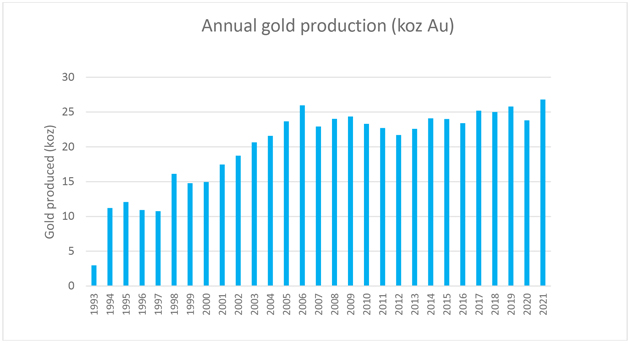
The Upper Mine has been in operation since 1993 and has produced between 20 and 26.8 thousand ounces (koz) of gold annually since 2003 from the existing 1,250 tpd capacity processing plant producing gold-silver doré via gravity concentration, flotation, flotation and gravity concentration regrind and cyanidation, and Merrill Crowe precipitation.
The Upper Mine has been developed to Level 21 at the 1,000 m elevation and the new Lower Mine will be constructed below the 950 m elevation at the boundary between the Upper Mine and Lower Mine. Mineral reserves have been estimated to the 335 m elevation.
1.4. Mineral resource and mineral reserve estimates
The Marmato mineral resource estimate effective June 30, 2022 is shown in Table 1.1. Mineral resources are inclusive of mineral reserves and were prepared by Ben Parsons, MSc, MAusIMM (CP) of SRK Consulting, who is a Qualified Person as defined by National Instrument 43-101 Standards of Disclosure for Mineral Properties (NI 43-101).
SRK has undertaken an assessment of reasonable prospects for economic extraction on the assumption of underground mining and assessing continuity of the mineralization above the selected cut-off grade. The assessment of the mineral resource estimate is based on two cut-off grades depending on the mine area and mining method. This includes a cut-off for the current mine operations at the Upper Mine and the long hole mining methods assumed for the Lower Mine, as well as metallurgical recoveries for both styles of mineralization and operating costs of the Upper Mine and Lower Mine. Operating costs are based on actual costs at the Upper Mine and on the pre-feasibility study cost estimates for the Lower Mine, and assume a conversion of 4,200 Colombian pesos (COP) to the United States dollar (US$). The assumptions used to determine the cut-off grades correspond to a 1.8 g/t Au cut-off grade for the Upper Mine mineral resources and a 1.3 g/t Au cut-off grade for the Lower Mine mineral resources.
Table 1.1 Marmato mineral resources effective June 30, 2022
| Area |
Category |
Tonnes (Mt) |
Grade Au (g/t) |
Grade Ag (g/t) |
Contained Au (koz) | Contained Ag (koz) | ||||||
|
Upper Mine |
Measured |
2.8 | 6.04 | 27.8 | 545 | 2,509 | ||||||
| Indicated |
12.7 | 4.14 | 16.8 | 1,691 | 6,847 | |||||||
| Measured + Indicated |
15.5 | 4.49 | 18.8 | 2,236 | 9,356 | |||||||
| Inferred |
2.6 | 3.03 | 15.4 | 250 | 1,265 | |||||||
|
Lower Mine |
Measured |
0.0 | 2.73 | 17.8 | 0 | 3 | ||||||
| Indicated |
46.0 | 2.54 | 3.3 | 3,761 | 4,912 | |||||||
| Measured + Indicated |
46.0 | 2.54 | 3.3 | 3,761 | 4,914 | |||||||
| Inferred |
33.1 | 2.39 | 2.3 | 2,537 | 2,418 | |||||||
|
Marmato Total |
Measured |
2.8 | 6.04 | 27.8 | 545 | 2,512 | ||||||
| Indicated |
58.7 | 2.89 | 6.2 | 5,452 | 11,758 | |||||||
| Measured + Indicated |
61.5 | 3.03 | 7.2 | 5,997 | 14,270 | |||||||
| Inferred |
35.6 | 2.43 | 3.2 | 2,787 | 3,682 | |||||||
|
Notes: 1. Measured and Indicated mineral resources are inclusive of mineral reserves. 2. Mineral resources are not mineral reserves and have no demonstrated economic viability. | ||||||||||||
| Effective date: June 30, 2022 |
Page 21 of 236 |
| Aris Mining Corporation
|
Technical Report Marmato Gold Mine
|
|
3. The mineral resource estimate was prepared by Benjamin Parsons, MSc, of SRK, who is a Qualified Person as defined by National Instrument 43-101. Mr. Parsons has reviewed and verified the drilling, sampling, assaying, and QAQC protocols and results, and is of the opinion that the sample recovery, preparation, analyses, and security protocols used for the mineral resource estimate are reliable for that purpose. 4. Totals may not add up due to rounding. 5. Mineral resources are reported above a cut-off grade of 1.8 g/t Au for the Upper Mine and 1.3 g/t Au for the Lower Mine. The cut-off grades are based on a metal price of US$1,700 per ounce of gold and gold recoveries of 90% for the Upper Mine and 95% for the Lower Mine. 6. The Upper Mine is defined as the current operating mine levels above the 950 m elevation and the Lower Mine is defined as below the 950 m elevation. 7. There are no known environmental, permitting, legal, title, taxation, socio-economic, marketing, political, or other relevant factors that could materially affect the mineral resources. | ||||||||||||
The Marmato mineral reserve estimate effective June 30, 2022 is shown in Table 1.2. Mineral reserves were prepared by Anton B. Chan, P. Eng. and Joanna Poeck, SME-RM, MMSAQP, both of SRK Consulting, who are Qualified Persons as defined by NI 43-101. Measured and indicated mineral resources were converted to proven and probable mineral reserves by applying the appropriate modifying factors, including dilution and mining recovery factors, to potential mining block shapes. The cut-off grade for the Upper Mine is calculated based on the current mine cost structure and corresponds to 2.05 g/t Au. The Lower Mine cut-off grade uses estimated Project costs and corresponds to 1.62 g/t Au. An optimized three dimensional design representing the planned mineral reserve mining areas and a life of mine schedule was created targeting a production rate of 1,250 tpd or 450,000 tonnes per year for the Upper Mine and 4,000 tpd or 1.46 million tonnes (Mt) per year for the Lower Mine.
Table 1.2 Marmato mineral reserves effective June 30, 2022
| Area |
Category |
Tonnes (kt) |
Grade Au (g/t) | Grade Ag (g/t) | Contained Au (koz) | Contained Ag (koz) | ||||||
|
Upper Mine |
Proven |
2,195.5 | 4.31 | 16.4 | 304 | 1,157 | ||||||
| Probable |
4,946.9 | 4.09 | 14.3 | 650 | 2,273 | |||||||
| Proven + Probable |
7,142.3 | 4.16 | 14.9 | 954 | 3,431 | |||||||
|
Lower Mine |
Proven |
- | - | - | - | - | ||||||
| Probable |
24,135.0 | 2.87 | 3.5 | 2,224 | 2,707 | |||||||
| Proven + Probable |
24,135.0 | 2.87 | 3.5 | 2,224 | 2,707 | |||||||
|
Marmato Total |
Proven |
2,195.5 | 4.31 | 16.4 | 304 | 1,157 | ||||||
| Probable |
29,081.8 | 3.08 | 5.3 | 2,874 | 4,980 | |||||||
| Proven + Probable |
31,277.3 | 3.16 | 6.1 | 3,178 | 6,138 | |||||||
|
Notes: 1. The Upper Mine mineral reserve estimate was prepared by Anton Chan, BEng, M.Sc., P.Eng, MMSAQP and the Lower Mine mineral reserve estimate was prepared by Joanna Poeck, BEng Mining, SME-RM, MMSAQP, both of whom are Qualified Persons as defined by NI 43-101. 2. All figures are rounded to reflect the relative accuracy of the estimate. Totals may not add up due to rounding. Mineral resources are reported inclusive of the Mineral reserves. 3. Upper Mine mineral reserves are reported above a cut-off grade of 2.05 g/t Au and the Lower Mine mineral reserves are reported above a cut-off grade of 1.62 g/t Au. The cut-off grades are based on a metal price of US$1,500 per ounce of gold, gold recoveries of 90% for the Upper Mine and 95% for the Lower Mine, and costs of US$89 per tonne for the Upper Mine and US$74.3 per tonne for the Lower Mine. 4. The economic analysis was completed with a gold price of $1,600 per ounce while the cut-off for the mine design and mineral reserves uses a gold price of $1,500 per ounce. The Project economics remain positive at a price of $1,500 per ounce gold. | ||||||||||||
| Effective date: June 30, 2022 |
Page 22 of 236 |
| Aris Mining Corporation
|
Technical Report Marmato Gold Mine
|
1.5. Mining methods
Mining at the Upper Mine is currently undertaken on six production levels using conventional cut and fill stoping of vein style mineralization at a targeted mining rate of 1,250 tpd following a gradual ramp up period. An area at the base of the Upper Mine between the 950 m and 1,050 m elevation, referred to as the Transition Zone, occurs where the deposit changes from narrow vein mineralization to large porphyry mineralized areas. Mining in the Transition zone is by long hole stoping and drift and fill. Ore is hauled by train on the main haulage level on Level 18 to the currently operating Upper Mine processing plant located adjacent to the mine portal.
The new Lower Mine porphyry style mineralization below the 950 m level will be mined using long hole stoping with paste backfill at a targeted mining rate of 4,000 tpd following a quick ramp up period. Ore will be hauled up a new decline to the new Lower Mine processing plant approximately 3 km by road from the Lower Mine.
The currently defined mine life of the Upper Mine is 19.5 years. Assuming timely receipt of the environmental permit for the Lower Mine, first stope production from the Lower Mine is expected to occur in September 2024 and ramps up to full production in 2026. The currently defined mine life of the Lower Mine is approximately 18 years.
The historical annual gold production summary from Marmato since 1993 is given in Figure 1.1.
Figure 1.1 Historical annual production summary
1.6. Recovery methods
Numerous processing plants have been operating at Marmato since the early 1600’s, and the process plant currently treating the Upper Mine ores has undergone continual upgrades. The current flowsheet includes 1,200 tpd capacity three stage crushing, ball mill grinding, gravity concentration, flotation, flotation and gravity concentrate regrind, cyanidation of the flotation and gravity concentrates, counter current decantation, Merrill Crowe precipitation, and smelting of the precipitate to produce gold-silver doré. Metal recoveries have improved with recent upgrades and were 90.8% for gold and 37.2% for silver in 2021. The Upper Mine plant is implementing a number of projects to increase plant availability and throughput to 1,250 tpd.
| Effective date: June 30, 2022 |
Page 23 of 236 |
| Aris Mining Corporation
|
Technical Report Marmato Gold Mine
|
The new processing plant that will be constructed for the Lower Mine includes 4,000 tpd capacity secondary crushing, semi-autogenous and ball mill grinding, gravity concentration, cyanidation of the gravity tailings, a carbon in pulp circuit, and electrowinning and refining to produce gold-silver doré. Metal recoveries are estimated at 95.4% for gold and 57.8% for silver.
1.7. Project infrastructure
The Upper Mine operations are supported by fully developed site infrastructure. The major new Project facilities for the Lower Mine will include the mine portal, crusher, stockpiles, processing facility, two dry stack tailings storage facilities, mining services, accommodation, access roads, power and water management and distribution facilities, and office buildings.
1.8. Permitting, environment, and social and community impact
The mining contract for Zona Baja #014-89m was renewed for a 30 year term in February 2021 and expires on October 14, 2051. A works and construction program (PTO) for the Upper Mine operations and the Lower Mine expansion Project demonstrating the technical, social, and environmental feasibility to operate was submitted to the National Mining Agency (Agencia Nacional de Mineria, or the ANM) in February 2022, and approval was received on November 3, 2022. The PTO will be in force for the 30 year contract extension period, although it may be subject to modifications depending on the Project’s strategic requirements.
The National Authority of Environmental Licenses (ANLA) is responsible to ensure all project, works, or activities subject to licensing, permit, or environmental procedures comply with the environmental regulations and contribute to the sustainable development of the country. ANLA approves or rejects licenses, permits, or environmental procedures according to the laws and regulations, and enforces compliances with the licenses, permits, and environmental procedures. The Corporación Autónoma Regional del Caldas (Corpocaldas) is the regional environmental authority responsible for the licensing of mining projects for those projects that produce less than two million tonnes of ore and waste per year, and ANLA is responsible for projects that produce more than two million tonnes per year. As the mine is planned to produce less than two million tonnes per year, Corpocaldas is responsible for licensing and monitoring of the mine.
Mining at Marmato predates the regulatory requirements to prepare an environmental impact assessment as part of the permitting process. The Upper Mine operations are authorized through the approval of an Environmental Management Plan (PMA) on October 29, 2001, covering environmental studies and management procedures for the Upper Mine, under Resolution 0496, File No. 616.
To support the construction of the Lower Mine expansion Project, Aris Mining submitted an updated PMA to Corpocaldas in April 2022, which addresses the environmental impacts of the Lower Mine development. The process to update the PMA is continuing, with several additional submissions to Corpocaldas made subsequent to the April 2022 submission, and final approval is pending.
The town of Marmato has been a centre for gold mining since it was founded in 1540. The population is approximately 10,000 and the main economic activity is formal and informal mining. There are around 3,000 artisanal and small scale miners in Marmato and there is also significant activity in the surrounding areas. Waste and tailings discharge by Informal mining activity directly into the environment has caused significant environmental contamination. These operations may increase the potential for environmental risk in terms of mass landslides and soil stability impacts to other associated resources, however, there are periodic review protocols that allow Aris Mining to identify any potential damage by third parties and to report them to Corpocaldas. The operational areas are protected to prevent access by unauthorized third parties and their activities to mitigate any risks and environmental liabilities.
The Project PMA requires the management of the social component of the mine. Aris Mining is required to maintain records on all community activities and provides the records every six months as part of the ongoing monitoring programs. The mine has developed a social investment model as part of the social management and monitoring
| Effective date: June 30, 2022 |
Page 24 of 236 |
| Aris Mining Corporation
|
Technical Report Marmato Gold Mine
|
program that seeks to promote community development in the area of influence, with the purpose of contributing to the consolidation of society and fostering economic development, guaranteeing the care and respect for the environment, and supporting and participating in actions aimed at improving the quality of life and well-being of its inhabitants.
1.9. Estimated capital and operating costs
The cost estimates have a base date of Q2 2022, are expressed in US$, and use a flat exchange rate of 4,200 COP to the US$
| 1.9.1. |
Estimated Lower Mine construction capital costs |
Construction capital cost estimates for the new Lower Mine include the new Lower Mine underground mining infrastructure, processing plant, and other surface infrastructure. The construction capital costs and expenditure schedule are summarized in Table 1.3.
Table 1.3 Estimated Lower Mine construction capital costs
| Category |
Total (US$M) | |||
| Process plant |
108.71 | |||
| Underground mine |
64.91 | |||
| Paste plant |
18.37 | |||
| Tailings storage facilities |
15.96 | |||
|
Non-process infrastructure |
26.33 | |||
| Owner’s costs |
45.28 | |||
|
Total |
279.57 |
| 1.9.2. |
Estimated sustaining capital costs |
The Upper and Lower mines will require sustaining capital to maintain the equipment and supporting infrastructure necessary to continue operations throughout the projected life of mine, as well as development to provide access to future stopes. The sustaining mine capital costs estimates include underground infill drilling, mine development based on the life of mine schedule, miscellaneous equipment purchases and rebuilds, mine ventilation and dewatering, maintenance of existing surface and underground mine infrastructure and stationary equipment, mine owner’s costs, mine contingency, phased tailings storage facility construction to increase capacity over the life of mine, and closure costs.
Estimated sustaining capital costs for the Upper and Lower mines are summarized in Table 1.4.
Table 1.4 Estimated life of mine sustaining capital costs
| Item |
Upper Mine (US$M) | Lower Mine (US$M) | Total (US$M) | |||||||||
| Cascabel Remediation |
1.71 | - | 1.71 | |||||||||
| Contingency |
- | 32.11 | 32.11 | |||||||||
| development |
28.98 | 158.62 | 187.60 | |||||||||
| Mine equipment |
29.30 | 2.40 | 31.71 | |||||||||
| Owner’s Cost |
0.11 | 0.60 | 0.71 | |||||||||
| Process Plant |
19.69 | - | 19.69 | |||||||||
| Surface Infrastructure |
5.77 | - | 5.77 | |||||||||
| Tailings |
- | 38.15 | 38.15 | |||||||||
| Total |
85.56 | 231.89 | 317.45 |
| Effective date: June 30, 2022 |
Page 25 of 236 |
| Aris Mining Corporation
|
Technical Report Marmato Gold Mine
|
| 1.9.3. |
Estimated operating costs |
Operating costs are divided into the Upper Mine operations and the Lower Mine expansion project and are summarized in Table 1.5. The mining costs assume an owner operation for the Upper Mine and a contractor operation for the Lower Mine. The following subsections provide the detailed breakout of each category.
Table 1.5 Estimated life of mine operating costs
| Item |
Units | Upper Mine | Lower Mine | Total | ||||||||||||
| Mining |
||||||||||||||||
| Total mining |
(US$M) | 381.87 | 990.99 | 1,372.86 | ||||||||||||
| Unit cost per processed tonne |
(US$/t) | 53.47 | 41.06 | 43.89 | ||||||||||||
| Unit cost per recovered ounce |
(US$/oz Au) | 437.35 | 469.11 | 459.82 | ||||||||||||
| Processing |
||||||||||||||||
| Processing |
(US$M) | 161.97 | 388.96 | 550.93 | ||||||||||||
| Unit cost per processed tonne |
(US$/t) | 22.68 | 16.12 | 17.61 | ||||||||||||
| Unit cost per recovered ounce |
(US$/oz Au) | 185.50 | 184.12 | 184.53 | ||||||||||||
| Site G&A and Social Investment |
||||||||||||||||
| Site G&A and Social Investment |
(US$M) | 125.02 | 199.25 | 324.27 | ||||||||||||
| Unit cost per processed tonnes |
(US$/t) | 17.50 | 8.26 | 10.37 | ||||||||||||
| Unit cost per recovered ounces |
(US$/oz Au) | 143.19 | 94.32 | 108.61 | ||||||||||||
| Total Operating |
||||||||||||||||
| Unit cost per processed tonnes |
(US$/t) | 93.65 | 65.43 | 71.87 | ||||||||||||
| Unit cost per recovered ounces |
(US$/oz Au) |
766.04 | 747.55 | 752.96 |
| 1.10. |
Economic analysis |
| 1.10.1. |
Assumptions |
SRK has undertaken an economic analysis, including annual cash flows, net present value, and internal rate of return, to confirm the proven and probable mineral reserves at Marmato.
Average life of mine mining rate assumptions are 1,250 tpd for the Upper Mine and 4,000 tpd for the Lower Mine.
The economic analysis has been conducted on an after-tax basis using 2022 US$. Cost assumptions are denominated in both US$ and COP, with COP converted to US$ using an exchange rate of 4,200 COP to the US$.
The base case analysis uses a flat metal price assumption of $1,600 per ounce for gold and $19 per ounce for silver. Refining charges of $6.38 per ounce of gold have been considered in the operating cost analysis.
Marmato is subject to a streaming agreement with Wheaton Precious Metals International (WPMI) whereby WPMI has agreed to purchase 10.5% of gold produced from the Marmato mine until 310,000 ounces of gold have been delivered, after which the purchased volume reduces to 5.25% of gold produced. WPMI will also purchase 100% of silver produced from the Marmato mine until 2.15 million ounces of silver have been delivered, after which the purchased volume reduces to 50% of silver produced. WPMI will continue to make payments upon delivery equal to 18% of the spot gold and silver prices until the uncredited portion of the upfront payment is reduced to zero, and 22% of the spot gold and silver prices thereafter.
WPMI has provided $53 million in upfront deposits and is committed to fund an additional $122 million during the Lower Mine construction period, as follows:
| • |
$40M when the construction of the Lower Mine is 25% complete; and |
| • |
$40M when the construction of the Lower Mine is 50% complete; and |
| Effective date: June 30, 2022 |
Page 26 of 236 |
| Aris Mining Corporation
|
Technical Report Marmato Gold Mine
|
| • |
$42M when the construction of the Lower Mine is 75% complete. |
Expected revenues from Marmato have been adjusted to account for the impact of precious metal sales to WPMI. Revenue from silver sales is treated as a credit against operating costs. As the streaming agreement is external to Colombia, Colombian corporate tax and royalties are assessed on the basis that all gold and silver is sold at market prices.
The key assumptions used in the economic analysis are provided in Table 1.6.
Table 1.6 Key assumptions used in the economic analysis
| Parameter |
Unit |
Upper Mine | Lower Mine | Total/average | ||||||||||
| Mined waste tonnes |
Mt |
0.5 | 3.2 | 3.7 | ||||||||||
| Mined ore tonnes |
Mt |
7.1 | 24.1 | 31.3 | ||||||||||
| Mined ore grade Au |
g/t |
4.16 | 2.87 | 3.16 | ||||||||||
| Mined ore grade Ag |
g/t |
14.9 | 3.5 | 6.1 | ||||||||||
| Mine life |
Years |
20 | 18 | 20 | ||||||||||
| Processing capacity |
Tonnes per day (tpd) |
1,250 | 4,000 | 5,250 | ||||||||||
| Gold recovery |
% |
92 | 95 | 94 | ||||||||||
| Silver recovery |
% |
36 | 57 | 45 | ||||||||||
| Gold recovered |
koz |
873.1 | 2,112.5 | 2,985.6 | ||||||||||
| Silver recovered |
koz |
1,253.0 | 1,543.2 | 2,778.2 | ||||||||||
| Gold price |
US$/oz |
1,600 | 1,600 | 1,600 | ||||||||||
| Silver price |
US$/oz |
19.00 | 19.00 | 19.00 |
| 1.10.2. |
Results |
The Lower Mine expansion project, with an initial construction capital including contingency estimate of $279.6 million, shows economic viability in the context of the overall operation of both the Upper Mine and Lower Mine. The integrated operation has an estimated after-tax NPV5% of $341 million and after-tax IRR of 29.7% at the base case gold price of $1,600 per ounce, as shown in Table 1.7. Project economics are inclusive of the precious metal streaming agreement with WPMI. See section 22 for the annual cash flow summary.
Table 1.7 Summary of economic results
|
Parameter
|
Unit
|
Total
| ||
| Gold revenue |
US$M |
4,385.7 | ||
| Refining charges |
(19.0) | |||
| Royalties |
US$M |
(423.8) | ||
|
| ||||
| Net revenue |
US$M |
3,942.9 | ||
| Mining costs |
US$M |
(1,372.9) | ||
| Processing costs |
US$M |
(550.9) | ||
| Mine site G&A costs |
US$M |
(249.6) | ||
| Social investment |
US$M |
(74.6) | ||
| Silver credit |
US$M |
13.6 | ||
|
| ||||
| Total operating costs |
US$M |
(2,234.5) | ||
| Operating margin |
US$M |
1,708.5 | ||
| Sustaining capital |
US$M |
(317.4) | ||
| Non-sustaining capital |
US$M |
(279.6) | ||
| Closure costs |
US$M |
(33.3) | ||
| Stream financing |
US$M |
122.0 | ||
|
| ||||
|
Pre-tax cash flow |
US$M |
1,200.1 | ||
| Effective date: June 30, 2022 |
Page 27 of 236 |
| Aris Mining Corporation
|
Technical Report Marmato Gold Mine
|
|
Parameter
|
Unit
|
Total
| ||
| Income tax |
US$M |
(551.6) | ||
|
| ||||
| After-tax cash flow |
US$M |
648.5 | ||
|
| ||||
| Pre-tax NPV5% |
US$M |
$674.0 | ||
| Pre-tax IRR |
% |
53.5% | ||
| After-tax NPV5% |
US$M |
$341.4 | ||
| After-tax IRR |
% |
29.7% | ||
| Cash cost |
US$/oz Au |
$897 | ||
| All in sustaining cost |
US$/oz Au |
$1,003 | ||
| Payback period1 |
Years |
2.6 | ||
| 1 The payback period is from the start of production from the Lower Mine |
||||
| 1.10.3. |
Sensitivity |
A sensitivity analysis of the Marmato economics to gold price was undertaken as shown in Table 1.8.
Table 1.8 Sensitivity of Project economics to gold price
| Gold price US$/oz |
Units | $1,400 | $1,500 | $1,6001 | $1,700 | $1,800 | ||||||||||||||||||
| Net cashflow |
US$M | $335 | $493 | $648 | $804 | $962 | ||||||||||||||||||
| After-tax NPV5% |
US$M | $150 | $246 | $341 | $438 | $533 | ||||||||||||||||||
|
After-tax IRR |
% | 16.1% | 22.8% | 29.7% | 37.1% | 45.2% | ||||||||||||||||||
| 1 base case | ||||||||||||||||||||||||
| 1.11. |
Conclusions and recommendations |
| 1.11.1. |
Mineral resources and mineral reserves |
The mineral resource estimate effective June 30, 2022 utilized 1,464 drillholes for a total of 314,874 m and 31,392 channel samples for a total of 53,343 m. SRK utilized mining software to create three dimensional wireframe interpretations for the mineral resource estimate. SRK has undertaken an assessment of reasonable prospects for economic extraction on the assumption of underground mining and assessing continuity of the mineralization above the selected cut-off grade.
SRK considers that the drilling and channel sampling information is sufficiently reliable to interpret the boundaries of the mineralized structures, and that the sample grade data are sufficiently reliable to support the mineral resource estimate. There are no known legal, political, environmental, or other risks that could materially affect the potential development of the mineral resources.
The mineral reserve estimate prepared by SRK and effective June 30, 2022 was based on the measured and indicated mineral resources by applying modifying factors appropriate to the Upper Mine and Lower Mine, including ore dilution and loss factors and additional allowance factors. The mineral reserve estimates are based on a three dimensional mine design representing the planned mineral reserve mining areas.
SRK knows of no existing environmental, permitting, legal, socio-economic, marketing, political, or other factors which could materially affect the underground mineral reserve estimate. SRK notes that there is a 2 Mt per year total material movement cap for the Project at this time, which was adhered to in the production schedule and affects the sequencing of the reserve material.
| Effective date: June 30, 2022 |
Page 28 of 236 |
| Aris Mining Corporation
|
Technical Report Marmato Gold Mine
|
| 1.11.2. |
Recovery methods and metallurgical testing |
The currently operating Upper Mine process plant is being optimized and expanded in a phased approach. The Phase 1 optimization plan, which is planned for completion by the end of 2022, will enable the plant to operate consistently at 1,250 tpd at a finer target grind of P80 135 µm.
The planned Lower Mine process plant designed by Ausenco Engineering will process 4,000 tpd and includes grinding, gravity recovery, leach/CIP tanks, carbon elution and regeneration, cyanide detoxification, and tailings thickening and filtration. Tailings will be disposed of as mine backfill or in a dry stack tailings facilities.
Metallurgical testwork is recommended on the Lower Mine ores to determine the variability in gold and silver extraction and to obtain additional data on ore hardness. Environmental testwork is recommended to aid in the identification of any potentially environmentally significant concentration of elements, to determine the mobility of any contaminates from the tailings, to determine the propensity of the tailings to generate acidic conditions, and to determine the balance between the acid producing and acid consuming components of the tailings samples.
| 1.11.3. |
Mining methods |
SRK generated a production schedule targeting a gradual ramp up to 1,250 tpd for the Upper Mine and 4,000 tpd for the Lower Mine. The schedule has considered a 2 Mt per year limit for total moved material. The life of mine plan for the Upper Mine is 19.5 years for a total of 7.14 Mt at 4.16 g/t Au. The Lower Mine currently has a mine life of approximately 18 years, and following construction, will operate concurrently with the Upper Mine.
The Upper Mine is currently in operation and mined using conventional cut and fill stope methods, which is appropriate for the deposit geometry, at a mining rate of 1,250 tpd. Mining in the Transition Zone is by long hole stoping to take advantage of the bulk characteristics of the mineralization style, and by drift and fill. The Lower Mine is located below the Upper Mine and has not yet been developed. A longhole stoping method is considered suitable for the deposit and stopes are sized to be large enough to support bulk mining methods. A 10 m sill pillar is left in situ between the Lower Mine and the Upper Mine.
Optimizations were run on the Lower Mine using various cut-off grades to identify higher grade mining areas and to understand the sensitivity of the deposit to cut-off grade. The results show large quantities of lower grade material where a small increase/decrease in cut-off grade has a material impact on the material available for design.
SRK recommends prioritizing grade control and mining discipline in the Upper Mine to improve performance with regard to mined grades. Continued effort should be made to using 3D methods to generate more realistic plans. SRK recommends setting up the underground cement plant and scheduling the waste rock backfill before mining the next lift of the Transition Zone to prevent sterilization of ore.
SRK recommends that the operation continue to monitor costs and the cut-off grade as small changes in the cut-off grade can have a material impact to the mine design. Similarly, the operation should continue to optimize the mining sequence to mine higher grade material earlier in the mine life in the next level of study. The Lower Mine mining plan needs to be completed to feasibility study level.
SRK recommends updating the available hydrogeologic information and revisiting the pumping system design to optimize the system. The pump sizing should be refined and consider an updated risk profile to match the pump system sizing to actual expected inflows. This evaluation could lead to a reduced pump size and lower power requirements.
SRK recommends evaluating the ventilation standard applied with respect to diesel dilution to consider whether a variance to North American standards would allow a more optimized ventilation fan sizing that would potentially reduce ventilation capital cost, operating cost, power system distribution size, and infrastructure dimension. In order to reduce long term operating costs and promote efficiency, the interaction between the Upper Mine exhaust
| Effective date: June 30, 2022 |
Page 29 of 236 |
| Aris Mining Corporation
|
Technical Report Marmato Gold Mine
|
decline and Lower Mine exhaust decline should be more closely examined with respect to the continued backfill haulage requirement for the Upper Mine exhaust decline.
The ventilation system currently developed for the Upper Mine should be surveyed and the ventilation model updated so that it can provide a more accurate basis for the future designs.
| 1.11.4. |
Geotechnical |
From the pre-feasibility study geotechnical investigation, SRK concludes that:
| • |
The geotechnical investigation, laboratory tests, and design parameters are suitable for a pre-feasibility study and should not be fully implemented before a feasibility level study is completed. |
| • |
The proposed stope design for the Lower Mine consists of maximum stope dimensions of 30 m high, 30 m long, and 10 m wide. The side walls could require some spot ground support. A 10 m span stope can likely be open for one to six months without ground support. |
| • |
Significant dilution is unlikely due to the good rock mass quality. Wall damage will likely be associated with blasting overbreak. SRK recommends that a blasting study is conducted during a feasibility study to evaluate the degree of overbreak. Negligible wall sloughing in the secondary stopes is anticipated. |
| • |
The decline route selection was considered a key part of the pre-feasibility study design and high level geological, geotechnical, hydrological, hydrogeological, and structural factors were considered. Special attention was paid to the effect of the modeled major faults on the drift stability. |
SRK’s recommendations for rock mechanics includes:
| • |
Conduct a geotechnical core logging and televiewer program to investigate critical underground infrastructures. |
| • |
Complete specific geotechnical drill holes to characterize the rock mass parameters around the decline |
| • |
Update the major faults model |
| • |
Conduct pre-mining in situ stress measurements |
| • |
Collect tiltmeter measurements to confirm that there is minimal subsidence above the Transition Zone |
| • |
Develop a ground control management plan with a triggered action response plan |
| • |
Perform mine scale stress analyses of the planned stoping sequence |
| • |
Acoustic emission tests are recommended to determine the damage energy and crack initiation |
| • |
Mine induced and in situ stress measurements should be conducted, to define the pre-mining stress distributions |
| • |
A mine scale hydrogeological pore pressure model should be developed to estimate the ground water effect on mine stability. |
| • |
3D numerical modeling at the mine scale is recommended for examining the effect of the mining sequence on the overall mine stability |
| • |
Preparation of an instrumentation program |
| • |
Refine the pre-feasibility study level ground support strategy |
| • |
Define an appropriated ground control management plan |
| • |
Additional drilling is necessary to understand the nature of faults within the mine design before development. |
| 1.11.5. |
Hydrogeological |
SRK developed a numerical groundwater model based on available hydrogeological data. The major sources of mine inflow are the depletion of groundwater storage and capturing of groundwater discharge to surface water bodies such as streams. The model predicts insignificant reversing of hydraulic gradient between the mine area and the Cauca River and causing inflow to the mine. Further investigation of the fault structures and their hydrogeological role are needed to verify the predictions.
To reduce uncertainties in the understanding of hydrogeological conditions in the underground mine, SRK recommends the completion of the following additional hydrogeological investigations/analyses:
| Effective date: June 30, 2022 |
Page 30 of 236 |
| Aris Mining Corporation
|
Technical Report Marmato Gold Mine
|
| • |
Structural analysis of the geological features and faults outside of the mining area |
| • |
Detailed water balance and estimate of recharge from precipitation |
| • |
Detailed groundwater inflow mapping in existing developments |
| • |
Evaluation of the role of paste filling in the reduction of groundwater inflow to the mine |
| • |
Improvement of mine discharge measurements at each level of the current mine |
| • |
Installation of a groundwater-level monitoring network outside of the mine area and along the river valley, including hydrogeological testing during the construction of monitoring wells |
| • |
Detailed water level measurements to observe drawdown propagation as a result of mine dewatering and seasonal variation as a result of precipitation |
| • |
Additional large-scale hydraulic testing to identify zones of enhanced permeability related to faults planned to be intersected by underground workings |
| • |
Drilling and hydraulic testing of pilot holes in places where ventilation declines are planned |
| • |
Updates to the developed numerical groundwater model based on the above items |
| • |
Improvements to the vertical discretization of the model to better simulate mining levels and the size of the stopes |
| • |
Incorporation of the most important faults and structures with enhanced permeability |
| • |
Improvements in model calibration to measured water levels and flows |
| • |
Re-evaluation of pumping design based on updated inflow predictions |
| • |
Evaluation of flow-through hydrogeological conditions during post-mining |
| • |
Groundwater chemistry sampling |
Based on this work dewatering requirements for the Lower Mine needs to be updated and included into the overall site water balance.
| 1.11.6. |
Water supply and management |
Water supply for the Lower Mine process plant will come from overflow from the tailings thickener, site runoff underground mine dewatering and collected runoff and seepage from the dry stack facilities. Groundwater inflows to the underground mine are expected to steadily increase over the life of mine, exceeding the raw water makeup demand expected. A secondary water supply extracting water from the Cauca river will provide makeup water to the plant during periods of excessive drought or if the dewatering flows are not available.
A site-wide water balance model was developed for the Project to evaluate water supply and demands for the life of mine. The model predicted that the dewatering flows from the Upper Mine and Lower Mine will be sufficient to meet the process water demands and that the process would be able to consume all runoff and seepage flows produced by the dry stack tailings facility.
| 1.11.7. |
Tailings storage facilities |
The Upper Mine tailings are stored in a series of historical, current, and planned future facilities in the Cascabel basin. SRK understands that the continued operation of the existing Cascabel facility is a high risk for the Project, which is currently being addressed by Aris Mining. Although no communities or infrastructure are encountered downstream of the facility, any flow of slurried tailings from the original Cascabel 1 facility will impact the downstream Cauca River if pushed by the Cascabel stream. The Cascabel 1 facility does not meet standard of practice stability requirements. Given the siting and operational constraints of the Cascabel 2 and 3 facilities, these may also have similar issues going forward. It is SRK’s understanding that Aris Mining is currently considering and undergoing ongoing remediation and improvement measures to bring these facilities (existing and planned) into compliance with internationals standards of good practice. SRK recommends an independent review to provide technical reviews of the detailed or construction designs currently being prepared by IRYS for Cascabel 2 and 3, and review of the planned remedial measures by Aris Mining for Cascabel 1 such that costs of bringing these facilities into compliance can be appropriately assessed.
| Effective date: June 30, 2022 |
Page 31 of 236 |
| Aris Mining Corporation
|
Technical Report Marmato Gold Mine
|
Two dry stack tailings storage facilities referred to as Site 2 and Site 6 are planned for the Lower Mine. The Site 2 facility has lower tailings transport costs and will require the successful negotiation, permit application approval, and the relocation of a high-voltage power line. Although further from the plant site, Site 6 has sufficient capacity for the expected life of mine production and does not require the relocation of power lines.
SRK recommends performance monitoring and remediation for Cascabel 1 facility so that it meets the minimum standard of practical stability. Annual independent audits, Dam Inspection Reports, Dam Safety Reports, and tailings governance compliance assessments are required. Installation of monitoring devices and monthly geotechnical monitoring and reporting is required. Water quality monitoring and water treatment downstream of the Cascabel facility is recommended.
An independent review of the designs and planned operations for Cascabel 2 and 3 is recommended to verify compliance with industry standard practice.
For the proposed tailings facilities, detailed tailings geotechnical testing is recommended. The borrow area identified should be properly characterized. Additional geotechnical site investigations are required to advance the tailings storage facilities to further stages of design. Boreholes, test pits, and laboratory tests are recommended to characterize foundation soils and bedrock.
Geological/geotechnical studies for access roads and tailings pipeline right of way are recommended. Detailed designs of Los Indios portal.
Hydrologic testwork and modeling studies are recommended to predict the runoff, infiltration, and seepage from the tailings and reclamation surfaces. Pond storage and water supply studies should be updated based on these results.
Climate studies are recommended to validate the use of the La Maria climate records. A climate change evaluation should be performed to evaluate the impacts of climate change on design storms.
| 1.11.8. |
Environmental studies, permitting, and social or community impact |
Baseline data collection programs have been completed or are currently underway with respect to the existing Upper Mine operation and the proposed Lower Mine. These resource studies will be used for impact analysis and the development of mitigation actions, environmental management, and compensation planning.
Environmental and social issues are currently managed in accordance with the approved PMA and will likely need to be updated and/or modified for the proposed expansion Project.
Routine monitoring is currently conducted on domestic wastewater discharges, non-domestic industrial wastewater discharges, and air quality emissions. The tailings are infrequently monitored for hazard classification purposes. The results of the monitoring are provided to the regional environmental authority. This monitoring program will require significant modification to include the facilities for the proposed expansion Project, and to bring it up to international best practice standards.
Continued work on groundwater hydrogeology and surface water is recommended. A detailed evaluation could provide information that would assist in forecasts of post-closure mine water discharge and possible long-term water treatment requirements and could also provide vital information on underground geotechnical stability.
Continued baseline surface water, groundwater, and soil data collection efforts are recommended to establish baseline conditions and try to quantify the contributions from artisanal or pre-mining conditions
| 1.11.9. |
Geochemistry |
Acid generating sulfide minerals are identified in the deposit. Samples of groundwater discharging into the underground are predominantly acidic. The underground water samples contain elevated metal(loid) concentrations. While the tailings will be placed in the dry stack tailings facilities with a neutral to alkaline
| Effective date: June 30, 2022 |
Page 32 of 236 |
| Aris Mining Corporation
|
Technical Report Marmato Gold Mine
|
geochemistry, the tailings themselves will be potentially acid generating with the potential to eventually overwhelm the alkaline conditions and produce acid drainage in the long term if not properly managed. A significant fraction of waste rock could be potentially acid generating and will require proper management.
Recommendations with respect to geochemistry include:
| • |
Implementing a program of contact water management to characterize the acid rock drainage and metal leaching properties of waste rock deposited above or below ground. |
| • |
Characterizing and monitoring the geochemical properties of underground paste backfill. |
| • |
Evaluating the potential for offsite migration of mine pool water at a feasibility study level. |
| • |
Preventing the encroachment of contamination from artisanal mining onto the Project property. |
| 1.11.10. |
Water management |
Management of contact water continues to be a challenge. Recent improvements include installation of ditches in the Cascabel tailings area and tailings encapsulation to reduce contact water. Aris Mining is prioritizing integration of contact water from tailings, waste rock, and site water into a single treatment system.
| 1.11.11. |
Permitting |
The mining contract for Zona Baja #014-89m was renewed for a 30 year term in February 2021 and expires on October 14, 2051. A PTO for the Upper Mine operations and the Lower Mine expansion Project demonstrating the technical, social, and environmental feasibility to operate was submitted to the ANM in February 2022, and approval was received on November 3, 2022. The PTO will be in force for the 30 year contract extension period, although it may be subject to modifications depending on the Project’s strategic requirements.
Mining at Marmato predates the regulatory requirements to prepare an environmental impact assessment as part of the permitting process. The Upper Mine operations are authorized through the approval of an Environmental Management Plan. To support the construction of the Lower Mine expansion Project, Aris Mining submitted an updated PMA to Corpocaldas in April 2022, which addresses the environmental impacts of the Lower Mine development. The process to update the PMA is continuing, with several additional submissions to Corpocaldas made subsequent to the April 2022 submission, and final approval is pending.
| 1.11.12. |
Artisanal mining |
Informal processing operations related to artisanal mining in this location using basic technology (many of which are unpermitted), has resulted in poor health and safety conditions and widespread water contamination from the discharge of tailings and waste directly into the environment. These operations may also increase the potential for environmental risk in terms of soil stability impacts to other associated resources.
| 1.11.13. |
Closure costs |
The reclamation and closure cost estimate provided for the current operations is approximately US$6.1 million, though there is considerable uncertainty surrounding the basis for this estimate. An additional US$7.5 million is estimated for the Lower Mine expansion facilities, assuming concurrent tailings reclamation. A requirement for long term post-closure water treatment, if any, could significantly increase this estimate.
It is recommended to prepare a more detailed site-wide closure plan for the existing Marmato facilities, including building plans and equipment inventories, from which a more accurate final closure cost estimate can be developed. An investigation identifying the potential need for post-closure water treatment based on the predicted geochemistry analysis of the seepage is recommended
| 1.11.14. |
Known environmental issues |
SRK is not currently aware of any known environmental issues that could materially impact Aris Mining’s ability to extract the mineral resources or mineral reserves at Marmato. While there will be some challenges associated with land acquisition during permitting and surface water control during operations, Aris Mining has not had, nor does
| Effective date: June 30, 2022 |
Page 33 of 236 |
| Aris Mining Corporation
|
Technical Report Marmato Gold Mine
|
it currently have any legal restrictions which affect access, title, mining rights, or capacity to perform work on the property. Likewise, in regard to environmental compliance, the operation is covered by the PMA and associated environmental permits, which further reduces environmental risks. Preliminary mitigation strategies have been developed to reduce environmental impacts to meet regulatory requirements and the conditions of the PMA.
| 1.11.15. |
Capital and operating costs |
Construction capital cost estimates for the new Lower Mine total $279.6M. Estimated sustaining capital costs total $85.6M for the Upper Mine and $231.9M for the Lower Mine. Estimated operating costs assume an owner operation for the Upper Mine and a contractor operation for the Lower Mine and total $93.65 per processed tonne for the Upper Mine and $65.43 per processed tonne for the Lower Mine.
SRK recommends preparing a first principles estimate of capital and operating costs with enough accuracy to support a future feasibility study of the Lower Mine Project. SRK recommends investigating adjusting the environmental licensing authority from Corpocaldas to ANLA, to allow the total mine material movement to increase to greater than 2 Mt per year, which will allow the Upper Mine to fully utilize its processing capacity.
| 1.11.16. |
Economic analysis |
The economic analysis has been conducted on an after-tax basis using 2022 US$. Cost assumptions are denominated in both US$ and COP, with COP converted to US$ using an exchange rate of 4,200 COP to the US$. The base case analysis uses a flat metal price assumption of $1,600 per ounce for gold and $19 per ounce for silver.
The Lower Mine expansion project shows economic viability in the context of the overall operation of both the Upper Mine and Lower Mine. The integrated operation has an estimated after-tax NPV5% of $341 million and after-tax IRR of 29.7% at the base case gold price of $1,600 per ounce. Project economics are inclusive of the precious metal streaming agreement with WPMI.
| Effective date: June 30, 2022 |
Page 34 of 236 |
| Aris Mining Corporation
|
Technical Report Marmato Gold Mine
|
2. Introduction
2.1. Issuer and purpose of the Technical Report
This Technical Report has been prepared for Aris Mining in compliance with the disclosure requirements of NI 43-101, to disclose updates to the mineral resource and mineral reserve estimates for Marmato based on additional drilling information, and the results of a pre-feasibility study on the Lower Mine expansion Project based on the updates to the mineral resources and reserves and the results of ongoing optimization studies since the previous pre-feasibility study of the Lower Mine expansion Project, disclosed in a Technical Report effective March 17, 2020.
The effective date of this Technical Report is June 30, 2022. No new material technical information has become available between this date and the signature date given on the certificate of the qualified persons (Qualified Persons).
Aris Mining is a Canadian mining company with its common shares listed on the Toronto Stock Exchange under the symbol “ARIS”.
2.2. Source of information
Unless otherwise stated, information, data, and illustrations contained in this report or used in its preparation have been prepared by Aris Mining, SRK Consulting, Ausenco, and Piteau Associates for the purpose of this Technical Report.
Unless otherwise stated, all units are metric and currencies are in United States dollars. Project data coordinates are in the Universal Transversal Mercator (UTM) coordinate system.
2.3. Qualified Persons and personal property inspections
Aris Mining has prepared this Technical Report with contributions from SRK Consulting, Ausenco Engineering, and Piteau Associates. SRK Consulting, Ausenco Engineering, and Piteau Associates are all independent of Aris Mining. The details and responsibilities of each Qualified Person are provided in Table 2.1.
Pamela De Mark visited the Property from December 6 to 10, 2021, February 14 to 18, 2022, and May 9 to 12, 2022. During the visit, Pamela reviewed channel sampling, exploration drilling, sampling and sample security protocols, drill core, the core cutting and storage facilities, and the onsite geochemical laboratory. Pamela visited the Upper Mine underground operations to review key production areas, ground conditions, and the nature of the structures being mined. Pamela also visited the Upper Mine processing plant and tailings storage facility, and reviewed the site and environmental setting and logistics for mining and processing.
Ben Parsons visited the Property numerous times since first visiting the Property in 2010. Ben most recently visited from June 10 to 12, 2021 and October 15 to 17, 2021. During the visit Ben reviewed the geological conditions both underground and within the drillcore, focusing on the Lower Mine drilling, to aid the development of the geological model. A review of the geological model was completed with the on site geological team during the October 2021 site inspection.
Anton Chan visited the Property from November 8 to 10, 2021 and December 2 to 7, 2021. During the site visits, Anton visited the underground operations, discussed and reviewed the short term mine plan completed by site personnel, and reviewed the operational data for mine production and costs.
Brian Prosser visited the Property from November 18 to 20, 2019. During the site visit the ventilation system in the Upper Mine was examined with site personnel and a base ventilation model was calibrated for the conditions encountered. Special attention was taken to examine the lower mining levels of the Upper Mine.
Joanna Poeck has not undertaken a site visit.
Eric Olin visited the Property from December 4 and 5, 2019. During the site visit Eric visited the Upper Mine
| Effective date: June 30, 2022 |
Page 35 of 236 |
| Aris Mining Corporation
|
Technical Report Marmato Gold Mine
|
processing plant and participated in a review of potential site locations for the installation of the Lower Mine processing plant.
Fredy Henriquez visited the Property from May 2 to 10, 2022. During the site visit, Fredy visited the existing underground Upper Mine operation (Transition Zone) and the exploration core yard. During the site visit, Fredy conducted specific geotechnical core logging at the core yard and performed traverse mapping in the existing mine excavation. As part of the site visit, SRK calibrated the preliminary rock mass strength parameters established by Wood at the time of the site visit. The site visit allowed Fredy to understand the rock mass performance under engineering requirements.
David Hoekstra has not undertaken a site visit.
Mark Willow visited the Property on December 1, 2016. This inspection was intended to familiarize Mark with the conditions on the Property, and any potentially available material information that could affect mine development and expansion in this location. Information collected on site was supplemented by the mine teams, as necessary.
Vladimir Ugorets has not undertaken a site visit.
Colleen Crystal has not undertaken a site visit.
Kevin Gunesch visited the Property from November 8 to 10, 2021 and December 2 to 7, 2021. During the site visits, Kevin reviewed the short term mine planning completed at site, reviewed operational data for mine production and costs, visited the Upper Mine process plant, and also visited the Upper Mine underground operations to review example production areas for different mining methods.
Tommaso Roberto Raponi has not undertaken a site visit.
David Bird has not undertaken a site visit.
| Table 2.1 |
Responsibilities of each Qualified Person |
| Qualified Person
|
Responsible for sections
| |
| Pamela De Mark, BAppSci, P.Geo., Senior Vice President, Technical Services of Aris Mining |
2: Introduction; 3: Reliance on other experts; 4: Property description and location; 5: Accessibility, climate, local resources, infrastructure, and physiography; 6: History; 7: Geological setting and mineralization; 8: Deposit types; 9: Exploration; 10: Drilling; 11: Sample preparation, analyses, and security; 12: Data verification; 23: Adjacent Properties; 24: Other relevant data and information; and the relevant summaries of those sections included in 1: Summary; 25: Interpretation and conclusions; and 26: Recommendations. | |
| Ben Parsons, MSc, MAusIMM (CP), Principal Consultant of SRK Consulting |
12: Data verification, 14: Mineral resource estimates; and the relevant summaries of these responsibilities included in 1: Summary; 2: Introduction; 3: Reliance on other experts; 25: Interpretation and conclusions; and 26: Recommendations. | |
| Anton Chan, BEng, MS, Peng, MMSAQP, Senior Consultant of SRK Consulting |
15: Mineral reserve estimates related to the Upper Mine; 16: Mining methods subsections 16.1, 16.4, and 16.6 with the exception of 16.4.7, and 16.6; and the relevant summaries of these responsibilities included in 1: Summary; 2: Introduction; 3: Reliance on other experts; 25: Interpretation and conclusions; and 26: Recommendations. | |
| Effective date: June 30, 2022 |
Page 36 of 236 |
| Aris Mining Corporation
|
Technical Report Marmato Gold Mine
|
| Qualified Person
|
Responsible for sections
| |
| Brian Prosser, PE, SME-RM, Principal Consultant of SRK Consulting |
16: Mining methods subsections 16.4.7 and 16.5.6 related to ventilation; and the relevant summaries of these responsibilities included in 1: Summary; 2: Introduction; 3: Reliance on other experts; 25: Interpretation and conclusions; and 26: Recommendations. | |
| Joanna Poeck, BEng, SME-RM, MMSAQP, Principal Consultant of SRK Consulting |
15: Mineral reserve estimates related to the Lower Mine, 16: Mining methods subsection 16.5 with the exception of 16.5.6.; the Lower Mine portion of 16.6, and the relevant summaries of these responsibilities included in 1: Summary; 2: Introduction; 3: Reliance on other experts; 25: Interpretation and conclusions; and 26: Recommendations. | |
| Eric J. Olin, MSc, MBA, SME-RM, MAusIMM, Principal Consultant of SRK Consulting |
13: Mineral processing and metallurgical testing; 17: Recovery methods related to the Upper Mine processing plant; and the relevant summaries of these responsibilities included in 1: Summary; 2: Introduction; 3: Reliance on other experts; 25: Interpretation and conclusions; and 26: Recommendations. | |
| Fredy Henriquez, MS, SME-RM, ISRM, Principal Consultant of SRK Consulting |
16: Mining methods subsection 16.2 related to geotechnical; and the relevant summaries of these responsibilities included in 1: Summary; 2: Introduction; 3: Reliance on other experts; 25: Interpretation and conclusions; and 26: Recommendations. | |
| David Hoekstra, BS, PE, NCEES, SME-RM, Principal Consultant of SRK Consulting |
Section 5: Accessibility, climate, local resources, infrastructure and physiography subsection 5.4 related to water sources; 18: Infrastructure subsections 18.2.8 and 18.2.9 related to water supply and management; and the relevant summaries of these responsibilities included in 1: Summary; 2: Introduction; 3: Reliance on other experts; 25: Interpretation and conclusions; and 26: Recommendations. | |
| Mark Allan Willow, MSC, CEM, SME-RM, Principal Consultant of SRK Consulting |
4: Property description and location related to environmental liabilities and permitting; 20: Environmental studies, permitting and social or community impact; and the relevant summaries of these responsibilities included in 1: Summary; 2: Introduction; 3: Reliance on other experts; 25: Interpretation and conclusions; and 26: Recommendations. | |
| Vladimir Ugorets, PhD, MMSA, Principal Consultant of SRK Consulting |
16: Mining methods subsection 16.3 related to hydrogeology; and the relevant summaries of these responsibilities included in 1: Summary; 2: Introduction; 3: Reliance on other experts; 25: Interpretation and conclusions; and 26: Recommendations. | |
| Colleen Crystal, MSc, PE, GE, Principal Consultant of SRK Consulting |
18: Project infrastructure related to tailings; and the relevant summaries of these responsibilities included in 1: Summary; 2: Introduction; 3: Reliance on other experts; 25: Interpretation and conclusions; and 26: Recommendations. | |
| Kevin Gunesch, BEng, PE, Principal Consultant of SRK Consulting |
19: Market studies and contracts; 21: Capital and operating costs related to mining; 22: Economic analysis; and the relevant summaries of these responsibilities included in 1: Summary; 2: | |
| Effective date: June 30, 2022 |
Page 37 of 236 |
| Aris Mining Corporation
|
Technical Report Marmato Gold Mine
|
| Qualified Person
|
Responsible for sections
| |
| Introduction; 3: Reliance on other experts; 25: Interpretation and conclusions; and 26: Recommendations. | ||
| Tommaso Roberto Raponi, BASc, P.Eng, Principal Metallurgist of Ausenco Engineering Canada Inc. |
2: Introduction; 17: Recovery Methods subsection 17.2; 18: Infrastructure subsections 18.2 to 18.2.8; 21: Capital and Operating Costs subsections 21.1.2.2, 21.2.2, 21.3.2.2 and 21.4.2.2; and the relevant summaries of those sections included in 1: Summary; 25: Interpretation and conclusions; and 26: Recommendations. | |
| David Bird, BS, MS, PG, SME-RM, Principal Geochemist of Piteau Associates |
2: Introduction; 20: Environmental studies, permitting and social or community impact; and the relevant summaries of those sections included in 1: Summary; 25: Interpretation and conclusions; and 26: Recommendations. | |
| Effective date: June 30, 2022 |
Page 38 of 236 |
| Aris Mining Corporation
|
Technical Report Marmato Gold Mine
|
3. Reliance on other experts
SRK has relied fully on information provided by the issuer, Aris Mining, regarding certain legal and tax matters relevant to the Technical Report. On legal matters, SRK has made full reliance on information provided by Aris Mining with respect to (i) the current legal status of environmental permits described in Section 20.1, (ii) the current legal status of mining permits described in section 20.2, and (iii) the current legal status of water management permits described in section 20.3. On tax matters, SRK has made full reliance on information provided by Aris Mining with respect to the taxation assumptions used for the financial analysis provided in Section 22.1.
| Effective date: June 30, 2022 |
Page 39 of 236 |
| Aris Mining Corporation
|
Technical Report Marmato Gold Mine
|
4. Property description and location
4.1. Location
The Property is located on the west side of the town of Marmato, in Marmato municipality of Caldas Department, Republic of Colombia, approximately 80 km from Medellín and 200 km northwest of the capital city of Bogotá, at approximately 5°28’38”N and 75°35’46”W. A 2022 Google Map of the Property location is shown in Figure 4.1.
Figure 4.1 Marmato location plan
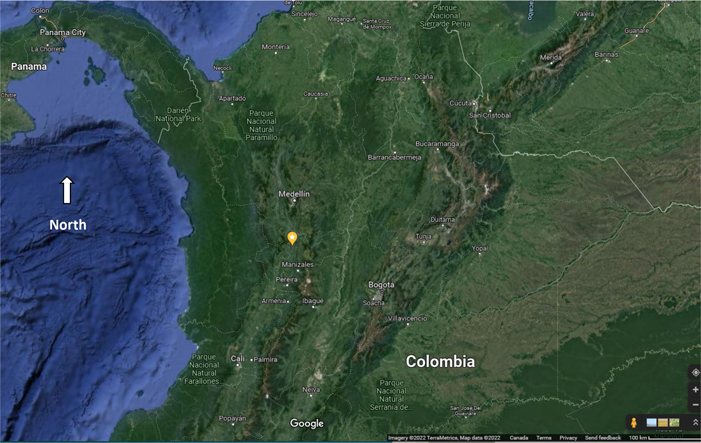
4.2. Mineral tenure
Cerro El Burro, a prominent hill at Marmato, has been mined for nearly 600 years, and was historically divided into three contiguous mining titles with numerous licenses within them, including Zona Alta (#CHG_081), Zona Baja (#014-89m), and Echandia (#RPP-357). A plan of the titles and two cross sections showing the division by elevation between Zona Baja and Zona Alta are shown in Figure 4.2.
In 1954 Marmato was divided into two zones by elevation, Zona Alta (High Zone) and Zona Baja (Low Zone), by Decree 2223, as shown in Figure 4.2 from Micon International Limited (2006). Marmato became part of the Aporte Minera Mine (Mining Contribution 1017 for precious metals) in 1981, a legal status created in 1940 by Law 1157 that reserves certain minerals and mines considered to be of national interest.
| Effective date: June 30, 2022 |
Page 40 of 236 |
| Aris Mining Corporation
|
Technical Report Marmato Gold Mine
|
Figure 4.2 Marmato title plan and cross sections
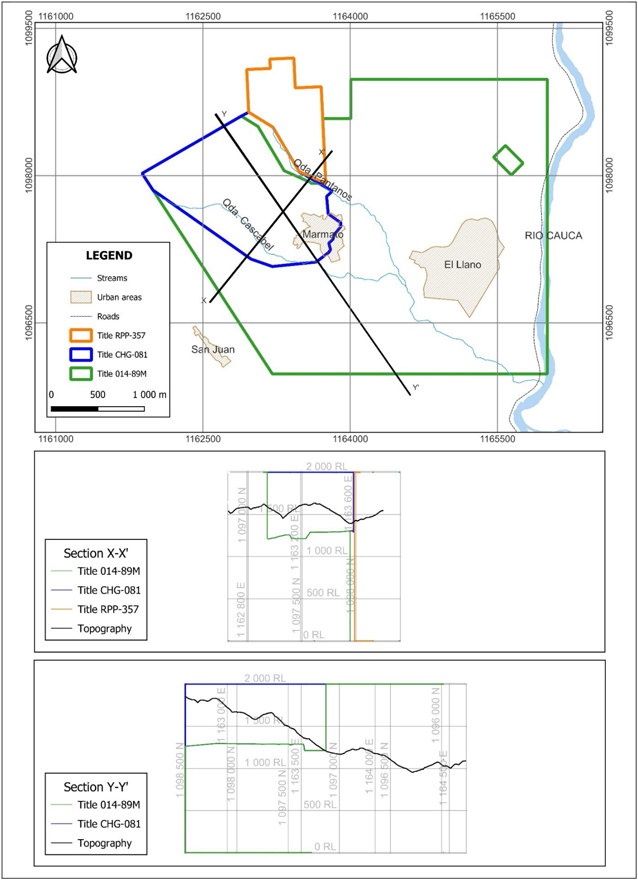
| Effective date: June 30, 2022 |
Page 41 of 236 |
| Aris Mining Corporation
|
Technical Report Marmato Gold Mine
|
Zona Baja (#014-89m) is 100% owned by Aris Mining Marmato S.A.S., a subsidiary of Aris Mining. The majority of the mineral resources and reserves reported by Aris Mining are contained within Zona Baja. The vertical boundary coincides with the road and varies from 1,207 to 1,298.3 m in elevation. It lies below the Zona Alta title, but in most other areas it continues to the surface and continues vertically to depth in all parts. It is adjacent to Echandia and extends east to the Cauca River, covering a surface area of 952.6187 hectares (ha). The mining title registration number is GAFL-11. The mining contract was renewed for a 30 year term in February 2021 and expires on October 14, 2051. A PTO for the Upper Mine operations and the Lower Mine expansion Project demonstrating the technical, social, and environmental feasibility to operate was submitted to the ANM in February 2022, and approval was received on November 3, 2022. The PTO will be in force for the 30 year contract extension period, although it may be subject to modifications depending on the Project’s strategic requirements.
Echandia (#RPP-357) was owned indirectly, through other subsidiaries, by GCM Mining, and has an area of 59.4481 ha. It lies to the northeast of Zona Alta and to the north of Zona Baja, and extends to depth. The mining title registration number is EDMN-01. Echandia is a freehold property dating from the 19th century. The Recognition of Private Property, Reconocimiento de Propiedad Privada (RPP) contract type was created by Law 20 in 1969 to respect prior mining and land rights. RPP titles are surface and subsurface rights granted in perpetuity and require the submission of proof of mining or exploration to maintain the license. Aris Gold held rights granted by Minera Croesus, S.A.S., previously an indirect, wholly owned subsidiary of GCM Mining, to undertake mining in Echandia. Subsequent to the effective date of this Technical Report, on September 26, 2022, Aris Gold completed a business combination with GCM Mining, and the combined entity was renamed Aris Mining Corporation. Echandia is now owned by Aris Mining. Aris Mining restricted mineral resources and mineral reserve estimates and the life of mine plan disclosed in this Technical Report to below the 1,300 m elevation at Echandia.
Zona Alta (#CHG_081) was co-owned by Minerales Andinos de Occidente S.A.S., which was indirectly owned by GCM Mining through other subsidiaries, and by Caldas Gold Marmato S.A.S., a subsidiary of Aris Gold. Aris Mining previously held a 2.7778% interest in the title, and following the business combination with GCM Mining, Zona Alta is now 100% owned by Aris Mining. The mining title has been suspended since 2017 by sentence SU-133 issued by the Constitutional Court to allow the Mayor’s Office and the National Mining Agency to conduct consultation. The license has an area of 178.9402 ha and lies above and within the larger area of Zona Baja.
4.3. Issuer’s interest
As of the effective date of this Technical Report, Aris Mining owned 100% of Zona Baja (#014-89m), 2.7778% of Zona Alta (#CHG_081), and held rights to mine in Echandia (#RPP-357). All of the mineral resources and reserves reported for Marmato are contained within the Zona Baja license and below the 1,300 m elevation in Echandia. As of September 26, 2022, Aris Mining holds 100% of Zona Baja, Zona Alta, and Echandia.
4.4. Royalties, agreements, and encumbrances
The Colombian government granted the Zona Baja license #014-89m to Ecominas, now referred to as the ANM, a state industrial and commercial organization. In 1991, Mineros Nacionales entered into an agreement for the exploration and exploitation of the title. It was agreed that the owners of the title, now Aris Mining, must pay a royalty to the ANM equal to 7% on gold revenue and 8% on silver revenue on 80% of the payable gold and silver produced.
Aris Mining pays the Colombian State a 4% royalty on 80% of the payable gold produced based on the previous month’s metal price as per the London Metal Exchange (LME), and a 4% royalty on 80% of the payable silver produced based on the previous month’s metal price as per the LME. The total royalty to the ANM and the Colombian State is calculated as 9.2% of gross metal sales deducted by the costs of transportation and metal refining.
Aris Gold paid a royalty of 4% on gold and silver revenue to Minera Croesus S.A.S., a subsidiary of GCM Mining, in respect of any production sourced from the Echandia mining title #RPP-357. Following the business combination
| Effective date: June 30, 2022 |
Page 42 of 236 |
| Aris Mining Corporation
|
Technical Report Marmato Gold Mine
|
with GCM Mining, the royalty is no longer payable.
On November 5, 2020, Aris Gold entered into a precious metals purchase agreement (PMPA) with WPMI where WPMI will purchase 6.5% of the gold production and 100% of the silver production from the Marmato mine until 190,000 ounces of gold and 2.15 million ounces of silver have been delivered, after which the stream drops to 3.25% of the gold produced and 50% of the silver produced for the life of mine. Under the arrangement WPMI will make an upfront cash payment of $110 million, $38 million of which has been received at the effective date of this Technical Report, and the remaining portion of which is payable in two equal installments during the development and construction of the Lower Mine, subject to the receipt of required permits and licenses, sufficient financing having been obtained to cover total expected capital expenditures, and other customary conditions. In addition, WPMI will continue to make payments upon metal delivery equal to 18% of the spot gold and silver prices until the uncredited portion of the upfront payment is reduced to zero, and 22% of the gold and silver prices thereafter. The precious metals stream is effective as of July 1, 2020.
Aris Gold amended the $110 million precious metals stream with WPMI, effective April 12, 2022, to increase the aggregate total funding amount to $175 million, with additional payments to Aris Mining of $15 million received on April 12, 2022, and $50 million payable during the construction and development of the Lower Mine. Effective April 12, 2022, WPMI has agreed to purchase 10.5% of the gold production and 100% of the silver production from Marmato until 310,000 ounces of gold and 2.15 million ounces of silver have been delivered, after which the stream drops to 5.25% of the gold production and 50% of the silver production for the life of mine.
As a result of the completion of the business combination with GCM Mining on September 26, 2022, Aris Mining has guaranteed the obligations of Aris Mining Holdings Corp. (formerly Aris Gold) under the PMPA.
4.5. Environmental liabilities
The town of Marmato has been a centre for gold mining since 1540. The population is approximately 10,000 and the main economic activity is formal and informal mining. There are around 3,000 artisanal and small scale miners in Marmato and there is also significant activity in the surrounding areas. Waste and tailings discharge by Informal mining activity directly into the environment has caused significant environmental contamination. These operations may increase the potential for environmental risk in terms of mass landslides and soil stability impacts to other associated resources, however, there are periodic review protocols that allow Aris Mining to identify any potential damage by third parties and to report them to Corpocaldas. The operational areas are protected to prevent access by unauthorized third parties and their activities to mitigate any risks and environmental liabilities.
At the termination of a mining concession, the concession holder is obliged to comply or guarantee the environmental obligations payable at the time the termination becomes effective. By law, the concession holder is liable for environmental remediation and other liabilities based on actions and/or omissions occurring after the date of the concession contract termination, even if the acts or omissions are by an authorized third party operator on the concession. The owner is not responsible for environmental liabilities which occurred before the concession contract was granted, from historical activities or from those that result from non-regulated mining activity, as has occurred on and around the Marmato mine.
4.6. Permits
The mining contract for Zona Baja #014-89m was renewed for a 30 year term in February 2021 and expires on October 14, 2051. A PTO for the Upper Mine operations and the Lower Mine expansion Project demonstrating the technical, social, and environmental feasibility to operate was submitted to the ANM in February 2022, and approval was received on November 3, 2022. The PTO will be in force for the 30 year contract extension period, although it may be subject to modifications depending on the Project’s strategic requirements.
Mining at Marmato predates the regulatory requirements to prepare an environmental impact assessment as part of the permitting process. The Upper Mine operations are authorized through the approval of an Environmental
| Effective date: June 30, 2022 |
Page 43 of 236 |
| Aris Mining Corporation
|
Technical Report Marmato Gold Mine
|
Management Plan dated October 29, 2001, covering environmental studies and management procedures for the Upper Mine under Resolution 0496, File No. 616.
To support the construction of the Lower Mine expansion Project, Aris Mining submitted an updated PMA to Corpocaldas in April 2022, which addresses the environmental impacts of the Lower Mine development. The process to update the PMA is continuing, with several additional submissions to Corpocaldas made subsequent to the April 2022 submission, and final approval is pending.
4.7. Significant factors and risks
There are no known significant factors or risks that may affect access, title, or the right or ability to perform work on the property.
| Effective date: June 30, 2022 |
Page 44 of 236 |
| Aris Mining Corporation
|
Technical Report Marmato Gold Mine
|
5. Accessibility, climate, local resources, infrastructure, and physiography
5.1. Topography, elevation, vegetation, and climate
Marmato is located in steep mountainous terrain on the eastern side of the Western Cordillera, with vertical relief of approximately 1,600 m, bound to the east by the Cauca River at 600 m elevation, and surrounded by mountain peaks that reach 2,200 m elevation. Much of the original tropical wet forest cover has been cleared for agriculture and grazing, especially at the lower elevations. The dominant land use is cattle grazing, agriculture including coffee, sugar cane, citrus, and bananas, and mining.
Annual rainfall ranges from 2 to 4 m, and averages 1.9 m. There are two drier periods around January and July and wetter periods around April to May and October to November. Temperatures range between 18 and 24°C. Exploration and mining can take place year round.
5.2. Property access, transport, population centres, and mining personnel
Marmato is a three hour drive from Medellín on the Pan-American Highway, National Route 25. An 8 km long, partially sealed secondary road leads to the Property. Marmato can also be reached by a three hour drive from the city of Pereira and a 2.5 hour drive from the city of Manizales. Medellín and Pereira are served by international airports and Manizales is served by a domestic airport with flights to Medellín and Bogotá. The Property is 200 km east of the Pacific Ocean and 300 km south of the Caribbean, with the nearest port on the Pacific side at Buenaventura, 320 km to the southwest on the Pan-American Highway.
The closest population to the mine is at the town of Marmato, which has a population of around 10,000 and a large population of skilled local and artisanal miners available for the current operations and the expansion Project. Mining supplies can be sourced from Medellín and Manizales.
5.3. Surface rights and land availability
The Upper Mine has sufficient surface rights and land to conduct the current operations. Additional land is required for the Lower Mine expansion Project, and the acquisition process is being finalized. If land purchase agreements cannot be reached with individual owners, the mining authorities grant the right to apply for the expropriation or temporary occupation of the land, which will be granted in exchange for a fair market payment made to the landowners, to the extent that the land is indispensable for the development of a mining project.
5.4. Power and water
Sufficient power is available for the existing Upper Mine operations through the Colombian power supplier, Central Hidroeléctrica de Caldas (CHEC) through existing local substations. Substantial transmission capacity is available over the transmission system of the third largest power producer in the country, ISAGEN.
Power to the Lower Mine is planned to be supplied by CHEC from the Salamina 115 kV substation located 15 km away. A total average power demand of 24.1 MW is required, of which approximately 9.4 MW is used by the existing Upper Mine operations and 14.7 MW will be used by the new Lower Mine operation and process plant.
The Upper Mine process plant water requirements are approximately 3,720 m3 per day and are provided by underground dewatering, plant recycling, and tailings storage facility reclaim.
The Lower Mine water requirements are estimated at 600 to 800 m3/day, which will be provided by underground dewatering, plant recycling, and return from seepage and runoff collected from the dry stack tailings storage facilities.
| Effective date: June 30, 2022 |
Page 45 of 236 |
| Aris Mining Corporation
|
Technical Report Marmato Gold Mine
|
6. History
Colombia produced 38% of the estimated 49 million ounces of total historical gold production in South America between 1514 and 1934, mostly from placer deposits. Total historical production in Colombia is estimated at 80 million ounces, of which 75% was produced from the departments of Antioquia and Caldas. Marmato, one of the largest historical mining operations in Colombia, is located near the border of these two departments.
6.1. Early private and national mining
The first references to Marmato began in 1525, and by 1634 large scale underground workings were present and the first gold mill was operating. In 1798, two near surface silver veins were mined at Echandia. Several different English companies mined gold at Marmato from 1819 to 1925. The Maruja Mine in Zona Baja was first developed between 1908 and 1925 by the Colombian Mining and Exploitation Company, an English company, which mined extensively in the upper levels and opened the Zancudo mine on level 17 at 1,210 metres above sea level, the Maruja main haulage level on Level 18, and La Palma at level 1,505 at Echandia. In 1925, the mines were expropriated and closed, then later leased to contractors until 1938, when the National Government administered the mines directly and contracted them to private individuals.
In 1954 Marmato was divided into the Alta and Baja Zones by Decree 2223 and in 1981 Marmato became part of the Aporte Minero scheme and was managed by a series of state mining companies between 1981 and 2004.
6.2. 1984 to 1985 – Phelps Dodge – Zona Baja
From 1984 to 1985, Minera Phelps Dodge de Colombia S.A. (Phelps Dodge) explored Zona Baja with the objective of defining a 300 tpd underground operation. They completed surface and underground sampling, drilled six underground core holes, re-opened La Maruja, and estimated historic mineral reserves.
6.3. 1989 to 2010 – Mineros Nacionales – Zona Baja
In April 1989, Mineros Nacionales S.A.S. (Mineros Nacionales), a private Colombian corporation that was owned 94.5% by Mineros S.A., a Colombia corporation with shares traded on the Colombian stock exchange, and 5.5% by private and juridical persons, was awarded a contract for Zona Baja for a period of 30 years until October 14, 2021, by an agency that is now administered by the ANM.
In 1993 Mineros Nacionales began a 300 tpd underground mine at La Maruja using handheld mining and haulage methods. In 1994 Mineros de Antioquia S.A., renamed Mineros S.A. in 2004, acquired 51.75% of Mineros Nacionales and upgraded the mine and the mill. The mill utilized a flotation circuit to produce a sulphide concentrate with gravimetric separation and gold recovery by the Merrill Crowe process. By 2007 the plant had been expanded to 800 tpd. During this time period, mining was taking place at Veronica on Level 16 at 1,260 m, Zancudo, the La Maruja main haulage drive on Level 18, and La Clavada on Level 19 at 1,110 m. Mineros Nacionales completed three surface drillholes for 498 m and 199 underground holes for 17,439 m.
6.4. 1995 to 1997 – Gran Colombia Resources - Echandia
From 1995 to 1997, Gran Colombia Resources Inc. (Gran Colombia Resources) carried out exploration at the Echandia and Chaburquia properties on the northern portion of the Marmato system. They completed soil surveys, magnetic and geophysical surveys, channel samples at the La Negra on level 1,563 at Echandia, La Felicia on level 1,591 at Echandia, and the La Palma adits, and completed 75 surface and underground drillholes totaling 11,185 m from 1996 to 1997. Gran Colombia Resources ceased operations in Colombia following a 1997 scoping study that concluded that the grade continuity was insufficient for a bulk tonnage open pit mining operation.
6.5. 1996 to 2000 – Conquistador and Corona Goldfields – Zona Baja and Zona Alta
From 1996 to 2000, the Canadian company Conquistador Mines Ltd. (Conquistador) explored the Property through its Colombian subsidiary, Corona Goldfields S.A. (Corona Goldfields). Conquistador had an option to explore Zona Baja over four years and to acquire 50.1% of Mineros Nacionales, and bought 13.15%, which it later sold in 2001.
| Effective date: June 30, 2022 |
Page 46 of 236 |
| Aris Mining Corporation
|
Technical Report Marmato Gold Mine
|
Conquistador also acquired several mines in Zona Alta. Conquistador drilled 47 holes for a total of 14,873 m, 33 from the surface (11,496 m) and 14 from underground (3,377 m), as well as 1,147 channel samples for 2,847 m from surface trenches and underground cross cuts. A mineral resource estimate and a scoping study was prepared in 1998, but no further work was completed as the option period expired.
6.6. 2005 to 2009 – Colombia Goldfields and Minera de Caldas – Zona Alta
Colombia Goldfields Limited (Colombia Goldfields), a private Canadian company, began acquiring mining licenses in Zona Alta in 2005 with the aim of consolidating all of the Zona Alta licenses into a single license. At the time, there were approximately 276 individual small mines, some legally registered and some operating illegally, and 30 mills and beneficiation plants in Zona Alta. By the end of 2008, Colombia Goldfields had acquired 109 mining titles of a total of 121 legally registered mining titles.
Colombia Goldfields undertook a census in 2006 to define the requirements to relocate the town of Marmato in order to develop an open pit mine, which determined that there were 333 buildings, 191 of which would require relocation, including police and fire departments, churches, schools, commercial buildings, and private homes.
Mining in Zona Alta was and still is conducted using underground handheld mining and haulage methods, with ore from each mine transported to surface via a network of cableways to numerous individually owned mills. Ore is generally passed through jaw crushers and milled in a ball mill, with around 80% of the gold separated by concentration tables and gold pans, with cyanide leaching of the sulphide tails to recover the remaining 20% of the gold, with overall gold recovery of around 60%. Waste rock and tailings are dumped down the mountain side and into waterways where the material is further worked by miners using panning and sluices. The waterways are significantly contaminated by mercury, cyanide, acid drainage, heavy materials, and solids from mining of Zona Alta, in addition to agricultural chemicals and waste, and untreated sewage from the town of Marmato.
Colombia Goldfields, through their wholly owned Colombian subsidiary Minera de Caldas, undertook channel sampling, underground surveying and mapping, topographic surveys, geophysical surveys, preliminary metallurgical test work, geotechnical studies, environmental studies, and during 2007 and 2008, drilled 201 holes from the surface totalling 46,007 m and 3 holes from underground totaling 314 m. Colombia Goldfields disclosed a Technical Report on the property in November 2006 and a resource estimate of Zona Alta in May 2008.
On November 20, 2007, Colombia Goldfields entered into a letter of intent with Colombia Gold, an English company, to acquire its mining rights in the Echandia property, and on January 29, 2008, entered into an agreement to acquire Mineros Nacionales S. A. and its interests in Zona Baja, but neither transaction took place. On June 8, 2009, an agreement was executed for Medoro Resources to acquire Colombia Goldfields.
6.7. 2009 to 2011 – Medoro Resources – Zona Alta, Zona Baja, and Echandia
Medoro Resources Ltd (Medoro) consolidated ownership of the three main license areas through its purchase of Colombia Goldfields and its interests in Zona Alta on October 30, 2009, the acquisition of Colombia Gold PLC, a privately held company of the United Kingdom and its mining rights in Echandia on February 8, 2010, and Mineros Nacionales S.A. and its 100% ownership of Zona Baja, on February 15, 2010. These properties were held by Medoro’s wholly owned Colombian subsidiaries, Colombia Goldfields, Colombia Gold, and Mineros Nacionales.
Medoro commenced infill drilling of Marmato from surface and underground and completed mineral resource estimates of all three license areas between 2009 and 2010. Drilling included 19 surface holes totalling 7,816 m at Echandia, 139 surface holes for 48,639 m and one underground hole for 180 m at Zona Alta, and 33 surface holes for 14,246 m and 33 underground holes for 4,428 m at Zona Baja. In 2011 Medoro completed a scoping study of the three licenses for an open pit and underground operation requiring the relocation of the town of Marmato.
| Effective date: June 30, 2022 |
Page 47 of 236 |
| Aris Mining Corporation
|
Technical Report Marmato Gold Mine
|
| 6.8. |
2011 to 2020 – Gran Colombia Gold Corp. (later GCM Mining, now Aris Mining) – Zona Alta, Zona Baja, and Echandia |
On June 10, 2011, Gran Colombia Gold, a publicly listed Canadian company later known as GCM Mining, and now known as Aris Mining, completed a merger with Medoro, acquiring 100% ownership of Zona Baja, Zona Alta, and Echandia, continuing under the name of Gran Colombia Gold, and began operating the producing Mineros Nacionales Mine in Zona Baja.
GCM Mining completed further infill drilling from surface and underground, as well as channel sampling of existing cross cuts, and a mineral resource estimate in September 2011 considering mining by both open pit and underground methods and also contemplating relocating the town of Marmato.
On January 9, 2012, GCM Mining announced the discovery of a deep mineralization trend, now referred to as the Lower Mine, 300 metres below the then known resources, now referred to as the Upper Mine. GCM Mining completed a mineral resource estimate in June 2012, followed by additional deep drilling extending the depth of known mineralization to 700 m below the then defined pit limit in October 2012.
GCM Mining updated the mineral resources effective June 16, 2017 to consider a change in mining methods from a planned combined open pit and underground to a smaller scale, higher grade underground operation only, including the newly defined Lower Mine mineralization.
Following a drilling campaign, on December 14, 2018, GCM Mining announced the extension of the high grade zone in the Lower Mine to more than 300 vertical metres below the deepest level of the then existing mining operations of the Upper Mine.
GCM Mining completed a total of four surface holes for 1,881 m and 491 underground holes for 79,248 m in Zona Baja, 36 surface holes for 14,123 m and 18 underground holes for 2,453 m in Zona Alta, and 15 surface holes for 7,101 m and 40 underground holes for 4,487 m in Echandia.
GCM Mining completed a mineral resource estimate and a preliminary economic assessment in July 2019, including the results of metallurgical testwork conducted by SGS Lakefield in 2019.
6.9. 2020 to 2021 – Caldas Gold Corp. (later Aris Gold, now Aris Mining) – Zona Baja
On February 24, 2020, Caldas Gold Corp. (formerly Bluenose Gold Corp. (Caldas Gold)) a Canadian company, completed an arm’s length reverse takeover and acquired Caldas Finance from Caldas Holding, a wholly owned subsidiary of Gran Colombia Gold, acquiring the Property and 100% ownership of the Zona Baja mining and processing operations and related infrastructure. Gran Colombia Gold retained the Echandia license and the majority share of the Zona Alta license.
Caldas Gold prepared mineral resource estimates of the Upper Mine and Lower Mine and a pre-feasibility study of the expansion of the Lower Mine in March 2020, resulting in the first mineral reserve estimate of Marmato in modern times. Metallurgical testwork was conducted by SGS Lakefield in 2020 and geotechnical studies were undertaken by SRK from 2018 to 2020 for the pre-feasibility study.
On February 4, 2021, Caldas Gold change its name to Aris Gold Corporation and appointed a new board of directors and management team. As of the effective date of this Technical Report, Marmato was 100% owned by Caldas Gold Marmato S.A.S., now Aris Mining Marmato S.A.S., (Aris Mining Marmato), an indirect, wholly owned subsidiary of Aris Gold existing under the laws of Colombia. Caldas Gold Colombia Inc. (Caldas Gold Colombia), a subsidiary of Aris Gold existing under the laws of Panama, was the 100% owner of Aris Mining Marmato. Aris Gold was the 100% owner of Caldas Gold Colombia. On September 26, 2022, Aris Gold completed a business combination with GCM Mining, and the combined entity was renamed Aris Mining Corporation. Aris Mining now holds an indirect 100% interest in Zona Baja, Zona Alta, and Echandia.
| Effective date: June 30, 2022 |
Page 48 of 236 |
| Aris Mining Corporation
|
Technical Report Marmato Gold Mine
|
By June 30, 2021, the mineral resource data cut-off date, Aris Mining had completed 80 underground holes for 33,270 m.
| 6.10. |
Historical mineral resource and reserve estimates |
Historical mineral resources and reserves have been estimated for the Zona Alta, Zona Baja, and Echandia licenses at Marmato since 1985, with planned mining methods evolving from underground, open pit, combined open pit and underground, and finally solely by underground methods. Table 6.1 shows the historical resource and reserve estimates associated with Zona Baja at the Property. A Qualified Person has not done sufficient work to classify the historical estimates as current mineral resources or mineral reserves, and Aris Mining does not consider any of these historical estimates to be current mineral resources or mineral reserves. These historical mineral resource and mineral reserve estimates have been superseded by additional sampling data and updated assumptions and parameters, and should not be relied on. The key assumptions, parameters, methods, and basis for the classification categories are unknown and should not be relied on.
Table 6.1 Historical resource estimates for the Property
| Mining method |
|
Cut-off grade (Au g/t) |
|
Classification |
Tonnes |
Gold grade g/t Au |
Silver grade g/t Ag | |||||||||
|
1985 – Phelps Dodge | ||||||||||||||||
| Underground |
unknown | “Proven reserves” |
102,900 | 7.83 | 24 | |||||||||||
|
1993 – Mineros Nacionales – Zona Baja | ||||||||||||||||
|
Underground |
Unknown | “Proven and probable reserves” |
99,787 | 8.58 | - | |||||||||||
|
1998 – Conquistador | ||||||||||||||||
|
Open pit |
1.25 | Inferred |
24,000,000 | 1.97 | 5.38 | |||||||||||
|
January 20, 2010 – Medoro – Zona Baja | ||||||||||||||||
|
Open pit |
0.30 | Measured |
12, 329,000 | 1.35 | 3.98 | |||||||||||
| Indicated |
80,180,000 | 1.14 | 3.15 | |||||||||||||
| Inferred |
39,924,000 | 1.02 | 3.19 | |||||||||||||
|
March 5, 2010 – Medoro – Zona Alta, Zona Baja, and Echandia | ||||||||||||||||
|
Open pit |
0.30 | Measured |
37,222,000 | 1.04 | 7.99 | |||||||||||
| Indicated |
207,887,000 | 0.93 | 5.75 | |||||||||||||
| Inferred |
75,810,00 | 0.92 | 5.51 | |||||||||||||
|
January 6, 2011 – Medoro – Zona Alta, Zona Baja, and Echandia | ||||||||||||||||
|
Open pit |
0.30 | Measured |
34,000,000 | 1.0 | 8.2 | |||||||||||
| Indicated |
192,000,000 | 0.9 | 4.6 | |||||||||||||
| Inferred |
116,000,000 | 0.9 | 5.9 | |||||||||||||
|
September 4, 2011 – Gran Colombia Gold – Zona Alta, Zona Baja, and Echandia | ||||||||||||||||
|
Open pit |
0.30 | Measured |
52,600,000 | 1.09 | 9.68 | |||||||||||
| Indicated |
254,100,000 | 1.0 | 5.82 | |||||||||||||
| Inferred |
68,300,000 | 1.1 | 5.1 | |||||||||||||
|
Underground |
1.50 | Measured |
- | - | - | |||||||||||
| Indicated |
2,100,000 | 1.82 | 9.54 | |||||||||||||
| Inferred |
6,400,000 | 2.3 | 7.6 | |||||||||||||
|
June 21, 2012 – Gran Colombia Gold – Zona Alta, Zona Baja, and Echandia | ||||||||||||||||
|
Open pit |
0.30 | Measured |
51,100,000 | 1.05 | 4.87 | |||||||||||
| Indicated |
358,500,000 | 0.87 | 6.27 | |||||||||||||
| Inferred |
79,100,000 | 1.02 | 3.71 | |||||||||||||
|
Underground |
1.50 | Measured |
- | - | - | |||||||||||
| Indicated |
300,000 | 2.05 | 14.26 | |||||||||||||
| Inferred |
6,700,000 | 2.62 | 4.41 | |||||||||||||
|
June 16, 2017 – Gran Colombia Gold – Zona Alta, Zona Baja, and Echandia – all underground |
|
|||||||||||||||
| Effective date: June 30, 2022 |
Page 49 of 236 |
| Aris Mining Corporation
|
Technical Report Marmato Gold Mine
|
|
Mining method |
|
Cut-off grade (Au g/t) |
|
Classification |
Tonnes |
Gold grade g/t Au |
Silver grade g/t Ag | |||||||||
|
Upper Mine |
1.20 and 1.90 | Measured |
2,600,000 | 4.7 | 21.3 | |||||||||||
| Indicated |
37,700,000 | 2.81 | 17.0 | |||||||||||||
| Inferred |
22,700,000 | 2.79 | 16.8 | |||||||||||||
| Lower Mine |
Measured |
- | - | - | ||||||||||||
| Indicated |
900,000 | 2.0 | 8.0 | |||||||||||||
| Inferred |
29,300,000 | 2.3 | 2.8 | |||||||||||||
| July 31, 2019 – GCM Mining – Zona Alta, Zona Baja, and Echandia – all underground |
|
|||||||||||||||
| Upper Mine |
1.90 | Measured |
2,700,000 | 5.0 | 25.5 | |||||||||||
| Indicated |
14,500,000 | 4.09 | 22.01 | |||||||||||||
| Inferred |
11,600,000 | 4.23 | 26.72 | |||||||||||||
|
Lower Mine |
1.30 | Measured |
- | - | - | |||||||||||
| Indicated |
6,400,000 | 2.6 | 4.7 | |||||||||||||
| Inferred |
41,200,000 | 2.1 | 2.7 | |||||||||||||
| March 17, 2020 – Caldas Gold Corp. – Zona Baja and Echandia below 1,300 m – all underground |
|
|||||||||||||||
|
Upper Mine |
1.90 | Measured |
2,132,000 | 5.6 | 27.0 | |||||||||||
| Indicated |
12,641,000 | 4.0 | 15.6 | |||||||||||||
| Inferred |
4,491,000 | 3.7 | 15.4 | |||||||||||||
| Lower Mine |
1.30 | Measured |
- | - | - | |||||||||||
| Indicated |
24,670,000 | 2.6 | 3.6 | |||||||||||||
| Inferred |
21,939,000 | 2.3 | 2.1 | |||||||||||||
|
Upper Mine |
2.23 and 1.91 | Proven |
802,000 | 5.2 | 22.1 | |||||||||||
| Probable |
4,342,000 | 4.0 | 14.2 | |||||||||||||
|
Lower Mine |
1.61 | Proven |
- | - | - | |||||||||||
| Probable |
14,556,000 | 2.9 | 3.8 | |||||||||||||
| 6.11. |
Historical production |
The historical annual gold production summary from Marmato since 1993 is given in Figure 6.1.
Figure 6.1 Historical annual production summary
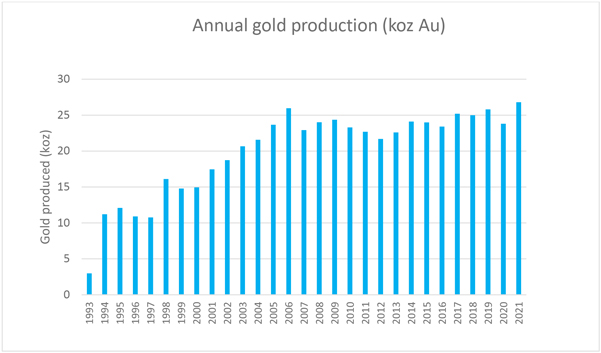
| Effective date: June 30, 2022 |
Page 50 of 236 |
| Aris Mining Corporation
|
Technical Report Marmato Gold Mine
|
7. Geological setting and mineralization
7.1. Regional geology
Marmato is located on the eastern side of the Western Cordillera, which forms the Colombian Andes along with the Central and Eastern Cordilleras. The three mountain ranges trend north to north-northeast, and are separated by two major basins, including the Cauca-Patia Depression and the Magdalena Depression. The Cauca River separates the Western Cordillera from the Central Cordillera. Marmato is within the Romeral terrane which is bound by the Cauca Fault to the west and the Romeral Fault to the east, and is part of the Pacific terrane, one of nine principal tectonic terranes in Colombia. A plan of the regional geology from Santacruz, et al. (2021) is shown in Figure 7.1.
The Marmato stock is part of Miocene aged magmatism characterized by calc-alkalic subvolcanic intrusions and volcanic rocks of the Combia Formation. The magmatism cross cuts the units of the Romeral terrane, the plutonic units of the Albian and early Cenozoic time periods, and the siliciclastic sequences of the Amagá Formation.
Miocene aged gold related magmatism in Colombia is notable in the Western and Central cordilleras associated with stocks. Late Miocene to Pliocene aged magmatism with gold mineralization has also been noted in the Santander Massif in the northern part of the Eastern Cordillera.
Figure 7.1 Regional geology plan
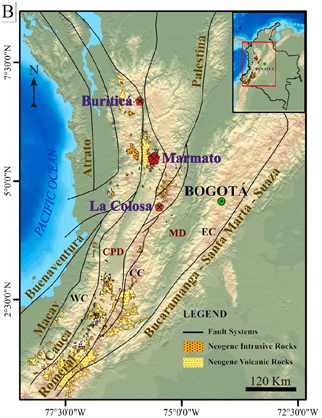
7.2. Local geology
The Marmato gold deposit is hosted in the 3 km long x 1.6 km to 2.5 km wide multiphase Marmato Porphyry Suite, which is located near the southern end of the porphyritic andesitic to dacitic late Miocene aged Marmato Stock, which is 18 km long x 3 km to 6 km wide. The Marmato Stock intrudes the Arquía Complex and the Amagá Formation on the east side in the Cauca Valley, and the Combia Formation on the west side.
| Effective date: June 30, 2022 |
Page 51 of 236 |
| Aris Mining Corporation
|
Technical Report Marmato Gold Mine
|
Five main early Miocene aged porphyry pulses have been identified in the Marmato Porphyry Suite and are named P1 to P5 from oldest to youngest. The Aguas Claras Porphyry Suite, located 3 km southwest of the Marmato Porphyry Suite, also has five identified porphyry pulses, named AP1 to AP5 from oldest to youngest. Two intrusive dikes of the Marmato Porphyry Suite, P3 and P5, cross cut the Aguas Claras Porphyry Suite. A plan of the local geology from Santacruz, et al. (2021) is shown in Figure 7.2.
Figure 7.2 Local geology plan
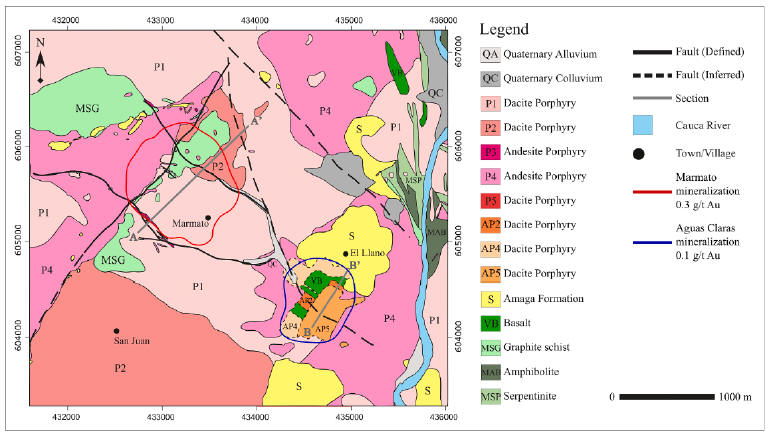
7.3. Property geology
| 7.3.1. Lithology |
At the Property, the five identified andesitic to dacitic Marmato Porphyry Suite intrusions are characterized by quartz, hornblende, biotite, and zoned plagioclase phenocrysts in a finely crystalline quartz-plagioclase groundmass, with variations in phenocryst proportion and sizes between intrusions. Mineralization is hosted in stocks P1 to P4, and is absent in P5, with nearly all of the mineral resources hosted in P1. Lithology interpretations have been made for the mineral resource estimate, including the Marmato Porphyry Suite, breccias, meta-sedimentary rocks, and volcanics. A cross section from Santacruz, et al. (2021), with a view to the northwest, of the five porphyries at the Property, is shown in plate A of Figure 7.3, and a cross section of the five Aguas Claras Porphyries is shown in Plate B. The location of the cross sections is indicated in Figure 7.2.
| Effective date: June 30, 2022 |
Page 52 of 236 |
| Aris Mining Corporation
|
Technical Report Marmato Gold Mine
|
Figure 7.3 Property geology cross sections
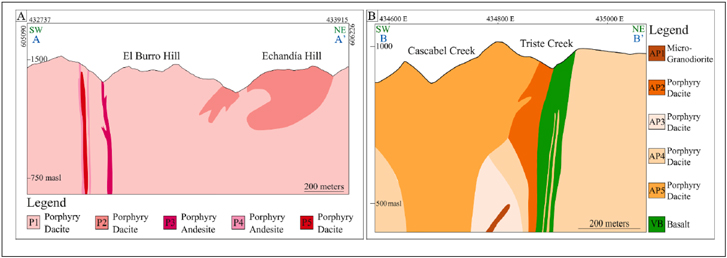
| 7.3.2. |
Marmato Porphyry Suite |
The P1 intrusion is the main dacite unit of the Marmato Porphyry Suite and comprises by far the largest volume of mineralized rock at the Property. It is overlain by quartz-sericite-graphite shales of the Arquia Complex, and contains small intrusions of the P4 andesite as well as the other porphyry intrusive bodies. The P1 dacite porphyry is a compact, granular rock characterized by large (5 millimetre, mm) quartz phenocrysts, hornblende, biotite, and plagioclase phenocrysts zoned with a fine granular matrix of quartz and plagioclases, with variable sizes and percentages.
The P2 porphyritic dacite intrusion is smaller than P1 and P4, and has only been observed in drill core. It is a hypocrystalline rock with medium grain size (finer than P1), light gray coloration, comprised of small sub-rounded quartz crystals accompanied by slightly zoned and epidotic plagioclase phenocrysts, biotite, and euhedral and chloritized amphiboles.
The P3 porphyritic andesite dikes have a northwest and east-west trend and are in contact with P1 in the Cascabel gorge and in Echandia, and also crosscut P1 and P2. They have slightly zoned euhedral plagioclase megacrystals with small subhedral crystals of plagioclase, biotite, hornblende, and lesser quartz and magnetite.
The P4 andesitic porphyry trends northeast, is approximately 1,600 m long x 750 m wide, forms a stock on the northwest side of Cerro Los Novios, and extends northeast through Echandia. Towards the southeast there are numerous P4 dikes with a northwest and east-west trend. It cross cuts P1, P2, and P3. The intrusions are grayish, massive, slightly equigranular, with scarce to no quartz, with abundant phenocrysts of coarse plagioclase with biotite, hornblende, and magnetite, with chlorite amphiboles.
The P5 porphyritic dacite intrusion cuts P1 in the Cascabel gorge and elsewhere. It has a massive, uneven, hypocrystalline texture, with small euhedral crystals of quartz and elongated plagioclase phenocrystals up to 10 mm in length, with biotite and hornblende crystals. P5 does not host mineralization.
| 7.3.3. |
Alteration |
Pervasive early propylitic alteration overprinted by phyllic and intermediate argillic alteration associated with intermediate sulfidation mineralization affects all of the porphyries, although it is weak in P5. Propylitic alteration is characterized by epidote replacement of plagioclase cores, albite replacement of plagioclase rims and matrix, chlorite replacement of mafic minerals, disseminated pyrite and pyrrhotite, and varies in intensity from veinlet-halo to pervasive. Calcite partially replaces plagioclase where propylitic alteration is weakly developed. Cross-cutting relationships show evidence of multiple propylitic alteration events related to each intrusion phase.
| Effective date: June 30, 2022 |
Page 53 of 236 |
| Aris Mining Corporation
|
Technical Report Marmato Gold Mine
|
Intermediate argillic alteration overprints the propylitic alteration and varies in intensity from vein/veinlet-halo to pervasive, associated with the intermediate sulfidation mineralization style and replaces epidote, chlorite, and albite. There is a strong and generally narrow halo of white to green illite or sericite alteration related to veins and veinlets of the mesothermal mineralization, which grades outward to pervasive illite, with distal smectite. The main disseminated sulfide is pyrite, although pyrrhotite and iron-rich sphalerite are also present.
Additionally, weak and patchy potassic alteration, represented mainly by biotite, occurs at depth in the Lower Mine. Progressively better preservation of early potassic alteration at depth may indicate the possibility of early gold-bearing phases.
Interpretations of shallow level epithermal hydrothermal alteration and mineralization and deeper level mesothermal alteration and mineralization have been made for the mineral resource estimate. Higher silver and gold grades are estimated with the epithermal style of mineralization associated with the Upper Mine, but the majority of the mineral resources are associated with the mesothermal style of mineralization of the Lower Mine due to the larger, bulk volumes of mineralization present at the Lower Mine.
| 7.3.4. |
Mineralization |
Marmato mainly comprises northwest and west-northwest trending veins and veinlets, with intermediate sulfidation epithermal and mesothermal mineralization styles transitioning with depth from the Upper to the Lower Mines. The veins outcrop at the surface, and within Aris Mining’s mining titles, mineralization extends vertically over 1,100 m and remains open at depth and along strike, and has a high expansion potential from future underground drilling programs.
The Upper Mine mineralization is characterized by epithermal mineralization comprising wider, parallel, sheeted, and anastomosing sulfide rich veins and veinlets with minor quartz, carbonate, pyrite, arsenopyrite, iron rich sphalerite, pyrrhotite, chalcopyrite, and electrum. Broad zones of intense veinlet mineralization hosted within a lower grade auriferous porphyry stock are locally referred to as “porphyry pockets” or “porphyry” mineralization.
In the Upper Mine, interpretations of 94 different veins and 53 zones of disseminated mineralization occurring directly in the hangingwall and footwall of the veins, and 89 discontinuous “splay” veins have been created for the mineral resource estimate. The mineral resource estimate of the porphyry “pocket” style mineralization has been undertaken using a grade indicator approach. The currently defined footprint of mineralization at the Upper Mine covers over 1,000 m east-west x 1,500 m north-south, and extends vertically for 350 m.
The Lower Mine mineralization is characterized by mesothermal fine veinlet (less than 5 cm thick) mineralization including quartz, pyrrhotite, chalcopyrite, bismuth sulfide, tellurides, and free gold, hosted primarily within the P1 porphyry unit. The steeply dipping, northwest trending veins are typically rimmed by a thin sodium-calcic alteration halo and the porphyry shows weak argillic and potassic alteration. The Lower Mine mineralization interpretation for the mineral resource estimate has been undertaken using a grade indicator approach to create low grade and high grade domains. The currently defined Lower Mine mineralization covers an area of 950 m northwest-southeast x 350 m northeast-southwest, over a vertical extent of 750 m.
| 7.3.5. |
Structure |
The dominant northwest and east-west trends of the veins are interpreted to have formed as tension fractures related to regional scale northwest-southeast compression and sinistral strike-slip movement on the north-south trending Cauca and Romeral Faults, which lie on either side of the deposit.
A 2010 review of the local and regional geology by Telluris Consulting Ltd (Telluris) to define a structural-hydrothermal model for Marmato concluded that the deposit is a series of north-northwest to east-west trending, steep to moderately dipping, gold bearing, sulfide rich veins hosted in a north-south trending late Miocene aged porphyry complex. Telluris noted that the porphyry complex was emplaced in folded and thrusted Paleozoic and Mesozoic aged metamorphic and sedimentary sequences adjacent to the eastern margin of the broadly north-
| Effective date: June 30, 2022 |
Page 54 of 236 |
| Aris Mining Corporation
|
Technical Report Marmato Gold Mine
|
south trending Cauca-Romeral terrane, accompanied by east-northeast to northwest-southeast compression. This resulted in north-south trending thrust and transpressional structures along with steep northwest and northeast conjugate fault zones.
Two principal deformation stages were recognized within the relatively young intrusive rocks of the Marmato deposit, including:
| ● |
Syn-mineralization west-northwest, east-southeast compression that reactivated some of the basement structures and generated a range of second order shear and extensional structures along north-northwest to east-west trends, as well as north-northeast trending thrusts. |
| ● |
Continued post-mineralization compression into the late Pliocene that resulted in uplift due to renewed thrusting along the main terrane boundaries, forming thrust-bounded intermontane basins such as the Cauca-Patia Depression. |
There are four principal trends of mineralized structures in the Marmato area, including:
| ● |
Northwest trending steep to subvertical faults and fractures |
| ● |
West-northwest trending steep to moderately inclined structures |
| ● |
East-west trending structures that have moderate to relatively low angle dips, including the Criminal, South, and Santa Ines faults. |
| ● |
East-northeast to northeast trending structures that show a range of dips, including the Obispo fault that generally limits mineralization to the northwest. |
In addition to the mineralized structures, a set of north-northeast trending structures of varying dip appear to represent different components of a reverse/thrust fault system. Both the west-northwest and east-west veins tend to splay from the main northwest structures, which is consistent with extensional and Riedel shear components to a sinistral shear system. Telluris reported that kinematic indicators show that mineralization accompanied a phase of west-northwest to east-southeast oriented compression. The north-northeast trending reverse faults and conjugate fractures reflect this compressional component.
Fault interpretations have been used in the mineral resource and reserve estimate to define separate fault blocks of the interpreted lithologies and alteration, including:
| ● |
The Cascabel fault is curvi-linear, moderately dipping, and wraps around or through the southern and western extents of the Upper Mine and Lower Mine mineralization |
| ● |
The Criminal fault is moderately dipping, east-west trending, crosses the Upper Mine mineralization, and lies to the northeast of the Lower Mine mineralization |
| ● |
The Santa Ines fault is moderately dipping, west-northwest trending, crosses the Upper Mine mineralization, and forms the northern boundary of the Lower Mine mineralization |
| ● |
The South fault is moderately dipping, west-northwest trending, crosses the Upper Mine mineralization, and lies to the south of the Lower Mine mineralization |
| ● |
Fault Two is moderately dipping, northwest trending, and crosses the Upper Mine and Lower Mine mineralization. |
| ● |
The Mellizos fault is steeply dipping, northwest trending, and crosses the Upper Mine and Lower Mine mineralization. |
| ● |
The Obispo fault is moderately steep dipping, northeast trending, crosses the northwest extents of the Upper Mine mineralization, and lies to the north of the Lower Mine mineralization. |
| ● |
The steeply dipping, northwest trending Fault 1-3 crosses the Upper Mine and Lower Mine mineralization. |
A plan view of the faults and vein interpretations on Level 20 at the 1,050 m elevation is given in Figure 7.4.
| Effective date: June 30, 2022 |
Page 55 of 236 |
| Aris Mining Corporation
|
Technical Report Marmato Gold Mine
|
Figure 7.4 Plan view of the principal faults
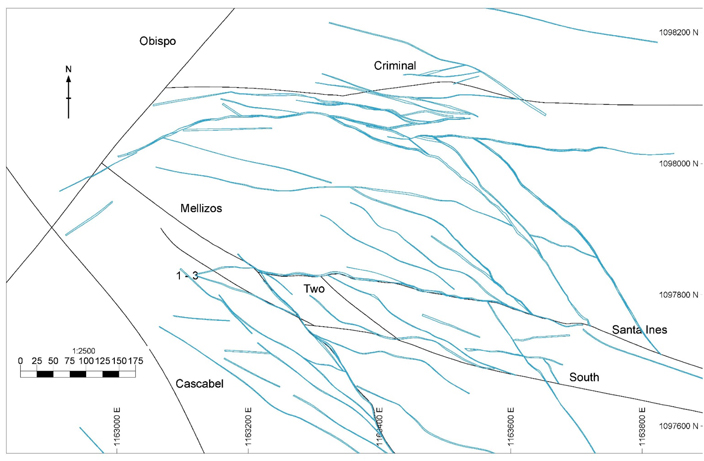
Post-mineral faults that trend steeply north to east-west with a moderate dip are located in the margins of some veins and veins with alteration to soft white clay gouge with ground pyrite. In places, coarse euhedral pyrite occurs in the clay gouge. Brittle faults without clay gouge are also noted. Northwest trending veins in the Lower Mine are observed to rotate counter clockwise to the northwest. They have competent wall rocks and do not require ground support, while the east-west veins are faulted with soft clay gouge and require ground support.
In the Lower Mine, mesothermal mineralization is hosted within veinlets developed in tension fractures that are arranged parallel to the main stress tensor that trends west-northwest, east-southeast, and is steeply dipping. The veinlets were reactivated and altered by subsequent epithermal events.
| Effective date: June 30, 2022 |
Page 56 of 236 |
| Aris Mining Corporation
|
Technical Report Marmato Gold Mine
|
8. Deposit types
Marmato is interpreted to be a porphyry hosted gold deposit with shallow epithermal and deeper mesothermal features and this interpretation has informed the exploration and mining plans.
The Upper Mine is distinguished by a sulfide rich, structurally controlled system of veins and veinlets of pyrite, arsenopyrite, iron-rich sphalerite, pyrrhotite, chalcopyrite, and electrum veins associated with biotite, sodic-calcic, and epidote-chlorite-carbonate alteration.
The Lower Mine is characterized by structurally localized veinlets of quartz, pyrrhotite, chalcopyrite, bismuth minerals, and free gold associated with illite-smectite and kaolinite alteration of the host rock. A transition zone approximately 200 m in vertical extent exists between the Upper Mine and Lower Mine mineralization, and is characterized by the extension of Upper Mine epithermal veins into the mesothermal style Lower Mine mineralization. These features indicate a reduced intrusion environment.
| Effective date: June 30, 2022 |
Page 57 of 236 |
| Aris Mining Corporation
|
Technical Report Marmato Gold Mine
|
9. Exploration
The majority of the historical exploration at Marmato has been by mining along the mineralized structures, while modern exploration has been undertaken by diamond drilling and underground channel sampling. The best exploration method for the deposit is by diamond drilling. The data collected from the drilling and channel sampling has been used as the basis for the geological interpretation and the mineral resource and reserve estimates.
9.1. Topography and underground surveys
Aerial photographs of the surface have been used since Colombia Goldfield’s tenure beginning in 2005, including a detailed 2 m resolution topography derived from satellite imagery in 2007, then expanded to a larger surface area at the end of 2008 to cover the location of additional future infrastructure. In 2019 a detailed topographic map with a resolution of between 0.5 and 1 m derived from LIDAR imagery was acquired.
Underground surveys have been basic and haphazard, with most of the workings surveyed using compass and tape and more recently by Global Positioning System (GPS), with a wide range of accuracy and with completeness limited to safely accessible open workings. Mineros Nacionales created digital drawings of the mine level plans from Level 16 to 21 and sections of all of the veins in Zona Baja, although the data collection method has not been documented. The underground workings are now surveyed using total station methods.
9.2. Geological mapping and rock chip (channel) sampling
Rock chip or channel samples have been taken from the faces, backs, cross cuts, and raises since Phelps Dodge’s tenure beginning in 1984. The channel sample database is not well documented in terms of operator and sample date. Most of the samples are taken in Zona Baja, then Zona Alta.
Conquistador, which held the Property between 1996 and 2000, took 1,147 channel samples totalling 2,847 m from surface trenches and underground. Samples were cut from channels 2 m long x 5 centimetres (cm) wide x 3 cm deep. Of these samples, 39 samples for 867 m from levels 16, 17, 18, and 19 are in the database.
Colombia Goldfields, which held the Property between 2005 and 2009, collected 918 channel samples for 2,750 m in Zona Alta and Level 16 of Zona Baja.
From 2011, cross cuts and each mining face have been channel sampled using a rock saw and chisel from cleaned cuts 6 to 10 cm high x 2 to 5 cm deep, with samples widths of between 0.5 and 2.0 m. Since 2020, some of the channels have been taken with an electric diamond saw. Faces are sampled approximately every 2 m following the mining advances. Most of the faces and cross cuts have been sampled across the full width of the opening, but some of the samples have been taken of only the vein material. Detailed geological and structural mapping and sample logging is also done during the sampling process. The channel sample coordinates are determined using tape and compass from a survey control point.
As of June 30, 2021, there was a total of 31,392 channels for a total of 53,343 m in the database. The majority of the samples are approximately 0.5 m wide from channels that are from 1 to 3 m wide. These channel samples have been used to estimate mineral resources and reserves, with a lower mineral resource confidence classification assigned to areas of the mine where channel samples have only been taken of the vein material. A long section with the location of the channels within the three mining titles, with lines indicating the level locations, is shown in Figure 9.1.
| Effective date: June 30, 2022 |
Page 58 of 236 |
| Aris Mining Corporation
|
Technical Report Marmato Gold Mine
|
Figure 9.1 Channel locations long section
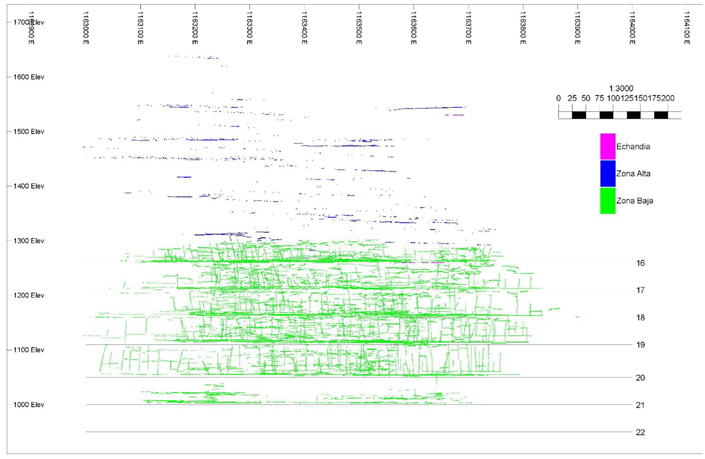
9.3. Geophysical surveys
Geophysical surveys were undertaken since at least 1985, but none of the data is available. Colombia Goldfields undertook magnetic and radiometric surveys in late 2007.
9.4. Material impact on the accuracy and reliability of sample data
The only exploration data used in the mineral resource estimate are diamond drillholes and channel samples of the underground mining operation. Aside from the practice of channel sampling only vein material in some sections of the mine, there are no known factors that may have resulted in sample biases. The channel samples taken only of the veins have been considered appropriately in the mineral resource classification. Channel samples are and have been historically taken in all active mine headings and are therefore representative of the active and past mining areas.
| Effective date: June 30, 2022 |
Page 59 of 236 |
| Aris Mining Corporation
|
Technical Report Marmato Gold Mine
|
10. Drilling
Several different owners have undertaken diamond drilling in Zona Alta, Zona Baja, and Echandia licenses over the history of the Project, which have been used for short term mine planning and mineral resource and mineral reserve estimates. Drilling has also been done for hydrological and geotechnical studies.
| 10.1. Summary |
A significant amount of drilling has been undertaken at Marmato since 1984 by successive operators including Phelps Dodge, Colombia Plc, Mineros Nacionales, Gran Colombia Resources, Conquistador, Colombia Goldfields, Medoro, GCM Mining, and Aris Mining. As is typical with a long life mining project, drilling protocols and standards have varied over time. The majority of the drilling has taken place since 1993, using industry standard methods.
As of the data cut-off date of June 30, 2021, there were 1,464 diamond drillholes totalling 314,874 m available in the database. A summary table of the drilling database is given in Table 10.1, a plan of all drillhole collar locations is given in Figure 10.1, a long section of all drillhole locations and drill spacing is given in Figure 10.2, and Figure 10.3 shows a plan of Level 19, with a 50 m window, indicating the drill spacing and orientation relative to the current mine workings.
The majority of the mineral resources are estimated using drilling data from Zona Baja supplemented with channel samples in the mine working areas. The drill coverage spacing is irregular due to the large number of mineralized trends and their variable orientations, challenging surface drilling access due to the steep topography, and the use of fan drilling. Similarly, the drill orientation relative to the strike and dip of the mineralized trends is reasonable in the shorter holes drilled from the levels, but becomes increasingly oblique in longer exploration holes. Since 2020, some of the deeper drilling has been undertaken using directional drilling methods to better control the location of the planned drillhole intersection with the mineralized trends. The long section of the drilling locations given in Figure 10.2 shows clusters of flat drillholes on the mine levels used to guide near term mining and clusters of fan drilling from underground drill stations. The location of surface drillholes and the downward slope of the topography towards the east is also evident in Figure 10.2.
Nearly all surface drill collars have been surveyed to a high degree of accuracy in the northings and eastings using a differential GPS and then adjusted to the topography. Underground drillhole collars have been surveyed by the mine survey department using differential GPS and total station methods and verified against the development surveys. The frequency of downhole surveys has been variable over time, with no surveys present for some of the older drillholes or for most of the short flat holes drilled from the levels. In Zona Baja, the median survey interval for surface drillholes is one survey every 66 m down hole, with ranges from 9 to 200 m, while the median survey interval for underground holes is every 35 m, with ranges from 1 to 552 m.
The majority of the holes are oriented to the south and southwest with the remainder oriented in the opposite direction to the north and northeast. Many of the holes have been oriented flat along the mining levels, or else oriented downward at angles ranging from 40 to 70°.
Table 10.1 Drilling summary
|
Location |
Year |
Operator |
Collar location |
Number of holes |
Metres drilled | |||||
| Zona Baja |
1984-1985 |
Phelps Dodge |
Underground |
6 |
696 | |||||
| Zona Baja |
2009 |
Mineros Nacionales |
Surface |
3 |
498 | |||||
| Zona Baja |
1993-2009 |
Mineros Nacionales |
Underground |
199 |
17,439 | |||||
| Zona Baja |
1996-2000 |
Conquistador |
Surface |
29 |
11,176 | |||||
| Zona Baja |
1996-2000 |
Conquistador |
Underground |
14 |
3,377 | |||||
| Zona Baja |
2010-2011 |
Medoro |
Surface |
33 |
14,246 | |||||
| Zona Baja |
2010-2011 |
Medoro |
Underground |
33 |
4,428 | |||||
|
Zona Baja |
2011 |
Gran Colombia Gold |
Surface |
4 |
1,881 |
| Effective date: June 30, 2022 |
Page 60 of 236 |
| Aris Mining Corporation
|
Technical Report Marmato Gold Mine
|
|
Location |
Year |
Operator |
Collar location |
Number of holes |
Metres drilled | |||||
|
Zona Baja |
2011-2020 |
Gran Colombia Gold |
Underground |
491 |
79,248 | |||||
|
Zona Baja |
2020-2021 |
Aris Mining |
Underground |
80 |
33,270 | |||||
| Total Zona Baja |
Surface |
69 |
27,802 | |||||||
| Underground |
823 |
138,458 | ||||||||
| Total |
892 |
166,260 | ||||||||
| Zona Alta |
1996-2000 |
Conquistador |
Surface |
4 |
320 | |||||
| Zona Alta |
2007-2008 |
Colombia Goldfields |
Surface |
201 |
46,007 | |||||
| Zona Alta |
2007-2008 |
Colombia Goldfields |
Underground |
3 |
314 | |||||
| Zona Alta |
2010-2011 |
Medoro |
Surface |
139 |
48,639 | |||||
| Zona Alta |
2011 |
Medoro |
Underground |
1 |
180 | |||||
| Zona Alta |
2011 |
Gran Colombia Gold |
Surface |
36 |
14,123 | |||||
|
Zona Alta |
2011 |
Gran Colombia Gold |
Underground |
18 |
2,453 | |||||
| Total Zona Alta |
Surface |
380 |
109,089 | |||||||
| Underground |
22 |
2,947 | ||||||||
| Total |
402 |
112,036 | ||||||||
| Echandia |
1996-1997 |
Gran Colombia Resources |
Surface |
36 |
7,231 | |||||
| Echandia |
1996-1997 |
Gran Colombia Resources |
Underground |
39 |
3,954 | |||||
| Echandia |
2005 |
Colombia Gold Plc |
Surface |
20 |
5,933 | |||||
| Echandia |
2007-2008 |
Colombia Goldfields |
Surface |
1 |
56 | |||||
| Echandia |
2010 |
Medoro |
Surface |
19 |
7,816 | |||||
| Echandia |
2011-2012 |
Gran Colombia Gold |
Surface |
15 |
7,101 | |||||
|
Echandia |
2011-2021 |
Gran Colombia Gold |
Underground |
40 |
4,487 | |||||
| Total Echandia |
Surface |
91 |
28,137 | |||||||
| Underground |
79 |
8,441 | ||||||||
| Total |
170 |
36,578 | ||||||||
| Total Marmato titles |
Surface |
540 |
165,029 | |||||||
| Underground |
924 |
149,846 | ||||||||
| Total |
1,464 |
314,874 |
| Effective date: June 30, 2022 |
Page 61 of 236 |
| Aris Mining Corporation
|
Technical Report Marmato Gold Mine
|
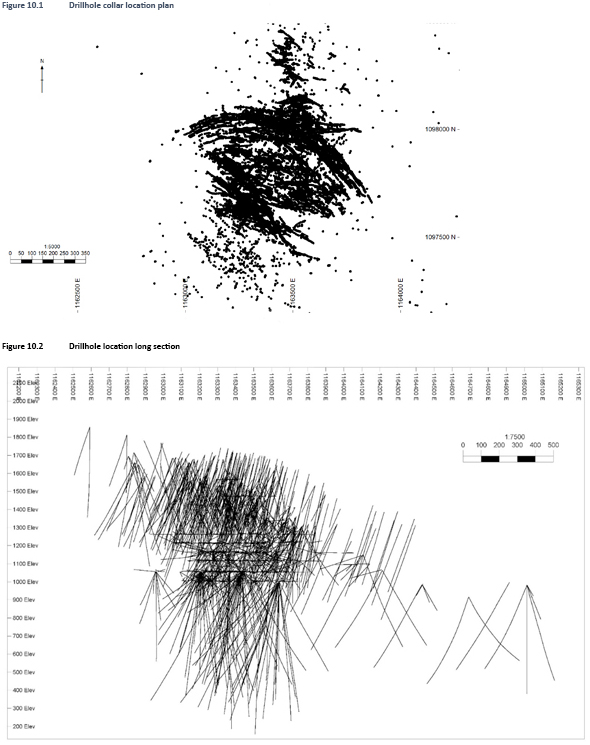
| Effective date: June 30, 2022 |
Page 62 of 236 |
| Aris Mining Corporation
|
Technical Report Marmato Gold Mine
|
Figure 10.3 Plan view of drillholes and mine workings on Level 19
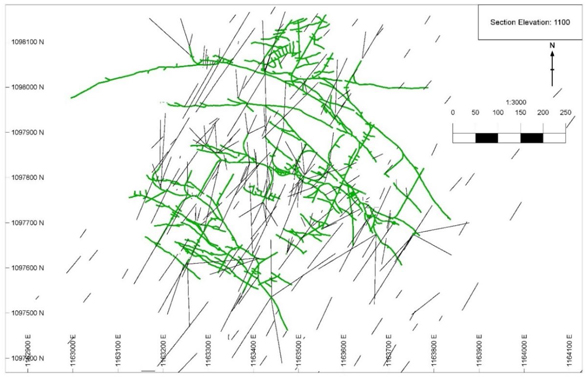
| 10.2. |
Zona Baja |
| 10.2.1. |
Phelps Dodge |
The first known drilling was by Phelps Dodge between 1984 and 1985, who drilled 696 m into the Upper Mine mineralization from 6 underground diamond holes from Level 18. These holes were oriented downwards towards Level 19, with lengths ranging from 70 to 175 m. No details are known of the drilling protocols and no downhole surveys were taken.
| 10.2.2. |
Mineros Nacionales |
Between 1993 and 2009, Mineros Nacionales drilled three holes from the surface for 498 m and 199 holes from underground for 17,439 m, mostly oriented flat, from Levels 16, 17, 18, 19, and 20, to guide their short term mining plans. Hole lengths ranged from 9 to 237 m, and no downhole surveys were taken. None of the Mineros Nacionales holes detected the Lower Mine mineralization.
| 10.2.3. |
Conquistador |
Conquistador drilled 43 holes for 14,553 m between 1996 and 2000 during their option agreement period with Mineros Nacionales. Of these, 29 holes for 11,176 m were drilled from the surface, mostly at around the 1,300 m elevation towards the eastern side of the deposit, with lengths ranging from 42 to 600 m. The remaining 14 holes for 3,377 m were drilled from underground from the middle of Level 18, oriented towards targets above and below Level 18, with lengths ranging from 39 to 600 m. Some of the deeper holes nearly approached the edges of the Lower Mine mineralization. Most of these holes have no downhole surveys.
| 10.2.4. |
Medoro |
Medoro drilled 33 surface holes for 14,246 m and 33 underground holes for 4,428 m between 2010 and 2011. Surface holes and longer underground holes had downhole surveys, but the majority of the underground holes were oriented flat and had no downhole surveys. Surface holes ranged in length from 60 to 700 m, and underground holes ranged from 35 to 360 m long. The underground holes were drilled from Levels 16, 17, 18, 19, and 20, mostly
| Effective date: June 30, 2022 |
Page 63 of 236 |
| Aris Mining Corporation
|
Technical Report Marmato Gold Mine
|
oriented downwards, but none of them extended into the Lower Mine mineralization.
| 10.2.5. |
GCM Mining |
GCM Mining completed four surface holes for 1,881 m and 491 underground holes for 79,248 m between 2011 and 2020. Soon after acquiring Marmato, GCM Mining began drilling deeper holes to test the down dip extents of the deposit and announced the discovery of the Lower Mine mineralization in January 2012. Underground holes were drilled from levels 16, 17, 18, 19, 20, and 21, with holes as deep as 1,012 m. About a quarter of the holes were surveyed at a median interval of one survey every 23 m downhole by a Flexit Multishot tool, then later by a digital gyro surveying tool.
| 10.2.6. |
Aris Gold |
All of Aris Gold’s drilling has been from underground. Aris Gold drilled 80 holes for 33,270 m from early 2020 and the data cut-off date of June 30, 2021. Some of the holes were drilled flat on the Upper Mine levels to guide in short term planning, but the majority were longer exploration holes targeting the Lower Mine mineralization with a focus on infilling existing drillhole patterns and testing new targets to the east, with positive results. Hole lengths range from 8 to 1,027 m.
Grade control and infill drilling in the Upper Mine is conducted using two drill rigs now owned by Aris Mining, including an Ingertol Ultra 20E-RH and a Diamec 232, with core diameters of 35 mm, and one LCUG-150 drill rig owned and operated by Logan Drilling of Canada, producing NQ sized drill core.
Conventional exploration drillholes were drilled by Explomin of Lima, Peru using Versadrill KmN1.4U and Tecdrill H400 drill rigs and by Logan Drilling of Canada using LCUG-800 drill rigs. Directional drilling was conducted by Styr Drilling of Santiago in some of the longer holes to achieve the planned intersection locations. Drillhole diameters were HQ for the first approximately 400 m then reduced to NQ diameter, producing BQ sized drill core during the curved part of the hole, then the remainder of the hole was completed with NQ diameter core.
Downhole surveys were taken every metre downhole with a Stockholm Precision Tools gyro or with a Reflex EZ-Trac at less frequent intervals. All of the longer holes have downhole surveys at a median interval of one survey every 19 m downhole.
| 10.3. |
Zona Alta |
| 10.3.1. |
Conquistador |
Between 1996 and 2000, Conquistador drilled four underground drillholes for 320 m in the southeast of Zona Alta, with one of the longest holes terminating in the upper portions of Zona Baja, barely reaching the currently defined mineral resources. None of these holes had downhole surveys.
| 10.3.2. |
Colombia Goldfields |
Colombia Goldfields began a mostly surface based exploration drilling program in early 2007 which was terminated in September 2008 due to the global financial crisis. By then, 205 holes for 46,007 m had been completed by 18 different drill rigs operated by four different contractors. Of these holes, 201 were drilled from surface for a total of 46,007 m and three were drilled from underground for 314 m. Holes averaged 227 m in length with the longest hole at 587 m. The majority of these holes were drilled above or to the north of the workings in Zona Baja.
Colombia Goldfield’s diamond drilling was carried out by Terramundo Drilling Inc of Bucaramanga, Colombia, Kluane Colombia E. U. of Bogota, Colombia, El Consorcio California (also known as GeoEvaluaciones) of Medellin, Colombia, and Andina de Perforaciones S. A. of Cundinamarca, Colombia. Numerous core diameters were used ranging from BQ, BTW, NQ, NTW, and HQ. Drill recoveries ranged from 84 to 89%, with daily average drill advances ranging from 21 to 68 m. Drilling conditions were challenging considering the steep terrain. Initial drilling was planned on sections located 100 m apart and adapted as necessary to deal with topographic and logistical
| Effective date: June 30, 2022 |
Page 64 of 236 |
| Aris Mining Corporation
|
Technical Report Marmato Gold Mine
|
restraints. Drill collars were surveyed using differential GPS and downhole surveys were conducted using a Flexit Multishot tool and a GyroSmart digital gyro tool at a median interval of one survey every 26 m downhole.
| 10.3.3. |
Medoro |
Medoro drilled one underground hole for 180 m and 139 surface holes for 48,639 m between 2010 and 2011. All of the longer holes had downhole surveys at a median rate of one survey for every 31 m downhole.
| 10.3.4. |
GCM Mining |
GCM Mining drilled 36 surface holes for 14,123 m and 18 underground holes for 2,453 m in 2011. Hole lengths ranged from 44 to 696 m, and nearly all had downhole surveys.
| 10.4. |
Echandia |
| 10.4.1. |
Gran Colombia Resources |
Gran Colombia Resources conducted drilling from mid-1996 to mid-1997 comprised of 75 diamond holes for 11,185 m. Of these, 36 NX diameter holes were drilled from surface totalling 7,231 m, with lengths ranging from 76 to 527 m. The remaining 3,954 m were 39 BX diameter underground drillholes with lengths ranging from 17 to 160 m. Only a few of the holes had downhole surveys, at a median rate of 1 survey every 61 m downhole.
| 10.4.2. |
Colombia Gold Plc |
In 2005, Colombia Gold Plc drilled 20 HQ diameter diamond holes from surface for 5,933 m, which were reduced to NQ diameter at around 200 m downhole. Hole lengths ranged from 51 to 560 m. The drill contractors were Terramundo Drilling Inc of Bucaramanga, Colombia. Generally widely spaced downhole surveys were done by single shot Pajari or multi-shot Flexit surveying instruments. The median downhole survey interval is one survey every 55 m. Drill collars were surveyed using differential GPS.
| 10.4.3. |
Colombia Goldfields |
Colombia Goldfields drilled one surface hole for 56 m in 2007, with frequent downhole surveys.
| 10.4.4. |
Medoro |
Medoro drilled 19 surface holes for 7,816 m in 2010. Hole lengths ranged from 82 to 680 m. Downhole surveys were usually taken every 10 or 15 m downhole.
| 10.4.5. |
GCM Mining |
GCM Mining drilled 15 surface holes for 7,101 m and 40 underground holes for 4,487 m between 2011 and 2012. Hole lengths ranged from 11 to 900 m. Downhole surveys were only taken for surface holes, at an interval of around one survey every 15 m downhole.
| 10.5. |
Material impact on the accuracy and reliability of drilling results |
The drilling at the property has been conducted by numerous operators using a wide variety of drilling machines, drill operators, drilling protocols, drill core diameters, and downhole survey methodologies and frequencies, using industry standard procedures at the time of drilling. Sample recovery has not been consistently recorded, however, review of the historical drillholes indicates that sample recovery is not a significant issue. There are no known drilling, sampling, or recovery factors that could materially impact the accuracy and reliability of the results, and the data is considered suitable for the estimation of mineral resources and mineral reserves.
| Effective date: June 30, 2022 |
Page 65 of 236 |
| Aris Mining Corporation
|
Technical Report Marmato Gold Mine
|
| 11. |
Sample preparation, analyses, and security |
| 11.1. |
Summary |
As with the diamond drilling history, the sampling, sample preparation, analysis, and security protocols have varied over time as Property ownership changed, and not all of the details are known. The laboratory certification details are also not always known and the details are provided where they are known. Both drillhole and channel samples have been collected and submitted for preparation and analysis, and the results have been used to estimate mineral resources and mineral reserves.
| 11.2. |
Sampling, sample preparation, sample analysis, QAQC, and security protocols |
| 11.2.1. |
1984 to 1985 – Phelps Dodge |
The drillhole sampling, sample preparation, sample analysis, QAQC and security protocols undertaken by Phelps Dodge are unknown, and no geological logging data is available. Sample widths were variable, and frequently at 0.5 and 1.0 m.
| 11.2.2. |
1989 to 2010 – Mineros Nacionales |
The drillhole and channel sampling and security protocols undertaken by Mineros Nacionales are also unknown. Drill core was logged for lithology and sampled on irregular lengths in the area of interest, and frequently at 1 and 2 m intervals. Channel samples were also taken at variable widths, most frequently at 0.5 m. No QAQC samples were submitted.
Mineros Nacionales prepared and analyzed samples at their own uncertified mine laboratory. Samples were dried and the entire sample was jaw crushed to greater than 95% passing less than 5 mm, riffle split to reduce the sample size to a 200 to 300 g sub-sample, and pulverized in a disc mill to greater than 80% passing -200 mesh. The pulverized sample was further split and then assayed for gold and silver by fire assay with gravimetric finish.
Medoro made check assays of 744 of Mineros Nacionales’ mine samples by taking channel samples across the vein in stope and development drives throughout the mine. The channel samples were hand chiselled and weighed approximately 1 kg. The samples were crushed at the Mineros Nacionales mine lab to greater than 95% passing 5 mm, riffle split to a 200 to 300 g sample, and pulverized and assayed at the mine laboratory. Medoro also obtained the coarse rejects for independent analysis and submitted them to the commercial SGS (ISO 9001 certified) preparation laboratory in Medellín. The samples were dried, re-crushed to greater than 95% passing -2 mm, then riffle split to a 250 to 500 g sub-sample, and pulverized to greater than 95% passing -140 mesh in chrome steel bowls in a vibrating ring mill. SGS in Lima Peru assayed the pulverized samples for gold by fire assay on a 30 g charge with atomic absorption spectrometry (AAS) finish and for silver by aqua regia with AAS finish or by three acid digestion with AAS finish. Samples with grades greater than 10 g/t gold were re-assayed by fire assay with gravimetric finish and samples greater than 100 g/t silver were repeated by four acid digestion and AAS finish. The pulp was also split for assay at Inspectorate Peru (ISO 9001:2000 and ISO 9002:1994 certified). QAQC samples were submitted with this program and any failed batches were re-assayed. The results indicated a high bias of around 24% at the Mineros Nacionales laboratory.
| 11.2.3. |
1995 to 1997 – Gran Colombia Resources |
The drillhole sampling, sample preparation, sample analysis, and security protocols undertaken by Gran Colombia Resources are unknown. Basic lithology logging data is available from their drillholes. Samples from surface holes were generally taken at 1 m intervals, respecting lithological boundaries, while underground holes were sampled at wider, irregular intervals averaging 1.8 m.
| 11.2.4. |
1996 to 2000 – Conquistador |
Conquistador’s drill core samples were logged for lithology and alteration, then sawed in half and sampled in mostly 2 m intervals. Hand chiselled channel samples were also taken mostly at 2 m lengths from channels measuring 2 m
| Effective date: June 30, 2022 |
Page 66 of 236 |
| Aris Mining Corporation
|
Technical Report Marmato Gold Mine
|
long x 5 cm wide x 3 cm deep. The security protocols are unknown and no QAQC samples were submitted.
Conquistador’s samples were prepared by Barringer Laboratories Inc. at their Medellín facility and assayed at Barringer’s Golden, Colorado facility. The sample preparation method is unknown. Samples were assayed for gold by fire assay with AAS finish with some high grade samples re-done by fire assay with gravimetric finish. The samples were assayed for silver by acid digestion with AAS finish.
Medoro made check assays of Conquistador’s samples by preparing a new sample pulp from riffle split coarse rejects of 285 core samples. Quarter core duplicates were prepared from 99 core samples by cutting the second half of the sample in half. These samples were prepared by Inspectorate’s laboratory in Medellín and assayed for gold and silver by Inspectorate’s laboratory in Lima, Peru. The samples were dried, jaw crushed to greater than 85% passing -10 mesh, split in a Jones splitter to obtain a 250 to 500 g subsample, and pulverized in a ring mill to greater than 80% passing -150 mesh. Samples were assayed for gold by fire assay on a 29.2 g charge with AAS finish and silver was assayed by aqua regia digest and AAS finish. Samples above 3.0 g/t gold were repeated by fire assay with gravimetric finish on a 29.2 g charge and samples above 200 g/t silver were repeated by fire assay with gravimetric finish on a 29.2 g charge. QAQC samples were submitted with the check assay campaign with failed batches re-assayed by the laboratory. No significant issues were identified with the QAQC data.
| 11.2.5. |
2005 to 2009 – Colombia Goldfields |
Colombia Goldfield’s drill core was placed in the core boxes with wood downhole depth markers at the end of each drill run, and the lids were nailed shut when the box was filled. The drill core boxes were claimed by company geologists or technicians at the drill platform and transported by hand or by mule to the nearest road or trail and then transported to the core shed by pickup truck or trailer mounted quad bike. At the core shed the core was washed, the boxes were permanently marked with the box number, hole number, drilling interval, and other data, and the core was photographed.
The core was logged for geotechnical features and mineralization to guide the selection of the sample intervals. Most of the samples were taken at 2 m lengths and adjusted to the vein and geology boundaries. The minimum sample length was 0.5 m, typically in the vein. The geologist aligned the drill core in the box and marked a cutting line along the core axis to ensure equal sampling by cutting the core perpendicular to the orientation of the dominant vein or veinlets. The core was cut in half with a diamond bladed saw and one half of the core was sealed in a plastic or cloth bag, then sealed with other bags in larger outer bags for transport. The core samples were transported by company vehicle to the company warehouse in Medellín, then transported by company vehicle to the sample preparation laboratories in Medellín. After sampling, the core trays with the second half of the core were photographed again and transported by company vehicle or local transportation company to the company warehouse in Medellín for storage.
Continuous channel samples were taken from all accessible cross cuts, as well as channels of faces, veins, and backs. Samples were hand chiselled from channels measuring 5 to 8 cm wide x 1 to 2 cm deep. Following concerns of the quality of the hand chiselled samples, the samples were taken using a hand-held core saw. Separate samples were taken of the hangingwall, vein, and footwall material, and where no discrete vein existed, a single sample of stockwork was taken. Sample lengths were irregular but frequently at 2 m intervals and any vein over 0.15 m wide was sampled separately. Samples were collected in plastic bags and then sealed in cloth bags. The channel samples were boxed, the boxes were sealed with tape and stored in a locked room at the camp, then transported by company vehicle to the company warehouse in Medellín and either air freighted or couriered to the sample preparation laboratory.
Colombia Goldfield’s samples were initially prepared by Inspectorate at their Medellín laboratory and assayed at their Sparks, Nevada laboratory (ISO 9001:2000 and ISO 9002-1994 certified). Following QAQC issues, the Sparks laboratory was discontinued and samples were assayed from late 2007 onward by Inspectorate’s laboratory in Lima, Peru.
| Effective date: June 30, 2022 |
Page 67 of 236 |
| Aris Mining Corporation
|
Technical Report Marmato Gold Mine
|
Samples were also prepared by SGS Colombia (ISO 9001 certified) at their Medellín or Barranquilla, Colombia sample preparation facilities and assayed by SGS Peru at their analytical laboratory in Lima to cover the backlog of samples caused by delays at Inspectorate.
At the Inspectorate preparation laboratory in Medellín, the samples were dried and crushed to greater than 70% passing -10 mesh in a jaw crusher and roll mill then later to greater than 85% passing -10 mesh in a jaw crusher. The crushed sample was split to a 250 to 500 g sub-sample in a Jones splitter, and pulverized to 90% passing -150 mesh in a ring mill.
The samples were assayed at Inspectorate’s laboratory in Sparks for gold and silver by fire assay on a 29.2 g charge with AAS finish. Any sample above 3 g/t gold and/or above 200 g/t silver was repeated by fire assay with gravimetric finish. QAQC samples were submitted and any failed batches were re-assayed until the samples passed. Only samples that passed the QAQC protocol were used for mineral resource estimates.
At the SGS Medellín and Barranquilla laboratories, samples were dried, jaw crushed in two stages to greater than 95% passing -6 and -2 mm, riffle split to a 250 to 500 g sub-sample, and pulverized to greater than 95% passing -140 mesh in chrome steel bowls in a vibrating ring mill.
At the Inspectorate laboratory in Lima, samples were assayed for gold and silver using fire assay on a 30 g charge with gravimetric finish and AAS finish. Silver was assayed by aqua regia digestion and AAS finish. Samples with gold grades greater than 3 g/t were repeated by fire assay on a 30 g charge with gravimetric finish, and samples with silver grades greater than 200 g/t were repeated by fire assay on a 30 g charge with gravimetric finish.
At the SGS Peru laboratory, samples were assayed for gold by fire assay on a 30 g charge with AAS finish. Any gold assay above 5 g/t was repeated by fire assay on a 30 g charge with gravimetric finish. Silver was assayed by nitric and hydrochloric acid digestion and inductively coupled plasma finish. Any sample above 100 g/t silver was repeated by multi-acid digestion and AAS finish.
The first industry standard quality assurance and quality control protocols at the mine were established by Colombia Goldfields in December 2005, which has been refined over time. The first protocols used several different certified reference standards with a range of gold grades purchased from Rocklabs Limited of New Zealand. Blank samples were initially comprised of a coarse quartz sand washed from a Colombian sourced kaolinized granite, then later comprised of fine quartz purchased from a swimming pool supply store in Medellín. The fine quartz was noted to be too fine to adequately measure all potential contamination points, and a coarse quartz blank purchased from Medellín was used after August 2007. Colombia Goldfields also submitted quarter core and sample pulp duplicates to the original laboratories and check assays to ALS Chemex in Vancouver, Canada. QAQC samples were submitted at a frequency of five standards, two blanks, two quarter core duplicates, and two pulp duplicates for every 100 samples. Any sample batches with failed standard results were re-analysed until the assays passed.
In 2007 Colombia Goldfields were experiencing considerable quality control issues at the Inspectorate laboratory in Sparks. Those batches were repeatedly re-analyzed at the Sparks laboratory or Inspectorate’s Lima laboratory until the quality control samples passed and the final results were retained in the database.
In 2008, Micon International reviewed Colombia Goldfields’ sample preparation and analyses, QAQC, and security protocols (Micon, 2008). Micon had concerns with the representativity of the channel samples and made recommendations to sample hangingwall and footwall material in addition to the vein material. Micon found that the QAQC procedures conformed to industry standards and were adequate for mineral resource estimates.
Additional testwork by Colombia Goldfields include screen metallic test work to assess the presence of coarse gold, and comparisons of saw-cut samples and hammer and chisel cut samples.
| Effective date: June 30, 2022 |
Page 68 of 236 |
| Aris Mining Corporation
|
Technical Report Marmato Gold Mine
|
| 11.2.6. |
2009 to 2011 – Medoro |
Medoro continued with the existing sample preparation and security protocols. Medoro logged the drill core for lithology and alteration, and sampled the entire length of the drillhole at mostly 2 m intervals, and less frequently at 1.0 and 1.5 m lengths.
Medoro’s primary laboratory was Acme Laboratories with sample preparation in Medellín and analysis in Santiago, Chile. SGS in Lima, Peru was used as a check laboratory. The samples were crushed to 85% passing -10 mesh, split to 250 to 300 g in a Jones splitter, and pulverized to 90% passing -150 mesh in a pulverizing ring mill.
At the Acme laboratory in Santiago, samples were assayed by fire assay with AAS finish. Samples greater than 10 g/t Au were re-assayed by fire assay with gravimetric finish. Silver was assayed by aqua regia digestion and AAS finish. Samples greater than 100 g/t were re-assayed by fire assay with gravimetric finish.
Samples prepared at the mine laboratory were jaw crushed to 95% passing 5 mm, riffle split to a 200 to 300 g sub-sample, and pulverized in a disc mill to 80% passing -200 mesh. Samples were assayed by fire assay with gravimetric finish.
SRK undertook a site visit to Marmato in 2010 and 2011, and visited the Acme sample preparation laboratory in Medellín in 2010. SRK reviewed the sampling, sample preparation, analytical methods, security, and QAQC protocols and results and considered the protocols to be in line with industry best practice. No issues were detected with the standard sample results and no issues with sample contamination were detected in the blank sample data. No significant differences were noted in the duplicate samples, indicating low inherent variability in the mineralization.
| 11.2.7. |
2011 to 2020 – GCM Mining |
GCM Mining continued and improved upon the existing sampling and security protocols. Underground core boxes were transported to the core shed in a company vehicle and laid out on racks for logging and sampling. The drill core was cleaned and the downhole lengths measured and reconciled against the driller’s depth markers. Downhole intervals were marked every metre on the core, then the sample recovery percent was recorded. The core was logged for geotechnical data, structure, lithology, alteration, and mineralization.
The geologists aligned the drillcore in the core tray to ensure that the sample was cut along the long axis of the geological features. Samples were selected according to geological features with a minimum sample length defined depending on core diameter to ensure an optimal sample weight, with lengths frequently at 0.4, 0.5, and 2.0 m. The entire length of the drillhole was sampled until 2017, when samples were taken selectively in the area of interest. Prior to cutting, the core was photographed, then the core was cut in half with a diamond bladed saw, with one half returned to the core box for future reference and the other half sealed in a sample bag with a sample ticket. The samples were transported by an external transport company to the company warehouse in Medellín and then collected from the warehouse by SGS Medellín. The second half of the sample was returned to the box and stored in covered racks at the core shed.
Channel samples were located by tape measure from a surveyed point in the backs. The site was cleaned with water and a wire brush and the sample intervals were marked with spray paint in intervals of approximately 30 to 40 cm, depending on geological features. A clean plastic bag was used to collect the hand chiselled sample from a channel five cm wide x three cm deep. The sample was sealed in the bag with a sample ticket and transported by company vehicle to the mine office for insertion of QAQC samples, then transported by an external transportation company to the site laboratory for preparation and analysis.
Prior to 2017, GCM Mining’s samples were prepared by Acme Laboratories at their Medellín sample preparation facility and assayed at Acme’s analytical laboratories in Santiago, Chile. SGS Lima was used as a check laboratory. After 2017, the primary laboratory for both sample preparation and analysis of exploration drill core was SGS Laboratories in Medellín and the primary laboratory for mine grade control drilling was ALS.
| Effective date: June 30, 2022 |
Page 69 of 236 |
| Aris Mining Corporation
|
Technical Report Marmato Gold Mine
|
At Acme’s Medellín sample preparation facility, the sample was dried, jaw crushed to greater than 85% passing -10 mesh, split to a 250 to 300 g sub-sample in a Jones splitter, and pulverized to greater than 90% passing -150 mesh in a pulverizing ring mill. At Acme’s Santiago analytical laboratory, the samples were assayed by fire assay with gravimetric finish and silver was assayed by aqua regia digest with AAS finish. Assays greater than 10 g/t gold and 100 g/t silver were re-assayed by fire assay with gravimetric finish.
Samples prepared by SGS Laboratories in Medellín were assayed for gold and silver by fire assay on a 30 gram (g) charge.
Channel samples prepared at the mine laboratory were dried, jaw crushed to greater than 95% passing 5 mm, riffle split to a 200 to 300 g sub-sample, and pulverized to greater than 80% passing -200 mesh in a disc mill. Assays for gold and silver were by fire assay with gravimetric finish.
QAQC submissions included several certified reference standards purchased from Rocklabs, Geostats, and OREAS at a range of grades, two blanks, two pulp duplicates, two coarse reject duplicates, and two field duplicates for every 100 samples. A database manager was responsible for tracking the samples through the laboratory, receiving the results, and importing them into the database. The QAQC sample results in each batch were reviewed, and if any sample results were out of compliance with the performance goals, the chief geologist was notified and discussions were held with the laboratory. In the event of a QAQC failure, the entire sample batch or sample tray was re-assayed.
SRK undertook site visits in 2012, 2017, and 2019, and reviewed the drilling, logging, sampling, security, sample preparation, sample analysis, and QAQC protocols and was of the opinion that the protocols were consistent with generally accepted industry best practices, and that the drillholes and samples were representative of the geology. SRK reviewed the QAQC results and noted no material bias in the certified standards, no indication of sample contamination, and reasonably good grade correlations in pulp and field duplicates compared to the original sample.
| 11.2.8. |
2020 to present – Aris Gold |
Aris Gold’s sampling, sample preparation and analysis, security, and QAQC protocols have followed those of GCM Mining. Exploration drillholes are prepared and analysed by SGS Laboratories in Medellín with check assays by ALS Laboratories in Lima, Peru. Underground channel samples and grade control drilling are prepared and analysed at the internal mine laboratory. At SGS the samples are crushed to 90% passing 2 mm and pulverized to 95% passing 75 microns (µm). Samples are assayed for gold by fire assay with AAS finish and for silver by multi acid digest and AAS finish. Samples with grades greater than 10 g/t Au are re-assayed by fire assay with gravimetric finish. At the mine laboratory, samples are dried, jaw crushed to greater than 95% passing 5 mm, riffle split to a 200 to 300 g sub-sample, and pulverized to greater than 80% passing -200 mesh in a disc mill. Assays for gold and silver are by fire assay with gravimetric finish.
QAQC submissions include fine and coarse blanks, a range of commercially prepared certified standards, and duplicate samples comprising of pulps, coarse rejects, and half core. A review of the 2020 and 2021 QAQC results show only one failed blank sample indicating a very low risk of sample contamination, no evidence of grade bias in the standards with only a few failures likely associated with standard labelling mistakes, and reasonably good grade correlations in the duplicate samples.
| 11.3. |
Bulk density measurements |
Bulk density measurements have been made by Colombia Goldfields, Medoro, GCM Mining, and Aris Gold. There are 3,492 bulk density measurements in the database with the majority taken in the P1 porphyry, which has a mean bulk density of 2.67 g/cm3. Very few measurements have been made on vein material, which has highly variable bulk density values ranging from 2.01 to 4.75 g/cm3. Based on discussions with the Aris Mining mine geology team and the work of the mine planning team, a value of 2.95 g/cm3 was applied to vein material in the mineral resource
| Effective date: June 30, 2022 |
Page 70 of 236 |
| Aris Mining Corporation
|
Technical Report Marmato Gold Mine
|
estimate. Work is underway by Aris Mining to increase the number of density measurements in spatially and geologically representative locations.
GCM Mining selected one piece of drill core per day for bulk density measurement. The core was cut in half, the volume was determined using calipers, and the sample was weighed to determine the density.
Aris Mining geologists routinely select drill core for bulk density measurements. A piece of unbroken core is selected from the tray, then a 15 cm interval is cut and sawn in half perpendicular to the core axis. Samples are coated in wax and measured for bulk density using the weight in air, weight in water method.
| 11.4. |
Material impact on the accuracy and reliability of sample data |
It is the opinion of the QP that the historical and current sampling, sample preparation and analysis, security, and QAQC protocols are consistent with generally accepted industry best practices and are therefore suitable for use in mineral resource and reserve estimates. The samples highlighted as having low or no QAQC data are typically located in areas within the upper portion of the deposit or in the active mining areas. The QP’s review of the available QAQC data has shown that there is no indication of any material bias in the assays, there is no evidence of material sample contamination, and that the duplicate samples generally show low variability.
| Effective date: June 30, 2022 |
Page 71 of 236 |
| Aris Mining Corporation
|
Technical Report Marmato Gold Mine
|
12. Data verification
| 12.1. |
Geology data reviews |
SRK conducted geology-related site visits in 2010, 2011, 2012, 2017, 2019, 2020 and 2021. Pamela De Mark conducted site visits in 2021 and 2022. During those visits SRK and Pamela De Mark reviewed the geology and geographical setting of the deposit; reviewed the exploration work; the drill rigs; the drilling, logging, and sampling protocols; reviewed the drill core; visited the underground workings to confirm the continuity of vein mineralization; discussed the geological interpretation with the site geologists; assessed logistical aspects and other constraints related to exploration; reviewed the on site sample preparation facility and discussed any quality issues; reviewed drillhole collar locations; and discussed the current and historical exploration activities with the site geologists. SRK additionally reviewed hard copies of the historical logs and original assay certificates for comparison with the database and visited the Acme sample preparation facility.
In 2019, SRK undertook a number of site visits by specialized geological staff to review the structural model controls and implementation for the geological model, and to witness the sampling procedures for the mine. The site visits were completed by Blair Hrabi for the structural review and by Giovanny Ortiz for the sampling and mapping review. SRK also reviewed the drilling database, QAQC data and results, geological interpretations, and mine surveying data.
SRK previously highlighted a lack of QAQC in the operating mine channel sampling program. In the absence of quality control information, SRK has relied upon reconciliation of the planned versus head grade from the grade control systems to determine whether the performance of the channel sampling is reasonable. A study of the planned versus head grades for 2006 to 2019 shows the differences in the grades range between -10.7 to + 8.6% on an annual basis, with the overall performance in the order of 2.3% during this period, when weighted for tonnage, which in SRK’s opinion is considered reasonable.
Overall from the verification work completed, in the opinion of the Qualified Persons, the data, assumptions, and parameters used to estimate mineral resources and reserves is sufficiently reliable for those purposes.
| 12.2. |
Mine engineering and geotechnical data reviews |
SRK conducted mine engineering related site visits in 2017, 2019, 2021, and 2022. During those visits SRK reviewed the geology and geographical setting; visited the underground workings to confirm the dimensions and continuity of vein mineralization and the mining, hydrological, and geotechnical conditions; mine operational and production data including dilution, ore loss, and ground control and waste disposal requirements; the mining fleet; mine operational, production, and cost data; and environmental and community factors. SRK also reviewed mine surveying data; processing data; the tailings storage facility design, construction, and deposition plan; the data to support the development of the life of mine plan including mining methods, production and recovery rates, and capital and operating cost estimates for the mine; transportation and logistics; power and water consumption, availability, and future requirements; and the parameters and assumptions used in the mineral resource and reserve estimates and the financial model.
In the opinion of the Qualified Persons, the data, assumptions, and parameters used to estimate mineral resources and reserves and the development of the financial model are sufficiently reliable for those purposes.
| 12.3. |
Metallurgy and processing data reviews |
SRK conducted metallurgy and processing related site visits in 2019. During those visits SRK reviewed the processing plant and operational data including metallurgical test work and production results; metal recovery rates and assumptions; metallurgical laboratory procedures; reagent consumption; processing rates; plant availability and utilization rates; pumping capacities; solution concentrations; power and water availability and requirements; capital and operating cost estimates; and the design, construction, and deposition plan of the tailings storage facilities.
| Effective date: June 30, 2022 |
Page 72 of 236 |
| Aris Mining Corporation
|
Technical Report Marmato Gold Mine
|
In the opinion of the Qualified Persons, the data and assumptions used to estimate gold and silver recovery for the mineral resource and reserve estimates and the development of the financial model are sufficiently reliable for those purposes.
| 12.4. |
Data adequacy |
It is the opinion of the Qualified Persons responsible for the preparation of this Technical Report that the data used to support the conclusions presented here are adequate for the purposes of the mineral resource and reserve estimates, life of mine plan, and the financial model.
| Effective date: June 30, 2022 |
Page 73 of 236 |
| Aris Mining Corporation
|
Technical Report Marmato Gold Mine
|
13. Mineral processing and metallurgical testing
| 13.1. |
Upper Mine mineral processing and metallurgical testing |
Numerous processing plants have been operating at Marmato since the early 1600’s. The Colombian Mining & Exploration Company installed a new cyanide plant and a 40 stamp mill near the La Maruja mine with a 6,000 to 8,000 ton per month capacity for the initial development of Zona Baja between 1913 and 1915. Little formal metallurgical testwork has been undertaken on the Upper Mine ores due to the extensive operational history of the successive processing plants.
Detailed production records for the Upper Mine are available from 1993 when Mineros Nacionales began mining Zona Baja and processing the ore in the 300 tpd capacity Mineros Nacionales Mill, which was sequentially upgraded to 800 tpd. The plant now has a capacity of about 1,200 tpd and incorporates a flowsheet that includes three stage crushing, ball mill grinding, gravity concentration, flotation, flotation and gravity concentrate regrind, cyanidation of the flotation and gravity concentrates, counter current decantation, Merrill Crowe precipitation, and smelting of the precipitates to produce gold and silver doré.
The first recorded metallurgical testwork occurred during Conquistador’s option period from 1996 and 2000, which reportedly showed good leachability of gold, but the details of that testwork are unknown.
In 2006, Colombia Goldfields engaged Kappes Cassidy to perform cyanide bottle roll tests on the coarse rejects of 20 face samples from Levels 16, 17, 18, and 19 of the lower levels of the Echandia license. This testwork showed gold recoveries of between 77 and 83% and silver recovery between 51 and 52% at a 1.7 mm grind size, and gold recovery of between 90 and 95% and silver recovery of 49 to 81% at grind sizes of 0.106, 0.09, and 0.075 mm, with no significant recovery variation between the three grind sizes.
In 2007, Colombia Goldfields engaged SGS Lakefield to conduct testwork to evaluate potential treatment options using two samples prepared from channel samples collected from several mines in Zona Alta. Relevant testwork included abrasion index, gravity separation, cyanidation of the gravity separation tails, flotation, and cyanidation of the flotation concentrate. The samples were categorized as fairly abrasive with an abrasive index of 0.5788 g. Gold recovery by gravity separation ranged from 26 to 39%, with carbon in leach of the gravity separation resulting in 82 to 86% extraction. Overall recovery by gravity separation and carbon in leach was 89% at 89 µm and 92% at 64 µm. Bulk sulphide flotation tests were also positive with gold recovery in the rougher concentrate at 97 to 98% in 13 to 15% of the mass. Following one cleaning stage, the mass pull was reduced to 7% with 96% gold recovery. Cyanidation of a rougher concentrate resulted in 78% gold recovery that increased to 89% following regrinding. The overall gold recovery by gravity separation, rougher flotation, and cyanidation was 81% without regrinding and 88% with regrinding. Gold extraction by cyanidation was 74 to 81% from a cleaner concentrate, with results expected to be improved with optimization of the leaching conditions. Cyanide consumption in whole ore leaching was approximately 0.8 kilograms per tonne (kg/t) of sodium cyanide (NaCN) and 0.2 to 0.4 kg/t NaCN.
SRK reviewed this test work in 2011 (SRK, 2011) and noted that while the testwork scope was brief in terms of the number, grade, and representativity of the samples used for the work, the samples responded well to conventional cyanidation and that good recoveries could also be achieved by flotation and cyanidation of the flotation concentrates. When comparing the two options of conventional cyanidation against flotation and concentrate leaching, SRK considered that the drawbacks of conventional cyanidation included greater capital and operating costs and earthworks and construction challenges due to the rugged topography and limited options for the location of a newly constructed plant. The benefits of the current flotation and concentrate leaching process are the advantage of much smaller cyanidation tanks suitable for the challenging topography, resulting in a more flexible layout, much shorter residence times, and much lower cyanide consumption.
Metallurgical testing by GCM Mining in 2019 and 2020 at SGS Lakefield included a small number of samples on the Upper Mine material. Two Upper Mine composite grades were 3.13 and 5.5 g/t Au, 10.9 and 19.6 g/t Ag, and 9.27 and 10.5% S. The composites were classified as moderately hard based on the Bond ball mill work index of 12.4
| Effective date: June 30, 2022 |
Page 74 of 236 |
| Aris Mining Corporation
|
Technical Report Marmato Gold Mine
|
kWh/t and 15.7 kWh/t and an A x b value of 141. The single composite tested for abrasion was considered extremely low with an abrasion index of 0.199 g. Gravity gold and silver recoveries were low at 11.5% for gold and 6.0% for silver. Tests on smaller variability samples showed higher gravity gold recoveries at approximately 57 to 58%.
The site laboratory provides daily test results of 80% passing (P80) sizes for the mill feed, hydrocyclones overflow, flotation tails, leach feed, and leach tail. Each month the amount of gold is quantified in each mass fraction to understand the distribution of contained gold and any necessary steps required to improve gold recovery.
| 13.2. |
Lower Mine mineral processing and metallurgical testing |
Metallurgical programs were conducted by SGS Lakefield (SGS) in 2019 and 2020 to evaluate processing requirements for the Lower Mine. The 2019 metallurgical program was conducted as part of the 2019 preliminary economic assessment and the 2020 metallurgical program was conducted to support the 2020 pre-feasibility study. The results of the 2019 metallurgical program are briefly summarized in this section along with the results of the 2020 metallurgical program, all of which have been sourced from SGS.
| 13.2.1 |
Lower Mine mineral processing and metallurgical testing – 2019 |
The SGS 2019 metallurgical program included comminution testwork, mineralogical studies and an evaluation of several different flowsheet options including:
| • |
Whole-ore cyanidation |
| • |
Gravity concentration followed by cyanidation of the gravity tailings |
| • |
Gravity concentration followed by gold flotation from the gravity tailing and cyanidation of the flotation concentrate |
| 13.2.2 |
Metallurgical sample characterization |
The test program was conducted on test composites prepared from drill core from the East, West and Central Lower Mine (East, West and Central composites). A Master Lower Mine composite (Master Composite) was formulated on a weighted basis from the East, West, and Central Lower Mine composites. In addition, a composite representing the current Upper Mine ore was also tested. Head analyses for each of the test composites are shown in Table 13.1. The location of each drillhole is shown in Figure 13.1.
Table 13.1 Head analyses for Lower Mine and Upper Mine test composites
|
Element |
West | Center | East | Master | Upper Mine | |||||||||||||||
| Au g/t (average of screened metallic assay) |
1.54 | 2.69 | 2.65 | 2.32 | 5.48 | |||||||||||||||
| Au g/t (average from testwork) |
1.3 | 2.61 | 1.8 | 2.36 | 4.83 | |||||||||||||||
| Ag g/t |
0.9 | 3.9 | 6.7 | 4.2 | 19.6 | |||||||||||||||
| S % |
1.22 | 2.04 | 2.2 | 1.95 | 10.5 | |||||||||||||||
| Te g/t |
<4 | <4 | <4 | <4 | <4 | |||||||||||||||
| Hg g/t |
0.3 | <0.3 | <0.3 | <0.3 | <0.3 | |||||||||||||||
| Effective date: June 30, 2022 |
Page 75 of 236 |
| Aris Mining Corporation
|
Technical Report Marmato Gold Mine
|
Figure 13.1 Location of 2019 Lower Mine metallurgical composites
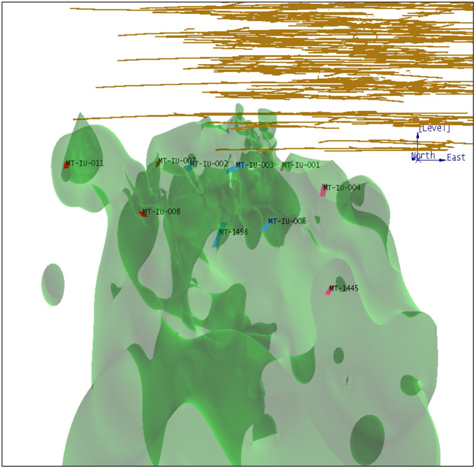
| 13.2.3 |
Mineralogy |
A mineralogical evaluation was conducted on a single sample from the Center Zone by Terra Mineralogical Services Inc. Key findings included the following:
| • |
Native gold was by far the predominant gold carrier |
| • |
Over 99% of the gold particles occurred in locations on mineral surfaces that would be readily accessible by leaching solutions |
| • |
The gold grains were predominately associated with silicate gangue minerals. |
| • |
The average grain size of the gold particle was very fine (<6 µm), however, a small amount of coarse gold particles was also identified. |
| 13.2.4 |
Comminution |
Comminution testwork included semi-autogenous grinding (SAG) mill comminution (SMC), Bond ball mill work index (BWI) and Abrasion index (AI) determinations. The SMC tests were conducted on the East, West and Center composites and the reported Axb values indicate that the material is very hard with respect to SAG mill impact grinding with an average value of 29. The BWI tests were conducted on all test composites using a 150 mesh (105 µm) closing screen, and the results indicate that the Lower Mine material is very hard with respect to ball mill grinding with an average of 19.0 kWh/t. The AI tests on the Lower Mine composites indicate that the samples are very abrasive at an average of 0.581, and high liner and grinding media wear rates can be expected.
| Effective date: June 30, 2022 |
Page 76 of 236 |
| Aris Mining Corporation
|
Technical Report Marmato Gold Mine
|
| 13.2.5 |
Whole-ore cyanidation |
Two whole-ore cyanidation tests were completed on the Lower Mine Master composite. The tests were conducted at a grind size of P80 60 µm with a maintained cyanide concentration of 1 g/l NaCN and evaluated the impact of pre-aeration and dissolved oxygen concentration on gold extraction and leach kinetics. These tests showed that without pre-aeration and only air injection to maintain the dissolved oxygen concentration during leaching at 5 to 8 mg/l, 98% of the gold could be extracted after 72 hours of leaching with NaCN consumption reported at 1.83 kg/t. However, with inclusion of pre-aeration for two hours and oxygen injection sufficient to maintain the dissolved oxygen concentration during leaching at about 20 mg/l, NaCN consumption was reduced to 0.66 kg/t and leach kinetics were significantly increased with gold leaching complete after 24 to 48 hours.
| 13.2.6 |
Gravity concentration |
Gravity concentration tests were conducted on the Lower Mine composites and the Upper Mine composite at grind sizes ranging from P80 70 to 223 µm with a Knelson centrifugal gravity concentrator followed by upgrading on a Mozley table. This testwork demonstrated that both the Lower and Upper mine ores are highly amenable to gravity concentration with gold recoveries ranging from 50.6 to 69.0% into gravity concentrates containing about 0.1 to 0.2 wt% of the feed.
| 13.2.7 |
Gravity tailing cyanidation |
Cyanidation tests were conducted on the gravity tailings from the Lower Mine Master Composite. Tests were conducted over a range of grind sizes and cyanide concentrations, both with and without pre-aeration and oxygen injection. These tests demonstrated that overall gold extractions (gravity concentration + gravity tailing cyanidation) of about 97 to 98% could be achieved. A grind size of about P80 100 µm appeared optimum with a cyanide concentration of 0.5 g/l. Pre-aeration appears to be beneficial in reducing cyanide consumption. Gold extraction versus leach retention time is shown in Figure 13.2.
Figure 13.2 Gold extraction versus retention time of the Lower Mine master composite gravity tailings
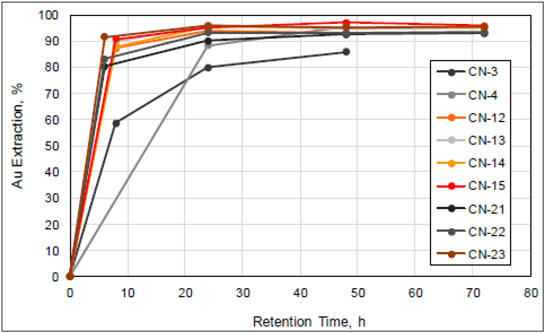
| 13.2.8 |
Variability composites |
The Lower Mine variability composites and the Upper Mine composite were subjected to gravity concentration followed by cyanidation of the gravity tailings using the following test conditions:
| Effective date: June 30, 2022 |
Page 77 of 236 |
| Aris Mining Corporation
|
Technical Report Marmato Gold Mine
|
| • Grind size: • Pre-aeration: • Dissolved O2: • NaCN: • Retention Time: • Slurry Density: |
P80 100 µm 4 hours with oxygen 20 mg/l 1.0 g/l (maintained) 48 hours 50% solids |
The results of these tests are summarized in Table 13.2, which show that overall gold recoveries for the West, Center, and East Zone composites were very similar to the results obtained from the Lower Mine Master composite. Overall gold recovery from the Upper Mine composite was about 92% with cyanide consumption at about 0.50 kg/t.
Table 13.2 Summary of variability testwork
|
Gravity Test |
Cyanidation Test |
Composite |
Grind Size | Au Distribution (%) | ||||||||||||
| P80 µm | Gravity | Gravity + Cyanidation | ||||||||||||||
|
G-6 |
CN-18 |
West Zone |
88 | 66.1 | 97.3 | |||||||||||
|
G-7 |
CN-19 |
Center Zone |
94 | 69.0 | 97.9 | |||||||||||
| G-8 |
CN-20 |
East Zone |
99 | 51.7 | 96.7 | |||||||||||
|
G-4 |
CN-16 |
Upper Mine |
70 | 57.9 | 92.0 | |||||||||||
|
G4R |
CN-16R |
Upper Mine |
78 | 56.9 | 91.8 | |||||||||||
| 13.2.9 |
Gravity tailing flotation |
Rougher flotation tests were conducted on gravity tailings from the Lower Mine master and Upper Mine composites using flotation conditions provided by GCM Mining. All tests were conducted at natural pH with 20 minutes of retention time and used potassium amyl xanthate (PAX) and MX5160 as the collectors, copper sulfate as a sulfide mineral activator, and Dowfroth 250 as the frother. Overall gold recoveries (gravity concentration + rougher flotation) of 96 to 97% were reported for the Lower Mine master composite and 97.4% for the Upper Mine composite. Rougher flotation concentrate grades produced from the Lower Mine master composite ranged from about 10 to 13 g/t Au. The rougher flotation concentrate produced from the Upper Mine composite contained 43.6 g/t Au.
| 13.2.10 |
Flotation concentrate cyanidation |
Cyanidation tests were conducted on the rougher flotation concentrates that had been reground to about 22 µm. Cyanidation tests were conducted at 1 g/l NaCN for 48 hours. These tests demonstrated that about 98% of the gold contained in the flotation concentrates could be extracted by cyanidation. It is important to note that 98% gold extraction from the flotation concentrate implies an overall gold recovery of about 95% to 96% from a gravity + flotation + cyanidation flowsheet. This is about 2% lower gold recovery than by the gravity + gravity tailing cyanidation flowsheet.
| 13.2.11 |
Cyanide detoxification |
The cyanidation leach residue produced from the Lower Mine master composite under optimized leach conditions was subjected to cyanide detoxification testing using the industry standard SO2/Air process to reduce the weak acid dissociable cyanide (CNWAD) to less than 10 mg/l. The main parameters adjusted during the testwork were sodium metabisulphite and copper addition rates. The initial leach residue contained 151 mg/l CNWAD, which was subsequently reduced to 8.95 CNWAD (Test 1-7) with the addition of 8.05 g SO2/g CNWAD and 0.22 g Cu/g CNWAD. This testwork established that the following operating conditions will achieve a discharge CNWAD concentration of <10 mg/l.
| • Slurry density: |
50% solids w/w | |
| • SO2 addition: |
8 g SO2 /g CNWAD | |
| Effective date: June 30, 2022 |
Page 78 of 236 |
| Aris Mining Corporation
|
Technical Report Marmato Gold Mine
|
| • Cu addition: |
0.22 g Cu /g CNWAD | |
| • pH: |
8.5 with lime added | |
| • Time: |
90 minutes |
| 13.2.12 |
Solid-liquid separation |
Thickening and rheological studies were conducted on a cyanidation leach residue at a P80 105 µm grind size that was adjusted to pH 8.5 with lime to simulate the detoxified slurry pH.
Flocculant screening
Flocculant screening tests identified BASF Magnafloc 10, which is a very high molecular weight, slightly anionic polyacrylamide flocculant, as a suitable flocculant for this application at an application rate of 40 g/t. Both static and dynamic thickening testwork were conducted with this flocculant.
Static thickening
Preliminary static settling tests were performed in two-litre graduated cylinders which were fixed with rotating picket-style rakes. Static settling test results were used to determine the starting conditions for subsequent dynamic thickening tests. The selected conditions based on these tests are summarized in Table 13.3.
Table 13.3 Static thickener test conditions
| Sample ID |
Flocculant dose (g/t) |
Feed %w/w |
U/F |
Unit area |
ISR m3/m2/day |
Supernatant clarity |
TSS mg/l | |||||||
| Lower Mine Comp |
40 | 8 | 62 | 0.11 | 833 | Hazy | 61 |
Dynamic thickening
Dynamic thickening testwork was initiated with a 50 g/t dosage of BASF Magnafloc 10 flocculant at a feedwell slurry density of 8% w/w solids. The dynamic thickening test responded very differently to the static thickening test under these conditions with a very turbid overflow with TSS measured at 450 mg/l. In order to improve the overflow clarity, BASF Magnafloc 1687 coagulant was applied to the diluted thickener feed prior to flocculant dosing. A series of additional tests established a dosage of Magnafloc 1687 at 15 g/t followed by a dosage of 25 g/t of Magnafloc 10 as optimal.
Thickener underflow rheology
The underflow samples contained 15 g/t BASF Magnafloc 1687 coagulant and 25 g/t BASF Magnafloc 10 flocculant. The testwork results are based on data produced by the unsheared and sheared slurry sample. Variable shearing was produced in the 0 to 600 1/s range, increasing and decreasing (up and down curves). A critical solids density (CSD) of approximately 61% solids was established, which corresponds to approximately 20 pascals (Pa) on the unsheared yield test and 13 Pa on the sheared yield test. CSD is the solids density at which a small increase of the solids density causes a significant decrease of the flowability of the slurry. The CSD value is also predictive of the maximum underflow solids density achievable in a commercial thickener.
| 13.3 |
Lower Mine metallurgical program – 2020 |
The 2020 metallurgical program was conducted on a master composite and six variability composites to further define the process parameters and design criteria to process ore from the Lower Mine using a flowsheet that includes gravity concentration followed by cyanidation of the gravity tailing. The test program included gravity concentration, gravity recoverable gold (E-GRG determination), cyanide leach optimization, and carbon in pulp modelling. Cyanide destruction, solid/liquid separation, and environmental testwork was also completed. The optimization and metallurgical design tests were all completed using the Master Composite. Once the optimized process parameters were set, the variability test samples were tested under these optimized gravity/cyanidation conditions.
| Effective date: June 30, 2022 |
Page 79 of 236 |
| Aris Mining Corporation
|
Technical Report Marmato Gold Mine
|
| 13.3.1 |
Metallurgical sample characterization |
The 2020 metallurgical program was conducted on a Lower Mine master composite and on variability composites representing low, medium and high grade Lower Mine ore, the Transition Zone between the Upper Mine and Lower Mine, and the Lower Mine. In addition, an ore sample from the Upper Mine was tested. The Lower Mine master and variability composites were formulated from selected drill core holes and intervals. The master composite was prepared from the low, medium and high grade Lower Mine variability composites on a weighted basis to represent the average grade of the Lower Mine. In addition, selected core intervals from five different drill holes were prepared for crushability testwork. Figure 13.3 shows the location of the selected drill holes and intervals.
Figure 13.3 Location of 2020 Lower Mine metallurgical composites
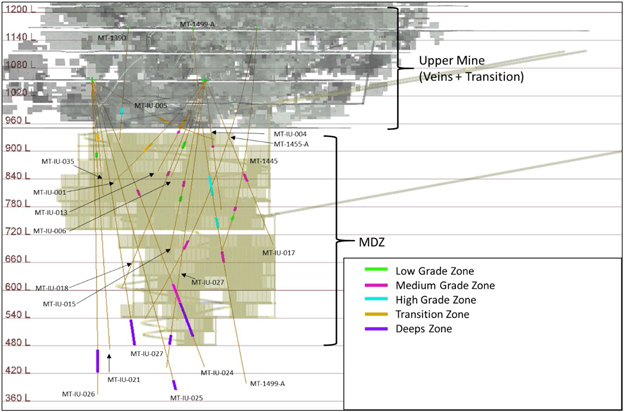
Head analyses for each of the Lower Mine metallurgical composites are shown in Table 13.4. Calculated gold and silver analyses are based on the average of all relevant tests and are considered a better indication of actual grades due to the test sample size and number of tests conducted. Cyanide soluble copper, organic carbon, mercury, and arsenic were low in all test composites and will not present any problem during processing. Total sulfur and sulfide sulfur analyses show that sulfur occurs primarily as sulfide sulfur. A multi-element ICP scan of each test composite shows that there are no elements in the test composites that would present special processing challenges.
Table 13.4 Head analyses for key elements
| Composite |
Direct assay g/t | Calculated g/t | S % | S= % | Cu CN Sol % | C org | Hg ppm | As ppm | ||||||||||||||||||||||||||||||||
| Au | Ag | Au | Ag | |||||||||||||||||||||||||||||||||||||
| Master |
3.73 | 2.9 | 2.99 | 3.3 | 1.22 | 1.15 | 0.004 | <0.05 | <0.3 | <60 | ||||||||||||||||||||||||||||||
| Low Grade |
1.95 | 2.8 | 1.80 | 3.1 | 1.12 | 1.09 | 0.002 | <0.05 | <0.3 | <60 | ||||||||||||||||||||||||||||||
| Medium Grade |
3.27 | 2.4 | 2.58 | 2.9 | 1.32 | 1.21 | 0.003 | <0.05 | <0.3 | <60 | ||||||||||||||||||||||||||||||
| High Grade |
3.58 | 3.6 | 3.99 | 3.8 | 0.89 | 0.82 | 0.004 | <0.05 | <0.3 | <60 | ||||||||||||||||||||||||||||||
| Transition |
2.50 | 3.7 | 2.82 | 5.6 | 1.74 | 1.54 | 0.004 | <0.05 | <0.3 | <30 | ||||||||||||||||||||||||||||||
| Effective date: June 30, 2022 |
Page 80 of 236 |
| Aris Mining Corporation
|
Technical Report Marmato Gold Mine
|
| Composite |
Direct assay g/t | Calculated g/t | S % | S= % | Cu CN Sol % | C org | Hg ppm | As ppm | ||||||||||||||||||||||||||||||||
| Au | Ag | Au | Ag | |||||||||||||||||||||||||||||||||||||
| Deep |
4.70 | 0.8 | 4.52 | 1.1 | 1.34 | 1.22 | 0.002 | <0.05 | <0.3 | <30 | ||||||||||||||||||||||||||||||
| Upper Mine |
4.18 | 10.3 | 3.15 | 10.1 | 9.27 | 8.62 | 0.005 | <0.05 | <0.3 | <100 | ||||||||||||||||||||||||||||||
| 13.3.2 |
Comminution |
BWI tests were conducted using a 120 mesh (125 µm) closing screen. The BWI values for the Lower Mine composites range from 17.7 to 19.8 kWh/t, which places them in the hard range of hardness. The Upper Mine ore BWI was much lower at 12.4 kWh/t.
Bond low impact crushing work index (CWI) and Bond Abrasion Index (AI) tests were conducted on drill core pieces selected to provide spatial representativity through the Lower Mine deposit. The results of CWI tests show that the average CWI was 10.7 kWh/t and the average hardness percentile was 56 (medium range of hardness). The AI’s ranged from 0.470 to 0.644, which would classify the Lower Mine ore as abrasive and will result in relatively high wear rates for liners and grinding media.
| 13.3.3 |
Gravity recoverable gold |
The Lower Mine master composite was submitted for an extended gravity recoverable gold (E-GRG) test. The three-stage gravity test was completed at SGS and the results were forwarded to FLSmidth (Knelson) for analysis and modelling. The E-GRG test involved sequential gravity separation tests at successively finer grinds (P80 659, 257 and 98 µm). An E-GRG value of 78.1% was determined for the Lower Mine master composite. The calculated head was 3.21 g/t Au.
The E-GRG value determined by SGS was used by FLSmidth (Knelson) to model gold recovery in the Lower Mine process under the following conditions:
| • Plant feed: |
116 tph | |
| • Circulating load: |
300% | |
| • Grind size (P80 µm): |
105 | |
| • Conc. cycle time (min): |
40 |
The modeling results were summarized under two scenarios. The first scenario included processing 45% of the cyclone underflow with a single Knelson concentrator (model QS40) followed by leaching in an Acacia intensive leach reactor (model CS2000) which would result in an estimated recovery of 51% of the E-GRG (78.1% per SGS) and result in about 40% overall gold recovery to the gravity circuit. The second scenario included processing 90% of the ball mill discharge to two Knelson concentrators (model QS48) followed by leaching in an Acacia intensive leach reactor (model CS4000) which would result in an estimated recovery of 67% of the E-GRG and result in about 52% overall gold recovery to the gravity circuit. Estimated gold recoveries include Acacia leach recoveries and therefore represent gold recovery to doré.
| 13.3.4 |
Gravity separation |
Gravity separation testwork was conducted using a Knelson MD-3 laboratory concentrator operated under standard
laboratory conditions. The Knelson gravity concentrate was upgraded on a Mozley Laboratory Mineral Separator targeting recovery of 0.05 to 0.1 wt% into the final Mozley concentrate. The Mozley tailing was recombined with the Knelson tailing and used
for downstream cyanidation testwork. The grind size of about P80 212 µm was used for the first test on the Lower Mine Master composite. A target grind size of
P80 105 µm was used for the remaining gravity separation tests. Gold recovery from the Master composite averaged 58.5%. The percent mass pull to the gravity concentrate
ranged from about 0.07 to 0.09% in these tests. Silver recovery ranged from about 16 to 21%. Gravity gold recoveries for the variability test composites ranged from about 49 to 82%. Gravity silver recoveries ranged from about 9 to 34%. These results
demonstrate that a gravity separation circuit should be considered in the overall process flowsheet and will serve to significantly reduce carbon handling in the downstream CIP circuit.
| Effective date: June 30, 2022 |
Page 81 of 236 |
| Aris Mining Corporation
|
Technical Report Marmato Gold Mine
|
| 13.3.5 |
Gravity concentrate cyanidation |
An intensive cyanide leach (ICN) test was conducted on the gravity concentrate produced from a 30 kg gravity concentration test without regrinding and used standard ICN test conditions that included:
| • Cyanide concentration: |
20 g/l NaCN | |
| • LeachAid: |
100 kg/t conc (0.12 kg/t ore) | |
| • Retention Time: |
48 hours | |
| • pH: |
11 to 11.5 |
The results of this test showed that 99.7% of gold and 87.9% of the silver contained in the gravity concentrate were extracted. NaCN consumption was 26.4 kg/t concentrate (0.032 kg/t ore). LeachAid addition was equivalent to 0.12 kg/t ore which has not been optimized.
| 13.3.6 |
Gravity tailing cyanidation versus grind size |
Whole-ore and gravity tailing cyanidation tests versus grind size were conducted on the Lower Mine Master composite. Five of the tests were conducted on whole-ore samples and five were conducted on the G 1 gravity tailing. The grind size P80 targets ranged from about 212 to 53 µm. Test conditions for this series included:
| • Grind size P80 µm: |
212, 150, 100, 75, and 53 | |
| • Pulp density: |
45% solids w/w | |
| • Dissolved oxygen: |
7 to 8 mg/l air sparged | |
| • Pulp pH: |
10.5 to 11 maintained with lime | |
| • Cyanide concentration: |
0.5 g/l NaCN maintained | |
| • Retention time: |
48 hours with kinetic subsampling |
Whole-ore leach results indicate that gold extractions of about 91 to 95% could be achieved over the grind size range tested. Gold extractions from the gravity tailing increased from 89.5 to 95.4% with decreasing grind size. Overall (gravity + cyanidation) gold recoveries increased from about 96 to 98%.
Cyanidation test results on the gravity tailing indicated that there was a clear linear relationship between grind size and residue grade. An engineering review of these test results was completed and a grind size of P80 105 µm was selected and used for all remaining cyanidation tests. There was no clear relationship versus grind size for the whole-ore leach tests, likely due to the presence of small amounts of coarse free gold. The test results indicated that an additional 0.1 g/t to 0.15 g/t gold will be recovered with gravity concentration included in the flowsheet. Overall silver recovery was about 61% at the target grind size.
| 13.3.7 |
Cyanidation versus cyanide concentration and pulp density |
A series of cyanidation tests were conducted to evaluate cyanide concentration over the range from 0.25 to 1 g/l NaCN (maintained) and leach slurry densities over the range from 45 to 55% solids w/w. Gold extraction and leach residue grade were independent of cyanide concentration above 0.5 g/l NaCN. At 0.5 g/l NaCN, overall gold extraction (gravity + cyanidation) was reported at 97.4% and cyanide consumption was reported at 0.88 kg/t. Cyanidation tests versus slurry density demonstrated that a slurry density of 50% solids w/w was optimum. Above 50% solids gold extraction decreased significantly, most likely due to the increased viscosity of the slurry.
| 13.3.8 |
Cyanidation versus pre-aeration/air versus oxygen injection |
Cyanidation tests on the gravity tailing were conducted to evaluate the impact of pre-aeration and the use of air versus oxygen injection. During tests with air injection, dissolved oxygen levels were reported at about 7 to 9 mg/l while dissolved oxygen levels during tests with oxygen injection were reported at about 21 to 25 mg/l. Gold extractions were about 95% and residue grades were 0.06 g/t Au for all tests. Overall gold extractions (gravity + cyanidation) were consistently close to 98%. The impact of oxygen on cyanide and lime consumptions was significant for each pre-aeration time that was tested. The cyanide consumptions in tests conducted with oxygen injection were approximately half as much as those tests conducted with air injection. Lime consumptions were
| Effective date: June 30, 2022 |
Page 82 of 236 |
| Aris Mining Corporation
|
Technical Report Marmato Gold Mine
|
about 25% less. This test series demonstrated that pre-aeration and oxygen injection resulted in lower cyanide consumption and significantly reduced leach retention time. Gold extraction versus leach retention time for each test is shown in Figure 13.4.
Figure 13.4 Gold extraction versus leach retention time for air and oxygen injection
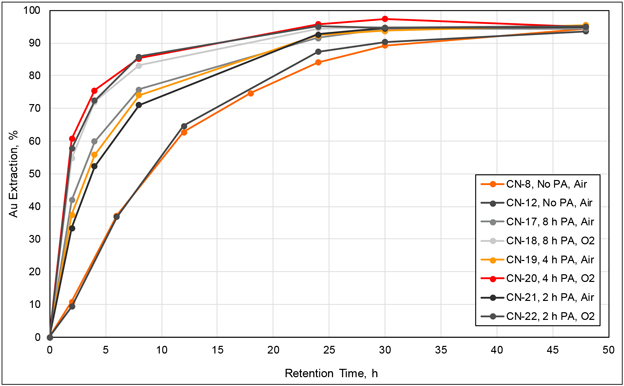
| 13.3.9 |
Cyanidation versus cyanide attenuation and pulp density |
A series of leach tests were conducted at slurry densities of 45, 50 and 55% solids at an initial cyanide concentration of 0.5 mg/l NaCN which was allowed to attenuate to 0.2 mg/l. Tests included pre-aeration (4 hours) and oxygen injection to maintain dissolve oxygen levels at about 20 to 25 mg/l. The results of these tests were similar. Gold extraction ranged from 94.7 to 95.6% and overall gold extractions (gravity + cyanidation) were about 98% for all tests. Gold residue grades were 0.05 to 0.07 g/t. Allowing cyanide to attenuate throughout the test significantly reduced NaCN consumption to 0.13 to 0.15 kg/t. The leach kinetic results are shown in Figure 13.5 and demonstrate that gold extraction was complete after about 24 hours of leaching.
| Effective date: June 30, 2022 |
Page 83 of 236 |
| Aris Mining Corporation
|
Technical Report Marmato Gold Mine
|
Figure 13.5 Gold extraction versus leach retention time
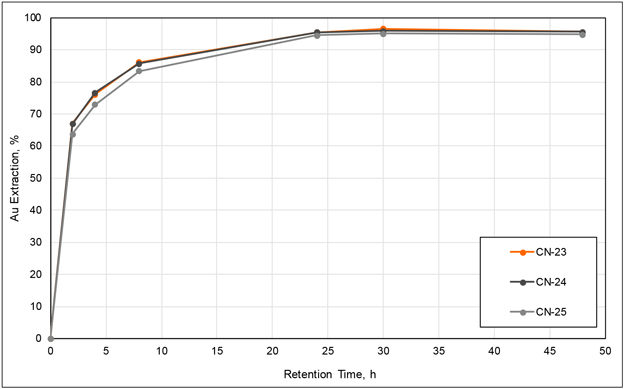
| 13.3.10 |
Hard stop retention time |
Hard stop retention time tests were conducted at 18, 24, 30 and 36 hours under the following conditions:
| • Grind size P80: |
105 µm | |
| • Pulp density: |
50% solids w/w | |
| • Pre-aeration: |
4 hours | |
| • O2 injection: |
20 to 25 mg/l dissolved O2 | |
| • Pulp pH: |
10.5 to 11 maintained with lime | |
| • Cyanide conc: |
0.5 g/l NaCN allowed to attenuate to 0.2 g/l |
The test results confirmed that with the use of oxygen a retention time of 24 hours is sufficient to achieve maximum gold extraction. Gold extractions ranged from about 93 to 94% with leach residues ranging from 0.07 to 0.08 g/t Au. Overall gold extraction (gravity + cyanidation) was 97.7% after 24 hours and NaCN consumption was 0.08 kg/t. A 24 hour optimized leach retention time was selected based on these test results.
| 13.3.11 |
Carbon in leach |
Carbon in leach tests were conducted at leach retention times of 24, 30 and 36 hours to further evaluate retention time. The results of these tests confirmed that the gold in solution will load onto activated carbon and that the Lower Mine ore is not preg-robbing. One gram of activated carbon was added to each bottle and gold loadings of about 950 g/t Au onto the carbon were reported.
| 13.3.12 |
Variability tests |
Testwork to evaluate gravity concentration and cyanidation of the gravity tailing on each of the variability composites was conducted under optimized conditions which included:
| • Grind size P80: |
105 µm | |
| • Pulp density: |
45% solids w/w | |
| • Pre-aeration: |
4 hours |
| Effective date: June 30, 2022 |
Page 84 of 236 |
| Aris Mining Corporation
|
Technical Report Marmato Gold Mine
|
| • O2 injection: |
20 to 25 mg/l dissolved O2 | |
| • Pulp pH: |
10.5 to 11 maintained with lime | |
| • Cyanide conc: |
0.5 g/l NaCN allowed to attenuate to 0.2 g/l | |
| • Retention time: |
24 hours |
Tests were conducted in duplicate. Gold recovery into the gravity concentrate ranged from 60.3 to 82% for the Lower Mine variability composites with the highest gravity gold recovery being reported for the Deep Zone variability composite. Gold extraction from the Lower Mine gravity tailings ranged from 91.4 to 92.8% and overall recovery (gravity + cyanidation) ranged from 97.4 to 98.5% gold. Gold recovery from the Upper Mine (Marmato) variability composite into the gravity concentrate was reported at 48.7% and gold extraction was 73.7% with an overall gold recovery of 86.5%.
| 13.3.13 |
CIP modelling |
CIP modeling was conducted by SGS in order to establish the design parameters and predict operational performance for the CIP circuit. SGS’s approach to CIP modelling involves conducting batch gold leaching and carbon adsorption tests with representative samples of ore or concentrate in contact with commercially available activated carbon or plant carbon. The rate of leaching is determined in a traditional bottle roll experiment, by taking timed samples of slurry from the bottle and analyzing the solution phase for gold. The rate of absorption of the leached gold onto activated carbon is then determined by adding carbon to the same leach slurry and taking further timed samples of slurry over a further 72 hour period in the same rolling bottle and analyzing the solution phase for gold. Gold on the carbon is determined by mass balancing the solution phase, while gold in the leach residue is determined by analysis at the end of the test, to produce an overall gold balance for the test.
The leaching and carbon adsorption kinetic data were then fitted to carbon adsorption modeling equations which generates profiles of gold in solution, on the carbon, and in the leach residue across a series of leaching and adsorption tanks in which carbon is advanced counter-current to the flow of slurry. The CIP models allow a number of operating parameters to be varied systematically. This allows the optimum design criteria for the plant to be established. CIP circuit parameters that were modeled include:
| • The percentage of the leachable gold that is in solution prior to the first carbon adsorption tank (100% generally assumed for CIP designs) | ||
| • The number of carbon adsorption tanks | ||
| • The volume of the adsorption tanks and pulp residence time | ||
| • The amount and concentration of carbon in each adsorption tank | ||
| • The carbon advance rate through the CIP plant, which yields the target gold loading on the carbon going to elution | ||
| • The target gold concentration in the solution exiting the last carbon adsorption tank | ||
| • The amount of gold remaining on the eluted carbon that is recycled to the last adsorption tank | ||
| Base-case circuit modeling included the following design parameters: | ||
| • Process plant feed rate: |
181 tph | |
| • Slurry feed rate: |
288 m3/hr | |
| • Leach retention time: |
24 hours | |
| • Number of leach tanks: |
3 | |
| • Adsorption tank size: |
288 m3 | |
| • CIP stages: |
6 | |
| • Au on stripped carbon: |
50 g/t | |
| • Carbon advance rate: |
3 t/d | |
The results from the CIP modelling study were very positive and excellent results can be expected when processing
the Lower Mine ore in a standard CIP circuit design. The optimized circuit design based on the results in this study
| Effective date: June 30, 2022 |
Page 85 of 236 |
| Aris Mining Corporation
|
Technical Report Marmato Gold Mine
|
| were as follows: |
| • Leach retention time of 24 hours |
| • CIP retention time of six hours (one hour per stage) |
| • Carbon inventory 6 t/tank (36 t total) |
| • Elution/regeneration plant capacity 3 t/day. A smaller carbon throughput of 2 t/day could be considered if there are no plans to increase plant capacity in the future |
| • Eluted carbon concentration target at 50 g/t Au |
| 13.3.14 |
Cyanide destruction |
The cyanidation leach residue produced under optimized leach conditions from the Lower Mine master composite was used for cyanide destruction testwork using the industry standard SO2/air detoxification process. The objective was to reduce CNWAD in the residue from about 200 mg/l CNWAD to <1 mg/l CNWAD.
The chemical reaction for the oxidation of CNWAD uses sodium metabisulphite as the source of SO2 and air as the source of oxygen. This reaction is catalyzed by the presence of copper. The feed usually contains some copper, and if required, additional copper is added as copper sulfate. Hydrated lime is added to the reactor.
The cyanide destruction tests were conducted on the leach residue at a slurry density of 45% w/w solids. The pH test target was approximately 8.5. All tests were conducted at room temperature with SO2 additions (as sodium metabisulphite) of 7 to 7.8 g SO2/g CNWAD and retention times that ranged from about 60 to 90 minutes. The CNpicric assay in three of these four tests was less than 10 mg/l CNWAD. CNWAD concentrations of less than 1 mg/l were only achieved after additional time (or aging) at the end of the tests. Upon completion of the program it was determined the following operating conditions will achieve a discharge CNWAD concentration of less than 10 mg/l:
| • |
45% solids w/w |
| • |
Approximately 7 g equivalent SO2 per gram CNWAD |
| • |
Approximately 20 mg/l copper addition |
| • |
pH 8.5 – lime added as needed (~1.5 kg/t) |
| • |
Approximately 80 minutes retention time |
In order to achieve a CNWAD concentration of <1 mg/l, the design will need to include holding (or aging) the detoxified leach residue to achieve the discharge target.
| 13.3.15 |
Tailing thickening |
Tailing thickening testwork was conducted by both SGS and Outotec. The process design engineer, Ausenco, used Outotec’s thickening testwork for process design purposes and, as such, only Outotec’s test results are discussed.
Outotec conducted high rate thickener testwork on detoxed leach tailings generated from the Lower Mine master and transition composites that were produced using optimized process parameters. The testwork was conducted using Outotec’s bench scale 99 mm diameter thickener test unit with Magnafloc 10 as the flocculant which is a high molecular weight slightly anionic flocculant. All rheological measurements were carried out using a Thermo Haake VT550 rheometer and an OK600 4 blade vane. A constant shear rate of 0.1 sec-1 was used. For each dynamic test underflow sample, a simple un-sheared vane yield stress was measured.
The tailings samples used for the tailing thickener testwork were characterized as follows:
|
|
Master Comp |
Transition Comp | ||||
| Density (g/mL): |
1.36 |
1.38 | ||||
| Solids SG (t/m3): |
2.66 |
2.66 | ||||
| pH: |
8.70 |
8.90 | ||||
| Effective date: June 30, 2022 |
Page 86 of 236 |
| Aris Mining Corporation
|
Technical Report Marmato Gold Mine
|
|
|
Particle size (P80 µm): |
107.7 |
103.3 |
An underflow density of 63.5% solids was achieved for the Lower Mine master composite tailing sample using Magnafloc 10 at a dosage of 50 g/t, which resulted in a flux of 0.80 t/ (m2.h). An underflow density of 63% solids was achieved for the Transition composite tailing sample using Magnfloc 10 at a dosage of 60 g/t, which resulted in a flux of 0.40 t/ (m2.h). Thickener overflows were clear with suspended solids reported at less than 100 mg/l and were suitable for recycle back to the process, although the target underflow density of 64% solids was not achieved in these tests. Outotec concluded that based on their experience with their testwork and full-scale operation of thickeners that an estimated 2 to 3% increase in thickener underflow density could be expected when comparing the testwork to a full-size thickener.
| 13.3.16 |
Tailings filtration |
Outotec conducted filtration testwork on detoxed leach tailings generated from the Lower Mine master and Transition composites that were produced using optimized process parameters. Filtration testing was performed using Outotec’s Labox 100 bench-scale unit and Scanmec leaf dip test apparatus to examine the filtering characteristics and process suitability. The filter cakes were required to have a cake moisture of less than 15% and be suitable for dry stacking at the tailings storage facility.
The thickened tailings samples used for the filtration testwork were characterized as follows:
|
|
Master Comp |
Transition Comp | ||||
| Density (g/mL): |
1.65 |
1.63 | ||||
| Slurry solids (% w/w): |
65.0 |
62.0 | ||||
| pH: |
8.9 |
8.7 | ||||
| Particle size (P80 µm): |
107.7 |
103.3 | ||||
The Lower Mine master composite tailing sample achieved 12% moisture contents over the range of cycle times tested (8.5 to 12 minutes). At the 8.5 minute cycle time, a filtration rate of 269.6 kg/m2.hour was reported. The transition composite tailing sample achieved 14.6 to 15.8% moisture contents over the range of cycles times tested (9 to 12 minutes). At the 10 minute cycle time, a cake moisture content of 14.6% and a filtration rate of 214.9 kg/m2.hour were reported. Pressure filtration on both the master and transition composite tailing samples achieved the required moisture content for disposal in a dry stack tailings facility.
Vacuum filtration tests were conducted on the Master and Transition tailing composite samples using the Scanmec Leaf Disc vacuum filtration apparatus. Tests on the Master composite tailing sample were conducted both with and without filter aid and produced cake thicknesses ranging from 7 to 16 mm. Cake moisture contents ranged from 17.5 to 22.4%. No vacuum filtration tests achieved the required 15% moisture content. Tests on the Transition composite tailing sample were conducted both with and without filter aid and produced cake thicknesses ranging from 3 to 8 mm. Cake moisture contents ranged from 20.7 to 21.7%. No vacuum filtration tests on the Transition composite tailing sample achieved the required 15% moisture content. Based on the results of these tests, vacuum filtration is not an option for filtering thickened Lower Mine tailings for disposal in a dry stack tailings storage facility.
| 13.4 |
Lower Mine recovery estimate |
Estimates of achievable gold and silver recoveries from the Lower Mine are based on a flowsheet that includes gravity concentration and cyanidation of the gravity tailing with optimized pre-feasibility study process parameters that include:
| • Grind size P80: |
105 µm | |
| • Retention time: |
24 hours | |
| • Pulp density: |
45 to 50% solids w/w |
| Effective date: June 30, 2022 |
Page 87 of 236 |
| Aris Mining Corporation
|
Technical Report Marmato Gold Mine
|
| • Pre-aeration: |
4 hours | |
| • O2 injection: |
20 to 25 mg/l dissolved O2 | |
| • Pulp pH: |
10.5 to 11 maintained with lime | |
| • Cyanide Conc: |
0.5 g/l NaCN allowed to attenuate to 0.2 g/l |
SRK recommends discounting laboratory-reported gold recoveries by 2% and silver recoveries by 5% to account for inherent plant inefficiencies. Based on the results of the pre-feasibility study metallurgical program, the estimated average discounted recoveries are 95% for gold and 51% for silver. This is very similar to the results from the PEA metallurgical program in which the average discounted gold recovery was estimated at 95% and average discounted silver recovery was 47%. There is little difference in reported gold recoveries for the master and variability composites and gold recovery appears to be independent of ore grade over the range tested.
| 13.5 |
Lower Mine significant factors |
The following significant metallurgical and mineral processing factors have been identified:
| • |
Native gold was by far the predominant gold carrier and over 99% of the gold particles occurred within mineral structures that would be readily accessible by leaching solutions. |
| • |
The metallurgical program optimized process parameters required to recover gold and silver values from the Lower Mine ore using a process flowsheet that includes gravity concentration followed by cyanidation of the gravity tailing. Optimized process conditions included: |
| ○ Grind size P80: |
105 µm | |
| ○ Pulp density: |
45% solids w/w | |
|
○ Pre-aeration: |
4 hours | |
| ○ O2 injection: |
20-25 mg/l dissolved O2 | |
| ○ Pulp pH: |
10.5 to 11 maintained with lime | |
| ○ Cyanide Conc: |
0.5 g/l NaCN allowed to attenuate to 0.2 g/l | |
| ○ Retention time: |
24 hours |
| • |
Gravity recoverable gold (E-GRG) testwork and modeling indicate that about 40% of the gold contained in the Lower Mine ore can recovered into a gravity concentrate. Gold contained in the gravity tailing would be recovered in a standard CIP cyanidation leach circuit. |
| • |
An intensive cyanide leach test on the gravity concentrate demonstrated that 99.7% of the contained gold and 87.9% of the contained silver could be extracted from the gravity concentrate without regrinding. |
| • |
Overall gold recovery is estimated at 95% and overall silver recovery is estimated at 51%. There is little difference in reported gold recoveries for the master and variability composites and gold recovery appears to be independent of ore grade over the range tested. |
| • |
Cyanide destruction tests demonstrated that CNWAD could be reduced to less than 10 mg/l with the SO2/air process. However, CNWAD levels would further attenuate to less than 1 mg/l with time. |
| • |
Pressure filtration will be required to dewater thickened tailings in order to achieve less than 15% moisture content required for disposal in a dry stack tailing facility. |
| • |
The operating data for the Upper Mine ores and metallurgical testwork on the Lower Mine ores indicates that there are no material issues or deleterious elements that could have a significant effect on potential economic extraction. |
| Effective date: June 30, 2022 |
Page 88 of 236 |
| Aris Mining Corporation
|
Technical Report Marmato Gold Mine
|
14. Mineral resource estimates
| 14.1. |
Disclosure |
The effective date of the mineral resource estimate is June 30, 2022. Mineral resources were prepared by Ben Parsons, MSc, MAusIMM (CP) of SRK Consulting, who is a Qualified Person as defined by NI 43-101.
| 14.2. |
Available data |
Aris Mining supplied SRK with the drilling and channel sampling databases as of June 30, 2021, in comma separated value format files including collars, surveys, geology, assays, density, sample recovery, and structure.
As of June 30, 2021, the drilling database contained 1,464 drillholes for a total of 314,874 m and the channel database contained 31,392 channels for a total of 53,343 m. This represents an increase of 107 additional drillholes for 35,929 m and 5,085 additional channels for 11,105 m compared to the previous mineral resource estimate effective March 17, 2020.
The drilling and channel databases were imported into Datamine and Leapfrog mining software for validation and interpretation.
| 14.3. |
Geological interpretations |
Seequent Leapfrog Geo (Leapfrog) software was used to create updated three dimensional wireframe interpretations of the structural geology, lithology, alteration, and mineralization of the Upper Mine and Lower Mine based on regional and mine scale mapping, drillhole and channel sample logging and assay data, geological interpretation work, and the current known controls on mineralization. These interpretations have evolved over time and will continue to evolve with additional data and underground exposures as well as increased mining experience and geological understanding.
The wireframes are used to code the sample data and the block model for the relevant geological attributes. All of the wireframes were trimmed to the surface topography and divided into separate fault blocks with the structural interpretations.
| 14.3.1. |
Lithology and structural interpretation |
A description of the lithology is provided in Section 7.3.1 and a description of the structural geology is provided in Section 7.3.5. A plan view of the eight principal faults relative to the vein interpretations on Level 20 is given in Figure 7.4. Lithology interpretations were created for the Marmato Porphyry Suite, metaschist, and breccia. The interpretations were divided into seven major fault blocks with the fault interpretations and trimmed to the surface using the topography wireframes. The P1 porphyry hosts nearly all of the mineral resources and reserves. An example section showing the lithology, mineralization, and structural interpretation at a midpoint of 1,163,390 m East and 1,098,000 m North is provided in Figure 14.1.
| Effective date: June 30, 2022 |
Page 89 of 236 |
| Aris Mining Corporation
|
Technical Report Marmato Gold Mine
|
Figure 14.1 Example section of lithology, mineralization, and structural interpretation
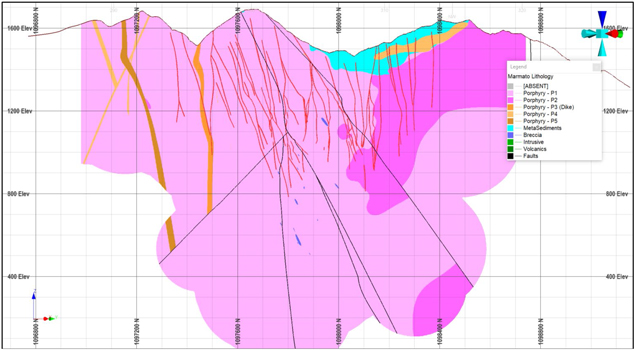
| 14.3.2. |
Alteration interpretation |
A description of the hydrothermal alteration of the host rock is provided in Section 7.3.3. Interpretation wireframes of shallow epithermal and deeper mesothermal alteration were made using the drillhole logging information, which includes codes for mineralization type and mineralogy. The Upper Mine is characterized by epithermal alteration and the Lower Mine is characterized by mesothermal alteration.
| 14.3.3. |
Mineralization interpretation |
A description of the mineralization styles is provided in Section 7.3.4. Wireframe interpretations of the mineralization types including vein style mineralization, disseminated or veinlet style mineralization in the hangingwall and footwall of the veins and focussed around the current mining levels between Levels 16 and 21, and vein splay style mineralization in the Upper Mine were made in Leapfrog. The interpretations were based on geological mapping; channel and drillhole sample data including lithology, vein codes, and sample grades; and the location of past and current mining, and considering vein characteristics including position, thickness, and grade continuity. The process was initially completed in the areas with strong geological control in the mine and then expanded into the upper and lower levels of the deposit which are predominantly supported by drilling information only. Mineralization remains open at depth and along strike.
Channel and drillhole samples within the Upper Mine mineralization wireframes were coded for the structure number for the mineral resource estimate. Given the large number of available channel samples and the relatively recent conversion of the mine to three dimensional surveying techniques, not all of the channel samples have been correctly located in three dimensional space. Channels that were identified as not yet correctly located were coded for geostatistical analysis but were not used in the grade estimate. It is the QP’s opinion that by combining the geological mapping and channel database from the mine, the lithological model has been improved with strong controls on the mineralization styles.
The disseminated vein models exist surrounding the main structures and are focused around Levels 16 through 21 of the Upper Mine. The mineralization occurs as veinlets or disseminated mineralization directly in the hangingwall
| Effective date: June 30, 2022 |
Page 90 of 236 |
| Aris Mining Corporation
|
Technical Report Marmato Gold Mine
|
and footwall of the veins. SRK used a combination of the lithological log and assays to define the limits of the disseminated material.
SRK identified small splays from the main structures based on drill core intersections coded as veins located outside of the defined veins and the geological mapping. SRK identified a total of 103 structures which show some degree of geological continuity to be able to define wireframes. Part of these splays have been identified by Aris Mining as tensional structures with limited continuity, which sometimes connect major veins. It is the QP’s opinion that the splays have lower geological confidence compared to the main veins and further sampling will be required to confirm their potential prior to mining.
Small pockets of spatially discontinuous porphyry hosted mineralization have been noted and mined in the epithermal zone of the Upper Mine. In order to account for these mineralized volumes in the mineral resource estimate, estimates of mineralization not already defined by logging or interpretations as vein, disseminated, or splays were made with indicator grade shell wireframes using a 0.5 g/t Au cut-off grade on 2 m sample composites from channels greater than 5 m in length, with trends following the orientation of the epithermal vein systems. Any volumes less than 1,000 m3 were discarded.
The mineralization interpretation in the Upper Mine was validated against level plans of the current mining operations between Levels 16 through 21 with respect to the channel and drillhole sample data and geological mapping. Interpretations made where channel sampling and mining activity has taken place are supported by significant amounts of information and have a higher confidence than interpretations made with wider spaced drilling data. The vein splay and porphyry pocket interpretations have less well defined structural continuity and are based on fewer data points, and therefore the interpretation has a lower confidence. The extension of the wireframe interpretations along strike and down dip were limited to a maximum of 25 m beyond the data.
Most of the detailed interpretation work in the Upper Mine is focussed on the 20 largest structures and surrounding veins. Interpretations were made of 94 different vein structures, 61 different disseminated interpretations, and 102 different splays. An example plan on Level 20 showing the relationship of the veins, disseminated, and splay interpretations is given in Figure 14.2. An example section with a 25 m window of the porphyry pocket style mineralization at a midpoint of 1,163,375 m East and 1,097,825 m North is given in Figure 14.3.
Figure 14.2 Plan of vein, disseminated, and splay interpretations
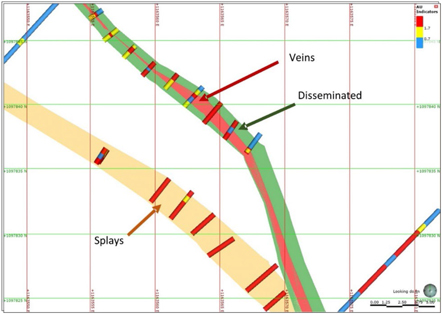
| Effective date: June 30, 2022 |
Page 91 of 236 |
| Aris Mining Corporation
|
Technical Report Marmato Gold Mine
|
Figure 14.3 Long section of the porphyry pocket style mineralization interpretation
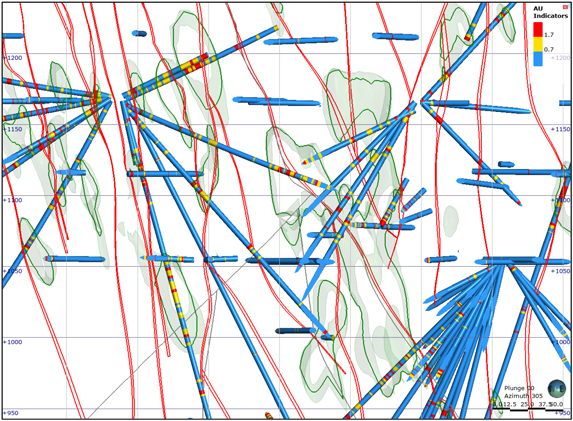
The main mineralization style at the Lower Mine has been defined using a series of indicator grade models using cut-offs of 0.7 and 1.7 g/t Au to define the low and high grade portions respectively. Grade indicators were generated in Leapfrog following structural trends using 3 m drillhole sample composites. An example section with a 50 m window at a midpoint of 1,163,460 m East and 1,097,760 m North showing the Lower Mine mineralization wireframe interpretation is given in Figure 14.4.
Estimates of the mineralization within the mesothermal alteration interpretation in the Lower Mine were made in Leapfrog using indicator grade shell wireframes above a cut-off grade of 0.7 g/t Au with a restricted internal high grade core, typically associated with increased veinlet density, created using indicator grade shell wireframes above a cut-off grade of 1.7 g/t Au. To define the statistical parameters for the final indicator model, SRK completed a detailed study using probability values ranging from 0.40 to 0.60 at selected increments. SRK monitored the volumetric changes of the interpreted grade shells, the mean grade, the internal waste percentage (samples less than the cut-off grade inside the wireframe) and the number of samples above the cut-off grade outside the grade shell. A probability value of 0.475 was chosen for the final model in the 0.7 g/t indicator shell, with a grid resolution of 5 m to define the wireframes. The same process was used within the high grade 1.7 g/t domains with an increased probability value of 0.50 to avoid overstating volume. Control lines were utilized to limit the extent of the indicator volumes in deeper areas with lower data support.
| Effective date: June 30, 2022 |
Page 92 of 236 |
| Aris Mining Corporation
|
Technical Report Marmato Gold Mine
|
Figure 14.4 Section of the Lower Mine mineralization interpretation
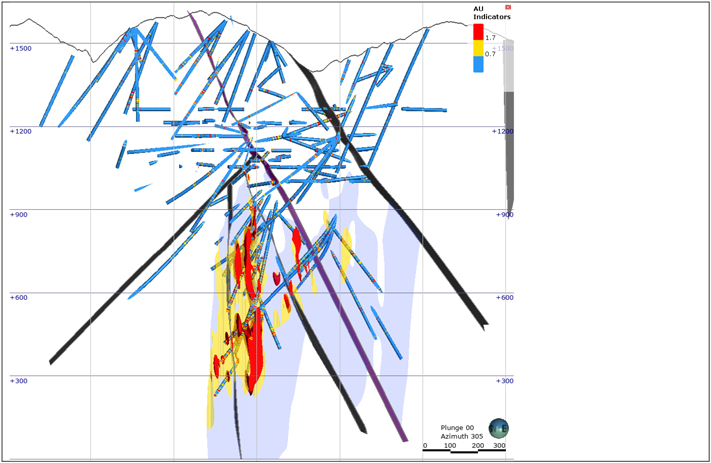
| 14.4. |
Grade estimation domains |
Six key domains were produced from the geological interpretations and coded for domain number, including high grade sulfide veins (Group 1000 with 94 different veins), disseminated veinlets and porphyry mineralization adjacent to the main vein structures (Group 2000 with 61 different structures), vein splays of the main structures with limited continuity (Group 3000 with 102 different splays), and numerous mineralized porphyry pockets characterized by higher grades above the 850 m elevation (Group 4000). These four domains are considered the Upper Mine epithermal style mineralization. The remaining two domains belong to the Lower Mine mesothermal style mineralization and are characterized by veinlet mineralization. There is a large well defined zone of Lower Mine mineralization (Group 5000) and another newly identified zone (Group 5001) located to the northeast of Group 5000. Summary statistics by domain for the raw sample data assays are provided in Table 14.1.
Table 14.1 Summary statistics of raw sample assays
| Metric |
1000 | 2000 | 3000 | 4000 | 5000 | |||||||||||||||
| Number of samples |
42,054 | 27,422 | 7,678 | 15,384 | 48,895 | |||||||||||||||
| Au g/t maximum |
1,425.04 | 947.13 | 1,766.57 | 891.03 | 345.92 | |||||||||||||||
| Au g/t mean |
5.81 | 2.35 | 4.91 | 1.83 | 1.39 | |||||||||||||||
| Au coefficient of variation |
2.4 | 3.4 | 5.8 | 4.8 | 3.0 | |||||||||||||||
| Ag g/t maximum |
1,995 | 538 | 1,235 | 5,613 | 7,980 | |||||||||||||||
| Ag g/t mean |
26.7 | 18.8 | 21.3 | 14.1 | 3.3 | |||||||||||||||
| Ag coefficient of variation |
1.5 | 1.2 | 1.6 | 5.6 | 15.0 |
| Effective date: June 30, 2022 |
Page 93 of 236 |
| Aris Mining Corporation
|
Technical Report Marmato Gold Mine
|
| 14.5. |
Sample capping |
The raw samples were capped for extreme sample assay values to minimize the effect of any unusually high grades during the grade estimate averaging process. Capping levels were assessed on the raw sample data, rather than composited data, which is considered a conservative approach. Capping levels were assessed with reference to a disintegration analysis of log probability plots for domains 1000 to 3000 and by percentile analysis of log probability plots for domains 4000 and 5000. For Groups 1000 and 2000, two different caps were chosen depending on the sample population supporting the veins, and for Groups 4000 and 5000 a range of different caps were chosen depending on the mineralization style of the sub-domains. Additional increasingly conservative caps were applied to composites used in the second and third searches in Domains 1000, 2000, and 3000. SRK aims to limit the impact of the capping to less than 5% change in the mean value, however in some cases with skewed distributions or extreme outliers, the change in the mean typically exceeds 5%. Table 14.2 shows the sample capping strategy by estimation domain.
Table 14.2 Sample capping strategy
| Au g/t | Ag g/t | |||||||||||||||
| Domain |
Search 1 | Search 2 and 3 | Search 1 | Search 2 and 3 | ||||||||||||
| 1000 |
20 or 60 | 15 or 40 | 150 or 450 | 110 or 300 | ||||||||||||
| 2000 |
10 or 60 | 7 or 15 | 90 or 334 | 80 or 300 | ||||||||||||
| 3000 |
30 | 20 | 150 | 110 | ||||||||||||
| 4000 |
4 to 12.6 | No change | 5 to 325 | No change | ||||||||||||
| 5000 |
7 to 17.5 | No change | 25 to 50 | No change | ||||||||||||
| 14.6. |
Sample compositing |
Following capping, the samples were composited to a common length to provide equal lengths for grade averaging during the estimate. Approximately 30% of the sample lengths within the mineralized domains are less than 0.5 m, 45% are between 0.5 and 1.0 m, and 15% are between 1.0 and 2.0 m. Overall 95% of the sample lengths are less than 2.0 m.
A composite length of 2.0 m was selected to provide a single composite across the veins. Summary statistics for the top cut and composited data are provided in Table 14.3.
Table 14.3 Summary statistics of top cut and composited data
| Metric |
1000 | 2000 | 3000 | 4000 | 5000 | |||||||||||||||
| Number of composites |
23,017 | 18,316 | 3,002 | 8,101 | 27,177 | |||||||||||||||
| Au g/t maximum |
60.00 | 20.00 | 30.00 | 12.60 | 40.00 | |||||||||||||||
| Au g/t mean |
5.59 | 2.11 | 4.04 | 1.37 | 1.33 | |||||||||||||||
| Au coefficient of variation |
1.4 | 1.5 | 1.3 | 1.1 | 1.6 | |||||||||||||||
| Ag g/t maximum |
450 | 334 | 150 | 325 | 50 | |||||||||||||||
| Ag g/t mean |
26.6 | 18.8 | 20.9 | 11.4 | 2.8 | |||||||||||||||
| Ag coefficient of variation |
1.1 | 1.1 | 1.1 | 2.2 | 1.6 |
| 14.7. |
Variography |
Semi-variograms were completed for gold and silver for each of the domains. Omni-directional and directional variograms were created for all domains and key elements. Omni-directional variograms were used in the Upper Mine given the large number of variably oriented structures, and variograms oriented to the trend of the mineralization were used for the Lower Mine. It is the QP’s opinion that the use of omni-directional variograms on the veins is appropriate as the mineralization has been limited across the width of the veins by a hard boundary, this results in orientations more like a plate than a ball when used during the estimation process.
| Effective date: June 30, 2022 |
Page 94 of 236 |
| Aris Mining Corporation
|
Technical Report Marmato Gold Mine
|
The nuggets, which refer to the inherent sample grade variability, ranged from 20% to 50% of total grade variability. Ranges were short for the first structure at between 2 and 20 m, moderate for the second structure at between 15 and 80 m, and relatively long for the third structure at between 30 and 400 m. A summary of the variogram parameters is shown in Table 14.4.
Table 14.4 Variogram parameters summary
| Mineralization |
Veins | Disseminated | Splays | Porphyry |
|
Lower Mine |
| |||||||||||||||||||||||||||||||||||||||||
| Domain |
1001 | 1002 | 2001 | 2002 | 3001 | 3002 | 4001 | 4002 | 5000 | 5001 | 5002 | All | ||||||||||||||||||||||||||||||||||||
| Element |
Au | Ag | Au | Ag | Au | Ag | Au | Ag | Au | Au | Au | Ag | ||||||||||||||||||||||||||||||||||||
| Rotation |
120 | 120 | 120 | 120 | ||||||||||||||||||||||||||||||||||||||||||||
| Rotation (dip) |
-80 | -80 | -80 | -80 | ||||||||||||||||||||||||||||||||||||||||||||
| Nugget |
0.2 | 0.15 | 0.4 | 0.2 | 0.35 | 0.20 | 0.47 | 0.47 | 0.20 | 0.31 | 0.40 | 0.24 | ||||||||||||||||||||||||||||||||||||
| Range1 (X) |
3 | 5.2 | 4 | 5 | 2 | 2 | 4 | 13 | 6 | 20 | 5 | 17 | ||||||||||||||||||||||||||||||||||||
| Range1 (Y) |
3 | 5.2 | 4 | 5 | 2 | 2 | 4 | 13 | 6 | 4 | 5 | 10 | ||||||||||||||||||||||||||||||||||||
| Range1 (Z) |
3 | 5.2 | 4 | 5 | 2 | 2 | 4 | 13 | 6 | 4 | 4 | 5 | ||||||||||||||||||||||||||||||||||||
| Sill 1 |
0.3 | 0.19 | 0.4 | 0.2 | 0.12 | 0.25 | 0.32 | 0.23 | 0.56 | 0.23 | 0.14 | 0.40 | ||||||||||||||||||||||||||||||||||||
| Range2 (X) |
20 | 31.8 | 28 | 40 | 13 | 14.5 | 14 | 30 | 55 | 81 | 25 | 123 | ||||||||||||||||||||||||||||||||||||
| Range2 (Y) |
20 | 31.8 | 28 | 40 | 13 | 14.5 | 14 | 30 | 31 | 16 | 20 | 32 | ||||||||||||||||||||||||||||||||||||
| Range2 (Z) |
20 | 31.8 | 28 | 40 | 13 | 14.5 | 14 | 30 | 25 | 10 | 10 | 16 | ||||||||||||||||||||||||||||||||||||
| Sill 2 |
0.10 | 0.12 | 0.2 | 0.6 | 0.08 | 0.06 | 0.18 | 0.16 | 0.15 | 0.17 | 0.14 | 0.36 | ||||||||||||||||||||||||||||||||||||
| Range3 (X) |
350 | 400 | 90 | 79.1 | 50 | 98 | 142 | 169 | 80 | – | ||||||||||||||||||||||||||||||||||||||
| Range3 (Y) |
350 | 400 | 90 | 79.1 | 50 | 98 | 120 | 60 | 60 | – | ||||||||||||||||||||||||||||||||||||||
| Range3 (Z) |
350 | 400 | 90 | 79.1 | 50 | 98 | 45 | 38 | 30 | – | ||||||||||||||||||||||||||||||||||||||
| Sill 3 |
0.10 | 0.11 | 0.3 | 0.49 | 0.2 | 0.23 | 0.09 | 0.29 | 0.11 | – | ||||||||||||||||||||||||||||||||||||||
| 14.8. |
Block model |
Datamine™ Studio RM was used to construct the geological solids, prepare assay data for geostatistical analysis, construct the block model, estimate metal grades and tabulate mineral resources. The block model was constructed using block dimensions of 5 m x 10 m x 10 m as a function of the channel sample spacing within the veins and rotated along the strike of the major structural trends. Sub-blocking was used to reflect the geological interpretation to a resolution of 0.25 m along strike, 1.0 m across strike, and 1.0 m in the vertical direction to provide an appropriate geometric representation. The block model was coded for alteration, lithology, and fault block. Each mineralization style was coded to the block model for use as estimation domains.
Density measurements are made routinely during core logging and sample preparation. The block model was coded for bulk density depending on rock type and mineralization style, based on over 3,626 samples and input from mining experience at the Upper Mine. The majority of the mineral resources are hosted by the P1 porphyry which was assigned a bulk density of 2.67 g/cm3 and the remainder is hosted within vein style mineralization, which was assigned a bulk density of 2.95 g/cm3.
| 14.9. |
Grade estimation |
A kriging neighbourhood analysis was undertaken to optimize the estimation parameters including the block size, block discretization, minimum and maximum number of composites to use in the estimate, and the size and orientation of the composite search ellipses.
Dynamic anisotropy of the search ellipse in most of the grade estimation domains was utilized with the interpretation wireframes to allow the composite search ellipse orientations to adjust to the local trend of the interpretations.
| Effective date: June 30, 2022 |
Page 95 of 236 |
| Aris Mining Corporation
|
Technical Report Marmato Gold Mine
|
60% of the estimate was made in the second search, 25% was made in the first search, and the remainder of the estimate was made in the third search.
The grade estimate was made using ordinary kriging (OK) in well informed areas and inverse distance to a power of 2 (ID2) in less well informed areas. A discretization grid of 3 m x 3 m x 3 m was used within each parent block during the estimation within the veins, disseminated, and splays domains (Group 1000 to 3000). A discretization grid of 4 m x 5 m x 4 m was used within each parent block during the estimation within the porphyry and the Lower Mine domains (Group 4000 to 5000).
A summary of the grade estimation parameters by estimation domain is provided in Table 14.5.
Table 14.5 Estimation parameter summary
| Domain |
1000 | 2000 | 3000 | 4000 |
|
5000/5001 |
| |||||||||||||||||||||||||||||||||||||||||||||
| Sub-domain |
1000 | 1000 | 2000 | 2000 | 3000 | 3000 | 4000 | 4000 | 5000 | 5001 | 5002 | 5003 | 5000– 5003 | |||||||||||||||||||||||||||||||||||||||
| Parameter |
Au | Ag | Au | Ag | Au | Ag | Au | Ag | Au low grade |
Au medium grade |
Au high grade |
Au new zone |
Ag | |||||||||||||||||||||||||||||||||||||||
| Rotation (Z) |
0 | 0 | 0 | 0 | 0 | 0 | 15 | 15 | 120 | 120 | 120 | 120 | 120 | |||||||||||||||||||||||||||||||||||||||
| Rotation (Dip) |
0 | 0 | 0 | 0 | 0 | 0 | -80 | -80 | -85 | -85 | -85 | -85 | -85 | |||||||||||||||||||||||||||||||||||||||
| X Range (m) |
25 | 25 | 25 | 25 | 25 | 25 | 25 | 35 | 40 | 45 | 45 | 40 | 55 | |||||||||||||||||||||||||||||||||||||||
| Y Range (m) |
25 | 25 | 25 | 25 | 25 | 25 | 25 | 35 | 50 | 35 | 35 | 50 | 55 | |||||||||||||||||||||||||||||||||||||||
| Z Range (m) |
25 | 25 | 25 | 25 | 25 | 25 | 15 | 15 | 20 | 10 | 10 | 20 | 15 | |||||||||||||||||||||||||||||||||||||||
| Minimum composites |
4 | 4 | 4 | 4 | 4 | 4 | 4 | 4 | 5 | 5 | 5 | 5 | 5 | |||||||||||||||||||||||||||||||||||||||
| Maximum composites |
12 | 12 | 12 | 12 | 12 | 12 | 12 | 12 | 24 | 20 | 20 | 24 | 20 | |||||||||||||||||||||||||||||||||||||||
| Dynamic search |
Yes | Yes | Yes | Yes | Yes | Yes | Yes | Yes | Yes | Yes | Yes | Yes | Yes | |||||||||||||||||||||||||||||||||||||||
| 2nd search volume factor |
3 | 3 | 3 | 3 | 3 | 3 | 2 | 2 | 2 | 2.2 | 2.2 | 2 | 1.5 | |||||||||||||||||||||||||||||||||||||||
| X Range (m) |
75 | 75 | 75 | 75 | 75 | 75 | 50 | 70 | 80 | 99 | 99 | 80 | 82.5 | |||||||||||||||||||||||||||||||||||||||
| Y Range (m) |
75 | 75 | 75 | 75 | 75 | 75 | 50 | 70 | 100 | 77 | 77 | 100 | 82.5 | |||||||||||||||||||||||||||||||||||||||
| Z Range (m) |
75 | 75 | 75 | 75 | 75 | 75 | 30 | 30 | 40 | 22 | 22 | 40 | 22.5 | |||||||||||||||||||||||||||||||||||||||
| Minimum composites |
4 | 4 | 4 | 4 | 4 | 4 | 4 | 4 | 5 | 5 | 5 | 5 | 5 | |||||||||||||||||||||||||||||||||||||||
| Maximum composites |
12 | 12 | 12 | 12 | 12 | 12 | 12 | 8 | 24 | 20 | 20 | 24 | 20 | |||||||||||||||||||||||||||||||||||||||
| Dynamic search |
Yes | Yes | Yes | Yes | Yes | Yes | Yes | Yes | Yes | Yes | No | Yes | Yes | |||||||||||||||||||||||||||||||||||||||
| 3rd search volume factor |
6 | 6 | 6 | 6 | 6 | 6 | 4 | 4 | 3 | 3.3 | 3.3 | 3 | 3 | |||||||||||||||||||||||||||||||||||||||
| X Range (m) |
150 | 150 | 150 | 150 | 150 | 150 | 100 | 140 | 120 | 148.5 | 148.5 | 120 | 165 | |||||||||||||||||||||||||||||||||||||||
| Y Range (m) |
150 | 150 | 150 | 150 | 150 | 150 | 100 | 140 | 150 | 115.5 | 115.5 | 150 | 165 | |||||||||||||||||||||||||||||||||||||||
| Z Range (m) |
150 | 150 | 150 | 150 | 150 | 150 | 60 | 60 | 60 | 33 | 33 | 60 | 45 | |||||||||||||||||||||||||||||||||||||||
| Minimum composites |
1 | 1 | 1 | 1 | 1 | 1 | 1 | 1 | 3 | 3 | 3 | 3 | 3 | |||||||||||||||||||||||||||||||||||||||
| Maximum composites |
8 | 8 | 8 | 8 | 8 | 8 | 8 | 8 | 8 | 8 | 8 | 8 | 8 | |||||||||||||||||||||||||||||||||||||||
| Dynamic search |
Yes | Yes | Yes | Yes | Yes | Yes | Yes | Yes | No | No | No | No | No | |||||||||||||||||||||||||||||||||||||||
| Octant search |
Yes | No | Yes | No | Yes | No | No | No | No | No | No | No | No | |||||||||||||||||||||||||||||||||||||||
| Minimum octants |
1 | 1 | 1 | 1 | 1 | 1 | 2 | 2 | 2 | 2 | 2 | 2 | 2 | |||||||||||||||||||||||||||||||||||||||
| Effective date: June 30, 2022 |
Page 96 of 236 |
| Aris Mining Corporation
|
Technical Report Marmato Gold Mine
|
| Domain |
1000 | 2000 | 3000 | 4000 | 5000/5001 | |||||||||||||||||||||||||||||||||||||||||||||||
| Minimum composites per octant |
1 | 1 | 1 | 1 | 1 | 1 | 1 | 1 | 1 | 1 | 1 | 1 | 1 | |||||||||||||||||||||||||||||||||||||||
| Maximum composites per octant |
2 | 4 | 2 | 4 | 2 | 4 | 4 | 4 | 4 | 4 | 4 | 4 | 4 | |||||||||||||||||||||||||||||||||||||||
| Maximum composites per hole |
2 | 2 | 2 | 2 | 2 | 2 | 3 | 3 | 4 | 4 | 4 | 4 | 4 | |||||||||||||||||||||||||||||||||||||||
| Interpolation method |
OK | OK | OK | OK | ID | 2 | ID | 2 | OK | OK | OK | OK | OK | OK | OK | |||||||||||||||||||||||||||||||||||||
| 14.10. |
Depletion |
As the mine is not yet fully surveyed in three dimensions, the resource estimate was depleted for previous mining as of June 30, 2022 by projecting volumes of the known mine working areas across the full width of the veins, and utilizing three dimensional surveys where available. The accuracy of this process will improve as the mine continues to advance the surveying work.
| 14.11. |
Estimation validation |
Estimation validation was undertaken using standard methods including visual inspection of estimated grades compared to composite grades in plan and section views, statistical comparisons of estimated and composite sample grades, comparison of estimates using other interpolation methods (ordinary kriging, inverse power of distance squared, and nearest neighbour). It is the QP’s opinion that the results of the validation were within sufficient levels of accuracy to report the mineral resource as presented. Areas of uncertainty have been accounted for during the classification process and are typically limited to areas of lower drilling density or geological confidence. Further exploration will be required to increase the confidence in these areas prior to mining. In the case of the higher grade locations such as the Upper Mine or the high grade areas of the Lower Mine, this typically results in a reduction in the average grades, while the lower grade locations are typically under drilled and therefore there is a slight increase in the average grades within these locations. The locations show satisfactory correlations between the composite and estimated block grades, with the highest errors noted within the low grade Lower Mine domain, but a comparison between the ordinary kriged and a nearest neighbour estimated returned acceptable results. This is minor domain in terms of material above the mineral resource cut-off grade, and therefore is not considered to be a material issue.
As part of the validation process, the input composite sample grades were compared to the estimated block model grades within a series of coordinates. The slice plots were complete on 10 m increments showing graphs of estimated and composite grade, and nearest neighbour trends by northing, easting, and elevation. It is the QP’s opinion that the correlation for the declustered composites to the estimates are reasonable, with the nearest neighbour comparison showing the best correlation to the estimates. Based on the review the estimates of grade were deemed acceptable by the QP.
An example section with a 75 m window at a midpoint of 1,163,250 m East and 1,097,880 m North showing the comparison of estimated and composite input sample grades is shown in Figure 14.5.
| Effective date: June 30, 2022 |
Page 97 of 236 |
| Aris Mining Corporation
|
Technical Report Marmato Gold Mine
|
Figure 14.5 Section of estimated grades compared to composite grades
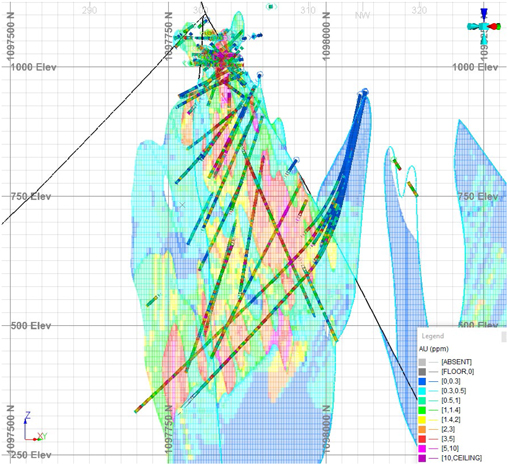
| 14.12. |
Confidence classification |
Tonnes and grade estimates for Marmato were classified according to the CIM Definition Standards for Mineral Resources and Mineral Reserves (CIM, 2014). Mineral Resource classification is a subjective concept. Industry best practice suggests that classification should consider the confidence in the geological continuity of the mineralized structures, the quality and quantity of exploration data supporting the estimates, and the geostatistical confidence in the tonnage and grade estimates. Appropriate classification criteria should aim to integrate both concepts to delineate regular volumes at a similar resource classification.
Data quality, drillhole spacing, and the interpreted continuity of grades controlled by the veins have allowed the QP to classify portions of the veins in the measured, indicated, and inferred mineral resource categories.
Measured mineral resources were assigned only to estimates made in the vein and disseminated material within the current mining levels supported by significant numbers of channel samples, within the first search of 25 m, which required a minimum of four composites and a maximum of 12.
Indicated mineral resources were assigned to estimates made in the first and second searches in the vein, disseminated, splays, and Lower Mine mineralization. This applied to portions of the deposit that are supported by drillholes on a 50 m x 50 m spacing, and where there is data support from both diamond drilling and channel sampling.
Inferred mineral resources were assigned to estimates made in the second and third searches where there is sufficient confidence in the geological interpretation and limited to 150 m from data support. Portions of the
| Effective date: June 30, 2022 |
Page 98 of 236 |
| Aris Mining Corporation
|
Technical Report Marmato Gold Mine
|
porphyry pocket mineralization were classified as inferred due to the relatively small size of the interpretations and the limited data support, as well as a lack of detailed mine surveys.
This classification scheme was coded to the block model, and then digitized on 50 m cross sections to create wireframes to re-code the block model to ensure smooth transitions between the classification categories. An example section with a 100 m window with a view to the north west, showing the classification scheme at a mid-point of 1,162,950 m East and 1,097,375 m North is shown in Figure 14.6.
Figure 14.6 Example section of the mineral resource confidence classification scheme
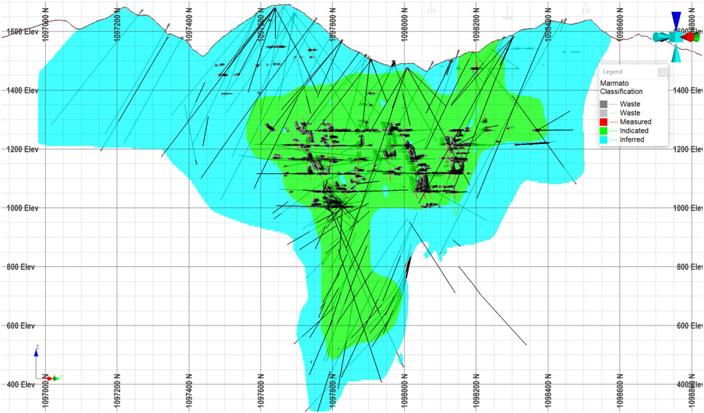
| 14.13. |
Cut-off grade assumptions |
SRK has undertaken an assessment of reasonable prospects for economic extraction on the assumption of underground mining and assessing continuity of the mineralization above the selected cut-off grade. The QP has defined the potential for economic extraction of the mineral resource estimate based on two cut-off grades depending on mining method. This includes a cut-off for the current operations at the Upper Mine and the long hole mining methods assumed for the Lower Mine, as well as metallurgical recoveries and operating costs of the Upper Mine and Lower Mine. Operating costs are based on the pre-feasibility study costs and assume a conversion of 4,200 COP to the USD. The assumptions used to determine the cut-off grades are shown in Table 14.6, which correspond to a 1.8 g/t Au cut-off grade for the Upper Mine mineral resources and a 1.3 g/t Au cut-off grade for the Lower Mine mineral resources.
Table 14.6 Cut-off grade assumptions
| Parameter |
Units |
Upper Mine |
Lower Mine |
|||||||
|
Gold price |
US$ per ounce |
1,700 | 1,700 | |||||||
|
Gold recovery |
% |
90 | 95 | |||||||
|
Mining cost |
US$/t mined |
50.46 | 34.77 |
| Effective date: June 30, 2022 |
Page 99 of 236 |
| Aris Mining Corporation
|
Technical Report Marmato Gold Mine
|
|
Parameter |
Units |
Upper Mine | Lower Mine | |||||||
|
Processing cost |
US$/t ore |
16.14 | 16.12 | |||||||
|
Royalties |
US$/t ore |
8.96 | 6.75 | |||||||
|
General and Administrative and other |
US$/t ore |
11.6 | 7.87 | |||||||
|
Total costs |
US$/t |
87.16 | 65.51 | |||||||
| Cut-off grade |
Au g/t |
1.8 | 1.3 |
| 14.14. |
Mineral resource tabulation |
The mineral resource estimate for the Marmato mine, effective June 30, 2022 is shown in Table 14.7.
Table 14.7 Marmato mineral resource estimate effective June 30, 2022
|
Area |
Category |
|
Tonnes (Mt |
) |
|
Grade Au (g/t |
) |
|
Grade Ag (g/t |
) |
|
Contained Au (koz |
) |
|
Contained Ag (koz |
) | ||||||
|
Upper Mine |
Measured |
2.8 | 6.04 | 27.8 | 545 | 2,509 | ||||||||||||||||
| Indicated |
12.7 | 4.14 | 16.8 | 1,691 | 6,847 | |||||||||||||||||
| Measured + Indicated |
15.5 | 4.49 | 18.8 | 2,236 | 9,356 | |||||||||||||||||
| Inferred |
2.6 | 3.03 | 15.4 | 250 | 1,265 | |||||||||||||||||
|
Lower Mine |
Measured |
0.0 | 2.73 | 17.8 | 0 | 3 | ||||||||||||||||
| Indicated |
46.0 | 2.54 | 3.3 | 3,761 | 4,912 | |||||||||||||||||
| Measured + Indicated |
46.0 | 2.54 | 3.3 | 3,761 | 4,914 | |||||||||||||||||
| Inferred |
33.1 | 2.39 | 2.3 | 2,537 | 2,418 | |||||||||||||||||
|
Marmato Total |
Measured |
2.8 | 6.04 | 27.8 | 545 | 2,512 | ||||||||||||||||
| Indicated |
58.7 | 2.89 | 6.2 | 5,452 | 11,758 | |||||||||||||||||
| Measured + Indicated |
61.5 | 3.03 | 7.2 | 5,997 | 14,270 | |||||||||||||||||
| Inferred |
35.6 | 2.43 | 3.2 | 2,787 | 3,682 | |||||||||||||||||
| Notes: 1. Measured and Indicated mineral resources are inclusive of mineral reserves. 2. Mineral resources are not mineral reserves and have no demonstrated economic viability. 3. The mineral resource estimate was prepared by Benjamin Parsons, MSc, of SRK, who is a Qualified Person as defined by National Instrument 43-101. Mr. Parsons has reviewed and verified the drilling, sampling, assaying, and QAQC protocols and results, and is of the opinion that the sample recovery, preparation, analyses, and security protocols used for the mineral resource estimate are reliable for that purpose. 4. Totals may not add up due to rounding. 5. Mineral resources are reported above a cut-off grade of 1.8 g/t Au for the Upper Mine and 1.3 g/t Au for the Lower Mine. The cut-off grades are based on a metal price of US$1,700 per ounce of gold, and gold recoveries of 90% for the Upper Mine and 95% for the Lower Mine. 6. The Upper Mine is defined as the current operating mine levels above the 950 m elevation and the Lower Mine is defined as below the 950 m elevation. 7. There are no known environmental, permitting, legal, title, taxation, socio-economic, marketing, political, or other relevant factors that could materially affect the mineral resources. |
| |||||||||||||||||||||
| 14.15. |
Mineral resource sensitivity |
The mineral resource estimate effective June 30, 2022 is sensitive to the selection of the reporting cut-off grade. To illustrate the sensitivity the block model quantities and grade estimates for Marmato were classified utilizing the existing classification scheme above a range of cut-off grades.
A summary of the grade tonnage amounts for measured and indicated resources for the Upper Mine is shown in Table 14.8 and for the Lower Mine in Table 14.9, and for inferred resources for the Upper Mine in Table 14.10 and
| Effective date: June 30, 2022 |
|
Page 100 of 236 |
|
| Aris Mining Corporation
|
Technical Report Marmato Gold Mine
|
for the Lower Mine in Table 14.11. The reader is cautioned that the figures presented in the tables should not be misconstrued with a mineral resource statement.
Table 14.8 Upper Mine measured and indicated grade tonnage table
| Cut-off grade Au (g/t) |
Tonnes (Mt) | Grade Au (g/t) | Grade Ag (g/t) | Contained Au (koz) | Contained Ag (koz) | |||||||||||||||||
| 1.8 | 15.5 | 4.49 | 18.8 | 2,236 | 9,356 | |||||||||||||||||
| 1.9 | 14.6 | 4.65 | 19.2 | 2,180 | 9,019 | |||||||||||||||||
| 2.0 | 13.7 | 4.82 | 19.8 | 2,128 | 8,729 | |||||||||||||||||
| 2.1 | 13.0 | 4.98 | 20.2 | 2,079 | 8,452 | |||||||||||||||||
| 2.2 | 12.3 | 5.14 | 20.7 | 2,031 | 8,189 | |||||||||||||||||
| 2.3 | 11.6 | 5.30 | 21.2 | 1,982 | 7,906 | |||||||||||||||||
| 2.4 | 11.1 | 5.45 | 21.6 | 1,940 | 7,678 |
Table 14.9 Lower Mine measured and indicated grade tonnage table
|
Cut-off grade Au (g/t) |
Tonnes (Mt) | Grade Au (g/t) | Grade Ag (g/t) | Contained Au (koz) | Contained Ag (koz) | |||||||||||||||
| 1.1 | 58.0 | 2.26 | 3.1 | 4,224 | 5,844 | |||||||||||||||
| 1.2 | 51.6 | 2.40 | 3.2 | 3,987 | 5,361 | |||||||||||||||
| 1.3 | 46.0 | 2.54 | 3.3 | 3,761 | 4,914 | |||||||||||||||
| 1.4 | 41.2 | 2.68 | 3.4 | 3,554 | 4,525 | |||||||||||||||
| 1.5 | 37.4 | 2.81 | 3.5 | 3,376 | 4,207 | |||||||||||||||
| 1.6 | 34.3 | 2.92 | 3.6 | 3,224 | 3,943 | |||||||||||||||
| 1.7 | 31.9 | 3.02 | 3.6 | 3,099 | 3,740 |
Table 14.10 Upper Mine inferred grade tonnage table
|
Cut-off grade Au (g/t) |
Tonnes (Mt) | Grade Au (g/t) | Grade Ag (g/t) | Contained Au (koz) | Contained Ag (koz) | |||||||||||||||
|
1.8 |
2.6 | 3.03 | 15.4 | 250 | 1,265 | |||||||||||||||
| 1.9 |
2.3 | 3.16 | 15.8 | 235 | 1,172 | |||||||||||||||
|
2.0 |
2.1 | 3.29 | 16.0 | 221 | 1,078 | |||||||||||||||
| 2.1 |
1.9 | 3.43 | 16.3 | 207 | 985 | |||||||||||||||
|
2.2 |
1.7 | 3.57 | 16.8 | 194 | 916 | |||||||||||||||
| 2.3 |
1.5 | 3.73 | 17.4 | 181 | 844 | |||||||||||||||
| 2.4 |
1.3 | 3.90 | 18.0 | 169 | 779 |
Table 14.11 Lower Mine inferred grade tonnage table
|
Cut-off grade Au (g/t) |
Tonnes (Mt) | Grade Au (g/t) | Grade Ag (g/t) | Contained Au (koz) | Contained Ag (koz) | |||||||||||||||
|
1.1 |
43.9 | 2.09 | 2.09 | 2,954 | 2,956 | |||||||||||||||
| 1.2 |
38.2 | 2.23 | 2.18 | 2,742 | 2,676 | |||||||||||||||
|
1.3 |
33.1 | 2.39 | 2.27 | 2,537 | 2,418 | |||||||||||||||
| 1.4 |
28.9 | 2.54 | 2.37 | 2,354 | 2,197 | |||||||||||||||
|
1.5 |
25.1 | 2.70 | 2.47 | 2,180 | 1,993 | |||||||||||||||
| 1.6 |
21.6 | 2.88 | 2.61 | 2,006 | 1,812 | |||||||||||||||
| 1.7 |
19.2 | 3.04 | 2.71 | 1,877 | 1,669 |
| Effective date: June 30, 2022 |
Page 101 of 236 |
| Aris Mining Corporation
|
Technical Report Marmato Gold Mine
|
| 14.16. |
Comparison to previous estimate |
The mineral resource estimate has increased since the previous mineral resource estimate effective June 30, 2021. There has been no additional drilling or updates to the geological model and grade estimates since that effective date but the mineral resource estimate has been updated to reflect the depletion for material mined as of June 30, 2022, and to reflect the latest economic assumptions used for defining the reasonable prospects for economic extraction in line with the current technical studies. The results of the adjustments for these key assumption has resulted in the following key changes in the reporting criteria:
| • |
Depletion for mining between June 30, 2021 to June 30, 2022 |
| • |
Change in the elevation used to define the Upper Mine and Lower Mine from the 1,000 m level to the 950 m level, shifting material previously allocated to the Lower Mine to the Upper Mine. |
| • |
Reduction in the Upper Mine cut-off grade from 1.9 g/t Au to 1.8 g/t Au |
| • |
Reduction in the Lower Mine cut-off grade from 1.4 g/t Au to 1.3 g/t Au |
| • |
Changing the cut-off grade applied according to elevation, rather than by elevation and mineralization style. |
Considering these differences the overall changes in the mineral resource statement are in the order of +3% in terms of contained gold ounces for the combined measured and indicated material, and +9% for the inferred contained gold ounces.
| 14.17. |
Material factors |
SRK considers that the drilling and channel sampling information is sufficiently reliable to interpret the boundaries of the mineralized structures, and that the sample grade data are sufficiently reliable to support the mineral resource estimate. There are no known legal, political, environmental, or other risks that could materially affect the potential development of the mineral resources.
| Effective date: June 30, 2022 |
Page 102 of 236 |
| Aris Mining Corporation
|
Technical Report Marmato Gold Mine
|
15. Mineral reserve estimates
| 15.1. |
Disclosure |
The effective date of the mineral reserve estimate is June 30, 2022. The mineral reserve estimate was prepared by Anton Chan, P. Eng. and Joanna Poeck, SME-RM, MMSAQP, both of SRK Consulting, who are Qualified Persons as defined by NI 43-101.
| 15.2. |
Overview |
The mine is currently developed to the 1,000 m elevation utilizing three different mining methods, separated into two distinct zones.
The Upper Mine is the mineralized vein material between 950 m elevation to 1,300 m elevation, and is currently in operation and mined using conventional cut and fill stope methods. The cut and fill stopes are divided into 30 m long by 50 m high panels with varying widths. An area at the base of the Upper Mine between the 950 m elevation and the 1,050 m elevation, referred to as the Transition Zone, occurs where the deposit changes from narrow vein mineralization to large porphyry mineralized areas. Mineralization is generally vertical, with vein widths ranging from more than one metre to several metres and porphyry widths up to approximately 100 m. Above 1,000 m elevation, a longhole stoping method will be used. The stope size is 15 m wide by 15 m high with varying lengths of up to 26 m. These stopes will be mined in a primary-secondary sequence with cemented waste rockfill for the primary stopes and unconsolidated waste rockfill for the secondary stopes. Between 950 m elevation and 1,000 m elevation, a drift and fill method will be used. The drift sizes are 4.5 m wide by 3 m high. These stopes will be mined in a primary-secondary sequence with cemented waste rockfill for the primary stopes and unconsolidated waste rockfill for the secondary stopes.
The Lower Mine comprises mineralized porphyry material below the 950 m elevation. There is a 10 m sill pillar left in situ between the Lower Mine and the Upper Mine. The Lower Mine material is mined using a longhole stoping method with stope sizes that are 20 m wide by 25 m high, with varying lengths of up to 20 m. The lowest elevation in the Lower Mine plan is 335 m. The Lower Mine area is currently not yet developed.
Ore from the Upper Mine is processed in the existing processing facility and ore from the Lower Mine will be sent to a new processing facility. Separate mine plans are presented for the Upper Mine and Lower Mine. Figure 18.3 shows the general locations of the mining areas and process facilities.
Mineral reserves were classified using the 2014 CIM Definition Standards. Measured and indicated mineral resources were converted to proven and probable mineral reserves by applying the appropriate modifying factors, as described herein, to potential mining block shapes created during the mine design process. Inferred resource material is treated as waste with zero grade. All mineral reserve tonnages are expressed as “dry” tonnes (i.e., no moisture) and are based on the density values stored in the block model. A 3D design has been created representing the planned mineral reserve mining areas.
| 15.3. |
Upper Mine conversion assumptions, parameters, and methods |
| 15.2.1. |
Dilution |
The dilution applied for cut and fill is 19%. In the past, the Upper Mine stopes were diluted by more than 50% from mining low grade veinlets and disseminated material. Recently, the mine has made improvements to grade control, however, more work is needed to ensure that the 19% dilution can be achieved consistently. The dilution applied for the long hole method in the Transition Zone is 20% and is based on actual data from site. The dilution for the drift and fill method in the Transition Zone is 15%.
| 15.2.2. |
Recovery |
Mining recovery factors are applied to the mine design by area as shown in Table 15.1. Items considered for the recovery include:
| • |
Upper Mine veins |
| Effective date: June 30, 2022 |
Page 103 of 236 |
| Aris Mining Corporation
|
Technical Report Marmato Gold Mine
|
| ○ |
Material loss due to mucking equipment inefficiencies |
| ○ |
Drill and blast inefficiencies |
| ○ |
Geotechnical factors |
| • |
Upper Mine transition |
| ○ |
Mucking blind corners in the stopes |
| ○ |
Material lost into backfill |
| ○ |
Drill and blast inefficiencies |
| ○ |
Geotechnical factors |
Table 15.1 Upper Mine mining recovery factors
| Mining area |
Mining method |
Recovery (%) | ||||
|
Upper Mine veins |
Cut and fill Levels 16 to 18 |
75% | ||||
| Upper Mine veins |
Cut and fill Levels 19 to 22 |
90% | ||||
|
Upper Mine Transition Zone |
Long hole |
90% | ||||
|
Upper Mine Transition Zone |
Drift and fill |
90% |
| 15.2.3. |
Additional allowance factors |
A 10% extra development allocation is applied to the lateral development items that were not included in the design, such as muck bays, sumps, safety bays, etc.
| 15.2.4. |
Cut-off grade calculation |
The cut-off grade for the Upper Mine is calculated based on the cost structure provided by Aris Mining as summarized in Table 15.2. SRK notes that the values presented may differ from the economic model, however SRK is of the opinion that the differences are not material.
Table 15.2 Upper Mine cut-off grade parameters
|
Parameter |
Unit |
Amount | ||||
| Mining cost Process cost G&A Total cost |
US$/t US$/t US$/t US$/t |
51 | ||||
| 16 | ||||||
| 22 | ||||||
| 89 | ||||||
|
Gold price Gold recovery Cut-off grade |
US$/oz % g/t Au |
1,500 | ||||
| 90 | ||||||
| 2.05 |
| 15.3. |
Lower Mine conversion assumptions, parameters, and methods |
| 15.3.1. |
Dilution |
The mining dilution estimate is based on ELOS (Clark and Pakalnis, 1997). ELOS is an empirical design method that is used to estimate the amount of overbreak/slough that will occur in an underground opening based on rock quality and the hydraulic radius of the opening. ELOS was applied to in situ rock exposed and to the paste backfill walls wherever mining will occur adjacent to a secondary stope. In additional to the ELOS allowances, an additional allowance was used to account for backfill dilution from the floor when mucking a stope. The dilution assumptions are shown in Table 15.3.
Table 15.3 Lower Mine dilution assumptions
|
Type |
Value (m) | |
|
Sidewall ELOS (rock) |
0.35 | |
|
Sidewall ELOS (backfill) |
0.20 | |
|
Bottom (mucking backfill) |
0.20 | |
|
Back ELOS (rock) |
0.35 |
| Effective date: June 30, 2022 |
Page 104 of 236 |
| Aris Mining Corporation
|
Technical Report Marmato Gold Mine
|
|
Type |
Value (m) | |||
|
Endwall ELOS (rock) |
0.35 | |||
|
Endwall ELOS (backfill) |
0.20 |
The ELOS and floor dilution factors result in a total dilution of 7%. Backfill dilution is added using zero grade. The rock portion of the dilution (approximately 3.1%) is expected to contain grade. The grade applied to rock dilution is based on querying block model grades just outside the stope designs in a representative area. This exercise showed that the dilution was approximately 60% of the stope grade, and therefore for the reserves, the grade applied to the rock dilution is 60% of the stope grade.
| 15.3.2. |
Recovery |
A stope recovery factor of 93.5% was used. The following items were used to calculate this factor:
| • |
Material loss into backfill (floor) of 0.20 m |
| • |
Material loss to mucking along sides and in blind corners |
| • |
Additional loss factor due to rockfalls, misdirected loads, and other geotechnical reasons |
A development recovery factor of 100% was used for all horizontal development.
| 15.3.3. |
Additional allowance factors |
Additional ramp allowance factors were used to account for additional excavations not included in the design and are summarized in Table 15.4. These items should be designed at the detailed planning stage. The average length item shown in the table is the representative length of ramp that the listed allowances are applied to.
Table 15.4 Additional ramp allowance factors
|
Type |
Units |
Main ramp | Footwall accesses | |||||||
|
Average length |
m |
500 | 350 | |||||||
| Muck bays with high backs |
m3 |
458 | - | |||||||
|
High backs for loading |
m3 |
- | 244 | |||||||
| Electrical bays |
m3 |
81 | 81 | |||||||
|
Pump stations |
m3 |
324 | 324 | |||||||
| Passing bays |
m3 |
685 | - | |||||||
|
Total additional allowance |
m3 |
1,548 | 649 | |||||||
|
Expressed as a % of representative length of development |
% |
10.4 | 7.5 |
| 15.3.4. |
Cut-off grade calculation |
Current estimated Project costs and the calculated cut-off grade are shown in Table 15.5, which do not include a consideration for silver. The mining cost includes backfill; G&A and other costs include tailings. SRK notes that the values presented may differ from the economic model, however SRK is of the opinion that the differences are not material. A minimum cut-off grade of 1.62 g/t Au was used for reporting mineral reserves within the mine design.
Table 15.5 Lower Mine cut-off grade parameters
|
Parameter |
Unit | Amount | ||||||
|
Mining cost |
US$/t | 41.15 | ||||||
| Process cost |
US$/t | 16.00 | ||||||
|
Production taxes/royalty |
US$/t | 7.16 | ||||||
| G&A, other |
US$/t | 9.99 | ||||||
|
Total cost |
US$/t | 74.30 | ||||||
| Gold price |
US$/oz | 1,500 | ||||||
|
Gold recovery |
% | 95 | ||||||
| Cut-off grade |
g/t | 1.62 |
| Effective date: June 30, 2022 |
Page 105 of 236 |
| Aris Mining Corporation
|
Technical Report Marmato Gold Mine
|
15.4. Mineral reserve tabulation
The mineral reserve estimate for Marmato, effective June 30, 2022, is shown in Table 15.6.
Table 15.6 Marmato mineral reserve estimate effective June 30, 2022
| Area |
Category |
Tonnes (kt) | |
Grade Au g/t |
|
|
Grade Ag g/t |
|
|
Contained Au (koz) |
|
Contained Ag (koz) | ||||||||
| Upper Mine |
Proven |
2,195.5 | 4.31 | 16.4 | 304 | 1,157 | ||||||||||||||
|
Probable |
4,946.9 | 4.09 | 14.3 | 650 | 2,273 | |||||||||||||||
|
Proven + Probable |
7,142.3 | 4.16 | 14.9 | 954 | 3,431 | |||||||||||||||
| Lower Mine |
Proven |
- | - | - | - | - | ||||||||||||||
|
Probable |
24,135.0 | 2.87 | 3.5 | 2,224 | 2,707 | |||||||||||||||
|
Proven + Probable |
24,135.0 | 2.87 | 3.5 | 2,224 | 2,707 | |||||||||||||||
| Marmato Total |
Proven |
2,195.5 | 4.31 | 16.4 | 304 | 1,157 | ||||||||||||||
|
Probable |
29,081.8 | 3.08 | 5.3 | 2,874 | 4,980 | |||||||||||||||
|
Proven + Probable |
31,277.3 | 3.16 | 6.1 | 3,178 | 6,138 | |||||||||||||||
| Notes: 1. The Upper Mine mineral reserve estimate was prepared by Anton Chan, BEng, M.Sc., P.Eng, MMSAQP and the Lower Mine mineral reserve estimate was prepared by Joanna Poeck, BEng Mining, SME-RM, MMSAQP, both of whom are Qualified Persons as defined by NI 43-101. 2. All figures are rounded to reflect the relative accuracy of the estimate. Totals may not add up due to rounding. Mineral resources are reported inclusive of the Mineral reserves. 3. Upper Mine mineral reserves are reported above a cut-off grade of 2.05 g/t Au and the Lower Mine mineral reserves are reported above a cut-off grade of 1.62 g/t. The cut-off grades are based on a metal price of US$1,500 per ounce of gold, gold recoveries of 90% for the Upper Mine and 95% for the Lower Mine, and costs of US$89 per tonne for the Upper Mine and US$74.3 per tonne for the Lower Mine. 4. The economic analysis was completed with a gold price of $1,600 per ounce while the cut-off for the mine design and mineral reserves uses a gold price of $1,500 per ounce. The project economics remain positive at a price of $1,500 per ounce gold. | ||||||||||||||||||||
15.5. Comparison to previous estimate
The mineral reserves estimate has increased since the previous mineral reserve estimate effective March 17, 2020, on the basis of an increase in the mineral resource estimate with additional drilling and channel sampling completed since the previous estimate. The Upper Mine mineral reserves have increased by 39% in contained gold ounces and the Lower Mine mineral reserves have increased by 67% in contained gold ounces.
15.6. Material factors
SRK knows of no existing environmental, permitting, legal, socio-economic, marketing, political, or other factors which could materially affect the underground mineral reserve estimate. SRK notes that there is a 2 Mt per year total material movement cap for the Project at this time, which was adhered to in the production schedule and affects the sequencing of the reserve material.
| Effective date: June 30, 2022 |
Page 106 of 236 |
| Aris Mining Corporation
|
Technical Report Marmato Gold Mine
|
16. Mining methods
16.1. Introduction
As described in Section 15.2, the Upper Mine is currently in operation and developed to the 1,000 m elevation utilizing three different mining methods, separated into two distinct zones.
The Upper Mine is the mineralized vein material between 950 m elevation to 1,300 m elevation, and is currently in operation and mined using conventional cut and fill stope methods at a mining rate of 1,250 tpd. An area at the base of the Upper Mine between the 950 m and 1,050 m elevation, referred to as the Transition Zone, occurs where the deposit changes from narrow vein style mineralization to large porphyry style mineralization. Mining in the Transition Zone is by long hole stoping and drift and fill at a mining rate of 350 tpd.
The planned Lower Mine comprises porphyry style mineralization below the 950 m elevation and will be mined using long hole stoping at a projected rate of 4,000 tpd. There is a 10 m sill pillar left in situ between the Lower Mine and the Upper Mine.
16.2. Mine geotechnical
16.2.1. Introduction
The geotechnical database and stability approaches used for the Lower Mine expansion Project at Marmato fulfill the pre-feasibility study requirements. The standards used by Marmato personnel for data collection are broadly consistent with industry standards.
The pre-feasibility study geotechnical field data collection program was developed for obtaining information for both RMR89 (Bieniawski, 1989) and Barton Q’-systems (Barton, et al., 1974). Both rock mass characterization methods were used to determine the Lower Mine rock mass quality (RMQ), which was used to support the underground mine design and define the type of ground support required for each underground excavation. All mine design parameters are based on empirical methods, which are acceptable for a pre-feasibility study level of design. More detailed stability modeling should be implemented at a feasibility study level and prior to construction. SRK recommends conducting 3D numerical modelling to determine the effect of the mine sequence on the overall stope stability and underground infrastructure. Special attention to the major fault interpretation also needs to be considered as part of the feasibility study geotechnical drilling program.
The following sections summarize the key sections of the pre-feasibility study geotechnical technical assessment conducted by SRK.
16.2.2. Database
From June 2018 to August 2022 a geotechnical diamond drill hole investigation program was conducted, under SRK’s guidance, to examine RMQ and structural features in and around the mineralized zone at different depths and orientations. Drillholes were drilled at varying orientations into the hangingwall, footwall and mineralized rock to cover a range of discontinuity intercepts. The field investigation included the drilling of core, structural feature measurements, geotechnical core logging, and core sample collection for laboratory strength testing. In addition to the geotechnical drilling program, additional mostly exploration drill holes were considered for validation to support the geotechnical domains. A total of 39,351 m in 81 drillholes were analyzed and considered valid for estimating the rock mass strength parameters.
The Project team carried out a laboratory testing program in 2020. Laboratory tests considered for analysis included 144 uniaxial compressive strength (UCS) tests, 90 multiaxial compressive strength (TCS) tests, 46 direct shear (DSS) tests applied to various discontinuities, 63 indirect tensile strength (BTS, Brazilian tests) tests, 151 elastic constant measurements (Young’s modulus and Poisson’s ratio), and 200 dry density tests.
| Effective date: June 30, 2022 |
Page 107 of 236 |
| Aris Mining Corporation
|
Technical Report Marmato Gold Mine
|
16.2.3. Engineering geology
Data from Aris Mining’s geotechnical databases were compiled, reviewed, and validated by SRK. The databases include data from additional core drilling that has been completed since the data available for analysis to support the 2020 pre-feasibility study. For each drillhole evaluated, RQD (%) was compared to fracture frequency (ff/m). RMR89 values were also compared to Q’ values. Reliable values that fell within acceptable ranges were validated and suspicious values were removed from consideration. A total of 8,609 m of validated core data was utilized to define geotechnical domains.
SRK observes that both the Transition Zone of the Upper Mine and the Lower Mine are dominated by a unique lithology, the P1 Porphyry. Other lithologies observed in the validated data include the Marmato porphyry stocks P2, P3, and P4, Combia Formation basalt, Amagá Formation clastic sediments, Arquía Complex graphitic-sericite schist, and a series of breccias. The geotechnical domains were defined by considering both lithology, especially with respect to the P1 Porphyry, and rock mass parameters, especially RMR89.
The Marmato Porphyries and Combia Formation basalts were grouped and then sub-divided into groups for Very Good Rock (I), Good Rock (II), and Fair Rock (III), establishing geotechnical domains 1 through 3. The remaining lithologies were also grouped and then sub-divided into groups for Very Good Rock (I), Good Rock (II) plus Fair Rock (III, high RQD), and Fair Rock (III, low RQD) plus Poor Rock (IV), establishing geotechnical domains 4 through 6. The Bieniawski characterization, weighted average RMR89, and approximate RQD values are provided by geotechnical domain in Table 16.1.
Table 16.1 Characteristics of each geotechnical domain
|
Domain |
Characterization | RMR89 weighted average | RQD % | |||
|
1 |
Very Good Rock Class I | 89.4 ±3.7 | 99.6 | |||
| 2 |
Good Rock Class II | 72.8 ±10.0 | 96.7 | |||
|
3 |
Fair Rock Class III | 45.9 ±16.8 | 56.0 | |||
| 4 |
Very Good Rock Class I | 84.5 ±19.8 | 100.0 | |||
|
5 |
Good Rock Class II | 74.2 ±12.2 | 96.3 | |||
|
6 |
Poor Rock Class IV | 31.0 ±16.8 | 35.4 |
There is no significant difference between the rock mass fabric of hangingwall, footwall, and ore. SRK notes that there are no clear lithological, structural, or RMQ boundaries. Therefore, the structural domain has been considered as a unique structural domain for the Lower Mine, which includes hangingwall, footwall, and ore. This assumption is valid for a pre-feasibility study level. Future drilling programs for feasibility study level design should confirm and/or adjust this assumption. Structural assessment revealed the existence of three differently oriented structural sets. The structural set orientations are well correlated with the orientation of the major faults.
16.2.4. Stope stability assessment
SRK agrees with the approach by Wood (2022) for stope stability assessment. For the stope back stability assessment, Wood estimated the maximum unsupported and supported transverse widths for stopes located in in the hangingwall and footwall planes. In order to maintain the stability of the stope with design strike lengths of 20 m, the analysis indicates that the back of the stopes located in both the hangingwall and footwall will require cable bolt support. The proposed transverse width based on the east-west stability analysis indicated that stopes should be paneled at around 15 to 18 m. The data shows that support of the footwall is not required for stope strike lengths of 20 m. However, when considering the rock mass condition data, a third of the stope footwalls located in both the hangingwall and footwall plane may not be stable. These stopes will need to be monitored for stability during operation and cable bolt support of draw points may be required in these cases. More detailed numerical simulations should be included as part of the feasibility level design.
| Effective date: June 30, 2022 |
Page 108 of 236 |
| Aris Mining Corporation
|
Technical Report Marmato Gold Mine
|
16.2.5. Dilution estimate
Dilution was estimated using the Clark and Pakalnis (1997) method, which predicts the quantity of unstable wall rock for a given RMQ and stope size. The dilution is estimated as an ELOS.
Wood (2022) estimated the total rock dilution ranging between 4 and 5% with an overall dilution of 4.4%, and estimated the paste backfill dilution ranging between 2 and 4% with an overall dilution of 3%. Wood’s investigation on stope dilution estimated a total overall dilution of 7.4% over the production of the Lower Mine. SRK concludes that Wood’s approach is valid for pre-feasibility study. Future feasibility study level design should include a numerical simulation for adjusting the ELOS based on the mine sequence and updated geotechnical domains.
16.2.6. Paste fill strength estimate
To estimate the paste fill strength at a pre-feasibility study level, SRK accepted the analytic solutions developed by Mitchell et al. (1982). The model was developed to estimate the factor of safety of a stope upon exposure of unsupported backfill. Based on the Mitchell approach, SRK estimates a backfill UCS strength of 1 MPa for single face fill exposure during mining of the adjacent secondary stope in high stress conditions. To reach the required paste fill strength for primary and secondary stopes, laboratory tests conducted by Paterson and Cooke (2020) indicated that 7% cement will be sufficient for obtaining high strength paste fill in 7 days, and that 4% cement will be sufficient for low strength paste fill.
At least one day of paste fill curing should be allowed to set the plug prior to completing stope filling. In secondary stopes where the paste fill will never be exposed, sufficient binder is required to prevent liquefaction of the paste fill during mining operations.
Based on the Paterson and Cooke test program (Paterson and Cooke, 2020), the majority of the tailings consist of the silicate mineral quartz (18.9%), and the feldspars albite (38.2%), orthoclase (12.5%), and anorthite (12.0%). These minerals are inert and do not participate in the hydration dynamics of the cementitious reactions. As such, they are considered good fillers for backfill material. The remaining tailings consist of the phyllosilicate minerals mica (annite, 8.9%) and chlorite (9.5%). Annite has weak bonds between the internal sheet structures of the mineral allowing for failure planes and crack propagation pathways, potentially lowering paste strength. The magnitude of this effect depends on the weathering of the material as well as the size fraction of the particles. It has been observed that contents above 5% can affect the strength of the backfill. The effect of chlorite is also dependent on the formation of the mineral, but the internal sheet structures are generally held together much more firmly than that of annite, and therefore is not usually an issue in backfill applications.
The water analysis shows that the decant water mainly contains trace amounts of alkali sulfates with some alkali chlorides. The chloride content (49 mg/l) is within acceptable limits for concrete use and will not delay the cement setting in the backfill.
There is no large presence of any other metals or problematic compounds reported in the water analysis (Paterson and Cooke, 2020). As such, the process water is considered acceptable for backfill purposes.
Paterson and Cooke conducted strength testwork with the objective of evaluating the feasibility of using the tailings as a paste fill to reach the targeted values of 1.0 MPa for single face exposure, and 0.5 MPa strengths for low stress conditions at 14 day cure rates.
Wood (2022) recommended UCS for primary stopes range from 172 to 584 kPa, while UCS for secondary stopes and longitudinal stopes range from 163 to 193 kPa, based on the assumption of a standard stope size of 25 m high x 20 m wide, with the length ranging from 14 to 18 m. Wood’s overall recommended weighted average strength is 309 kPa. Based upon results from Paterson and Cooke (2020), Wood concluded that an overall strength of 309 kPa is achievable with a 4.5% binder content. Wood also concluded that the upper strength range for primary stopes (per their recommendation of 584 kPa) is achievable with 6% binder, and that the upper strength range for secondary stopes (per their recommendation of 193 kPa) is achievable with 3% binder.
| Effective date: June 30, 2022 |
Page 109 of 236 |
| Aris Mining Corporation
|
Technical Report Marmato Gold Mine
|
For future feasibility study level design, SRK agrees with Wood’s assessment of the need to conduct an updated cemented paste backfill material study based upon actual tailings produced from the Lower Mine, as the Paterson and Cooke 2020 study was based upon tailings from the Upper Mine. SRK also agrees with Wood’s assessment to conduct testing utilizing local water and cement to confirm that the previous testing results are valid, with 7, 56, and 112 day tests for all mixes, utilizing the 112 day tests to confirm that no degradation occurs due to sulphide minerals.
| 16.2.7. |
Ground support requirements |
SRK used the Norwegian Method of Tunneling support techniques, modified by Grimstad and Barton (2014) to estimate the pre-feasibility study level ground support requirements for infrastructure excavations as shown in Table 16.2. Table 16.3 summarizes the Wood (2022) recommendations for ground support in stopes.
Table 16.2 Ground support requirements for infrastructure excavations
|
Duration |
Excavation type |
Dimensions | Ground support type |
Bolting spacing (m) | ||||||||||||||||
| Depth (m) | ||||||||||||||||||||
| Width (m) |
Height |
600 |
700 |
800 |
900 |
1000 |
1100 | |||||||||||||
|
Long term |
Decline |
5.5 | 5.6 |
Spot bolting (20% of total excavation) |
Systematic 2 m long 25 mm diameter bolts on 1.2 m square spacing and 15 by 15 m Steel 5 mm welded wire mesh |
1.2 | ||||||||||||||
| Ramps |
5.5 | 5.5 | ||||||||||||||||||
| Main access |
5.0 | 5.0 | ||||||||||||||||||
| Shop run around loops |
5.5 | 5.5 |
Spot bolting and meshing as needed (10% of excavations) | |||||||||||||||||
| Declines |
5.5 | 5.5 | ||||||||||||||||||
| Medium term (one year) |
Footwall access/haulage drives |
5.0 | 5.0 | Spot bolting (5% of excavations) |
Spot bolting (5% of excavations) |
1.2 | ||||||||||||||
| Cross cuts option 1 |
4.5 | 4.5 | ||||||||||||||||||
| Cross cuts option 2 |
6.5 | 6.0 | Spot Bolting and Meshing (10% Of Excavations) |
Systematic Bolting (backs) | ||||||||||||||||
| Cross cuts option 3 |
6.5 | 7.0 | ||||||||||||||||||
| Short term (less than one year) |
Stope access/in stope drifts |
4.5 | 4.5 | Spot bolting (10% of excavations) |
||||||||||||||||
| Stope access/in stope drifts |
5. | 5.0 | Spot bolting (10% of excavations) | |||||||||||||||||
| Effective date: June 30, 2022 |
Page 110 of 236 |
| Aris Mining Corporation
|
Technical Report Marmato Gold Mine
|
| Duration |
Excavation type |
Dimensions | Ground support type |
Bolting spacing (m) | ||||||||||||||||
| Depth (m) | ||||||||||||||||||||
| Width (m) |
Height |
600 |
700 |
800 |
900 |
1000 |
1100 | |||||||||||||
|
Production shafts (apiques) |
5 | Systematic bolting (backs |
1.2 | |||||||||||||||||
|
Emergency access |
5 | Spot bolting (5% of excavation) plus systematic fiber reinforced shotcrete 5 cm thick |
2 | |||||||||||||||||
| 4.5 | ||||||||||||||||||||
Table 16.3 Ground support requirements for stopes
|
Stope location |
Assessed plane |
Exposure |
Elevation (above/below 730 m) |
Cable bolt density (bolts/m2) |
Cable bolt equivalent spacing (m) |
Design length (m) | ||||||
|
HW plane |
HW |
HW rock |
Above |
0.18 |
2.4 m x 2.4 |
4 - 6 | ||||||
|
HW |
HW rock |
Below |
0.19 |
2.3 m x 2.3 |
6 - 9 | |||||||
|
Back |
HW plane |
Above |
0.23 |
2.1 m x 2.1 |
6 - 9 | |||||||
|
Back |
HW plane |
Bellow |
0.25 |
2.0 m x 2.0 |
6 - 9 | |||||||
|
FW plane |
HW |
HW plane |
Above |
0.18 |
2.4m x 2.4 |
4 - 6 | ||||||
|
HW |
HW plane |
Below |
0.19 |
2.3 m x 2.3 |
6 - 9 | |||||||
|
Back |
HW plane |
Above |
0.24 |
2.0 m x 2.0 |
6 - 9 | |||||||
|
Back |
HW plane |
Below |
0.23 |
2.1 m x 2.1 |
6 - 9 |
| 16.2.8. |
Sill pillar |
To estimate the sill pillar dimension SRK used an analytic solution, which included the pillar dimensions assuming the under-hand stope will have a backfill gap and provide no confinement to the sill pillar. For a 30 m stope span, SRK estimates that a 9.5 m thick sill pillar is necessary. The pillar will be located approximately at 800 m depth and has a factor of safety of 1.5. The sill pillar could be optimized and/or recovered at a feasibility study level design, which could result in a potential opportunity for additional ore recovery by using numerical simulations, reducing the rock mass uncertainties, and accepting a factor of safety of 1.3. Numerical simulation should be used for future feasibility level designs to consider the mine induced stresses, which the analytic solutions have not considered.
| 16.2.9. |
Critical infrastructure stability assessment |
The stability study for critical infrastructure, such as the underground workshop and long term accesses, was assessed at a pre-feasibility study level and should not be implemented without more detailed investigation.
In terms of the underground workshop infrastructure, the stability assessment was conducted using a tributary area method. The method assumed that the workshop station is located about 750 m deep and assumed a factor of safety of 1.5. The stability assessment indicates that pillar widths should be 9 m wide and 7 m high. The acceptable hydraulic radius is dependent on pillar length and is 2.7 for 30 m lengths, 2.6 for 25 m lengths, and 2.5 for 20 m lengths.
Assuming the maximum bay width is 7.5 m, SRK anticipates needing systematic bolting of 2 m long bolts, 25 mm in diameter, and spaced 1.2 m, as well as 5 mm diameter 150 by 150 mm steel welded wire mesh with 5 cm fiber reinforced shotcrete.
| Effective date: June 30, 2022 |
Page 111 of 236 |
| Aris Mining Corporation
|
Technical Report Marmato Gold Mine
|
The decline route selection was considered a key part of the pre-feasibility study design. To select a suitable tunnel route, high level geological, geotechnical, hydrological, hydrogeological, and structural factors were taken into consideration. Special attention was given to the effect of the modeled major faults on the tunnel stability. To assess the potential effect of the major faults and expected rock mass quality, SRK considered criteria including reducing the exposure of the tunnel to major faults, ensuring that the tunnel trajectory crosses perpendicular to major faults, avoids faults and shear zones, and avoids crossing highly clayed materials.
16.2.10. Conclusions
From the pre-feasibility study geotechnical investigation, SRK concludes that:
| • |
The geotechnical investigation, laboratory tests, and design parameters are suitable for a pre-feasibility study and should not be fully implemented before a feasibility study is completed. |
| • |
The proposed stope design consists of maximum stope dimensions of 30 m high, 30 m long, and 10 m wide to maintain stability. Empirical charts suggest that the side walls are located in unsupported transition zones, which could require some spot ground support for potential wedge formations depending on discontinuity persistence and continuity. |
| • |
The empirical chart for estimating the open stope stand up time was accepted for the pre-feasibility study. The results indicate that a 10 m span stope can likely be open for one to six months without ground support. |
| • |
The data indicates that significant dilution is unlikely due to the good rock mass quality. Wall damage will likely be associated with blasting overbreak. SRK recommends that a blasting study is conducted during a feasibility study to evaluate the degree of overbreak. |
| • |
For secondary stopes that are open after mucking, a backfill UCS strength of 1 MPa will be adequate to maintain backfill stability and prevent backfill from sloughing into the open stope. Negligible wall sloughing is anticipated. |
| • |
SRK estimated a sill pillar height equal to 9.5 m, considering a factor of safety of 1.5. |
| • |
In terms of the underground workshop infrastructure, the stability assessment was conducted using a tributary area method. The method assumed that the workshop station is about 750 m deep and requires a factor of safety of 1.5, which resulted in a 9 m pillar width and a 7 m pillar height. |
| • |
Assuming a maximum bay width of 7.5 m, SRK anticipates needing systematic bolting of 25 mm diameter, 2 m long bolts spaced 1.2 m apart. 5 mm diameter 150 by 150 mm steel welded wire mesh with 5 cm fiber reinforced shotcrete is also anticipated. |
| • |
The decline route selection was considered a key part of the pre-feasibility study design. High-level geological, geotechnical, hydrological, hydrogeological, and structural factors were taken into consideration to select the suitable decline route. Special attention was paid to the effect of the modeled major faults on the drift stability. The route selection criteria considered by SRK included reducing the exposure of the decline to major faults, crossing major faults at a perpendicular orientation, and avoiding shear zones and crossing highly clayed materials. |
16.2.11. Limitations and recommendations
The limitations described in this section are acceptable for a pre-feasibility study level design, and SRK recommends addressing the geotechnical model’s limitations and updating the design approach for future feasibility study level design. The main limitations and gaps of the current pre-feasibility study level models, requirements, parameters, and designs include:
| • |
The structural domains were defined based on four oriented drill holes and limited structural data obtained from the underground mine. SRK recommends utilizing an acoustic or optical televiewer in future exploration drill hole programs and to acquire more structural data from the underground excavations. |
| Effective date: June 30, 2022 |
Page 112 of 236 |
| Aris Mining Corporation
|
Technical Report Marmato Gold Mine
|
| • |
The major structural model should be updated based on specific drill holes and underground mapping. Additional large scale faults not included in the geological model which have been identified should also be considered. For a feasibility study, shear zones and breccia zones should be investigated. |
| • |
The empirical design charts do not include the effect of induced stresses due to the mine extraction sequence. For a feasibility study, SRK recommends reviewing the mine designs with further consideration given to mining sequences. |
| • |
The ground support requirements are based on an empirical approach. SRK recommends using a more detailed approach to determine the required ground support at a feasibility study level. |
| • |
The hydrogeological model has not been integrated into the geotechnical model; SRK considers it important to include the potential pore pressure in future stability models. |
| • |
3D numerical simulations should be conducted as part of a feasibility study. |
| • |
Long term access to critical infrastructure such as workshops should be investigated in more detail. Specific geotechnical drill holes and numerical simulations should be considered for a feasibility study. |
| • |
Specific monitoring information from the current mine operations, such as excavation displacements and excavation damage, should be collected to be used for future numerical model calibrations. |
| • |
Stress measurements should be conducted to estimate the existing mine induced stress conditions. |
| • |
An integration between the Transition Zone and the Lower Mine mine design should be incorporated as part of the feasibility study. |
To advance the design to a feasibility study level, additional characterization data will be required to reduce uncertainty in the data variation. SRK provides the following recommended characterization activities to advance the design to a final design level:
| • |
Although the intact rock strength is considered high, the micro cracking due to the intense veinlets will have a significant effect on the intact rock behaviour. An analysis of this effect should be included as part of the feasibility level analyses. |
| • |
Specific geotechnical drill holes should be drilled to characterize the rock mass parameters around the critical underground infrastructures. |
| • |
Geotechnical core logging and televiewer data in specific exploration drill holes should be collected and analyzed. The selection of exploration drill holes should be strategically placed in footwall infrastructure areas and planned stope mining areas to provide sufficient data to statistically verify the range of expected ground conditions. This includes: |
| o |
Collecting RMR/Q and structural orientation data |
| o |
Updating the structural model and geotechnical models and mine design parameters |
| o |
Update the major faults model |
| o |
Conduct pre-mining in situ stress measurements |
| o |
Collect tiltmeter measurements to confirm there is minimal subsidence above the Transition Zone |
| • |
Develop a ground control management plan with a triggered action response plan in case of excessive deformation or drift collapse or seepage inflows |
| • |
Perform mine scale stress analyses of the planned stoping sequence to evaluate the appropriateness of infrastructure setback distances, anomalous stress conditions resulting from the stoping sequence, variations in stress and groundwater conditions, and spatial variations in rock mass strength conditions |
| • |
A mine scale hydrogeological pore pressure model should be developed to estimate the ground water effect on mine stability and to provide key information for defining pumping requirements. |
| • |
Long term access to critical infrastructure should be evaluated, such as the crusher station and workshops. Specific geotechnical drill holes and numerical simulations should be considered for the feasibility study. |
| • |
Specific monitoring information from the current mine operations should be reviewed for future numerical simulations and calibrations, such as excavation displacements and excavation damage. It is important to re-evaluate the ground support based on depth and mine sequencing |
| Effective date: June 30, 2022 |
Page 113 of 236 |
| Aris Mining Corporation
|
Technical Report Marmato Gold Mine
|
16.3. Hydrogeology and mine dewatering
16.3.1. Hydrogeological conditions
The mine area is located in the hydrogeological regional area of Magdalena Cauca. The region is comprised of igneous and metamorphic rocks with limited groundwater storage capacity and hydraulic conductivity (IDEAM, 2013). The porphyry units represent the main hydrogeological units in the mine area, with a low hydraulic conductivity and limited groundwater storage capacity. Groundwater flow is compartmentalized within structural blocks with limited hydraulic communication across fault boundaries due to fault gouge, weathering, or an offset of geological units.
Previous field campaigns were performed by Knight Piésold in 2011 and 2012 (Knight Piésold, 2012). A field campaign performed by SRK has been underway since early 2020 and primarily consists of packer isolated interval testing, monitoring wells, and vibrating wire piezometer installations in underground drillholes or locations distal to the mine area.
SRK analyzed all available hydrogeological data, including:
| • |
Knight Piésold’s 172 packer tests, three piezometers installed underground, and 11 surface piezometers |
| • |
SRK’s 70 packer tests completed in four drillholes and vibrating wire piezometers installed in two drillholes |
| • |
SRK’s 2020 field campaign currently in progress focusing on underground targets from surface locations |
| • |
Historic mine water discharge records in 2017 and 2019 |
| • |
Historic water level measurements in the hydrogeologic study area |
| • |
Water level measurements in vibrating wire piezometers installed in two drillholes in 2020 |
16.3.2. Hydrogeological units and faults
Saprolitic coverage and intrusive fractured rock are the two major hydrogeological units defined in the Marmato mine area. The saprolite is formed by clay material that has weathered on the top of intrusive rock units. It can reach over 30 m in some locations and is usually dry in the mine area. The intrusive fractured rock corresponds to dacite and andesite porphyry stocks and a sheeted pyrite veinlet system associated with intermediate argillic and propylitic alteration.
The Amagá Formation is present east and southeast of the mine area in disconnected pockets and more extensively west of the mine within the Supia River Valley. Alluvial sediments are present along creeks and rivers.
The Criminal fault, which is located to the north of the Cerro El Burro hill at Marmato, and runs toward the Cauca River on Quebrada Los Pantanos, appears to form compartmentalization of geological blocks with limited communication across the fault (Knight Piésold, 2012). This fault represents a contact point between the dacite porphyry P1 in Cerro El Burro and dacite porphyry P2 and graphitic schist exposed to the north. The Criminal Fault is 15 to 20 m wide, has a clayey alteration and has a low water filtration flow. However, to the north of this contact, horizontal boreholes produce water flow from 7 to 8 l/s in Level 17. Also, water flow has been reported in the same location on Level 21.
Drillholes from the 2020 program encountered high-permeability zones with a hydraulic conductivity greater than 0.1 m/d, which may be associated with Fault 2 and Fault 1-3, in the vicinity of the planned Lower Mine at depths of 600 to 800 m below surface.
16.3.3. Hydraulic parameters
Measured hydraulic conductivity tests of the bedrock groundwater system in the vicinity of the mine were obtained from the 2012 and 2020 investigations. 250 tests were available, the majority of which were obtained from between 400 and 850 m below ground surface. The results indicate large variability in the data, on the order of 2 to 3 orders of magnitude, a general trend of decreasing conductivity with depth, and very low permeability at around 850 m below ground surface, where the bottom of the Lower Mine is planned.
| Effective date: June 30, 2022 |
Page 114 of 236 |
| Aris Mining Corporation
|
Technical Report Marmato Gold Mine
|
The zone of enhanced hydraulic conductivity values at depths of 600 to 800 m below the ground surface corresponds to fractured zones associated with Fault 2 and Fault 1-3 in the mine area. Based on these findings, bedrock units were grouped into four hydrogeological units varying with depth. The base case distribution of hydraulic conductivities is based on the geometric mean at discrete depth intervals and was used to predict expected mine inflow.
16.3.4. Measured water levels and groundwater flow direction
Measured water levels show elevations from 661 to 2,022 m, following the topography at 100 m depth in most of the locations outside the mine area. The estimated water table and direction of groundwater flow for pre-mining conditions are shown in Figure 16.1.
Figure 16.1 Estimated water table and direction of groundwater flow
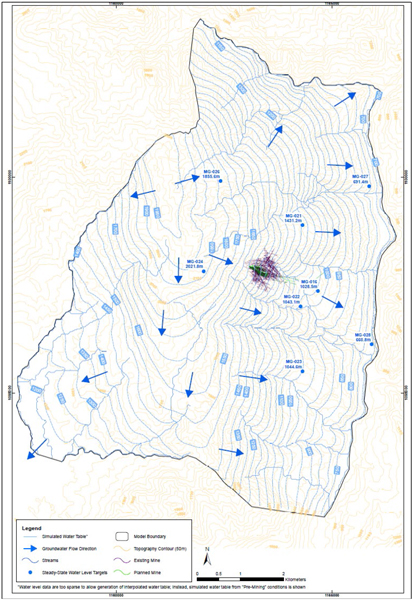
Water levels vs. depth and vertical hydraulic gradients were measured in two deep drillholes drilled in 2020 in the vicinity of the planned Lower Mine. Two strings of grouted-in transducers were installed in these two drillholes, indicating water level elevations ranging from 1,006 to 1, 012 m and from 1,065 to 1,072 m in the two holes, and a mixture of upward and downward hydraulic gradients in both holes.
| Effective date: June 30, 2022 |
Page 115 of 236 |
| Aris Mining Corporation
|
Technical Report Marmato Gold Mine
|
A depressurization zone was detected in the underground piezometers where the water levels have a horizontal trend. The shape or extent of the depressurization zone is currently unknown. On a more regional scale, the groundwater flows west to east following the topographical gradient to the Cauca River, located at 692 m in the proximity of the mine. The Cauca River represents the main discharge for the hydrogeological system. A conceptual hydrogeological cross-section is shown in Figure 16.2.
Figure 16.2 Conceptual hydrogeological cross section
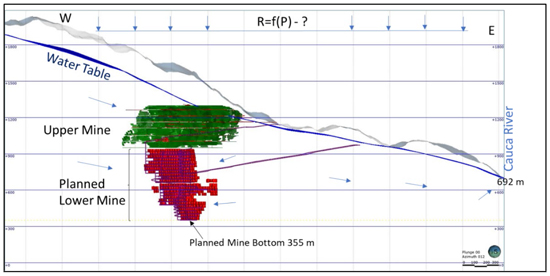
16.3.5. Current mine dewatering
The mine has a series of pumps and tanks from Level 22 to Level 19, where the water is pumped to the processing plant for use as makeup water. The water produced in each level developments in addition to infiltration coming from levels above is collected, briefly stored in a tank, and pumped to the next level above. Water from Level 16 and Level 17 is collected by gravity and discharges to Level 18 and through to the process plant. The existing dewatering system fits the current needs for the Upper Mine operations.
A measurement record of total mine water discharge is available from January 2017. The measured monthly average of total dewatering in the Upper Mine is 37 l/s, varying from 26.8 to 46.4 l/s. Strong seasonal trends were not observed; however, a decrease of approximately 16 l/s can be detected in the last 12 months.
The dewatering flow is a combination of groundwater inflows and water content in the hydraulically placed backfill material (60 to 65% of water). According to Marmato operational personnel, the contribution of the backfill material is 7 to 14 l/s, depending on the number of hydraulic backfill equipment in operation. Therefore, the average fresh groundwater inflow into the mine could vary from 23 to 30 l/s. A significant amount of groundwater flow comes from the north section of Level 17, crossing the Criminal Fault, where horizontal boreholes contribute 7 to 8 l/s.
16.3.6. SRK numerical groundwater model
SRK developed a preliminary 3D numerical groundwater flow model using the MODFLOW-USG code, based on available climatic, geological, and hydrogeological data. Historic and proposed underground mine developments were incorporated into the model. A modeled cross section showing hydraulic conductivity by rock unit and depth is shown in Figure 16.3.
| Effective date: June 30, 2022 |
Page 116 of 236 |
| Aris Mining Corporation
|
Technical Report Marmato Gold Mine
|
Figure 16.3 Cross section of hydraulic conductivity
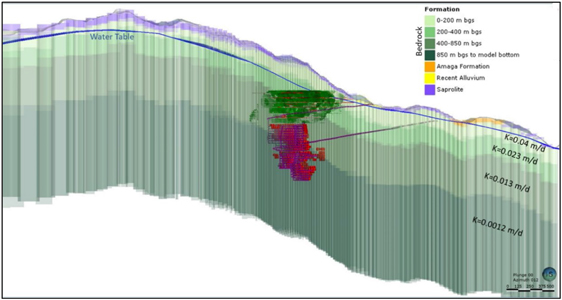
The World Climate dataset was used to define precipitation within the model domain. Mean annual precipitation varies from about 2,700 mm/year in the mountains to 1,930 mm/year in the vicinity of the Cauca River, with values of 2,400 to 2,500 mm/year in the mine area. The relationship between recharge coefficient vs. ground surface elevation was established during the model calibration process to match the measured water levels and groundwater flows. Within the mine area, the recharge coefficient was calculated to be within the range of 0.35 to 0.45, or from 35% to 45% of mean annual precipitation.
The rivers, creeks, and groundwater outflows as simulated by the numerical model are shown in Figure 16.4.
Figure 16.4 Plan of simulated rivers, creeks, and groundwater outflows
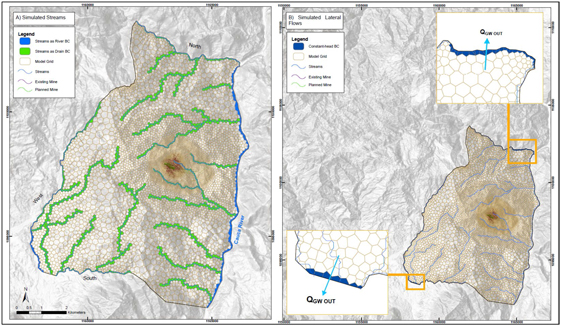
| Effective date: June 30, 2022 |
Page 117 of 236 |
| Aris Mining Corporation
|
Technical Report Marmato Gold Mine
|
16.3.7. SHI alternative groundwater model
An alternative groundwater model was developed by SHI (2021) by updating/re-calibrating the SRK (2020a) model. This model uses updated recharge estimates, which are reasonable, in SRK’s opinion, different hydraulic conductivity and storage parameters for the hydrogeological units, six faults simulated as hydrogeological units for the base case, and the same grid and number of the cells in both the lateral and vertical extents.
SHI’s model uses lower recharge from precipitation than SRK’s model, which most likely overestimates recharge rates, simulates changes in recharge during future mining in the facilities area, and uses a different distribution of hydraulic parameters. SHI simulates that the upper part is more permeable and the lower part is less permeable, by about 20 times, than SRK’s model. In SRK’s opinion, the simulations have unreasonably high specific storage parameters (55 times than the literature parameters used in SRK’s mode), and higher drain conductance (by 10 times) for mine workings than SRK’s model to simulate the same flow under less recharge.
SHI’s model has six faults with hydraulic conductivity values higher than the rock. SRK’s model does not simulate the faults under base case and uses equivalent hydraulic parameters for entire rock units. SHI’s model shows lower hydraulic conductivity of deep bedrock compared to measured values.
SHI’s model uses drain conductance to simulate groundwater discharge into mining workings of 0.1 m2/d (or 10 times larger compared to SRK’s model) due to the decreasing hydraulic conductivity of bedrock and recharge from precipitation.
Both models similarly represent observed water levels including pre-mining 2011 and 2012 and in recently installed piezometers in 2020 and historic mine inflows from 2017 to 2019, although the water level calibration statistics of SHI’s model looks slightly better than SRK’s model.
The data generally indicates that SHI’s model assumes permeability within the faults and very low permeability of bedrock between the faults. This approach makes hydrogeological sense, however major structures in the deposit area (Faults 1_3 and 2), identified by packer testing, were not incorporated in SHI’s model, resulting, in SRK’s opinion, underestimating mine inflow predictions.
Considering these differences between SRK’s and SHI’s models and the presence of hydrogeologic uncertainties, the predicted inflow to the future mine developments were made based on both models, with the base case and maximum inflow estimate using SRK’s 2020 model, and the minimum inflow estimate using SHI’s 2021 model.
16.3.8. Simulated mine plans
Both historic and future underground developments (tunnels, drifts, declines, stopes, vents, and ramps) were simulated using drain cells, which extract groundwater from the model depending on the water level elevation above the development and the assigned conductance.
Mine plans for the Upper Mine and Lower Mine were incorporated into the numerical models using the life of mine schedule to model historic, current, and future developments in the life of mine plan.
The following assumptions were made:
| • |
Groundwater inflow to drain cells representing the decline, ramp, and other supporting infrastructure would be restricted due to differences between the model cell and the size of the actual development. This restriction was simulated by a limited value of drain cells conductance. |
| • |
Groundwater inflow to the stopes is non-restrictive due to their size, similar to the model cell. This assumption was implemented by using a large value of drain cells conductance for simulation of the stopes. |
| • |
Paste fill of the stopes will be completed under pressure and further restrict groundwater inflow to the stopes similarly to pre-mining conditions. This restriction was simulated by replacing large drain conductance to a limited value six months after mining of the stope starts. An effect of restriction of groundwater inflow into the |
| Effective date: June 30, 2022 |
Page 118 of 236 |
| Aris Mining Corporation
|
Technical Report Marmato Gold Mine
|
stopes by paste fill was evaluated by sensitivity run when large drain cell conductance for the stope was kept unchanged throughout the life of mine, and the sensitivity was used to simulate maximum inflow conditions.
16.3.9. Groundwater model prediction results
The SRK and SHI numerical models were used to predict passive inflow to the existing and planned underground mine, propagation of drawdown as the result of planned dewatering under mining conditions, and changes in groundwater discharge to river and creeks under mining conditions.
The model predictions were made under four scenarios, including the base case of expected inflow, and sensitivity runs of maximum and minimum inflow and permeable faults completed as sensitivity analyses to identify the possible range of groundwater inflow scenarios to the existing and planned underground mines.
The model predicts that the majority inflow to the planned Lower Mine (up to 67 l/s with a possible range from 36 to 113 l/s) is expected from the upper levels above 650 m where elevated hydraulic conductivity values of the bedrock groundwater system were measured. Mine inflow to the planned Lower Mine below 650 m is predicted to be lower (36 l/s with a possible range from 17 to 56 l/s) due to reduced measured hydraulic conductivity with depth. It should be noted that maximum inflow to the lower part of the Lower Mine for the permeable fault scenario is predicted up to 110 l/s at the end of mining. Total maximum mine discharge to the Lower Mine is predicted to be up to 77 l/s with a possible range from 40 to 133 l/s. Total maximum discharge into the entire mine complex, including flow to the existing mine levels, is predicted to be up to 114 l/s with a possible range from 76 to 162 l/s. The major sources of mine inflow are the depletion of groundwater storage and capturing of groundwater discharge to surface water bodies such as streams. The model predicts the insignificant reversing of hydraulic gradient between the mine area and the Cauca River and causing inflow to the mine from the river of 0.15 l/s, with a possible range from 0 to 0.3 l/s. However, further investigation of the structures and their hydrogeological role are needed to verify these predictions.
In SRK’s opinion, the completed predictions of mine inflow are conservative, given that the model is based on the extrapolation of the measured hydraulic conductivity values in mine areas for the entire model domain, including topographic high areas outside of the mine area, where measured water levels are high and hydraulic conductivity values are most likely lower than in the mine area, as well as uses high recharge from precipitation to calibrate the base case model to measured water levels, and uses calibrated conductance values that reproduce measured inflow to the existing, relatively shallow mine for the simulation of groundwater inflow to the deep underground developments of the planned mine.
The model predicts the lowering of the water table in the mine area of up to 120 m and drawdown propagation of up to 1.8 km away from the mine, assuming a 10 m drawdown extent, and the creation of a bulb of depressurization around the planned underground mine.
Table 16.4 summarizes the predicted maximum mine inflows, the maximum reduction of groundwater discharge to the rivers and creeks from the current conditions, and potential maximum inflow from the Cauca River under a range of scenarios. The predicted maximum inflow is predicted at different times. The base case, maximum inflow, and permeable faults scenario is simulated from SRK’s 2020 model, and the minimum inflow scenario is simulated from SHI’s 2021 model.
Table 16.4 Predicted mine inflows and groundwater discharge under different scenarios
| Scenario |
Predicted maximum inflow (l/s)
|
Maximum reduction of groundwater discharge to rivers and creeks from current conditions (l/s) |
Maximum inflow from Cauca River (l/s)
| |||||||
| Total | Upper Mine | Lower Mine | ||||||||
| Expected inflow - Base case |
114 | 49 | 77 | 70.8 | 0.15 | |||||
| Effective date: June 30, 2022 |
Page 119 of 236 |
| Aris Mining Corporation
|
Technical Report Marmato Gold Mine
|
| Scenario |
Predicted maximum inflow (l/s)
|
Maximum reduction of groundwater discharge to rivers and creeks from current conditions (l/s) |
Maximum inflow from Cauca River (l/s)
| |||||||
| Total | Upper Mine | Lower Mine | ||||||||
| Maximum inflow scenario |
150 | 42 | 126 | 111.5 | 0.3 | |||||
| Minimum inflow scenario |
76 | 40 | 40 | 15.7 | 0 | |||||
| Permeable faults scenario |
162 | 41 | 133 | 4.7 | 0.2 | |||||
16.3.10. Hydrogeological uncertainties
The completed analysis of available hydrogeological data and numerical groundwater modeling indicates that several uncertainties remain in the understanding of the hydrogeological conditions in the proximity of the mine. These uncertainties include:
| • |
The hydrogeological role of faults, the extent outside of the mine area, and any connection to the Cauca River |
| • |
The hydraulic properties of bedrock outside of the mine area, especially in areas of topographic high, where a shallow depth to water table has been measured |
| • |
The nature of elevated hydraulic conductivity in the mine area at depths from about 600 to 800 m below the ground surface and approximately between the 700 and 900 m elevations in the vicinity of Fault 2 and Fault 1_3 planned to be intersected by underground workings |
| • |
Recharge estimates from direct precipitation and potential recharge enhancement in the mine area as a result of artisanal mine developments |
| • |
The limited availability of hydrogeological data related to: |
| o |
Groundwater inflow to the current mine, including changes over time, the spatial and vertical distribution, and the water usage for mining |
| o |
Water table elevation and water level changes due to passive mine dewatering and seasonal changes in precipitation |
| o |
Hydrogeological role of paste fill material and the possibility to reduce groundwater inflow to mine developments and stopes |
| o |
Groundwater chemistry with depth |
Considering the hydrogeological uncertainties mentioned above, SRK recommends conservative planning for a maximum mine pumping capacity:
| • |
Upper Mine – 50 l/s |
| • |
Lower Mine, upper part – 120 l/s |
| • |
Lower Mine, lower part – 60 l/s |
16.3.11. Recommendations
To reduce these uncertainties, SRK recommends the completion of the following additional hydrogeological investigations/analyses:
| • |
A structural analysis of the geological features and faults outside of the mining area, with emphasis on any potential connection to the Cauca River |
| • |
A detailed water balance and estimate of recharge from precipitation |
| • |
Detailed groundwater inflow mapping in existing developments |
| • |
Evaluation of the role of paste filling in the reduction of groundwater inflow to the mine |
| • |
Improvement of mine discharge measurements at each level of the existing mine |
| • |
Installation of a groundwater-level monitoring network outside of the mine area and along the river valley, including hydrogeological testing during construction of monitoring wells |
| Effective date: June 30, 2022 |
Page 120 of 236 |
| Aris Mining Corporation
|
Technical Report Marmato Gold Mine
|
| • |
Detailed water level measurements to observe drawdown propagation as a result of mine dewatering and seasonal variation as a result of precipitation |
| • |
Additional large-scale hydraulic testing to identify zones of enhanced permeability related to Fault 2, Fault 1_3, Obispo, Cascabel, and Mellizos faults planned to be intersected by underground workings. |
| • |
Drilling and hydraulic testing of pilot holes in places where ventilation declines are planned |
| • |
Updates to the developed numerical groundwater model based on the above items to improve its predictability: |
| o |
Improve vertical discretization of the model to better simulate mining levels and the size of the stopes |
| o |
Incorporate the most important faults and structures with enhanced permeability |
| o |
Improve model calibration to measured water levels and flows |
| o |
Re-evaluation of pumping design based on updated inflow predictions |
| o |
Evaluation of flow-through hydrogeological conditions during post-mining |
| o |
Groundwater chemistry sampling |
16.4. Upper Mine mining methods
16.4.1. Mine layout and access
Mining at the Zona Baja mining title extends approximately 300 m vertically and 900 m along the vein structure, in the area referred to as the Upper Mine. The mine has been developed with level accesses proceeding horizontally from the main portal at the surface on Level 18 to horizontal cross cuts that provide access to the veins. There are currently six production levels and one level in development, with the highest production level at Level 16 and the lowest production level at Level 21. Figure 16.5 shows an isometric view of the current production and development levels. Each level is spaced 50 m apart vertically, with the exception of Level 20, which is 60 m from Level 19. Level 18 is the main haulage level and the primary access for the mine and is shown in a plan view in Figure 16.6. A track drift provides the main haulage for all material. The trains exit via the south portal, unload at the Upper Mine processing plant, and enter the mine via the north portal. Personnel and material enter via the north portal only. All levels can be reached via ladderways. Level 16 and Level 17 also have adit accesses from surface, mainly for ventilation. A rail decline from Level 18 to Level 19 provides the ability to move material and supplies between levels. Levels below 18 are accessed by vertical shafts referred to as apiques which utilize a hoist and skip system that allows transport of material. There are other apiques that transport supplies to the lower levels. A brief description of the main activities on the levels are given in Table 16.5.
Figure 16.5 Isometric view of Upper Mine production and development levels
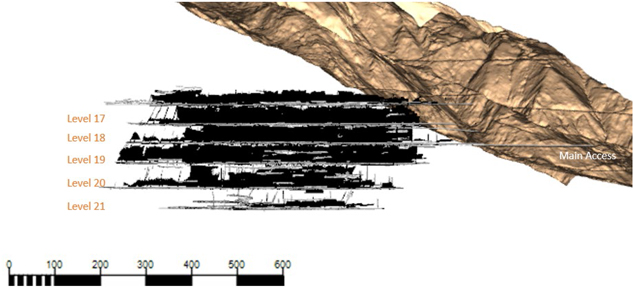
| Effective date: June 30, 2022 |
Page 121 of 236 |
| Aris Mining Corporation
|
Technical Report Marmato Gold Mine
|
Figure 16.6 Plan view of Level 18 underground and surface infrastructure
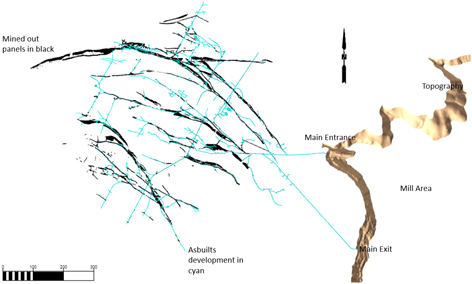
Table 16.5 Upper Mine level elevations and description
| Level | Elevation | Description | ||||||
| 16 | 1,260 | Production and ventilation exhaust | ||||||
| 17 | 1,210 | Production and ventilation exhaust | ||||||
| 18 | 1,160 | Main entrance/exit, main haulage | ||||||
| 19 | 1,110 | Production and incline to Level 18 | ||||||
| 20 | 1,050 | Production | ||||||
| 21 | 1,000 | Production and Transition Zone | ||||||
| 22 | 950 | In development |
16.4.2. Stope optimization
Stope optimization was completed using Deswik’s implementation of Alford Mining System’s Stope Optimization program and the mineral resource block model. The optimization parameters were determined based on the mineralization geometry, current equipment constraints, and geotechnical constraints and are provided in Table 16.6. The stopes were angled based on the vein orientation. Figure 16.7 shows an isometric view of the Upper Mine stope optimization results coloured according to activity type. Figure 16.8 shows an isometric view of the overall mine design based on the stope optimization results from the Upper Mine veins and Transition Zone material, coloured by gold grade.
Table 16.6 Upper Mine stope optimization parameters
| Parameter |
Units |
Vein material drift and fill |
Transition material longhole stopes |
Transition material drift and fill stopes | ||||
| Au cut-off grade |
g/t |
2.05 | 2.05 | 2.05 | ||||
| Minimum mining |
m |
1 | 5 | 5 | ||||
| width |
||||||||
| Block height |
m |
5 | 15 | 3 | ||||
| Block length |
m |
10 | 5 to 20 | 5 to 50 |
| Effective date: June 30, 2022 |
Page 122 of 236 |
| Aris Mining Corporation
|
Technical Report Marmato Gold Mine
|
| Parameter |
Units |
|
Vein material |
|
|
Transition material longhole |
|
|
Transition material drift and fill |
| ||||
| Block width |
m |
1 to 8 | 15 | 4.5 | ||||||||||
| Elevation |
m |
950 – 1,300 | 1,000 – 1,050 | 950 – 1,000 | ||||||||||
| Final stope height |
m |
5 | 15 | 3 | ||||||||||
| Final stope length |
m |
30 | 25 | 5 to 50 |
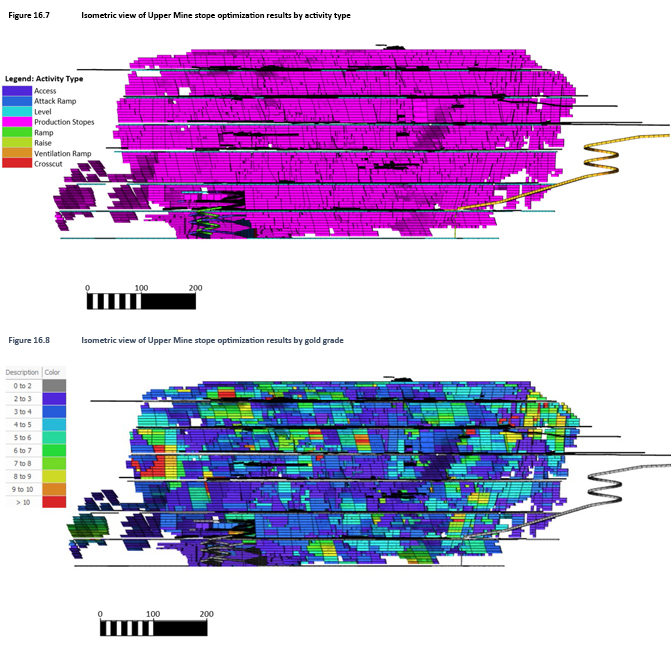
16.4.3. Mine design
16.4.3.1. Vein stopes and development
The cut and fill stopes generated from the stope optimizer were amalgamated into 30 m long by 5 m high blocks. The minimum mining width is 1 m and the stope widths vary between 1 and 3 m. This is consistent with the stope
| Effective date: June 30, 2022 |
Page 123 of 236 |
| Aris Mining Corporation
|
Technical Report Marmato Gold Mine
|
size that is currently used to mine the veins. There are certain gaps in the blocks generated by the optimizer, and these are not included as part of the mining plan. These gaps could potentially be mined as marginal grade material.
The Upper Mine operations team proposed a narrow vein longhole mining method to recover the narrower veins while minimizing dilution. The proposed method will have ramps connecting to sublevels 10 m apart. The top and bottom sublevel are developed. A longhole drill will drill off the stope, and the stope will be blasted and mucked using electric micro-scoops in the wider zones and slushers in the narrower zones. There are several areas identified for this method and scheduled to be tested.
2.4 m by 2.4 m drifts are designed to follow the veins where possible. A diluted grade was calculated for this development material, and tonnages and grades for development material are tracked separately from stope material in the production schedule.
Sublevels are typically 1.4 m wide x 2.2 m high and is calculated into the production rate of the stopes.
Vertical raise development at the ends of the blocks is 1.4 m wide x 1.4 m long and is also calculated into the production rate for the stopes.
16.4.3.2. Transition Zone stopes and development
The Transition Zone above 1,000 m will use a long hole stoping method. Stopes are 15 m wide x 15 m high x 5 to 25 m long. Stopes are mined in an alternating primary-secondary sequence with cemented waste rockfill as the primary backfill and waste rock as secondary backfill. An underground cement plant will be commissioned. Waste rock will primarily come from development, or trucked in from the surface when development waste rockfill is insufficient or unavailable. Top and bottom transverse accesses are driven into the stopes and the stopes are drilled down using a jumbo fitted with a longhole drill.
The Transition Zone between the 950 m and 1,000 m elevation will use a drift and fill method. Drifts are 3 m high by 4.5 m wide. Stopes are mined in an alternating primary-secondary sequence with cemented waste rockfill as the primary backfill and waste rock as secondary backfill. A ramp currently under development is being driven down to level 22, with attack ramps leading to each stoping level.
16.4.4. Dilution
The mine operations team calculates and tracks the planned dilution, which is calculated by the following formula: Planned Dilution = (cutting width-vein width)/(cutting width)×100.
Historically, mining width was driven by the minimum equipment width of the bobcat loader, which introduced excessive dilution in the narrow veins. Currently, the operation has eliminated the use of bobcats in the narrower veins, and utilizes improved drilling practices and better training and supervision to control dilution, which is currently on the order of 20%.
16.4.5. Production schedule
The production schedule is based on the productivity rates shown in Table 16.7. The production rate for the vein material includes the development of the raises and mining of the stope, and the rate for the transition material includes drilling and blasting of the stope. The apique development rate assumes that the apiques are in use in the level above.
Table 16.7 Upper Mine productivity rates
| Activity Type |
Rate | Units | Dimensions (m) | |||
| Vein stopes |
18 | tpd | ||||
| Narrow longhole stopes |
100 | tpd | ||||
| Vein development |
2.4 | m/d | 2.4 x 2.4 |
| Effective date: June 30, 2022 |
Page 124 of 236 |
| Aris Mining Corporation
|
Technical Report Marmato Gold Mine
|
| Activity Type |
Rate | Units | Dimensions | (m) | ||||||||
| Vein level |
2.4 | m/d | 2.4 x 2.4 | |||||||||
| Vein ramp |
2.4 | m/d | 2.8 x 2 | |||||||||
| Vein access |
2.4 | m/d | 2.8 x 2.8 | |||||||||
| Transition longhole stopes |
200 | tpd | ||||||||||
| Transition drift and fill stopes |
30 | tpd | ||||||||||
| Transition development (access, ramp and level) |
4 | m/d | 3.5 x 3.5 | |||||||||
| Transition crosscuts and attack ramps |
4 | m/d | 3.0 x 3.0 | |||||||||
| Sand backfill |
220 | m3/d | ||||||||||
| Longhole waste rockfill |
60 | m3/d | ||||||||||
| Drift and fill waste rockfill |
100 | m3/d | ||||||||||
| Apique |
0.6 | m/d | 2 x 4 | |||||||||
| Transition vent ramp |
4 | m/d | 5 x 5 |
The production schedule targets a total production of 1,250 tpd or 450,000 tonnes per year, based on 360 days per year, to the mill. A gradual ramp up is planned for 850 tpd (305,000 tonnes per year) in July 2022, and 1,000 tpd (360,000 tonnes per year) from August 2022 to December 2023. The Transition material accounts for roughly 25% of the total production while the remaining Upper Mine production comes from the vein material. The life of mine plan for the Upper Mine is 19.5 years for a total of 7.14 Mt at 4.16 g/t Au.
There is a 2 Mt per year permit limit to material moved for the mine for projects that are authorized under Corpocaldas. The production schedule prioritizes the production of the Lower Mine, therefore the production in the Upper Mine from 2028 to 2036 is reduced to respect this limit.
The production schedule was completed using Deswik Scheduling software. Table 16.8 shows the Upper Mine total production schedule and Table 16.9 shows the total development schedule.
| Effective date: June 30, 2022 |
Page 125 of 236 |
| Aris Mining Corporation
|
Technical Report Marmato Gold Mine
|
Table 16.8 Upper Mine production schedule
|
Name |
Row |
Jul |
Oct |
2022 |
Jan |
Apr |
Jul |
Oct |
2023 |
Jan |
Apr |
Jul |
Oct |
2024 |
Jan |
Apr |
Jul |
Oct |
2025 |
Jan |
Apr |
Jul |
Oct |
2026 |
2027 |
2028 |
2029 |
2030 |
2031 |
2032 |
2033 |
2034 |
2035 |
2036 |
2037 |
2038 |
2039 |
2040 |
2041 |
|||||||||||||||||||||||||||||||||||||||||
| total |
2022 - |
2022 - |
2023 - |
2023 - |
2023 - |
2023 - |
2024 - |
2024 - |
2024 - |
2024 - |
2025 - |
2025 - |
2025 - |
2025 - |
2026 - |
2026 - |
2026 - |
2026 - |
||||||||||||||||||||||||||||||||||||||||||||||||||||||||||||||
| Q3 |
Q4 |
Q1 |
Q2 |
Q3 |
Q4 |
Q1 |
Q2 |
Q3 |
Q4 |
Q1 |
Q2 |
Q3 |
Q4 |
Q1 |
Q2 |
Q3 |
Q4 |
|||||||||||||||||||||||||||||||||||||||||||||||||||||||||||||||
| Summary |
||||||||||||||||||||||||||||||||||||||||||||||||||||||||||||||||||||||||||||||||
| Total ore Tonnes |
7,142,336 | 76,236 | 93,173 | 169,408 | 90,565 | 90,088 | 89,953 | 90,022 | 360,628 | 112,493 | 112,495 | 112,520 | 112,491 | 449,999 | 112,510 | 112,686 | 112,729 | 111,642 | 449,567 | 112,178 | 112,979 | 112,668 | 112,586 | 450,411 | 449,757 | 372,113 | 380,498 | 314,698 | 280,711 | 160,178 | 282,117 | 440,459 | 444,456 | 271,222 | 441,685 | 450,048 | 450,077 | 446,095 | 78,209 | |||||||||||||||||||||||||||||||||||||||||
| Average Au grade |
4.16 | 5.23 | 5.86 | 5.57 | 4.48 | 4.74 | 4.47 | 4.47 | 4.54 | 5.31 | 5.66 | 5.06 | 5.28 | 5.33 | 5.06 | 4.91 | 5.17 | 4.83 | 4.99 | 4.62 | 5.13 | 5.51 | 5.38 | 5.16 | 4.77 | 4.47 | 3.93 | 3.97 | 4.52 | 3.88 | 3.38 | 3.31 | 3.21 | 3.11 | 3.01 | 3.42 | 4.29 | 4.12 | 4.72 | |||||||||||||||||||||||||||||||||||||||||
| Average Ag grade |
14.94 | 15.24 | 17.67 | 16.57 | 17.42 | 17.86 | 15.29 | 17.12 | 16.93 | 19.27 | 20.86 | 17.03 | 16.87 | 18.51 | 16.89 | 17.25 | 17.82 | 15.76 | 16.93 | 14.87 | 15.99 | 15.90 | 15.11 | 15.47 | 15.72 | 14.76 | 14.44 | 12.64 | 14.18 | 11.17 | 15.42 | 15.32 | 14.72 | 13.88 | 13.39 | 14.17 | 14.53 | 12.80 | 14.41 | |||||||||||||||||||||||||||||||||||||||||
| Total Au Oz |
954,249 | 12,811 | 17,543 | 30,354 | 13,045 | 13,742 | 12,919 | 12,946 | 52,651 | 19,192 | 20,463 | 18,304 | 19,086 | 77,045 | 18,320 | 17,778 | 18,737 | 17,328 | 72,163 | 16,658 | 18,648 | 19,963 | 19,468 | 74,738 | 68,981 | 53,457 | 48,117 | 40,212 | 40,800 | 20,005 | 30,696 | 46,804 | 45,876 | 27,096 | 42,739 | 49,502 | 62,027 | 59,128 | 11,860 | |||||||||||||||||||||||||||||||||||||||||
| Total Ag Oz |
3,430,555 | 37,355 | 52,917 | 90,273 | 50,732 | 51,734 | 44,212 | 49,561 | 196,239 | 69,708 | 75,459 | 61,611 | 61,009 | 267,786 | 61,091 | 62,512 | 64,596 | 56,572 | 244,771 | 53,633 | 58,071 | 57,590 | 54,686 | 223,980 | 227,320 | 176,632 | 176,672 | 127,876 | 128,000 | 57,535 | 139,831 | 216,895 | 210,341 | 121,002 | 190,211 | 205,077 | 210,283 | 183,607 | 36,224 | |||||||||||||||||||||||||||||||||||||||||
| Waste tonnes |
467,397 | 23,005 | 14,753 | 37,759 | 13,859 | 10,539 | 10,898 | 32,271 | 67,568 | 37,179 | 37,274 | 11,183 | 8,514 | 94,150 | 15,893 | 15,038 | 7,852 | 3,360 | 42,143 | 10,036 | 11,416 | 4,564 | 14,798 | 40,814 | 28,268 | 24,506 | 26,895 | 14,494 | 7,089 | 4,967 | 1,358 | 1,848 | 483 | 2,167 | 3,261 | 54,393 | 15,235 | |||||||||||||||||||||||||||||||||||||||||||
| Total development length |
25,678 | 1,157.4 | 811.2 | 1,969 | 777.4 | 651.2 | 580.9 | 846.5 | 2,856 | 782.7 | 726.7 | 398.4 | 292.4 | 2,200 | 753.2 | 1,016.1 | 541.7 | 238.8 | 2,550 | 650.3 | 636.9 | 307.0 | 910.8 | 2,505 | 1,665.2 | 1,448.8 | 1,558.2 | 1,297.2 | 463.6 | 312.0 | 80.9 | 112.3 | 28.5 | 137.3 | 1,303.3 | 4,217.1 | 974.1 | |||||||||||||||||||||||||||||||||||||||||||
| Total tonnes moved |
7,609,733 | 99,241 | 107,926 | 207,167 | 104,424 | 100,627 | 100,851 | 122,293 | 428,196 | 149,672 | 149,769 | 123,703 | 121,005 | 544,149 | 128,403 | 127,724 | 120,581 | 115,002 | 491,710 | 122,214 | 124,394 | 117,232 | 127,384 | 491,225 | 478,025 | 396,619 | 407,393 | 329,191 | 287,800 | 165,145 | 283,475 | 442,307 | 444,939 | 273,389 | 441,685 | 453,309 | 504,470 | 461,329 | 78,209 | |||||||||||||||||||||||||||||||||||||||||
| Ore breakout |
||||||||||||||||||||||||||||||||||||||||||||||||||||||||||||||||||||||||||||||||
| Development ore tonnes |
80,267 | 1,070 | 324 | 1,394 | 388 | 1,532 | 850 | 940 | 3,711 | 355 | 4 | 1,256 | 527 | 2,142 | 1,373 | 2,721 | 2,298 | 791 | 7,182 | 1,768 | 1,524 | 1,639 | 691 | 5,622 | 2,884 | 2,940 | 2,842 | 9,597 | 3,237 | 1,080 | 55 | 172 | 18,877 | 17,329 | 1,202 | |||||||||||||||||||||||||||||||||||||||||||||
| Development Au grade |
3 .74 | 3.60 | 3.37 | 3.55 | 2.68 | 3.88 | 2.98 | 2.89 | 3.30 | 3.74 | 3.93 | 3.95 | 3.09 | 3.70 | 2.67 | 2.49 | 3.72 | 7.66 | 3.49 | 3.03 | 3.55 | 3.52 | 2.44 | 3.24 | 3.64 | 3.40 | 3.01 | 3.64 | 3.49 | 3.92 | 2.15 | 2.34 | 3.94 | 4.20 | 3.90 | |||||||||||||||||||||||||||||||||||||||||||||
| Development Ag grade |
10.15 | 7.88 | 11.03 | 8.61 | 17.01 | 6.95 | 8.47 | 10.45 | 9.23 | 12.45 | 6.43 | 7.94 | 9.02 | 8.95 | 7.50 | 12.68 | 8.77 | 3.54 | 9.43 | 9.91 | 6.05 | 5.82 | 7.51 | 7.38 | 6.46 | 6.45 | 7.40 | 9.35 | 6.43 | 8.48 | 7.84 | 9.34 | 12.60 | 12.07 | 10.83 | |||||||||||||||||||||||||||||||||||||||||||||
| Stope ore tonnes |
7,062,070 | 75,166 | 92,849 | 168,014 | 90,177 | 88,556 | 89,103 | 89,082 | 356,918 | 112,138 | 112,491 | 111,264 | 111,965 | 447,857 | 111,137 | 109,965 | 110,431 | 110,851 | 442,385 | 110,410 | 111,454 | 111,030 | 111,895 | 444,789 | 446,873 | 369,174 | 377,656 | 305,101 | 277,474 | 159,097 | 282,117 | 440,404 | 444,456 | 271,050 | 441,685 | 431,170 | 432,747 | 444,893 | 78,209 | |||||||||||||||||||||||||||||||||||||||||
| Stope Au grade g/t |
4.16 | 5.25 | 5.87 | 5.59 | 4.49 | 4.76 | 4.48 | 4.49 | 4.55 | 5.31 | 5.66 | 5.07 | 5.29 | 5.33 | 5.09 | 4.97 | 5.20 | 4.81 | 5.02 | 4.64 | 5.16 | 5.54 | 5.40 | 5.19 | 4.78 | 4.48 | 3.94 | 3.98 | 4.53 | 3.88 | 3.38 | 3.31 | 3.21 | 3.11 | 3.01 | 3.40 | 4.29 | 4.12 | 4.72 | |||||||||||||||||||||||||||||||||||||||||
| Stope Ag grade g/t |
14.92 | 15.35 | 17.69 | 16.64 | 17.43 | 18.05 | 15.35 | 17.19 | 17.01 | 19.30 | 20.86 | 17.13 | 16.91 | 18.55 | 17.00 | 17.37 | 18.01 | 15.85 | 17.06 | 14.95 | 16.12 | 16.05 | 15.15 | 15.57 | 15.78 | 14.83 | 14.49 | 12.74 | 14.27 | 11.19 | 15.42 | 15.32 | 14.72 | 13.88 | 13.39 | 14.24 | 14.63 | 12.81 | 14.41 |
Table 16.9 Upper Mine development schedule
| Name |
Row | Jul | Oct | 2022 | Jan | Apr | Jul | Oct | 2023 | Jan | Apr | Jul | Oct | 2024 | Jan | Apr | Jul | Oct | 2025 | Jan | Apr | Jul | Oct | 2026 | 2027 | 2028 | 2029 | 2030 | 2031 | 2032 | 2033 | 2034 | 2035 | 2036 | 2037 | 2038 | 2039 | 2040 | 2041 | |||||||||||||||||||||||||||||||||||||||||||||||||||||||||||||||||||||||||||||||||||||||||||||||||||||||||||||||||||||
| total | 2022 | 2022 | 2023 | 2023 | 2023 | 2023 | 2024 | 2024 | 2024 | 2024 | 2025 | 2025 | 2025 | 2025 | 2026 | 2026 | 2026 | 2026 | ||||||||||||||||||||||||||||||||||||||||||||||||||||||||||||||||||||||||||||||||||||||||||||||||||||||||||||||||||||||||||||||||||||||||||
| - Q3 | - Q4 | - Q1 | - Q2 | - Q3 | - Q4 | - Q1 | - Q2 | - Q3 | - Q4 | - Q1 | - Q2 | - Q3 | - Q4 | - Q1 | - Q2 | - Q3 | - Q4 | |||||||||||||||||||||||||||||||||||||||||||||||||||||||||||||||||||||||||||||||||||||||||||||||||||||||||||||||||||||||||||||||||||||||||||
| Lateral development breakout: |
||||||||||||||||||||||||||||||||||||||||||||||||||||||||||||||||||||||||||||||||||||||||||||||||||||||||||||||||||||||||||||||||||||||||||||||||||||||||||||
| Cut and fill level |
20,230.1 | 622.2 | 716.0 | 1,338 | 730.5 | 595.6 | 505.8 | 501.5 | 2,333 | 320.1 | 189.9 | 167.1 | 46.7 | 724 | 456.5 | 956.8 | 701.2 | 225.9 | 2,340 | 556.6 | 370.2 | 181.4 | 883.5 | 1,992 | 1,367.5 | 1,026.9 | 1,159.2 | 1,217.9 | 26.7 | 204.4 | 115.1 | 23.3 | 336.9 | 280.9 | 688.1 | 4,163.8 | 891.9 | |||||||||||||||||||||||||||||||||||||||||||||||||||||||||||||||||||||||||||||||||||||||||||||||||||||||||||||||||||||||
| Ramps in veins |
432.5 | 368.0 | 64.5 | 433 | 0 | |||||||||||||||||||||||||||||||||||||||||||||||||||||||||||||||||||||||||||||||||||||||||||||||||||||||||||||||||||||||||||||||||||||||||||||||||||||||
| Ramps in transition |
350.7 | 10.0 | 20.0 | 30 | 60.0 | 60.0 | 60.0 | 100.0 | 280 | 40.7 | 41 | |||||||||||||||||||||||||||||||||||||||||||||||||||||||||||||||||||||||||||||||||||||||||||||||||||||||||||||||||||||||||||||||||||||||||||||||||
| Level access in veins |
89.1 | 89.1 | 89 | 0 | ||||||||||||||||||||||||||||||||||||||||||||||||||||||||||||||||||||||||||||||||||||||||||||||||||||||||||||||||||||||||||||||||||||||||||||||||||||||||
| Level access in transition |
616.2 | 78.2 | 30.7 | 109 | 46.9 | 55.6 | 65.1 | 35.5 | 203 | 38.6 | 43.0 | 42.8 | 63.3 | 188 | 116.6 | 117 | ||||||||||||||||||||||||||||||||||||||||||||||||||||||||||||||||||||||||||||||||||||||||||||||||||||||||||||||||||||||||||||||||||||||||||||
| Attack ramp |
1,823.9 | 69.8 | 50.9 | 61.6 | 182 | 122.6 | 39.5 | 21.7 | 184 | 61.2 | 182.5 | 60.9 | 305 | 242.5 | 242.2 | 303.7 | 121.4 | 182.6 | 60.9 | |||||||||||||||||||||||||||||||||||||||||||||||||||||||||||||||||||||||||||||||||||||||||||||||||||||||||||||||||||||||||||||||||||||||||
| Crosscut |
1,020.6 | 30.0 | 20.9 | 51 | 36.9 | 19.8 | 99.6 | 12.8 | 169 | 9.9 | 56.9 | 64.7 | 27.3 | 159 | 124.1 | 137.2 | 79.8 | 93.5 | 115.5 | 91.7 | ||||||||||||||||||||||||||||||||||||||||||||||||||||||||||||||||||||||||||||||||||||||||||||||||||||||||||||||||||||||||||||||||||||||||
| Vent ramp |
1,065.2 | 289.6 | 290 | 364.0 | 364.0 | 47.6 | 776 | |||||||||||||||||||||||||||||||||||||||||||||||||||||||||||||||||||||||||||||||||||||||||||||||||||||||||||||||||||||||||||||||||||||||||||||||||||||
| Vertical development breakout |
||||||||||||||||||||||||||||||||||||||||||||||||||||||||||||||||||||||||||||||||||||||||||||||||||||||||||||||||||||||||||||||||||||||||||||||||||||||||||||
| Apique to Level 22 |
50.0 | 22.7 | 27.3 | 50 | ||||||||||||||||||||||||||||||||||||||||||||||||||||||||||||||||||||||||||||||||||||||||||||||||||||||||||||||||||||||||||||||||||||||||||||||||||||||||
| Effective date: June 30, 2022 |
Page 126 of 236 |
| Aris Mining Corporation
|
Technical Report Marmato Gold Mine
|
16.4.6. Mining operations
16.4.6.1. Stopes
The cut and fill stopes in the vein material are mined using stopers and jacklegs. Once the level access is driven, raises are driven on either side of the stope. A sublevel is driven laterally and used as a drilling platform, where 1.7 to 2.3 m slices are drilled up into the back. After blasting and bolting, the stope is mucked out either using slushers for higher grade stopes or skid steer loaders/micro-scoops for lower grade stopes to a raise, where the material is loaded onto trains and hauled along the production level. Once the stope is mucked out, concrete barricades are built on either side of the stope and filled with unconsolidated hydraulic sand fill. Once the sand fill is stabilized, the cycle is repeated with the working base on the sand fill.
In stopes where the back is fractured and not amenable to vertical drilling and blasting, the slice is mined horizontally along strike.
Transition Zone stopes above 1,000 m elevation are mined using longhole stoping in a primary-secondary sequence. The stope is drilled from a top access using a jumbo fitted with an adapter for long hole drilling. A slot is drilled and blasted before the rest of the stope is slashed into the slot. The material is mucked from the bottom using a remote scoop. The primary stopes are backfilled using cemented waste rockfill and the secondary stopes are filled with waste rock.
The Transition Zone drift and fill stopes between 950 m and 1,000 m elevation will be mined using a jumbo in a primary-secondary sequence. The stopes are separated into two separate areas approximately 100 m long. A ramp will be developed down to the 958 m elevation and attack ramps will access the ore. Crosscuts are driven to the far end of the ore and primary drifts are mined and filled with cemented waste rock. Once filled, the secondary stopes are mined and filled with waste.
16.4.6.2. Development
Development in the vein material is completed using jacklegs. Level accesses are 2.4 m by 2.4 m and sublevels vary depending on the width of the vein. The apiques will be extended down to level 22.
A 3.5 m by 3.5 m ramp is used to access the Transition Zone stopes. The level access and transverse drifts are the same size as the ramp. Crosscuts and attack ramps to the drift and fill area are 3 m by 3 m. Development for the Transition Zone is done using a jumbo.
16.4.6.3. Haulage
All ore is hauled using rail haulage on the level. The main haulage level is Level 18, and material from Levels 16 and 17 above Level 18 is passed to Level 18 via an ore pass. Material on Level 19 is hauled up to Level 18 from the incline and material below Level 19 is hoisted up via the shaft hoist.
10 tonne trucks will be used in the Transition Zone to haul ore to the ore pass, which is then loaded to rail carts and railed to the apiques.
16.4.6.4. Backfill
Backfilling in the veins area is completed using unconsolidated hydraulic backfill from the plant with a capacity of 715 m3/d. Currently, approximately 55% of the mill tailings are returned to the mine as backfill. There are four 290 m3/d capacity tailings pipelines going underground to different levels. SRK recommends the installation of a surge tank to allow for additional capacity in the event of a delay in tailings. Waste rock generated underground that is not hauled out of the mine is used as backfill.
The Transition Zone will use a combination of cemented and uncemented waste rockfill as backfill for the stopes. The waste rockfill will mainly come from development and supplemented from the surface via a ramp that will also be used for ventilation.
| Effective date: June 30, 2022 |
Page 127 of 236 |
| Aris Mining Corporation
|
Technical Report Marmato Gold Mine
|
| 16.4.7. |
Ventilation |
As the mining operations are below 1,500 m above sea level, Colombian regulations state that the minimum airflow for diesel equipment is 4 m3/min per horsepower (hp) which relates to 0.09 m3/s per kW of engine power to ensure gaseous and aerosol contaminants from diesel equipment are sufficiently diluted, which is a typical minimum design value for many ventilation systems, although the typical dilution rates are usually presented as between 0.06 and 0.08 m3/s per kW. The value of 0.09 m3/s per kW has been used to determine the airflow in the ramps/haulage routes, and on the mining levels where diesel equipment is used. There is no Colombian specific criteria or legislative limit for diesel particulate matter.
Colombian regulations also state that the minimum airflow per worker is at least 0.05 m3/s. This airflow requirement is typically used in areas without diesel equipment, as the requirements for ventilating diesel equipment will far exceed this value.
| 16.4.7.1. |
Ventilation model development |
The VentSIM Visual ventilation simulation software was used to generate the ventilation model for both the Upper Mine and Lower Mine.
The overall airflow quantity for the Upper Mine is split into two districts including general remnant mining and mechanized long hole stoping in the lower levels. The airflow quantity can be distributed according to which areas are in operation. Utilization factors are not used in the lower levels to provide for greater options for flexibility and conservativeness.
The breakdown for the airflow requirement is shown in Table 16.10. An overall airflow requirement for the mine is approximately 135.4 m3/s with approximately 71.1 m3/s required below Level 21 for both the ramp mining area and vein mining areas. 53.9 m3/s is required to dilute the mini dumpers, scoop trams, several micro-scoops, and the backfill truck.
Table 16.10 Upper Mine airflow requirements
| Item |
Power (kW) | Quantity1 | Availability (%) | Utilization (%) | Dilution factor (m3/s/kW) | Required airflow (m3/s) | ||||||
|
Bobcat S100 |
25 | 10 | 0.85 | 0.5 | 0.09 | 9.7 | ||||||
|
Bobcat S130 |
34 | 0 | 0.85 | 0.5 | 0.09 | 0.0 | ||||||
|
Bobcat S175 |
34 | 5 | 0.85 | 0.5 | 0.09 | 6.6 | ||||||
|
Bobcat S530 |
37 | 9 | 0.85 | 0.5 | 0.09 | 12.6 | ||||||
|
Micro-scoop Dalli |
41 | 9 | 0.85 | 0.5 | 0.09 | 12.6 | ||||||
|
Micro-scoop CT-500 |
41 | 3 | 0.85 | 0.5 | 0.09 | 14.1 | ||||||
|
Micro-scoop MTI |
41 | 0 | 0.85 | 0.5 | 0.09 | 3.1 | ||||||
|
Scoop tram |
81 | 3 | 0.85 | 0.75 | 0.09 | 0.0 | ||||||
|
Mini Dumper SD-30 |
150 | 3 | 0.85 | 0.75 | 0.09 | 13.9 | ||||||
|
Backfill truck |
300 | 1 | 0.85 | 0.75 | 0.09 | 25.8 | ||||||
|
Personnel |
400 | 0.05 | 20 | |||||||||
|
General leakage at 10% |
12.3 | |||||||||||
|
Total |
135.4 | |||||||||||
| 1 0 quantities are provided where the equipment exists but is not being utilized underground | ||||||||||||
| 16.4.7.2. |
Airflow routing |
The ventilation system for the Upper Mine draws fresh air in through all existing portals. The three raises for production, hoisting and ventilation provide fresh air to the levels below Level 18. Airflow circulates to the individual
| Effective date: June 30, 2022 |
Page 128 of 236 |
| Aris Mining Corporation
|
Technical Report Marmato Gold Mine
|
mining stopes utilizing a stope raise between the levels to complete the flow through ventilation, with fresh air from top to bottom, or bottom to top depending upon the location on level and the level within the mining horizon. Airflow is drawn into the exhaust decline through several locations including the spiral ramp on Level 21, and Levels 20 and 19 at the end of the mining zones. The two upper connections into the exhaust decline may be required to be regulated to route additional airflow to the bottom of the Upper Mine. The lower spiral ramp will require a parallel drop raise to allow the airflow to naturally circulate to the bottom of the spiral.
An exhaust fan will be required to be installed near the portal of the exhaust decline. In order to allow the passage of backfill trucks, a set of equipment doors will be required to be installed in a parallel access/by-pass.
| 16.4.7.3. |
Fan requirements |
The fans are required to be sized based on the worst case or the long range mine plan, which incorporates mining at both above and below Level 21. The operating duty for the main exhaust fan installation, comprising two fans operating in parallel, each operating at 70 m3/s, will be approximately 0.7 kPa at an airflow of 140 m3/s each. Each fan will be required to have a motor power of approximately 70 kW (70% fan efficiency) at a density of 1.16 kg/m3. Each fan will be required to have back flow dampers so they can be operated individually.
There is a general air velocity limitation of 6 m/s in areas where personnel have the ability to access. This ventilation system adheres to this limitation. There are two zones where the ventilation system will be operating very close to this limitation, including the La Maruja portal area and the exhaust decline between the last access to the mining areas and the portal. However, these areas are not expected to exceed the limitation.
| 16.4.8. |
Mine services |
| 16.4.8.1. |
Pumping |
The mine has an operating system of ditches, sumps, and small pumps that control water on the individual mine level and pump water to the main pump system.
The main pumping system used in the mine is a staged system of 10,000 to 15,000 litre sumps/tanks and pumps that move water from the lowest levels of the mine at Level 21 up to the mine portal where the water is used in the Upper Mine processing plant. On Level 21, at the bottom of the currently developed Upper Mine, there is a storage tank with three Krebs pumps that pump through two 4 inch and one 6 inch pipelines up to Level 20. On Level 20, another tank and pump system with three pumps moves the water to Level 19 to a concrete lined sump with two Goulds 5500 slurry pumps that pump through 4 inch pipelines to the portal on Level 18 to the process plant water tank. There is redundancy built into the system with extra pumps on Level 19 and additional locations to place pumps on Level 20. The pump system handles on average 37 l/s with a range from 26.8 to 46.4 l/s.
| 16.4.8.2. |
Power supply |
The existing Upper Mine electrical system includes an 8.1 MVA main Project substation with six transformers that provide power to the Upper Mine and mill. The mine system power is provided at 33 kV through transformers that transform power to feed the mine surface and underground facilities. The three mine related transformers and loads they feed are summarized as follows:
| ● |
Transformer 1 (2,000 KVA) steps the 33 kV power down to 13.2 kV and feeds the three mine substations that in turn feed the compressors, pumps and offices/shops at 440 VAC |
| ● |
Transformer 2 (2,000 KVA) feeds the mine at 13.2 kV through three separate mine transformers that in turn feed the various mine levels, hoists, pumps, and mine equipment. The equipment operates on 440 VAC |
| ● |
Transformer 4 (1,250 KVA) and 5 (630 KVA) feed two compressors each at 440 VAC |
The largest loads at the mine are the compressors, pumps, and hoists which account for approximately 65% percent of the mine load.
| Effective date: June 30, 2022 |
Page 129 of 236 |
| Aris Mining Corporation
|
Technical Report Marmato Gold Mine
|
| 16.4.8.3. |
Health and safety |
The mine has a mine phone system and emergency egress is provided through stairs in the shaft declines and a series of ladders to the surface portal level. The mine has a health and safety response plan and miner safety training sessions for instruction on proper work procedures and safe work activities.
| 16.4.8.4. |
Personnel |
As of June 2022, there are 1,630 personnel working at Marmato, including underground staff, process plant staff, and other support staff. In 2021, there was a company restructuring that resulted in downsizing by 350 employees, as well as management changes in 2022. Relatively high employee turnover is being addressed through changes to shift structures, training, benefits, and improved work place conditions.
| 16.4.8.5. |
Equipment |
The mine utilizes a large number of jackleg drills and small electric and air operated equipment as well as small diesel micro-scoops and skid steer loaders. The current equipment list, some of which is owned by contractors, is provided in Table 16.11. The mine plans to add additional small drills and micro-scoops in the future.
Table 16.11 Upper Mine equipment list
| Equipment
|
Amount
| |
|
Skid steer loaders |
25 | |
|
Jacklegs/stopers |
248 | |
|
Micro-scoops |
11 | |
|
Locomotives |
26 | |
|
Winches |
4 | |
|
Slushers |
114 | |
|
Fans |
62 | |
|
Compressors |
8 | |
|
Jumbo T1D |
1 | |
|
LHD ST2G |
3 | |
|
Total equipment |
502 | |
| 16.4.9. |
Upper Mine recommendations |
SRK notes the following recommendations and opportunities for the Upper Mine.
| ● |
The Upper Mine has historically achieved mined grades that are lower than the grades estimated in the reserve model due to the mining of additional unplanned lower grade veinlets and disseminated material around the higher grade vein. Efforts have been made to control dilution through better grade control in headings. The operation has added additional geologists to sample and mark headings, however assay turn around times have been too slow for effective decision making. Better solutions are being investigated to shorten the turnaround time. SRK recommends that the operation prioritizes grade control and mining discipline to improve performance with regard to mined grades. |
| ● |
Longhole stoping is a new mining method for the Upper Mine. A small number of stopes have been mined with poor results due to the lack of timely backfill, lack of a cement plant, and overly large stopes have sterilized secondary stopes in the Transition Zone. SRK recommends installing the underground cement plant and scheduling waste rock backfill before mining the next lift of the Transition Zone to prevent ore sterilization. |
| ● |
The Upper Mine technical services team has moved towards 3D modelling, designing, and scheduling using Deswik software, but has not yet fully implemented the processes. SRK recommends that continued effort be made to using 3D methods to generate more realistic plans. |
| ● |
Reconciliation is not carried out on a regular basis. SRK recommends that production information be reconciled |
| Effective date: June 30, 2022 |
Page 130 of 236 |
| Aris Mining Corporation
|
Technical Report Marmato Gold Mine
|
to the mine plan on a regular basis to ensure the mine plan is predicting appropriate tonnes/grades. Within a known mining area, the tonnes/grades mined should be compared to the tonnes/grades in the block model. If there are continuous discrepancies between the mined material and the predicted mine plan, modifications to the mine plan process should be made to more accurately predict future mining.
| 16.5. |
Lower Mine mining methods |
| 16.5.1. |
Mining |
The Lower Mine has not yet been developed. Mineralization is located approximately 800 to 1,400 m below the surface (330 to 950 metres above sea level), which is below the currently operating Upper Mine. Based on geomechanical information and mineralization geometry, an underground longhole stoping method is suitable for the deposit. Cut and fill vein mining will continue above the Lower Mine.
The Lower Mine deposit will be mined in blocks where mining within a block occurs from bottom to top with the use of paste backfill for support. Sill pillars are left in situ between blocks. The backfill will have sufficient strength to allow for mining adjacent to filled stopes without the need for dip pillars. The stopes will be 20 m wide and stope length will vary based on mineralization grade. A spacing of 25 m between levels has been used.
The mine will be accessed by dual decline drifts with mineralization transported from stopes via loader to an ore pass system, and then to surface by truck. For the levels below an elevation of 480 m, an ore pass system will not be used and material will be directly loaded into a truck for haulage to surface. Internal intake and exhaust raises will be developed using raise bore machines and air will flow into the mine down the dual declines and exhaust via a dedicated ventilation drift to surface. A new 4,000 tpd process facility using gravity concentration and cyanidation of the gravity tailings will be constructed to process material from the Lower Mine. In addition, two new dry stack tailings facilities will be constructed to receive approximately 57% of the total life of mine tailings from the plant. The other 43% of tailings will go back underground into the mine as cemented paste backfill.
| 16.5.2. |
Stope optimization |
Based on geomechanical information and mineralization geometry an underground long hole stoping method is suitable for the deposit. Paste backfill will be used to allow for a high recovery of economic material.
Figure 16.9 shows a view to the north of mineral resource block model blocks above an Au cut-off grade of 1.62 g/t Au which have been classified as measured and indicated, coloured by a range of mining cut-off grades. There are pockets of higher grade material, particularly in the upper portion of the deposit. Generally, the Lower Mine deposit is approximately 500 m along strike and 150 m in width. This model formed the basis of the stope design.
| Effective date: June 30, 2022 |
Page 131 of 236 |
| Aris Mining Corporation
|
Technical Report Marmato Gold Mine
|
Figure 16.9 Lower Mine mineral resource estimate coloured by mining cut-off grade
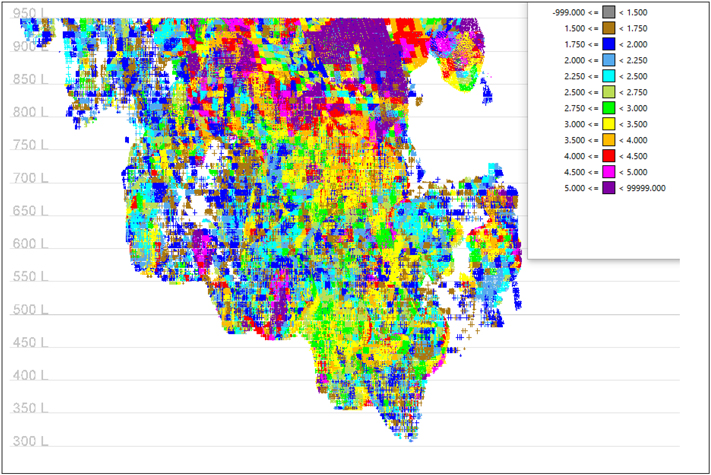
Stope optimization within Vulcan software was used to determine potentially economically minable material. Stope walls were vertical and wall dilution was not applied at the optimization stage, however the cut-off grade used for design was elevated to account for the expected dilution.
Optimizations were run using various cut-off grades to identify higher grade mining areas and understand the sensitivity of the deposit to cut-off grade. The results show large quantities of lower grade material where a small increase/decrease in cut-off grade has a material impact on the material available for design. Figure 16.10 and Table 16.12 show the stope optimization results for undiluted resources classified as measured and indicated at various cut-off grades using a stope size of 10 m wide by 30 m high. Note that stope sizes used for optimization here are different than that used in the mine design. Additional stope optimization runs were completed after final stope sizing was determined and no material differences were found in the results.
| Effective date: June 30, 2022 |
Page 132 of 236 |
| Aris Mining Corporation
|
Technical Report Marmato Gold Mine
|
Figure 16.10 Undiluted stope optimization results for varying cut-off grades
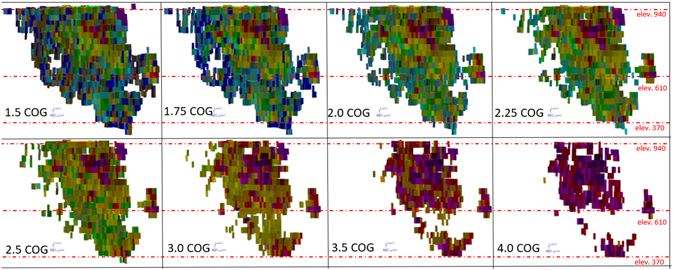
Table 16.12 Lower Mine undiluted stope optimization results for varying cut-off grades
| Au cut-off (g/t) |
Au (g/t) | Ag (g/t) | Tonnes (kt) | Contained Au (Oz) | Contained Ag (Oz) | |||||
|
1.50 |
2.64 | 3.32 | 36,692 | 3,115,387 | 3,917,807 | |||||
|
1.75 |
2.88 | 3.48 | 29,456 | 2,731,206 | 3,298,859 | |||||
|
2.00 |
3.08 | 3.65 | 24,569 | 2,432,287 | 2,885,206 | |||||
|
2.25 |
3.26 | 3.85 | 20,547 | 2,156,431 | 2,545,544 | |||||
|
2.50 |
3.45 | 4.05 | 16,866 | 1,872,704 | 2,198,229 | |||||
|
2.75 |
3.66 | 4.29 | 13,411 | 1,577,995 | 1,850,175 | |||||
|
3.00 |
3.90 | 4.55 | 10,236 | 1,283,123 | 1,498,370 | |||||
|
3.50 |
4.43 | 5.06 | 5,701 | 811,070 | 926,946 | |||||
|
4.00 |
4.91 | 5.33 | 3,306 | 521,424 | 566,776 | |||||
Stope optimization results using a 2.0 g/t Au cut-off were targeted for design work with inclusion of material to a 1.75 g/t cut-off where little additional development was required. The mineral reserve cut-off grade is 1.62 g/t Au. As stope optimization results did not consider dilution, 7% dilution was factored into the optimization cut-off which results in a stope optimization cut-off of approximately 1.75 g/t Au (i.e. a 1.75 g/t stope, diluted by 7%, is approximately equal to the mineral reserve cut-off grade of 1.62 g/t.
| 16.5.3. |
Mine design |
Stopes will be 20 m wide and 25 m high with varying length. Each stope will have a 4.5 m by 4.5 m access located at the bottom of the stope. Figure 16.11 shows a typical stope cross section. Top accesses will be available on most levels to give access to stopes on the next level and to allow for backfilling. For uppermost stopes in a block or where there is no mining above, it is assumed a hole can be drilled from adjacent development into the stope for backfilling purposes. The stopes will be drilled top down and rings will be blasted from the end of a stope toward the access. The blasted material will be remotely mucked from the stope access. A typical level will be made up of approximately 20 stopes along strike.
| Effective date: June 30, 2022 |
Page 133 of 236 |
| Aris Mining Corporation
|
Technical Report Marmato Gold Mine
|
Figure 16.11 Upper Mine typical stope cross section
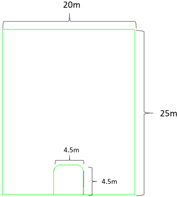
A primary/secondary stoping sequence will be used, where on any given level, primary stopes must be separated by a secondary stope. Extraction of the secondary stope can only occur after the two immediately adjacent primary stopes have been mined, backfilled, and have had time to cure. Backfilling will be an integral part of the long hole stope mining cycle, and a seven day cure time is planned.
The stope accesses will be connected to a level access which is offset approximately 20 m away from the end of the stopes. Each stope access will typically connect to the level access except in cases where stopes are small and long development is required to reach the stope. In those instances, a connection from an adjacent stope is included in the design. This minimizes the amount of development; however, it also limits the sequencing order.
The level accesses will connect to the main ramp which is offset at least 75 m from stoping into the footwall. The offset may be optimized during a feasibility study, after numerical modelling. On the southeast side of each level, the level access will connect to an intake air ventilation/egress raise and on the northwest side will connect to an exhaust air raise. Figure 16.12 shows a typical level plan.
Figure 16.12 Lower Mine typical level plan
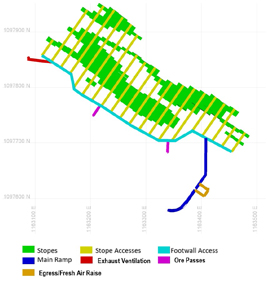
| Effective date: June 30, 2022 |
Page 134 of 236 |
| Aris Mining Corporation
|
Technical Report Marmato Gold Mine
|
Access and infrastructure development underground was designed to support the mining method and sized based on mining equipment and production rate requirements. All ore material will be hauled to a surface crusher located near the portal. Ore passes will be used for most levels to drop material to two main haulage levels (the 665 level and the 480 level). Material on levels below the 480 elevation will be loaded directly into trucks and hauled out of the mine without use of an ore pass. Figure 16.13 shows the location of the ore passes.
There are several known faults in the area that range from several cm to several m in width. The faults impact the development design in several locations, and the development is oriented to cross the faults as perpendicularly as possible. As faults become better understood, appropriate measures should be taken to minimize the risk to the design in terms of development rate and costs.
There will be two declines from the plant site. One will be the main access to the Lower Mine for personnel/materials, and the other will be the main haulage out of the mine. This decline will be 5.5 m wide by 5.5 m high, excavated at a grade of approximately 15%. There is also an upper dedicated ventilation drift, named the Higueron ramp, as shown in Figure 16.13. This drift will carry exhaust air out of the Lower Mine.
Tonnages/grades for the mine design were calculated based on the mineral resource block model. Dilution and recovery were added to the designed tonnage to account for unplanned stope dilution and unrecoverable material within the stope as discussed Section 15.
The Lower Mine design resulted in 24.1 Mt at an average grade of 2.87 g/t Au and 3.49 g/t Ag and is shown in a rotated view looking northeast in Figure 16.13. Figure 16.14 shows the stopes coloured by gold grade. Table 16.13 summarizes the mine design by activity type.
Figure 16.13 Lower Mine design
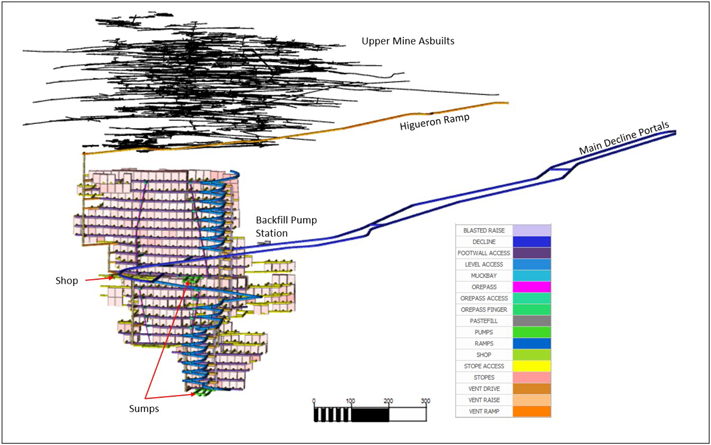
| Effective date: June 30, 2022 |
Page 135 of 236 |
| Aris Mining Corporation
|
Technical Report Marmato Gold Mine
|
Figure 16.14 Lower Mine stopes by gold grade
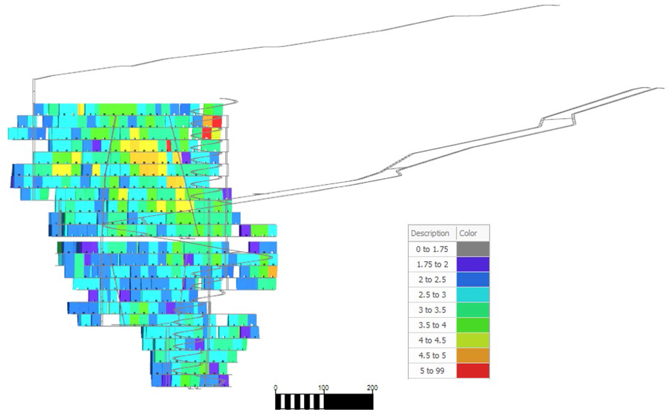
Table 16.13 Lower Mine design summary by activity type
| Activity |
Units | Quantity | ||
|
Development ore tonnes |
t | 1,257,239 | ||
|
Stope ore tonnes |
t | 22,877,714 | ||
|
Waste tonnes |
t | 3,197,914 | ||
|
Lateral development breakout |
||||
|
Main decline |
m | 4,567 | ||
|
Higueron ramp |
m | 1,539 | ||
|
Ramps |
m | 4,582 | ||
|
Level access |
m | 1,823 | ||
|
Footwall access |
m | 7,707 | ||
|
Stope access |
m | 48,889 | ||
|
Vent drive |
m | 2,477 | ||
|
Orepass access |
m | 925 | ||
|
Others |
m | 2,035 | ||
|
Paste fill distribution |
m | 120 | ||
|
Vertical development breakout |
||||
|
Blasted raise 4 x 4 |
m | 471 | ||
|
Blasted raise 4 x 4 |
qty | 23 | ||
|
Blasted raise 2 x 2 |
m | 822 | ||
| Effective date: June 30, 2022 |
Page 136 of 236 |
| Aris Mining Corporation
|
Technical Report Marmato Gold Mine
|
| Activity |
Units | Quantity | ||
| Blasted raise 2 x 2 |
qty | 66 | ||
| Raise bore 5.5 m diameter |
m | 569 | ||
| Raise bore 5.5 m diameter |
qty | 4 | ||
| Raise bore 4 m diameter |
m | 237 | ||
| Raise bore 4 m diameter |
qty | 1 | ||
16.5.4. Production schedule
The production schedule is based on the mine design and mineral reserves discussed in previous sections.
Productivities were developed from first principles. Input from mining contractors, blasting suppliers, and equipment vendors was considered for key parameters such as drilling penetration rates, blast hole size and spacing, explosives loading time, bolt and mesh installation time, etc. The rates developed from first principles were adjusted based on benchmarking and the experience and judgment of SRK.
The productivity rates used for mine scheduling are shown in Table 16.14, followed by a description of the general and activity-specific parameters upon which the productivity rates are based. All drifting rates are per face. Multiple areas/faces are mined at the same time to generate the production schedule. Stoping rates include drilling, blasting, and mucking for the slot and stope. Paste backfill rates include pour time and three days of lag for pouring the plug, waiting three days for the cure, and pouring the remainder.
Table 16.14 Lower Mine productivity rates
|
Activity |
Type |
Heading Type |
Dimensions | Rate | ||||||||
| Main decline |
Multiple |
5.5 m x 5.5 m | 5.5 m/d | |||||||||
| Drifting |
Higueron ramp |
Single |
5.0 m x 5.0 m | 5.2 m/d | ||||||||
| Ramps |
Single |
5.5 m x 5.5 m | 5.5 m/d | |||||||||
| Level access |
Single |
5.0 m x 5.0 m | 6.6 m/d | |||||||||
| FW access |
Multiple |
5.0 m x 5.0 m | 6.9 m/d | |||||||||
| Stope access |
Multiple |
4.5 m x 4.5 m | 6.6 m/d | |||||||||
| Vent drive |
Multiple |
5.0 m x 5.0 m | 6.6 m/d | |||||||||
| Orepass access |
Multiple |
5.0 m x 5.0 m | 6.6 m/d | |||||||||
| Others |
5.0 m x 5.0 m | 6.6 m/d | ||||||||||
| Paste fill distribution |
Multiple |
6.0 m x 6.0 m | 2.5 m/d | |||||||||
|
Stoping |
Stoping |
- | 2,142 tpd | |||||||||
| Ventilation raise Upper Block |
5.5 m diameter | 2.8 m/d | ||||||||||
| Vertical development |
Ventilation raise Lower Block |
4.0 m diameter | 2.8 m/d | |||||||||
| Blasted raise with escape way |
4.0 m x 4.0 m | 8.4 m/d | ||||||||||
| Blasted raise for ore pass |
2.0 m x 2.0 m | 8.4 m/d | ||||||||||
|
Backfill |
Paste backfill |
- | 1,870 m3/d | |||||||||
General schedule parameters applicable to all underground mining activities are presented in Table 16.15.
Table 16.15 Lower Mine schedule parameters for underground mining
|
Schedule parameters |
Units |
Value | ||||
| Annual mining days1 |
days/year |
365 | ||||
| Mining days per week |
days/week |
7 | ||||
| Effective date: June 30, 2022 |
Page 137 of 236 |
| Aris Mining Corporation
|
Technical Report Marmato Gold Mine
|
| Schedule parameters |
Units |
Value | ||
| Shifts per day |
shifts/day |
2 | ||
| Scheduled shift length |
hrs/shift |
11.5 | ||
| Scheduled deductions | ||||
| Shift change |
hrs/shift |
0.25 | ||
| Travel time |
hrs/shift |
0.42 | ||
| Equipment inspection |
hrs/shift |
0.25 | ||
| Lunch break |
hrs/shift |
0.50 | ||
| Equipment parking/reporting |
hrs/shift |
0.50 | ||
| Total scheduled deductions |
hrs/shift |
1.92 | ||
| Operating time (scheduled shift length less scheduled deductions) |
hrs/shift |
9.58 | ||
| Effective time (operating time reduced to a 50 minute hour, i.e., multiplied by 83.3%) |
hrs/shift |
7.99 | ||
|
1 Actual operational mining days are 360. For simplicity the schedule has been completed assuming 365 with pro-rated productivity rates. | ||||
Key assumptions regarding ore and waste material characteristics are detailed in Table 16.16.
Table 16.16 Lower Mine ore and waste material characteristics
| Characteristic |
Units |
Value | ||
| In situ density |
t/m3 |
2.7 | ||
| Swell |
% |
40 | ||
| Loose density |
t/m3 |
1.93 |
For the purposes of developing productivity estimates, the ground support requirements detailed in Table 16.3 were used.
16.5.4.1. Drifts
The main ramps systems will be developed with a twin boom jumbo drilling 41 mm diameter blast holes and 102 mm relief holes. All jumbo holes will be drilled 4.24 m in length, which allows for an effective advance rate of 4.02 m per round. The drill pattern provides for 64 charged blast holes and two uncharged relief holes. Drilling times were calculated based on average penetration rates of 1.4 m/min for 41 mm charged holes and 0.4 m/min for 102 mm reamed relief holes. A 10% redrill factor was assumed.
Use of a bulk ANFO explosive was assumed at a powder factor of 0.95 kg/t. The blasting cycle time considered mobilization, charging and tying in of holes, clean-up, and demobilization.
Loading will be performed with a 7.3 m3 (17 t) loader that will transport blasted rock to remuck bays that are spaced 250 m apart. Load, maneuver, and dump times were considered and an 85% bucket fill factor was assumed. The time associated with loading haul trucks at the remuck bays was accounted for as an activity that is separate from the main ramp development.
During the pre-production period and until the low strength backfill stope is available, development waste rock that is placed in a remuck bay will be loaded into trucks and hauled to the surface for use in construction of the dry stack tailings facility. After the dry stack tailings facility is constructed, development waste will be placed in empty secondary stopes.
Ground support will be installed as specified in Table 16.2. Time allowances have been included for mobilization and setup, scaling, bolting/meshing/shotcreting as required, and demobilization.
| Effective date: June 30, 2022 |
Page 138 of 236 |
| Aris Mining Corporation
|
Technical Report Marmato Gold Mine
|
Utility installation includes piping lines, ventilation tube, electrical cable, messenger cable, and leaky feeder. Piping, ventilation, and electrical utilities will be installed at the end of every other round.
Table 16.17 shows the average development rates for long, medium, and short term openings. The three main ramp types are all considered long term development openings. The footwall access are medium term development openings, and will be developed much in the same way as the long-term openings. The advance shown for the footwall access is for a single heading environment. A multiple heading environment using the same assumptions gives a rate of 6.9 m/d for footwall access and 6.6 m/d for ventilation connections. The short term drift access openings will be developed much in the same way as the long-term openings. For these, the advance shown is for a single heading environment. Multiple heading environments using the same assumptions gives a rate of 6.6 m/d.
Table 16.17 Lower Mine average development rates
| Long term development openings - declines |
||||||||
| Task |
Units |
Main decline (5.5 x 5.5 m) | Ramps (5.5 x 5.5 | Higueron ramp (5 x 5 m) | ||||
| Drilling |
hrs/round |
3.51 | 3.31 | 3.09 | ||||
| Blasting |
hrs/round |
3.80 | 3.54 | 3.36 | ||||
| Mucking |
hrs/round |
2.95 | 2.79 | 2.41 | ||||
| Ground support |
hrs/round |
7.17 | 6.05 | 4.74 | ||||
| Utilities/services |
hrs/round |
1.90 | 2.11 | 2.11 | ||||
| Blasting clear time |
hrs/round |
0.50 | 0.50 | 0.50 | ||||
| Total cycle time |
hrs/round |
19.83 | 18.31 | 16.21 | ||||
| Total advance rate |
m/day |
3.89 | 4.21 | 4.76 | ||||
|
Medium term openings – footwall access | ||||||
| Task |
Units |
Footwall Access (5 x 5 |
Ventilation Connection Drifts (5 x 5 m) | |||
| Drilling |
hrs/round |
3.25 | 3.43 | |||
| Blasting |
hrs/round |
3.73 | 4.20 | |||
| Mucking |
hrs/round |
2.38 | 2.86 | |||
| Ground Support |
hrs/round |
5.07 | 6.09 | |||
| Utilities/Services |
hrs/round |
1.26 | 1.36 | |||
| Blasting Clear Time |
hrs/round |
0.5 | 0.5 | |||
| Total Cycle Time |
hrs/round |
16.20 | 18.43 | |||
| Total Advance Rate |
m/day |
4.76 | 4.18 | |||
|
Short term openings – drift access | ||||
| Task |
Units |
Drift Accesses (4.5x4.5 m) | ||
| Drilling |
hrs/round |
3.32 | ||
| Blasting |
hrs/round |
3.94 | ||
| Mucking |
hrs/round |
2.45 | ||
| Ground support |
hrs/round |
4.89 | ||
| Utilities/services |
hrs/round |
1.26 | ||
| Blasting clear time |
hrs/round |
0.5 | ||
| Total cycle time |
hrs/round |
16.35 | ||
| Total advance rate |
m/day |
4.72 | ||
16.5.4.2. Stopes
After top and bottom stope development drifts are established, a slot will be developed at the far end of the stope. The slot consists of a conventionally blasted drop raise and 28 fan-drilled holes that will be slashed into the void
| Effective date: June 30, 2022 |
Page 139 of 236 |
| Aris Mining Corporation
|
Technical Report Marmato Gold Mine
|
that is created by the drop raise. Including the fan-drilled holes, the overall dimensions of the slot will be 20 m wide by 6 m long by 25 m high.
All blasthole drilling for the slot will be at a diameter of 114 mm (4.5 inches) using an in-the-hole drill. A total of 50 holes will be required for the slot (22 holes for the drop raise and 28 holes for slashing). The estimated penetration rate for the in-the-hole drill is 0.75 m/min and the total drilling requirement is 1,128 m (including 10% re-drill).
Stopes will be 25 m in height by 20 m in width and will have varying lengths. An in-the-hole production drill will be used to fan drill the stope from the upper access drift. Blast holes will be 114 mm (4.5 inches) in diameter and the estimated drill penetration rate is 0.75 m/min. The total drilling requirement is 332 m per ring (including 10% redrill) and the ore blasted per ring is 3,886 t.
Stope blasting will average 1.43 rings per day, the number of which will be dictated by the length of the stope. Each three-ring blast will have a total of 51 charged holes (17 holes per ring). A bulk emulsion product will be used, and the powder factor will be 0.80 kg/t. The estimated blasting cycle time includes travel/set up, charging and tying in of holes, clean up, and demobilization.
Stope ore will be mucked with a 7.3 m3 (17 t) loader that will transport blasted ore to the closest ore pass on the level. The average haul length is 161 m. Load, maneuver, and dump times were considered and an 85% bucket fill factor was assumed.
As shown in Table 16.18, the stope production rate is 2,142 tpd.
Table 16.18 Lower Mine stope production rate
| Task |
Units |
Slot | Stope | Total | ||||||||||
|
Drilling |
Hours |
47.5 | 14.2 | 61.7 | ||||||||||
|
Blasting |
Hours |
13.2 | 16.8 | 30.0 | ||||||||||
|
Mucking |
Hours |
39.1 | 234.3 | 273.4 | ||||||||||
| Total cycle time |
Hours |
99.8 | 265.3 | 365.1 | ||||||||||
| Days |
Days |
4.2 | 11.1 | 15.2 | ||||||||||
|
Total production rate |
tpd |
1,622 | 2,174 | 2,142 | ||||||||||
16.5.4.3. Raise bored raises
There will be five raise bores for ventilation exhaust raises, four 5.5 m diameter raises on the west side and one 4.0 m diameter raise on the east side. Two 5.5 m diameter raises will be developed in the early periods to set up the ventilation circuit for the Upper Block and the other two raises will be developed in 2032 for the ventilation circuit for the Lower Block. The 4.0 m diameter raise will be developed in 2031 to tie in the east side. The 5.5 m diameter raise has a total of 569 m and the 4.0 m diameter raise has a total of 237 m. The raise bore average advance rate is 2.8 m/d. The rate includes drilling the pilot hole and reaming the vent raise. Loading will be performed with a 7.3 m3 (17 t) loader that will transport cuttings to a re-muck bay that will be located 75 m from the bottom of the raise. Load, maneuver, and dump times were considered, and an 85% bucket fill factor was assumed. Raise bore cuttings that are placed in a re-muck bay will be loaded into trucks and hauled up the decline to the surface during preproduction.
16.5.4.4. Drop raise with escapeway
The ventilation connections will be 4 m wide by 4 m long by 25 m high. The advance rate is 8.4 m/day.
All blast hole drilling for the ventilation connections will be at a diameter of 114 mm (4.5 inches) using an in-the-hole drill. A total of 22 holes will be required for the drop raise (16 charged blast holes and six uncharged relief
| Effective date: June 30, 2022 |
Page 140 of 236 |
| Aris Mining Corporation
|
Technical Report Marmato Gold Mine
|
holes). The estimated penetration rate for the in-the-hole drill is 0.75 m per minute and the total drilling requirement is 605 m (including 10% re-drill).
The drop raise will be removed in a series of three blasts using a bulk emulsion product. The first two blasts will remove the bottom 12 m of the drop raise. The third and final blast will remove the remaining 7.8 m at the top of the drop raise. The blasting cycle time includes travel/set up time, charging and tying in of holes, clean up, and demobilization.
16.5.4.5. Drop raise ore pass
The ore pass will be 2 m wide by 2 m long by 25 m high. The advance rate is 8.4 m/day.
All blast hole drilling for the ventilation connections will be at a diameter of 114 mm (4.5 inches) using an in-the-hole drill. A total of 17 holes will be required for the drop raise (12 charged blast holes and five uncharged relief holes). The estimated penetration rate for the in-the-hole drill is 0.75 m per minute and the total drilling requirement is 468 m (including 10% re-drill).
The drop raise will be removed in a series of three blasts using a bulk emulsion product. The first two blasts will remove the bottom 12 m of the drop raise. The third and final blast will remove the remaining 7.8 m at the top of the drop raise. The blasting cycle time includes travel/set up time, charging and tying in of holes, clean up, and demobilization.
16.5.4.6. Development and production schedule
The production and development schedules were completed using Deswik software. The production schedule is based on the rate assumptions shown in Table 16.18.
The mining operation schedule is based on 365 days/year, seven days/week, with three eight hour shifts each day. Actual operational mining days are 360. For simplicity the schedule has been completed assuming 365 with pro-rated productivity rates. A production rate of 4,000 tpd (1.46 Mt/year) was targeted with ramp-up to full production as quickly as possible. The schedule timeframe is quarterly for four years and annually for the remainder of the mine life.
The Lower Mine schedule starts July 1st, 2022 with the Higueron Ramp which will be completed in February 2023. The two declines from the plant area begin in Q3 of 2023. First stope production occurs in September 2024, with 85% of production in 2025, and full production in 2026. The Lower Mine currently has a mine life of approximately 18 years, and following construction, will operate concurrently with the Upper Mine. Figure 16.15 shows the mine production schedule colored by year. Table 16.19 summarizes the Lower Mine production schedule and Table 16.20 summarizes the Lower Mine development schedule.
| Effective date: June 30, 2022 |
Page 141 of 236 |
| Aris Mining Corporation
|
Technical Report Marmato Gold Mine
|
Figure 16.15 Lower Mine production schedule
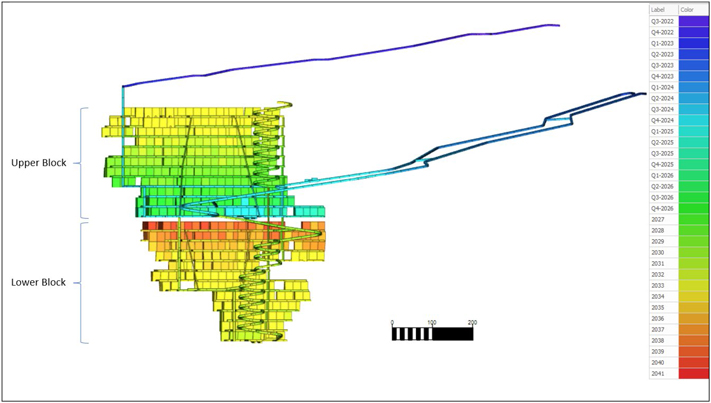
| Effective date: June 30, 2022 |
Page 142 of 236 |
| Aris Mining Corporation
|
Technical Report Marmato Gold Mine
|
Table 16.19 Lower Mine production schedule
| Unit | Row Total | Jul 2022 - | Oct 2022 - | 2022 | Jan 2023 - | Apr 2023 - | Jul 2023 - | Oct 2023 - | 2023 | Jan 2024 - | Apr 2024 - | Jul 2024- | Oct 2024 - | 2024 | Jan 2025 - | Apr 2025 - | Jul 2025 - | Oct 2025 - | 2025 | Jan 2026 - | Apr 2026 - | Jul 2026 - | Oct 2026 - | 2026 | 2027 | 2028 | 2029 | 2030 | 2031 | 2032 | 2033 | 2034 | 2035 | 2036 | 2037 | 2038 | 2039 | 2040 | 2041 | 2042 | ||||||||||||||||||||||||||||||||||||||||||||||||||||||||||||||||||||||||||||||||||||||||||||||||||||||||||||||||||||||||||||
| Q3 | Q4 | Q1 | Q2 | Q3 | Q4 | Q1 | Q2 | Q3 | Q4 | Q1 | Q2 | Q3 | Q4 | Q1 | Q2 | Q3 | Q4 | |||||||||||||||||||||||||||||||||||||||||||||||||||||||||||||||||||||||||||||||||||||||||||||||||||||||||||||||||||||||||||||||||||||||||||||||||||
| Summary: |
||||||||||||||||||||||||||||||||||||||||||||||||||||||||||||||||||||||||||||||||||||||||||||||||||||||||||||||||||||||||||||||||||||||||||||||||||||||||||||||||||||
| Total ore tonnes |
t | 24,134,953 | 10,056 | 10,056 | 129,242 | 249,766 | 315,772 | 348,221 | 1,043,001 | 356,428 | 359,101 | 362,124 | 358,317 | 1,435,971 | 1,440,751 | 1,440,112 | 1,439,025 | 1,498,154 | 1,391,540 | 1,356,691 | 1,458,413 | 1,452,188 | 1,434,220 | 1,437,301 | 1,442,952 | 1,435,681 | 1,446,243 | 1,435,661 | 1,422,778 | 114,215 | ||||||||||||||||||||||||||||||||||||||||||||||||||||||||||||||||||||||||||||||||||||||||||||||||||||||||||||||||||||||||||||||||||||||
| Average Au grade |
g/t | 2.87 | 2.86 | 2.86 | 3.04 | 2.90 | 2.92 | 2.93 | 2.93 | 2.86 | 3.02 | 3.22 | 2.81 | 2.98 | 3.04 | 2.95 | 3.03 | 3.12 | 3.14 | 3.32 | 2.91 | 2.80 | 2.72 | 2.55 | 2.41 | 2.54 | 2.75 | 2.80 | 2.79 | 2.61 | ||||||||||||||||||||||||||||||||||||||||||||||||||||||||||||||||||||||||||||||||||||||||||||||||||||||||||||||||||||||||||||||||||||||
| Average Ag grade |
g/t | 3.49 | 3.44 | 3.44 | 3.55 | 4.07 | 4.41 | 4.28 | 4.18 | 3.58 | 3.66 | 3.29 | 3.40 | 3.48 | 4.21 | 4.27 | 4.25 | 3.82 | 3.98 | 4.73 | 3.75 | 4.74 | 3.57 | 2.40 | 1.73 | 2.43 | 2.91 | 2.49 | 2.65 | 3.01 | ||||||||||||||||||||||||||||||||||||||||||||||||||||||||||||||||||||||||||||||||||||||||||||||||||||||||||||||||||||||||||||||||||||||
| Total Au ounces |
oz | 2,223,678 | 924 | 924 | 12,617 | 23,306 | 29,652 | 32,779 | 98,354 | 32,737 | 34,825 | 37,461 | 32,383 | 137,406 | 140,920 | 136,685 | 140,211 | 150,059 | 140,523 | 144,754 | 136,635 | 130,591 | 125,388 | 117,840 | 111,778 | 117,338 | 127,823 | 129,096 | 127,757 | 9,595 | ||||||||||||||||||||||||||||||||||||||||||||||||||||||||||||||||||||||||||||||||||||||||||||||||||||||||||||||||||||||||||||||||||||||
| Total Ag ounces |
oz | 2,707,293 | 1,112 | 1,112 | 14,752 | 32,712 | 44,822 | 47,876 | 140,162 | 40,983 | 42,290 | 38,300 | 39,189 | 160,762 | 195,162 | 197,557 | 196,719 | 183,785 | 178,032 | 206,304 | 176,063 | 221,419 | 164,680 | 110,754 | 80,256 | 112,273 | 135,453 | 114,741 | 121,015 | 11,044 | ||||||||||||||||||||||||||||||||||||||||||||||||||||||||||||||||||||||||||||||||||||||||||||||||||||||||||||||||||||||||||||||||||||||
| Waste tonnes |
t | 3,198,259 | 30,739 | 55,651 | 86,390 | 16,307 | 14,966 | 80,380 | 111,652 | 84,958 | 76,556 | 91,326 | 152,595 | 405,435 | 160,470 | 59,613 | 60,102 | 35,888 | 316,073 | 38,873 | 8,207 | 162,805 | 153,690 | 150,761 | 302,314 | 466,472 | 256,517 | 105,462 | 119,793 | 286,732 | 114,918 | 112,163 | ||||||||||||||||||||||||||||||||||||||||||||||||||||||||||||||||||||||||||||||||||||||||||||||||||||||||||||||||||||||||||||||||||||
| Total development length |
m | 76,767 | 463 | 836 | 1,299 | 245 | 186 | 999 | 1,430 | 1,056 | 954 | 1,324 | 2,524 | 5,858 | 4,662 | 1,476 | 2,273 | 2,105 | 10,515 | 1,704 | 418 | 3,945 | 4,523 | 4,243 | 5,248 | 9,099 | 6,392 | 3,047 | 3,260 | 7,321 | 4,239 | 4,225 | ||||||||||||||||||||||||||||||||||||||||||||||||||||||||||||||||||||||||||||||||||||||||||||||||||||||||||||||||||||||||||||||||||||
| Total tonnes moved |
t | 27,333,212 | 30,739 | 55,651 | 86,390 | 16,307 | 14,966 | 80,380 | 111,652 | 84,958 | 76,556 | 91,326 | 162,651 | 415,491 | 289,712 | 309,379 | 375,874 | 384,109 | 1,359,074 | 395,302 | 367,308 | 362,124 | 358,317 | 1,483,051 | 1,440,751 | 1,602,917 | 1,592,715 | 1,648,915 | 1,693,854 | 1,823,163 | 1,714,930 | 1,557,650 | 1,554,013 | 1,724,033 | 1,557,871 | 1,547,844 | 1,446,243 | 1,435,661 | 1,422,778 | 114,215 | ||||||||||||||||||||||||||||||||||||||||||||||||||||||||||||||||||||||||||||||||||||||||||||||||||||||||||||||||||||||||||||
Table 16.20 Lower Mine development schedule
| Unit | Row Total | Jul 2022 - | Oct 2022 - | 2022 | Jan 2023 - | Apr 2023 - | Jul 2023 - | Oct 2023 - | 2023 | Jan 2024 - | Apr 2024 - | Jul 2024- | Oct 2024 - | 2024 | Jan 2025 - | Apr 2025 - | Jul 2025 - | Oct 2025 - | 2025 | Jan 2026 - | Apr 2026 - | Jul 2026 - | Oct 2026 - | 2026 | 2027 | 2028 | 2029 | 2030 | 2031 | 2032 | 2033 | 2034 | 2035 | 2036 | 2037 | 2038 | 2039 | 2040 | 2041 | 2042 | ||||||||||||||||||||||||||||||||||||||||||||||||||||||||||||||||||||||||||||||||||||||||||||||||||||||||||||||||||||||||||||
| Q3 | Q4 | Q1 | Q2 | Q3 | Q4 | Q1 | Q2 | Q3 | Q4 | Q1 | Q2 | Q3 | Q4 | Q1 | Q2 | Q3 | Q4 | |||||||||||||||||||||||||||||||||||||||||||||||||||||||||||||||||||||||||||||||||||||||||||||||||||||||||||||||||||||||||||||||||||||||||||||||||||
|
Lateral development breakout: |
||||||||||||||||||||||||||||||||||||||||||||||||||||||||||||||||||||||||||||||||||||||||||||||||||||||||||||||||||||||||||||||||||||||||||||||||||||||||||||||||||||
|
Main decline |
m | 4,567 | 186 | 999 | 1,185 | 1,056 | 954 | 721 | 477 | 3,208 | 174 | |||||||||||||||||||||||||||||||||||||||||||||||||||||||||||||||||||||||||||||||||||||||||||||||||||||||||||||||||||||||||||||||||||||||||||||||||||||||||
|
Higueron ramp |
m | 1,544 | 463 | 836 | 1,299 | 245 | 245 | |||||||||||||||||||||||||||||||||||||||||||||||||||||||||||||||||||||||||||||||||||||||||||||||||||||||||||||||||||||||||||||||||||||||||||||||||||||||||||||
|
Ramps |
m | 4,582 | 448 | 224 | 224 | 1,538 | 1,624 | 523 | ||||||||||||||||||||||||||||||||||||||||||||||||||||||||||||||||||||||||||||||||||||||||||||||||||||||||||||||||||||||||||||||||||||||||||||||||||||||||||||
|
Level access |
m | 1,823 | 50 | 311 | 361 | 42 | 130 | 91 | 98 | 418 | 501 | 99 | 24 | 6 | 43 | 9 | ||||||||||||||||||||||||||||||||||||||||||||||||||||||||||||||||||||||||||||||||||||||||||||||||||||||||||||||||||||||||||||||||||||||||||||||||||||
|
Footwall access |
m | 7,707 | 307 | 768 | 1,075 | 335 | 97 | 520 | 678 | 587 | 443 | 1,198 | 586 | 434 | 413 | 747 | 257 | 337 | ||||||||||||||||||||||||||||||||||||||||||||||||||||||||||||||||||||||||||||||||||||||||||||||||||||||||||||||||||||||||||||||||||||||||||||||||||
|
Stope access ore |
m | 23,770 | 190 | 190 | 1,950 | 439 | 1,121 | 1,426 | 4,936 | 941 | 263 | 1,258 | 1,892 | 1,624 | 626 | 1,680 | 1,981 | 1,122 | 1,019 | 1,964 | 2,110 | 2,162 | ||||||||||||||||||||||||||||||||||||||||||||||||||||||||||||||||||||||||||||||||||||||||||||||||||||||||||||||||||||||||||||||||||||||||||||||
|
Stope access waste |
m | 25,118 | 271 | 271 | 939 | 542 | 1,079 | 679 | 3,239 | 655 | 155 | 1,284 | 1,402 | 1,474 | 1,414 | 1,882 | 2,642 | 1,384 | 1,643 | 4,340 | 1,728 | 1,606 | ||||||||||||||||||||||||||||||||||||||||||||||||||||||||||||||||||||||||||||||||||||||||||||||||||||||||||||||||||||||||||||||||||||||||||||||
|
Vent drive |
m | 2,477 | 116 | 229 | 345 | 220 | 14 | 14 | 247 | 14 | 131 | 73 | 73 | 541 | 761 | 135 | 21 | 53 | 54 | 27 | ||||||||||||||||||||||||||||||||||||||||||||||||||||||||||||||||||||||||||||||||||||||||||||||||||||||||||||||||||||||||||||||||||||||||||||||||
|
Ore pass access |
m | 925 | 33 | 32 | 65 | 95 | 36 | 28 | 42 | 62 | 59 | 58 | 36 | 56 | 117 | 36 | 43 | 65 | 66 | 60 | ||||||||||||||||||||||||||||||||||||||||||||||||||||||||||||||||||||||||||||||||||||||||||||||||||||||||||||||||||||||||||||||||||||||||||||||||
|
Muck bay |
m | 213 | 0 | 45 | 19 | 9 | 9 | 46 | 66 | 19 | ||||||||||||||||||||||||||||||||||||||||||||||||||||||||||||||||||||||||||||||||||||||||||||||||||||||||||||||||||||||||||||||||||||||||||||||||||||||||||
|
Pump station |
m | 909 | 136 | 318 | 268 | 186 | ||||||||||||||||||||||||||||||||||||||||||||||||||||||||||||||||||||||||||||||||||||||||||||||||||||||||||||||||||||||||||||||||||||||||||||||||||||||||||||||
|
Shop |
m | 914 | 0 | 542 | 542 | 371 | ||||||||||||||||||||||||||||||||||||||||||||||||||||||||||||||||||||||||||||||||||||||||||||||||||||||||||||||||||||||||||||||||||||||||||||||||||||||||||||||
|
Paste fill distribution |
m | 120 | 96 | 23 | 120 | |||||||||||||||||||||||||||||||||||||||||||||||||||||||||||||||||||||||||||||||||||||||||||||||||||||||||||||||||||||||||||||||||||||||||||||||||||||||||||||||
| Effective date: June 30, 2022 |
Page 143 of 236 |
| Aris Mining Corporation
|
Technical Report Marmato Gold Mine
|
16.5.5. Mining operations
16.5.5.1. Stopes
Stopes will be mined using the longhole open stoping method. Individual stope blocks are designed to be 20 m wide, up to 18.5 m long, and will have a transverse orientation. Levels are spaced 25 m apart and each stope block will have a top and bottom access (4.5 m by 4.5 m flat back drifts).
Stopes will be drilled downward from the top access using 114 mm diameter holes (stope slots and stope production rings will be drilled with an in-the-hole drill). A bottom up, primary/secondary extraction sequence will be followed. Primary stopes will be backfilled with high strength paste backfill and secondary stopes will be backfilled with run of mine waste from the underground operation and low strength paste backfill as needed when waste rock is not available.
Stope extraction will occur in two steps. During the first step, a slot will be mined at the far end of the stope using a drop raise and 28 fan-drilled slash holes. The slot is required to create sufficient void space for the remainder of the stope to be blasted. During the second step, production rings will be blasted three rows at a time (17 blastholes per ring) until the stope is completely extracted. The number of three-row blasts in a given stope will depend on the length of the stope. All blasting will be performed with bulk emulsion.
Ore will be remotely mucked from the bottom stope access using a 7.3 m3 (17 t) loader. The loader will transport the ore to the nearest ore pass on the level. A fleet of 45 t haul trucks will be used to transport ore from the ore pass to the surface.
16.5.5.2. Development
Lateral development includes the main decline, interlevel truck ramps, ventilation drifts, level accesses, stope accesses, and short connecting drifts for ventilation. The main decline system will be 5.5 m wide by 5.5 m high with an arched back at a maximum 14% gradient. The interlevel truck ramps will be 5.5 m wide by 5.5 m high with an arched back at a maximum 14% gradient. Level accesses will be 5 m wide by 5 m high with a flat back and will be mined higher at the re-muck bays to allow the haul trucks to be loaded by the loader. Stope access drifts will be flat back 4.5 m wide by 4.5 m high.
Interlevel ramps and levels accesses will be located in the hangingwall so as to not limit the potential growth of the mineral reserves. Stope accesses are oriented perpendicular to the strike of the deposit.
The lateral development is sized for the operation of the mining equipment fleet that has been selected for the operation. The development profiles include allowances for ventilation ducting and services.
Conventional drop raising will be used to establish ventilation connection and secondary egress.
16.5.5.3. Material handling system
The underground material handling system is designed to size the rock, provide surge, and storage capacity for moving the rock to surface via trucks.
During operations, ore will be brought to the ore pass on the level with a grizzly over the opening to prevent oversized material from clogging the pass. Trucks will load the ore at the main loading levels and haul up the decline to the surface.
16.5.5.4. Haulage
The mine plan assumes that 7.3 m3 (17 t) loaders will load waste rock to 45 t haul trucks from re-muck bays that will be strategically located throughout the development workings. Ore will be hauled to ore passes and loaded to 45 t haul trucks and trucked to surface through the decline. Ore and waste haulage distances and cycle times were calculated using the haulage profile module in Vulcan and are based on estimated underground truck speeds as
| Effective date: June 30, 2022 |
Page 144 of 236 |
| Aris Mining Corporation
|
Technical Report Marmato Gold Mine
|
shown in Table 16.21. The outputs from the Vulcan haulage profile module are a one-way haulage distance and an average truck cycle time (round trip). Uphill and downhill hauls are assumed at the same speeds.
Table 16.21 Lower Mine truck hauling speeds
| Status |
Road Grade (%) | Speed (km/hr) | ||
|
Loaded |
0 – 2.5 | 11.0 | ||
| 2.5 – 5.0 | 10.5 | |||
| 5.0 -7.5 | 10.3 | |||
| 7.5 – 10.0 | 10.2 | |||
| 10.0 – 12.5 | 10.1 | |||
| 12.5 – 15.0 | 7.4 | |||
| 15.0 -2 0.0 | 7.4 | |||
|
Empty |
0 – 2.5 | 11.0 | ||
| 2.5 – 5.0 | 10.5 | |||
| 5.0 – 7.5 | 10.5 | |||
| 7.5 – 10.0 |
10.5 | |||
| 10.0 – 12.5 | 10.5 | |||
| 12.5 – 15.0 | 9.0 | |||
| 15.0 – 20.0 | 7.5 |
The ore haulage distances were evaluated from the mine production schedule. Based on this evaluation, ore haulage pathways were created to approximate the location of ore development and stope mining in each time period. Vulcan haulage profile was then used to generate a one-way ore haulage distance and an average cycle time (round trip) using the speed parameters shown in Table 16.21.
All waste material mined before the first secondary stope will be sent to the surface for surface construction purposes. Once the first secondary stope is mined, and through the end of the mine life, the availability of mined-out secondary stopes was evaluated to determine haulage distances for waste material. These waste haulage pathways were created to approximate the location of development waste mining and waste rock dumping for each time period. Vulcan haulage profile was then used to generate a one-way waste haulage distance and an average cycle time (round trip) using the speed parameters shown in Table 16.21.
The average one-way ore haulage distances are approximately 2,500 m early in the mine life through 2031 and increase to approximately 3,700 m later in the mine life. The life of mine average is 3,200 m. Waste haulage distances are approximately 2,040 m when hauling material to surface and 690 m thereafter. At the peak, four haul trucks are required to transport the ore and waste. Figure 16.16 shows the round trip haul cycle time by period. SRK notes the cycle times reflected in this summary are indicative as there is a fixed component including the loading time, dumping time, positioning time, and additional delays that are included in the productivity and equipment quantity determinations and not included in the information summarized in the figure.
A small bypass stockpile near the portal will be available for short term storage if needed, but there is limited stockpiling space on surface and as soon as ore material is produced, it is expected to be processed.
| Effective date: June 30, 2022 |
Page 145 of 236 |
| Aris Mining Corporation
|
Technical Report Marmato Gold Mine
|
Figure 16.16 Lower Mine round trip haulage cycle times
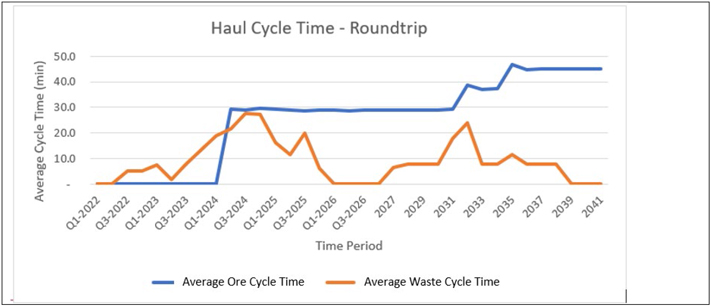
16.5.5.5. Backfill
The mine production sequence includes the use of cemented paste backfill to fill the voids left by mining the stopes to maintain the mine structural integrity. The mine will utilize a high strength backfill paste that has a 7% cement content in the primary stopes. A lower strength paste with 4% cement will be used to backfill the secondary stopes. Section 18.2.5.4 discusses the surface plant and system to move the paste fill underground to the stopes. A backfill operations crew will install barricades in the lower access drift to the stopes, extend the pipe delivery system in the upper access drift into the stopes, and monitor the backfill as the stope fills. Once the stope is filled the backfill will be allowed to cure for seven days to the design strength of over 1 MPa prior to blasting on the adjoining stope.
The life of mine backfill breakdown by volume and type is shown in Table 16.22.
Table 16.22 Lower Mine backfill volume summary
| Backfill type |
Volume (m3) |
|||
| Total backfill |
8,198,733 | |||
| Low strength backfill (Waste rock or 4% cement paste fill) |
1,958,887 | |||
| High strength backfill (7% cement paste fill) |
6,239,846 |
16.5.5.6. Ground support
The current knowledge of the geotechnical characteristics indicates that ground support will be required in the ramps, in areas of faulting, and in primary access drifts and shop areas. The stope access drifts will require minimum ground support except at the brows of the stopes. The ground support plan includes the use of grouted rebar and split set style bolts as a standard. The bolting will be supplemented with wire mesh, shotcrete, and additional support where required. The plan includes allowances for areas of full shotcrete that will be used in longer term active mine areas. A bolter will be utilized as normal practice and shotcrete equipment is included in the estimate. Additionally, a cable bolter has been included in the equipment fleet to allow for cable bolting if necessary, in intersections and at the stope brows.
| Effective date: June 30, 2022 |
Page 146 of 236 |
| Aris Mining Corporation
|
Technical Report Marmato Gold Mine
|
16.5.5.7. Grade control
As part of the routine mining sequence, infill drilling will be conducted on routine sampling grids, and a grade control program will be executed to monitor the mining production. The infill drilling will be conducted from established drilling stations on each level, with underground diamond drilling using NQ core diameter drilled across the width of the known mineralization. Drilling will be logged for basic geological and geotechnical parameters and sampled using the current established protocols. SRK envisions up to three holes in a fan pattern can be drilled from each station to gain knowledge for levels above and below as required.
The aim of the grade control program is to deliver the most economic material to the mill via accurate definition of ore and waste contacts. The basis of a successful program in an underground environment will be completed via detailed geological mapping and sample assays ahead of the mining. The grade control strategy is related to the mining method and mineralization style. For underground operations, sampling methods include continuous chip, channel, and panel samples, and drill-based samples.
The aim of the program will be to identify variations in dip, strike, and width of the ore, the impact of faulting effects on a local scale, and grade continuity. Variations in geometry at the edge of the mineralization will require good geological understanding to ensure optimum grade, minimal dilution, and maximum mining recovery.
The current proposed mining methods involve development of cross cuts at regular intervals across the width of the mineralization at the top and bottom of a stope prior to mining. Samples should be taken across the full width of the exposed mineralization via cut channel sampling using the current sampling protocols, with sufficient volume to ensure a representative sample. The aim of the sampling should be to achieve a sample weight the equivalent of at minimum half NQ core for the sampling interval. The samples should be logged geologically marking the width of the mineralization and any hanging wall or footwall mineralization. The samples should be processed at the onsite facility to enable quick turnaround, with sufficient QAQC samples inserted to monitor the quality of the laboratory. Further to the channel sampling programs, the mine geologist will perform daily mapping, as well as define the ore/waste contact for the mining teams. The mapping should be incorporated into a digital format to further improve the geological model and enable the development of short term grade control estimates.
SRK recommends that the geology team creates a series of protocols to cover all grade control tasks from mapping to sampling and integration with the database. The local sampling should be used in the generation of a short term grade control model for use in short term planning. The use of short term models will also aid the mine in the ability to complete routine reconciliation studies to monitor the performance of the grade estimation and mining processes, and to identify any potential issues.
On-going QAQC monitoring and review will allow protocols and staff to be updated as required.
16.5.6. Ventilation
The ventilation configuration of the Lower Mine Project is considered a best practice design as it is configured to minimize series ventilation. The ventilation design includes dedicated ventilation splits for fixed facilities so that all the air used in the shops and crusher dump areas is transferred directly to exhaust and away from working levels. The design also provides fresh air to each active mining level. Five stages of mine development were modeled, with each stage accounting for worst-case operating conditions.
16.5.6.1. Ventilation modelling criteria
Several factors were considered when determining the airflow requirements for the Lower Mine such as gas dilution, diesel particulates, maintaining minimum air velocities, and meeting government regulations as described in Section 16.4.7. These factors need to be applied to targeted areas to determine the total mine airflow requirement. SRK applied general mine ventilation best practices to the ventilation design and the Colombian Underground Mining Safety Code for specific ventilation requirements for the Project location.
| Effective date: June 30, 2022 |
Page 147 of 236 |
| Aris Mining Corporation
|
Technical Report Marmato Gold Mine
|
16.5.6.2. Air velocities
Air velocity limitations vary according to airway type. In areas such as return airways and shafts where personnel are not expected to work, higher velocities are acceptable. Airway velocities typically used by SRK for various airway types are shown in Table 16.23. Air velocity limits and recommended values for travel ways, at a maximum of 6 m/s, are established to accommodate work and travel by people and equipment, optimizing dust entrainment, and temperature regulation.
16.5.6.3. Airflow calculations
The airflow requirements for the Lower Mine are based on two distinct upper and lower mining zones and earlier and later time phases as mining progresses. There will be an increase in the required number of haulage trucks as the haulage level is developed deeper because the haulage will be from ore passes moving material to common haulage levels, accounting for differences in airflows. Airflow through fixed facilities must also be accounted for, including the underground shop, however the individual airflow requirement was based on an allocation from the haulage fleet requirement. The total minimum airflow for the mine is estimated to be near 320 m3/s with an initial requirement of approximately 243 m3/s. The difference in airflow is based on the expansion of the haulage fleet as the haulage level is deepened during later mining stages and is used as a guideline for the airflow distribution regime. The leakage rate is also assumed to increase as the mine grows and additional connections between the fresh air side and return air side are developed. A summary of the airflow requirements by equipment type is shown in Table 16.23.
Table 16.23 Lower Mine airflow requirements by equipment type
| Equipment type | Number of pieces |
Power (kW) |
Availability | Operating in the mine (diesel) |
Applied power in the mine (diesel) (kW) |
Airflow requirement (m3/s) | ||||||
| Sandvik DD422i - jumbo, 2 boom |
3 | 119 | 85% | 20% | 61 | 5.5 | ||||||
| Sandvik DS411 - mechanical bolter |
4 | 110 | 85% | 20% | 75 | 6.7 | ||||||
| Sandvik DS421 - cablebolter |
1 | 120 | 85% | 20% | 20 | 1.8 | ||||||
| Sandvik DU421 - production drill |
4 | 130 | 85% | 20% | 88 | 8.0 | ||||||
| Orica MaxiCharger 5344 -production |
2 | 120 | 85% | 20% | 41 | 3.7 | ||||||
| Normet Spraymec 1050 - shotcrete sprayer |
4 | 110 | 85% | 20% | 75 | 6.7 | ||||||
| Getman A64 HD R60 - Transmixer truck |
2 | 129 | 85% | 20% | 44 | 3.9 | ||||||
| Orica Handiloader 1120 -development |
2 | 120 | 85% | 20% | 41 | 3.7 | ||||||
| Sandvik LH517 - LHD, 7.3 m3, 17 t |
1 | 256 | 85% | 75% | 163 | 14.7 | ||||||
| Electric cable LHD |
3 | 256 | 85% | 75% | 0 | 0.0 | ||||||
| Sandvik LH307 - LHD, 3.7 m3, 7 t |
1 | 160 | 85% | 70% | 95 | 8.6 | ||||||
| Sandvik TH545i - haulage truck, 45 t |
5 | 450 | 85% | 83% | 1,587 | 142.9 | ||||||
| CAT UG20M – grader1 |
0 | 105 | 85% | 20% | 0 | 0.0 | ||||||
| Getman A64 - scissor lift |
2 | 129 | 85% | 10% | 22 | 2.0 | ||||||
| Getman A64 - boom truck |
1 | 129 | 85% | 10% | 11 | 1.0 | ||||||
| Getman A64 - flat deck truck |
1 | 129 | 85% | 10% | 11 | 1.0 | ||||||
| 4x4 Pickup - Light vehicles |
4 | 75 | 85% | 10% | 26 | 2.3 | ||||||
| 4x4 Pickup - Light vehicles |
2 | 75 | 85% | 10% | 13 | 1.1 | ||||||
| Effective date: June 30, 2022 |
Page 148 of 236 |
| Aris Mining Corporation
|
Technical Report Marmato Gold Mine
|
| Equipment type | Number of pieces |
Power (kW) |
Availability | Operating in the mine (diesel) |
Applied power in the mine (diesel) (kW) |
Airflow requirement (m3/s) | ||||||
| Getman A64 - Fuel/lube truck |
2 | 129 | 85% | 10% | 22 | 2.0 | ||||||
| Getman A64 - personnel carrier, 16 person |
1 | 129 | 85% | 10% | 11 | 1.0 | ||||||
| Kubota RTV 1120D - personnel carrier |
3 | 19 | 85% | 10% | 5 | 0.4 | ||||||
| CAT 1255D - Forklift/telehandler |
1 | 106 | 85% | 10% | 9 | 0.8 | ||||||
| Getman A64 - Explosives truck |
2 | 129 | 85% | 10% | 22 | 2.0 | ||||||
| CAT 272D - Skid steer |
2 | 73 | 85% | 10% | 12 | 1.1 | ||||||
| Total airflow required for diesel dilution |
2,454 | 220.8 | ||||||||||
| Fixed facilities (ventilated from decline flows) |
0.0 | |||||||||||
| Leakage (10%) |
22.1 | |||||||||||
| Early Phase - total airflow requirement |
243 | |||||||||||
| Late Phase 2x Sandvik TH545i-haulage truck, 45 t |
2 | 450 | 85% | 83% | 635 | 57.1 | ||||||
| Total airflow required for diesel dilution |
3,088 | 278.0 | ||||||||||
| Fixed facilities (ventilated from decline flows) |
0.0 | |||||||||||
| Late Phase leakage (15%) |
41.7 | |||||||||||
| Late Phase - total airflow requirement |
320 | |||||||||||
| 1 0 quantity provided for considered equipment but not selected for the mine plan |
||||||||||||
16.5.6.4. Ventilation model development
The VentSIM Visual ventilation simulation software was used to generate the ventilation model.
16.5.6.5. Airflow distribution and design points
The ventilation design is configured to intake air through the parallel declines which are separated at the cross cuts with bulkheads containing personnel doors, with one decline serving for haulage trucks and the other for intermittent use by light vehicles, internal ramps, and intake raises and exhaust air through the exhaust raise system and upper exhaust decline to surface. This design allows the mine to use on-shift blasting since blast fumes will be mainly isolated to each working level and directly exhausted instead of contaminating the ramp. A single exhaust fan installation is developed near the portal in the upper exhaust decline.
16.5.6.6. Ventilation summary
There are two basic ventilation configurations including an upper zone to be mined first and a lower zone to be mined last. For the upper mining zone, the main declines will be developed to initially service the haulage from the 665 Level and the internal spiral ramp will be developed up as additional levels are developed. For the lower mining zone, once the upper mining zone is completed and the mining blocks at the bottom of the mine are completed, the haulage will be focused from the 480 Level. Because of the longer haulage distances, the number of trucks is increased from 5 to 8, which increases the overall system airflow requirement.
| Effective date: June 30, 2022 |
Page 149 of 236 |
| Aris Mining Corporation
|
Technical Report Marmato Gold Mine
|
The mine is to be ventilated using an exhausting ventilation system with a primary fan at the surface exhaust portal. The twin intake declines will be required to be developed with a dimension of 5.5 m x 5.5 m to keep the air velocity below 6 m/s. The upper exhaust decline will not have any personnel access and so it can function at a higher air velocity. With a dimension of 5 m x 5 m the air velocity will be in the order of 11 m/s in the short term and 14.5 m/s in the long term.
16.5.6.7. Auxiliary ventilation
For auxiliary ventilation, a standard size of 1.2 m was chosen to provide enough clearance between the ducting and equipment. Short headings on levels can be ventilated with 50 kW fans, while longer development headings can require 75 kW fans, assuming a 75% fan efficiency. Development of the lower access decline and lower portion of the ramp can be challenging to provide the target airflow due to the length of duct (1.7 km) and leakage. For these long drives it is recommended to use two 1.2 m ducts in parallel using 75 kW fans in series. A summary of the ducting and fan requirements is provided in Table 16.24.
Table 16.24 Lower Mine auxiliary ventilation fan summary
| Duct diameter (m) | Fan pressure (kPa) | Inlet airflow (m³/s) | Air power (kW) | Motor power (kW) | ||||
| 1.2 | 1.4 | 26 | 35 | 46 | ||||
| 1.2 | 2.4 | 23 | 54 | 72 |
16.5.6.8. Main fans
The primary ventilation circuits will be established with one main fan installation. The primary exhaust fan is the main driver of air for the mine. Table 16.25 shows the fan operating points during the two phases of the ventilation system based on the maximum motor power output for each fan, which assumes 75% efficiency. The fans are assumed to be located underground near the surface portals.
Table 16.25 Lower Mine fan operating points
| Main exhaust fan installation phase |
Pressure (kPa) |
Quantity (m³/s) |
Motor power |
Inlet density (kg/m³) | ||||
| 665 Level haulage |
1.95 | 265 | 690 | 1.14 | ||||
| 480 Level haulage |
3.60 | 350 | 1,680 | 1.13 |
16.5.7. Infrastructure and services
The Lower Mine infrastructure includes a power distribution system, mine dewatering systems, underground service water supply system, an underground paste backfill pumping system, an underground ore handling system, diesel fueling system, an underground shop, warehouse and storage, offices, explosives storage, and communications system. The major systems are described in the following sections. Figure 16.13 shows the location of the major infrastructure systems.
16.5.7.1. Power distribution
The main power for the Lower Mine mining area will be supplied by two 13.2 kV power lines down the decline to the crusher area. The power then will be distributed through 13.2 kV power lines through the remainder of the mine to stepdown portable substations at the shop, paste plant pump station, mine pump stations, and operating mining and development areas. The main ventilation fans will receive power through the Higueron ramp near the bottom of the Upper Mine and will be fed from the existing Upper Mine substation. The mining connected loads, including the surface backfill plant, total 9.2 MW. The average running load is approximately 5.3 MW. The major loads include mine ventilation and mine pumping systems. The mine pumping system runs intermittently and is the main reason the connected load and average running load are substantially different.
| Effective date: June 30, 2022 |
Page 150 of 236 |
| Aris Mining Corporation
|
Technical Report Marmato Gold Mine
|
Backup generation of approximately 3.6 MW will be provided by the backup generator at the Lower Mine plant. The fans will use the backup generation capacity at the existing Upper Mine plant.
16.5.7.2. Mine dewatering
The Lower Mine pumping system is developed in stages. Declines will be constructed at the Lower Mine and Upper Mine sites. Skid mounted pump systems (60 l/s capacity) will be installed in the active development declines and will be staged to control water in the declines. Once the declines are completed the skid mounted pump systems will be used on the development ramps as the mine is expanded.
At the 730 m level of the mine, a permanent pump station will be established with a sump and agitator system. The pump system will include two pump trains of three 300 kW pumps in series with a capacity of 180 l/s at a total dynamic head of 270 m. One train will be operational with one on standby. The pump discharges to a 30.5 cm steel pipe that carries mine water from the pump station to the surface to the plant storage water tank. Based on the current knowledge of the hydrogeology, the pump system is planned to operate at 60 l/s on average.
Later in the mine life, at the current planned bottom of the mine, a second permanent pump station will be constructed at the 480 m level. The second permanent pump station will be a duplicate of the system installed at the 730 m level and will operate in the same manner. The system will pump through 30.5 cm schedule 40 steel pipe to the pump station on the 730 m level where the 730 m level station will pump to the surface.
The system is designed to handle maximum flows and operate at the much lower operational flow rate.
16.5.7.3. Underground water supply
Mine service water is supplied from the supply tank located at the surface backfill plant via 10.2 cm HDPE pipeline down the Lower Mine decline to the mine operational areas.
16.5.7.4 Underground backfill system
The surface portion of the cemented paste backfill system is described in Section 18.2.5.4. Cemented paste is moved via 20.3 cm schedule 120 pipe from the surface plant to an underground booster pump station that pumps the paste from the 750 m level to the stopes above this level. The booster pump station includes a paste hopper and piston pump, pump hydraulic power unit, flush and clean up water storage tank, and a high pressure flush pump and clean up pump. The booster pump station moves the paste through the underground paste reticulation system to the stopes. For the stopes below the 730 m level, boreholes have been included to house the piping that will transport the paste to the lower level stopes.
16.5.7.5. Underground fuel storage and distribution
Fuel from the surface will be transported to the underground storage system via fuel trucks. One fuel station is included in the design, located near the shop area. The station will be a bladder type, with up to 150% containment, complete with the following safety functions: four hour rated Underwriter Laboratory approved roll up door, thermal activated fuel shut off valve to dispensing system, anti-syphon valve, and a dry chemical automatic fire suppression system with detection and actuation. The station should be alarmed, by means of a PLC with level alarms, and a level switch.
Additionally, fusible link fire doors are also included in the underground layout, these twin fire doors, upon actuation will isolate the fueling area from the main shops.
16.5.7.6. Underground shop
The maintenance area consists of large bays to accommodate vehicular traffic. A service trench runs the length of each bay to allow access to the undercarriage of the vehicles. One wash bay is also included in the workshop layout. A drainage trench with covering grating will run the length of the bay to carry water to a nearby oil capture sump. Grading of the area will help reduce the possibility of oil contamination. Each maintenance bay will also come equipped with an overhead crane to help facilitate the maintenance work on vehicles.
| Effective date: June 30, 2022 |
Page 151 of 236 |
| Aris Mining Corporation
|
Technical Report Marmato Gold Mine
|
Warehouse and tool cribs are also included within walking distance of the maintenance bays.
Three rollup doors will separate the two maintenance bays from the rest of the mine. An office will be located at the end of a drift located in the maintenance area.
16.5.7.7. Explosives storage
Underground powder and primer magazines are included in the mine design. The mine explosives will be stored off site by the military and deliveries will be on an as needed basis with the underground magazines providing the capacity required for production needs.
16.5.7.8. Safety infrastructure
The mine design includes portable and permanent refuge stations. The portable refuge stations will be staged near the operating faces during development. An emergency hoist is included in the design for the bottom section of the mine to allow emergency egress. A stench warning system through the ventilation system will notify workers of emergency conditions.
16.5.7.9. Communications system
The mine will be equipped with a leaky feeder system that will allow internet, phone, and radio communications underground. The mine will have standard underground call phones with intercom. A control system will allow remote operation of the rock breaker and CCTV system to monitor dump points, crusher, and key material handling locations.
16.5.8. Labour
Development and production will be contractor operated. Owner labour will include the management and technical team, working five nine-hour days per week. Table 16.26 shows the overall owner mine staffing at full production. All operating and maintenance personnel will be provided by the contractor. The estimated number of operating and maintenance personnel required is 181.
Table 16.26 Lower Mine owner mining labour estimate
| Department/section |
Category |
Shift hours |
Maximum staff |
|||||||||
| Mine technical staff |
|
45 | ||||||||||
|
Mine superintendent |
Salary |
9 | 1 | |||||||||
|
Chief mining engineer |
Salary |
9 | 1 | |||||||||
|
Long term planning engineer |
Salary |
9 | 1 | |||||||||
|
Stope designer engineer |
Salary |
9 | 1 | |||||||||
|
Production reporting supervisor |
Salary |
9 | 1 | |||||||||
|
Short term planning |
Salary |
9 | 2 | |||||||||
|
Grade control engineer |
Salary |
9 | 2 | |||||||||
| Surveyors |
Salary |
9 | 4 | |||||||||
| Technician |
Salary |
9 | 2 | |||||||||
|
Senior geotechnical engineer |
Salary |
9 | 1 | |||||||||
|
Geotechnical engineer |
Salary |
9 | 3 | |||||||||
|
Geotechnical technician |
Salary |
9 | 2 | |||||||||
|
Ventilation engineer |
Salary |
9 | 1 | |||||||||
|
Ventilation technician |
Salary |
9 | 2 | |||||||||
|
Backfill engineer |
Salary |
9 | 1 | |||||||||
|
Backfill technician |
Salary |
9 | 2 | |||||||||
|
Chief mine geologist |
Salary |
9 | 1 | |||||||||
| Effective date: June 30, 2022 |
Page 152 of 236 |
| Aris Mining Corporation
|
Technical Report Marmato Gold Mine
|
| Department/section |
Category |
Shift hours |
Maximum staff |
|||||||
| Grade control geologist |
Salary |
9 | 3 | |||||||
| Infill drilling supervisor |
Salary |
9 | 3 | |||||||
| Backfill coordinator |
Salary |
9 | 1 | |||||||
| Backfill plant supervisor |
Hourly |
12 | 2 | |||||||
| Senior modelling geologist |
Salary |
9 | 1 | |||||||
| Senior field logging geologist |
Salary |
9 | 1 | |||||||
| Project lead |
Salary |
9 | 1 | |||||||
| Mechanical engineer |
Salary |
9 | 1 | |||||||
| Civil engineer |
Salary |
9 | 2 | |||||||
|
Clerk |
Salary |
9 | 2 |
16.5.9. Equipment
Development and production will be contractor operated. Site will provide miscellaneous equipment and infrastructure such as main dewatering pumps, main ventilation fans, backfill infrastructure, powder and fuse magazines, and health and safety equipment.
Major mobile equipment and auxiliary equipment will be provided and maintained by the contractor. Auxiliary fans and consumables will also be provided by contractors. Table 16.27 shows the estimated required mobile equipment.
Table 16.27 Lower Mine estimated mobile equipment list
|
Major Mobile Equipment |
Requirement |
|||||
| Sandvik DD422 - Jumbo, 2 boom |
1 to 2 | |||||
| Sandvik DS411 - Mechanical bolter |
1 to 2 | |||||
| Sandvik DS422i - Cablebolter |
1 | |||||
| Sandvik DU411 ITH - Production drill |
2 | |||||
| Getman Orica - Explosives truck with Orica MaxiCharger 5344 |
1 | |||||
| Getman Orica - Getman explosives truck with Orica Handiloader |
1 to 2 | |||||
| Getman SST Shotcrete unit - Shotcrete Sprayer |
1 | |||||
| Getman A64 HD R60 - Transmixer truck |
1 | |||||
| Sandvik LH517i - LHD, 7.3 m3, 17 t |
1 | |||||
| Sandvik TH545i - Haulage truck, 45 t |
6 to 8 | |||||
| Sandvik LH514 - Electric LHD - cable, 5.4 m3, 14 t |
4 | |||||
| Auxiliary Equipment |
||||||
| CAT UG20M - grader |
1 | |||||
| Sandvik LH307 - LHD, 3.7 m3, 7 t |
1 | |||||
| Getman A64 - Scissor lift |
2 | |||||
| Getman A64 - Boom truck |
1 | |||||
| Getman A64 - Flat deck truck |
1 | |||||
| 4 x 4 pickup - Light vehicles |
12 | |||||
| Getman A64 - Fuel truck |
2 | |||||
| Getman A64 - Personnel carrier, 16 person |
3 | |||||
| Kubota RTV 1120D - Personnel carrier |
6 to 12 | |||||
| Effective date: June 30, 2022 |
Page 153 of 236 |
| Aris Mining Corporation
|
Technical Report Marmato Gold Mine
|
| CAT 1255D - Forklift/telehandler |
1 |
|||
| Getman A64 - Service mechanic truck |
1 | |||
| CAT 272D - Skid steer |
2 | |||
| Sandvik DE142 - Underground core drill |
2 | |||
| CAT 982M - Front end loader - 6.7m3/8.75 yd3 |
1 | |||
| Getman A64 - Lube truck |
1 | |||
| Getman A64 - SLHanger scissor lift |
1 | |||
| Getman A64 - SLWing scissor lift |
1 | |||
| Getman A64 - Pallet handler |
1 |
16.6. Upper Mine and Lower Mine production schedule
The combined Upper Mine and Lower Mine production schedule is shown in Table 16.28.
| Effective date: June 30, 2022 |
Page 154 of 236 |
| Aris Mining Corporation
|
Technical Report Marmato Gold Mine
|
Table 16.28 Combined Upper Mine and Lower Mine production schedule
| Unit |
Row total |
Jul 2022 - |
Oct 2022 - |
2022 |
Jan 2023 - |
Apr 2023 - |
Jul 2023 - |
Oct 2023- Q4 |
2023 |
Jan 2024 - |
Apr 2024 - |
Jul 2024 - |
Oct 2024 - |
2024 |
Jan 2025 - |
Apr 2025 - |
Jul 2025 - |
Oct 2025 - |
2025 | Jan 2026 - |
Apr 2026 - |
Jul 2026 - |
Oct 2026 - |
2026 | 2027 | 2028 | 2029 | 2030 | 2031 | 2032 | 2033 | 2034 | 2035 | 2036 | 2037 | 2038 | 2039 | 2040 | 2041 | 2042 | ||||||||||||||||||||||||||||||||||||||||||
| Summary: |
||||||||||||||||||||||||||||||||||||||||||||||||||||||||||||||||||||||||||||||||||
| Total ore |
t | 31,163,075 | 76,236 | 93,173 | 169,408 | 90,565 | 90,088 | 89,953 | 90,022 | 360,628 | 112,493 | 112,495 | 112,520 | 122,548 | 460,056 | 241,753 | 362,452 | 428,501 | 459,863 | 1,492,568 | 468,606 | 472,079 | 474,793 | 470,903 | 1,886,382 | 1,890,508 | 1,812,226 | 1,819,523 | 1,812,852 | 1,672,251 | 1,516,869 | 1,740,530 | 1,892,647 | 1,878,676 | 1,708,523 | 1,884,637 | 1,885,729 | 1,896,320 | 1,881,756 | 1,500,987 | 114,215 | |||||||||||||||||||||||||||||||||||||||||
| Average Au |
g/t | 3.16 | 5.23 | 5.86 | 5.57 | 4.48 | 4.74 | 4.47 | 4.47 | 4.54 | 5.31 | 5.66 | 5.06 | 5.08 | 5.27 | 3.98 | 3.53 | 3.51 | 3.39 | 3.55 | 3.28 | 3.52 | 3.76 | 3.42 | 3.50 | 3.45 | 3.26 | 3.22 | 3.26 | 3.37 | 3.38 | 2.99 | 2.92 | 2.84 | 2.64 | 2.55 | 2.75 | 3.11 | 3.11 | 2.89 | 2.61 | |||||||||||||||||||||||||||||||||||||||||
| Average Ag |
g/t | 6.12 | 15.24 | 17.67 | 16.57 | 17.42 | 17.86 | 15.29 | 17.12 | 16.93 | 19.27 | 20.86 | 17.03 | 15.77 | 18.18 | 9.76 | 8.17 | 7.94 | 7.06 | 8.02 | 6.28 | 6.61 | 6.28 | 6.20 | 6.34 | 6.95 | 6.42 | 6.38 | 5.35 | 5.69 | 5.41 | 5.65 | 7.20 | 6.21 | 4.22 | 4.46 | 5.23 | 5.67 | 4.93 | 3.26 | 3.01 | |||||||||||||||||||||||||||||||||||||||||
| Total Au |
oz | 3,168,332 | 12,811 | 17,543 | 30,354 | 13,045 | 13,742 | 12,919 | 12,946 | 52,651 | 19,192 | 20,463 | 18,304 | 20,010 | 77,969 | 30,938 | 41,084 | 48,388 | 50,107 | 170,517 | 49,395 | 53,473 | 57,425 | 51,851 | 212,144 | 209,900 | 190,143 | 188,328 | 190,271 | 181,323 | 164,758 | 167,331 | 177,395 | 171,264 | 144,935 | 154,517 | 166,840 | 189,850 | 188,223 | 139,617 | 9,595 | |||||||||||||||||||||||||||||||||||||||||
| Total Ag |
oz | 6,126,804 | 37,355 | 52,917 | 90,273 | 50,732 | 51,734 | 44,212 | 49,561 | 196,239 | 69,708 | 75,459 | 61,611 | 62,121 | 268,898 | 75,843 | 95,224 | 109,418 | 104,448 | 384,933 | 94,616 | 100,361 | 95,890 | 93,875 | 384,742 | 422,482 | 374,190 | 373,391 | 311,661 | 306,033 | 263,838 | 315,895 | 438,314 | 375,021 | 231,756 | 270,467 | 317,350 | 345,736 | 298,347 | 157,239 | 11,044 | |||||||||||||||||||||||||||||||||||||||||
| Waste |
t | 3,665,656 | 53,744 | 70,404 | 124,149 | 30,166 | 10,539 | 25,864 | 112,651 | 179,219 | 122,137 | 113,830 | 102,509 | 161,109 | 499,584 | 176,362 | 74,652 | 67,954 | 39,247 | 358,216 | 48,909 | 19,623 | 4,564 | 14,798 | 87,894 | 28,268 | 187,310 | 180,585 | 165,255 | 309,403 | 471,439 | 257,875 | 107,310 | 120,277 | 288,899 | 114,918 | 115,424 | 54,393 | 15,235 | 0 | 0 | |||||||||||||||||||||||||||||||||||||||||
| Total |
m | 102,445 | 1,620 | 1,647 | 3,268 | 1,023 | 651 | 767 | 1,846 | 4,286 | 1,839 | 1,681 | 1,723 | 2,816 | 8,058 | 5,415 | 2,492 | 2,815 | 2,344 | 13,065 | 2,354 | 1,055 | 307 | 911 | 4,627 | 1,665 | 5,394 | 6,081 | 5,540 | 5,711 | 9,411 | 6,473 | 3,160 | 3,288 | 7,459 | 4,239 | 5,529 | 4,217 | 974 | 0 | 0 | |||||||||||||||||||||||||||||||||||||||||
| Total tonnes |
t | 34,828,730 | 129,980 | 163,577 | 293,557 | 120,731 | 100,627 | 115,817 | 202,673 | 539,847 | 234,630 | 226,324 | 215,029 | 283,656 | 959,640 | 418,115 | 437,103 | 496,455 | 499,111 | 1,850,784 | 517,516 | 491,702 | 479,357 | 485,701 | 1,974,276 | 1,918,776 | 1,999,536 | 2,000,108 | 1,978,107 | 1,981,654 | 1,988,308 | 1,998,405 | 1,999,957 | 1,998,953 | 1,997,422 | 1,999,556 | 2,001,153 | 1,950,713 | 1,896,990 | 1,500,987 | 114,215 | |||||||||||||||||||||||||||||||||||||||||
| Effective date: June 30, 2022 |
Page 155 of 236 |
| Aris Mining Corporation
|
Technical Report Marmato Gold Mine
|
| 17. |
Recovery methods |
| 17.1. |
Upper Mine |
| 17.1.1. |
Flow sheet |
The Upper Mine process plant has been expanded several times over the years to its current 1,200 tpd rated capacity. The process plant includes three stage crushing, closed circuit ball mill grinding, gravity concentration, flotation, flotation and gravity concentrate regrind, cyanidation of the flotation and gravity concentrates, counter current decantation, Merrill Crowe precipitation, and smelting of the precipitate to produce a gold-silver doré. Gold and silver recovery has improved with recent plant upgrades and averaged 90.8% for gold and 37.2% for silver during 2021. The Upper Mine process plant flowsheet is shown in Figure 17.1 and a list of major equipment is shown in Table 17.1. Each of the process unit operations is briefly described in this section.
Figure 17.1 Upper Mine process plant flow sheet
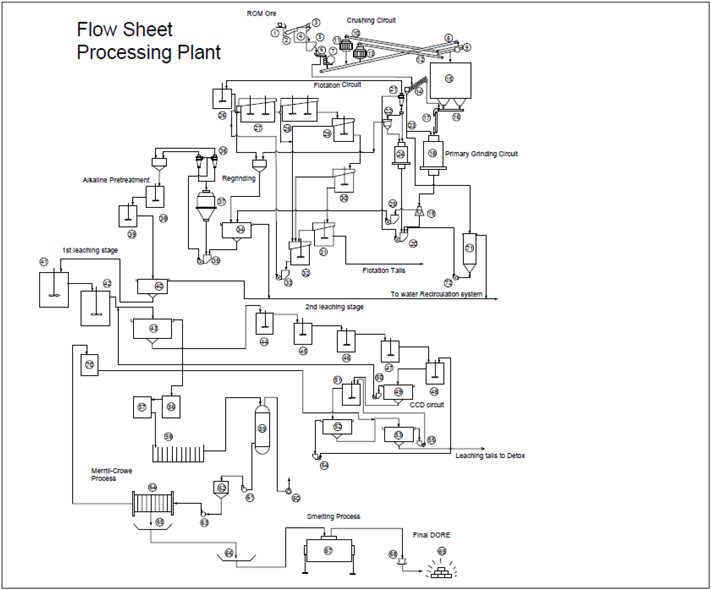
| Effective date: June 30, 2022 |
Page 156 of 236 |
| Aris Mining Corporation
|
Technical Report Marmato Gold Mine
|
Table 17.1 Upper Mine process plant equipment list
| Flowsheet No. |
Equipment |
Description |
Quantity | Power requirement | ||||||
| 1 | Mine rail cars |
1.5 t |
||||||||
| 2 |
Pre-hopper |
100t |
1 | |||||||
| 3 | Winch |
2 | 60 | |||||||
| 4 | Hopper |
5 m x 7 m |
1 | |||||||
| 5 | Feed hopper and gate |
1 | ||||||||
| 6 | Vibrating grizzly |
5 ft x 13 ft |
20 | |||||||
| 7 | Primary jaw crusher |
25” x 40” |
1 | 125 | ||||||
| 8 | Conveyor belt |
30” |
1 | 25 | ||||||
| 9 | Vibrating screen (double deck) |
20 ft x 8 ft (7/8” x 3/8”) |
1 | 40 | ||||||
| 10 | Conveyor belt |
24” x 14 m |
1 | 12 | ||||||
| 11 | Secondary cone crusher |
HP300 |
1 | 300 | ||||||
| 12 | Conveyor belt |
24” x 14 m |
1 | 12 | ||||||
| 13 | Tertiary cone crusher |
HP300 |
1 | 300 | ||||||
| 14 | Spiral classifier |
30” x 17 ft |
1 | 7.5 | ||||||
| 15 | Fine ore bin |
7 m x 5.8 m |
1 | |||||||
| 16 | Conveyor belt |
24” x 7 m |
1 | 7 | ||||||
| 17 | Conveyor belt and scale |
24” x 9 m |
1 | 7 | ||||||
| 18 | Primary ball mill (Allis Chalmers) |
9.5 ft x 14 ft |
1 | 600 | ||||||
| 19 | Jig |
17 ft2 |
4 | 7 | ||||||
| 20 | Cyclone feed pump |
6” x 6” |
2 | 75 | ||||||
| 21 | Hydrocyclone |
Gmax 20” |
2 | |||||||
| 22 | Flash flotation cell |
SK-80 |
1 | 20 | ||||||
| 23 | Knelson concentrator |
KXD-30 |
1 | 30 | ||||||
| 24 | Secondary ball mill (Denver) |
7.5 x 10 ft |
1 | 300 | ||||||
| 25 | Gravity concentrate pumps |
3” x 3” |
1 | 20 | ||||||
| 26 | Flotation conditioner |
12 ft x 12 ft |
1 | 30 | ||||||
| 27 | Rougher flotation cell |
KCF/KYF 30 |
1 | 75 | ||||||
| 28 | Scavenger flotation cell |
KCF/KYF 30 |
1 | 75 | ||||||
| 29 -31 | Scavenger flotation cell (tank cell) |
10 ft x 10 ft |
3 | 30 | ||||||
| 32 | Cleaner flotation cell |
2 m x 2 m |
2 | 7.5 | ||||||
| 33 | Conc. recirculation pump |
3” x 3” |
1 | |||||||
| 34 | Concentrate thickener |
24 ft x 10 ft |
1 | 3 | ||||||
| 35 | Regrind cyclone feed pump |
Wilfley 5k |
2 | 60 | ||||||
| 36 | Regrind cyclone |
6” |
4 | |||||||
| 37 | Regrind ball mill |
Hardinge 7 ft x 5 ft |
1 | 200 | ||||||
| 38-39 | Conditioners |
12 ft x 12 ft |
2 | 12 | ||||||
| 40 | Thickener |
24 ft x 10 ft |
1 | 3 | ||||||
| 41-42 | Leach tanks (first stage) |
20 ft x 20 ft |
2 | 20 | ||||||
| 43 | Thickener |
24 ft x 10 ft |
1 | 3 | ||||||
| 44-48 | Leach tanks (second stage) |
12 ft x 12 ft |
6 | 12 | ||||||
| 49 | Thickener |
24 ft x 10 ft |
1 | 3 | ||||||
| 50 | Pump |
3” x 3” |
1 | 20 | ||||||
| 51 | Leach tank |
12 ft x 12 ft |
1 | 12 | ||||||
| 52-53 | Thickener |
24 ft x 10 ft |
2 | 3 |
| Effective date: June 30, 2022 |
Page 157 of 236 |
| Aris Mining Corporation
|
Technical Report Marmato Gold Mine
|
| Flowsheet No. |
Equipment |
Description |
Quantity | Power requirement | ||||
| 54-55 | Pump |
3” x 3” |
2 | 20 | ||||
| 56-57 | Pregnant leach solution tank |
12 ft x 12 ft |
1 | |||||
| 58 | Clarifier |
1 | ||||||
| 59 | Deaeration tower |
1 | ||||||
| 60 | Vacuum pump |
Hydra1 |
1 | 12 | ||||
| 61 | Zinc dust dosing cone feed pump |
Halberg Nowa |
1 | 25 | ||||
| 62 | Zinc dust dosing cone |
|||||||
| 63 | Filter press feed pump |
Halberg Nowa |
1 | 25 | ||||
| 64 | Filter press |
2 | ||||||
| 65 | Precipitate tray |
1 | ||||||
| 66 | Flux mixing tray |
1 | ||||||
| 67 | Doré furnace |
1 | ||||||
| 68 | Ingot molds |
2 | ||||||
| 69 | Doré |
|||||||
| 70 | Barren solution tank |
12 ft x 12 ft |
1 | |||||
| 71 | Thickener |
12 ft x 35 ft |
1 | |||||
| 72 | Peristaltic pump |
Bredal SPX-65 |
1 |
17.1.2. Crushing
Ore from the underground mine is transported by 1.5 tonne rail cars and dumped into a hopper where a slusher moves the ore (500 mm top size) to a 5 m x 7 m feed hopper that feeds through a 5 ft x 13 ft vibratory grizzly to a 25 inch x 40 inch 125 hp primary jaw crusher. The material from the jaw crusher is conveyed on a 30 inch wide conveyor to a 20 ft x 8 ft double deck vibratory screen. The screen oversize is conveyed to a Nordberg Omnicone 250 hp secondary cone crusher operated in closed circuit with the double deck vibrating screen. Ore retained on the second deck is conveyed to a tertiary Nordberg 300 hp cone crusher, also operated in closed circuit with the vibratory screen. Screen undersize material (-9.5 mm) is the final crushed product and is conveyed to a 7.0 m x 5.8 m fine ore bin. The undersize from the vibratory grizzly is directed to a spiral classifier. The classifier oversize is fed directly into the primary ball mill and the undersize is thickened and pumped to the primary hydrocyclones.
17.1.3. Grinding and gravity concentration
Crushed ore is conveyed from the bottom of the fine ore bin to a 600 hp Allis Chalmers 9 1⁄2 ft x 14 ft ball mill that is operated in open circuit and discharges to a gravity concentrator to recover coarse gold. The gravity tailings are pumped to two 20 inch hydrocyclones for size separation at P80 150 µm. The cyclone underflow reports to a 300 hp 7.5 ft x 10 ft secondary ball mill operated in closed circuit with the cyclones. The cyclone overflow advances to the flotation circuit. The gravity concentrate is combined with the flotation concentrate prior to advancing to the regrind and cyanidation circuits.
17.1.4. Flotation and concentrate regrind
Cyclone overflow from the grinding circuit advances to the flotation circuit where it is conditioned with flotation reagents and then subjected to one stage of rougher flotation followed by two stages of scavenger flotation which provide 40 minutes of total retention time. The scavenger flotation concentrate is upgraded in one stage of cleaner flotation and the scavenger cleaner flotation tailing is recycled back to the rougher flotation circuit. The rougher concentrate and scavenger cleaner flotation concentrate are combined with the gravity concentrate and thickened to about 55% solids and reground in a 200 hp 7 ft x 5 ft Hardinge ball mill operated in closed circuit with cyclones to approximately P80 44 µm before proceeding to the cyanidation circuit. A portion of the flotation tails are delivered to an agitated storage tank and pumped to the underground mine by a positive displacement pump for use as hydraulic backfill in the mine.
| Effective date: June 30, 2022 |
Page 158 of 236 |
| Aris Mining Corporation
|
Technical Report Marmato Gold Mine
|
17.1.5. Cyanide leaching and detoxification
Reground flotation and gravity concentrates report to two 12 ft x 12 ft agitated conditioning tanks where the pH is adjusted to 10.5 with lime and thickened in a 24 ft x 10 ft thickener. The thickener underflow feeds a two stage conventional cyanidation circuit with a total retention time of 30 hours. The first stage leach circuit consists of two 20 ft x 20 ft agitated leach tanks operated in series at a NaCN concentration of 700 mg/l and a pH of 10.5 adjusted with lime, which discharge to a 24 ft x 10 ft thickener. The thickener overflow feeds the Merrill Crowe gold recovery circuit. The thickener underflow reports to a second stage of cyanide leaching consisting of six 12 ft x 12 ft agitated leach tanks. The first leach tank in the second stage leach circuit is operated at a NaCN concentration of 700 mg/l, which is allowed to attenuate to 400 mg/l during leaching. The leached slurry from the second stage leaching is advanced to the counter current decantation circuit, which consists of three 24 ft x 10 ft thickeners, to wash the pregnant leach solution from the leached solids. The leached slurry from the final thickener is combined with the flotation circuit tailings and advanced to the cyanide detoxification circuit, where it is treated to reduce the CNWAD concentration to less than 1 mg/l to comply with environmental regulations.
17.1.6. Merrill Crowe circuit and smelting
The pregnant leach solution is pumped to the Merrill Crowe circuit where it is first clarified to remove any remaining suspended solids and then de-aerated to less than 1 mg/l dissolved oxygen in a vacuum tower. Zinc dust is then added to the de-aerated pregnant leach solution in a controlled manner which results in the precipitation of the gold and silver, which are then recovered in a filter press. The resulting gold and silver precipitate is removed from the filter press on a scheduled basis and then smelted using a flux with the following composition:
| • |
Borax: |
40 | % | |||
| • |
Sodium nitrate: |
30 | % | |||
| • |
Soda ash: |
20 | % | |||
| • |
Silica: |
10 | % |
Approximately 600 kg of flux is blended with 600 kg of precipitate and smelted in a LPG fired furnace to produce a final gold-silver doré product.
17.1.7. Tailings thickening and filtration
Scavenger flotation tailings and the detoxified leach residue flow by gravity to the Cascabel tailings thickening and filtration area, where they are combined and thickened in a 30 ft diameter thickener. The thickened tailings are then filtered in a 10 disc vacuum disc filter to 18% moisture and discharged to a temporary storage area. The filtered tailings are then transported to the dry stack tailings storage facility.
17.1.8. Power and water requirements
The Upper Mine currently has contracts with Colombian power utilities Central Hidroeléctrica de Caldas (CHEC) and EPM to provide 4.5 MW from the national power grid, which will increase to 7.5 MW in November 2022 and to 8.5 MW in the first quarter of 2023, which will provide sufficient capacity for future optimization and expansion projects. Annual power usage estimated using actual requirements is approximately 13,650 MWh per year at a cost of US$0.1 per kWh based on current utility rates, approximately US$4.42 per tonne.
Water requirements are approximately 600 m3 per day and is provided by a combination of underground dewatering, plant recycling, and tailings storage facility reclaim.
17.1.9. Consumables
Process plant consumables are shown in Table 17.2 and includes grinding media, wear materials and process reagents.
| Effective date: June 30, 2022 |
Page 159 of 236 |
| Aris Mining Corporation
|
Technical Report Marmato Gold Mine
|
Table 17.2 Upper Mine process plant consumables
| Item |
kg/t | US$/t | ||||||||
|
Grinding balls |
0.98 | 1.7 | ||||||||
|
Liners |
0.32 | |||||||||
|
Sodium cyanide |
0.43 | 1.41 | ||||||||
|
Zinc dust |
0.02 | 0.13 | ||||||||
|
Lime |
0.99 | 0.22 | ||||||||
|
Copper sulphate |
0.03 | 0.06 | ||||||||
|
Xanthate (Z-6) |
0.04 | 0.20 | ||||||||
|
Aerofroth (A65) |
0.04 | 0.33 | ||||||||
|
Collector MX 5160 |
0.00 | 0.01 | ||||||||
|
Aero AR1404 |
0.03 | 0.04 | ||||||||
|
Lead acetate |
0.00 | 0.02 | ||||||||
|
Flocculant (EGA 1203) |
0.02 | 0.08 | ||||||||
|
Silica |
0.09 | |||||||||
|
Borax |
0.02 | 0.01 | ||||||||
|
Hydrogen peroxide |
0.18 | 0.18 | ||||||||
|
Flocculant (KEMSEP 8356) |
0.04 | 0.22 | ||||||||
|
Flocculant (KEMSEP) |
0.01 | 0.00 | ||||||||
17.1.10. Operational performance
The recent performance of the Upper Mine process plant is summarized in Table 17.3.
Table 17.3 Upper Mine process plant production summary
| Parameter |
2017 | 2018 | 2019 | 2020 | 2021 | 2022 | (Jan-June) | |||||||||||||||||
| Ore tonnes |
365,119 | 338,902 | 370,495 | 308,576 | 323,957 | 162,429 | ||||||||||||||||||
|
Ore tpd |
1,000 | 928 | 1,015 | 843 | 887 | 897 | ||||||||||||||||||
| Ore grade |
||||||||||||||||||||||||
| Au g/t |
2.47 | 2.67 | 2.48 | 2.70 | 2.78 | 3.04 | ||||||||||||||||||
|
Ag g/t |
9.61 | 10.53 | 9.98 | 9.88 | 9.36 | 10.27 | ||||||||||||||||||
|
Recovery |
||||||||||||||||||||||||
|
Au% |
86.8 | 85.5 | 87.1 | 89.1 | 90.8 | 92.3 | ||||||||||||||||||
|
Ag% |
35.1 | 32.7 | 33.3 | 34.9 | 37.2 | 33.5 | ||||||||||||||||||
|
Metal produced |
||||||||||||||||||||||||
| Au ounces |
25,163 | 24,834 | 25,750 | 23,832 | 26,830 | 14,830 | ||||||||||||||||||
|
Ag ounces |
39,524 | 37,522 | 39,558 | 34,206 | 36,671 | 18,271 |
17.1.11. Operating costs
Recent Upper Mine process plant operating costs, excluding tailings management, are summarized in Table 17.4.
Table 17.4 Upper Mine process plant operating cost summary
|
Parameter |
2020 | 2021 | 2022 (Jan-June) | |||||
| Au oz produced |
23,832 | 26,830 | 14,830 | |||||
| Ore tonnes processed |
308,576 | 323,957 | 162,429 |
| Effective date: June 30, 2022 |
Page 160 of 236 |
| Aris Mining Corporation
|
Technical Report Marmato Gold Mine
|
| Parameter |
2020 | 2021 | 2022 (Jan-June) | |||||||||
|
Direct process costs (COP M) |
||||||||||||
|
Crushing |
2,133 | 2,785 | 608 | |||||||||
|
Grinding |
2,950 | 4,393 | 1,860 | |||||||||
|
Flotation |
1,034 | 2,111 | 1,019 | |||||||||
|
Leaching and Merrill Crowe |
2,538 | 3,394 | 2,289 | |||||||||
|
Refining |
140 | 476 | 397 | |||||||||
|
Total direct process costs |
8,795 | 13,160 | 6,173 | |||||||||
|
Total process costs (US$ 1000s) |
2,381 | 3,516 | 1,577 | |||||||||
|
US$/oz |
100 | 131 | 106 | |||||||||
|
US$/t |
7.72 | 10.85 | 9.71 | |||||||||
|
Indirect process costs (COP M) |
||||||||||||
|
Power |
4,336 | 5,586 | 3,092 | |||||||||
|
Maintenance |
2,955 | 2,704 | 1,288 | |||||||||
|
Total processing costs (COP M) |
16,086 | 21,450 | 10,553 | |||||||||
|
Total processing costs (US$ 1000s) |
4,355 | 5,731 | 2,696 | |||||||||
|
US$/oz |
183 | 214 | 182 | |||||||||
|
US$/t |
14.11 | 17.69 | 16.60 | |||||||||
|
Exchange rate (COP/US$) |
3,693 | 3,743 | 3,914 |
| 17.1.12. |
Optimization and expansion plans |
The Upper Mine process plant is being optimized and expanded in a phased approach. The Phase 1 optimization plan, which is planned for completion by the end of 2022, will enable the plant to operate consistently at 1,250 tpd at a finer target grind of P80 135 µm. A key component of the Phase 1 optimization plan is the refurbishment of the primary Allis Chalmers ball mill, which will allow the ball mill to carry a larger ball load and draw maximum grinding power. The Phase 1 schedule and capital cost estimate is shown in Table 17.5 and will include:
| • |
Installation of a Knelson concentrator and new pumps in the grinding circuit to increase the recovery of fine free gold |
| • |
Refurbishment of the existing Allis Chalmers ball mill, including installation of a new ring gear, pinion shaft, and refurbishment of the feed and discharge end trunnions and bearings |
| • |
Installation of new liners in the Allis Chalmers ball mill with an improved liner configuration designed to improve grinding efficiency |
| • |
Installation of a new hydrocyclones cluster and two new slurry pumps among the mill discharge and hydrocyclones cluster to improve the mill throughput and flotation feed particle size at P80 135 µm |
| • |
Reconfiguration of the concentrate regrind thickening circuit to avoid gold losses associated with operational issues |
| • |
Upgrading the Merrill Crowe circuit to increase solution processing capacity from 730 m3/day to 1,100 m3/day |
| • |
Installation of a small ball mill and Gemini table to recover gold from slag and recover concentrate from mill liner changes |
Table 17.5 Upper Mine phase 1 plant optimization capital cost estimate and schedule
| Area |
Capital cost US$ | Completion Date | ||
|
Knelson concentrator and pump installation |
200,000 | Jul-22 | ||
| Ball mill refurbishment |
850,000 | Oct-22 | ||
|
Cyclone cluster and feed pumps |
150,000 | Oct-22 | ||
|
New concentrate thickener arrangement |
Opex | Nov-22 |
| Effective date: June 30, 2022 |
Page 161 of 236 |
| Aris Mining Corporation
|
Technical Report Marmato Gold Mine
|
| Area |
Capital cost US$ | Completion Date | ||||||
|
Merrill Crowe circuit upgrades |
150,000 | Dec-22 | ||||||
|
Refinery slag processing optimization |
60,000 | Aug-22 | ||||||
|
Total |
1,410,000 |
| 17.2. |
Lower Mine |
| 17.2.1. |
Flow sheet |
The planned process plant for the Lower Mine is based on a flowsheet with unit operations that are well proven. The proposed flow sheet uses standard processes for:
| • |
Crushing and grinding |
| • |
Gravity, leaching, and adsorption |
| • |
Desorption, electrowinning, and refining |
| • |
Cyanide detoxification |
| • |
Tailings thickening and filtration |
Metallurgical test programs involving SGS Lakefield, Ausenco’s industry experience, and input from equipment suppliers were contemplated in the design of the overall proposed flowsheet.
17.2.2. Design criteria
The Lower Mine process plant has a design throughput of 1.46 Mt per year 4,000 tpd with a plant availability of 8,059 h/y, or 92%. The process design criteria summary is provided Table 17.6.
Table 17.6 Lower Mine process plant key design criteria
|
Design Parameter |
Units | Value | ||||||
| Plant throughput |
tpd | 4,000 | ||||||
| Gold head grade |
g/t | 2.87 | ||||||
| Silver head grade |
g/t | 3.49 | ||||||
| Overall gold recovery |
% | 95.4 | ||||||
| Overall silver recovery |
% | 57.8 | ||||||
| Specific gravity, nominal |
- | 2.66 | ||||||
| Ore moisture, % water - design |
% w/w | 5 | ||||||
| SMC Axb - design |
- | 24.5 | ||||||
| Bond Abrasion Index (Ai), nominal |
g | 0.578 | ||||||
| Bond Impact Work Index (CWi) - design |
kWh/t | 23.4 | ||||||
| Bond Ball Mill Work Index (BWi) - design |
kWh/t | 19.0 | ||||||
| Crusher availability |
% | 67 | ||||||
| Plant availability |
% | 92 | ||||||
| Ball mill circulating load - design |
% | 350 | ||||||
| Grinding circuit product 80% passing size |
µm | 105 | ||||||
|
Pre-aeration tanks |
# | 1 | ||||||
| Residence time per pre-aeration tank |
h | 3.6 | ||||||
| Number of leach tanks |
# | 4 | ||||||
| Residence time per tank |
h | 3.6 | ||||||
| Number of CIP tanks |
# | 6 | ||||||
| Residence time per CIP tank |
h | 1 | ||||||
|
Total leach and CIP residence time |
h | 24 |
| Effective date: June 30, 2022 |
Page 162 of 236 |
| Aris Mining Corporation
|
Technical Report Marmato Gold Mine
|
|
Design Parameter |
Units | Value | ||||||
| Cyanide detox feed CN[WAD] - design |
mg/l | 200 | ||||||
| Cyanide detox target CN[WAD]- design |
mg/l | 1.0 | ||||||
|
Cyanide detox residence time |
min | 60 |
17.2.3. Crushing
The crushing and grinding circuits are configured in a 2C-SAB circuit, which is two stage crushing followed by SAG grinding mill and ball mill. Run of mine ore will be trucked to the primary crusher located on surface and dumped into a run of mine bin. The bin will have a 600 mm x 600 mm static grizzly installed to prevent large oversize from plugging the primary crusher feed cavity, and a rock breaker to treat any oversize. A vibrating grizzly feeder with 100 mm bar spacing ahead of the primary jaw crusher will be used to screen out the finer material and feed the grizzly oversize material to the jaw crusher. The jaw crusher will produce a product with an 80% passing size of 128 mm. The crushing circuit is designed for an annual operating time of 5,869 hours or 67% availability.
The primary crusher product along with the grizzly feeder undersize will be conveyed along a short sacrificial conveyor and transferred to a longer conveyor and discharged into the secondary crusher surge bin. A pan feeder will feed the secondary crusher screen, with the oversize fed to a secondary cone crusher, which produces a product with an 80% passing size of 36 mm. The screen undersize and the secondary cone crusher discharge (fine ore product) will be combined and conveyed to the crushed ore stockpile. The stockpile allows for 24 hours of continuous milling operation at the nominal feed rate. Crushed ore will be 100% passing 65 mm and 80% passing 32 mm.
Crushed ore will be withdrawn from the stockpile by two variable speed belt feeders. The belt feeders are sized such that during maintenance, one of the feeders can provide the full mill feed capacity of 181 tonnes per hour.
17.2.4. Grinding
Crushed ore from the stockpile will be transferred to the SAG mill via the mill feed conveyor. The conveyor is equipped with a weightometer to provide feed rate data for feed control to the SAG mill.
Grinding media will be added to both mills with a kibble lifted with the overhead crane.
Primary grinding will be provided by a 6 m diameter x 3.6 m effective grinding length SAG mill, with installed power of 2 MW. The SAG mill trommel undersize will report to the cyclone feed hopper, with the oversize recirculated back to the SAG mill feed conveyor by means of a high angle pebble conveyor. There is a contingency for a future pebble crusher installation at the head end of the high angle pebble conveyor. Secondary grinding will be provided by a 4.9 m diameter x 7.3 m ball mill, with installed power of 3.1 MW and operated in closed circuit with hydrocyclones. The classification circuit will operate at a nominal circulating load of 300% which is a typical for ore of similar characteristics and target grind size of 80% passing 105 µm. To avoid damage to the cyclone feed pumps and cyclone clusters, ball mill discharge will be screened through a trommel screen to scalp off oversized particles and broken grinding media. The trommel screen undersize slurry from the ball mill discharges to the cyclone feed hopper. The slurry will be pumped by the cyclone feed pump to the classification cyclone cluster.
Slurry from the cyclone cluster underflow launders will be split, with 40% of the flow feeding the gravity concentration and intensive cyanide leach circuit and 60% of the flow returning directly back to the ball mill. The tails of the gravity concentration and intensive cyanide leach circuit return to the ball mill. The cyclone overflow slurry from the cyclone cluster gravity flows to a trash screen, with the screen undersize reporting to the pre-aeration tank prior to leaching. Trash screen oversize discharges to a collection area for removal. A sump pump will be provided in the grinding area to facilitate cleanup. The pump will discharge into the cyclone feed hopper.
17.2.5. Gravity concentration and intensive cyanide leach
A portion of the cyclone underflow reports to the gravity circuit scalping screen with an aperture of 2 mm. The scalping screen oversize returns to the ball mill feed. The scalping screen undersize reports to the centrifugal
| Effective date: June 30, 2022 |
Page 163 of 236 |
| Aris Mining Corporation
|
Technical Report Marmato Gold Mine
|
concentrator, which will be operated in a semi batch process. The gravity concentrate will be collected in the concentrate storage cone and flushed into the intensive cyanidation leach reactor for leaching. The tails of the centrifugal concentrator reports to the ball mill feed.
The intensive cyanidation leach unit (ICU) extracts the contained gold in the gravity concentrate by intensive cyanidation. The leach solution from the ICU, containing a mixture of NaCN, NaOH, and Leach Aid, will be prepared in a heated ICU reactor vessel feed tank. The leached residue from the reaction vessel will be washed and returned to the cyclone feed hopper. The pregnant solution from the ICU will be sent to the ICU pregnant solution tank in the gold room for electrowinning and smelting.
17.2.6. Leaching and adsorption
The leaching and adsorption circuit will consist of a pre-aeration tank, four leach tanks, and six CIP tanks. The circuit will be gravity fed from the trash screen undersize to the pre-aeration tank. The pre-aeration and leach tanks are the same dimensions, providing a total residence time of 18 hours at 43% solids slurry density in the leach tanks. Pre-aeration passivates reactive sulphides such as pyrrhotite and pyrite, which increases available oxygen and improves cyanide consumption in the leach stage. The leach tanks allow the gold bearing solids to encounter cyanide and oxygen, dissolving the gold from the ore into solution in the form of a stable gold-cyanide complex. The tanks will be oxygen sparged to maintain elevated dissolved oxygen levels up to 20 mg/l. Hydrated lime will be added to the pre-aeration tank and first leach tank to reach the target pH range of 10.5 to 11. The discharge of the leach tanks gravity flows to the first CIP tank.
The six CIP tanks will provide a total residence time of 6 hours at 43.2% w/w density. Carbon from the carbon regeneration circuit will be returned to the last CIP tank. The carbon will then circulate counter current to the slurry flow with carbon transfer pumps. Carbon will be maintained at a concentration of 25 g/l of slurry. Mechanically swept carbon retention screens in each CIP tank will keep carbon in the tank, while allowing slurry to continue to flow by gravity downstream. The carbon in the first CIP tank will be pumped to the loaded carbon screen in the carbon acid wash, elution, and regeneration circuit. The slurry from the last CIP tank gravity feeds to the cyanide detoxification tanks.
17.2.7. Carbon elution and regeneration
Slurry from the first CIP tank will be pumped to the loaded carbon screen. The oversize from the loaded carbon screen flows by gravity and will be directed to the acid wash column with 4 t carbon capacity. Screen undersize will be returned to the first CIP tank. Prior carbon elution, acid soluble foulants that have loaded onto the carbon surface will be dissolved in a dilute acid washing stage. Hydrochloric acid will be diluted with fresh water in an in-line mixer to provide the required acid wash solution concentration and injected into the acid wash column. Acid solution will be circulated through the acid wash column and then rinsed with fresh water, prior to transfer to the elution column. The spent acid solution and rinse water will be drained to the acid wash area sump and transferred to the cyanide detoxification tanks.
The Anglo American Research Laboratory process will be used for the gold stripping (elution) from loaded carbon. The elution system comprises an elution column, strip eluate tank, strip eluate pump, and an elution heater package. This equipment operates in a closed loop with the electro-winning cell located inside the gold room.
The elution process begins with filling the elution column with a set volume of water, along with cyanide and sodium hydroxide to obtain a strong NaCN and NaOH solution. The strong solution will be heated to 120°C and allowed to soak in the column for 30 minutes.
The pre-soak solution will be transferred to the pregnant eluate tank. Elution water will be heated to 120°C and pumped through the heat exchanger and elution heater. The heated water will then cycle through the elution column to the pregnant eluate tank.
| Effective date: June 30, 2022 |
Page 164 of 236 |
| Aris Mining Corporation
|
Technical Report Marmato Gold Mine
|
After completion of the elution process, stripped carbon will be transferred from the elution column to the carbon dewatering screen. The screened carbon will be fed into the kiln feed hopper and a screw feeder meters the carbon into the carbon regeneration kiln. The carbon regeneration kiln will be propane fired, and will be a horizontal, rotary unit designed to regenerate 100% of the stripped carbon at a temperature between 700 and 750°C.
Regenerated carbon discharges by gravity from the kiln to a quench tank to cool down and will then transfer to the carbon sizing screen. The barren carbon will be screened and the oversize carbon reports to the last tank in the adsorption circuit. Fine carbon will be discarded to the cyanide detoxification tanks.
17.2.8. Electrowinning and gold room
Gold recovery will be performed by electrowinning pregnant solutions from the ICU and the elution circuits and smelted into gold-silver doré. The process takes place within the gold room, a secure area that will be equipped with access control, intruder detection, and closed circuit television equipment.
The pregnant solution from ICU and elution will each be processed in dedicated electrowinning cells, with their own pregnant solution tanks and pumps recirculating the solution through the electrowinning cells fitted with stainless steel mesh cathodes. Gold will be deposited onto the cathodes and the resulting barren solution will be pumped to the first leach tank.
Gold flake washed from the cathodes and cell floor sludge will be drained from the electrowinning cell to a sludge hopper. The sludge will then be pumped to a plate and frame filter. The filter cake (gold/silver sludge) will be loaded from the sludge filter into trays on the electrowinning sludge trolley. The sludge will be oven dried, combined with fluxes, and smelted in a barring furnace to produce gold-silver doré.
17.2.9. Cyanide detoxification
The CIP tails flow by gravity to the cyanide detoxification distribution box, which will be combined with washdown water from different areas in the plant and feed two detoxification tanks in parallel. The tanks provide a total residence time of one hour each to reduce the CNWAD concentration from 200 mg/l to less than 1 mg/l to comply with environmental requirements prior to deposition in the dry stack tailings storage facility.
The cyanide detoxification method used will be the SO2/O2 process. The process requires the use of oxygen, lime, copper sulphate, and sodium metabisulphite (SMBS) as the SO2 source. Oxygen will be sparged into each tank bottom and the tanks will have intensive agitation to ensure completion of the reactions. Once the slurry is treated, the tailings gravitate to the carbon safety screen. The carbon safety screen oversize will be collected into a carbon bag for re-use or disposal, while the screen undersize transfers to the tailings thickener distribution box.
17.2.10. Tailings thickening and filtration
Prior to deposition to the dry stack tailings facility, the tailings will be thickened and filtered to achieve the 15% w/w moisture content for dry stacked tailings. The tailings thickening will occur at the Lower Mine process plant, with the combination of the tailings slurry, returning filter press filtrate water, and any other washdown water from the plant areas in the tailings thickener distribution box. Flocculant will be added to improve settling rates and achieve an underflow density of 60% w/w solids. The tailings thickener overflow gravity feeds the process water tank for recirculation back into the process. The thickened tailings will report to the filter feed tank for pumping to either the paste backfill plant or the tailings filter plant located next to the processing plant.
The tailings filter plant receives thickened tailings in the filter feed tank. Two horizontal plate and frame pressure filters will be used to treat the tailings and reduce the moisture content below the 15% w/w target for dry stacked tailings. The filters are situated to allow the filter cake to drop below the filter floor to a filter cake loadout bunker and transferred by a front-end loader to the dry stack tailings facility.
17.2.11. Reagent requirements and consumables
Key reagents and consumables used in the process and their specific consumption rates are shown in Table 17.7 .
| Effective date: June 30, 2022 |
Page 165 of 236 |
| Aris Mining Corporation
|
Technical Report Marmato Gold Mine
|
Table 17.7 Lower Mine key reagents and consumables
|
Reagent Description |
Consumption (kg/t) | |||
| SAG mill grinding media |
0.67 | |||
| Ball mill grinding media |
1.12 | |||
| Hydrated lime |
1.34 | |||
| Sodium cyanide |
0.56 | |||
| Hydrochloric acid |
0.05 | |||
| 50% sodium hydroxide solution |
0.14 | |||
| Activated carbon |
0.05 | |||
| Sodium metabisulphite |
1.82 | |||
| Copper sulphate |
0.02 | |||
| Flocculant |
0.05 | |||
| Liquid oxygen |
1.77 | |||
17.2.12. Reagent handling and storage
Each set of reagent mixing and storage system tanks will be equipped with level indicators, instrumentation, and alarms to ensure spills do not occur during normal operation. Sumps and sump pumps will be provided for spillage control.
The following reagent systems are required for the process:
| • |
Hydrated lime |
| • |
Sodium cyanide |
| • |
Hydrochloric acid |
| • |
Sodium hydroxide |
| • |
Copper sulphate |
| • |
Sodium metabisulphite |
| • |
Flocculant |
| • |
Smelting fluxes |
| • |
Binder |
| • |
Oxygen |
| • |
Sulphamic acid |
| • |
Leach Aid |
| 17.2.12.1. Hydrated |
lime |
The hydrated lime is supplied in bulk bags and will be lifted using a frame and the mobile crane onto the bag splitter located above the lime mix/storage tank. The tank will be partially filled with process water at the beginning of the mixing sequence to achieve a slurry concentration of 20% w/w. The lime slurry is used as a pH modifier and will be pumped by the lime distribution pumps to the various locations in the plant through a ring main. Unused lime returns to the lime mix/storage tank. Spillage in the lime area will be collected in the lime sump and pumped to the cyanide detoxification distribution box.
| 17.2.12.2. Sodium |
cyanide |
NaCN is used as a gold lixiviant and will be supplied in briquette form in 1 t bulk bags shipped in boxes. The boxes
| Effective date: June 30, 2022 |
Page 166 of 236 |
| Aris Mining Corporation
|
Technical Report Marmato Gold Mine
|
will be offloaded by forklift and stored in a limited access cyanide storage facility that is part of the cyanide mixing area. The NaCN will be dissolved into a 20% w/w solution. NaCN is in briquettes and is pre-buffered with sodium hydroxide to ensure high solution pH and prevent hydrogen cyanide formation in the mixing system.
The mixed solution gravitates to the cyanide holding tank sitting under the mix tank. The cyanide solution will be pumped by the NaCN pumps to dosing points in leaching and elution. Spillage in the NaCN area will be collected in the NaCN sump and pumped to the cyanide detoxification distribution box.
| 17.2.12.3. Sodium |
hydroxide |
Sodium hydroxide is used as a pH modifier and will be supplied in liquid bulk containers at a concentration of 50% w/w. A sodium hydroxide container and dosing pump will be located at the intensive cyanide leach area to dose directly to the ICU. A second container will be located at the reagent area for dosing to the pregnant elution and ICU solution tanks in the electrowinning and gold room area and to the NaCN mixing tank. Spillage in the intensive cyanide leach area will be collected in the intensive cyanide leach sump and pumped to the first leach tank. Spillage in the sodium hydroxide area will be collected in the NaCN sump.
| 17.2.12.4. Hydrochloric |
acid |
Hydrochloric acid is used in the acid wash cycle to remove any foulants that may be present on the carbon surface prior to elution. The hydrochloric acid will be supplied in liquid bulk containers at a concentration of 33% w/w and will be dosed to the acid wash column. Spillage in the hydrochloric acid area will be collected in the hydrochloric acid sump trap.
| 17.2.12.5. Copper |
sulphate |
Copper sulphate is used as a catalyst for the cyanide detoxification process and will be supplied in 25 kg bags. The copper sulphate mixing tank will be partially filled with process water and the copper sulphate will be manually loaded into the tank by way of a bag splitter. The copper sulphate will be dissolved into 20% w/w solution concentration and then gravitates to the copper sulphate storage tank under the mixing tank. The copper sulphate solution will be distributed by the copper sulphate distribution pump to the cyanide detoxification distribution box. Spillage in the copper sulphate area will be collected in the copper sulphate sump and pumped to the cyanide detoxification distribution box.
17.2.12.6. Sodium metabisulphite
SMBS is the source of SO2 in the SO2/O2 process for cyanide detoxification and will be supplied in bulk bags. The SMBS mixing tank will be filled with process water and the SMBS will be lifted by mobile crane on to the bag splitter above the mixing tank. The SMBS will be dissolved into a 20% w/w solution concentration and the solution will be transferred to the SMBS storage tank by the SMBS transfer pump. The SMBS solution will be pumped by the SMBS dosing pump to the cyanide detoxification distribution box. Spillage in the SMBS area will be collected in the SMBS sump and pumped to the cyanide detoxification distribution box.
17.2.12.7. Oxygen
Oxygen will be injected into the pre-aeration and leach tanks to help enhance the cyanide reaction with the slurry and improve the dissolution of gold. Oxygen will also be used in the cyanide detoxification to react with SO2 and cyanide to break down the cyanide compounds. Oxygen will be supplied in liquid form and delivered to the oxygen storage tanks. The liquid oxygen flows through a vaporizer to transform the liquid to gas for distribution. Dosing will be done through spargers to the bottom of the pre-aeration, leach, and cyanide detoxification tanks.
| 17.2.12.8. Activated |
carbon |
Activated carbon will be supplied in solid granular form in bulk bags. The activated carbon will be added to the carbon quench tank, by way of bag breaker, when needed to make up for any carbon losses.
| Effective date: June 30, 2022 |
Page 167 of 236 |
| Aris Mining Corporation
|
Technical Report Marmato Gold Mine
|
17.2.12.9. Flocculant
Flocculant will be used to help improve the settling of solids in the tailings thickener and will be supplied in a powder form in bulk bags. A self-contained flocculant metering and mixing system will be installed for controlled batch mixing at a solution strength of 0.5% w/w using process water. The mixed flocculant solution will be piped to the flocculant storage tank below and dosed to the tailings thickener distribution box, where it will be further diluted at a ratio of 1:10 flocculant to process water to aid in flocculant dispersion. Spillage in the flocculant area will be collected in the flocculant sump and pumped to the tailings thickener distribution box.
17.2.12.10. Leach Aid
Leach Aid will be delivered to site in liquid form in totes. It will be dosed to the intensive cyanidation leaching circuit to help accelerate gold leaching.
17.2.12.11. Sulphamic acid
Sulphamic acid will be used in the strip elution to remove calcium carbonate scale from heat exchangers. The sulphamic acid will be supplied in liquid bulk containers at a concentration of 33% w/w. Spillage in the sulphamic acid area will be collected in the sulphamic acid sump trap.
17.2.12.12. Smelting fluxes
Borax, silica sand, nitre, and sodium carbonate are delivered as powder in 25 kg bags and mixed with dry sludge in the gold room as needed.
17.2.13. Power requirements
Power will be supplied to the Lower Mine from the grid, which provides electricity to the entire Marmato site. The Lower Mine is expected to nominally draw 7,985kW, for a total annual nominal consumption of 62,024 MWh. A breakdown of power needs per plant area is shown in Table 17.8.
Table 17.8 Lower Mine processing plant power requirements
| Area |
|
Installed (kW) |
|
|
Max Demand (kW) |
|
|
Nom Demand (kW) |
|
|
Consumption (kWh/a) |
| ||||
| Crushing and conveying |
1,545 | 1,313 | 1,063 | 6,237,477 | ||||||||||||
| Milling and gravity |
5,908 | 5,425 | 4,264 | 34,363,806 | ||||||||||||
| Leaching and CIP |
938 | 793 | 608 | 4,899,098 | ||||||||||||
| Recovery |
63 | 49 | 28 | 223,988 | ||||||||||||
| Electrowinning |
179 | 72 | 54 | 432,228 | ||||||||||||
| Cyanide destruction and reagents |
192 | 159 | 118 | 953,684 | ||||||||||||
| Plant services |
1,071 | 843 | 659 | 5,310,804 | ||||||||||||
| Tailings management |
2,669 | 1,646 | 1,144 | 9,219,860 | ||||||||||||
| Water management |
57 | 55 | 48 | 383,106 | ||||||||||||
| Total |
12,623 | 10,354 | 7,985 | 62,024,054 |
17.2.14. Water requirements and supply
An assessment of water needs was part of the development of the mass balance for the process plant, shown in Table 17.9.
Table 17.9. Lower Mine processing plant water requirements
| Process plant water systems |
Water use (m3/day) | |
| Fresh water |
319 |
| Effective date: June 30, 2022 |
Page 168 of 236 |
| Aris Mining Corporation
|
Technical Report Marmato Gold Mine
|
| Process plant water systems |
Water use (m3/day) | |
| Gland water |
10 | |
| Process water |
8,405 |
17.2.14.1. Fresh water supply
Fresh water will be supplied from the Cauca River to the process plant fresh/fire water tank. The fresh water will be used in various reagent areas and locations in the process that require low suspended solids and salt content. The fresh/fire water tank also provides emergency fire water. A freshwater truck supplies the tailings filter plant with make up water for the gland, fire, and potable water needs.
17.2.14.2. Gland water supply
Gland water is a portion of fresh water used to keep all slurry pump glands clean from abrasive solids. A dedicated pump will be used to provide most of the slurry pumps, with an additional booster pump for the tailings pipeline pumps to achieve the higher operating pressure required for the pump application. The tailings filter plant will have a separate gland water pump to provide water to the filter feed slurry pumps.
17.2.14.3. Process water supply
Process water will mainly be supplied from the tailings thickener overflow launder, with make up water being provided by the site runoff pond and/or the fresh water tank. Process water will be used throughout the plant, mostly in the grinding circuit for pulping the ore to allow for transport, pumping, and classification. A dedicated process water pump provides the tailings filter plant with process water for cloth wash and washdown water.
17.2.15. Services and utilities
17.2.15.1. Process and instrument air
High pressure air will be produced by compressors and will be stored in an air receiver tank to meet the plant requirements. A portion of the high-pressure plant air will be passed through an air dryer to supply instrument air to the various field instruments in the plant. The tailings filter plant will be equipped with high- and low-pressure air compressors and receivers to provide the necessary air for diaphragm pressing and air blowing cycles for the vertical plate pressure filters.
17.2.15.2. Diesel fuel
The diesel storage area will be supplied and maintained by the supplier. The diesel will be used in various mobile equipment and vehicles related to operations and maintenance in the process plant.
17.2.15.3. Propane gas
The propane storage area will be supplied and maintained by the supplier. The propane gas will be used as the energy source for the elution column heating and the kiln heater.
| Effective date: June 30, 2022 |
Page 169 of 236 |
| Aris Mining Corporation
|
Technical Report Marmato Gold Mine
|
18. Infrastructure
18.1. Upper Mine infrastructure
The Upper Mine operations are supported by fully developed site infrastructure, including access roads, site roads, three mine portals, a rail car servicing yard, processing facility, administrative offices, shops, warehouses, electrical maintenance buildings, helicopter pad, camp facility and cafeteria, employee parking, compressed air systems, ventilation systems, underground backfill system, tailings storage facilities, water supply, water pumping systems, water management structures, water treatment systems, electrical supply and distribution, solid waste handling facilities, septic systems, security checkpoint, and communication systems. A plan of the general access and major facilities is shown in Figure 18.1.
Figure 18.1 Plan of Marmato access and major facilities
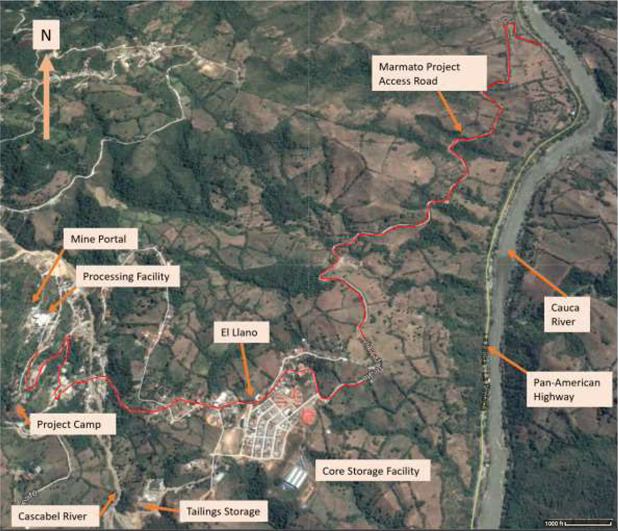
18.1.1. Tailings management facilities overview
The Upper Mine tailings are stored in a series of historical, current, and planned future facilities in the Cascabel basin. These facilities include the historical Cascabel 1; Cascabel 1 “dry stack” ;a Cascabel rear extension currently in operation utilizing a rotary disk vacuum filter system; Cascabel 2 “dry stack” located 170 m by road to the east of Cascabel 1 which is currently in construction, and the future planned Cascabel 3 which is located 1,600 m by road to the southwest of the Cascabel 2. A plan of the facilities is shown in Figure 18.2.
| Effective date: June 30, 2022 |
Page 170 of 236 |
| Aris Mining Corporation
|
Technical Report Marmato Gold Mine
|
Figure 18.2 Plan of Upper Mine tailings storage facilities
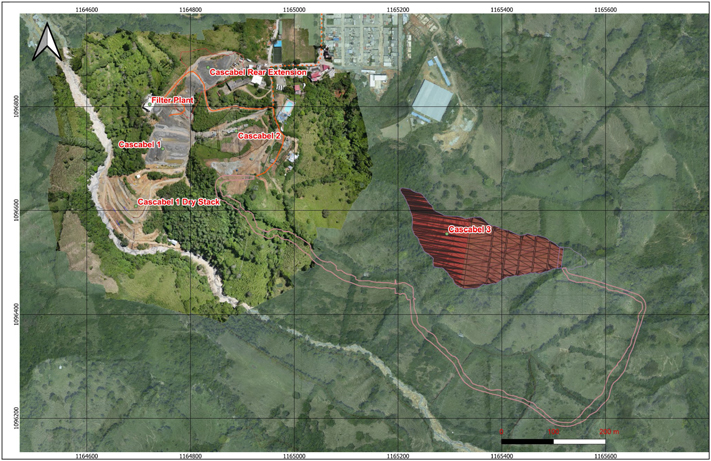
18.1.2. Cascabel 1 tailings facilities
Mineros Nacionales contracted GIGA Ltda (GIGA) of Colombia in 2004 to design the first tailings storage facility at Marmato. The Cascabel 1 tailings facility was designed as a partial upstream construction facility, starting at the 980 m elevation with an 90 m total height and a 230,000 tonne capacity. The growth upstream (upstream of the vertical drainage zone) consists of dikes built on the coarse fraction of the cycloned tailings. The planned design included internal vertical drainage/filter zones and some horizontal drainage. Planned, but not constructed, concurrent reclamation consisted of welded wire mesh Gabion cages filled with rock to cover the facility face. The design includes surface water management structures including diversion ditches. The Cascabel 1 facility is located in a steep and closed V-shaped valley that provides some limited containment of the structure; however, the structure as is stands does not meet standard of practice minimum required factors of safety. Further, no detail was provided on site investigation and characterization work undertaken to develop the geotechnical parameters for stability and seepage assessments. The design was approved in 2005, construction began in 2006, and the facility was approved in 2006 by Resolution 062 of 2006. GIGA supported construction from 2006 to 2010 with the embankment constructed to an elevation of 940 m. No plans of the final constructed facility were made and no as-built or construction quality assurance report was made on the construction process.
The tailings management process for the Cascabel “dry stacks” originally began with tailings from the Upper Mine being treated in a hydrogen peroxide and copper sulfate destruction unit to reduce cyanide concentrations before the tails were hydraulically transferred to a series of unlined settling ponds with internal meanders that generated a “beach” of solid material and allowed a large amount of water to be decanted from the tailings via a vertical drain filter, in situ at settling ponds upstream of the facility footprint. The underdrain water from these ponds was
| Effective date: June 30, 2022 |
Page 171 of 236 |
| Aris Mining Corporation
|
Technical Report Marmato Gold Mine
|
directed downgradient to small collection basins and flocculant was added to the water as required to remove any residual suspended solids, which were then directed back to the tailings settling pond. The clarified overflow water was pumped back to the processing plant for re-use, and any excess water not required at the process plant was discharged under permit to the Quebrada Cascabel stream.
In 2010 modifications at the 940 m to 950 m elevation designed by Fabio Villegas of Colombia were made to Cascabel 1 to improve the internal filtration and drainage of tailings after the main filter clogged, and a horizontal drain was installed at the face of the facility to aid dewatering.
“Dry stacking” of dewatered tailings commenced in 2010 and proceeded as follows: when the tailings in the settling ponds were sufficiently dewatered via evaporation to allow mechanical handling, a process taking approximately four days, the tailings were excavated from the ponds and trucked down gradient of the settling ponds to the Cascabel 1 tailings storage facility. Mine waste trucked from underground to the tailings storage facility was mixed and encapsulated with the dried tailings. The tailings were spread and compacted in nominal earthwork lifts and a one metre thick rockfill layer was constructed every three metres in elevation. The mixed dried tailings and mine waste were then reportedly mechanically compacted for final storage. On the outside of the dry stack, a soil cover was placed in horizontal lifts as part of progressive reclamation and closure.
In 2012, “dry stack” Cascabel 1, located immediately southwest of Cascabel 1, received the approval of the Charco Hondo Creek occupation by Resolution 003 of 2012. The facility has a design height of 80 m and a capacity of 164,000 tonnes. The toe is founded on the Cascabel 1 tailings, with a height extending to the 990 m elevation. While the facility was referred to as a “dry stack facility”, the tailings were not dried and compacted to industry standards, nor are any records of such available.
In 2018, Pi Epsilon of Colombia were hired for design studies to increase the design capacity of Cascabel 1 from elevation 950 m to 978 m. A field assessment was completed to define the geological, geotechnical, and hydrogeological conditions, and a stability analysis was undertaken.
In 2019, Geogral of Colombia were engaged to complete additional design studies for the Cascabel 1 dry stack facility.
In early 2020, Aris Mining engaged Ausenco to conduct a seismic hazard assessment at the Cascabel 1 tailings storage facility and process plant areas to determine appropriate seismic design parameters for facility stability (Ausenco, 2020). According to Colombia’s 2010 Earthquake Resistance Standard NSR-10, the site is located in a high seismic hazard zone. On the basis of this Ausenco report, and subsequent evaluations by SRK, the Cascabel facilities were found to be not compliant with applicable regulations or international standards of good practice for static or seismic stability.
In mid 2020, Aris Mining engaged Dynami Geo Consulting S.A.S. (Dynami) to undertake a stability analysis of Cascabel 1 and the future site of Cascabel 2 and Cascabel 3, and to make recommendations for further work (Dynami, 2020). In the second half of 2020, Aris Mining conducted a series of geotechnical investigations recommended by Dynami to characterize the materials in the Cascabel tailings area, including conventional sludge tailings, compacted tailings, infill materials, soils, and foundation rock and to provide data for stability analysis of Cascabel 1. The work included 11 drillholes with sampling and standard penetration tests, 64 m of cone penetration tests with pore pressure measurements, 33 m of Marchetti seismic dilatometer tests, 10 lines of geophysical testwork, topographic surveys, and field observations. Inclinometers and piezometers were also installed to allow for facility monitoring. The drillhole tailings samples were assessed in the laboratory for moisture content, sieving granulometry testing, Atterberg limits, unit weight determinations, direct shear tests, non-drained consolidated triaxial compressions, and compaction tests. The purpose of the work was to provide data for updated stability analysis of Cascabel 1, to determine the stratigraphic profiles and characteristics of the dam, tailings, and foundation, and to provide a set of recommendations for improvement and management of Cascabel 1 following
| Effective date: June 30, 2022 |
Page 172 of 236 |
| Aris Mining Corporation
|
Technical Report Marmato Gold Mine
|
the 2010 Colombian Earthquake Resistance Standard NSR-10, Canadian Dam Association guidelines, and the United States Army Corp of Engineers Engineering Manual EM-110-2-2300.
Following the receipt of the testwork results, Dynami updated the stability analysis of Cascabel 1 in January 2021 (Dynami, 2021a) and again in March of 2021 (Dynami, 2021b).
During these investigations it was found that not all of the original planned design features made in 2004 were incorporated in the construction of the existing facility, including:
| • |
no gabions present on the face of the dam, |
| • |
steeper than planned slope angles, |
| • |
inadequate compaction and drainage within the stacks, |
| • |
irregular thicknesses of mine waste material acting as filters or drainage zones, |
| • |
a lack of geotextiles filters planned, |
| • |
an absence of drainage systems such as ditches and effective horizontal filters, as well as evidence of water impoundment and tailings erosion. |
| • |
A vertical drain filter (combined of gabions with layers of gravel on both sides) which presents an increased dam safety risk by the storage of saturated tailings against the containment “structural” embankment zone as well as results in an elevated, high water table within the stack. |
| • |
Portions of the saturated tailings, within the stacks, are subject to static and/or seismic liquefaction. |
Subsequent to Dynami’s 2021 studies, recommendations were made by Dynami to: i) not build an upstream rise; ii) to reduce the water table within the facility by halting deposition of slurry tailings on the area; iii) to install horizontal drains and wick drains to reduce the water table within the body of the containment structure; and iv) to densify the impounded tailings.
If these recommended measures are not implemented, and monitoring and performance continue to indicate non-compliance with standards of practice, it will be necessary to remove the Cascabel 1 tailings, in their entirety, and incorporate the tailings into a properly designed and constructed facility, as previously recommended by Dynami.
In 2020, Knight Piésold Consulting (Knight Piésold, 2020) conducted a desktop assessment of the history and condition of the Cascabel tailings storage facility and made recommendations for improvements utilizing engineering best practices. Knight Piésold noted that several studies by Aris Mining were underway in early 2020 based on the recommendations made by Dynami and Knight Piésold to align with international standards, including the Canadian Dam Association’s Dam Safety Guidelines. This included recommendations for further work to include: slope stability analyses of the Cascabel 1 and Cascabel 1 dry stack facilities, design of hydraulic structures for surface water management at the Cascabel 1 dry stack facility, the design of geotechnical instrumentation and a monitoring plan for the Cascabel 1 tailings facility, a terrain hazard assessment for part of the mining concession, design of a waste water treatment plant for removal of heavy metals and sulfates from the Cascabel tailings storage facility outlet pipe flows, a dam breach study for Cascabel 1 and Cascabel 1 dry stack facility as well as for the future Cascabel 2 dry stack facility, and an updated seismic hazard assessment.
Cascabel 1 was filled to capacity in 2020 and in 2021 an extension initially designed by GeoGral of Colombia in 2019 was made to the rear of the facility, with a capacity of 153,600 tonnes of tailings and 10,468 tonnes of waste. This extension is currently in operation. In late 2021 a rotary vacuum disc filter filtration system to dry the tailings to a moisture content of between 15% and 18% with a capacity of 20 to 50 tonnes per hour was commissioned in the Cascabel area to modernize and bypass the settling pond drying process and to better reduce the tailing’s moisture content for ongoing placement in the extension area.
In 2022, rehabilitation and final closure of Cascabel 1 was under way, however as noted above, the Cascabel 1 TSF is not compliant with applicable regulations or international standards of good practice for static or seismic stability.
| Effective date: June 30, 2022 |
Page 173 of 236 |
| Aris Mining Corporation
|
Technical Report Marmato Gold Mine
|
18.1.3. Cascabel 2 tailings facilities
The design for the Cascabel 2 dry stack tailings storage facility, located 170 m by road to the east of Cascabel 1, was submitted to Corpocaldas in 2017, and approved by Resolution 1004 of 2021 in July 2021. The initial geotechnical analysis and facility design was completed by IRYS Ingeniería de Rocas y Suelos S.A.S. (IRYS) of Colombia in 2018 and updated to a conceptual level by Dynami. The design considers the expected acid generation potential of the tailings impounded in the facility, and therefore includes a liner. The conceptual designs are currently being updated by IRYS. The facility has a capacity of 175,000 tonnes of dry filtered tailings dewatered to 15% moisture and 15,000 tonnes of waste.
The main components of the facility include an HDPE geomembrane lined basin, a starter embankment following the valley floor to close the bottom of the facility and to provide an initial buttress to compact the tailings at the start of operations, an internal filter system with a layer of geotextile, the mechanically compacted tailings, contact and non-contact surface water management structures to minimize the amount of water infiltrated into the environment, a recommendation for a wastewater treatment plant, slope protection, and progressive closure, and instrumentation monitoring including piezometers, inclinometers, topographic surveys, and drone photogrammetry as well as regular visual inspections. The starter dam has a capacity of 1,500 m3 and will be constructed of compacted local non-acid generating saprolite and rock. Cascabel 2 is currently in early works construction. Aris Mining has not yet engaged with an engineering firm to provide engineer of record and QAQC services, however, there are plans to do so. For this reason, as well as siting and capacity concerns previously expressed, SRK has similar concerns with respect to the construction and operation of the facility in accordance with the design intent, in order to ensure that the facility (as constructed) will meet the requisite standard of practice requirements for a safe and stable landform. The facility has a relatively small capacity and is expected to reach full capacity and ready for rehabilitation and final closure by May 2023.
18.1.4. Cascabel 3 tailings facilities
In November 2021, a modification of the PMA was submitted to include the Cascabel 3 dry stack tailings storage facility, designed to a conceptual level by SRK. The design includes a HDPE geomembrane lined starter facility to provide a base for initial dry filtered tailings placement, an internal sub-tailings drainage system, mechanically compacted tailings, contact and non-contact water management structures, a wastewater treatment plant, slope protection and progressive reclamation and closure, and instrumentation and monitoring. The facility has a capacity of 1.1 Mt of tailings and 28,800 tonnes of rockfill required for the starter embankment, and is located 500 m to the southeast of Cascabel 1. The conceptual design has a capacity of 1.1 Mt of dry stack tailings with rehabilitation and closure scheduled for the end of 2027. The current concept is considering a contact water operations pond, similar to the approach planned for the Lower Mine tailings facility, to maximize the available area.
18.1.5. Summary of Upper Mine tailings management facilities
SRK understands that the continued operation of the existing Cascabel facility is a high risk for the Project, which is currently being addressed by Aris Mining. Although no communities or infrastructure are encountered downstream of the facility (Dynami, 2020), any flow of slurried tailings from the original Cascabel 1 facility will impact the downstream Cauca River if pushed by the Cascabel stream. As stated above, the Cascabel 1 facility does not meet standard of practice stability requirements. Given the siting and operational constraints of the Cascabel 2 and 3 facilities, these may also have similar issues going forward. It is SRK’s understanding that Aris Mining is currently considering and undergoing ongoing remediation and improvement measures to bring these facilities (existing and planned) into compliance with international standards of good practice. SRK recommends an independent review to provide technical reviews of the detailed or construction designs currently being prepared by IRYS for Cascabel 2 and 3, and review of the planned remedial measures by Aris Mining for Cascabel 1 such that costs of bringing these facilities into compliance can be appropriately assessed.
| Effective date: June 30, 2022 |
Page 174 of 236 |
| Aris Mining Corporation
|
Technical Report Marmato Gold Mine
|
18.2. Lower Mine infrastructure
The major new Project facilities for the Lower Mine will include the mine portal, crusher, stockpiles, processing facility, dry stack tailings storage facility, mining services, accommodation, access roads, power and water management and distribution facilities, and office buildings, as shown in Figure 18.3. Some of these facilities will also be utilized by the Upper Mine, as indicated.
Figure 18.3 Plan of Marmato facilities and general site arrangement
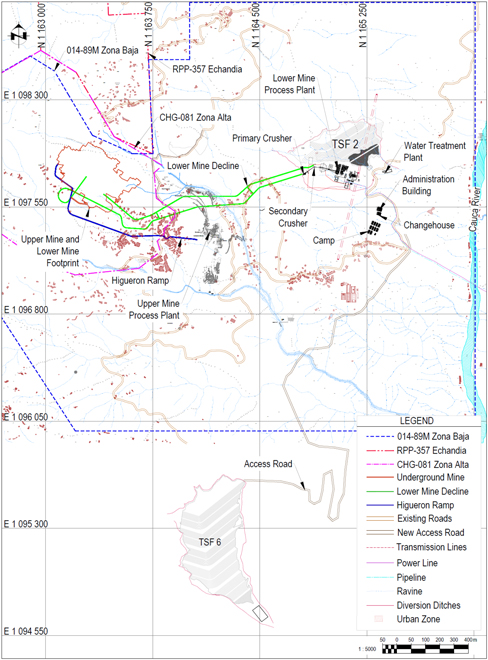
18.2.1. On site roads and river crossings
The access to the process plant site will be provided by three new access roads, including:
| Effective date: June 30, 2022 |
Page 175 of 236 |
| Aris Mining Corporation
|
Technical Report Marmato Gold Mine
|
| • |
A new 400 m long, 8 m wide, east-west gravel road connecting the lowest bench of the process plant to the Marmato public road will be built at the start of construction to access the site. |
| • |
A new 750 m long, 8 m wide, north-south gravel road connecting the lowest bench of the process plant to the camp and administration area located southwest of the process plant will be constructed, adjacent to the town of El Llano. |
| • |
A new 400 m long, 8 m wide, east-west gravel road connecting the Marmato public road to the new 750 m long camp access road. This road will be the main access to the site. |
Slope stabilization techniques and retaining walls will be put in place, for which engineering is underway.
The new site access roads cross seasonal streams and creeks at several locations. Corrugated steel or reinforced concrete culverts will be placed at water crossings. The culverts will be sized to accommodate the peak flow of water during a storm event.
18.2.2. Operations support facilities
18.2.2.1. Personnel camps
The camp will be located south of the process plant and north of the town of El Llano. The camp will comprise of a three story modular construction building which will house construction personnel during construction and then transition to housing plant operation personal after commissioning.
The camp is sized for a total of 466 personnel. There will be 58 personnel in single bedrooms, 18 in two bed rooms, and 390 in six bed rooms. The camp facility also includes a kitchen and recreation area.
18.2.2.2. Mine administration and dry building
The main mine administration building will be a two story modular construction building, 850 m² each floor, located at the camp and administration area. The building will house the mess hall as well as cubicles and shared and private offices for mine administrative personnel.
The mine dry building will be a single story modular construction building with a 550 m² footprint, located at the camp and administration area. The building will be used primarily by the local workforce employed as miners and plant operators. The workforce will arrive to the facility at the beginning of each shift and bussed from the dry facility to the process plant and mine portal. This is intended to limit vehicle traffic within the process facility.
18.2.2.3. General maintenance building
The general maintenance building is a 20 m wide, 50 m long, and 12 m high pre-engineered metal building with a 20 tonne capacity overhead crane. All the process plant and mine equipment repair and maintenance will be performed in the facility.
18.2.2.4. Truck wash facility
The underground mining trucks will be washed on a designated truck wash pad area adjacent to the general maintenance building. The pad consists of concrete slab-on-grade with a water collection sump.
18.2.2.5. Truck fuel facility and equipment ready line
The area in front of the general maintenance shop will be the designated ready line parking for mobile equipment.
18.2.2.6. Fuel and explosives storage facilities
Fuels will be stored on the surface, while explosives will be stored in a magazine area below ground under the Upper Mine portal.
| Effective date: June 30, 2022 |
Page 176 of 236 |
| Aris Mining Corporation
|
Technical Report Marmato Gold Mine
|
18.2.3. Process plant
18.2.3.1. Site location
The process plant site is located about 3 km west by road of the Lower Mine, on a naturally occurring plateau with a 30% east-west and 15% north-south grade slope.
The location of the plant was selected based on the following factors:
| • |
Proximity to the Lower Mine, resulting in shortest length of the decline |
| • |
Utilizing a naturally occurring plateau that is relatively flat compared to the surrounding terrain |
| • |
Ground stability for process plant foundations and avoiding fluvial deposits |
| • |
Minimizing upstream watershed and land slide risk |
| • |
Land availability and land agreement |
18.2.3.2. Site geotechnical
IRYS conducted a geotechnical campaign in May 2021 to investigate sites for the proposed process plant and tailings facilities. The campaign included test pits, boreholes and geophysical lines.
The proposed process plant site is located on a relatively gentle slope, with soil depths up to 25 m. The soil is geotechnically stable with low to no risk of liquefaction, but with some areas which might show moderate swelling behaviour. Standard soil stabilisation techniques and the mass of the buildings overlaying the surface should be enough to mitigate these effects, but IRYS recommends re-evaluating the stabilisation techniques once the process plant buildings are in the detailed engineering phase. The soil analysis performed by IRYS does not consider dynamic loads created by comminution equipment or surcharges possible from the construction of other civil structures.
18.2.3.3. Site preparation earthworks and foundations
The process plant area will be graded to five cascading benches following the natural topography at each location, including:
| • |
Bench 1: Filtration plant |
| • |
Bench 2: Process plant |
| • |
Bench 3: Reclaim tunnel and future pebble crusher |
| • |
Bench 4: Secondary crusher |
| • |
Bench 5: Mine portal |
The pads will be mainly cut in west of each pad and filled in east of each pad. The transition between each pad will be constructed of 1V:1.5H sloped grade, soil nailed stabilized slopes and mechanically stabilized earth retaining wall as required, following the footprint for the process plant layout. The pads will be accessed via plant roads at the south edge of the process plant pads. The in-plant roads have a slope of 10% to 14% maximum.
The grading of the process plant benches is designed with all major foundations placed in cut, allowing the foundation to rest on undisturbed competent ground or bed rock. Only light foundations are placed on compacted fill.
All foundations are designed as shallow foundations. No deep foundation (piles) or rock are considered in the design. The suitability of shallow foundations will be confirmed based on the findings of the field geotechnical investigations.
18.2.4. Process plant support facilities
|
18.2.4.1. Administrative |
building and first aid facility |
The process plant administration office and first aid facility will be a single-story modular construction building, with a 250 m² footprint, located near the process plant.
| Effective date: June 30, 2022 |
Page 177 of 236 |
| Aris Mining Corporation
|
Technical Report Marmato Gold Mine
|
18.2.4.2. Laboratory
The laboratory will be constructed of prefabricated, single story, modular buildings on precast concrete blocks, with a 140 m² footprint. It will house the equipment for site assays.
18.2.4.3. Warehouse and storage yard
The warehouse building will be a 16 m wide, 28 m long, and 12 m high pre-engineered metal building with a 10 tonne capacity overhead crane. This building will be used for the storage of process reagents, consumables, and sensitive equipment that require indoor storage. The area south of the future pebble crusher structure is designated as an outdoor storage yard which will be used as a laydown area during construction.
18.2.4.4. Gatehouse
The security and gatehouse building will be a 6 m wide, 4 m long, and 3 m high prefabricated building located near the process plant at the main entry to the process area.
18.2.5. Support facilities
18.2.5.1. Communications
All programmable logic controllers (PLC) within the plant will be linked to a common ethernet communications network, where practical. The backbone of the communications network will be via fiber optic cabling, with spare cores provided for future use. Copper CAT 6 cabling will be used for the final connection to individual points.
The main hub for all PLC communication will be installed in the plant services switch room. Fiber optic breakout boxes, ethernet switches, media converters, and power supplies will be provided and installed wherever required.
All I/O signals for the PLCs will be via standard digital and analog modules. The PLC equipment installed within each area will function autonomously, such that a failure of the PLC in one plant area will not affect the other areas.
18.2.5.2. Waste water treatment
Two modular containerized sewage treatment plants will collect and treat the sanitary sewage for the Project. Studies to design an appropriate waste water treatment circuit are under way.
18.2.5.3. Solid waste management
Solid wastes will be separated at site by type and stored in a designated waste storage area for disposal in regulatory approved disposal sites. Underground waste rock will be utilized for construction of the dry stack tailings facilities. All other waste rock will be used for backfill in secondary stopes underground.
18.2.5.4. Cemented paste backfill plant
A cemented paste backfill plant will be located adjacent to the underground mine portal. The paste backfill will be made from a combination of tailings, water, and cement binder.
Thickened tailings from the process plant will be pumped to the paste plant where they will be filtered with vacuum disk filters to produce a filter cake. The filter cake will be weighed and transferred to the paste backfill continuous twin-haft mixer. The filter cake, water, and cement binder (either 4% for low strength or 7% for high strength paste) will be combined in the mixer and then a hydraulic piston pump will pump it underground through a pipeline down the decline to an underground booster pump station.
The plant will have a process water tank, a freshwater tank, and two cement storage silos that store approximately 24 hours of cement required for the operation. Cement will be delivered in 25 t bulk cement trucks that will be available seven days per week and 24 hours per day from a local supplier.
18.2.6. Tailings management facilities
18.2.6.1. Site selection
Initial potential site selection assessments and workshops with Aris Mining were held by SRK in 2020 and Wood in
| Effective date: June 30, 2022 |
Page 178 of 236 |
| Aris Mining Corporation
|
Technical Report Marmato Gold Mine
|
2022, which identified two potential sites, called Site 2 and Site 6. Site 2 is located next to the proposed Lower Mine process plant and Site 6 is located approximately 5 km away from the Lower Mine process plant. In order to manage the production and capital expenditure schedules, Aris Mining has elected to develop the smaller Site 2, followed by Site 6. The Site 2 facility has lower tailings transport costs and will require the successful negotiation, permit application approval, and the relocation of a high-voltage power line. Although further from the plant site, Site 6 has sufficient capacity for the expected life of mine production and does not require the relocation of power lines.
Other constraints are summarised below.
18.2.6.2. Site constraints
SRK has identified the following as potential constraints for the construction of tailings facilities on the Property, which will require confirmation during the Environmental Permit Application. These include:
| • |
Site 6: |
| ○ |
The current configuration of Site 6 considers a 20 m setback from the edge of the power lines. The facility was designed to accommodate the expected tailings production without moving the power lines, but some minor structures will inevitably be built below the right of way, such as diversion channels discharge. |
| ○ |
The facility was designed occupying the La Presidenta creek and is located on the boundary between the municipalities of Marmato and Supía. |
| • |
Site 2: |
| ○ |
A high voltage power line crosses the eastern area of the proposed facility, which must be moved for any significant capacity to be available in the area. |
| ○ |
Los Indios creek must be diverted and discharged downstream of the facility. This will require two new culverts crossing the municipal road to accommodate the larger design flows, and the corresponding permit to build the structure. |
| ○ |
The environmental team identified a “dry tropical forest” within Site 2´s footprint, which must be compensated as part of the environmental permit activities. |
18.2.6.3. Geotechnical investigations
IRYS (2021) performed twelve boreholes, 18 test pits and 13 geophysical lines in the process plant and Site 2 and Site 6 areas. Due to property limitations, the investigation on Site 6 was limited to a few geophysical lines. The results of these investigations were included in the pre-feasibility study level geotechnical designs of the tailings facilities.
The investigations were used to understand the thicknesses and basic properties of the main soil and bedrock types expected in the tailings storage facility areas. Further work will be required to:
| • |
Understand the stress history, residual strength and deformability of fine grained foundation soils. |
| • |
Study the strain-softening potential foundation soils, which was unknown when IRYS (2021) indicated that the liquefaction potential of foundation soils is negligible. |
| • |
Obtain detailed tailings characterization required for future design stages, including liquefaction potential, strain softening, undrained shear strength, and post-liquefaction strengths of filtered, compacted tailings. |
18.2.6.4. Stability analysis
In the absence of detailed tailings and foundation soils testing and characterization, the geotechnical stability sensitivity analyses utilized in the conceptual design phase were based on site specific data and reasonably achievable strength and benchmarked tailings material properties based on SRK´s experience with recent dry stack projects in similar geological and climatic environments.
Stability sensitivity analysis also considered the potential for post-liquefaction or strain softened strengths on a portion of saturated tailings near the base of the planned facilities, and buttressing as well as slope inclination and overall facility heights were adjusted accordingly in the conceptual design. On the basis of the conceptual design and analyses undertaken to date, Site 6 offers a viable tailings management alternative for which a facility that
| Effective date: June 30, 2022 |
Page 179 of 236 |
| Aris Mining Corporation
|
Technical Report Marmato Gold Mine
|
meets standard of practice requirements for static and seismic stability as well as closure and post-closure requirements can be met.
18.2.6.5. Risk assessment
The following concepts are relevant with respect to risk evaluation for the Site 2 and 6 conceptual designs:
| • |
Several probable failure modes have the potential to result in excessive deformation and/or a flow liquefaction failure. These are related to both static and seismic loading that could lead to strain-softening or liquefaction of the tailings or foundation soils. |
| • |
The current conceptual designs for Site 6 have a higher potential to address/mitigate these potential risks due to constraints on capacity and topography at Site 2. Additional work will be necessary to better understand and design ways to further reduce the risk. |
| • |
The specific risks at Site 2 include: |
| ○ |
Sizing and location of surface water diversions required to handle significant upstream watersheds |
| ○ |
Siting constraints (size and toe areas within the existing creek) that may lead to excessive rates of rise and limited capacity (that also represents a risk of requiring steeper slopes than required for adequate safety) |
| ○ |
The proximity of the facility to the process plant and municipal road |
| • |
General considerations include: |
| ○ |
Overtopping of the facility under large storms: the channels were designed to route the probable maximum precipitation event downstream of the facility, but landslides, blocks, or debris dragged into the channels during a storm event could reduce their hydraulic capacity and cause spilling, which could flow into the facility. Under these assumptions, satisfactory stability conditions and deformations were estimated. If the deposited tailings are properly filtered, transported, conditioned, placed, compacted, and protected from infiltration the proposed filtered stacks can be expected to be designed to achieve required performance goals, to meet international standards of good practice |
| ○ |
Liquefaction of tailings: saturated, loose tailings have the potential to strain-soften and/our liquefy especially under both static and dynamic loading. Typically, if high moisture contents and poor compaction result from daily operations, a tailings contractive behaviour can be expected, which can lead to liquefaction and loss of strength under various loading conditions. Detailed laboratory testing will be required to assess the achievable levels of compaction from the Marmato tailings and to understand residual and fully-remolded strength values to be considered against postulated static and dynamic loading conditions for future design stages. |
| ○ |
Further, the provision of adequate internal drainage within the stack design will also mitigate the potential for excess pore pressures and static or seismic liquefaction. Off specification tailings: wet of optimum tailings resulting from conditions such as inefficient filtration processes due to malfunctioning or poor adjustment of the filters, or due to operations during a wet season, will likely not reach the desired compaction level and will result in low strength, contractive tailings. Lime or cement addition will be required to improve the workability of off-spec the tailings, particularly for the constrained (resulting in relatively high rate of rise requirements and smaller operating deck areas for moisture conditioning) at Site 2. |
| ○ |
Lime or cement amendment will be required to achieve the proposed 3:1 (H:V) outslopes for the proposed Site 2. Site 2 may further require internal reinforcement (biaxial geogrid, or other) to achieve desired stability given the site constraints. Alternatively, at TSF-6, site and TSF geometry may be considered to further flatten the outslopes (to 4:1, H:V) as the design progresses. |
Specific risks based on GISTM assessment criteria are shown in Table 18.1.
Table 18.1 Lower Mine risk identification for tailings storage facility sites 2 and 6
| Criteria |
Site 2 |
Site 6 | ||
|
Loss of life |
A failure of the facility on Site 2 could impact workers on the process plant and |
No roads or private property are found downstream of the facility. Only temporary crews could be impacted during a failure of the facility. |
| Effective date: June 30, 2022 |
Page 180 of 236 |
| Aris Mining Corporation
|
Technical Report Marmato Gold Mine
|
|
Criteria |
Site 2 |
Site 6 | ||
| pedestrians/vehicles on the road between Marmato and the main highway |
||||
|
Environmental |
A failure could impact the water diversion structures required for Los Indios creek, which could in turn be blocked and spill over, washing tailings to the creek and eventually the Cauca River. |
The water diversion structures required for La Presidenta creek could be blocked and the creek´s flow could spill over, washing tailings to the creek body. | ||
|
Cultural |
None identified |
None identified | ||
|
Infrastructure |
A failure on the south slope could impact the process plant, halting the Project for an unknown period of time. A larger failure on the east slope could block the road between Marmato and the main national road. |
The majority of impacts would likely be limited to Project owned land. Some adjacent private land could be impacted. | ||
18.2.6.6. Design criteria and operational philosophy
The pre-feasibility study level designs for the tailings storage facilities on Site 6 and Site 2 are based on a processing rate of approximately 4,000 tpd for 17.5 years. Of the tailings produced, approximately half will be used as underground paste backfill processed through a cement mixing plant. The remaining tailings will be dewatered and trucked to the tailings facility area. The tailings will be mixed with lime or cement and placed and compacted in controlled lifts to a specified minimum compacted density. The required volume for tailings is estimated at 7.6 Mm3, assuming a dry density of 1.8 t/m3.
The main design features of the tailings facilities and design criteria are summarized in Table 18.1, Table 18.2, and Table 18.3.
Table 18.2 Lower Mine tailings storage facility physical stability criteria
| Seismicity |
Year return period |
Peak ground acceleration (g ) |
Source | |||
| 100 |
0.15 |
Ausenco, 2020 | ||||
| 475 |
0.28 |
Ausenco, 2020 | ||||
| 1,000 |
0.38 |
Ausenco ,2020 | ||||
| 2,475 |
0.53 |
Ausenco, 2020 | ||||
| 5,000 |
0.66 |
Ausenco, 2020 | ||||
| 10,000 |
0.81 |
Ausenco, 2020 | ||||
| Maximum Credible Earthquake |
0.50 |
Ausenco, 2020 | ||||
|
Stability |
Conditions |
Minimum factor of safety |
Source | |||
| Static |
1.5 to 1.9 |
ANLA, 2016 ICMM, 2020 | ||||
| Pseudo-static |
1.0 |
ANLA, 2016 | ||||
| Static, post-liquefied or softened strength |
1.2 |
ANCOLD, 2019, Adopted, SRK |
Table 18.3 Lower Mine tailings chemical stability criteria
|
Criteria |
Description |
Value |
Source | |||
|
Acid |
Potentially acid generating tailings/waste rock NPR |
< 3 |
SRK, 2020a | |||
| Potentially non-acid generating tailings/waste rock NPR |
> 1 |
SRK, 2020a | ||||
| Uncertain range |
1 < NPR < 3 |
SRK, 2020a |
Table 18.4 Lower Mine hydraulic stability criteria
|
Criteria |
Description |
Value (mm) |
Source | |||
|
Design storm |
100 year storm |
172 |
Calculated, SRK, 2022 |
| Effective date: June 30, 2022 |
Page 181 of 236 |
| Aris Mining Corporation
|
Technical Report Marmato Gold Mine
|
|
Criteria |
Description |
Value (mm) |
Source | |||
| 1,000 year storm |
245 |
Calculated, | ||||
| Probable maximum precipitation storm |
485 |
Calculated, |
Water from the tailings will be extracted via thickening and filtration to a percentage of moisture near the optimum content for handling and compaction. Once the tailings have been deposited on the working deck, equipment will be used to spread and compact the tailings to near the maximum achievable density, forming a rising stack of stable, compacted materials. Off-specification tailings and storm season deposition management plans are required for the facilities.
Non-contact runoff water from the surrounding basin will be captured and diverted using open channels and/or pipes to a downstream discharge point. Contact flows from direct precipitation on the stack will be directed to the back of the working deck to a temporary sump which will send the collected runoff back to the process plant. Seepage flows will report to a downstream collection pond which will also report back to the process plant.
The use of compacted, filtered tailings at the Property is based on the need for a stable landform on the steep hills around the Project area, and occupying the least amount of land while recovering water to be reused in the process plant. The required capacity according to the mine plan is 7.6 Mm3 or 13.73 Mt. For the purposes of the pre-feasibility study level designs, outer inter-bench slopes were set at 4H to 1V for Site 6, while the outer slope of Site 2 was set at 3:H to 1V. Cement addition is assumed to be required to achieve global stability of the tailings mass at both sites, particularly the steeper, Site 2. Further laboratory work will be required to better understand the static and dynamic behaviour of the expected tailings. The actual required amount of cement or lime addition will be determined through later detailed laboratory testing programs.
The operation will require temporary tailings overflow storage to accommodate several days of production during large storm events and a framework to deal with off-specification tailings.
Compaction activities will be continuously performed during mine operations until the designed shape is achieved. For operating cost estimates, a single daily 12 hour shift of operation was assumed.
In addition to the stack of filtered, compacted tailings, the tailings facilities will include:
| • |
Starter dam embankment and foundation |
| • |
Subdrainage systems |
| • |
Basin lining requirements |
| • |
Construction of the stack |
| • |
Contact and non-contact water management |
| • |
Operations pond |
| • |
Cover and closure |
| • |
Monitoring and instrumentation |
| • |
Access roads |
| • |
Off-specification tailings management |
| • |
Material borrow areas |
18.2.6.7. Construction plan
Tailings will be deposited by building successive layers founded atop previously compacted layers. Tailings transport will be done using end-dump trucks from the filtration plant located in the process plant for Site 2, and near the top of a ridge to the north of the facility for Site 6.
Once dumped by the trucks, bulldozers and graders will spread from the outer face of the stack towards the inside of the facility, in layers not exceeding 30 cm in thickness. A roller compactor will then make the necessary passes
| Effective date: June 30, 2022 |
Page 182 of 236 |
| Aris Mining Corporation
|
Technical Report Marmato Gold Mine
|
to achieve the minimum density as required by the technical specifications. The equipment size, roller weight, number of passes, and other details will be defined in future design stages and in test pads once tailings are produced. Layers will be compacted with a smooth roller by the end of each shift to prevent infiltration and sloped towards the operations pond(s) to promote runoff. QAQC will be required to document construction progress and comply with applicable tailings management standards.
18.2.6.8. Starter dam embankment and foundation
A starter embankment to provide a stable, competent wedge for geotechnical stability will be required prior to tailings placement. This embankment will be comprised of non-acid generating, competent mechanically compacted rockfill.
Excavation for the starter embankment will require removing loose, saturated soils, organic material, and liquefiable layers. A large shear key for geotechnical stability will be provided along the centreline of the embankment, reaching the bedrock underlying the surface soils. For Site 2, this key will require an excavation of approximately 15 m in depth, whereas Site 6 will require approximately 10 m of excavation. The starter embankments will have 2.5H:1V slopes and a 10 m wide crest.
The starter embankments must be constructed using frictional, competent, non-acid generating materials. For Site 6, Wood (2022) identified a source of andesite west of the proposed facility. Further studies are required to assess its adequacy for starter embankments and filter materials. For Site 2, waste rock from underground developments could be used if the rock is non-acid generating. Otherwise, the borrow area identified for Site 6 could be used for this embankment. External commercial quarries located along the Cauca River approximately 20 km away from Marmato will be used to source clean gravels for filters and drains.
The starter embankments will require 200,000 m3 of compacted imported material for Site 2 and 150,000 m3 for Site 6. Given the acid generation potential of the development waste rock, this material may need to be sourced from a quarry within Site 6´s footprint or nearby commercial quarries.
The main features of the rock starter embankments are as follows:
| • |
Site: |
| ○ |
Crest elevation: 940 m |
| ○ |
Crest width: 10 m |
| ○ |
Upstream slope: 2:1 |
| ○ |
Downstream slope: 2:1 |
| ○ |
Maximum embankment height at centerline: 15 m |
| ○ |
Maximum starter embankment height from toe: 40 m |
| • |
Site 6: |
| ○ |
Crest elevation: 955 m |
| ○ |
Crest width: 10 m |
| ○ |
Upstream slope: 2:1 |
| ○ |
Downstream slope: 2:1 |
| ○ |
Maximum embankment height at centerline: 28 m |
| ○ |
Maximum starter embankment height from toe: 40.5 m |
The material to be excavated from the foundation areas on Site 2 and Site 6 is a predominantly fine grained residual soil which is not adequate for the starter embankment construction. This excavated material must be transported to the approved waste material deposits.
Foundation preparation for the filtered tailings will require removal of topsoil which has been observed to be between 0.5 and 1.0 m thick in the available test pits. Excavated and unsuitable soils must be transported to a soil stockpile.
| Effective date: June 30, 2022 |
Page 183 of 236 |
| Aris Mining Corporation
|
Technical Report Marmato Gold Mine
|
18.2.6.9. Subdrainage systems
A filter system will be provided to allow drainage of the moisture released by the compacted tailings and other infiltration flows, consisting of a clean gravel filter with perforated HDPE pipes wrapped in non-woven geotextile. The pipes will cross the starter embankment fill and report to a downstream seepage collection pond.
Beneath the filter, a system of membranes and pipes will be installed to line the area to be occupied by tailings. An additional basal drain will be constructed on natural ground along the main drainage, to capture and convey any elevated phreatic surfaces or water springs out of the facility´s footprint.
Materials for filters and drains will be imported from nearby quarries along the Cauca River. Two companies located approximately 10 km from site were contacted for quotation of filter materials.
18.2.6.10. Basin lining requirements
The basin will require the installation of an impervious layer to minimize the amount of seepage infiltrating to the deeper soil and rock layers. This will be provided by means of an HDPE double liner system, comprised of a main, upper 80 mm thick spiked membrane and a lower 60 mm textured membrane. The upper layer will serve as the main liner and will be installed beneath the gravel filter. Underneath the main liner, the secondary liner and a series of HDPE pipes will serve as a secondary containment and leak detection system. The pipes will be installed between the two liners along gravel filled channels and also report to the seepage collection pond.
18.2.6.11. Stack construction
The final geometry of the tailings facility on Site 6 considers 4:1 slopes with 10 m wide benches every 15 m vertical. Site 2 will require 3:1 slopes with 10 m wide benches every 15 m vertical to accommodate any significant volumetric capacity. This implies the geotechnical properties of the tailings potentially stored within Site 2 must be improved by means of lime and/or cement addition.
Tailings will be compacted in 30 cm thick lifts, achieving via mechanical compaction a density no lower than 95% of the maximum dry density from compaction tests. The filtration plant must be tuned so the resulting tailings cake is at a moisture within ±3% of the optimum water content. Density tests and topography surveys are required as part of the quality control plan.
The working deck will be sloped between 3 and 5% towards the upstream natural terrain, so that direct runoff from precipitation flows to temporary ponds rather than the tailings slopes. The main properties of each facility option are shown in Table 18.5.
Table 18.5 Lower Mine design properties of tailings storage facilities sites 2 and 6
|
Feature |
Units |
Site 2 |
Site 6 | |||
| Maximum thickness |
m |
25 |
45 | |||
| Total height – toe to crest |
m |
60 |
145 | |||
| Starter embankment volume |
m3 |
200,000 |
150,000 | |||
| Total tailings capacity |
m3 |
1,300,000 |
7,600,000 | |||
|
Slopes |
3:1 |
4:1 on Stage 1 and 2,3:1 on remaining stages | ||||
| Facility area |
m2 |
98,000 |
324,000 |
18.2.6.12. Water management
Minimizing contact flows is key for the performance of the tailings facility. Non-contact flows include runoff from the upper reaches of the basin and potential water springs or high phreatic surfaces. Contact flows include the moisture slowly released by the compacted tailings and runoff and infiltration from direct precipitation on the stack. The former will be diverted upstream of the facility using open reinforced concrete channels and the latter will be conveyed to the process plant for future reuse in the process plant.
| Effective date: June 30, 2022 |
Page 184 of 236 |
| Aris Mining Corporation
|
Technical Report Marmato Gold Mine
|
The open channels were designed for the probable maximum precipitation storm event. These include the main channel, energy dissipators, and a discharge structure downstream of the facility. Site 2 will require 2,180 m of non-contact water channels to divert the basin to both sides of the facility and discharge above the existing Los Indios creek culvert beneath the municipal road to Marmato. The south reach of the diversion channel will flow above the process plant and the cut for the Lower Mine portal, before discharging downstream of the facility. An additional capacity contingency for this channel was considered to accommodate debris and sediment loads which could increase the water height along the channel. An allowance for slope reinforcing along the reach above the process plant was included in the designs.
Site 6 will require 3,100 m of non-contact water channels, situated to divert the La Presidenta creek occupied by the TSF around the facility and discharge in the original drainage below the TSF. Contact water will be managed via the filtration and membrane system described previously. Pipes will report to a lined downstream pond equipped with pumps to send the collected seepage back to the process plant. The main features of the water management systems are given in Table 18.6.
Table 18.6 Lower Mine water management systems for tailings storage facility sites 2 and 6
|
Feature |
Units |
Site 2 |
Site 6 | |||
| Channel length |
m |
2,180 |
3,100 | |||
| Channel minimum slope |
% |
2 |
2 | |||
| Seepage collection pond volume |
m3 |
1,200 |
2,000 | |||
| Operations pond volume |
m3 |
5,000 |
3,500 | |||
| Basal drain 10” pipe length |
m |
900 |
1,530 | |||
| Internal drainage pipe length, 6”/ 8” |
m |
1,400 |
3,452 |
18.2.6.13. Operations ponds
A stormwater management pond will be required on the working deck to provide temporary collection of contact water runoff from large precipitation events on the tailings storage facility. This volume will be provided away from the outer face of the facility by excavating and lining a temporary pond and providing a set of trash pumps with sufficient capacity to send the collected water back to the process plant. The size of the pond can vary over time and operations will be required to build new ponds as the deck elevation rises. Once the facility has reached its final height and all surfaces have been closed, contact water produced from runoff from the facility will be effectively eliminated.
Operations ponds were designed to store the 1 in 50 year event without impacting operations, with additional capacity to store the probable maximum precipitation event.
An additional pond is required at the toe of the facility to collect contact water seepage produced by the tailings. This is expected to include both the water produced by consolidation of the tailings as well as pass through of meteoric water infiltrating into the working deck of the facility or through the reclamation cover. Due to the robust non-contact diversion channels and progressive closure described below, minimal contributions from runoff are anticipated to enter this pond.
18.2.6.14. Cover and closure
The tailings facilities have been designed as compacted dry stack structures. One of the benefits of using this type of facility is the capability of progressive closure as the facility grows, limiting the amount of contact water runoff produced by the face of the facility. Slopes and berms will be covered using a layer of non-acid generating material that can be in turn covered with organic material to promote vegetation growth. This cover consists of compacted prisms of competent material formed “ahead” of the rising facility, so there is always one dyke higher than the current working deck. This allows emergency water storage for the probable maximum precipitation event. Channels on the inside edge of the berms will be constructed to convey runoff to an approved discharge point.
| Effective date: June 30, 2022 |
Page 185 of 236 |
| Aris Mining Corporation
|
Technical Report Marmato Gold Mine
|
18.2.6.15. Monitoring and instrumentation
Phreatic surface development and pore pressures, settlements, and lateral movements are the key variables to be monitored in a tailings facility. These will be measured with piezometers, topographical benchmarks, and vertical inclinometers on different locations of the facility.
For Site 2, twenty topographical benchmarks are recommended, installed on benches and key locations of the facility. Five vibrating wire piezometers and three inclinometers are also recommended.
For Site 6, thirty topographical benchmarks, ten vibrating wire piezometers, and three inclinometers are recommended. Conventional monitoring can also be coupled with drone, LiDAR or satellite data capture and processing to monitor the changes of the entire facility surface.
Periodic cone penetration testing is recommended twice a year to confirm the as-compacted tailings strengths and liquefaction potential.
Other environmental monitoring such as underground water quality and sediment load on surface water is not included in this plan.
18.2.6.16. Access roads
Site 2 will share its access road with the process plant. This is a 250 m long, 15 m wide stretch of road departing from the existing road to Marmato. Site 6 will require a 2,000 m long, 15 m wide segment from the Marmato - Rio Sucio road to the filtration plant and the bottom of the valley. Both roads will have a maximum slope of 12%.
18.2.6.17.Off-specification tailings management
During production ramp up, commissioning, and maintenance periods, the filtration plant may not provide sufficient reduction of the moisture content to allow for proper compaction. In such cases, several techniques must be performed:
| • |
If weather permits, spreading and ripping and turning the tailings so that excess moisture evaporates |
| • |
Mixing with cement or lime to reduce moisture content. Typically, a 1 to 2% lime addition by weight can achieve a 3 to 5% moisture content decrease. This must be confirmed with early field test pads and laboratory testing during future stages of design |
| • |
The operation must have a stock of lime and cement available. As mentioned before, Site 2 will likely require cement amendment to improve the strength of the tailings body. |
18.2.6.18.Opportunities and future work
The analysis presented in this report were based on knowledge of the Project, conversations with Aris Mining, and SRK’s experience in similar projects; however, there are still unknowns that have the potential of driving the feasibility of the options studied. These include:
| • |
Geotechnical investigation has not been carried out for the design of the Site 6 dry stack tailings storage facility. The geology of the site and thickness of surface layers was idealized from limited geophysical data. |
| • |
No geotechnical laboratory testing on the Lower Mine tailings is available. Extensive testing is required for future design phases to confirm tailings geotechnical characteristics and cement addition requirements. The results of the testing should be used to evaluate the final configuration of each tailings facility in accordance with internationally accepted standards of practice. The results may indicate a different lime and cement addition requirement from that specified in this report. The following program is recommended: |
| ○ |
Compaction tests: modified and standard Proctor tests with different additions of lime and cement |
| ○ |
Index testing: grain size distribution, Atterberg limits, and specific gravity |
| ○ |
Shear strength: drained and undrained triaxial tests under varying degrees of compaction and saturation, cyclic triaxial tests, and direct simple shear tests |
| ○ |
Hydraulic conductivity of compacted tailings |
| Effective date: June 30, 2022 |
Page 186 of 236 |
| Aris Mining Corporation
|
Technical Report Marmato Gold Mine
|
| • |
The facilities will be lined with geomembrane, which will act as a low friction interface layer. A value of 14 degrees was used for the interface based on testing performed by SRK for another project in Colombia. SRK recommends performing strength testing on site specific foundation soils and Marmato tailings to better define this parameter and help in the selection of the membrane. |
| • |
Given the incomplete understanding of the geology and geotechnical setting of the sites, there is a degree of uncertainty, such as deeper soft soil profiles, unstable slopes, etc., that could impact the costs. |
| • |
Borrow sources for rockfill were identified outside the Property, as waste rock from the mine will not be available during the early stages of the tailings storage facility construction and the fact that this material has been identified as having acid generation potential. No other local sources of non-acid generating rock materials have been identified during site visits and interviews with Aris Mining personnel |
| • |
Site 2 has been designed under the assumption that the power lines crossing the area will be moved, as instructed by Aris Mining. SRK understands that this is feasible, pending the approval of a separate permit application and construction process, which could take at least two years to complete. Should the permit be denied or take longer than expected, SRK recommends abandoning future designs on this site and developing only Site 6. |
| • |
SRK (2020b) recommended kinetic testing on tailings and waste rock samples to confirm the results of acid base accounting tests available at the time. No kinetic tests have been performed to date and the decision to line the basins was made on the basis of previous acid base accounting results. SRK recommends reviewing the geochemistry data to confirm the need for membrane lining of the tailings storage facilities. |
18.2.7. Power supply
18.2.7.1. Electrical power source
Major electrical power will be required at the Lower Mine plant as all process facilities and major infrastructure buildings are situated there. Electrical power to the Lower Mine plant is planned to be supplied by CHEC from the Salamina 115 kV substation located 15 km away.
Site power will be obtained from a 115 kV HV line that will be provided by the local power authority up to the Lower Mine plant outdoor substation. A total average demand of 24.1 MW is required, of which approximately 9.4 MW are used by the existing Upper Mine operations and 14.7 MW will be used by the new Lower Mine operation and process plant.
18.2.7.2. Electrical distribution
The plant electrical system is based on a 4.16 kV, 60 Hz distribution. The 115 kV feed from the local power authority will be stepped down to a 4.16 kV x 2 10/13.3 MVA oil natural air natural/ oil natural air forced (ONAN/ONAF) cooled transformers at the plant main substation and will supply the plant main 4.16 kV switchgear housed in the switch room next to the plant main substation through a 4.16 kV cable bus.
For the mining load substation, the 115 kV feed from the local power authority will be stepped down to a 13.2 kV 25/33.25 MVA ONAN/ONAF transformer and will supply the mining substation through a 13.2 kV overhead line.
The following substations/electrical rooms will be provided in the following areas:
| • |
Plant main HV switchyard (outdoor substation) |
| • |
Process plant |
| • |
Grinding plant |
| • |
Primary crusher |
| • |
Secondary crusher |
| • |
Reagents and process plant |
| • |
Tailings and filtration |
Electrical rooms will house the 4.16 kV switchgear, MV VFDs, 440 V motor control centers (MCCs), LV VFDs, plant control system cabinets, lighting transformers, various distribution boards, and UPS power distribution.
| Effective date: June 30, 2022 |
Page 187 of 236 |
| Aris Mining Corporation
|
Technical Report Marmato Gold Mine
|
Overhead power lines of 4.16 kV will provide power to various remote facilities, ancillary buildings, and camp. Pole mounted and/or pad mounted transformers will step down the voltage at each location, and supply 440 V to the respective remote facilities, ancillary buildings, and camp.
18.2.7.3. Electrical rooms
Electrical buildings will be prefabricated panel buildings to minimize installation time on site. The buildings will be installed on a structural framework over 2 m above ground level to allow for bottom entry of cables into electrical switchboards, panels, MCCs, and cabinets. The electrical buildings will be installed with HVAC units and suitably sealed to prevent ingress of dust. They will be in the process plant area and as close as possible to the main load points to reduce cost. In order to reduce the size of the electrical rooms and avoid heat issues, the transformers for most electrical rooms will be ONAN type and installed just outside each electrical room.
18.2.7.4. Transformers
The main power transformers are 115 kV/13.2 kV and 115 kV/4.16 kV and will be ONAN, with provisions for future ONAF cooling configuration and will have either on-line tap changer or external voltage regulators. All plant 4.16 kV/440 V distribution transformers will be ONAN, with provisions for future ONAF cooling configuration and will have a de-energized tap changer.
18.2.7.5. Standby and emergency power supply
The site will be provided with a 1 MW standby diesel generator sized to supply critical process loads and life safety systems. The standby diesel generator will be located close to the process plant main substation.
18.2.7.6. SAG and ball mill drives
The SAG and ball mill motors will be equipped with liquid rheostat and use a slip energy recovery starting method to minimize voltage drop impact on the utility supply system during motor start up. A PWM based slip energy recovery system on the SAG mill motor will provide variable speed and energy recovery.
Two 1 MVAR harmonic filters and capacitor banks have been added on the 4.16 kV main busbars to achieve a 0.95 PF at the supply end, to minimize harmonic impact on the power distribution system.
18.2.7.7. Redundancy
Redundancy for the main site electrical power distribution system has been minimized to optimize capital costs. Warehouse spare transformers will be carried to minimize long shutdowns in the unlikely event of transformer failure, rather than installing standbys.
18.2.8. Water supply
18.2.8.1. Water requirements
Overflow from the tailings thickener in the process plant, site runoff pond decant water, underground mine dewatering, and returned water from the dry stack tailings facilities runoff and seepage will supply the main process water requirements. Underground dewatering from the Lower Mine is expected to steadily increase over the LOM to over 6,000 m3/day, well in excess of the 600 to 800 m3/day of makeup needed by the processing plant after inflow from the tailings thickener overflow and tailings filtrate is accounted for. As an additional back up fresh water can be sourced from the pumping station at the Cauca River during excessive drought periods or if dewatering flows are not available.
18.2.8.2. Runoff water collection and treatment system
Surfaces will be graded to naturally drain water to connection swells and ditches through the plant. The collected water from drainage ditches will be discharged to a lined storm water management pond located to the west of the processing plant. Water quality in the pond will be monitored and tested for compliance with local environmental discharge requirements. Studies are under way to design an appropriate water treatment plant, which will be placed adjacent to the pond to treat the water prior to discharge to environment.
| Effective date: June 30, 2022 |
Page 188 of 236 |
| Aris Mining Corporation
|
Technical Report Marmato Gold Mine
|
18.2.8.3. River water collection and treatment system for Upper Mine and Lower Mine
A new back up water collection and pumping facility designed by Aris Mining will be constructed to remove water under permits from the Cauca River from a basin that will feed the Lower Mine plant during excessive drought periods or if dewatering flows are not available.
18.2.9. Site water management
A site wide water balance was developed for the site using GoldSim simulation software. The model was developed to include the Upper Mine and Lower Mine schedules, underground mine dewatering flows, process plants, and tailings facilities through the life of mine from 2022 through 2042. The model was simulated on a daily basis using climate inputs developed from the nearby climate station at La Maria supplemented by the PERSIANN global gridded precipitation data set bias corrected to the La Maria data. The La Maria data set was previously evaluated and found to be representative of the site climate (Knight Piésold, 2022). This provided a 22 year daily record of precipitation representative of historical climate at the site. The model stochastically sampled precipitation in monthly increments from the record to simulate the system under both drought and wet conditions at the site, producing annual precipitation totals ranging from 800 to 3,500 mm per year. Evaporation data from previous studies (Knight Piésold, 2022) was used to simulate potential evaporation at the site.
The model assumes that makeup water at the Upper Mine and Lower Mine process plants will be preferentially supplied from the tailings thickener underflow and tailing filtrate sources. Secondary priority for makeup water was assumed to be supplied by water collected at the Lower Mine dry stack tailings facilities, both seepage water from the toe of the facilities and runoff collected primarily from the upper deck collection ponds, which are sized to contain the runoff from the probable maximum precipitation storm event. The model assumes that the face of the dry stack will be concurrently reclaimed during operations, limiting the amount of contact water runoff produced by the facility. Runoff from the remaining uncovered surface and seepage from the toe of the facility will be collected in permanent and temporary ponds associated with the tailings facilities and returned to the process plant for use as makeup water.
Currently no water is returned from the Upper Mine tailings facility as a result of higher rainfall associated with the La Niña weather pattern. This condition was conservatively assumed for the duration of the mine water supply simulation. The model indicated that makeup demands at the Lower Mine process plant are sufficient to consume the contact water produced at the dry stack tailings facilities over the life of the mine.
Dewatering flow from the underground mine will supply freshwater demands and remaining process makeup water to both the Upper Mine and Lower Mine process plants. The dewatering flows predicted during mining exceed the makeup demands at the process plants and are expected to supply both process plants with adequate water supply. However, as the dewatering flows steadily increase over the life of mine, adequate supply may not be available early in the mine life or during periods when the dewatering flows from the mine are not available or during periods of excessive drought. Additional back up water supply is available from the river abstraction system on the Cauca River to ensure adequate water supply to the mine.
As a test of the system under extreme drought and wet periods, the system was artificially stressed by using the driest and wettest of each month of the historical record for a three year period in the middle of the mining period from 2031 to 2033. Under the extreme dry scenario, the annual precipitation was 511 mm per year for those three years and the median precipitation was 2,293 mm per year for all other years. The model indicated that the underground dewatering flows are sufficient to provide the mine with a sufficient water supply.
Under the extreme wet scenario, the annual precipitation was 5,135 mm per year for those three years and the median precipitation for all other years. The model indicated that the Lower Mine process plant was still able to consume the contact water runoff and seepage flows produced from the dry stack tailings facility while still requiring some underground dewatering flows for makeup needs at the plant.
| Effective date: June 30, 2022 |
Page 189 of 236 |
| Aris Mining Corporation
|
Technical Report Marmato Gold Mine
|
19. Market studies and contracts
19.1. Market studies
The gold-silver doré produced by the Upper Mine is sold to an international refinery under a long-term, non-exclusive sales agreement. The additional doré produced by the Lower Mine can be sold under the existing sales agreement or to other buyers. Gold and silver are freely traded commodities with fluctuating prices, and there are numerous international buyers.
Metal prices for the economic analysis are based on the long term outlook for gold and silver and are shown in Table 19.1. This projection is below the current spot prices and is comparable to the 48 month rolling average for gold and the 60 month rolling average for silver as shown in Figure 19.1.
Table 19.1 Metal price used in the economic analysis
| Metal |
Value |
Unit | ||||
| Gold |
1,600 |
US$/troy oz |
||||
| Silver |
19.00 |
US$/troy oz |
Figure 19.1 Gold and silver spot and rolling average prices

| Effective date: June 30, 2022 |
Page 190 of 236 |
| Aris Mining Corporation
|
Technical Report Marmato Gold Mine
|
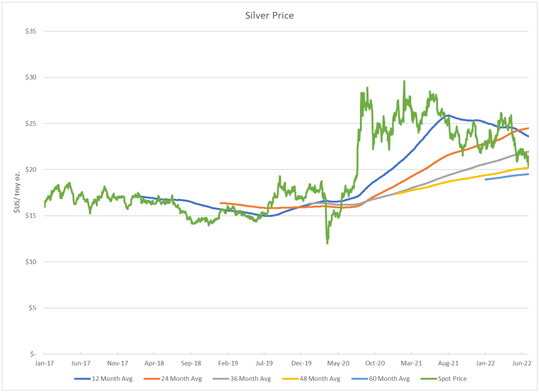
19.2. Contracts
The major contracts in place for supplies and services at the Upper Mine include:
| • |
Power supply with Isagen Energia Productive, the second largest power generation company in Colombia |
| • |
Power transmission with Unidad de Planeación Minero Energética, a unit of the Colombian Ministry of Mines and Energy |
| • |
Explosives supply with INDUMIL Industria Militar, the Colombian explosives authority |
| • |
Plant consumables including mill balls with Forjas Santa Barbara and lime and other reagents with Distribuidora de Químicos Industriales |
| • |
Cyanide with ORICA Colombia S.A.S. |
| • |
Steel with Aceros Arequipa |
| • |
Freight forwarding and logistics with Mariano Roldan S.A. |
| • |
Security with Fidelity Security Company Ltda, a private Colombian security firm. |
Aris Mining is planning for an engineering, procurement, construction, and management contractor for the Lower Mine process plant, which will be awarded in late 2022. Aris Mining will directly manage contracts and contractors for the remaining works, including the underground mine, dry stack tailings storage facility, paste fill facility, and non-process infrastructure. As the Lower Mine moves into the detailed engineering and procurement phases, contracts will be progressively awarded as the detailed engineering develops, and will support the respective construction works. This is expected to commence upon receipt of environmental permits. A contract is in place with Estyma S.A., a private Colombian infrastructure and mining company, for the development of the Lower Mine portal and mine. Early construction works have commenced with numerous local contracts awarded.
19.3. Review by the Qualified Person
The Qualified Person has reviewed the market studies and contracts and confirms that they are within industry norms and are reflected appropriately in the economic analyses.
| Effective date: June 30, 2022 |
|
Page 191 of 236 |
|
| Aris Mining Corporation
|
Technical Report Marmato Gold Mine
|
20. Environmental studies, permitting, and social or community impact
20.1. Environmental studies
20.1.1. Environmental and social setting
Marmato is located on the eastern side of the Western Cordillera, to the west of the Cauca River, which joins the Magdalena River before flowing to the Caribbean. The mine is at an elevation of 1,050 metres above sea level and the local topography is characterized by steep, incised valleys. The climate is tropical with an average temperature of 21°C and with rainfall throughout the year ranging from 300 to 800 mm per month. The rainfall drainage pattern in the license area is dendritic and drains to the Cauca River, which is heavily influenced by artisanal mining operations. The vegetation in the area is mainly disturbed grassland for mining and livestock, with patches of fragmented forests mainly following the valleys. In 2020, the mine reforested 2.5 hectares of land in partnership with the Colombian government.
The town of Marmato has been a centre for gold mining since it was founded in 1540. The population is approximately 10,000 and the main economic activity is formal and informal mining. There are around 3,000 artisanal and small-scale miners in Marmato and there is also significant activity in the surrounding areas. Waste and tailings discharge by informal mining activity directly into the environment has caused significant environmental contamination. These artisanal operations may increase the potential for environmental and geotechnical risk in terms of mass landslides and soil stability impacts to other associated resources, however, there are periodic review protocols that allow Aris Mining to identify any potential damage by third parties and to report them to Corpocaldas. The operational areas are protected to prevent access by unauthorized third parties and their activities to mitigate any risks and environmental liabilities. In 2021, Aris Mining established a formal dialogue process with local government officials and a select group of approximately 20 artisanal miners, representing the broader group, and participation by representatives of the Association of Traditional Miners of Marmato. This process allowed the parties to address risk situations that are identified in the area.
In 2020, Aris Mining completed a mapping exercise to identify the different stakeholders across the territory by visiting the areas near the mine, meeting with community stakeholders, and conducting surveys to understand community concerns and interests. The outcome was a documentation of all identified stakeholder groups and their corresponding concerns and issues. The top three concerns identified include:
| • |
Land use for exploration, development, and mining is perceived as a risk to heritage, homes, and livelihood |
| • |
Environmental concerns such as landslides, water resources, air quality, and any consequent health impacts |
| • |
Critical infrastructure, including roads, water systems, and energy sources |
| • |
Improving the quality of public health services and educational infrastructure, reduced home affordability, and impacts to recreational areas |
20.1.2. Environmental studies
A comprehensive environmental baseline data collection program was initiated in 2019 to gather relevant site information with respect to the existing Upper Mine operation and the Lower Mine expansion. The study area included the Lower Mine underground portal, processing plant site, access road, pipeline areas, magazine location, and tailings storage facilities. The collected data was compiled, assessed, and reported in May 2020. The report included a description of the environmental management programs of the current operations, including costs, and an overview of the site closure plan and costs. The topics covered by the data collection programs and studies include:
| • |
A comprehensive soil characterization including surface uses, chemical characteristics, and agronomic properties |
| • |
Hydrology, including flows and quality |
| • |
Climatology data collected from 10 regional stations including wind, temperature, precipitation, relative humidity, cloudiness/solar radiation, and evapo-transpiration potential |
| Effective date: June 30, 2022 |
Page 192 of 236 |
| Aris Mining Corporation
|
Technical Report Marmato Gold Mine
|
| • |
Air quality data from stations in El Llano, El Atrio, and La Plaza including particulate matter, sulfur oxides, nitrogen oxides, carbon monoxide, volatile organic carbons, and ozone |
| • |
Ambient noise levels from seven monitoring locations |
| • |
Baseline ecological data including ecosystems and cover types, flora, and fauna |
| • |
Archeological and cultural resource assessment of the surrounding areas conducted by personnel from the Archeology Laboratory at the University of Caldas |
| • |
An assessment of the current socioeconomic situation within the study area, including demographics, sanitation conditions, power infrastructure and usage, and education |
| • |
A biodiversity inventory was undertaken through the development of the environmental baseline studies that supported the PMA modification requests for the Cascabel 3 and Lower Mine projects. It was determined that there are no endangered species in the mine’s area of influence. Monitoring of flora and fauna found 27 species of Gliricidia sepium, 18 species of Myrcia paivae, 11 species of Bactris gasipaes, 9 other species of flora, 9 species of amphibians, 15 species of reptiles, and 17 species of mammals. |
In 2021, a wildlife rescue plan was implemented and a biodiversity offset plan for the Cascabel 1 TSF closure plan that covers 2.55 hectares of land. A Forest Compensation Plan for the Cascabel 1 project was filed with Corpocaldas that indicates that the mine must compensate for 1,838 trees that were removed in order to conduct mining activities. After the submission is approved, the mine will commence the reforestation process and plant trees in areas defined by both parties.
20.1.3. Known environmental issues
SRK is not aware of any known environmental issues that could materially impact Aris Mining’s ability to extract the mineral resources or mineral reserves at Marmato. While there will be some challenges associated with land acquisition and surface water control during operations, Marmato has not had, nor does it currently have any legal restrictions which affect access, title, mining rights, or capacity to perform work on the property. Likewise, in regard to environmental compliance, the operation is covered by the PMA and associated environmental permits, which further reduces environmental risks.
Informal processing operations related to artisanal mining in this location using basic technology (many of which are unpermitted), has resulted in poor health and safety conditions and widespread water contamination from discharge of tailings and waste directly into the environment. These operations may also increase the potential for environmental risk in terms of soil stability impacts to other associated resources. There are periodic review protocols which allow Aris Mining to identify potential damages by third parties and report them to Corpocaldas and the local government. The operational areas are generally protected to prevent access by unauthorized third parties and their activities to protect against risks and environmental liabilities.
20.2. Mine waste management and monitoring
20.2.1. Geochemistry
Two geochemical characterization programs have been completed on tailings and waste rock in recent years. In 2020 SRK directed a sampling and analytical program to generate environmental geochemistry data for the tailings and waste rock for the existing Upper Mine operations and the Lower Mine expansion. The program consisted of 60 waste rock samples from drill core, two samples representing future tailings collected from the 2020 metallurgical program, and two samples of existing tailings collected from TSF facilities on site. The on-site tailings samples included one of conventional flotation tailings and one of concentrate cyanide leach tailings. In 2021, the Intera-SHI consulting group completed a geochemical characterization program (Intera, 2021) consisting of static testing on samples from the La Maruja Mine in the Upper Mine, analysis of seven samples collected from the tailings stream, and a test program consisting of nine humidity cell tests (Intera, 2022) on samples of underground waste rock collected by SRK in the 2020 program. The Intera-SHI humidity cell program was designed to test samples from the SRK program that registered as “uncertain” under the MEND classification scheme for potentially acid generating materials (Price, 2009).
| Effective date: June 30, 2022 |
Page 193 of 236 |
| Aris Mining Corporation
|
Technical Report Marmato Gold Mine
|
The combined results of the characterization programs that will be considered in the mine waste management and monitoring programs can be summarized as follows:
| • |
Acid generating sulfide minerals identified in the deposit include pyrite, arsenopyrite, iron bearing sphalerite, pyrrhotite, and chalcopyrite. |
| • |
Test work indicates that tailings solids will be potentially acid generating (PAG). All seven of the Intera-SHI tailings samples reported as PAG. The SRK work indicated that the tailings from the TSF will be PAG, while the cyanide tailings registered near the classification boundary between PAG and “uncertain.” |
| • |
Data from SRK’s metallurgical program indicates that tailings will be discharged with a neutral to alkaline supernatant. However, the tailings solids will be PAG with the potential to eventually exceed the alkaline supernatant and produce acidic drainage in the longer term. |
| • |
The detoxified tailings are anticipated to have elevated concentrations of arsenic, sulfate, and total dissolved solids in potential leachates. |
| • |
Test work on paste backfill tailings suggests that the material will be acid-neutralizing in the short term, but in the long term, the material could become acidic. |
| • |
Intera-SHI stated that their humidity cell test program did not evaluate the acid rock drainage / metal leaching (ARDML) potential of PAG materials, and the data obtained from their test program likely underestimates the full potential for AMDML at mine closure. |
| • |
The two programs combined conducted laboratory static testing on 110 waste rock samples collected from underground and the existing surface waste rock storage facility. Test work indicated that 58 of the 110 samples (53%) are classified as potentially acid generating (PAG), subdivided as follows: |
| ○ |
44 of 85 samples (52%) collected from underground are PAG |
| ○ |
14 of 25 samples (56%) collected from the surface waste rock dump are PAG |
| • |
Assuming the data set is representative of the overall system, the proportion of future waste rock classified as PAG is expected to fall close to 50%. |
Other risks associated with mining waste geochemistry that will be considered in the management and monitoring programs include the following:
| • |
The PAG nature of the ore and waste rock is reflected in the chemistry of adit discharges and underground seepage. Underground water is reported as predominantly acidic with elevated copper, iron, lead and zinc (Hatch, 2012). This has water management implications in the present day and post-closure: |
| ○ |
Mine water used in processing carries a risk if containment systems exceed capacity. The chemistry of mill storage pond overflow discharge is currently variable throughout the day, ranging from neutral to acidic, with elevated metals including arsenic, copper, iron, lead, and zinc. |
| ○ |
SRK hydrogeologists do not expect discharge of mine water from portals after closure, but the potential exists for post-mining hydraulic communication from the underground mine pool to the Cauca River. SRK believes this potential should be evaluated at a feasibility level. |
| • |
Tailings that will be used in underground cemented paste backfill are likely to be PAG and thus could adversely affect the quality of water in the underground. The geochemical characteristics of the backfill should be analyzed regularly to inform evaluations of potential impacts from the backfill to groundwater quality and dewatering effluent. |
| • |
Management of contact water continues to be a challenge. Recent improvements include installation of ditches in the Cascabel tailings area and tailings encapsulation to reduce contact water. Aris Mining is prioritizing integration of contact water (tailings, waste rock, site water) into a single treatment system. |
| • |
The environmental impacts from artisanal mining are an ongoing problem. Work by Torrance et al. (2021) based on water samples collected from streams around Marmato in January 2012 discusses the impact of gold mining, ore processing, and mineralization on water quality in the Marmato area. The numerous small mills impact surface water through discharge of milled waste rock slurry, highly alkaline cyanide treated effluent, and elevated dissolved metal loads consisting of antimony, arsenic, cadmium, copper, lead, mercury, and zinc, |
| Effective date: June 30, 2022 |
Page 194 of 236 |
| Aris Mining Corporation
|
Technical Report Marmato Gold Mine
|
| among others. The source of elevated mercury concentrations in the surface water samples was most likely from amalgamation of ore concentrates by artisanal miners, as mercury is not significantly elevated in the Marmato deposit. It has been estimated that 30 to 50% of mercury is not recovered during amalgamation in the small mills. More recently, Aris Mining conducted water quality monitoring of Pantanos and Marmato creeks in May 2022, with mercury levels below the laboratory reference limits and below the limit for agricultural use defined by Colombian regulations. |
| • |
Aris Mining has in recent years expanded the water quality monitoring program in the areas of tailings, mine discharge, and surface water. Adding additional water quality data collection points, such as monitoring wells, should be considered. This is important due to the established link between the geochemistry of the mineralized system and the resulting quality of groundwater in the mine area. Decisions on current and future water management, mitigation, and future water treatment will likely be poorly informed without improved water quality data collection and reporting efforts. |
20.2.2. Waste rock management
Being an underground mine, Marmato produces a relatively small quantity of waste rock. The projected mass of waste rock to be moved through year 2041 is approximately 3.2 Mt, amounting to 13% of the total rock to be moved, with the balance of 24.1 Mt consisting of ore. Historically most waste rock was returned to the underground for use as backfill. The current schedule has all waste rock brought to ground surface until late 2024. All waste rock during this period is planned for use as construction of the Lower Mine tailings storage facilities. From 2027 forward, the proportion of waste rock used as backfill ramps up, with 100% of waste rock going to backfill in nine of the final 12 years of production.
20.2.3. Tailings management
Approximately 50% of the coarse sized fraction of tailings produced by the Upper Mine processing plant are returned to the underground workings as hydraulic sand backfill. The remainder of the tailings were historically detoxified, thickened, air-dried, trucked to the Cascabel tailings storage facilities located in the Marmato basin, and co-deposited with mine waste material. The detoxified tailings are now piped to a rotary disk vacuum filter system located in the Marmato basin, and the filter cake is then transported and mechanically compacted.
The Upper Mine tailings are monitored to assess whether they meet the classification of hazardous as defined through corrosive, reactive, explosive, toxic, inflammable, and pathogen (CRETIB) analyses. Toxicity analyses on cyanide, chromium, mercury, and lead were carried out by the Universidad Pontificia Bolivariana in Medellín, and the results support the classification of the tailings as non-toxic for the metals based on the maximum concentration thresholds established by Colombian Decree 4741 of 2005, and that the total cyanide is below the threshold allowed in Decree 1594 of 1984 for water discharge.
A similar ratio of tailings to the underground backfill and the tailings storage facility is expected for the Lower Mine operation. The majority of the Lower Mine tailings will be thickened and filtered to remove the majority of the water in the tailings, so these can then be transported, compacted, and stored in two new dry stack tailings storage facilities. The dry stack tailings facility design will produce a stable landform and include water management structures that minimize contact runoff from direct precipitation and upstream flows. Any contact water will be collected at the dry stack tailings facility for re-use in the processing plant, with any excess discharged under permit to designated discharged points. Initial tailings from the Lower Mine will be stored in the Cascabel 3 dry stack facility during the construction of the new Lower Mine tailings storage facility.
20.3. Site monitoring
Site monitoring programs are a component of the approved PMA for the Upper Mine and additional monitoring will take place with respect to the Lower Mine. The mine verifies compliance of mining and exploration activities with the provisions of the environmental mining guide adopted by Resolution 18-0861 of 2002 by the Ministry of Mines and Energy.
| Effective date: June 30, 2022 |
Page 195 of 236 |
| Aris Mining Corporation
|
Technical Report Marmato Gold Mine
|
In 2020, the mine commenced a biodiversity inventory review to inform the development of a biodiversity management plan and compensation program, and established monitoring measures to understand any changes and the impact of management practices on the species and habitats.
Water monitoring programs to establish baseline data and to improve the understanding of potential environmental impacts were initiated in 2021. Surface and underground water flow monitoring was carried out with instruments installed for this purpose. Groundwater measurements were capture through 14 piezometers that were installed within existing areas of the Upper Mine facilities and the future Lower Mine facilities.
20.4. Permitting
20.4.1. Environmental permitting
The Environmental and Sustainable Development Ministry is responsible for the management of the environment and renewable natural resources and regulates the environmental order of the territory. The ministry defines policies and regulations related to rehabilitation, conservation, protection, order, management, and sustainable use of natural resources. Regional Autonomous Corporations, including Corpocaldas, which is the regional environmental authority responsible for Marmato, function in the same way as the Ministry but with jurisdiction over specific territories.
ANLA is responsible to ensure all project, works, or activities subject to licensing, permit, or environmental procedures comply with the environmental regulations and contribute to the sustainable development of the country. ANLA approves or rejects licenses, permits, or environmental procedures according to the laws and regulations, and enforces compliances with the licenses, permits, and environmental procedures. Corpocaldas is responsible for the licensing of mining projects for those projects that produce less than two million tonnes of ore and waste per year, and ANLA is responsible for projects that produce more than two million tonnes per year. As the mine is planned to produce less than two million tonnes per year, Corpocaldas is responsible for licensing and monitoring of the mine. Both ANLA and Corpocaldas can enforce project compliance with the terms of their licenses or permits.
Mining at Marmato predates the regulatory requirements to prepare an environmental impact assessment as part of the permitting process. The Upper Mine operations are authorized through the approval of the PMA. Other permits and non-environmental requirements are required for construction and operation of the Project.
The site-specific PMA covering environmental studies and management procedures for the Upper Mine at Marmato was approved by Corpocaldas on October 29, 2001, under Resolution 0496, File No. 616. Environmental related permits required by Corpocaldas and held by Aris Mining include atmospheric emission permits and water permits for surface water concessions, domestic and non-domestic water discharge, and channel occupation.
Aris Mining submits environmental compliance reports for the Upper Mine operations to Corpocaldas every six months, and conducts periodic internal audits to verify legal and environmental compliance. In over 30 years of continuous operations, there have been three instances of non-compliance, all related to the management of water resources.
To support the construction of the Lower Mine expansion Project, Aris Mining submitted an updated PMA to Corpocaldas in April 2022, which addresses the environmental impacts of the Lower Mine development. The process to update the PMA is continuing, with several additional submissions to Corpocaldas made subsequent to the April 2022 submission, and final approval is pending. The PMA covers topics such as:
| • |
Management of unstable zones, including erosion control |
| • |
Water management in the underground mine |
| • |
Stormwater runoff management |
| • |
Domestic and non-domestic wastewater management |
| • |
Water usage |
| Effective date: June 30, 2022 |
Page 196 of 236 |
| Aris Mining Corporation
|
Technical Report Marmato Gold Mine
|
| • |
Management and protection of watersheds |
| • |
Containment structures |
| • |
Tailings storage management |
| • |
Cyanide destruction |
| • |
Control planning and use of explosives |
| • |
Air resource management |
| • |
Physical risk management measures |
| • |
Social management |
| • |
Biological management |
| • |
Reforestation and revegetation programs |
| • |
Reclamation and mine closure planning |
For the development of the Lower Mine, additional channel occupancy permits will be required for the dry stack tailings facility, the process plant site, and the underground mine portal. A forest exploitation permit will also be required for any surface disturbance of trees and any special protected areas that may require additional compensation.
Aris Mining additionally maintains internal management files to identify any environmental impacts associated with exploration activities that are not covered under the mining management plan, for the purposes of any necessary control, mitigation, and correction. Management files include resources such as water, air, soil, flora and fauna, waste management, hazardous materials, and socio-economic components in terms of employment and economic transformation due to the demand for goods and services, attention and response to requests and complaints from the communities, and maintaining good relationships. In accordance with the provisions of the environmental mining guidelines, any impacts associated with the biotic, abiotic, and socio-economic components which the activity may generate or cause have been identified, as well as the measures that have been established to address the impacts.
20.4.2. Mine permitting
The Ministry of Mines and Energy (MME) is the main mining authority with the legal capacity to regulate mining activities in accordance with the laws issued by the Colombian Congress, and can delegate its mining related authority to other national and departmental authorities. With limited exceptions, the mining regulations in Colombia consider all mineral deposits to be property of the state and therefore may only be exploited with the permission of the relevant mining authority, which may include the MME, the National Mining Agency (ANM), or the regional governments designated by law. The Mining Code Law 685 issued in 2001 established that the rights to explore and exploit mining reserves may only be granted through a single mining concession agreement, but does not apply to pre-existing mining titles that continue to be in force until their terms lapse. The 2001 Concession Agreement includes phases including exploration, construction, exploitation, and mine closure and is granted for periods of up to 30 years, and may be extended by the title holder for an additional 30 year term. The initial 30 year term is divided into three different phases, including:
| • |
Exploration – during the first three years of the concession agreement, the title holder performs the technical exploration of the concession area. The term may be extended for two additional years, four additional times, allowing exploration to occur up to 11 years. |
| • |
Construction – once the exploration term lapses, the title holder has three years to construct the necessary infrastructure for mining and related activities. This term may be extended for one additional year. |
| • |
Exploitation – during the remainder of the initial term minus the previous two phases, the title holder is entitled to perform exploitation activities as well as reclamation and mine closure activities. |
The mining contract for Zona Baja #014-89m was renewed for a 30 year term in February 2021 and expires on October 14, 2051. A PTO for the Upper Mine operations and the Lower Mine expansion Project demonstrating the technical, social, and environmental feasibility to operate was submitted to the ANM in February 2022, and subsequent to the effective date of this Technical Report, approval was received on November 3, 2022. The PTO
| Effective date: June 30, 2022 |
Page 197 of 236 |
| Aris Mining Corporation
|
Technical Report Marmato Gold Mine
|
will be in force for the 30 year contract extension period, although it may be subject to modifications depending on the Project’s strategic requirements.
20.4.3. Water management and permitting
The Colombian regulations that principally govern water quality, including the maximum permissible limits for discharge of wastewater into the environment and freshwater abstraction and their requirements, are Decree 2811 of 1974, Decree 1541 of 1978, Decree 1594 of 1984, and Decree 3930 of 2010, all of which are compiled in Decree 1076 of 2015, and Resolution 631 of 2015. Resolution 631 of 2015 provides updated parameters and maximum limits on point discharges and is used as the guideline for Marmato. Corpocaldas enforces compliance with these regulations.
Water rights for mining activities are granted by Corpocaldas by means of a water concession, which is independent of the mining concession or land ownership. The water rights related to mining activities are part of the environmental permits together with the approved PMA and are normally granted for at least five years, which may be extended according to Colombian regulations. The terms and conditions under which a water concession is granted may depend on, among other factors, the amount of water available in the specific region, any potential environmental impact of the concession, water demand, ecological flow, and the different water source users. The water concession is accompanied with a discharge permit.
Marmato holds two industrial water concessions granted by Corpocaldas. The concession at the Bocamina La Maruja was approved under Resolution 345 on March 17, 2014 for a five year term, with an extension request filing date of January 29, 2019. Another concession covering Aguas Claras, Zaparillo, and El Guineo was approved under Resolution 0046 of March 9, 2004, and amended by Resolution 127 on May 5, 2004, valid for a ten year term, with an extension request filing date of February 7, 2014. On August 20, 2021 Aris Mining extended the water concession for 10 years and received approval of the flow of the Zaparillo stream to the Aguas Clara stream concession, and maintained the El Guineo intake through Resolution 2021-1385.
The water discharge permits associated with the water licenses and held by the mine include a water discharge permit for domestic and non-domestic water discharge, granted by Corpocaldas under Resolution 270 of April 27, 2009, and amended by Resolution 254 on February 28, 2014. A channel occupation permit at Charco Hondo was granted by Corpocaldas under Resolution 0062 on February 15, 2006, later modified by Resolution 003 of 2012.
The Upper Mine operations require 39 litres per second of water, of which approximately a third is provided from recycled water from the TSF and the remainder from underground mine dewatering. The company takes only 0.9 litres per second of surface water from El Guineo Creek for domestic use. Aris Mining is currently undertaking engineering designs to source fresh water from the Aguas Claras stream to supply the camp and mining operations as a contingency for potential future increased demands. The total discharge of treated domestic wastewater is 0.533 litres per second from eight septic systems distributed throughout the mining operations. Discharge of domestic wastewater from the camp and offices and non-domestic wastewater from the tailings thickener, sedimentation ponds, and TSF is monitored for environmental compliance and the results of the testwork are reported to Corpocaldas.
Underground dewatering from the Lower Mine is expected to range from 2,000 to 6,000 m3/day, well in excess of the 600 to 800 m3/day of makeup needed by the processing plant after inflow from the tailings thickener overflow and tailings filtrate is accounted for. Additional back up fresh water can be sourced from the pumping station at the Cauca River.
20.4.4. Air and noise management and permitting
Resolution 909 of 2008, Resolution 650 of 2010, Resolution 2153 of 2010, Resolution 2154 of 2010, Decree 1076 of 2015, and Resolution 2254 of 2017 provide the main regulations on protection and control of air quality. These regulations set forth the general principles and regulations for the atmospheric protection, prevention mechanisms, control, and attention of pollution episodes from fixed, mobile, or diffused sources. These regulations
| Effective date: June 30, 2022 |
Page 198 of 236 |
| Aris Mining Corporation
|
Technical Report Marmato Gold Mine
|
also provide emission levels or standards. The mine holds an atmospheric emission permit granted by Corpocaldas under Resolution 270 on April 27, 2009, which is valid for five years, and an extension was filed with Corpocaldas on February 21, 2014, and is still under evaluation. Air quality emissions from the metallurgical laboratory and smelting facility are regulated and monitored by the Air Pollution Unit every two to three years. Additional air quality monitoring points may be required around the Lower Mine portal and dry stack TSF. Air emissions from fixed assets are within regulatory limits.
The significant sources of Scope 1 greenhouse gas emissions are from fuel combustion from mobile mining equipment, from the blasting process, the smelting furnace, and metallurgical laboratory. The emissions are within regulatory limits. Scope 2 greenhouse gas emissions are related to the power purchased from the Colombian power supplier. The fuel used during the smelting process was switched from diesel to liquified petroleum gas and a heat exchanger was installed at the furnace outlet to reduce emissions by lowering the temperature of the gas.
20.4.5. Performance and reclamation bonding
The termination of a mining concession can happen for several reasons: resignation, mutual agreement, and expiration of the term, the concession holder’s death, free revocation, and reversion. In all cases, the concession holder is obliged to comply or guarantee the environmental obligations payable at the time the termination becomes effective.
The 2001 Mining Code requires the concession holder to obtain an insurance policy to guarantee compliance with mining and environmental obligations which must be approved by the relevant authority, annually renewed, and remain in effect during the life of the Project and for three years from the date of termination of the concession contract. The value to be insured is calculated as follows:
| • |
During the exploration phase of the Project, the insured value under the policy must be 5% of the value of the planned annual exploration expenditures |
| • |
During the construction phase, the insured value under the policy must be 5% of the planned investment for assembly and construction |
| • |
During the exploitation phase, the insured value under the policy must be 10% of the value resulting from the estimated annual production multiplied by the pithead price established annually by the government |
According to the Law, the concession holder is liable for environmental remediation and other liabilities based on actions and or omissions occurring after the date of the concession contract, even if the actions or omissions are by an authorized third-party operator on the concession. The owner is not responsible for environmental liabilities which occurred before the concession contract, from historical activities, or from those which result from non-regulated mining activity, as has occurred on and around the Marmato mine.
In accordance with the terms and conditions of the PMA, Aris Mining maintains an Environmental Insurance Policy for the current operation. That policy is renewed annually with Corpocaldas as beneficiary. This policy is intended to cover the entire Marmato operations and all aspects of environmental compliance. According to Aris Mining, the current amount covered by the policy is COP$314,342,730 (US$76,159 as of June 30, 2022). This amount will be reviewed and adjusted during the modification process of the PMA for the expansion Project.
20.5. Social and community factors and management
The Project PMA requires the management of the social component of the mine. Aris Mining is required to maintain records on all community activities and provides the records every six months as part of the ongoing monitoring programs. The mine has developed a social investment model as part of the social management and monitoring program that seeks to promote community development in the area of influence, with the purpose of contributing to the consolidation of society and fostering economic development (Economic Development), guaranteeing the care and respect for the environment (Environmental Development), and supporting and participating in actions aimed at improving the quality of life and well-being of its inhabitants (Social Development and Promotion of Solidarity Actions).
| Effective date: June 30, 2022 |
Page 199 of 236 |
| Aris Mining Corporation
|
Technical Report Marmato Gold Mine
|
Aris Mining adopted a comprehensive suite of policies in 2021, and is working to align the mine Health and Safety Management systems with ISO 9001 and ISO 95001 standards. Aris Mining’s first annual sustainability report was published in 2021, covering the previous year’s performance.
The mine has a strategy of procuring supplies and recruiting employees from the local area. In 2021, the local supply contributed 9% and the plan is to double this amount in 2022. Approximately 70% of the mine budget is spent at the national or international level to acquire goods that are not available locally, such as explosives, which are supplied by the government, and internationally produced mining machinery. Supplies and services were sourced from 230 different local businesses.
In 2020, 80% of the employees and contractors at Marmato were from the three communities closest to the mine. In 2021, the mine hired 517 people, of which 72% were from Caldas department. As of the end of 2021, Aris Mining employed 1,227 people, of which 87% are from the Caldas region. 1,068 employees are covered under collective bargaining agreements, and of these, 709 are part of labour unions.
Aris Mining has partnered with a local charitable organization, Angelitos de Luz, to carry out health, wellness, and education programs in local communities. Prior to the onset of COVID-19, Angelitos de Luz implemented a Health Brigade program whereby medical specialists were brought into the community to provide care, such as visual health, to people in need. With the COVID-19 restraints, Aris Mining prioritized community health and wellness by funding the distribution of medical supplies, face masks, sanitation kits, and nutrition packages. This included food donations to families in Marmato, Supia, and Riosucio, and the supply of sanitation kits to security forces, formalized miners, vulnerable families, and the city halls of the municipalities of Segovia, Remedios, and Marmato. Aris Mining provided funding for the development and construction of a community centre to promote community spirit and to provide a central location in the Marmato community for extracurricular education and training in areas such as English language, software coding, robotics, and textile design.
In 2020, Aris Mining provided community investments of $950,000 (US$40 per ounce of gold produced in 2020), of which approximately 60% was directed towards food for families in need and helping local leaders and health authorities to respond to the COVID-19 pandemic. Additionally, all worker contracts were honoured throughout the year during government lockdowns preventing 60% of mine employees from working. As part of the 30 year extension of the Marmato mining contract, the mine committed to contribute a minimum of US$25 per ounce of gold produced at the mine toward community investments, subject to an annual minimum of US$300,000, commencing in October 2021. In 2021, community investments totaled US$606,965 (US$23 per ounce of gold produced in 2021), focussed on health and wellbeing, education and culture, infrastructure and social culture, and institutional strengthening.
The mine has a complaints and petitions handling procedure to record any grievances at the mine offices and the community office in El Llano. The grievance and response procedures follow international good practices. Aris Mining has established a formal ethics program and due diligence process to prevent and avoid violations of the law or to the company’s code of conduct, including launching an online whistleblower platform. No complaints have been received through the whistleblower platform that relate to matters of illegal or unethical conduct or other matters relating to fraud against stakeholders of the company.
Community relations have remained positive with no community blocks, demonstrations, or disruptions to mining activities.
20.6. Mine closure, remediation, and reclamation
At the termination of a mining concession, the concession holder is obliged to comply or guarantee the environmental obligations payable at the time the termination becomes effective. By law, the concession holder is liable for environmental remediation and other liabilities based on actions and/or omissions occurring after the date of the concession contract termination, even if the acts or omissions are by an authorized third party operator on the concession. The owner is not responsible for environmental liabilities which occurred before the concession
| Effective date: June 30, 2022 |
Page 200 of 236 |
| Aris Mining Corporation
|
Technical Report Marmato Gold Mine
|
contract was granted, from historical activities, or from those that result from non-regulated mining activity, as has occurred on and around the Marmato mine.
Detailed, site-wide closure actions have not yet been defined, as these will be developed through five-year updates to help identify potential closure risks that Aris Mining may need to manage and finalize closer to the end of operations. The following discussion focuses on final closure and post-closure as currently envisioned.
Some surface facilities, such as the dry stack tailings facility, will be progressively reclaimed over the duration of the mine site operations, albeit on a limited basis, as there are relatively few surface facilities suitable for concurrent reclamation and closure. In addition, progressive reclamation and closure can result in the development of expertise on the most appropriate reclamation methods. Progressive reclamation and closure will be undertaken, however, without posing impediments on day-to-day operations of the site. Final closure of the mine site will be undertaken following completion of all mining operations.
Final closure of the Marmato facilities is currently envisioned to entail the following activities, if not undertaken during progressive closure phases, in agreement with the mining contract with the State:
| • |
Underground workings: | |
| o |
All equipment with resale value will be removed and salvaged. | |
| o |
All portals, ventilation structures, etc., will be sealed to exclude public access. | |
| o |
Portal area will be regraded, covered with growth media, and revegetated. | |
| • |
Plant and other buildings: | |
| o |
Plant equipment will be decommissioned and removed. Any equipment with resale value will be salvaged. | |
| o |
Buildings will be decommissioned, demolished, and the rubble removed. | |
| o |
Concrete will be broken and buried in place. | |
| o |
Yard areas will be regraded, covered with growth media, and revegetated. | |
| • |
Reclamation of tailings facilities: | |
| o |
The surface of the tailings facilities will be covered with growth media and revegetated. | |
| o |
Concrete structures (if present) will be properly decommissioned. | |
| o |
Metal fences will be removed. | |
| o |
Seepage management will continue. | |
| • |
Reclamation of roads not needed for access during long-term care and maintenance. | |
| • |
Erosion control measures will be taken where there is evidence of erosion. | |
| • |
Human resources: mine workers’ contracts will not be renewed (no extra costs to be included in the reclamation | |
| and closure cost estimate) or the contracts will be terminated (which would incur additional costs). |
Post-closure activities include monitoring for physical and chemical stability. Physical stability monitoring will include monitoring for ground movements which would indicate subsidence. Monitoring of physical stability will continue twice annually for three years and then annually for three years if no movement is detected. Chemical stability will include monitoring or water quality of mine effluent as well as draindown. Monitoring of water quality will continue twice a year for the first three years and then once annually for at least three years until such time that permissible limits are met, or flows diminish (in the case of draindown from tailings).
20.6.1. Reclamation and closure costs
Reclamation and closure costs for the current operation are provided in the May 2019 reclamation and closure plan. These costs are based on percentages of costs to build the facilities. The plan does not provide the basis for the percentages, and SRK did not independently calculate or validate this estimate; however, the amount is in keeping with the closure of other moderate-sized underground mining operations in South America. The reclamation and closure cost estimate provided totals COP$20,128,000,000 (US$6.1 million based on an exchange rate of 3,300 COP to 1 USD at that time. This $6.1 million uninflated estimate from 2019 is anticipated to cover the required closure costs given the increase in costs since 2019 and the change in the exchange rate to 4,200 COP to
| Effective date: June 30, 2022 |
Page 201 of 236 |
| Aris Mining Corporation
|
Technical Report Marmato Gold Mine
|
1 USD). A requirement for long-term post-closure water treatment, if deemed necessary, could significantly increase this estimate.
Based on limited pre-feasibility study design information for the Marmato expansion Project, an additional cost of US$7.5 million was included in the economic model (for a total of US$12.0 million) to account for the increase in production anticipated for the new Lower Mine operations and the construction of the new plant and tailings storage facilities. Post-closure water management, for example tailings storage facility seepage management costs, not included in the total, are estimated to average $455,000 per year after the first two years which are estimated significantly higher until the seepage stabilizes. If any area or variable is not stable, post-closure activities will be extended as necessary. Concurrent reclamation of the tailings storage facility is anticipated, which, due to the construction method, requires reclamation during operations as opposed to entirely post closure. However, nominal infiltration of precipitation through the engineered soil cover will occur and will require management until the concentrations reach maximum permissible levels as defined by Resolution 631 of 2015. At that time, seepage will likely be directly discharged (under permit) and no longer require treatment. Additional investigation of the long-term seepage quality anticipated from the tailings storage facilities is recommended in order to more precisely define this aspect of the closure costs.
Numerous assumptions were used in order to calculate a reasonable estimate, though a more robust assessment of the facilities is recommended as part of any feasibility study of the Project:
| • |
The river water pumping station will remain post closure for use by the community. |
| • |
Structures and facilities associated with the main camp will remain post closure for use by the community. This includes the domestic wastewater package plant. No costs for demolition and removal were included. |
| • |
Cover placement costs for the tailings facilities were calculated for the entire surface of each facility. |
| • |
No new stormwater diversion structures are expected to be constructed post closure. Diversion structures in place during operations are anticipated to be sized for closure requirements. |
| • |
The water treatment plant is assumed to be constructed prior to closure. No capital costs are included. |
| • |
Operating cost estimates provided for detoxification and water treatment are inclusive of labour, maintenance, reagents, and electricity. |
| • |
Seepage from the tailings storage facilities will not contain cyanide. |
| • |
Most newly constructed and existing roads servicing the mine will remain post closure to facilitate access to the portal area, tailings facilities, and stormwater diversion structures, all of which are likely to require inspection, and care and maintenance in the future. |
| • |
Roads from each tailings facility to the borrow area will be reclaimed. |
| Effective date: June 30, 2022 |
Page 202 of 236 |
| Aris Mining Corporation
|
Technical Report Marmato Gold Mine
|
21. Capital and operating costs
21.1. Introduction
The cost estimates for the pre-feasibility study are divided into the current Upper Mine operations and the Lower Mine expansion Project. The Upper Mine costs are based on actual cost data for the operation provided by Aris Mining and reviewed by SRK. The Lower Mine costs were split into the process plant (estimated by Ausenco), the underground mine (estimated by SRK), the paste plant (estimated by Paterson and Cooke and reviewed by SRK), the tailings facility (estimated by SRK), non-process infrastructure (prepared by Aris Mining and reviewed by Ausenco), and owner’s costs (prepared by Aris Mining and reviewed by SRK). The mining costs assume an owner operation for the Upper Mine and a contractor operation for the Lower Mine. Mining contractor operating costs were developed from first principles with a 10% allowance for profit and also include capital recovery for mining equipment.
The cost estimate has a base date of Q2 2022, is expressed in US$, and uses a flat exchange rate of 4,200 COP to the US$.
21.2. Capital cost estimate
Capital costs are divided into construction capital, sustaining capital and closure costs. The majority of the capital costs for the Upper Mine are considered sustaining capital, with the remaining capital costs related to the closure of this operation. Capital costs for the Lower Mine are split between construction, sustaining and closure costs. Construction capital costs for the Lower Mine include:
| • |
Installation of surface facilities such as the portal, surface air intake, and exhaust fans |
| • |
Power supply and distribution |
| • |
Access roads |
| • |
Employee camp and buildings |
| • |
Processing plant |
| • |
Dry stack tailings storage facilities |
| • |
Paste backfill plant |
| • |
Water treatment plant |
| • |
Installation of underground facilities such as waste development to access the underground stopes, workshops, ventilation systems, refuge chambers, pumping stations, paste fill distribution network, and fuel distribution, and |
| • |
Owner’s costs for mining, infrastructure, and processing plant, EPCM, as well as contingency |
21.2.1. Lower Mine construction capital cost estimate
Construction capital cost estimates for the new Lower Mine include the new Lower Mine underground mining infrastructure, processing plant, and other surface infrastructure. The construction capital costs and expenditure schedule are summarized in Table 21.1. The following subsections provide the detailed breakout of each category.
Table 21.1 Estimated Lower Mine construction capital costs
|
Category |
2022 (US$M) | 2023 (US$M) | 2024 (US$M) | Total (US$M) | ||||||||||||
| Process plant |
18.56 | 90.15 | 108.71 | |||||||||||||
| Underground mine |
6.41 | 13.89 | 44.62 | 64.91 | ||||||||||||
| Paste plant |
6.03 | 12.34 | 18.37 | |||||||||||||
| Tailings storage facilities |
5.24 | 10.72 | 15.96 | |||||||||||||
|
Non-process infrastructure |
15.60 | 5.55 | 5.18 | 26.33 | ||||||||||||
| Owner’s costs |
7.51 | 17.01 | 20.77 | 45.28 | ||||||||||||
|
Total |
29.52 | 66.27 | 183.78 | 279.57 | ||||||||||||
| Effective date: June 30, 2022 |
Page 203 of 236 |
| Aris Mining Corporation
|
Technical Report Marmato Gold Mine
|
21.2.1.1. Process plant
The breakdown of the estimated construction capital costs for the new Lower Mine process plant is shown in Table 21.2. This estimate was prepared by Ausenco with earthworks, power, and water estimated by Aris Mining and reviewed by Ausenco.
Table 21.2 Estimated Lower Mine process plant construction capital costs
|
Item |
US$M | |||
| On-site infrastructure |
2.59 | |||
|
Electrical tie ins |
0.67 | |||
|
Crushing and conveying |
10.36 | |||
|
Grinding |
15.45 | |||
|
Leach / CIP |
8.61 | |||
|
Detox |
1.25 | |||
| ADR/ elution |
2.21 | |||
| Gold room |
1.66 | |||
|
Reagents |
2.30 | |||
| Air/ water |
2.06 | |||
|
Tailings thickening and filtering |
12.79 | |||
|
EPCM |
18.80 | |||
|
Spares and first fills |
2.05 | |||
|
Contingency |
12.12 | |||
|
Earthworks |
3.40 | |||
|
Power |
1.40 | |||
|
Water resources |
10.97 | |||
|
Total |
108.71 | |||
21.2.1.2. Underground mine
The Lower Mine underground mine will be a contractor operation with no upfront capital purchases of major equipment. Engineering costs for the mine are included in the detailed breakdown. The costs for construction management and procurement were estimated by Aris Mining, and are included in the owner’s costs. The breakdown of the estimated construction capital costs is shown in Table 21.3.
Table 21.3 Estimated Lower Mine mining construction capital costs
| Item |
US$M | |||
| Development |
31.81 | |||
| Miscellaneous equipment purchase |
7.67 | |||
| Services |
13.18 | |||
| Contingency |
9.71 | |||
| Engineering cost |
2.53 | |||
|
Total |
64.91 | |||
21.2.1.3. Paste plant
The breakdown of the estimated construction capital costs for the Lower Mine paste plant and distribution system is shown in Table 21.5.
| Effective date: June 30, 2022 |
Page 204 of 236 |
| Aris Mining Corporation
|
Technical Report Marmato Gold Mine
|
Table 21.4 Lower Mine paste plant construction capital cost estimate
|
Item |
US$M | |||
|
Surface backfill - tailings, water delivery, return water |
0.37 | |||
|
Surface backfill - surface paste plant |
9.22 | |||
|
Underground backfill – underground booster pump station |
2.22 | |||
|
Underground backfill – underground reticulation system (paste delivery) |
2.80 | |||
|
Surface shotcrete - modular shotcrete plant |
0.71 | |||
|
Contingency |
3.06 | |||
|
Total |
18.37 | |||
21.2.1.4. Tailings storage facility
The breakdown of the estimated construction capital costs for the Lower Mine Site 2 tailings storage facility is shown in Table 21.4. The capital cost estimate for Site 2 includes the full construction of the facility, which is utilized at the onset of production from the Lower Mine. The estimate costs for the Site 6 tailings facility is considered in sustaining capital and is phased to meet the increasing storage capacity requirements through the life of mine. The costs for the filter presses to produce dry filtered tailings are included in the process plant costs. The costs below relate to the full construction of site 2 which is not phased due to geometric constraints.
Table 21.5 Estimated Lower Mine tailings storage facility Site 2 construction capital costs
|
Item |
USD$M | |||
|
Access |
0.43 | |||
|
Embankment |
2.41 | |||
|
Lined impoundment |
1.88 | |||
|
Stormwater management |
3.89 | |||
|
Underdrain |
1.61 | |||
|
Piping |
0.32 | |||
|
Power line relocation |
2.00 | |||
|
Concurrent reclamation |
3.33 | |||
|
Monitoring |
0.09 | |||
|
Total |
15.96 | |||
21.2.1.5. Non-process infrastructure
The breakdown of the estimated construction capital costs for the Lower Mine non-process infrastructure is shown in Table 21.6. Costs are categorized into facilities, site preparation, access, and waste rock disposal. Costs are categorized into facilities, site preparation, access, and waste rock disposal.
Table 21.6 Estimated Lower Mine non-process infrastructure construction capital costs
|
Area |
Item |
USD$M | ||||
| Camp facilities |
6.52 | |||||
| Concrete plant |
1.92 | |||||
| Powder magazine |
1.13 | |||||
| Facilities |
Change house |
1.06 | ||||
| Shotcrete plant |
0.80 | |||||
| Fuel station area |
0.80 | |||||
| Offices |
0.81 | |||||
| Truck shop |
0.61 | |||||
| Effective date: June 30, 2022 |
Page 205 of 236 |
| Aris Mining Corporation
|
Technical Report Marmato Gold Mine
|
|
Area |
Item |
USD$M | ||||
| Warehouse |
0.41 | |||||
| Heliport |
0.06 | |||||
| Subtotal |
14.12 | |||||
| Slope stabilization |
4.44 | |||||
| Laydown area |
0.78 | |||||
| Site preparation |
Parking lot |
0.65 | ||||
| Subtotal |
5.87 | |||||
| Slope stabilization in intervened areas—roads |
1.30 | |||||
| Processing plant access road |
1.29 | |||||
| Powder magazine road access |
0.83 | |||||
| Camps road access |
0.53 | |||||
| Access |
Laydown access |
0.63 | ||||
| Parking lot road access |
0.25 | |||||
| Waste water treatment plant road access |
0.15 | |||||
| Subtotal |
4.98 | |||||
| Waste Rock |
Waste rock deposit |
1.35 | ||||
|
All |
Total |
26.32 | ||||
| 21.2.1.6. |
Owner’s costs |
The breakdown of the estimated construction capital costs for the Lower Mine owner’s cost is shown in Table 21.7.
Table 21.7 Lower Mine construction capital cost for Owner’s cost estimate
|
Item |
US$M | |||
|
Labor |
7.45 | |||
|
Consulting |
0.55 | |||
|
Direct cost |
11.32 | |||
|
Upper Mine Allocation |
2.47 | |||
|
Taxes and duties |
14.10 | |||
|
Freight |
9.40 | |||
|
Total |
45.28 | |||
21.3. Estimated sustaining capital costs
The Upper Mine and Lower Mine will require sustaining capital to maintain the equipment and supporting infrastructure necessary to continue operations throughout the projected life of mine, as well as development to provide access to future stopes. Sustaining capital cost estimates have been prepared by SRK and Ausenco with input from Aris Mining and are detailed in the following section.
Sustaining mine capital costs estimates include underground infill drilling, mine development based on the life of mine schedule, miscellaneous equipment purchases and rebuilds, mine ventilation and dewatering, maintenance of existing surface and underground mine infrastructure and stationary equipment, mine owner’s costs, mine contingency, phased tailings storage facility construction to increase capacity over the life of mine, and closure costs.
Sustaining process capital cost estimates include maintenance of existing equipment and infrastructure, replacement of equipment and rebuilds, plant owner’s costs, plant contingency, and closure costs. Additionally, for the Upper Mine, these costs include upgrades to the ball mill for a minor expansion of the existing Upper Mine
| Effective date: June 30, 2022 |
Page 206 of 236 |
| Aris Mining Corporation
|
Technical Report Marmato Gold Mine
|
processing facility to 1,250 tpd as well as remediation of the Cascabel 1 tailings facility. For the Lower Mine, mining will be done as a contractor operation. Capital recovery is included as an operating cost for major mining equipment.
Estimated sustaining capital costs for the Upper Mine and Lower Mine are summarized in Table 21.8.
Table 21.8 Life of mine sustaining capital cost estimate
| Item |
Upper Mine (US$M) | Lower Mine (US$M) | Total (US$M) | |||||||||
| Cascabel Remediation |
1.71 | - | 1.71 | |||||||||
| Contingency |
- | 32.11 | 32.11 | |||||||||
| development |
28.98 | 158.62 | 187.60 | |||||||||
| Mine equipment |
29.30 | 2.40 | 31.71 | |||||||||
| Owner’s Cost |
0.11 | 0.60 | 0.71 | |||||||||
| Process Plant |
19.69 | - | 19.69 | |||||||||
| Surface Infrastructure |
5.77 | - | 5.77 | |||||||||
|
Tailings |
- | 38.15 | 38.15 | |||||||||
|
Total |
85.56 | 231.89 | 317.45 | |||||||||
21.4. Closure cost estimates
SRK and Aris Mining prepared closure costs estimates for the Upper Mine and Lower Mine that will cover project closure and post closure monitoring. The closure cost estimate is US$6.1 million for the Upper Mine and US$27.25 million for the Lower Mine. These cost estimates were included in periods subsequent to the end of each area’s life of mine.
21.5. Basis of the capital cost estimates
| 21.5.1. |
Upper Mine |
Aris Mining provided past production and cost history for the Upper Mine operations in addition to their planned capital expenditures for the life of the mine. SRK reviewed these estimates and agrees that they properly reflect the necessary sustaining capital expenditures over the mine life. Aris Mining provided unit development costs which were reviewed by SRK. The unit costs were multiplied by the development metres to calculate the sustaining development cost by period. The estimated unit development cost by heading size is shown in Table 21.9.
Table 21.9 Estimated unit development costs by heading size
|
Heading size (m) |
US$/m | |
| 2.4 x 2.4 |
940 | |
| 2.8 x 2.8 |
1,221 | |
| 3.0 x 3.0 |
1,401 | |
| 3.5 x 3.5 |
1,816 | |
|
5.0 x 5.0 |
3,139 | |
| 21.5.2. |
Lower Mine |
| 21.5.2.1. |
Mining |
SRK created a first principles buildup contractor cost model for all required components of the Lower Mine underground mine development, which includes a 10% profit margin and capital recovery of mining equipment. The estimate includes all materials, equipment, and labor for the mine development as well as the engineering costs required for continued operation. Details of the mine development are presented in Section 16. Contingencies were applied on an item specific basis and average 20%.
| Effective date: June 30, 2022 |
Page 207 of 236 |
| Aris Mining Corporation
|
Technical Report Marmato Gold Mine
|
| 21.5.2.2. |
Construction indirects |
Estimates for contractor field indirect costs and labour hours and material quantities considered included:
| • |
Work areas and bays |
| • |
Roads, walk and parking areas |
| • |
Temporary buildings |
| • |
Temporary utilities |
| • |
Power |
| • |
Sewage and other |
As well as minor temporary construction services including:
| • |
General and final clean-up |
| • |
Craft training and testing |
| • |
On site services |
| • |
Operation and maintenance of temporary facilities |
| • |
Unallocated service labor and surveying |
| 21.5.2.3. |
Processing |
Equipment and commodity take-off costs
Mechanical equipment costs were estimated using similar project benchmarks , as well as recent capital cost work from Wood. The gold plant and associated facility estimates were prepared on a commodity basis (i.e., divided into earthworks, concrete, structural, etc.).
Installation and labour rates
The Lower Mine estimated labour rates are shown in Table 21.10.
Table 21.10 Lower Mine labour rate estimate
| Description |
All-in labour rate $US/hour | |
|
Concrete |
20.87 | |
|
Structural steel |
17.36 | |
|
Platework |
22.98 | |
|
Mechanical equipment |
23.93 | |
|
Electrical |
21.39 |
| 21.5.2.4. |
Infrastructure |
Overall site clearing, fill, and levelling cost estimates are based on local contractor rates.
The overland piping, which constitutes the tailings lines, process water, raw water, effluent water, and sewage lines, were all defined by first principles, and the estimated quantities for piping materials and trenching were combined with historical material rates to compile the overall cost. Civil works for surface water management are included in the construction costs and are based on local contractor rates.
| 21.5.2.5. |
Exclusions |
The following costs and scope are excluded from the estimate include:
| • |
Sales taxes |
| • |
Scope changes |
| Effective date: June 30, 2022 |
Page 208 of 236 |
| Aris Mining Corporation
|
Technical Report Marmato Gold Mine
|
| • |
Costs to advance the project from a pre-feasibility study to feasibility study |
| • |
Costs incurred to accelerate the work |
| • |
Costs associated with weather interruption of the work |
| • |
Currency fluctuations |
| • |
Credits for salvage value of any demolition or modification work, residual construction materials, vehicles, and temporary buildings |
21.6. Operating cost estimates
The estimate of operating costs for the production schedule were prepared by SRK, Ausenco, and Aris Mining. Operating costs are divided into the Upper Mine operations and the Lower Mine expansion project and are summarized in Table 21.11. The mining costs assume an owner operation for the Upper Mine and a contractor operation for the Lower Mine. The following subsections provide the detailed breakout of each category in showing total costs as well as unit costs.
Table 21.11 Life of mine operating cost estimate
| Item |
Units | Upper Mine | Lower Mine | Total | ||||||||||||
|
Mining |
||||||||||||||||
|
Total mining |
(US$M | ) | 381.87 | 990.99 | 1,372.86 | |||||||||||
|
Unit cost per processed tonne |
(US$/t | ) | 53.47 | 41.06 | 43.89 | |||||||||||
|
Unit cost per recovered ounce |
(US$/oz Au | ) | 437.35 | 469.11 | 459.82 | |||||||||||
|
Processing |
||||||||||||||||
|
Processing |
(US$M | ) | 161.97 | 388.96 | 550.93 | |||||||||||
|
Unit cost per processed tonne |
(US$/t | ) | 22.68 | 16.12 | 17.61 | |||||||||||
|
Unit cost per recovered ounce |
(US$/oz Au | ) | 185.50 | 184.12 | 184.53 | |||||||||||
|
Site G&A and Social Investment |
||||||||||||||||
|
Site G&A and Social Investment |
(US$M | ) | 125.02 | 199.25 | 324.27 | |||||||||||
|
Unit cost per processed tonnes |
(US$/t | ) | 17.50 | 8.26 | 10.37 | |||||||||||
|
Unit cost per recovered ounces |
(US$/oz Au | ) | 143.19 | 94.32 | 108.61 | |||||||||||
|
Total Operating |
||||||||||||||||
|
Unit cost per processed tonnes |
(US$/t | ) | 93.65 | 65.43 | 71.87 | |||||||||||
|
Unit cost per recovered ounces |
(US$/oz Au | ) | 766.04 | 747.55 | 752.96 | |||||||||||
21.6.1. Mining
The Upper Mine cost estimates are based on actual cost data for the operation provided by Aris Mining and reviewed by SRK and is based on the expanded processing rate of 1250 tpd. The Lower Mine costs were developed by SRK from first principles for a contractor operation utilizing a production rate of 4,000 tpd. The cost breakout the Lower Mine costs by category are shown in Table 21.12. A detailed breakout of the Upper Mine mining cost into the listed categories was not provided by Aris Mining.
Table 21.12 Lower Mine mining operating cost estimate
|
Item |
US$M | US$/t | ||||||
|
Labour |
84.85 | 3.52 | ||||||
|
Materials |
335.35 | 13.89 | ||||||
|
Equipment |
341.03 | 14.13 | ||||||
|
Fuel |
33.17 | 1.37 | ||||||
|
Power |
96.26 | 3.99 | ||||||
|
Subcontract |
9.62 | 0.40 | ||||||
| Effective date: June 30, 2022 |
Page 209 of 236 |
| Aris Mining Corporation
|
Technical Report Marmato Gold Mine
|
|
Item |
US$M | US$/t | ||||||
|
Capital Recovery |
90.70 | 3.76 | ||||||
|
Total |
990.99 | 41.06 | ||||||
21.6.2. Processing
Processing operating costs for the Lower Mine were estimated by Ausenco, as shown in Table 21.12.
Table 21.13 Lower Mine process operating cost estimate
|
Item |
US$M | $ US$/t processed | ||||||
| Process operating costs |
||||||||
| Reagents and consumables |
10.30 | 7.05 | ||||||
| Plant maintenance |
1.17 | 0.80 | ||||||
| Power |
6.20 | 4.25 | ||||||
| Laboratory |
0.27 | 0.19 | ||||||
| Labour (operations and maintenance) |
2.12 | 1.46 | ||||||
| Vehicles |
0.27 | 0.19 | ||||||
|
Subtotal |
20.3 | 13.93 | ||||||
| Day services |
||||||||
| Camp |
2.63 | 1.80 | ||||||
| Power (camp, G&A, plant buildings) |
0.41 | 0.28 | ||||||
|
Subtotal |
3.04 | 2.08 | ||||||
| Water treatment |
||||||||
| Plant maintenance |
0.09 | 0.06 | ||||||
| Power |
0.04 | 0.03 | ||||||
|
Reagents |
0.03 | 0.02 | ||||||
|
Subtotal |
0.15 | 0.10 | ||||||
|
Total processing operating costs |
23.5 | 16.12 | ||||||
21.6.3. Social Commitment
A social commitment cost of $25 per ounce of gold produced is included for both the Upper Mine and Lower Mine.
21.7. Basis of the operating cost estimates
The operating cost estimates are based on the quantities outlined in the mine production schedule, including:
| • |
Development meters |
| • |
Stope ore tonnage |
| • |
Milled ore tonnage |
Operating costs for the mine include:
| • |
Labour (supervision, operations, maintenance, administrative, etc.) |
| • |
Maintenance (tools, spare parts) |
| • |
Consumables |
| • |
Lubricants and fuels |
| • |
Electricity |
| • |
Other recurring expenses needed for mine operations |
A more detailed discussion of the assumptions made in constructing the operating costs follows.
| Effective date: June 30, 2022 |
Page 210 of 236 |
| Aris Mining Corporation
|
Technical Report Marmato Gold Mine
|
21.7.1. Upper Mine
The Upper Mine costs are based on actual cost data and the projected budget for 2023 for the operation provided by Aris Mining. SRK has reviewed the costs and agrees that they properly reflect the operating costs. SRK calculated unit costs and adjusted them for the increased production rate of 1,250 tpd.
21.7.2. Lower Mine
| 21.7.2.1. |
Mining |
SRK developed operating costs from first principles utilizing a production rate of 4,000 tpd which cover drilling, blasting, mucking, hauling, backfilling, mine services, and definition drilling. These costs were increased to allow for capital recovery of mining equipment by the contractor and a 10% profit margin.
21.7.2.2. Processing
This basis considers the development of a processing facility with a daily throughput of 4,000 tpd. Key assumptions made in the development of the operating cost estimate include:
| • |
Mill labour rates were adapted from data provided by Aris Mining and is assumed to be drawn from a local workforce. |
| • |
It was assumed that the mill operates 341 days per year under a daily schedule of two shifts of 12 hours. |
| • |
Power was priced at US$0.11/kWh. |
| • |
Diesel was priced at US$2.37/gallon. |
Consumables
Reagent consumption rates were estimated based on available testwork, Ausenco’s in-house experience and industry practice. Reagent costs were obtained through recent benchmarking by Wood, Ausenco benchmarking against recent projects in South America, and data provided by Aris Mining. The reagents and grinding media consumption rates and their descriptions are provided in Section 17.
Other consumables which have also been accounted for include ball and SAG mill media and liners, crusher liners, and filter cloths. The consumptions were estimated based on abrasion testwork, Ausenco’s in-house simulations and estimated power consumption.
Plant maintenance
Maintenance costs were estimated using a flat 4% of the mechanical equipment capital cost estimate based on Ausenco’s project experience and internal database.
Power
Power costs were estimated using the projected nominal load drawn by the installed electrical equipment.
Laboratory
The on-site laboratory and assay cost estimates include sampling process solids and solutions from comminution, leaching, carbon in pulp, carbon regeneration, cyanide detox, and water treatment. The frequency of sampling, either daily, weekly, or monthly, was assigned to each type of test and the cost was then summarized as an annual cost. Breakable items like glassware and a 5% contingency for duplicates in the plant is also included, on a weekly basis.
Labour
Labour costs were estimated using salary and burden material provided by Aris Mining. A schedule of four 12 hour shifts was anticipated for most mill operations.
Vehicles
Vehicle cost estimates are based on expected use and associated fuel costs.
| Effective date: June 30, 2022 |
Page 211 of 236 |
| Aris Mining Corporation
|
Technical Report Marmato Gold Mine
|
22. Economic analysis
22.1. Assumptions
SRK has undertaken an economic analysis, including quarterly (2022 to 2026) to annual cash flows, net present value, and internal rate of return, to confirm the proven and probable mineral reserves at Marmato, which comprise 31.3 million tonnes at 3.16 g/t Au and 6.1 g/t Ag. The economic analysis is effective June 30, 2022. Average life of mine mining rate assumptions are 1,250 tpd for the Upper Mine and 4,000 tpd for the Lower Mine. The combined total mine movement at the Property is limited to a maximum of 2 million tonnes per year under the current Property environmental regulation structure but could be increased in the future if desired.
The model is a strict cash flow model that that does not estimate intermediate stocks and cost of good sold nor attempt to “match” expenditure and revenue for the purposes of deriving accounting measures such as profit or earnings.
The economic analysis has been conducted on an after-tax basis using 2022 US$. Cost assumptions are denominated in both US$ and COP, with COP converted to US$ using an exchange rate of 4,200 COP to the US$. The base case analysis uses a flat metal price assumption of $1,600 per ounce for gold and $19 per ounce for silver. Refining charges of $6.38 per ounce of gold have been considered in the operating cost analysis.
Capital costs were estimated using a combination of first principles models, quotes and estimates from previous quotes as detailed in Section 21. The capital costs in the technical economic model aggregate capital cost estimates from various sources.
Operating costs were estimated using combination of first principles models and estimates based on information from the Upper Mine operations, as detailed in Section 21.
Working capital assumptions are 15 days for account receivables and 30 days for account payables.
Royalties have been considered as described in Section 4.4.
The analysis considers a corporate income tax rate of 35%. Tax depreciation has been estimated in accordance with the statutory tax laws of Colombia, where assets are depreciated over their applicable tax useful lives depending on the nature of the underlying assets or expenditures. For the purposes of the technical economic model, the analysis assumed no opening balances for tax loss carry-forwards or depreciable tax assets.
Other considerations include the $25 per ounce of gold production social investment commitment that is included as part of the 30 year extension of the Marmato mining contract.
Marmato is subject to a streaming agreement with WPMI whereby WPMI has agreed to purchase 10.5% of gold produced from the Marmato mine until 310,000 ounces of gold have been delivered, after which the purchased volume reduces to 5.25% of gold produced. WPMI will also purchase 100% of silver produced from the Marmato mine until 2.15 million ounces of silver have been delivered, after which the purchased volume reduces to 50% of silver produced. WPMI will continue to make payments upon delivery equal to 18% of the spot gold and silver prices until the uncredited portion of the upfront payment is reduced to zero, and 22% of the spot gold and silver prices thereafter.
WPMI has provided $53 million in upfront deposits and is committed to fund an additional $122 million during the Lower Mine construction period, as follows:
| • |
$40M when the construction of the Lower Mine is 25% complete; and |
| • |
$40M when the construction of the Lower Mine is 50% complete; and |
| • |
$42M when the construction of the Lower Mine is 75% complete. |
| Effective date: June 30, 2022 |
Page 212 of 236 |
| Aris Mining Corporation
|
Technical Report Marmato Gold Mine
|
Expected revenues from Marmato have been adjusted to account for the impact of precious metal sales to WPMI. Revenue from silver sales is treated as a credit against operating costs. As the streaming agreement is external to Colombia, Colombian corporate tax and royalties are assessed on the basis that all gold and silver is sold at market prices.
The key assumptions used in the economic analysis are provided in Table 22.1.
Table 22.1 Key assumptions used in the economic analysis
|
Parameter |
Unit |
Upper Mine | Lower Mine | Total/average | ||||||||||
|
Mined waste tonnes |
Mt |
0.5 | 3.2 | 3.7 | ||||||||||
|
Mined ore tonnes |
Mt |
7.1 | 24.1 | 31.3 | ||||||||||
|
Mined ore grade Au |
g/t |
4.16 | 2.87 | 3.16 | ||||||||||
|
Mined ore grade Ag |
g/t |
14.9 | 3.5 | 6.1 | ||||||||||
|
Mine life |
Years |
20 | 18 | 20 | ||||||||||
|
Processing capacity |
tpd |
1,250 | 4,000 | 5,250 | ||||||||||
|
Gold recovery |
% |
92 | 95 | 94 | ||||||||||
|
Silver recovery |
% |
36 | 57 | 45 | ||||||||||
|
Gold recovered |
koz |
873.1 | 2,112.5 | 2,985.6 | ||||||||||
|
Silver recovered |
koz |
1,253.0 | 1,543.2 | 2,778.2 | ||||||||||
|
Gold price |
US$/oz |
1,600 | 1,600 | 1,600 | ||||||||||
|
Silver price |
US$/oz |
19.00 | 19.00 | 19.00 | ||||||||||
22.2. Economic results
At the base case metal price the project after-tax NPV5% is $341 million and the project IRR is 30%, as shown in Table 22.2. Project economics are inclusive of the precious metal streaming agreement with WPMI.
Table 22.2 Summary of economic results
|
Parameter |
Unit |
Total | ||||
| Gold revenue |
US$M |
4,385.7 | ||||
| Refining charges |
(19.0 | ) | ||||
| Royalties |
US$M |
(423.8 | ) | |||
| Net revenue |
US$M |
3,942.9 | ||||
| Mining costs |
US$M |
(1,372.9 | ) | |||
| Processing costs |
US$M |
(550.9 | ) | |||
| Mine site G&A costs |
US$M |
(249.6 | ) | |||
| Social investment |
US$M |
(74.6 | ) | |||
| Silver credit |
US$M |
13.6 | ||||
| Total operating costs |
US$M |
(2,234.5 | ) | |||
| Operating margin |
US$M |
1,708.5 | ||||
| Sustaining capital |
US$M |
(317.4 | ) | |||
|
Non-sustaining capital |
US$M |
(279.6 | ) | |||
| Closure costs |
US$M |
(33.3 | ) | |||
| Stream financing |
US$M |
122.0 | ||||
|
Pre-tax cash flow |
US$M |
1,200.1 | ||||
| Income tax |
US$M |
(551.6 | ) | |||
|
After-tax cash flow |
US$M |
648.5 | ||||
|
Pre-tax NPV5% |
US$M |
$ | 674.0 | |||
|
Pre-tax IRR |
% |
53.5 | % | |||
|
After-tax NPV5% |
US$M |
$ | 341.4 | |||
|
After-tax IRR |
% |
29.7 | % | |||
| Effective date: June 30, 2022 |
Page 213 of 236 |
| Aris Mining Corporation
|
Technical Report Marmato Gold Mine
|
|
Parameter |
Unit |
Total | ||||
| Parameter |
Unit |
Total | ||||
| Cash cost |
US$/oz Au |
$897 | ||||
| All in sustaining cost |
US$/oz Au |
$1,003 | ||||
| Payback period1 |
Years |
2.6 | ||||
|
1 The payback period is from the start of production from the Lower Mine |
||||||
| Effective date: June 30, 2022 |
Page 214 of 236 |
| Aris Mining Corporation
|
Technical Report Marmato Gold Mine
|
22.3. Annual mining, processing, and cash flow schedule
The annual mining, processing, and cash flow schedule over the life of mine is shown in Table 22.3. Numbers may not total due to rounding.
Table 22.3 Annual mining, processing, and cash flow schedule
| Parameter |
Units | LOM totals/averages | H2-2022 | 2023 | 2024 | 2025 | 2026 | 2027 | 2028 | 2029 | 2030 | 2031 | 2032 | 2033 | 2034 | 2035 | 2036 | 2037 | 2038 | 2039 | 2040 | 2041 | 2042 | 2043+ | ||||||||||||||||||||||||||
|
Mining | ||||||||||||||||||||||||||||||||||||||||||||||||||
|
Upper Mine |
||||||||||||||||||||||||||||||||||||||||||||||||||
| Waste mined |
kt | 467 | 38 | 68 | 94 | 42 | 41 | 28 | 25 | 27 | 14 | 7 | 5 | 1 | 2 | 0 | 2 | - | 3 | 54 | 15 | - | - | - | ||||||||||||||||||||||||||
|
Ore mined |
kt | 7,142 | 169 | 361 | 450 | 450 | 450 | 450 | 372 | 380 | 315 | 281 | 160 | 282 | 440 | 444 | 271 | 442 | 450 | 450 | 446 | 78 | - | - | ||||||||||||||||||||||||||
| Ore gold grade |
g/t | 4.16 | 5.57 | 4.54 | 5.33 | 4.99 | 5.16 | 4.77 | 4.47 | 3.93 | 3.97 | 4.52 | 3.88 | 3.38 | 3.31 | 3.21 | 3.11 | 3.01 | 3.42 | 4.29 | 4.12 | 4.72 | - | - | ||||||||||||||||||||||||||
|
Ore silver grade |
g/t | 14.9 | 16.6 | 16.9 | 18.5 | 16.9 | 15.5 | 15.7 | 14.8 | 14.4 | 12.6 | 14.2 | 11.2 | 15.4 | 15.3 | 14.7 | 13.9 | 13.4 | 14.2 | 14.5 | 12.8 | 14.4 | - | - | ||||||||||||||||||||||||||
| Contained gold |
koz | 954 | 30 | 53 | 77 | 72 | 75 | 69 | 53 | 48 | 40 | 41 | 20 | 31 | 47 | 46 | 27 | 43 | 50 | 62 | 59 | 12 | - | - | ||||||||||||||||||||||||||
|
Contained silver |
koz | 3,431 | 90 | 196 | 268 | 245 | 224 | 227 | 177 | 177 | 128 | 128 | 58 | 140 | 217 | 210 | 121 | 190 | 205 | 210 | 184 | 36 | - | - | ||||||||||||||||||||||||||
|
Lower Mine | ||||||||||||||||||||||||||||||||||||||||||||||||||
|
Waste mined |
kt | 3,198 | 86 | 112 | 405 | 316 | 47 | 0 | 163 | 154 | 151 | 302 | 466 | 257 | 105 | 120 | 287 | 115 | 112 | 0 | 0 | 0 | 0 | 0 | ||||||||||||||||||||||||||
| Ore mined |
kt | 24,135 | - | - | 10 | 1,043 | 1,436 | 1,441 | 1,440 | 1,439 | 1,498 | 1,392 | 1,357 | 1,458 | 1,452 | 1,434 | 1,437 | 1,443 | 1,436 | 1,446 | 1,436 | 1,423 | 114 | - | ||||||||||||||||||||||||||
|
Ore gold grade |
g/t | 2.87 | - | - | 2.86 | 2.93 | 2.98 | 3.04 | 2.95 | 3.03 | 3.12 | 3.14 | 3.32 | 2.91 | 2.80 | 2.72 | 2.55 | 2.41 | 2.54 | 2.75 | 2.80 | 2.79 | 2.61 | - | ||||||||||||||||||||||||||
| Ore silver grade |
g/t | 3.5 | - | - | 3.4 | 4.2 | 3.5 | 4.2 | 4.3 | 4.3 | 3.8 | 4.0 | 4.7 | 3.8 | 4.7 | 3.6 | 2.4 | 1.7 | 2.4 | 2.9 | 2.5 | 2.6 | 3.0 | - | ||||||||||||||||||||||||||
|
Contained gold |
koz | 2,224 | 0 | 0 | 1 | 98 | 137 | 141 | 137 | 140 | 150 | 141 | 145 | 137 | 131 | 125 | 118 | 112 | 117 | 128 | 129 | 128 | 10 | 0 | ||||||||||||||||||||||||||
| Contained silver |
koz | 2,707 | 0 | 0 | 1 | 140 | 161 | 195 | 198 | 197 | 184 | 178 | 206 | 176 | 221 | 165 | 111 | 80 | 112 | 135 | 115 | 121 | 11 | 0 | ||||||||||||||||||||||||||
|
Total | ||||||||||||||||||||||||||||||||||||||||||||||||||
| Waste mined |
kt | 3,666 | 124 | 179 | 500 | 358 | 88 | 28 | 187 | 181 | 165 | 309 | 471 | 258 | 107 | 120 | 289 | 115 | 115 | 54 | 15 | - | - | - | ||||||||||||||||||||||||||
|
Ore mined |
kt | 31,277 | 169 | 361 | 460 | 1,493 | 1,886 | 1,891 | 1,812 | 1,820 | 1,813 | 1,672 | 1,517 | 1,741 | 1,893 | 1,879 | 1,709 | 1,885 | 1,886 | 1,896 | 1,882 | 1,501 | 114 | - | ||||||||||||||||||||||||||
| Ore gold grade |
g/t | 3.16 | 5.57 | 4.54 | 5.27 | 3.55 | 3.50 | 3.45 | 3.26 | 3.22 | 3.26 | 3.37 | 3.38 | 2.99 | 2.92 | 2.84 | 2.64 | 2.55 | 2.75 | 3.11 | 3.11 | 2.89 | 2.61 | - | ||||||||||||||||||||||||||
|
Ore silver grade |
g/t | 6.1 | 16.6 | 16.9 | 18.2 | 8.0 | 6.3 | 7.0 | 6.4 | 6.4 | 5.3 | 5.7 | 5.4 | 5.6 | 7.2 | 6.2 | 4.2 | 4.5 | 5.2 | 5.7 | 4.9 | 3.3 | 3.0 | - | ||||||||||||||||||||||||||
| Contained gold |
koz | 3,178 | 30 | 53 | 78 | 171 | 212 | 210 | 190 | 188 | 190 | 181 | 165 | 167 | 177 | 171 | 145 | 155 | 167 | 190 | 188 | 140 | 10 | - | ||||||||||||||||||||||||||
|
Contained silver |
koz | 6,138 | 90 | 196 | 269 | 385 | 385 | 422 | 374 | 373 | 312 | 306 | 264 | 316 | 438 | 375 | 232 | 270 | 317 | 346 | 298 | 157 | 11 | - | ||||||||||||||||||||||||||
| Processing |
||||||||||||||||||||||||||||||||||||||||||||||||||
|
Upper Mine | ||||||||||||||||||||||||||||||||||||||||||||||||||
| Ore processed |
kt | 7,142 | 169 | 361 | 427 | 426 | 426 | 426 | 427 | 419 | 315 | 281 | 160 | 282 | 426 | 426 | 304 | 426 | 426 | 426 | 427 | 160 | - | - | ||||||||||||||||||||||||||
|
Processed gold grade |
g/t | 4.16 | 5.57 | 4.54 | 5.33 | 5.02 | 5.10 | 4.85 | 4.55 | 3.99 | 3.97 | 4.52 | 3.88 | 3.38 | 3.31 | 3.21 | 3.12 | 3.01 | 3.41 | 4.22 | 4.13 | 4.42 | - | - | ||||||||||||||||||||||||||
| Processed silver grade |
g/t | 14.9 | 16.6 | 16.9 | 18.6 | 17.0 | 15.6 | 15.7 | 14.9 | 14.5 | 12.6 | 14.2 | 11.2 | 15.4 | 15.3 | 14.7 | 14.0 | 13.4 | 14.1 | 14.5 | 13.0 | 13.7 | - | - | ||||||||||||||||||||||||||
|
Gold recovery |
% | 91.5% | 91.5% | 91.5% | 91.5% | 91.5% | 91.5% | 91.5% | 91.5% | 91.5% | 91.5% | 91.5% | 91.5% | 91.5% | 91.5% | 91.5% | 91.5% | 91.5% | 91.5% | 91.5% | 91.5% | 91.5% | 0.0% | 0.0% | ||||||||||||||||||||||||||
| Silver recovery |
% | 36.0% | 36.0% | 36.0% | 36.0% | 36.0% | 36.0% | 36.0% | 36.0% | 36.0% | 36.0% | 36.0% | 36.0% | 36.0% | 36.0% | 36.0% | 36.0% | 36.0% | 36.0% | 36.0% | 36.0% | 36.0% | 0.0% | 0.0% | ||||||||||||||||||||||||||
|
Gold produced |
koz | 873 | 28 | 48 | 67 | 63 | 64 | 61 | 57 | 49 | 37 | 37 | 18 | 28 | 41 | 40 | 28 | 38 | 43 | 53 | 52 | 21 | - | - | ||||||||||||||||||||||||||
| Silver produced |
koz | 1,235 | 32 | 71 | 92 | 84 | 77 | 77 | 74 | 70 | 46 | 46 | 21 | 50 | 76 | 73 | 49 | 66 | 70 | 72 | 64 | 25 | - | - | ||||||||||||||||||||||||||
|
Lower Mine | ||||||||||||||||||||||||||||||||||||||||||||||||||
| Ore processed |
kt | 24,135 | - | - | - | 1,049 | 1,364 | 1,364 | 1,368 | 1,364 | 1,364 | 1,364 | 1,368 | 1,364 | 1,364 | 1,364 | 1,368 | 1,364 | 1,364 | 1,364 | 1,368 | 1,364 | 1,247 | - | ||||||||||||||||||||||||||
|
Processed gold grade |
g/t | 2.87 | - | - | - | 2.93 | 2.98 | 3.03 | 2.96 | 3.02 | 3.10 | 3.13 | 3.27 | 3.00 | 2.85 | 2.76 | 2.62 | 2.48 | 2.52 | 2.66 | 2.74 | 2.77 | 2.76 | - | ||||||||||||||||||||||||||
| Processed silver grade |
g/t | 3.5 | - | - | - | 4.2 | 3.5 | 4.2 | 4.3 | 4.3 | 3.9 | 4.0 | 4.5 | 3.9 | 4.5 | 3.9 | 2.9 | 2.1 | 2.3 | 2.7 | 2.6 | 2.6 | 2.6 | - | ||||||||||||||||||||||||||
|
Gold recovery |
% | 95.0% | 0.0% | 0.0% | 0.0% | 95.0% | 95.0% | 95.0% | 95.0% | 95.0% | 95.0% | 95.0% | 95.0% | 95.0% | 95.0% | 95.0% | 95.0% | 95.0% | 95.0% | 95.0% | 95.0% | 95.0% | 95.0% | 0.0% | ||||||||||||||||||||||||||
|
Silver recovery |
% | 57.0% | 0.0% | 0.0% | 0.0% | 57.0% | 57.0% | 57.0% | 57.0% | 57.0% | 57.0% | 57.0% | 57.0% | 57.0% | 57.0% | 57.0% | 57.0% | 57.0% | 57.0% | 57.0% | 57.0% | 57.0% | 57.0% | 0.0% | ||||||||||||||||||||||||||
| Effective date: June 30, 2022 |
Page 215 of 236 |
| Aris Mining Corporation
|
Technical Report Marmato Gold Mine
|
| Parameterpm |
Units | LOM totals/averages | H2-2022 | 2023 | 2024 | 2025 | 2026 | 2027 | 2028 | 2029 | 2030 | 2031 | 2032 | 2033 | 2034 | 2035 | 2036 | 2037 | 2038 | 2039 | 2040 | 2041 | 2042 | 2043+ | ||||||||||||||||||||||||||||
| Gold produced |
koz | 2,112 | - | - | - | 94 | 124 | 126 | 124 | 126 | 129 | 130 | 137 | 125 | 119 | 115 | 109 | 103 | 105 | 111 | 114 | 115 | 105 | - | ||||||||||||||||||||||||||||
|
Silver produced |
koz | 1,543 | - | - | - | 80 | 87 | 104 | 107 | 106 | 97 | 99 | 114 | 98 | 113 | 97 | 72 | 53 | 58 | 67 | 64 | 65 | 61 | - | ||||||||||||||||||||||||||||
|
Total | ||||||||||||||||||||||||||||||||||||||||||||||||||||
| Ore processed |
kt | 31,277 | 169 | 361 | 427 | 1,475 | 1,790 | 1,790 | 1,795 | 1,783 | 1,679 | 1,645 | 1,528 | 1,646 | 1,790 | 1,790 | 1,671 | 1,790 | 1,790 | 1,790 | 1,795 | 1,524 | 1,247 | - | ||||||||||||||||||||||||||||
|
Processed gold grade |
g/t | 3.16 | 5.57 | 4.54 | 5.33 | 3.53 | 3.49 | 3.46 | 3.34 | 3.25 | 3.26 | 3.37 | 3.33 | 3.06 | 2.96 | 2.87 | 2.71 | 2.61 | 2.73 | 3.03 | 3.07 | 2.94 | 2.76 | - | ||||||||||||||||||||||||||||
| Processed silver grade |
g/t | 6.1 | 16.6 | 16.9 | 18.6 | 7.5 | 6.0 | 6.6 | 6.5 | 6.3 | 5.3 | 5.4 | 5.1 | 5.6 | 6.7 | 6.1 | 4.7 | 4.6 | 4.9 | 5.2 | 4.8 | 3.6 | 2.6 | - | ||||||||||||||||||||||||||||
|
Gold recovery |
% | 93.9% | 91.5% | 91.5% | 91.5% | 93.6% | 93.8% | 93.9% | 93.9% | 94.0% | 94.2% | 94.2% | 94.6% | 94.4% | 94.1% | 94.1% | 94.3% | 94.1% | 94.0% | 93.9% | 93.9% | 94.5% | 95.0% | 0.0% | ||||||||||||||||||||||||||||
| Silver recovery |
% | 45.3% | 36.0% | 36.0% | 36.0% | 46.3% | 47.2% | 48.1% | 48.4% | 48.6% | 50.3% | 50.3% | 53.8% | 49.9% | 48.6% | 48.0% | 48.5% | 45.4% | 45.5% | 46.2% | 46.5% | 51.1% | 57.0% | 0.0% | ||||||||||||||||||||||||||||
|
Gold produced |
koz | 2,986 | 28 | 48 | 67 | 157 | 188 | 187 | 181 | 175 | 166 | 168 | 155 | 153 | 160 | 155 | 137 | 141 | 148 | 164 | 166 | 136 | 105 | - | ||||||||||||||||||||||||||||
|
Silver produced |
koz | 2,778 | 32 | 71 | 92 | 164 | 164 | 182 | 181 | 177 | 143 | 145 | 134 | 149 | 189 | 169 | 121 | 119 | 128 | 139 | 129 | 91 | 61 | - | ||||||||||||||||||||||||||||
|
Annual cash flow | ||||||||||||||||||||||||||||||||||||||||||||||||||||
| Gross revenue Au |
US$M | 4,385.7 | 40.6 | 70.4 | 98.0 | 229.3 | 275.2 | 273.7 | 264.4 | 255.9 | 243.7 | 246.5 | 227.6 | 224.8 | 235.4 | 228.1 | 201.6 | 207.4 | 217.0 | 240.4 | 244.5 | 200.1 | 161.1 | 0.0 | ||||||||||||||||||||||||||||
| Refining charges |
US$M | (19.0) | (0.2) | (0.3) | (0.4) | (1.0) | (1.2) | (1.2) | (1.2) | (1.1) | (1.1) | (1.1) | (1.0) | (1.0) | (1.0) | (1.0) | (0.9) | (0.9) | (0.9) | (1.0) | (1.1) | (0.9) | (0.7) | - | ||||||||||||||||||||||||||||
| Royalties |
US$M | (423.8) | (4.0) | (6.9) | (9.6) | (22.3) | (26.7) | (26.6) | (25.7) | (24.9) | (23.5) | (23.8) | (22.0) | (21.7) | (22.8) | (22.1) | (19.5) | (20.0) | (20.9) | (23.2) | (23.6) | (19.3) | (14.8) | - | ||||||||||||||||||||||||||||
| Net revenue |
US$M | 3,942.9 | 36.5 | 63.3 | 88.0 | 206.0 | 247.3 | 245.9 | 237.5 | 229.9 | 219.2 | 221.6 | 204.7 | 202.0 | 211.6 | 205.0 | 181.3 | 186.5 | 195.1 | 216.2 | 219.9 | 179.9 | 145.6 | 0.0 | ||||||||||||||||||||||||||||
| Operating costs |
||||||||||||||||||||||||||||||||||||||||||||||||||||
| Mining |
US$M | (1,372.9) | (10.4) | (21.1) | (22.9) | (73.3) | (81.0) | (79.7) | (77.9) | (78.7) | (74.5) | (66.5) | (66.5) | (71.8) | (79.7) | (80.7) | (79.2) | (81.6) | (82.1) | (82.1) | (82.1) | (62.6) | (18.6) | - | ||||||||||||||||||||||||||||
| Processing |
US$M | (550.9) | (3.0) | (7.5) | (9.3) | (26.2) | (31.3) | (31.3) | (31.3) | (31.2) | (29.2) | (28.8) | (27.4) | (28.8) | (31.3) | (31.3) | (29.9) | (31.3) | (31.3) | (31.3) | (31.3) | (28.1) | (20.1) | - | ||||||||||||||||||||||||||||
| Mine site G&A |
US$M | (249.6) | (2.6) | (5.3) | (5.3) | (14.1) | (15.2) | (11.2) | (10.6) | (13.6) | (13.6) | (13.6) | (13.6) | (13.6) | (13.6) | (13.6) | (13.6) | (13.6) | (13.6) | (13.6) | (13.6) | (13.6) | (8.1) | - | ||||||||||||||||||||||||||||
| Social investment |
US$M | (74.6) | (0.7) | (1.2) | (1.7) | (3.9) | (4.7) | (4.7) | (4.5) | (4.4) | (4.1) | (4.2) | (3.9) | (3.8) | (4.0) | (3.9) | (3.4) | (3.5) | (3.7) | (4.1) | (4.2) | (3.4) | (2.6) | - | ||||||||||||||||||||||||||||
| Silver credit |
US$M | 13.6 | 0.1 | 0.2 | 0.3 | 0.3 | 0.3 | 0.3 | 0.3 | 0.2 | 0.5 | 0.5 | 0.5 | 0.5 | 0.6 | 0.6 | 1.0 | 1.3 | 1.4 | 1.6 | 1.4 | 1.0 | 0.7 | - | ||||||||||||||||||||||||||||
| Total operating costs |
US$M | (2,234.5) | (16.6) | (34.9) | (38.8) | (117.2) | (131.9) | (126.6) | (124.1) | (127.6) | (120.9) | (112.6) | (111.0) | (117.5) | (128.0) | (128.9) | (125.2) | (128.6) | (129.3) | (129.5) | (129.8) | (106.7) | (48.8) | - | ||||||||||||||||||||||||||||
| Operating margin |
US$M | 1,708.5 | 19.9 | 28.4 | 49.2 | 88.8 | 115.4 | 119.4 | 113.4 | 102.3 | 98.2 | 109.0 | 93.7 | 84.5 | 83.6 | 76.1 | 56.1 | 57.8 | 65.8 | 86.6 | 90.1 | 73.2 | 96.8 | - | ||||||||||||||||||||||||||||
| Sustaining capital |
US$M | (317.4) | (13.6) | (18.6) | (13.3) | (35.8) | (30.0) | (9.4) | (14.3) | (16.1) | (18.2) | (20.5) | (31.4) | (24.6) | (9.9) | (9.6) | (20.1) | (14.5) | (12.6) | (4.0) | (0.9) | - | - | - | ||||||||||||||||||||||||||||
| Non-sustaining capital |
US$M | (279.6) | (29.5) | (82.0) | (168.0) | - | - | - | - | - | - | - | - | - | - | - | - | - | - | - | - | - | - | - | ||||||||||||||||||||||||||||
| Closure costs |
US$M | (33.3) | - | - | - | - | - | - | - | - | - | - | - | - | - | - | - | - | - | - | - | - | (3.1) | (30.2) | ||||||||||||||||||||||||||||
| Stream financing |
US$M | 122.0 | - | 40.0 | 82.0 | - | - | - | - | - | - | - | - | - | - | - | - | - | - | - | - | - | - | - | ||||||||||||||||||||||||||||
| Working capital |
US$M | (0.0) | 1.0 | (1.2) | 0.9 | (0.7) | 0.5 | 0.3 | (0.2) | (0.6) | 0.0 | 0.8 | (0.6) | (0.7) | (0.4) | (0.4) | (0.8) | (0.1) | 0.3 | 0.9 | 0.2 | 0.2 | 0.6 | - | ||||||||||||||||||||||||||||
| Pre-tax net cash flow |
US$M | 1,200.1 | (22.2) | (33.4) | (49.3) | 52.3 | 85.9 | 110.3 | 98.9 | 85.5 | 80.0 | 89.2 | 61.6 | 59.3 | 73.3 | 66.2 | 35.2 | 43.2 | 53.6 | 83.6 | 89.3 | 73.4 | 94.3 | (30.2) | ||||||||||||||||||||||||||||
| Income tax |
US$M | (551.6) | - | (8.4) | (12.1) | (20.0) | (30.1) | (40.3) | (41.4) | (38.8) | (34.3) | (31.4) | (34.9) | (28.5) | (24.7) | (24.9) | (22.2) | (22.4) | (23.1) | (26.7) | (34.7) | (36.3) | (16.4) | - | ||||||||||||||||||||||||||||
| After-tax net cash-flow |
US$M | 648.5 | (22.2) | (41.9) | (61.3) | 32.3 | 55.8 | 70.0 | 57.6 | 46.8 | 45.7 | 57.8 | 26.7 | 30.8 | 48.6 | 41.3 | 13.0 | 20.8 | 30.5 | 57.0 | 54.6 | 37.1 | 77.9 | (30.2) | ||||||||||||||||||||||||||||
| Cash cost |
|
US$/ oz Au |
$897 | $746 | $873 | $728 | $896 | $849 | $824 | $835 | $878 | $877 | $819 | $865 | $916 | $947 | $979 | $1,060 | $1,059 | $1,023 | $940 | $928 | $932 | $612 | $0 | |||||||||||||||||||||||||||
|
All in sustaining cost |
|
US$/ oz Au |
$1,003 | $1,235 | $1,259 | $927 | $1,124 | $1,009 | $875 | $914 | $970 | $987 | $942 | $1,067 | $1,077 | $1,009 | $1,040 | $1,207 | $1,162 | $1,108 | $964 | $933 | $932 | $612 | $0 | |||||||||||||||||||||||||||
| Effective date: June 30, 2022 |
Page 216 of 236 |
| Aris Mining Corporation
|
Technical Report Marmato Gold Mine
|
22.4. Sensitivity analysis
A sensitivity analysis of the Marmato after-tax NPV5% to gold price and capital and operating costs was undertaken, which shows that the project economics are most sensitive to gold price but are sufficient to remain economically positive over the range of sensitivities, as shown in Table 22.4 and Figure 22.1.
Table 22.4 Sensitivity of project NPV5% to gold price and costs
| Sensitivity Factor |
Operating Costs | Capital Costs | Gold Price | |||
| -15% |
$476 | $401 | $111 | |||
| -10% |
$431 | $381 | $187 | |||
| -5% |
$386 | $361 | $265 | |||
| Base case - 0% |
$341 | $341 | $341 | |||
| 5% |
$297 | $322 | $418 | |||
| 10% |
$252 | $302 | $496 | |||
| 15% |
$207 | $282 | $572 |
Figure 22.1 Sensitivity of project NPV5% to gold price and costs
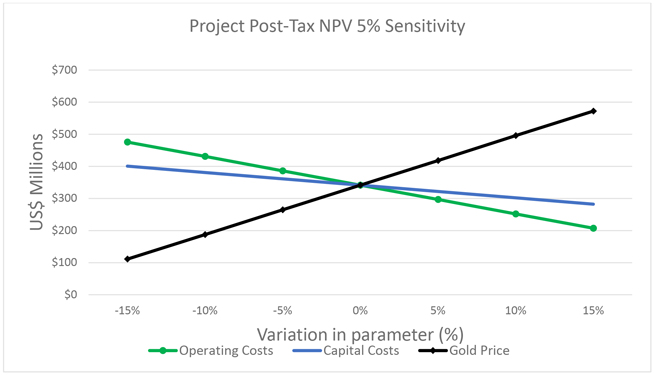
A sensitivity analyses of the Marmato undiscounted net cash flow, after-tax NPV5%, and IRR to gold price was undertaken, as shown in Table 22.5.
Table 22.5 Sensitivity analysis of project economics to gold price
| Gold price US$/oz |
Units | $1,400 | $1,500 | $1,6001 | $1,700 | $1,800 | ||||||
| Net cashflow |
US$M | $335 | $493 | $648 | $804 | $962 | ||||||
| After-tax NPV5% |
US$M | $150 | $246 | $341 | $438 | $533 | ||||||
| After-tax IRR |
% | 16.1% | 22.8% | 29.7% | 37.1% | 45.2% | ||||||
|
1 base case | ||||||||||||
| Effective date: June 30, 2022 |
Page 217 of 236 |
| Aris Mining Corporation
|
Technical Report Marmato Gold Mine
|
22.5. Conclusions
The economic analysis demonstrates the economic viability of the Marmato mineral reserve under the assumptions used. When ranked, the sensitivity analysis indicates that Marmato is most sensitive to gold price, and less sensitive to operating and capital costs. The estimated after-tax NPV5% remains positive over the complete range of +/- 15% sensitivities tested.
The Lower Mine expansion project, with an initial construction capital including contingency estimate of $279.6 million, shows economic viability in the context of the overall operation of both the Upper Mine and Lower Mine. The integrated operation has an estimated after-tax NPV5% of $341 million and after-tax IRR of 29.7% at the base case gold price of $1,600 per ounce.
| Effective date: June 30, 2022 |
Page 218 of 236 |
| Aris Mining Corporation
|
Technical Report Marmato Gold Mine
|
23. Adjacent properties
There is no relevant information on adjacent properties to report.
| Effective date: June 30, 2022 |
Page 219 of 236 |
| Aris Mining Corporation
|
Technical Report Marmato Gold Mine
|
24. Other relevant data and information
There is no additional information to report.
| Effective date: June 30, 2022 |
Page 220 of 236 |
| Aris Mining Corporation
|
Technical Report Marmato Gold Mine
|
25. Interpretation and conclusions
25.1. Mineral resources and mineral reserves
The mineral resource estimate effective June 30, 2022 utilized 1,464 drillholes for a total of 314,874 m and 31,392 channel samples for a total of 53,343 m. Mining software was utilized to create three dimensional wireframe interpretations of the structural geology, lithology, alteration, and mineralization of the Upper Mine and Lower Mine based on regional and mine scale mapping, drillhole and channel sample logging and assay data, geological interpretation work, and the current known controls on mineralization. The resource estimate of the Upper Mine is focussed on the 20 largest structures and surrounding veins, with interpretations made for a large number of different vein structures, interpretations of disseminated material, and vein splays. Grade estimates were made utilizing either ordinary kriging in well informed areas and inverse power of distance in less well informed areas within in each mineralized interpretation using capped, composited sample grades. The resource estimate has been validated and classified into measured, indicated and inferred categories based on sample spacing and the QP’s confidence in the geological continuity. The resource estimate was depleted for previous mining as of June 30, 2022. SRK has undertaken an assessment of reasonable prospects for economic extraction on the assumption of underground mining and assessing continuity of the mineralization above the selected cut-off grade. The resource estimates were reported above cut-off gold grades appropriate to the Upper Mine and Lower Mine metallurgical recoveries and costs.
SRK considers that the drilling and channel sampling information is sufficiently reliable to interpret the boundaries of the mineralized structures, and that the sample grade data are sufficiently reliable to support the mineral resource estimate. There are no known legal, political, environmental, or other risks that could materially affect the potential development of the mineral resources.
The mineral reserve estimate effective June 30, 2022 was based on the measured and indicated mineral resources by applying modifying factors appropriate to the Upper Mine and Lower Mine, including ore dilution and loss factors and additional allowance factors. The mineral reserve estimates are based on a three dimensional mine design representing the planned mineral reserve mining areas. The lowest elevation of the Lower Mine mineral reserve is at the 335 m elevation, which is 665 m below the current development level at the Upper Mine.
The mineral reserves estimate has increased since the previous mineral reserve estimate effective March 17, 2020, on the basis of an increase in the mineral resource estimate with additional drilling and channel sampling completed since the previous estimate. The Upper Mine mineral reserves have increased by 39% in contained gold ounces and the Lower Mine mineral reserves have increased by 67% in contained gold ounces.
SRK knows of no existing environmental, permitting, legal, socio-economic, marketing, political, or other factors which could materially affect the underground mineral reserve estimate. SRK notes that there is a 2 Mt per year total material movement cap for the Project at this time, which was adhered to in the production schedule and affects the sequencing of the reserve material.
25.2. Mineral processing and metallurgical testing
| 25.2.1. Upper |
Mine |
Numerous processing plants have been operating at Marmato since the early 1600’s. A cyanide plant and a 40 stamp mill near the La Maruja mine with a 6,000 to 8,000 ton per month capacity was in place for the initial development of Zona Baja between 1913 and 1915. Little formal metallurgical testwork has been undertaken on the Upper Mine ores due to the extensive operational history of the successive processing plants.
Detailed production records for the Upper Mine are available from 1993 when Mineros Nacionales began mining Zona Baja and processing the ore in the 300 tpd capacity Mineros Nacionales Mill, which was sequentially upgraded to 800 tpd. The plant now has a capacity of about 1,200 tpd and incorporates a flowsheet that includes three stage crushing, ball mill grinding, gravity concentration, flotation, flotation and gravity concentrate regrind, cyanidation
| Effective date: June 30, 2022 |
Page 221 of 236 |
| Aris Mining Corporation
|
Technical Report Marmato Gold Mine
|
of the flotation and gravity concentrates, counter current decantation, Merrill Crowe precipitation, and smelting of the precipitates to produce gold and silver doré.
| 25.2.2. Lower |
Mine |
Metallurgical testwork was conducted on test composites from the Lower Mine. Key findings include:
| • |
Native gold is the predominant gold carrier and over 99% of the gold particles occur within mineral structures that will be readily accessible by leaching solutions. |
| • |
The pre-feasibility study metallurgical program optimized process parameters required to recover gold and silver values from the Lower Mine ore using a process flowsheet that includes gravity concentration followed by cyanidation of the gravity tailing. |
| • |
Comminution tests demonstrated that the Lower Mine ore is classified as hard with regard to impact breakage and grinding characteristics. |
| • |
Overall gold recovery is estimated at 95% and overall silver recovery is estimated at 51%. Cyanide destruction tests demonstrated that CNWAD could be reduced to less than 10 mg/l with the SO2/air process. However, CNWAD levels will further attenuate to less than 1 mg/l with time. |
| • |
Pressure filtration will be required to dewater thickened tailings in order to achieve less than 15% moisture content required for disposal in a dry stack tailings facility. |
25.3. Mining methods
| 25.3.1. Upper |
Mine |
The Upper Mine is currently in operation and developed to the 1,000 m elevation utilizing two different mining methods, separated into two distinct zones.
The Upper Mine is the mineralized vein material between 950 m elevation to 1,300 m elevation, and is currently in operation and mined using conventional cut and fill stope methods, which is appropriate for the deposit geometry, at a mining rate of 1,250 tpd. An area at the base of the Upper Mine between the 950 m and 1,050 m elevation, referred to as the Transition Zone, occurs where the deposit changes from narrow vein mineralization to large porphyry mineralized areas. Mining in the Transition Zone is by long hole stoping to take advantage of the bulk characteristics of the mineralization style, and drift and fill. The Lower Mine is below the Upper Mine at the 950 m elevation. There is a 10 m sill pillar left in situ between the Lower Mine and the Upper Mine.
Access to the Upper Mine is already established. The primary haulage is on Level 18 and material from levels above is brought down via existing ore passes. Material below level 18 is transported up an incline or in the apiques. The main production apique is at level 22, and a secondary production apique at Level 20 will extend down to Level 22. The Transition Zone is accessed via Level 21 and Level 22. A ramp will also connect the two levels as a secondary egress and ventilation exhaust.
A quarterly/yearly production schedule was generated using Deswik software. The schedule targeted a gradual ramp up to 1,250 tpd. The schedule has considered a 2 Mt per year limit for total moved material for projects reporting through Corpocaldas. The life of mine plan for the Upper Mine is 19.5 years for a total of 7.14 Mt at 4.16 g/t Au.
| 25.3.2. Lower |
Mine |
The Lower Mine has not yet been developed. Mineralization is located approximately 800 to 1,400 m below the surface (330 to 950 metres above sea level), below the currently operating Upper Mine. Based on geomechanical information and mineralization geometry, an underground longhole stoping method is suitable for the deposit.
Stopes are sized to be large enough to take advantage of bulk mining methods. Optimizations were run using various cut-off grades to identify higher grade mining areas and to understand the sensitivity of the deposit to cut-off grade. The results show large quantities of lower grade material where a small increase/decrease in cut-off grade has a material impact on the material available for design. A minimum cut-off grade of 1.62 g/t Au was used
| Effective date: June 30, 2022 |
Page 222 of 236 |
| Aris Mining Corporation
|
Technical Report Marmato Gold Mine
|
for the mine design and mineral reserve. The Lower Mine currently has a mine life of approximately 18 years, and following construction, will operate concurrently with the Upper Mine.
The Lower Mine will be accessed through dual declines and ventilation raises connect the mine to an exhaust decline. Tonnage and grades presented in the mineral reserve estimate include dilution and recovery and are benchmarked to other similar operations. Productivities were generated from first principles with inputs from mining contractors, blasting suppliers, and equipment vendors where appropriate. The productivities were also benchmarked to similar operations. Equipment used in this study is standard equipment used world-wide with only standard package/automation features.
A quarterly/yearly production schedule was generated using Deswik software. The schedule targeted 4,000 tpd.
| 25.3.3. Geotechnical |
From the pre-feasibility study geotechnical investigation, SRK concludes that:
| • |
The geotechnical investigation, laboratory tests, and design parameters are suitable for a pre-feasibility study and should not be fully implemented before a feasibility level study is completed. |
| • |
The proposed stope design for the Lower Mine consists of maximum stope dimensions of 30 m high, 30 m long, and 10 m wide to maintain stability. Empirical charts suggest that the side walls are located in unsupported transition zones, which could require some spot ground support for potential wedge formations depending on discontinuity persistence and continuity. |
| • |
The empirical chart for estimating the open stope stand up time was accepted for the pre-feasibility study. The results indicate that a 10 m span stope can likely be open for one to six months without ground support. |
| • |
The data indicates that significant dilution is unlikely due to the good rock mass quality. Wall damage will likely be associated with blasting overbreak. SRK recommends that a blasting study is conducted during a feasibility study to evaluate the degree of overbreak. |
| • |
For secondary stopes that are open after mucking, a backfill UCS strength of 1 MPa will be adequate to maintain backfill stability and prevent backfill from sloughing into the open stope. Negligible wall sloughing is anticipated. |
| • |
SRK estimated a sill pillar height equal to 9.5 m, considering a factor of safety of 1.5. |
| • |
Assuming a maximum bay width of 7.5 m, SRK anticipates needing systematic bolting of 25 mm diameter, 2 m long bolts spaced 1.2 m apart. 5 mm diameter 150 by 150 mm steel welded wire mesh with 5 cm fiber reinforced shotcrete is also anticipated. |
| • |
The decline route selection was considered a key part of the pre-feasibility study design. High level geological, geotechnical, hydrological, hydrogeological, and structural factors were taken into consideration to select the suitable decline route. Special attention was paid to the effect of the modeled major faults on the drift stability. The route selection criteria considered by SRK included reducing the exposure of the decline to major faults, crossing major faults at a perpendicular orientation, and avoiding shear zones and crossing highly clayed materials. |
| 25.3.4. Hydrogeological |
A numerical groundwater model has been developed based on available hydrogeological data. The predicted groundwater inflows to the planned Lower Mine are:
| • |
For the Upper Mine above 650 m - up to 67 l/s with a possible range from 36 to 113 l/s |
| • |
For the Upper Mine levels below 650 m and the Lower Mine - 36 l/s with a possible range from 17 to 56 l/s due to reduced measured hydraulic conductivity with depth |
Total maximum discharge into the entire mine complex, including flow to the existing mine levels, is predicted to be up to 114 l/s with a possible range from 76 to 162 l/s.
The major sources of mine inflow are the depletion of groundwater storage and capturing of groundwater discharge to surface water bodies such as streams. The model predicts insignificant reversing of hydraulic gradient between
| Effective date: June 30, 2022 |
Page 223 of 236 |
| Aris Mining Corporation
|
Technical Report Marmato Gold Mine
|
the mine area and the Cauca River and causing inflow to the mine from the river of 0.15 l/s, with a possible range from 0 to 0.3 l/s. However, further investigation of the fault structures and their hydrogeological role are needed to verify these predictions.
Considering the hydrogeological uncertainties, the recommended dewatering rates for planning for a maximum mine pumping capacity are:
| • |
Upper Mine – 50 l//s |
| • |
Lower Mine, upper part – 120 l/s |
| • |
Lower Mine, Lower part – 60 l/s |
25.4. Recovery methods
| 25.4.1. Upper |
Mine |
The currently operating Upper Mine process plant is being optimized and expanded in a phased approach. The Phase 1 optimization plan, which is planned for completion by the end of 2022, will enable the plant to operate consistently at 1,250 tpd at a finer target grind of P80 135 µm. A key component of the Phase 1 optimization plan is the refurbishment of the primary Allis Chalmers ball mill, which will allow the ball mill to carry a larger ball load and draw maximum grinding power. The Phase 1 plant expansion will include:
| • |
Installation of a Knelson concentrator and new pumps in the grinding circuit to increase the recovery of fine free gold |
| • |
Refurbishment of the existing Allis Chalmers ball mill, including installation of a new ring gear, pinion shaft, and refurbishment of the feed and discharge end trunnions and bearings |
| • |
Installation of new liners in the Allis Chalmers ball mill with an improved liner configuration designed to improve grinding efficiency |
| • |
Installation of a new hydrocyclone cluster and two new slurry pumps among the mill discharge and hydrocyclones cluster to improve the mill throughput and flotation feed particle size at P80 135 µm |
| • |
Reconfiguration of the concentrate regrind thickening circuit to avoid gold losses associated with operational issues |
| • |
Upgrading the Merrill Crowe circuit to increase solution processing capacity from 730 m3/day to 1,100 m3/day |
| • |
Installation of a small ball mill and Gemini table to recover gold from slag and recover concentrate from mill liner changes |
| 25.4.2. Lower |
Mine |
The planned Marmato Lower Mine process plant is designed to process 4,000 dry tpd (1.4 Mt per year) with a plant availability of 92%. The plant is planned as an outdoor facility which includes grinding, gravity recovery, leach/CIP tanks, carbon elution and regeneration, cyanide detoxification, and tailings thickening and filtration. Tailings will be disposed of as mine backfill or in a dry stack tailings facilities nearby. The final product will be doré bars produced by electrowinning.
25.5. Infrastructure
| 25.5.1. Tailings |
storage facilities |
25.5.1.1. Upper Mine
The Upper Mine tailings are stored in a series of historical, current, and planned future facilities in the Cascabel basin. SRK understands that the continued operation of the existing Cascabel facility is a high risk for the Project, which is currently being addressed by Aris Mining. Although no communities or infrastructure are encountered downstream of the facility, any flow of slurried tailings from the original Cascabel 1 facility will impact the downstream Cauca River if pushed by the Cascabel stream. As stated above, the Cascabel 1 facility does not meet standard of practice stability requirements. Given the siting and operational constraints of the Cascabel 2 and 3 facilities, these may also have similar issues going forward. It is SRK’s understanding that Aris Mining is currently
| Effective date: June 30, 2022 |
Page 224 of 236 |
| Aris Mining Corporation
|
Technical Report Marmato Gold Mine
|
considering and undergoing ongoing remediation and improvement measures to bring these facilities (existing and planned) into compliance with internationals standards of good practice. SRK recommends an independent review to provide technical reviews of the detailed or construction designs currently being prepared by IRYS for Cascabel 2 and 3, and review of the planned remedial measures by Aris Mining for Cascabel 1 such that costs of bringing these facilities into compliance can be appropriately assessed.
25.5.1.2. Lower Mine
Two dry stack tailings storage facilities referred to as Site 2 and Site 6 are planned for the Lower Mine. Site 2 is located next to the proposed Lower Mine process plant and Site 6 is located approximately 5 km away from the Lower Mine process plant. In order to manage the production and capital expenditure schedules, Aris Mining has elected to develop the smaller Site 2, followed by Site 6. The Site 2 facility has lower tailings transport costs and will require the successful negotiation, permit application approval, and the relocation of a high-voltage power line. Although further from the plant site, Site 6 has sufficient capacity for the expected life of mine production and does not require the relocation of power lines.
The facilities designs are based on a processing rate of approximately 4,000 tpd for 18 years. Of the tailings produced, approximately half will be used as underground paste backfill processed through a cement mixing plant. Water from the remaining tailings will be extracted via thickening and filtration to a percentage of moisture near the optimum content for handling and compaction, and mixed with lime or cement. Once the tailings have been deposited on the working deck, equipment will be used to spread and compact the tailings to near the maximum achievable density, forming a rising stack of stable, compacted materials.
A filter system will be provided to allow drainage of the moisture released by the compacted tailings and other infiltration flows. Beneath the filter, a system of membranes and pipes will be installed to line the area to be occupied by tailings. The basin will require the installation of an impervious layer to minimize the amount of seepage infiltrating to the deeper soil and rock layers. This will be provided by means of an HDPE double liner system. Minimizing contact flows is key for the performance of the tailings facility, and will be managed by diverting contact flows upstream of the facility using open reinforced concrete channels.
The tailings facilities have been designed as compacted dry stack structures. One of the benefits of using this type of facility is the capability of progressive closure as the facility grows, limiting the amount of contact water runoff produced by the face of the facility. Slopes and berms will be covered using a layer of non-acid generating material that can be in turn covered with organic material to promote vegetation growth.
Phreatic surface development and pore pressures, settlements, and lateral movements will be monitored in the tailings facility with piezometers, topographical benchmarks, and vertical inclinometers on different locations of the facility.
| 25.5.2. Water |
supply and management |
Water supply for the Lower Mine process plant will come from overflow from the tailings thickener, site runoff underground mine dewatering and collected runoff and seepage from the dry stack facilities. Groundwater inflows to the underground mine are expected to steadily increase over the life of mine to 6,000 m3/day, exceeding the 800 m3/day of raw water makeup demand expected. A secondary water supply extracting water from the Cauca river will provide makeup water to the plant during periods of excessive drought or if the dewatering flows are not available.
A site-wide water balance model was developed for the Project to evaluate water supply and demands for the life of mine. Under simulated drought conditions, the model predicted that the dewatering flows from the Upper Mine and Lower Mine will be sufficient to meet the process water demands. Under simulated high rainfall conditions, the model predicted the process would be able to consume all runoff and seepage flows produced by the dry stack tailings facility.
| Effective date: June 30, 2022 |
Page 225 of 236 |
| Aris Mining Corporation
|
Technical Report Marmato Gold Mine
|
25.6. Environmental studies, permitting, and social or community impact
The following interpretations and conclusions have been drawn with respect to the currently available information provided for the Project:
| 25.6.1. Environmental |
studies |
Baseline data collection programs have been completed or are currently underway with respect to the existing Upper Mine operation and the proposed Lower Mine. These resource studies will be used for impact analysis and the development of mitigation actions, environmental management, and compensation planning.
| 25.6.2. Environmental |
and social management |
Environmental and social issues are currently managed in accordance with the approved PMA and will likely need to be updated and/or modified for the proposed expansion Project. In 2020, Aris Gold completed a mapping exercise to identify the different stakeholders across the territory, meeting with community stakeholders, and conducting surveys to understand community concerns and interests which are being considered in mine planning.
| 25.6.3. Monitoring |
Routine monitoring is currently conducted on domestic wastewater discharges and non-domestic industrial wastewater discharges. Air quality emissions are also monitored for: particulate matter, sulphur dioxide , nitrogen oxides, and lead. The tailings are infrequently monitored for hazard classification purposes through a Corrosive, Reactive, Explosive, Toxic, Inflammable, Pathogen (biological) program. The results of the monitoring are provided to the regional environmental authority. This monitoring program will require significant modification to include the facilities for the proposed expansion Project, and to bring it up to international best practice standards.
| 25.6.4. Geochemistry |
Acid generating sulfide minerals identified in the deposit include pyrite, arsenopyrite, iron-bearing sphalerite, pyrrhotite, and chalcopyrite. Samples of groundwater discharging into the underground are predominantly acidic. The underground water samples contain elevated metal(loid) concentrations. While the tailings will be placed in the dry stack tailings facilities with a neutral to alkaline geochemistry, the tailings themselves will be potentially acid generating with the potential to eventually overwhelm the alkaline conditions and produce acid drainage in the long term if not properly managed. A significant fraction of waste rock could be potentially acid generating and will require proper management.
| 25.6.5. Water |
management |
Management of contact water continues to be a challenge. Recent improvements include installation of ditches in the Cascabel tailings area and tailings encapsulation to reduce contact water. Aris Mining is prioritizing integration of contact water from tailings, waste rock, and site water into a single treatment system.
| 25.6.6. Permitting |
The mining contract for Zona Baja #014-89m was renewed for a 30 year term in February 2021 and expires on October 14, 2051. A PTO for the Upper Mine operations and the Lower Mine expansion Project demonstrating the technical, social, and environmental feasibility to operate was submitted to the ANM in February 2022, and subsequent to the effective date of this Technical Report, approval was received on November 3, 2022. The PTO will be in force for the 30 year contract extension period, although it may be subject to modifications depending on the Project’s strategic requirements.
Mining at Marmato predates the regulatory requirements to prepare an environmental impact assessment as part of the permitting process. The Upper Mine operations are authorized through the approval of an Environmental Management Plan covering environmental studies and management procedures for the Upper Mine on October 29, 2001, under Resolution 0496, File No. 616.
To support the construction of the Lower Mine expansion Project, Aris Mining submitted an updated PMA to Corpocaldas in April 2022, which addresses the environmental impacts of the Lower Mine development. The
| Effective date: June 30, 2022 |
Page 226 of 236 |
| Aris Mining Corporation
|
Technical Report Marmato Gold Mine
|
process to update the PMA is continuing, with several additional submissions to Corpocaldas made subsequent to the April 2022 submission, and final approval is pending.
|
25.6.7. Stakeholder engagement |
Aris Mining has conducted extensive stakeholder identification and analysis programs and has set stakeholder engagement objectives and goals to develop communications plans with government, community, media and informal miners. The Company adopted a comprehensive suite of policies in 2021 and is working to align the mine Health and Safety Management systems with ISO 9001 and ISO 95001 standards. Their first annual sustainability report was published in 2021, covering the previous year’s performance.
| 25.6.8. Artisanal mining |
Informal processing operations related to artisanal mining in this location using basic technology (many of which are unpermitted), has resulted in poor health and safety conditions and widespread water contamination from the discharge of tailings and waste directly into the environment. These operations may also increase the potential for environmental risk in terms of soil stability impacts to other associated resources.
| 25.6.9. Closure costs |
The reclamation and closure cost estimate provided for the current operations is approximately US$6.1 million, though there is considerable uncertainty surrounding the basis for this estimate. An additional US$7.5 million is estimated for the Lower Mine expansion facilities, assuming concurrent tailings reclamation. A requirement for long term post-closure water treatment, if any, could significantly increase this estimate.
|
25.6.10. Known environmental issues |
SRK is not currently aware of any known environmental issues that could materially impact Aris Mining’s ability to extract the mineral resources or mineral reserves at Marmato. While there will be some challenges associated with land acquisition during permitting and surface water control during operations, Aris Mining has not had, nor does it currently have any legal restrictions which affect access, title, mining rights, or capacity to perform work on the property. Likewise, in regard to environmental compliance, the operation is covered by the PMA and associated environmental permits, which further reduces environmental risks. Preliminary mitigation strategies have been developed to reduce environmental impacts to meet regulatory requirements and the conditions of the PMA.
|
25.7. Capital and operating costs |
Construction capital cost estimates for the new Lower Mine include the new Lower Mine underground mining infrastructure, processing plant, and other surface infrastructure, and total $279.6M. Estimated sustaining capital costs total $85.6M for the Upper Mine and $231.9M for the Lower Mine. Estimated operating costs assume an owner operation for the Upper Mine and a contractor operation for the Lower Mine and total $93.65 per processed tonne for the Upper Mine and $65.43 per processed tonne for the Lower Mine.
|
25.8. Economic analysis |
The economic analysis has been conducted on an after-tax basis using 2022 US$. Cost assumptions are denominated in both US$ and COP, with COP converted to US$ using an exchange rate of 4,200 COP to the US$. The base case analysis uses a flat metal price assumption of $1,600 per ounce for gold and $19 per ounce for silver.
The Lower Mine expansion project shows economic viability in the context of the overall operation of both the Upper Mine and Lower Mine. The integrated operation has an estimated after-tax NPV5% of $341 million and after-tax IRR of 29.7% at the base case gold price of $1,600 per ounce. Project economics are inclusive of the precious metal streaming agreement with WPMI.
| Effective date: June 30, 2022 |
Page 227 of 236 |
| Aris Mining Corporation
|
Technical Report Marmato Gold Mine
|
26. Recommendations
The following recommendations are made for the Upper Mine operations and the advancement of the Lower Mine expansion Project.
26.1. Mineral processing and metallurgical testing
Metallurgical testwork is recommended on the Lower Mine ores, including gravity separation, cyanidation of the gravity tailings, and solid/liquid separation tests, to determine the variability in gold and silver extraction. Comminution testwork on the Lower Mine ore is recommended to obtain additional data on ore hardness. Environmental testwork is recommended, including liquid effluent analysis, trace elemental analysis to aid in the identification of any potentially environmentally significant concentration of elements, extraction testing to determine the mobility of any contaminates from the tailings, field humidity cell setup, modified acid-base accounting testing to determine the propensity of the tailings to generate acidic conditions, and net acid generation testing to determine the balance between the acid producing and acid consuming components of the tailings samples. The cost of this testwork is estimated at US$140,000.
Materials handling testing at an estimated cost of $75,000 should be considered as it is beneficial, and the subsequent phase of Project development is not contingent on positive results.
26.2. Mining methods
| 26.2.1. Upper |
Mine |
SRK recommends prioritizing grade control and mining discipline to improve performance with regard to mined grades. The site operations team has moved towards 3D modelling, designing, and scheduling using Deswik software, but have not yet fully implemented the process. Continued effort should be made to using 3D methods to generate more realistic plans. The cost for continued training and implementation is estimated at $250,000. Longhole stoping is a new mining method for the Upper Mine. A small number of stopes have been mined with poor results due to a lack of timely backfill, lack of a cement plant, and overly large stopes have caused secondary stopes in the Transition Zone to be sterilized. SRK recommends setting up the underground cement plant and scheduling the waste rock backfill before mining the next lift of the Transition Zone to prevent sterilization of ore. The cost for this is estimated at $50,000.
| 26.2.2. Lower |
Mine |
SRK recommends that the operation continue to monitor costs and the cut-off grade as small changes in the cut-off grade can have a material impact to the mine design. Similarly, the operation should continue to optimize the mining sequence to mine higher grade material earlier in the mine life in the next level of study. The Lower Mine mining plan needs to be completed to feasibility study level. The cost for this is estimated at $2,500,000.
SRK recommends updating the available hydrogeologic information and revisiting the pumping system design to optimize the system. The pump sizing should be refined and consider an updated risk profile to match the pump system sizing to actual expected inflows. This evaluation could lead to a reduced pump size and lower power requirements including sizing of the substation and electrical infrastructure. The estimated cost for a feasibility study level design optimization program is $30,000.
SRK recommends evaluating the ventilation standard applied with respect to diesel dilution to consider whether a variance to North American standards would allow a more optimized ventilation fan sizing that would potentially reduce ventilation capital cost, operating cost, power system distribution size, and infrastructure dimension. The cost for a ventilation standard evaluation is estimated at $50,000.
| 26.2.3. Rock |
mechanics |
SRK’s recommendations for rock mechanics includes:
| Effective date: June 30, 2022 |
Page 228 of 236 |
| Aris Mining Corporation
|
Technical Report Marmato Gold Mine
|
| • |
Conduct a geotechnical core logging and televiewer program to investigate critical underground infrastructures. This includes: |
| ○ |
Collecting RMR/Q data |
| ○ |
Collecting structural orientation data |
| ○ |
Updating the structural model and geotechnical models |
| ○ |
Updating the mine design parameters |
| • |
Complete specific geotechnical drill holes to characterize the rock mass parameters around the decline |
| • |
Update the major faults model |
| • |
Conduct pre-mining in situ stress measurements |
| • |
Collect tiltmeter measurements to confirm that there is minimal subsidence above the Transition Zone |
| • |
Develop a ground control management plan with a triggered action response plan in case of excessive deformation, drift collapse, or seepage inflows |
| • |
Perform mine scale stress analyses of the planned stoping sequence to evaluate: |
| ○ |
The appropriateness of infrastructure setback distances |
| ○ |
Anomalous stress conditions resulting from the stoping sequence |
| ○ |
Variations in stress and groundwater conditions |
| ○ |
Spatial variations in rock mass strength conditions |
| • |
Based on the intact rock strength behaviour, acoustic emission tests are recommended to determine the damage energy and crack initiation due to the intact rock fabric |
| • |
Mine induced and in situ stress measurements should be conducted, to define the pre-mining stress distributions, for use in numerical modelling |
| • |
A mine scale hydrogeological pore pressure model should be developed that considers the pore pressure model to allow the operation to estimate the ground water effect on mine stability. Also the hydrogeological model will provide key information for defining pumping requirements. |
| • |
3D numerical modeling at the mine scale is recommended for examining the effect of the mining sequence on the overall mine stability |
| • |
Preparation of an instrumentation program |
| • |
Refine the pre-feasibility study level ground support strategy |
| • |
Define an appropriated ground control management plan |
| • |
The mine design crosses through several known faults, however, little is understood about these faults in the location of the development. Additional drilling/network is necessary to understand this before development. |
Table 26.1 summarizes the estimated investigation and engineering costs for upgrading the rock mechanics information from pre-feasibility study level to feasibility study level.
Table 26.1 Estimated costs for a feasibility study level rock mechanics program
| Recommended action plan |
Estimated Cost (US$) | |
| In situ stress measurements |
120,000 | |
| Acoustic emission tests |
20,000 | |
|
Hydrogeological model (pore -pressure model) |
100,000 | |
| 3D numerical modeling |
150,000 | |
| Geotechnical feasibility study level program |
140,000 | |
| Total estimated cost |
530,000 |
| 26.2.4. Ventilation |
In order to reduce long term operating costs and promote efficiency, the interaction between the Upper Mine exhaust decline and Lower Mine exhaust decline should be more closely examined with respect to the continued backfill haulage requirement for the Upper Mine exhaust decline. If a portion of the exhaust airflow can be diverted
| Effective date: June 30, 2022 |
Page 229 of 236 |
| Aris Mining Corporation
|
Technical Report Marmato Gold Mine
|
away from the Lower Mine exhaust decline and transition to the Upper Mine exhaust decline, then the Lower Mine exhaust fan pressure/power can be more closely optimized and reduced. This should be a focus for the next stage of the study.
The airflow quantity required for the dilution of diesel exhaust fumes (0.09 m3/s/kW) as specified by Colombian regulations is significantly higher than the requirements in other countries when modern diesel equipment is utilized (0.06 m3/s/kW is typical). An investigation into the possibility of obtaining a variance by the mining regulators should be conducted as this will have a significant impact on the system airflow and infrastructure requirements. The cost of this investigation is estimated at $25,000.
The ventilation system currently developed for the Upper Mine should be surveyed and the ventilation model updated so that it can provide a more accurate basis for the future designs. This will be required as changes will be made to the inter level connections/raises and the routing of airflow through the lower levels. The cost of this work is estimated at $60,000.
| 26.2.5. Hydrogeology |
To reduce uncertainties in the understanding of hydrogeological conditions in the underground mine, SRK recommends the completion of the following additional hydrogeological investigations/analyses:
| • |
Structural analysis of the geological features and faults outside of the mining area, with emphasis on any potential connection to the Cauca River |
| • |
Detailed water balance and estimate of recharge from precipitation |
| • |
Detailed groundwater inflow mapping in existing developments |
| • |
Evaluation of the role of paste filling in the reduction of groundwater inflow to the mine |
| • |
Improvement of mine discharge measurements at each level of the current mine |
| • |
Installation of a groundwater-level monitoring network outside of the mine area and along the river valley, including hydrogeological testing during the construction of monitoring wells |
| • |
Detailed water level measurements to observe drawdown propagation as a result of mine dewatering and seasonal variation as a result of precipitation |
| • |
Additional large-scale hydraulic testing to identify zones of enhanced permeability related to Fault 2, Fault 1-3, Obispo, Cascabel, and Mellizos faults planned to be intersected by underground workings |
| • |
Drilling and hydraulic testing of pilot holes in places where ventilation declines are planned |
| • |
Updates to the developed numerical groundwater model based on the above items to improve its predictability |
| • |
Improvements to the vertical discretization of the model to better simulate mining levels and the size of the stopes |
| • |
Incorporation of the most important faults and structures with enhanced permeability |
| • |
Improvements in model calibration to measured water levels and flows |
| • |
Re-evaluation of pumping design based on updated inflow predictions |
| • |
Evaluation of flow-through hydrogeological conditions during post-mining |
| • |
Groundwater chemistry sampling |
The cost of the recommended hydrogeological work is about $500,000. Based on this work dewatering requirements for the Lower Mine needs to be updated and included into the overall site water balance.
26.3. Infrastructure
| 26.3.1. Tailings |
storage facilities |
SRK recommends performance monitoring and remediation for Cascabel 1 facility so that it meets the minimum standard of practical stability. Annual independent audits, Dam Inspection Reports, Dam Safety Reports, and tailings governance compliance assessments are required at an estimated cost of $240,000 per year. Installation of monitoring devices are recommended, including piezometers, inclinometers, topographical benchmarks, etc., at an estimated cost of $1,350,000. Monthly geotechnical monitoring and reporting is required at an estimated cost of
| Effective date: June 30, 2022 |
Page 230 of 236 |
| Aris Mining Corporation
|
Technical Report Marmato Gold Mine
|
$20,000 per month. Water quality monitoring is recommended at an estimated $10,000 per month and water treatment downstream of the Cascabel facility is recommended at an estimated $150,000 per month. This includes detoxification and water treatment.
An independent review of the designs and planned operations for Cascabel 2 and 3 is recommended to verify compliance with industry standard practice at an estimated cost of $80,000.
For the proposed tailings facilities, detailed tailings geotechnical testing is recommended to understand the mechanical properties of compacted tailings, including shear strength, deformability, strength of the geomembrane-foundation soil interface, and liquefaction potential, at an estimated cost of $150,000. The borrow area identified should be properly characterized for its use as source as waste rock for the starter embankments, at an estimated cost of $50,000. Additional geotechnical site investigations are required to advance the tailings storage facilities to further stages of design. Boreholes, test pits, and laboratory tests are recommended to characterize foundation soils and bedrock at an estimated $150,000.
Geological/geotechnical studies for access roads and tailings pipeline right of way are recommended at an estimated cost of $80,000. Detailed designs of Los Indios portal are required once the final configuration of the process plant is completed, at an estimated cost of $90,000.
Hydrologic testwork and modeling studies are recommended to predict the runoff, infiltration, and seepage from the tailings and reclamation surfaces. Pond storage and water supply studies should be updated based on these results to ensure both adequate containment of contact water and uninterrupted water supply to the processing plant, at an estimated cost of US$80,000.
Climate studies are recommended to validate the use of the La Maria climate records, bias corrected to the site location, and to develop new evaporation data sets. A climate change evaluation should be performed to evaluate the impacts of climate change on design storms including the selection of the probable maximum precipitation storm and other aspects of the water management system, at an estimated cost of US$120,000.
26.4. Environmental studies, permitting, and social or community impact
The following recommendations are made with respect to environmental, permitting, and social issues regarding the Project. Most are for informational purposes, and advancing to a subsequent phase is not contingent on positive results.
| 26.4.1. Environmental |
hydrogeology |
Continued work on groundwater hydrogeology and surface water is recommended to better define the risk associated with potential groundwater contamination and underground dewatering impacts. A detailed evaluation, including a groundwater model, could provide information that would assist in forecasts of post-closure mine water discharge and possible long-term water treatment requirements. Such an investigation could also provide vital information on underground geotechnical stability, both during operations and post closure, at an estimated cost of $75,000.
Continued baseline surface water, groundwater, and soil data collection efforts are recommended to establish baseline conditions and try to quantify the contributions from artisanal or pre-mining conditions, especially with respect to mercury from artisanal mining, at an estimated cost of $25,000.
| 26.4.2. Geochemistry |
Recommendations with respect to geochemistry include:
| • |
Implementing a program of contact water management at an estimated cost of $10,000 to $50,000, to characterizing the acid rock drainage and metal leaching properties of waste rock deposited above or below ground at an estimated cost of $5,000. |
| Effective date: June 30, 2022 |
Page 231 of 236 |
| Aris Mining Corporation
|
Technical Report Marmato Gold Mine
|
| • |
Characterizing and monitoring the geochemical properties of underground paste backfill at an estimated cost of $5,000. |
| • |
Evaluating the potential for offsite migration of mine pool water at a feasibility study level at an estimated cost of $30,000. |
| • |
Preventing the encroachment of contamination from artisanal mining onto the Project property at an estimated cost of $10,000 to $50,000. |
| 26.4.3. Closure |
It is recommended to prepare a more detailed site-wide closure plan for the existing Marmato facilities, including building plans and equipment inventories, from which a more accurate final closure cost estimate can be developed, at an estimated cost of $50,000.
An investigation identifying the potential need for post-closure water treatment based on the predicted geochemistry analysis of the seepage is recommended at an estimated cost of US$50,000.
26.5. Capital and operating costs and economic analysis
The following recommendations are made with respect to capital and operating costs and the economic evaluation of the Project. The costs are included as part of a feasibility study estimate for the Lower Mine.
| • |
Prepare first principles estimate of capital and operating costs with enough accuracy to support a future feasibility study of the Lower Mine Project. |
| • |
Investigate adjusting the environmental licensing authority from Corpocaldas to ANLA, to allow the total mine material movement to increase to greater than 2 Mt per year, which will allow the Upper Mine to fully utilize its processing capacity. |
| Effective date: June 30, 2022 |
Page 232 of 236 |
| Aris Mining Corporation
|
Technical Report Marmato Gold Mine
|
27. References
| Author and date
|
Title | |||
| Ausenco, 2020 |
Caldas Gold Marmato Deep Zone Project, Marmato Seismic Hazard Assessment. Report prepared by Ausenco for Caldas Gold, dated February 2020.
| |||
| Australian National Committee on Large Dams, 2019 |
Guidelines on Tailings Dams, Planning, Design, Construction, Operation, and Closure. Guidelines prepared by Australian National Committee on Large Dams, Addendum, dated July 2019.
| |||
| Autoridad Nacional de Licencias Ambientales (ANLA), 2016 |
Terms of Reference for the Preparation of the Environmental Impact Assessment – EIA – Mining Exploitation Projects. Guidelines provided by ANLA, 2016.
| |||
| Barton, N., Lien, R., and Lunde, J. 1974 |
Engineering classification of rock masses for the design of tunnel support. Rock Mechanics, Vol. 6, No. 4, 189-236.
| |||
| Bieniawski, 1989 |
Bieniawski Z.T., 1989: Rock mass classification as a design aid in tunnelling. Tunnels & Tunnelling, July 1988.
| |||
| Canadian Dam Association, 2013 |
Dam Safety Guidelines, 2007, revised 2013. Guidelines provided by the Canadian Dam Association.
| |||
| CIM, 2014 |
CIM Definition Standards for Mineral Resources and Mineral Reserves. Prepared by the CIM Standing Committee on Reserve Definitions, adopted by CIM Council May 19, 2014.
| |||
| Clark and Pakalnis, 1997 |
An empirical design approach for estimating unplanned dilution from open stope hangingwalls and footwalls. 99th CIM Annual General Meeting, Vancouver, British Columbia.
| |||
| Dynami Geoconsulting, 2020 |
Tailings Stability Analysis Cascabel 1 and 2, Caldas Gold Marmato, Marmato Project, Colombia. Report prepared by Dynami Geoconsulting for Caldas Gold, dated June 2020.
| |||
| Dynami Geoconsulting, 2021a |
Tailings Stability Analysis, Cascabel, Caldas Gold, Marmato, Colombia. Report prepared by Dynami Geoconsulting for Caldas Gold, dated February 2021.
| |||
| Dynami Geoconsulting, 2021b |
Tailings Stability Analysis Cascabel 1, Caldas Gold Marmato, Colombia. Report prepared by Dynami Geoconsulting for Caldas Gold, dated March 2021.
| |||
| Grimstad, E. and Barton, N., 2014
|
Updating of the Q-System for NMT. | |||
| Hatch, 2012 |
Options Studies Report, Environment Considerations and Overview. Report prepared by Hatch for Gran Colombia Gold, dated September 2012.
| |||
| IDEAM, 2013 |
Aguas Subterráneas en Colombia: Una Visíon General, Instituto de Hidrología, Meteorología y Estudios Ambientales (IDEAM). Publication by IDEAM, 2013.
| |||
| Effective date: June 30, 2022 |
Page 233 of 236 |
| Aris Mining Corporation
|
Technical Report Marmato Gold Mine
|
| Author and date
|
Title | |
| INTERA Incorporated (Intera), 2021 |
Geochemical Characterization Report (DRAFT). Report prepared by Intera for Caldas Gold, dated June 2021.
| |
| INTERA Incorporated (Intera), 2022 |
Lower Mine Humidity Cell Testing Report (DRAFT). Report prepared by Intera for Caldas Gold, dated February 2022.
| |
| International Council on Mining and Metals, 2020 |
Global Industry Standard on Tailings Management. Standard in GlobalTailingsReview.org, dated August 2020.
| |
| IRYS, 2021 |
Marmato Deep Zone (MDZ) Expansion Project, Geotechnical Studies at the Pre-Feasibility Level (PFS) for the New Tailings Deposit and Process Plant. Report prepared by Irys S.A.S. for Caldas Gold, dated May 2021.
| |
| Knight Piésold, 2012 |
Marmato Mine, Pre-Feasibility Study Hydrogeology Report. Report prepared by Knight Piésold for Gran Colombia Gold, dated April 12, 2012.
| |
| Knight Piésold, 2020 |
Cascabel TSF Due Diligence Review. Memorandum prepared by Knight Piésold Consulting for Wheaton Precious Metals International, dated May 13, 2020.
| |
| Knight Piésold, 2022 |
Stability Analysis of the Dry Stack Cascabel 1, 2, 3, and Rear Extension. Memorandum prepared by Knight Piésold for Caldas Gold, dated January 7, 2022.
| |
| Micon International Limited, 2006 |
NI 43-101 Technical Report on the Marmato and Caramanta Projects, Departments of Caldas and Antioquia, Republic of Colombia. Technical report prepared by Micon for Colombia Goldfields Limited, dated November 14, 2006.
| |
| Micon International Limited, 2008 |
Updated NI 43-101 Technical Report and Preliminary Resource Estimate for the Marmato Project, Department of Caldas, Republic of Colombia. Technical Report prepared by Micon for Colombia Goldfields Limited, dated May 30, 2008. | |
| Mitchell, et. al., 1982 |
Mitchell, R.J., Olsen, R.S., and Smith, J.D. 1982. Model studies on cemented tailings used in mine backfill. Canadian Geotechnical Journal, 19(1): 14–28. doi:10.1139/t82-002
| |
| Outotec, 2010a |
Filtration Test Report. Summary of gold tailings slurry testwork completed by Outotec for Ausenco on behalf of Aris Mining, dated January 30, 2020.
| |
| Outotec, 2010b |
Thickening Report. Summary of gold tailings slurry testwork completed by Outotec for Ausenco on behalf of Aris Mining, dated February 21, 2020.
| |
| Paterson and Cook, 2020 |
Marmato Deep Paste PFS. Report prepared by Paterson & Cooke for Gran Colombia Gold, dated March 19, 2020.
| |
| Price, W.A., 2009 |
Prediction Manual for Drainage Chemistry from Sulphidic Geologic Materials. CANMET - Mining and Mineral Sciences Laboratories, Smithers, British
|
| Effective date: June 30, 2022 |
Page 234 of 236 |
| Aris Mining Corporation
|
Technical Report Marmato Gold Mine
|
| Author and date |
Title
| |
| Columbia. MEND (Mine Environment Neutral Drainage) Report 1.20.1. Canada.
| ||
| Santacruz, Leonardo R.; Redwood, Stewart D.; Cecchi, Alessandro; Matteini, Massimo; Botelho, Nilson F.; Ceballos, Julian; Starling, Tony; and Molano, Juan C., 2021
|
The age and petrogenesis of reduced to weakly oxidized porphyry intrusions at the Marmato gold deposit, Colombia. Ore Geology Reviews 131. | |
| SGS Canada Inc., 2019 |
An Investigation into the Recovery of Gold from Marmato Deposit Samples. Report prepared by SGS Canada Inc. for Gran Colombia Gold Corp., dated April 16, 2019.
| |
| SGS Canada Inc., 2020 |
An Investigation into the Recovery of Gold from Marmato Deposit Samples. Report prepared by SGS Canada Inc. for Gran Colombia Gold Corp., dated June 18, 2020.
| |
| SHI, 2021 |
Actualization de Modelo Hidrogeologico Numerico de Flujo Proyecto Marmato DMZ, presentacion de socialization. Report prepared by SHI for Aris Mining, dated August 13, 2021.
| |
| SRK Consulting, 2019 |
NI 43-101 Technical Report, Preliminary Economic Assessment, Marmato Project, Colombia. Technical Report prepared by SRK Consulting for Gran Colombia Gold Corp., dated November 27, 2019.
| |
| SRK Consulting, 2020a |
Hydrogeologic Investigation and Groundwater Modeling, Marmato Underground Mine Colombia. Report prepared by SRK Consulting for Caldas Gold Corp., dated August, 2020.
| |
| SRK Consulting, 2020b |
Revised NI 43-101 Technical Report, Pre-Feasibility Study, Marmato Project, Colombia. Technical Report prepared by SRK Consulting for Caldas Gold Corp., dated September 18, 2020.
| |
| SRK Consulting, 2021a |
Tailings Geotechnical Design of Cascabel 2, Caldas Gold Marmato, Marmato Project, Colombia. Report prepared by SRK Consulting for Caldas Gold, dated September, 2021.
| |
| SRK Consulting, 2021b |
Tailings Geotechnical Design of Cascabel 3, Marmato, Caldas. Report prepared by SRK Consulting for Caldas Gold, dated November 2021.
| |
| Torrance, K.W., et al., 2021 |
The impact of artisanal gold mining, ore processing and mineralization on water quality in Marmato, Colombia. Environmental Geochemistry and Health, 43: 4265-4282
| |
| Wood, 2022 |
Marmato Lower Mine Underground Rock Mechanics Feasibility Study Design Report. Report prepared by Wood for Caldas Gold, dated May 27, 2022.
|
| Effective date: June 30, 2022 |
Page 235 of 236 |
| Aris Mining Corporation
|
Technical Report Marmato Gold Mine
|
28. Date, signatures, and certificates
| Effective date: June 30, 2022 |
Page 236 of 236 |
Certificate of Qualified Person
I, Benjamin Parsons, MSc, MAusIMM (CP) do hereby certify that:
| 1. |
I am a Principal Consultant (Resource Geology) of SRK Consulting (U.S.), Inc, 999 Seventeenth Street, Suite 400, Denver, CO, USA, 80202. |
| 2. |
This certificate applies to the technical report titled “Technical Report for the Marmato Gold Mine, Caldas Department, Colombia, Pre-Feasibility Study of the Lower Mine Expansion Project” with an Effective Date of June 30, 2022 (the “Technical Report”). |
| 3. |
I graduated with a degree in Exploration Geology from Cardiff University, UK in 1999. In addition, I have obtained a Master’s degree (MSc) in Mineral Resources from Cardiff University, UK in 2000 and have worked as a geologist for a total of 22 years since my graduation from university. I am a member of the Australian Institution of Materials Mining and Metallurgy and I am a Chartered Professional. |
| 4. |
I have read the definition of “qualified person” set out in National Instrument 43-101 Standards of Disclosure for Mineral Projects (“NI 43-101”) and certify that by reason of my education, affiliation with a professional association (as defined in NI 43-101) and past relevant work experience, I fulfill the requirements to be a “qualified person” for the purposes of NI 43-101. |
| 5. |
I most recently visited the Marmato Property on June 10 to 12, 2021 and October 15 to 17, 2021. |
| 6. |
I am responsible for Sections 12, 14, and the relevant summaries of these responsibilities included in Sections 1, 2, 3, 25, and 26. |
| 7. |
I am independent of Aris Mining Corporation as described in section 1.5 of NI 43-101. |
| 8. |
I have been involved with the property that is the subject of the Technical Report since 2010 as part of previous mineral resource estimates and technical studies. |
| 9. |
I have read NI 43-101 and Form 43-101F1, and the sections of the Technical Report I am responsible for have been prepared in compliance with that instrument and form. |
| 10. |
As of the aforementioned Effective Date, to the best of my knowledge, information, and belief, the sections of the Technical Report I am responsible for contain all scientific and technical information that is required to be disclosed to make the Technical Report not misleading. |
Dated this 23rd Day of November, 2022
Signed
/s/ Benjamin Parsons
Benjamin Parsons, MSc, MAusIMM
Principal Consultant (Resource Geology) SRK Consulting (U.S.) Inc.
Certificate of Qualified Person
I, Anton Chan, BEng, MS, PEng, MMSAQP do hereby certify that:
| 1. |
I am a Senior Consultant (Mining Engineer) of SRK Consulting (U.S.), Inc, 999 Seventeenth Street, Suite 400, Denver, CO, USA, 80202. |
| 2. |
This certificate applies to the technical report titled “Technical Report for the Marmato Gold Mine, Caldas Department, Colombia, Pre-Feasibility Study of the Lower Mine Expansion Project” with an Effective Date of June 30, 2022 (the “Technical Report”). |
| 3. |
I graduated with an Engineering degree from McGill University, Canada in 2008. In addition, I have obtained a Masters degree (MSc) in Earth Sciences from Delft University of Technology, The Netherlands in 2010 and have worked as a mining engineer for a total of 12 years since my graduation from university. My relevant experience includes open pit and underground design, mine scheduling, pit optimization, and cost modeling. I am a Registered Member and QP Member of the Mining and Metallurgical Society of America, and a Professional Engineer with Engineers Geoscientists Manitoba. |
| 4. |
I have read the definition of “qualified person” set out in National Instrument 43-101 Standards of Disclosure for Mineral Projects (“NI 43-101”) and certify that by reason of my education, affiliation with a professional association (as defined in NI 43-101) and past relevant work experience, I fulfill the requirements to be a “qualified person” for the purposes of NI 43-101. |
| 5. |
I visited the Marmato Property on several occasions with the most recent time on December 2 to 7, 2021. |
| 6. |
I am responsible for Section 15 related to Upper Mine mineral reserve estimates, Section 16 related to mining methods of the Upper Mine, and the relevant summaries of these responsibilities included in Sections 1, 2, 3, 25, and 26. |
| 7. |
I am independent of Aris Mining Corporation as described in section 1.5 of NI 43-101. |
| 8. |
I have had prior involvement with the property that is the subject of the Technical Report. The nature of my prior involvement is serving as QP on reports titled “Revised NI 43-101 Technical Report Pre-Feasibility Study Marmato Project Colombia” filed August 17, 2020, and “NI 43-101 Technical Report Preliminary Economic Assessment Marmato Project Colombia,” dated February 6, 2020. I have read NI 43-101 and Form 43-101F1, and the sections of the Technical Report I am responsible for have been prepared in compliance with that instrument and form. |
| 9. |
As of the aforementioned Effective Date, to the best of my knowledge, information, and belief, the sections of the Technical Report I am responsible for contain all scientific and technical information that is required to be disclosed to make the Technical Report not misleading. |
Dated this 23rd Day of November, 2022
Signed
/s/ Anton Chan
Anton Chan, BEng, MS, Peng, MMSAQP
Senior Consultant (Mining Engineer) SRK Consulting (U.S.) Inc.
Certificate of Qualified Person
I, Brian Prosser, PE SME-RM do hereby certify that:
| 1. |
I am a Principal Consultant (Ventilation) of SRK Consulting (U.S.), Inc, 999 Seventeenth Street, Suite 400, Denver, CO, USA, 80202. |
| 2. |
This certificate applies to the technical report titled “Technical Report for the Marmato Gold Mine, Caldas Department, Colombia, Pre-Feasibility Study of the Lower Mine Expansion Project” with an Effective Date of June 30, 2022 (the “Technical Report”). |
| 3. |
I graduated with a degree in Mining Engineering from Virginia Polytechnic Institute and State University in 1994. |
I am a licensed engineer in the states of Virginia, West Virginia, Kentucky, and Nevada. I am a registered Member of the Society for Mining, Metallurgy, and Exploration and a member of the Mine Ventilation Society of South Africa. I have worked as a mining engineer for a total of 27 years since my graduation from university. My relevant experience includes the development of ventilation systems, network modelling, system troubleshooting, and design evaluation.
| 4. |
I have read the definition of “qualified person” set out in National Instrument 43-101 Standards of Disclosure for Mineral Projects (“NI 43-101”) and certify that by reason of my education, affiliation with a professional association (as defined in NI 43-101) and past relevant work experience, I fulfill the requirements to be a “qualified person” for the purposes of NI 43-101. |
| 5. |
I visited the Marmato Property on November 18 to 20, 2019. |
| 6. |
I am responsible for Section 16 related to ventilation of the Upper and Lower Mines, and the relevant summaries of these responsibilities included in Sections 1, 2, 3, 25, and 26. |
| 7. |
I am independent of Aris Mining Corporation as described in section 1.5 of NI 43-101. |
| 8. |
I have been involved with the property that is the subject of the Technical Report since 2019 as part of previous technical studies. |
| 9. |
I have read NI 43-101 and Form 43-101F1, and the sections of the Technical Report I am responsible for have been prepared in compliance with that instrument and form. |
| 10. |
As of the aforementioned Effective Date, to the best of my knowledge, information, and belief, the sections of the Technical Report I am responsible for contain all scientific and technical information that is required to be disclosed to make the Technical Report not misleading. |
Dated this 23rd Day of November, 2022
Signed
/s/ Brian Prosser
Brian Prosser, PE, SME-RM
Principal Consultant (Ventilation) SRK Consulting (U.S.) Inc.
Certificate of Qualified Person
I, Joanna Poeck, BEng, SME-RM, MMSAQP do hereby certify that:
| 1. |
I am a Principal Mining Engineer of SRK Consulting (U.S.), Inc, 999 Seventeenth Street, Suite 400, Denver, CO, USA, 80202. |
| 2. |
This certificate applies to the technical report titled “Technical Report for the Marmato Gold Mine, Caldas Department, Colombia, Pre-Feasibility Study of the Lower Mine Expansion Project” with an Effective Date of June 30, 2022 (the “Technical Report”). |
| 3. |
I graduated with a degree in Mining Engineering from Colorado School of Mines in 2003. I am a Registered Member of the Society of Mining, Metallurgy & Exploration Geology. I am a QP Member of the Mining & Metallurgical Society of America. I have worked as a Mining Engineer for a total of 18 years since my graduation from university. My relevant experience includes open pit and underground design, mine scheduling, pit optimization, and truck productivity analysis. |
| 4. |
I have read the definition of “qualified person” set out in National Instrument 43-101 Standards of Disclosure for Mineral Projects (“NI 43-101”) and certify that by reason of my education, affiliation with a professional association (as defined in NI 43-101) and past relevant work experience, I fulfill the requirements to be a “qualified person” for the purposes of NI 43-101. |
| 5. |
I have not visited the Marmato Property. |
| 6. |
I am responsible for portions of section 15 related to the mineral reserve estimate of the Lower Mine, portions of section 16.5 with the exception of 16.5.6, the Lower Mine portion of 16.6, and the relevant summaries of these responsibilities included in Sections 1, 2, 3, 25, and 26. |
| 7. |
I am independent of the issuer, Aris Mining Corporation, as described in section 1.5 of NI 43-101. |
| 8. |
I have had prior involvement with the property that is the subject of the Technical Report. The nature of my prior involvement is serving as QP on reports titled “Revised NI 43-101 Technical Report Pre-Feasibility Study Marmato Project Colombia” filed August 17, 2020, and “NI 43-101 Technical Report Preliminary Economic Assessment Marmato Project Colombia,” dated February 6, 2020. |
| 9. |
I have read NI 43-101 and Form 43-101F1, and the sections of the Technical Report I am responsible for have been prepared in compliance with that instrument and form. |
| 10. |
As of the aforementioned Effective Date, to the best of my knowledge, information, and belief, the sections of the Technical Report I am responsible for contain all scientific and technical information that is required to be disclosed to make the Technical Report not misleading. |
Dated this 23rd Day of November, 2022
Signed
/s/ Joanna Poeck
Joanna Poeck, BEng, SME-RM, MMSAQP
Principal Consultant (Mining Engineer) SRK Consulting (U.S.) Inc.
Certificate of Qualified Person
I, Eric Olin, MSc, MBA, SME-RM do hereby certify that:
| 1. |
I am a Principal Process Metallurgist of SRK Consulting (U.S.), Inc, 999 Seventeenth Street, Suite 400, Denver, CO, USA, 80202. |
| 2. |
This certificate applies to the technical report titled “Technical Report for the Marmato Gold Mine, Caldas Department, Colombia, Pre-Feasibility Study of the Lower Mine Expansion Project” with an Effective Date of June 30, 2022 (the “Technical Report”). |
| 3. |
I graduated with a Master of Science degree in Metallurgical Engineering from the Colorado School of Mines in 1976. I am a registered Member of the Society for Mining, Metallurgy, and Exploration. I have worked as a metallurgist for a total of 40 years since my graduation from the Colorado School of Mines. My relevant experience includes extensive consulting, plant operations, process development, project management, and research and development experience with base metals, precious metals, ferrous metals, and industrial minerals. I have served as the plant superintendent for several gold and base metal mining operations. Additionally, I have been involved with numerous third-party due diligence audits and preparation of project conceptual, pre-feasibility, and feasibility studies. |
| 4. |
I have read the definition of “qualified person” set out in National Instrument 43-101 Standards of Disclosure for Mineral Projects (“NI 43-101”) and certify that by reason of my education, affiliation with a professional association (as defined in NI 43-101) and past relevant work experience, I fulfill the requirements to be a “qualified person” for the purposes of NI 43-101. |
| 5. |
I visited the Marmato Property on December 4 and 5, 2019. |
| 6. |
I am responsible for Section 13, Section 17 related to the recovery methods of the Upper Mine processing plant, and the relevant summaries of these responsibilities included in Sections 1, 2, 3, 25, and 26. |
| 7. |
I am independent of Aris Mining Corporation as described in section 1.5 of NI 43-101. |
| 8. |
I have been involved with the property that is the subject of the Technical Report since 2019 as part of previous technical studies. |
| 9. |
I have read NI 43-101 and Form 43-101F1, and the sections of the Technical Report I am responsible for have been prepared in compliance with that instrument and form. |
| 10. |
As of the aforementioned Effective Date, to the best of my knowledge, information, and belief, the sections of the Technical Report I am responsible for contain all scientific and technical information that is required to be disclosed to make the Technical Report not misleading. |
Dated this 23rd Day of November, 2022
Signed
/s/ Eric Olin
Eric Olin, MSc, MBA, SME-RM
Principal Process Metallurgist SRK Consulting (U.S.) Inc.
Certificate of Qualified Person
I, Fredy Henriquez, MS, SME, ISRM do hereby certify that:
| 1. |
I am a Principal Consultant (Rock Mechanics) of SRK Consulting (U.S.), Inc, 999 Seventeenth Street, Suite 400, Denver, CO, USA, 80202. |
| 2. |
This certificate applies to the technical report titled “Technical Report for the Marmato Gold Mine, Caldas Department, Colombia, Pre-Feasibility Study of the Lower Mine Expansion Project” with an Effective Date of June 30, 2022 (the “Technical Report”). |
| 3. |
I graduated with a degree in Civil Mine Engineering from the University of Santiago, Chile, in 2000. In addition, I have obtained a Master’s degree (MSc) in Engineering (Rock Mechanics) from WASM, Curtin University, Australia, in 2011. I am a Registered Member of the Society for Mining, Metallurgy, and Exploration. I have worked as a geotechnical engineer for a total of 25 years since my graduation from university. My relevant experience includes civil and mining geotechnical projects ranging from conceptual through feasibility design levels and operations support. I am skilled in both soil and rock mechanics engineering and specialize in the design and management of mine excavations. My primary areas of expertise include mine operations, mine planning, hard and soft rock characterization, underground and open pit stability analysis, database management, geotechnical data collection, probabilistic analysis, risk assessment, slope monitoring, modelling, and pit wall pore pressure reductions. I have undertaken and managed large geotechnical projects for the mining industry throughout the Americas, Australia, and South Africa. |
| 4. |
I have read the definition of “qualified person” set out in National Instrument 43-101 Standards of Disclosure for Mineral Projects (“NI 43-101”) and certify that by reason of my education, affiliation with a professional association (as defined in NI 43-101) and past relevant work experience, I fulfill the requirements to be a “qualified person” for the purposes of NI 43-101. |
| 5. |
I visited the Marmato Property from May 2 to 10, 2022. |
| 6. |
I am responsible for Section 16 related to geotechnical engineering, and the relevant summaries of these responsibilities included in Sections 1, 2, 3, 25, and 26. |
| 7. |
I am independent of Aris Mining Corporation as described in section 1.5 of NI 43-101. |
| 8. |
I have been involved with the property that is the subject of the Technical Report since 2020 as part of previous technical studies. |
| 9. |
I have read NI 43-101 and Form 43-101F1, and the sections of the Technical Report I am responsible for have been prepared in compliance with that instrument and form. |
| 10. |
As of the aforementioned Effective Date, to the best of my knowledge, information, and belief, the sections of the Technical Report I am responsible for contain all scientific and technical information that is required to be disclosed to make the Technical Report not misleading. |
Dated this 23rd Day of November, 2022
Signed
/s/ Fredy Henriquez
Fredy Henriquez, MS, SME, ISRM
Principal Consultant (Rock Mechanics) SRK Consulting (U.S.) Inc.
Certificate of Qualified Person
I, David Hoekstra, BS, PE, NCEES, SME-RM do hereby certify that:
| 1. |
I am a Principal Consultant (Civil Engineer) of SRK Consulting (U.S.), Inc, 999 Seventeenth Street, Suite 400, Denver, CO, USA, 80202. |
| 2. |
This certificate applies to the technical report titled “Technical Report for the Marmato Gold Mine, Caldas Department, Colombia, Pre-Feasibility Study of the Lower Mine Expansion Project” with an Effective Date of June 30, 2022 (the “Technical Report”). |
| 3. |
I graduated with a degree in Civil Engineering from Colorado State University in 1986. I am a Professional Engineer of the States of Alaska, Colorado, Montana, South Carolina, and Wyoming. I have worked as an engineer for a total of 35 years since my graduation from university. My relevant experience includes the design and implementation of mine water management systems and storm water controls for numerous preliminary economic assessments and pre-feasibility and feasibility study level and operating mine projects in the US and abroad. |
| 4. |
I have read the definition of “qualified person” set out in National Instrument 43-101 Standards of Disclosure for Mineral Projects (“NI 43-101”) and certify that by reason of my education, affiliation with a professional association (as defined in NI 43-101) and past relevant work experience, I fulfill the requirements to be a “qualified person” for the purposes of NI 43-101. |
| 5. |
I have not visited the Marmato Property. |
| 6. |
I am responsible for Section 5 related to water sources, Section 18 related to water supply and management, and the relevant summaries of these responsibilities included in Sections 1, 2, 3, 25, and 26. |
| 7. |
I am independent of Aris Mining Corporation as described in section 1.5 of NI 43-101. |
| 8. |
I have been involved with the property that is the subject of the Technical Report since 2019 as part of previous technical studies. |
| 9. |
I have read NI 43-101 and Form 43-101F1, and the sections of the Technical Report I am responsible for have been prepared in compliance with that instrument and form. |
| 10. |
As of the aforementioned Effective Date, to the best of my knowledge, information, and belief, the sections of the Technical Report I am responsible for contain all scientific and technical information that is required to be disclosed to make the Technical Report not misleading. |
Dated this 23rd Day of November, 2022
Signed
/s/ David Hoekstra
David Hoekstra, BS, PE, NCEES, SME-RM
Principal Consultant (Civil Engineer) SRK Consulting (U.S.) Inc.
Certificate of Qualified Person
I, Mark Allan Willow, MSc, CEM, SME-RM do hereby certify that:
| 1. |
I am a Principal Consultant of SRK Consulting (U.S.), Inc, 5250 Neil Road, Reno, Nevada, USA, 89502. |
| 2. |
This certificate applies to the technical report titled “Technical Report for the Marmato Gold Mine, Caldas Department, Colombia, Pre-Feasibility Study of the Lower Mine Expansion Project” with an Effective Date of June 30, 2022 (the “Technical Report”). |
| 3. |
I graduated with a Bachelor’s degree in Fisheries and Wildlife Management from the University of Missouri in 1987 and a Master’s degree in Environmental Science and Engineering from the Colorado School of Mines in 1995. I have worked as a biologist/environmental scientist for over 27 years since my graduation from university. My relevant experience includes environmental due diligence/competent persons evaluations of developmental and operational phase mines through the world. My project manager experience includes several site characterization and mine closure projects. |
| 4. |
I have read the definition of “qualified person” set out in National Instrument 43-101 Standards of Disclosure for Mineral Projects (“NI 43-101”) and certify that by reason of my education, affiliation with a professional association (as defined in NI 43-101) and past relevant work experience, I fulfill the requirements to be a “qualified person” for the purposes of NI 43-101. |
| 5. |
I visited the Marmato Property on December 1, 2016. |
| 6. |
I am responsible for Section 4 related to environmental liabilities and permitting, Section 20, and the relevant summaries of these responsibilities included in Sections 1, 2, 3, 25, and 26. |
| 7. |
I am independent of Aris Mining Corporation as described in section 1.5 of NI 43-101. |
| 8. |
I have been involved with the property that is the subject of the Technical Report since 2019 as part of previous technical studies. |
| 9. |
I have read NI 43-101 and Form 43-101F1, and the sections of the Technical Report I am responsible for have been prepared in compliance with that instrument and form. |
| 10. |
As of the aforementioned Effective Date, to the best of my knowledge, information, and belief, the sections of the Technical Report I am responsible for contain all scientific and technical information that is required to be disclosed to make the Technical Report not misleading. |
Dated this 23rd Day of November, 2022
Signed
/s/ Mark Allan Willow
Mark Allan Willow, MSc, CEM, SME-RM
Principal Consultant, SRK Consulting (U.S.) Inc.
Certificate of Qualified Person
I, Vladimir Ugorets, PhD, MMSA do hereby certify that:
| 1. |
I am a Principal Consultant of SRK Consulting (U.S.), Inc, 999 Seventeenth Street, Suite 400, Denver, CO, USA, 80202. |
| 2. |
This certificate applies to the technical report titled “Technical Report for the Marmato Gold Mine, Caldas Department, Colombia, Pre-Feasibility Study of the Lower Mine Expansion Project” with an Effective Date of June 30, 2022 (the “Technical Report”). |
| 3. |
I graduated with a Master’s degree in Hydrogeology from Moscow Geology-Prospecting University (Soviet Union) in 1978 Fisheries and Ph.D. degree in Hydrogeology in the same university in 1984. I have worked as a hydrogeologist for over 43 years since my graduation from university. My relevant experience includes mining hydrogeology and dewatering of open pit and underground mine operations over the world. |
| 4. |
I have read the definition of “qualified person” set out in National Instrument 43-101 Standards of Disclosure for Mineral Projects (“NI 43-101”) and certify that by reason of my education, affiliation with a professional association (as defined in NI 43-101) and past relevant work experience, I fulfill the requirements to be a “qualified person” for the purposes of NI 43-101. |
| 5. |
I have not visited the Marmato Property. |
| 6. |
I am responsible for Section 16 related to hydrogeology, and the relevant summaries of these responsibilities included in Sections 1, 2, 3, 25, and 26. |
| 7. |
I am independent of Aris Mining Corporation as described in section 1.5 of NI 43-101. |
| 8. |
I have been involved with the property that is the subject of the Technical Report since 2020 as part of previous technical studies. |
| 9. |
I have read NI 43-101 and Form 43-101F1, and the sections of the Technical Report I am responsible for have been prepared in compliance with that instrument and form. |
| 10. |
As of the aforementioned Effective Date, to the best of my knowledge, information, and belief, the sections of the Technical Report I am responsible for contain all scientific and technical information that is required to be disclosed to make the Technical Report not misleading. |
Dated this 23rd Day of November, 2022
Signed
/s/ Vladimir Ugorets
Vladimir Ugorets, PhD, MMSA
Principal Consultant, SRK Consulting (U.S.) Inc.
Certificate of Qualified Person
I, Colleen Crystal, Msc, PE, GE do hereby certify that:
| 1. |
I am a Principal Consultant of SRK Consulting (Canada), Inc, 1066 West Hastings Street, Vancouver, BC V6E 3X2, Canada. |
| 2. |
This certificate applies to the technical report titled “Technical Report for the Marmato Gold Mine, Caldas Department, Colombia, Pre-Feasibility Study of the Lower Mine Expansion Project” with an Effective Date of June 30, 2022 (the “Technical Report”). |
| 3. |
I graduated with a Bachelor’s degree in Civil Engineering form the University of Kansas in 1995 and a Masters degree in Civil and Geotechnical Engineering from the University of Southern California in 1998. I have worked as a geotechnical engineer for over 26 years since my graduation from university. My relevant experience includes due diligence/competent persons evaluations of developmental and operational phase mine waste management through the world. |
| 4. |
I have read the definition of “qualified person” set out in National Instrument 43-101 Standards of Disclosure for Mineral Projects (“NI 43-101”) and certify that by reason of my education, affiliation with a professional association (as defined in NI 43-101) and past relevant work experience, I fulfill the requirements to be a “qualified person” for the purposes of NI 43-101. |
| 5. |
I have not visited the Marmato Property. |
| 6. |
I am responsible for Section 18 related to tailings, and the relevant summaries of these responsibilities included in Sections 1, 2, 3, 25, and 26. |
| 7. |
I am independent of Aris Mining Corporation as described in section 1.5 of NI 43-101. |
| 8. |
I have had no prior involvement with the property that is the subject of the Technical Report. |
| 9. |
I have read NI 43-101 and Form 43-101F1, and the sections of the Technical Report I am responsible for have been prepared in compliance with that instrument and form. |
| 10. |
As of the aforementioned Effective Date, to the best of my knowledge, information, and belief, the sections of the Technical Report I am responsible for contain all scientific and technical information that is required to be disclosed to make the Technical Report not misleading. |
Dated this 23rd Day of November, 2022
Signed
/s/ Colleen Crystal
Colleen Crystal, MSc, PE, GE
Principal Consultant, SRK Consulting (Canada) Inc.
Certificate of Qualified Person
I, Kevin Gunesch, BEng, PE do hereby certify that:
| 1. |
I am a Principal Consultant of SRK Consulting (U.S.), Inc, 999 Seventeenth Street, Suite 400, Denver, CO, USA, 80202. |
| 2. |
This certificate applies to the technical report titled “Technical Report for the Marmato Gold Mine, Caldas Department, Colombia, Pre-Feasibility Study of the Lower Mine Expansion Project” with an Effective Date of June 30, 2022 (the “Technical Report”). |
| 3. |
I graduated with a Bachelor of Science degree in Mining Engineering from the Colorado School of Mines in 2000. I have practiced mining engineering for 22 years, including working for several mining companies and as a consultant. |
| 4. |
I have read the definition of “qualified person” set out in National Instrument 43-101 Standards of Disclosure for Mineral Projects (“NI 43-101”) and certify that by reason of my education, affiliation with a professional association (as defined in NI 43-101) and past relevant work experience, I fulfill the requirements to be a “qualified person” for the purposes of NI 43-101. |
| 5. |
I visited the Marmato Property on November 8 to 10, 2021, and December 2 to 7, 2021. |
| 6. |
I am responsible for Sections 19, 21 related to mining, and 22, and the relevant summaries of these responsibilities included in Sections 1, 2, 3, 25, and 26. |
| 7. |
I am independent of Aris Mining Corporation as described in section 1.5 of NI 43-101. |
| 8. |
I have had no prior involvement with the property that is the subject of the Technical Report. |
| 9. |
I have read NI 43-101 and Form 43-101F1, and the sections of the Technical Report I am responsible for have been prepared in compliance with that instrument and form. |
| 10. |
As of the aforementioned Effective Date, to the best of my knowledge, information, and belief, the sections of the Technical Report I am responsible for contain all scientific and technical information that is required to be disclosed to make the Technical Report not misleading. |
Dated this 23rd Day of November, 2022
Signed
/s/ Kevin Gunesch
Kevin Gunesch, BEng, PE
Principal Consultant, SRK Consulting (U.S.) Inc.
Certificate of Qualified Person
I, Tommaso Roberto Raponi, P.Eng do hereby certify that:
| 1. |
I am a Principal Metallurgist at Ausenco Engineering Canada Inc., 11 King Street West, Suite 1550, Toronto, ON, M5H 4C7. |
| 2. |
This certificate applies to the technical report titled “Technical Report for the Marmato Gold Mine, Caldas Department, Colombia, Pre-Feasibility Study of the Lower Mine Expansion Project” with an Effective Date of June 30, 2022 (the “Technical Report”). |
| 3. |
I hold a Bachelor’s degree in Geological Engineering from the University of Toronto, Toronto, Ontario, Canada. I am registered as a Professional Engineer in Ontario and British Columbia. I have worked for more than 38 years in the mining industry in various positions continuously since my graduation from university. My relevant experience for the purpose of the Technical Report is in the development, design, commissioning and operation of mineral processing plants in Canada, United States, Mexico, Brazil, Venezuela, Surinam, Chile, Kyrgyzstan, Mongolia, Turkey, and Saudi Arabia. I have worked as an independent consultant since 2016. |
| 4. |
I have read the definition of “qualified person” set out in National Instrument 43-101 Standards of Disclosure for Mineral Projects (“NI 43-101”) and certify that by reason of my education, affiliation with a professional association (as defined in NI 43-101) and past relevant work experience, I fulfill the requirements to be a “qualified person” for the purposes of NI 43-101. |
| 5. |
I have not visited the Marmato Property. |
| 6. |
I am responsible for Section 2.3, Section 17.2 related to recovery methods of the Lower Mine process plant, Section 18 related to the Lower Mine process plant and related surface infrastructure (sections 18.2.1 to 18.2.5.3 and 18.2.7 to 18.2.7.7), Section 21 related to construction capital and operating costs of the Lower Mine process plant and related surface infrastructure (sections 21.1, 21.2, 21.2.1 to 21.2.1.1, 21.2.1.5, 21.2.1.6, 21.5.2.2 to 21.5.2.5, 21.6.2, and 21.7.2.2), Sections 25.4.2 and 25.7 and the relevant summaries of those sections included in Sections 1.6, 1.7, 1.9.1, 1.9.3, 1.11.2, and 1.13. |
| 7. |
I am independent of Aris Mining Corporation as described in section 1.5 of NI 43-101. |
| 8. |
I have been involved with the property that is the subject of the Technical Report since 2020 as part of previous technical studies. |
| 9. |
I have read NI 43-101 and Form 43-101F1, and the sections of the Technical Report I am responsible for have been prepared in compliance with that instrument and form. |
| 10. |
As of the aforementioned Effective Date, to the best of my knowledge, information, and belief, the sections of the Technical Report I am responsible for contain all scientific and technical information that is required to be disclosed to make the Technical Report not misleading. |
Dated this 23rd Day of November, 2022
Signed
/s/ Tommaso Roberto Raponi
Tommaso Roberto Raponi, P. Eng.
Principal Metallurgist, Ausenco Engineering Consultant
Certificate of Qualified Person
I, David Bird, BS, MSc, PG, SME-RM do hereby certify that:
| 1. |
I am a Principal Geochemist at Piteau Associates, 19563 East Main Street, Suite 201, Parker, CO, 80138 USA. |
| 2. |
This certificate applies to the technical report titled “Technical Report for the Marmato Gold Mine, Caldas Department, Colombia, Pre-Feasibility Study of the Lower Mine Expansion Project” with an Effective Date of June 30, 2022 (the “Technical Report”). |
| 3. |
I graduated with Bachelor’s degrees in Geology and Business Administration Management from Oregon State University in 1983. In addition, I obtained a Master’s degree in Geochemistry/hydrogeology from the University of Nevada-Reno in 1993. I am a Registered Member of the Society for Mining, Metallurgy, and Exploration. I am a certified Professional Geologist in the State of Oregon. I have worked full time as a geologist and geochemist for a total of 34 years. My relevant experience includes design, execution, and interpretation of mine waste geochemical characterization programs in support of open pit and underground mine planning and environmental impact assessments, design and supervision of water quality sampling and monitoring programs, geochemical modelling, and management of the geochemistry portions of preliminary economic assessments and pre-feasibility and feasibility study level mine projects in the US and abroad.. |
| 4. |
I have read the definition of “qualified person” set out in National Instrument 43-101 Standards of Disclosure for Mineral Projects (“NI 43-101”) and certify that by reason of my education, affiliation with a professional association (as defined in NI 43-101) and past relevant work experience, I fulfill the requirements to be a “qualified person” for the purposes of NI 43-101. |
| 5. |
I have not visited the Marmato Property. |
| 6. |
I am responsible for parts of Section 2, Section 20, and the relevant summaries of these responsibilities included in Sections 1, 25, and 26. |
| 7. |
I am independent of Aris Mining Corporation as described in section 1.5 of NI 43-101. |
| 8. |
I have been involved with the property that is the subject of the Technical Report since 2019 as part of previous technical studies. |
| 9. |
I have read NI 43-101 and Form 43-101F1, and the sections of the Technical Report I am responsible for have been prepared in compliance with that instrument and form. |
| 10. |
As of the aforementioned Effective Date, to the best of my knowledge, information, and belief, the sections of the Technical Report I am responsible for contain all scientific and technical information that is required to be disclosed to make the Technical Report not misleading. |
Dated this 23rd Day of November, 2022
Signed
/s/ David Bird
David Bird, BS, MSc, PG, SME-RM
Principal Geochemist, Piteau Associates
Certificate of Qualified Person
I, Pamela De Mark, P.Geo. do hereby certify that:
| 1. |
I am Senior Vice President Technical Services of Aris Mining Corporation, 550 Burrard Street, Suite 2900, Vancouver, BC V6C 0A3, Canada. |
| 2. |
This certificate applies to the technical report titled “Technical Report for the Marmato Gold Mine, Caldas Department, Colombia, Pre-Feasibility Study of the Lower Mine Expansion Project” with an Effective Date of June 30, 2022 (the “Technical Report”). |
| 3. |
I graduated with a Bachelor of Applied Science in Applied Geology from the University of Technology, Sydney, Australia in 1994. I have worked as a geologist since my graduation from university in environments including underground gold mines, mining consulting firms, mining company corporate offices, and mining finance in the banking sector. During this time I have been involved with mine geology, drilling, geological interpretation, mineral resource and reserve estimates, reconciliation, mine planning, due diligence studies, feasibility studies, public disclosure, risk management, and capital solutions. I am registered as a Professional Geologist with Engineers & Geoscientists British Colombia. |
| 4. |
I have read the definition of “qualified person” set out in National Instrument 43-101 Standards of Disclosure for Mineral Projects (“NI 43-101”) and certify that by reason of my education, affiliation with a professional association (as defined in NI 43-101) and past relevant work experience, I fulfill the requirements to be a “qualified person” for the purposes of NI 43-101. |
| 5. |
I visited the Marmato Property on December 6 to 10, 2021, February 14 to 18, 2022, and May 9 to 12, 2022. |
| 6. |
I am responsible for Sections 2 through 12, 23, and the relevant summaries of those sections included in Sections |
| 1, |
25, and 26. |
| 7. |
I am not independent of Aris Mining Corporation as described in section 1.5 of NI 43-101 due to my employment with Aris Mining Corporation. |
| 8. |
I have had no prior involvement with the property that is the subject of the Technical Report prior to my employment with Aris Mining Corporation. |
| 9. |
I have read NI 43-101 and Form 43-101F1, and the sections of the Technical Report I am responsible for have been prepared in compliance with that instrument and form. |
| 10. |
As of the aforementioned Effective Date, to the best of my knowledge, information, and belief, the sections of the Technical Report I am responsible for contain all scientific and technical information that is required to be disclosed to make the Technical Report not misleading. |
Dated this 23rd Day of November, 2022
Signed
/s/ Pamela De Mark
Pamela De Mark, BAppSc, P.Geo
Senior Vice President, Technical Services, Aris Mining Corporation